Women of Fukushima speak out
Filmmaker: Hope is hard to come by in Fukushima — To this day women having abortions for fear of genetic damage, families breaking up http://enenews.com/fukushima-filmmaker-to-this-day-women-having-abortions-for-fear-of-genetic-damage
November 6th, 2012 Title: Production Notes
Source: ‘Women of Fukushima’ website
The full ramifications of the aftermath of the disaster that occurred at the Fukushima Daiichi Nuclear Power Plant in March 2011 will take decades to unfold. Having shifted from the initial visceral drama to a more long-term, almost invisible threat, there is a real risk that the situations faced by residents of Fukushima Prefecture will simply vanish from the radar screens of the world’s media (or, in the case of Japanese media, remain non-existent). To this day, as a result of the meltdowns, children can’t play outside, families are breaking up, and women are even having abortions for fear of genetic damage to their unborn children. Hope is hard to come by in Fukushima.
However, after meeting a group of outspoken local women, we were compelled to capture their spirit and stories. […]
One month after the explosion, Kazue Morizono of Koriyama, fell sick with symptoms of vomiting, cold sores, diarrhea and joint pain. She was bedridden for months, but upon recovery she was out in full force, speaking up at public meetings and making heartfelt appeals to government and electric company officials— all of which fell on deaf ears. Vibrant, compassionate, angry and hurt, Morizono, like all of the Women of Fukushima, bears the burden of keeping the children safe.
“The government is 80-90% men and they are making all the decisions. It’s time for them to become enlightened to the fact that they are wrong. I want them to listen to us women; the women need to speak up, I feel that very strongly.”
$125 billion and decades to clean up Fukushima – says TEPCO
The clean-up is expected to take decades, with scientists warning that some settlements may have to be abandoned.
The company said it would need more government help to meet the colossal figure
Fukushima operator warns clean-up ‘may cost $125 bn’ By Kyoko Hasegawa (AFP) 7 Nov 12 TOKYO — The cost of the clean-up and compensation after Japan’s Fukushima nuclear power plant disaster may double to $125 billion, the plant’s operator warned Wednesday. Tokyo Electric Power Company (TEPCO) said decontamination of irradiated areas and compensating those whose jobs or home lives have been affected would cost much more than the five trillion yen it estimated in April. Continue reading
Russia sends radioactive products back to Japan
TV: 200% as many radioactive products returned to Japan this year than
in 2011 says Russian report (VIDEO) http://enenews.com/200-more-radioactive-products-sent-back-to-japan-this-year-than-in-2011-says-russian-report-video
November 7th, 2012 Title: Russia ShipBack #Radiation
Detected Goods from #Japan
Source: TBS/JNN
Translation & Subtitle: Jo2Rayden
Date Aired: Oct 25, 2012
Date Published: Nov 6, 2012
h/t junebloke
[…]
According to the Russian news agency Prima Media, from January to
September in this year, the radiation dose exceeded of Russia standard
value was detected from 319 goods, such as used car, food, medical
supplies and others which were imported from Japan, to the Russian Far
East ports.
The Russia customhouse did not accept importing 284 goods, then, send
back to Japan.
145 goods send back to Japan in whole last year, due to the radiation
dose exceeded of standard value was detected in the Russian Far East
area.
But, It will reach almost double compared to 2011 with this year, even
until September.
http://www.youtube.com/watch?v=gWy3BkF7tQ4
Shortage of workers at Fukushima – TEPCO fudges the numbers
NHK – TEPCO over-reports number of Fukushima workers http://www.youtube.com/watch?feature=player_embedded&v=Voqq-DYQ48k
NHK: Concerns rising at Fukushima plant — 16,000 workers have quit, ‘severe working conditions’ blamed (VIDEO) http://enenews.com/nhk-concerns-rising-at-fukushima-plant-16000-workers-have-quit-severe-working-conditions-blamed-video
November 5th, 2012
Title: TEPCO over-reports number of Fukushima workers
Source: NHK
Date: Nov. 5, 2012
“Concerns are rising over whether Tepco has secured enough workers to decommission the Fukushima Daiichi nuclear power plant”
[…] NHK found through an interview with TEPCO officials that only 8,000 workers are registered for the job, as of last month.
Earlier, the utility said there would be no manpower shortage as it had secured about 24,000 workers.
But this figure represents the total number of people who have worked at the crippled plant since the accident on March 11 last year.
16,000 workers have already quit the job. Many of them left due to severe working conditions. […]
South Korea’s tarnished nuclear reputation with 60 forged safety certificates
 KHNP, fully owned by state-run utility Korea Electric Power Corp (KEPCO), reported eight firms that supplied parts had forged 60 certificates to cover 7,682 items between 2003 and 2012, the ministry and the company officials said.
South Korea widens nuclear investigation, risks power cuts By Meeyoung Cho SEOUL Nov 6, 2012 (Reuters) – South Korea’s main nuclear power supervisor extended an investigation into forged safety certificates for reactor components to three more facilities on Tuesday, a day after shutting down two reactors……
in the aftermath of the Fukushima nuclear accident in Japan, there were concerns the discovery could tarnish the image of the country’s nuclear program. Continue reading
USA pressure on Japan to keep with nuclear energy
 U.S. needs Japan to remain nuclear, US expert says Relations in region not likely to change with Obama or Romney, even in China tiesJapan Times, By TAKASHI KITAZUME, 3 Nov 12 A “zero-nuclear” Japan will be a serious concern for the United States as its key ally both from economic and security standpoints, the chief of an influential U.S. think tank said at a recent seminar on Japan-U.S. relations.
The policy set out in September by Prime Minister Yoshihiko Noda’s Cabinet seeking to phase out nuclear power generation in Japan by the end of the 2030s — in response to strong anti-nuclear sentiments in the country following the triple meltdowns at Tokyo Electric Power Co.’s Fukushima No. 1 Nuclear Power Plant in March 2011 — is not viable given Japan’s vast economic needs, said John Hamre, president and CEO of the Center for Strategic and International Studies in Washington.
Hamre, a former deputy U.S. defense secretary, and his CSIS colleague Michael Green were speaking at a seminar organized by the Keizai Koho Center on Oct. 25 to discuss American policy on East Asia ahead of the U.S. presidential election as well as the imminent change in leadership in China.
Nuclear power generation in Japan over the past four decades has been an important part of Japan’s economic success that provided “a strong, reliable supply of base energy” for the historically energy-poor country, Hamre said.
While he said he understood that the Fukushima crisis shook people’s confidence in nuclear power — just as the 1979 Three Mile Island incident did for Americans — he noted there is “too much of a romantic idea about alternative energy in this country as a substitute for nuclear power.”
The Democratic Party of Japan-led government’s policy does not include a specific road map to achieve the goal, but assumes that renewable sources like wind and solar power will account for a greater portion of the nation’s energy mix in coming decades.
 Citing U.S. experience in wind and solar power generation, Hamre said the low efficiency and output of these sources that rely on natural conditions will not “replace the base capacity of nuclear power generation.”……
Hamre said. “There can’t be any romanticism about alternative energy. If you’re going to be a modern, sophisticated economy, you have to address this question of making nuclear power a legitimate source of energy.”
Hamre also said the policy poses a security concern from the viewpoint of international control for nonproliferation of nuclear materials…..
If Japan is to give up nuclear energy — and if nuclear power is to wither in the U.S. due to competition with cheap natural gas and in Europe as in the case of Germany — “the countries that have given us the security system are going to diminish, and who’s going to replace them?” he said. “Americans cannot afford from a security standpoint to have Japan abandon nuclear power. It’s too important to us.”.….. http://www.japantimes.co.jp/text/nb20121103d1.html
Japan’s leaders cave in to pressure: will keep nuclear power
Japan’s leaders give up on quitting nuclear power Although Japan’s 2011 Fukushima Daiichi nuclear disaster set much of the public against nuclear power, politicians are not convinced. Christian Science Momitor By Gavin Blair, Correspondent / November 5, 2012 TOKYO In mid-September, Japan said it would close all 50 of its nuclear reactors by “the end of the 2030s.”
Days later, the administration backtracked in the face of opposition from the main business lobby and some senior lawmakers in Prime Minister Yoshihiko Noda’s own Democratic Party of Japan (DPJ). Although the 2011 Fukushima Daiichi nuclear disaster has profoundly increased the public’s antipathy toward nuclear power, politicians have yet to be convinced.

“The majority of Japanese people are now against nuclear power, but none of the major political parties are listening to them,” Continue reading
Earthquake fault under Oi nuclear reactor is definitely active
 Gov’t Nuclear Expert: Immediately halt Japan’s only 2 operating reactors — “It’s certain there’s an active fault” http://enenews.com/govt-nuclear-expert-immediately-halt-japans-only-two-operating-reactors-its-certain-there-is-an-active-fault
November 4th, 2012
Title: Panel at odds over fault at Oi nuke plant Source: Kyodo Date: Nov. 5, 2012
 A fault running under the Oi nuclear plant in Fukui Prefecture is definitely active, an expert on a Nuclear Regulation Authority panel investigating the compound’s safety said Sunday, as other members continued to debate the potential danger.
Toyo University professor Mitsuhisa Watanabe is calling for the immediate halt of two reactors at the plant, the only nuclear facility reactivated since the Fukushima disaster last year, arguing evidence points to an active fault.
“It’s certain there is an active fault. Operations should be stopped and another investigation should be conducted” at the Oi plant, Watanabe said. […]
Haphazard storage of radioactive rubble in Japan
local officials are breaking the law by failing to inform residents and ensure the sites are properly monitored.
Koriyama’s case illustrates that much related to nuclear power – and its very powerful business interests – remains hidden from an increasingly distrustful public.
Laws don’t require signs to be posted at these sites or ground water nearby to be monitored
“I’m very angry,” “The city isn’t protecting us.”
 Japan’s nuclear dilemma: What to do with all that nuclear waste?
Japanese citizens are balking at the lack of information and supervision of waste stored in public places, such as playgrounds. By Winifred Bird | Christian Science Monitor, 5 Nov 12, The small sandy square in front of Yasushi Takemoto’s apartment in Koriyama, a city of 328,000 about 150 miles north of Tokyo , looks like a normal public park. On a recent weekday morning, a group of children played on the swings while the retired dentistry professor strolled under the trees.
Beneath the soil in one unmarked, unfenced corner, however, lie hundreds of bags packed with radioactive dirt, sludge from drainage ditches, and other contaminated debris. Continue reading
India’s Kudankulam nuclear power plant founded on illegalities
Kudankulam on shaky legal ground http://www.thehindu.com/opinion/op-ed/kudankulam-on-shaky-legal-ground/article4064951.ece D. NAGASAILA
V. SURESH 5 Nov Violations of Coastal Regulation Zone and Environmental Impact Assessment notifications make official claims questionable
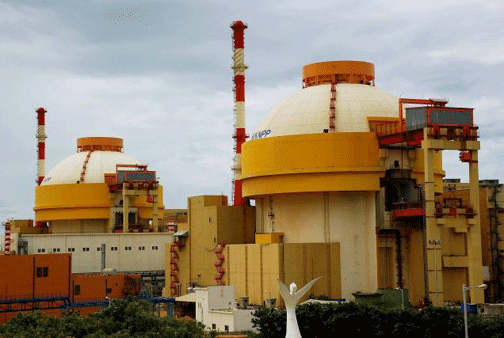
The debate over nuclear energy will go on, but the issue with the Kudankulam Nuclear Power Plant (KKNPP) is one of the several illegalities on which it is founded. Continue reading
Active fault under Oi nuclear power plant – restart decision is postponed
Decision on fault under Oi nuclear plant deferred http://www.yomiuri.co.jp/dy/national/T121104002958.htm Jiji Press, 5 Nov 12Nuclear regulators deferred a decision Sunday as to whether an active fault runs under Kansai Electric Power Co.’s Oi nuclear power plant in Fukui Prefecture.
Outside experts who participated in the Nuclear Regulation Authority’s on-site inspection of the plant Friday were divided in their evaluations of whether a crush zone underneath the plant is an active fault. The authority decided to hold another meeting Wednesday.
Mitsuhisa Watanabe, a professor at Toyo University, said he was certain there is an active fault under the Oi plant. But Norio Shigematsu, a research scientist at the National Institute of Advanced Industrial Science and Technology, and Atsumasa Okada, a professor at Ritsumeikan University, said it would be premature to draw a conclusion and called for further surveys.
If the authority determines the crush zone is an active fault, the Oi plant’s No. 3 and No. 4 reactors, currently the only active reactors in Japan, would face a possible shutdown.
The crush zone runs directly under a seawater intake channel to cool the No. 3 and No. 4 reactors in the event of emergencies. If the crush zone moves in an earthquake, the emergency system could become unavailable. In an interim report to the government, Kansai Electric said there are no data suggesting the crush zone is an active fault.
The reactors were brought back online in July. The rest of the country’s 50 reactors remain idled in the wake of the accident at Tokyo Electric Power Co.’s Fukushima No. 1 nuclear power plant.
Japan’s nuclear watchdog members funded by nuclear industry
 Atomic industry bankrolls Japan’s nuclear watchdog RT 04 November, 2012 Members of Japan’s nuclear watchdog who are charged with drafting nuclear safety rules have received sizable funds from the atomic industry. The reports raise concerns that regulations may be diluted after last year’s Fukushima nuclear disaster. Continue reading
Taiwan legislators want end to nuclear power
Legislators call for nuclear plant conversion
http://www.taipeitimes.com/News/taiwan/archives/2012/11/05/2003546939 By Lee I-chia / Staff reporter Chinese Nationalist Party (KMT) legislators Ting Shou-chung (丁守中) and Chiu Wen-yen (邱文彥) yesterday urged the government to replace nuclear
power with liquified natural gas (LNG) and to halt the construction of the Fourth Nuclear Power Plant in New Taipei City’s (新北市) Gongliao District (貢寮) in a bid to prevent nuclear disaster. Continue reading
Pakistan’s nuclear arms race
Pakistan’s hot nuclear greenhouse, THE HINDU PRAVEEN SWAMI, 4 Nov 12, The world’s fastest growing arsenal is being produced not just because of the fear of India but a strategic paranoia exacerbated by existential anxieties…… ‘CIVILISATIONAL’
DIFFERENCE Continue reading
Japan might shut down its only operating nuclear reactor
 AP: Japan’s only operating nuclear power plant may be closed http://enenews.com/ap-japans-only-operating-nuclear-reactor-may-be-closed November 2nd, 2012
NHK, Nov. 2: Japan’s Nuclear Regulation Authority ha surveyed the country’s only operating nuclear power plant to determine whether a seam under the facility is an active fault. The authority says it may ask the Ohi plant’s operator — Kansai Electric Power Company — to suspend operations, depending on the survey results.
1 This Month
23-25 October – on Zoom – World BEYOND War’s annual global conferenc


Shut down the radiation-damaged Heysham nuclear reactors now
To see nuclear-related stories in greater depth and intensity – go to https://nuclearinformation.wordpress.com

Say No to NASA’s Reckless Nuclear Reactor on the Moon
Say No to NASA’s Reckless Nuclear Reactor on the Moon
-
Archives
- October 2026 (180)
- September 2026 (339)
- August 2026 (330)
- July 2026 (355)
- June 2026 (287)
- May 2026 (306)
- April 2026 (356)
- March 2026 (251)
- February 2026 (267)
- January 2026 (308)
- December 2025 (358)
- November 2025 (359)
-
Categories
- 1
- 1 NUCLEAR ISSUES
- business and costs
- climate change
- culture and arts
- ENERGY
- environment
- health
- history
- indigenous issues
- Legal
- marketing of nuclear
- media
- opposition to nuclear
- PERSONAL STORIES
- politics
- politics international
- Religion and ethics
- safety
- secrets,lies and civil liberties
- spinbuster
- technology
- Uranium
- wastes
- weapons and war
- Women
- 2 WORLD
- ACTION
- AFRICA
- Atrocities
- AUSTRALIA
- Christina's notes
- Christina's themes
- culture and arts
- Events
- Fuk 2022
- Fuk 2023
- Fukushima 2017
- Fukushima 2018
- fukushima 2019
- Fukushima 2020
- Fukushima 2021
- general
- global warming
- Humour (God we need it)
- Nuclear
- RARE EARTHS
- Reference
- resources – print
- Resources -audiovicual
- Weekly Newsletter
- World
- World Nuclear
- YouTube
-
RSS
Entries RSS
Comments RSS

