Japan admits to errors in radiation data for every nuclear power plant in the country
Japan’s ‘nuclear radiation projection’ had errors http://zeenews.india.com/news/world/japans-nuclear-radiation-projection-had-errors_816717.html, December 14, 2012, Washington: The Nuclear Regulation Authority of Japan said a thorough review of its mistake-plagued projections for the spread of radiation, in a case of possible meltdown like the Fukushima crisis, turned up errors in the data for every atomic power plant in the country. Continue reading
Cesium in mushroom, wild boar – Japan
 25,550 Bq/Kg of cesium from Matsutake mushroom, 10,980 Bq/Kg from wild boar from Minamisoma http://fukushima-diary.com/2012/12/25550-bqkg-of-cesium-from-matsutake-mushroom-10980-bqkg-from-wild-boar-from-minamisoma/ by Mochizuki on December 13th, 2012 ·
Minamisoma city measured cesium from 674 among 1,243 samples for self-consumption.
The test was conducted this October and the result was published on 11/6/2012.
The highest reading was 25,550 Bq/Kg from Matsutake mushroom, the second highest reading was 10,980 Bq/Kg from the meat of a wild boar. Wild boar eats mushroom.
Iori MochizukiFukushima reactor No 2 – leaking highly radioactive water
 Asahi: Tepco can’t find where huge amount of highly radioactive water is leaking at Reactor No. 2 — ‘Fractures’ in containment vessel suspected http://enenews.com/asahi-tepco-find-huge-amount-highly-radioactive-water-leaking-reactor-2-fractures-containment-vessel-suspected December 12th, 2012
Title: TEPCO unable to locate source of leak in Fukushima reactor
Source: AJW by The Asahi Shimbun
Date: December 12, 2012
TEPCO unable to locate source of leak in Fukushima reactor
The operator of the Fukushima No. 1 nuclear power plant is grappling to locate the source of a leak of highly radioactive water in the crippled No. 2 reactor […]
A remote-controlled robot is now scouring the basement of the reactor building […]
TEPCO suspects the radioactive water is leaking from fractures near the pressure suppression chamber [lower part of containment vessel].
It was the first detailed inspection near the chamber. […]
A huge volume of highly radioactive water, used to cool down the fuel, has since been leaking from the reactor, TEPCO said.
Japan’ s trading houses look towards a non nuclear Japan
Sojitz Sees Beyond Rare Earths to LNG, Solar in Non-Atomic Japan, Bloomberg by Yuriy Humber & Ichiro Suzuki – Dec 13, 2012 Sojitz Corp. (2768), Japan’s top trader of rare earths, plans to tap into the nation’s shift from nuclear power by setting up its own liquefied natural gas business and building solar plants, said Chief Executive Officer Yoji Sato. Continue reading
Lynas’ dealings with Malaysia not transparent
Ten months have passed, and a safe permanent depository has yet to be identified and agreed upon by all parties. Instead Lynas is still talking of rendering the waste “safe”. Continue reading
Solar power plants for Japan
Sojitz Sees Beyond Rare Earths to LNG, Solar in Non-Atomic Japan, Bloomberg by Yuriy Humber & Ichiro Suzuki – Dec 13, 2012 “….Another way for Sojitz to meet the changing energy needs of Japan will be via renewables.
Solar Power
Sojitz wants to build five solar power plants totaling about 100 megawatts, including on the northern isle of Hokkaido and in Kagoshima prefecture, western Japan, Sato said. The trader aims to register the projects with the government by the end of March, he said.
Japan introduced this year the world’s highest payment rate for renewable energy, known as a feed-in tariff, as a way to stimulate investments in solar, wind and biomass generation and ease reliance on nuclear power. The tariff rate will be revised from April.
“With a fixed feed-in tariff the economics set up has become very easy to understand,” Sato said.
The current low cost of raw materials for solar panels and Sojitz’s experience with three solar energy projects in Germany should help the trader set up an efficient business in Japan, Sato said. The company has since sold one of the projects, he said.
Sojitz commissioned a 24 megawatt solar plant in Mixdorf in July 2011 and completed a 3 megawatt station in Betzweiler in May 2010, according to Bloomberg New Energy Finance data……http://www.bloomberg.com/news/2012-12-14/sojitz-sees-beyond-rare-earths-to-lng-solar-in-non-atomic-japan.html
Wind energy taking off in a big way, in China
China’s Wind Power Sector Set for Rapid Development after Year of Stagnancy Renewable Energy World, By Liu Yuanyuan, December 11, 2012 BEIJING — China’s wind power sector, after stagnating for nearly a year, is expected to experience rapid development as local governments launch favorable policies. Continue reading
Tsuruga nuclear plant not safe to restart: how many others are the same?
EDITORIAL: Why flirt with disaster? Decommission Tsuruga nuclear reactor Asahi Shimbun December 12, 2012 Breaking away from the “safety myth” that surrounded nuclear energy, the Nuclear Regulation Authority (NRA) has changed the way Japan judges the safety of nuclear power plants.
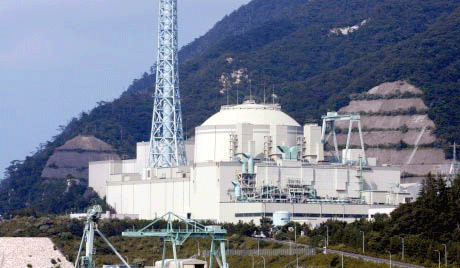
The new industry watchdog said Dec. 10 there is a high possibility that a fault line running directly beneath a reactor at Japan Atomic Power Co.’s Tsuruga nuclear plant in Fukui Prefecture is active. “Under the current circumstances, there is no way we can carry out the
safety assessments (that are required) for a restart (of the reactor),” NRA Chairman Shunichi Tanaka said.
This signals a major turning point in the nation’s nuclear regulation administration. Continue reading
Safety finding about Tsuruga plant brings gloom to Japan’s nuclear utilities
 Japan Utilities Plunge After Fault Found Under Nuclear Plant, Bloomberg, By Tsuyoshi Inajima – Dec 10, 2012 Kansai Electric Power Co. led declines in Japan’s utilities after geologists said an earthquake faultline may be active under a nuclear plant that houses the country’s oldest reactor. Kansai Electric shares fell as much as 9.7 percent, their biggest
intraday decline since Oct. 23, and closed 4.4 percent lower at 742yen in Tokyo. The Topix Electric Power & Gas Index fell 1 percent.
The company is the second-biggest stakeholder in Japan Atomic Power Co., which runs the Tsuruga nuclear plant on the coast 127 kilometers (79 miles) northeast of Osaka that was examined by geologists this month. The finding was announced yesterday and may lead to decommissioning of the unit.
“The assessment raises the risk” that the nuclear watchdog will come to a similar conclusion for other atomic generators under investigation, Reiji Ogino, a Tokyo-based analyst at Mitsubishi UFJ Morgan Stanley, said by phone today. Continue reading
Deterioration of Fukushima’s spent nuclear fuel pool No 4
Fukushima Worker: Concrete reinforcement of Spent Fuel Pool No. 4 is terribly deteriorating… now in a “dangerous state” — Cooling system stopped working, men helicoptered in http://enenews.com/fukushima-worker-concrete-reinforcement-of-spent-fuel-pool-no-4-is-terribly-deteriorating-in-a-dangerous-state
December 11th, 2012
Source: Iwakami Yasumi, Japanese journalist
Translation: Fukushima Diary
Date: Dec. 11, 2012
On December 11, 2012, Japanese journalist Iwakami Yasumi received this email from Mitsuhei Murata, former Japanese ambassador to Switzerland
I received this message on 12/9/2012.
The pump of the SFP in reactor4 had been having the spotty trouble, but it went out of order on 12/8/2012 at the end.
Nuclear workers were collected for emergency to replace the pump but it takes more 2~3 days to fix they say. (Extra workers were brought by helicopter even at night.)
According to a nuclear worker collected for emergency, the concrete to reinforce the SFP is terribly deteriorating to be in the “dangerous state”.
[…] a former executive manager of a major company commented this, which is very insightful.
“My fear has come into the truth. If it was merely the problem of the pump, it wouldn’t be such an issue but if the base to support SFP4 has some damage where we can’t see, the situation is much more serious.” […]
Ambassador Murata: “I sent this email to all the chief editors of national newspaper companies, NHK and influential people of major mass media but they all ignored it. I was shocked. I called the manager of disaster headquarter of Fukushima prefectural government but he didn’t know that. It seems like they didn’t report it to Fukushima local government. ”
South Korea’s and Japan’s nuclear operators – not to be trusted
Now, South Korea wants to develop uranium enrichment technology in violation of its commitments under the 1992 Joint Declaration on the Denuclearization of the Korean Peninsula.
South Korea has no legitimate need for enrichment technology (there is ample global enrichment capacity) and there are serious proliferation concerns as enrichment provides a direct route to nuclear weapons material in the form of highly-enriched uranium…..
Japan’s plutonium program demonstrably fans regional proliferation tensions.
How can we trust nuclear, if we can’t trust its operators? The Punch, by Jim Green 13 DEC “……Widespread safety breaches and proliferation concerns in North Asia are recent manifestations of the problem. In May, fiveengineers were charged with covering up a potentially dangerous power failure at South Korea’s Kori-I reactor which led to a rapid rise in the reactor core temperature. The accident occurred because of a failure to follow safety procedures. A manager decided to conceal theincident and to delete records, despite a legal obligation to notify the Nuclear Safety and Security Commission.
In October, authorities temporarily shut down two reactors at separateSouth Korean nuclear plants after system malfunctions. Continue reading
Conflict of interest in Japanese scientists on International Commission on Radiological Protection (ICRP)
The doctor on the parliamentary panel, Hisako Sakiyama, is outraged about utility funding for Japan’s ICRP members. She fears that radiation standards are being set leniently to limit costly evacuations.
“The assertion of the utilities became the rule. That’s ethically unacceptable. People’s health is at stake,” she says. “The view was twisted so it came out as though there is no clear evidence of the risks, or that we simply don’t know.”
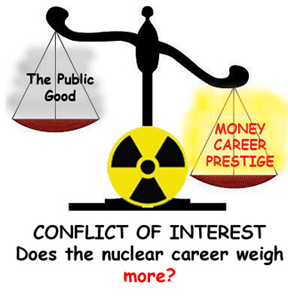 Japanese Radiation Regulators Admit Conflict of Interest, Laboratory Equipment, 12 Dec 12 Yuri Kageyama Influential scientists who help set Japan’s radiation exposure limits have for years had trips paid for by the country’s nuclear plant operators to attend overseas meetings of the world’s top academic group on radiation safety.
The potential conflict of interest is revealed in one sentence buried in a 600-page parliamentary investigation into last year’s Fukushima Dai-Ichi nuclear power plant disaster and pointed out to The Associated Press by a medical doctor on the 10-person investigation
panel.
Some of these same scientists have consistently given optimistic assessments about the health risks of radiation, interviews with the scientists and government documents show. Their pivotal role in setting policy after the March 2011 tsunami and ensuing nuclear meltdowns meant the difference between schoolchildren playing outside or indoors and families staying or evacuating their homes.
One leading scientist, Ohtsura Niwa, acknowledged that the electricity industry pays for flights and hotels to go to meetings of the International Commission on Radiological Protection, and for overseas members visiting Japan……… Continue reading
Nuclear non Proliferation not working, as North Korea launches missile
N. Korean rocket success a failure of nuclear non-proliferation regime PAUL KORING WASHINGTON — The Globe and Mail , Dec. 12 2012, With a fiery – and finally successful – launch of a satellite into orbit, North Korea’s new leader has boldly defied the international community even as he erased the shame of previous failures and solidified his hold on the
impoverished neo-Stalinist state.
In the face of stark warnings and a UN ban outlawing both nuclear and long-distance missile testing, Pyongyang has done both –underscoring the failure of the international community to make good on vague threats against rogue states or enforce United Nations resolutions…..
http://www.theglobeandmail.com/news/world/north-korean-rocket-success-shows-failure-of-nuclear-non-proliferation-regime/article6228596/
4 non-earthquake reasons to worry about Fukushima nuclear reactor no 4
 4 reasons why we must be worried about reactor4 “other than earthquake” http://fukushima-diary.com/2012/12/column-4-reasons-why-we-must-be-worried-about-reactor4-other-than-earthquake/ by Iori Mochizuki December 11th, 2012 · Now the biggest risk of Japan is reactor4.
However, we are only supposed to be worried about an “earthquake” to seriously damage the SFP of reactor4. Is this true ? No, it is not enough. We are missing 4 important facts.
1. It’s already deteriorating.
About one hour ago, Fukushima Diary reported the coolant system of SFP4 was stopped from 12/8 to 12/11. [Link] It is not known if the M7.4 of 12/7 affected.
Because of the warning, Tepco reinforced SFP4 by building a concrete base to support from the bottom of the pool.
However, if Mr. Murata is all correct, the concrete base is deteriorating, and the damage is on-going somewhere we can’t see. In that case, that would be really difficult to replace the concrete base anymore and all we could do is just to see it become unable to support the pool horizontally.
2. Ground is weakened. Continue reading
New solar fabric will light up your clothes
Japan researchers invent solar-cell fabric, Herald Sun, From: AAP December 12, 2012 CLOTHES that could literally light up your life were unveiled Tuesday by Japanese researchers who said their solar-cell fabric would eventually let wearers harvest energy on the go. Continue reading
1 This Month
23-25 October – on Zoom – World BEYOND War’s annual global conferenc


Shut down the radiation-damaged Heysham nuclear reactors now
To see nuclear-related stories in greater depth and intensity – go to https://nuclearinformation.wordpress.com

Say No to NASA’s Reckless Nuclear Reactor on the Moon
Say No to NASA’s Reckless Nuclear Reactor on the Moon
-
Archives
- October 2026 (180)
- September 2026 (339)
- August 2026 (330)
- July 2026 (355)
- June 2026 (287)
- May 2026 (306)
- April 2026 (356)
- March 2026 (251)
- February 2026 (267)
- January 2026 (308)
- December 2025 (358)
- November 2025 (359)
-
Categories
- 1
- 1 NUCLEAR ISSUES
- business and costs
- climate change
- culture and arts
- ENERGY
- environment
- health
- history
- indigenous issues
- Legal
- marketing of nuclear
- media
- opposition to nuclear
- PERSONAL STORIES
- politics
- politics international
- Religion and ethics
- safety
- secrets,lies and civil liberties
- spinbuster
- technology
- Uranium
- wastes
- weapons and war
- Women
- 2 WORLD
- ACTION
- AFRICA
- Atrocities
- AUSTRALIA
- Christina's notes
- Christina's themes
- culture and arts
- Events
- Fuk 2022
- Fuk 2023
- Fukushima 2017
- Fukushima 2018
- fukushima 2019
- Fukushima 2020
- Fukushima 2021
- general
- global warming
- Humour (God we need it)
- Nuclear
- RARE EARTHS
- Reference
- resources – print
- Resources -audiovicual
- Weekly Newsletter
- World
- World Nuclear
- YouTube
-
RSS
Entries RSS
Comments RSS

