South Korea keen to sell nukes: must clean up their act
 There is a lot at stake for South Korea, which aims to export 80 nuclear reactors by 2030, expected to be worth up to $300 billion, according to government plans.
South Korea urged to restore trust in nuclear Australia Network News Nov 24, 2012 The International Energy Agency (IEA) says South Korea needs to rebuild public trust in nuclear power by boosting transparency and improving regulation, after safety scares have closed reactors and threaten to trigger blackouts over winter. Continue reading
Shutting down the critics of Lynas rare earths project in Malaysia
” there will be no discernible risk for the public or anyone else from this facility.”
But this is far from true.
 Lynas’ waste plans a toxic pipe dream Aliran, 19 December 2012 Scientists and community leaders are concerned about radioactive waste from Lynas’ Malaysian plant but the company representative who took Wendy Bacon’s questions brushed off the criticism. “…….
New Matilda asked to interview Lynas Executive Chairperson Nick Curtis but he was not available. Instead we interviewed a Lynas spokesperson who insists that the waste products of the Lamp project are “not hazardous in any way”. Continue reading
Lynas rare earths company aims to discredit National Toxic Network (NTN)
Lynas’ waste plans a toxic pipe dream Aliran, 19 December 2012 Scientists and community leaders are concerned about radioactive waste from Lynas’ Malaysian plant but the company representative who took Wendy Bacon’s questions brushed off the criticism. “……Discrediting sources is a familiar public relations tactic used by companies to protect themselves against journalists relying on their critics as sources. So NM asked if the company had prepared a response to the NTN report. The spokesperson said it had but it was “unfortunately contained material before a [Malaysian] court and I can’t share that with you”.
The NTN report deals with Lamp waste steams which include non radioactive fluoride, dust particulates, gas, acidic waste water as well as more than 22000 tonnes of low level Water Leach Purification (WLP) radioactive waste which a year. The most critical issue is the control and disposal of the WLP wastes — which for radioactive material may mean for many hundreds of years.
On the basis of specific criticisms, NTN has two main recommendations. First, that the temporary licence issued by the AELB should be revoked until the issue of long term waste disposal is resolved and second, that the plant should not be allowed to operate until the release of millions of litres of effluent into the Balok River that runs past the site has been “further modelled and assessed”.
“The lack of data on these issues (the impact on the river) means the Lynas EIA is well below international standards and insufficient for granting of operational licences,” theNTN says; the Lamp temporary licence would never have been granted in Australia…….http://aliran.com/11018.html
Lands subsiding in Japan, following earthquake 2011
Japan Officials: Ground subsidence spreading after quake — Concern about sinking buildings being damaged — Only an inch can jeopardize stability http://enenews.com/japan-officials-ground-subsidence-is-spreading-after-quake-concern-about-sinking-buildings-being-damaged-only-an-inch-can-jeopardize-stability-video
December 18th, 2012
Title: Quake-caused subsidence spreads
Source: NHK WORLD English-
Date: Dec. 17, 2012
The Environment Ministry says nearly 6,000 square kilometers of land across Japan have subsided by more than 2 centimeters in the last fiscal year. […]
This level is judged to have a potential impact on buildings’ stability.
The ministry says Kesennuma in Miyagi Prefecture sank deepest by 73.8 centimeters, followed by Ichikawa in Chiba by 30.9 centimeters [Fukushima Prefecture NOT tested]
The ministry officials say the subsidence is attributable to last year’s March 11th earthquake. They have expressed concerns over the spread of subsidence and further damage to buildings.
Japan’s new government, bad for the environment, and for women
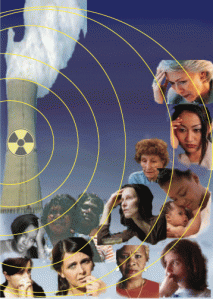 activists are concerned about two areas they fear will slip beneath the radar of the incoming administration: the country’s nuclear policy in the aftermath of the disastrous accident at the Fukushima Daiichi nuclear reactor following the earthquake and tsunami last March; and job stability for youth and women, both grappling with badly paid or part-time work.
Only 38 female candidates, from a total of 225, won seats in the parliament during this election, a major dip from the 54 women who won seats at the last poll in 2009.
Already, Japan has been ranked as low as 110th on the World Economic Forum’s latest gender gap survey, which rates countries based on gender equality in political representation.
Women and Activists Lament Japan’s Election Outcome By Suvendrini Kakuchi TOKYO, Dec 18 2012 (IPS) – The return to power of Japan’s conservative and hard-line Liberal Democratic Party (LDP) on Sunday indicates that voters traded urgently needed social and environmental reforms for traditional male-led leadership, according to analysts here.
Youth and feminist organisations who had campaigned vigorously for better environmental protections, labour equality and the upholding of regional peace ahead of the elections, expressed frustration about Sunday’s outcome, lamenting that the victorious LDP is yet to present concrete policies to tackle Japan’s most pressing problems……
LDP leader Shinzo Abe, whose brief term as Prime Minister ended abruptly in 2007, is now set to take back the reins.
A hawkish politician, he has raised his profile by promising to usher in a militarily stronger Japan – Continue reading
Fukushima nuclear situation still critical, with “makeshift” cooling system
 Fukushima plant situation ‘volatile,’ a year after cold shutdown declared, Asahi Shimbun December 18, 2012 By NAOYA KON/ Staff Writer Workers are nowhere close to determining the state of melted fuel at the Fukushima No. 1 nuclear plant, a year after the government declared the damaged reactors were in a “cold shutdown” state.
Storage tanks at the site are nearing capacity for radioactive water. A makeshift system is still being used to cool the nuclear fuel. And leaks of contaminated water and quake-induced collapses of plant facilities remain a threat. Continue reading
A ticking time bomb – Fukushima nuclear reactors
Kaku: Fukushima reactors “a ticking time bomb” — “Catastrophe beyond comprehension” if major pipe break or quake (VIDEO) http://enenews.com/kaku-fukushima-reactors-like-ticking-time-bomb-catastrophe-beyond-comprehension-major-pipe-break-quake-video
December 17th, 2012 at
Full broadcast here
Title: Radioactively Hot Show (Re-broadcast with Dr. Michio Kaku)
Source: SOAPBOX #106
Date: December 7, 2012
The reactor is still like a ticking time bomb. If you have a secondary earthquake, another pipe break, evacuation of workers, the accident starts up all over again.
Realize that we have 5 reactors in various states of degradation in the area. The accident is not over by any means. The accident could start up all over again if there’s a secondary earthquake or another pipe break. In a worst case scenario, if there is a major pipe break or secondary earthquake, they would have to evacuate the workers and because the pumps are not working at the site, it means that you have to manually, manually, insert the water over the reactors and without the workers you would be in free fall. At that point with an evacuation of all the workers, water levels would begin to drop, the reactors would then start to melt again and we would breach containment — that is the release of uncontrolled amounts of radiation in to the environment. And that is a catastrophe beyond comprehension.
Full broadcast here
No early return to nuclear energy, for Japan
Japan Shifts to LNG Dependency from Nuclear, Eyes US Fuel, Energy Tribune, December 17, 2012 Liquefied Natural Gas (LNG) purchase, a post-Fukushima item in Japan’s imports list that sent country’s foreign trade figures to their first deficit in 38 years in 2011, will continue dominating the country’s energy near future, as officials confirm that they are in LNG trade talks with the U.S., not a traditional supplier. Qatar and Australia seem to be maintaining their top supply positions to the Japan with new deals, the country’s Nuclear Policy Unit has said.
Before the devastating earthquake and subsequent tsunami on May 11, 2011, Japan was planning to increase nuclear power’s share in its energy bucket to 50 percent as of 2030, from 26 percent at the time.
Today, the revised plans vary from zero to a maximum 25 percent of nuclear, the Nuclear Policy Unit Cabinet Secretariat Yoshinori Tanaka told journalists in Tokyo on Dec. 13.
Along with purchases from Qatar and Australia, the country is looking to buy LNG from the U.S., he also revealed. However, other officials have stated that the U.S. is primarily considering meeting its domestic demand first.
A new Japanese strategy document prioritizes renewables, but such projects will take time to fill the significant energy gap in Asia’s second largest economy.
Japan, which was once energy self-sufficient, this year and in 2011 bought large amounts of LNG, along with coal and oil, to meet the gap that emerged after the closure of its nuclear facilities, the assistant press secretary of the Japanese Foreign Ministry, Masaru Sato, told the Hürriyet Daily News……
The country’s newly founded Nuclear Regulation Authority, a governmental body focusing exclusively on nuclear safety, will start inspecting nuclear plants to restart operations only in June 2013, showing that a nuclear comeback is also not on the agenda in the immediate short term…..http://www.energytribune.com/68237/japan-shifts-to-lng-dependency-from-nuclear-eyes-us-fuel
Contradictory information about Lynas rare earths project in Malaysia
Lynas will be in court in Malaysia on 19 December. The Save Malaysia Stop Lynas (SMSL) campaignerswill be appealing against the Kuantan High Court decision to lift its stay on the company being able to exercise its rights to proceed under the temporary licence.
The toxic waste that’s not in Australia’s backyard http://aliran.com/11005.html 18 Dec 12, Australian-owned company Lynas is quietly shipping rare earth to a processing plant in Malaysia – without a firm plan in place to dispose of dangerous radioactive waste. Wendy Bacon reports.
If a manufacturing plant involving radioactive materials moved into your community, one of the first things you would ask is, “what’s going to happen to the waste?”
This is exactly how residents of Kuantan on Malaysia’s east coast reacted when the Australian company Lynas announced plans to build Lamp, the world’s biggest rare earth processing plant in their area.
Several years later, they have no clear answer. Indeed last week, while the plant that will use concentrate imported from Lynas’s rare earth mine at Mount Weld in Western Australia was finally ramping up for production, the Malaysian government and the company were in direct conflict about what would happen to the waste. Continue reading
100% of Fukushima white rockfish had cesium levels, November-December
 Cesium measured from 100% of Fukushima white rockfish in November and December http://fukushima-diary.com/2012/12/cesium-measured-from-100-of-fukushima-white-rockfish-in-november-and-december/
by Mochizuki December 17th, 2012
On 9/9/2012, Fukushima Diary reported white rockfish (Shiromebaru) tends to accumulate cesium. http://fukushima-diary.com/2012/09/85-of-fukushima-rockfish-exceeds-safety-limit-in-cesium/
According to Fukushima prefectural government, high level of cesium was measured from 100% (19 of 19) of the samples taken in November and December from offshore Fukushima. 84% (16/19) of them exceeded the government’s safety limit of 100Bq/Kg.
The highest reading was 1,731 Bq/Kg (11/30/2012), the second highest reading was 1,225 Bq/Kg (12/8/2012).
Japan: political win for the nuclear Mafia
Far Right Dinosaur Party Wins Japan Elections http://rense.com/general95/farright.html By Richard Wilcox 12-16-12 Looking over the results on the TV here in Japan, the far right CIA created and sustained “Liberal Democratic Party” (LDP) which ruled Japan since WWII is back in power, BIG TIME. They won almost all the seats. The only other parties to win numerous seats are almost or just as far right and as pathologically fueled by power.
All of these parties are captured by the Nuclear Mafia and fiercely devoted to the continuation of nuclear power, if not the development of nuclear weapons to boot. Don’t ask me why the Japanese vote for these nuts and if you ask folks, “why?” they like a certain candidate, they are at a loss to give a reason and smile with embarrassment.

I guess the LDP pay off certain voting sectors with construction projects and kickbacks since they have a pile of stolen money hiddenaway.
Of course, the system is rigged so that only big money candidates can get enough votes. Also, culturally, Japanese tend to support the utmost superficial and glib politicians in a battle of form over substance. Same as USA! Japanese have forgotten about the nuclear disaster thanks to media manipulation so there has been no referendum on nuclear policy.
There are intelligent and sincere political parties and candidates in Japan but they get no-head way, because they are too principled and lack the funds, and the system is set up to block their progress (sounds like USA again, aka Ron Paul). Only the most cheeky and shameless people ascend to power.
Any of the mildly progressive or anti-nuclear power parties took a few pitiful token seats, which are probably in the restroom of theParliament building– the toilet seats.
Look for some of Japan’s nuclear power plants to start up next year, fast and furious, devil take the hindmost. To paraphrase the punk rock band the Sex Pistols: Never Mind The Earthquakes.
Nuclear energy’s friend Liberal Democratic Party wins in Japan elections
The anti-nuclear Tomorrow Party – formed just three weeks ago _captured just nine seats, according to NHK. Party head Yukiko Kada said she was very disappointed to see LDP, the original promoter of Japan’s nuclear energy policy making a big comeback.
Japan Elections 2012: LDP Wins Majority In Parliamentary Elections HUFFINGTON POST, By MALCOLM FOSTER 12/16/12 TOKYO — Japan’s conservative Liberal Democratic Party returned to power in a landslide election victory Sunday after three years in opposition, according to unofficial results,….
The victory means that the hawkish former Prime Minister Shinzo Abe will get a second chance to lead the nation
after a one-year stint in 2006-2007. He would be Japan’s seventh prime minister in six-and-a-half years.
In the first election since the March 11, 2011, earthquake, tsunami and nuclear disasters, atomic energy ended up not being a major election issue even though polls show about 80 percent of Japanese want to phase out nuclear power…….
LDP, the most pro-nuclear power party, had 118 seats before the election. A new, staunchly anti-nuclear power party won just nine seats, according to NHK.
In the end, economic concerns won out, said Kazuhisa Kawakami, a political science professor at Meiji Gakuin University.
“We need to prioritize the economy, especially since we are an island nation,” he said. “We’re not like Germany. We can’t just get energy from other countries in a pinch.”….. Continue reading
Health effects of Fukushima radiation were minimised by World Health Organisation
 Last month, the German branch of the international physicians’ group sent a letter to WHO Director General Margaret Chan, calling for a substantial expansion of medical research on the health effects of the Fukushima disaster. The branch also sought the early establishment of a comprehensive registry of residents in Fukushima who are estimated to have been exposed to radiation of more than 1 millisievert following the triple meltdowns.
WHO downplayed health effects of nuclear crisis on Fukushima residents : German physician
http://www.japantimes.co.jp/text/nn20121216a4.html?utm source=feedburner&utm_medium=feed&utm_campaign=Feed%3A+japantimes+%28The+Japan+Times%3A+All+Stories%29 Jiji BERLIN — A German doctor and member of a Nobel Peace Prize-winning physicians’ group has criticized a World Health Organization report on the Fukushima nuclear catastrophe for underestimating its impact on human health.
In a research paper, Alex Rosen said the WHO report, published in May this year on estimated radiation doses received by residents near the crippled Fukushima No. 1 nuclear plant, was compiled mainly by officials related to the International Atomic Energy Agency, which promotes the use of atomic energy for peaceful purposes.

Rosen, a member of International Physicians for the Prevention of Nuclear War, called for an independent assessment based on solid scientific methodology that would examine the health impacts from radioactive fallout released after the Fukushima No. 1 complex suffered three core meltdowns in March 2011. Continue reading
Japan imprisons professor who opposes radiation management
Radioactive contamination has not been properly dealt with at all, and the contamination is being spread through the circulation of food and other goods. In the midst of this situation, the government lies about “insufficient electricity” to try to continue using nuclear power plants. This is nothing but insanity.
Every day I look at my students and wonder what sort of world they will live in when these 20-year-olds turn forty like me
 Unjust Arrest of a Professor Opposing Debris Incineration in Osaka http://fukushimavoice-eng.blogspot.com.au/2012/12/unjust-arrest-of-professor-opposing.html Below this background information is a letter from Masaki Shimoji, a university associate professor who has been unfairly detained since his sudden arrest on December 9, 2012. The arrest occurred
  because he walked through the Japan Railways Osaka station on October 17, 2012.
Professor Shimoji and others are opposing the “areawide management of the disaster debris” measure, which intended to spread, incinerate and bury harmful substances in the disaster debris all over Japan that should not be incinerated, such as radioactive material and asbestos. Osaka-city is trying to begin regular incineration and burial beginning in February 2013.
The following is the timeline for the arrest: Continue reading
Nuclear Japan’s love affair with the criminal Yakuza
 How the Yakuza and Japan’s Nuclear Industry Learned to Love Each Other JAKE ADELSTEIN MAY 24, 2012 After arrest of a yakuza boss for his alleged role in supplying workers to TEPCO’s Fukushima Daichi Nuclear Plant, we are learning the details of how Japan’s nuclear industry relied on organized crime. Since July of last year, a few months after the March 11 earthquake and tsunami resulted in a triple meltdown at the Fukushima plant, investigators have been probing possible yakuza links to TEPCO and the nuclear industry under the guidance of the National Police Agency.
“Yakuza involvement in the nuclear industry is believed to go back to 2007 or earlier,” said a police source, “and the gangs involved were dispatching yakuza to nuclear sites all over Japan.” Continue reading
1 This Month
23-25 October – on Zoom – World BEYOND War’s annual global conferenc


Shut down the radiation-damaged Heysham nuclear reactors now
To see nuclear-related stories in greater depth and intensity – go to https://nuclearinformation.wordpress.com

Say No to NASA’s Reckless Nuclear Reactor on the Moon
Say No to NASA’s Reckless Nuclear Reactor on the Moon
-
Archives
- October 2026 (180)
- September 2026 (339)
- August 2026 (330)
- July 2026 (355)
- June 2026 (287)
- May 2026 (306)
- April 2026 (356)
- March 2026 (251)
- February 2026 (267)
- January 2026 (308)
- December 2025 (358)
- November 2025 (359)
-
Categories
- 1
- 1 NUCLEAR ISSUES
- business and costs
- climate change
- culture and arts
- ENERGY
- environment
- health
- history
- indigenous issues
- Legal
- marketing of nuclear
- media
- opposition to nuclear
- PERSONAL STORIES
- politics
- politics international
- Religion and ethics
- safety
- secrets,lies and civil liberties
- spinbuster
- technology
- Uranium
- wastes
- weapons and war
- Women
- 2 WORLD
- ACTION
- AFRICA
- Atrocities
- AUSTRALIA
- Christina's notes
- Christina's themes
- culture and arts
- Events
- Fuk 2022
- Fuk 2023
- Fukushima 2017
- Fukushima 2018
- fukushima 2019
- Fukushima 2020
- Fukushima 2021
- general
- global warming
- Humour (God we need it)
- Nuclear
- RARE EARTHS
- Reference
- resources – print
- Resources -audiovicual
- Weekly Newsletter
- World
- World Nuclear
- YouTube
-
RSS
Entries RSS
Comments RSS

