Ocean fish to be studied for Fukushima radiation
 L.A. Times: NOAA to start testing wildlife for Fukushima contamination http://enenews.com/l-a-times-noaa-to-start-testing-wildlife-for-fukushima-radiation
February 26th, 2013
Title: Radioactive tuna from Fukushima? Scientists eat it up
Source: Los Angeles Times
Author: Eryn Brown
Date: February 25, 2013
Title: Radioactive tuna from Fukushima? Scientists eat it up
[…] In coming months, the three researchers and colleagues at the National Oceanic and Atmospheric Administration and other institutions plan to analyze hundreds more bluefin tuna, as well as albacore tuna; mahi mahi; ocean sunfish; opa; mako, blue and salmon sharks; loggerhead turtles; and sooty shearwaters, a type of migratory seabird.
They’ll examine samples collected in New Zealand, Hawaii and Alaska as well as in California. They might look through archived specimens for salmon and whales to test. Other research groups may track the contamination to study marine animals too, [Dan Madigan of Stanford University] said.
If scientists find Fukushima radiation in swordfish, for example, it will be the first evidence that the species migrates across the entire Pacific. […]
“Amazing”
They concluded that their tracking method worked, and that Fukushima provided “an unprecedented opportunity” for scientists to use radioactive tracers to follow animal movement. “This was just nature being amazing,” [Nicholas Fisher of Stony Brook University] said.
He imagines pulling together a map of the Pacific crisscrossed by the paths of radiation-toting animals — “an amazing image of transport … all from a little dot” in Japan, Madigan said.
See also: HuffPost: “Radioactive Fish Found In California” — Is it a good thing?
Girls most affected by Fukushima radiation – World Health Organisation
Japan to Begin Restarting Idled Nuclear Plants, Leader Says NYT By MARTIN FACKLER and HIROKO TABUCHI Matthew L. Wald contributed reporting from Washington. February 28, 2013 ”……..According to the study, girls exposed as infants to radioactivity in the most contaminated regions of Fukushima Prefecture faced a 70 percent higher risk of developing thyroid cancer than would be expected normally. The report pointed out, however, that the normal risk of thyroid cancer was just 0.75 percent, and that the additional lifetime risk would raise that to 1.25 percent.
 Girls exposed to radioactivity as infants in the most heavily contaminated areas also had a 6 percent higher risk of developing breast cancer, and a 4 percent higher risk of developing cancers that cause tumors. Meanwhile, boys exposed as infants had a 7 percent higher chance of developing leukemia.
The study also said that about a third of the emergency workers who remained to try to stabilize the Fukushima Daiichi plant were estimated to have a slightly increased risk of developing leukemia, thyroid cancer and other types of cancer.
The analysis was based on data available as of September 2011, and takes into account airborne contamination as well as contaminated food, water and other sources of contamination, the WH.O. said. http://www.nytimes.com/2013/03/01/world/asia/japan-to-begin-restarting-idled-nuclear-plants.html?_r=0
High increase in radiation in soil near Fukushima river
 Radiation level offshore Fukushima river increased to be 95 times much as 1 month before http://fukushima-diary.com/2013/02/radiation-level-offshore-fukushima-river-increased-to-be-95-times-much-as-1-month-before/
According to Tepco, the radiation level of sea ground soil jumped up by 950% from November to December in 2012.
The sampling location was 2km offshore of Ukedogawa in Namie machi, where is in 4~5 km north from Fukushima plant.
It was 25Bq/Kg in November, it was 2,370Bq/Kg in December.
Validity of Japan’s official radiation figures is in doubt
Rising doubts about Japan’s official radiation figures, DW 27 Feb 13, As the two-year anniversary of the world’s second-worst nuclear accident nears, citizen groups are questioning the accuracy of the government’s contamination data for the area around the Fukushima Dai-ichi nuclear plant…… ome volunteer groups are conducting out their own monitoring efforts and sharing the data on websites.
“We believe it is dangerous for people still living in highly contaminated areas,” said Hajime Matsukubo, a spokesman for the Tokyo-based Citizens’ Nuclear Information Center (CNIC). He points to independent studies indicating that people in Fukushima and Koriyama – cities well beyond the exclusion zone imposed by the government – are still exposed to high levels of radioactivity. Continue reading
Conflict of interest, safety fears, in South Korea’s nuclear power plans
“The Republic of Korea is going to be the only country across the globe where regulators and basically developers or promoters might be working all together under the same roof,” said Suh Kune Yull, a nuclear engineering professor at Seoul National University. “A conflict of interest is inevitable.”
Safety concerns cloud South Korea nuclear drive, Japan Times, AFP-JIJI FEB 28, 2013 GORI, SOUTH KOREA – South Korea has big plans to become a major nuclear energy player, but they are unfolding at a time when the global industry is under intense scrutiny after the 2011 Fukushima disaster.And its ambitions have not been helped by a series of domestic scandals and forced reactor shutdowns in 2012 that rattled public confidence and exposed a glaring lack of regulatory transparency.
Around $400 billion is riding on South Korea’s ability to sell its technology to potential clients as it aims to take on the United States, France and Russia and grab a 20 percent share of the nuclear energy market……
A survey commissioned by the Economics Ministry and published in November showed only 35 percent of South Koreans considered nuclear power to be safe — sharply down from 71 percent in January 2010. Continue reading
Japan Mass Media Banned From Reporting Radiation Dangers
In contrast to official Japanese government policy which allows 20 millisieverts of annual background radiation, a joint French and Japanese NGO project found that “external radiation” continues to cause “unacceptable health risks for hundreds of thousands of citizens” and that government estimates ignore internal consumption of radionuclides through food, water and air.
Powerful Lies – The Fukushima Nuclear Disaster And The Radioactive Effects On Human Health By Richard Wilcox PhD 2-22-13 Rense.com, “……. How many people will die from Fukushima nuclear meltdown radiation? Two years have passed since Japan’s Fukushima nuclear disaster. Every day we learn of more evidence of the dangers of low-level radiation from a variety of natural and man-made causes, including medical x-rays and scans (11; 12). Our health, and particularly the health of people in Fukushima, is under increasing distress.
We now see evidence of children with thyroid cancer from the Fukushima area . It has also been revealed that the mass media in Japan is unofficially BANNED from discussing radiation issues. Journalists who write about radiation dangers will be fired whereas they are permitted to debate whether Japan should use nuclear energy or not .
The latter debate is permissible because it is long-term and changeable depending on the whims of government policy and manipulation of public sentiment. Serious discussion of radiation danger strikes fear in the heart of the public, and may also lead to costly liability payments, and is therefore taboo. Undoubtedly, the ban on discussing the danger of radiation in the media translates into public ignorance about radiation. It is astonishing to me that most of the people I talk to in Tokyo are only dimly aware that radiation is entering their bodies on a daily basis: from public water supply, food, drinks, ongoing air pollution emissions from the FNPP, and the burning of radioactive debris in public incinerators. People think that it is only a small risk. Continue reading
Park Geun-hye , South Korea’s new President’s challenge to negotiate with North korea
Park warned after the test that North Korea faces international isolation, economic difficulties and, eventually, a collapse if it continues to build its atomic program. She also pressed Pyongyang to respond to her overtures.
“We can’t achieve trust with only one side’s efforts. Isn’t there a saying that ‘We need both hands to make a clapping sound?”‘ she said.
South Korea’s 1st female president faces nuclear crisis CBC News, Park Geun-hye takes office Monday after election vow to soften approach to North Korea The Associated Press Feb 24, 2013 Even before she takes office Monday as South Korea’s first female president, Park Geun-hye’s campaign vow to soften Seoul’s current hard-line approach to rival North Korea is being tested by Pyongyang’s recent underground nuclear detonation. Continue reading
Danger to Sri Lanka from Kudankulam Nuclear Power Plant
Lanka seeks protection from Indian radiation http://www.emirates247.com/news/sri-lanka/lanka-seeks-protection-from-indian-radiation-2013-02-23-1.496099, February 23, 2013 Even before being commissioned, Kudankulam Nuclear Power Plant had developed leaks and leading environmentalists have urged the Indian government to protect Sri Lanka from the nuclear power plant, ‘The Island’ reported. Continue reading
Inadequate assessment for planned Saurashtra’s Bhavnagar nuclear plant
‘Cancel public hearing for Mithi Virdi nuclear project’
http://www.thehindu.com/news/national/other-states/cancel-public-hearing-for-mithi-virdi-nuclear-project/article4449713.ece
THE HINDU, 24 Feb 13, Environmentalists in Gujarat have claimed that
the March 5 environmental public hearing (EPH) for the 6,000-MWe
nuclear power plant in Saurashtra’s Bhavnagar district will be on the
basis of an environmental impact assessment (EIA) by Engineers India
Limited, which did not have the necessary accreditation. Continue reading
Radiation situation at Fukushima is unimaginably bad
 No workers were visible around the No. 3 reactor building. An unmanned crane was removing debris on the roof.
It is hazardous to human health to work in the reactor building where
radiation levels range from 20 to 100 millisieverts per hour.
 The amount of radioactive water stored in tanks and other facilities
rose to 230,000 tons this month, up from 10,000 tons in July 2011.
In addition, an estimated 100,000 tons of water have accumulated in
the basements of buildings.
Decommissioning will not be completed for the next 30 to 40 years
High radiation bars decommissioning of Fukushima plant Asahi  Shimbun,
February 21, 2013
By HISASHI HATTORI/ Senior Staff Writer
Preparations for the mammoth task of decommissioning crippled reactors
at the Fukushima No. 1 nuclear power plant are being stymied by
continued high levels of radiation from the triple meltdowns there two
years ago.
Tokyo Electric Power Co., operator of the plant, has had to install
more tanks to store radioactive water, which continues to swell by
several hundreds of tons daily.
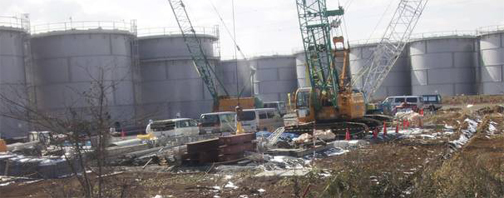
Asahi Shimbun reporters entered the No. 4 reactor building on Feb. 20,
accompanied by inspectors from the secretariat of the Nuclear
Regulation Authority, to assess the situation….. Continue reading
Cash strapped Japanese nuclear power companies selling uranium back to original sellers at a lower price!
 A senior official of a major utility said the move was exceptional because it likely meant selling the uranium for less than the import price.
Japan Atomic Power takes rare step of selling uranium to pay off loans http://www.japantimes.co.jp/news/2013/02/21/national/japan-atomic-power-takes-rare-step-of-selling-uranium-to-pay-off-loans/#.USfWWB1wpLt
KYODO
 A Japanese nuclear power company has taken the rare step of selling some of its uranium, apparently to help repay loans amid its faltering business conditions, according to sources.
Japan Atomic Power Co. apparently needs to secure money to repay loans due in April amid uncertainty over when it can resume operating its three idled reactors.
Tokyo Electric Power Co. is considering taking similar action as it continues to face funding difficulties following the crisis at the Fukushima No. 1 complex, the sources said. Continue reading
No costs for nuclear firms that built Fukushima reactors, but residents must pay back compensation
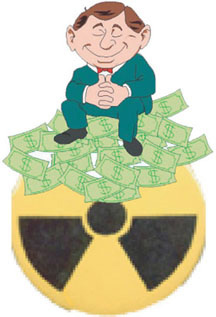 the firms that helped design and build the Fukushima reactors, such as General Electric, Toshiba and Hitachi, are not required to pay a cent in compensation.
Aslihan Tumer, Greenpeace’s international nuclear project leader, says some of the companies are continuing to profit from the reactor.
“Nuclear suppliers are completely protected from accepting any liability or being held accountable in case of an accident,” he said.
Residents paying back Fukushima compensation ABC News, By North Asia correspondent Mark Willacy Feb 19, 2013 Nearly two years on from the meltdowns at the Fukushima nuclear plant, there are accusations the nuclear industry is evading its responsibilities.
The disaster has mostly dropped out of the news in Japan and its victims remain largely hidden after being placed in tiny, so-called temporary apartments across the country.
The ABC has learned that TEPCO, the operator of the Fukushima plant, is handing out what are called “temporary compensation” payments – money handed out to victims of the meltdowns, but which must be repaid….. Continue reading
Taiwan government downgrades nuclear safety regulator
 Cabinet demotes nuclear safety body Taipei Times, 21 Feb 13, SAFE?With the ministerial-level Atomic Energy Council set to be disbanded, the new nuclear safety regulator will be a third-level agency under the Executive Yuan
By Shih Hsiu-chuan / Staff reporterDespite mounting public concern, the Cabinet yesterday declared that the agency overseeing nuclear safety would be downgraded from a ministerial-level council as part of an ongoing government restructuring plan.
The Cabinet yesterday approved the draft organic law of the nuclear safety regulatory authority, in which the current regulator, the Atomic Energy Council (AEC), would be disbanded and replaced by a third-level independent agency subordinate to the Executive Yuan. Part of the AEC’s functions will also be transferred to two ministries in charge of economic affairs and energy and technology, as part of the government’s efforts to streamline its agencies.
As a third-level agency subordinate to the Executive Yuan, the nuclear safety regulator would have the same rank as an institution like the Aviation Security Council, according to the Cabinet’s Research, Development and Evaluation Commission.
Lawmakers, anti-nuclear activists and even some AEC officials have said that the downgrade would make it more difficult for officials in charge of nuclear safety regulation to coordinate with ministerial-level bodies to ensure nuclear safety……. http://www.taipeitimes.com/News/front/archives/2013/02/22/2003555394
Tepco demands that Fukushima nuclear victims pay back compensation money!
 AUDIO Company asking Fukushima victims to repay compensation: Greenpeace http://www.radioaustralia.net.au/international/radio/program/connect-asia/company-asking-fukushima-victims-to-repay-compensation-greenpeace/1090696
Title: Company asking Fukushima victims to repay compensation: Greenpeace
Source: ABC Radio Australia
Author: Mark Willacy, North Asia correspondent
Date: February 19, 2013
h/t Pu239
[…] A report by the environmental activist group Greenpeace, to be released later today, points out that the firms that helped design and build the Fukushima reactors [such as General Electric, Toshiba and Hitachi] are not required to pay a cent in compensation and are profiting from the disaster.
Meanwhile, the ABC program AM has learned that the operator – TEPCO – is handing out what’s called ‘temporary’ compensation which victims of the meltdown have to repay.
“We had that money deducted from our compensation. I was surprised, so I called TEPCO and said that they were using dirty tricks, that they were using fraud. Why did they give it to us to if we had to pay it back?” -Yukiko Kameya of Futaba
full broadcast here
Ocean near Fukushima still getting radiation leakage, blue fin tuna with radiation

“…The answer was yes. (See below for the PDF of the study.) That means, ultimately, that there is still a high level of radiation in the waters near the Fukushima plant most likely because, as marine chemist, Ken Buessler, asserts, the plant is still leaking radiation into the ocean nearly two years later….”
Bluefin Tuna From The Fukushima Nuclear Meltdown Still Have Traces Of Radiation, Forbes, Monte Burke, 20 Feb 13,
Last May I wrote a piece about Bluefin tuna caught off the coast of southern California that carried radiation from the Fukushima,Japan, nuclear plant that was damaged in the March 2011. The fish were caught in August 2011 as they migrated east 6,000 miles from their spawning grounds in Japan in search of prey….
Last week one of the authors of the study from last year, Daniel J. Madigan from Stanford University’s Hopkins Marine Station—along with five other scientists— published a new follow-up study. The main question that this new study wanted to answer: Would the migratory Bluefin tuna show up again a year later off the coast of California carrying radiation from Fukushima? Bluefin Tuna Study http://www.forbes.com/sites/monteburke/2013/02/20/bluefin-tuna-from-the-fukushima-nuclear-meltdown-still-have-traces-of-radiation/
1 This Month
23-25 October – on Zoom – World BEYOND War’s annual global conferenc


Shut down the radiation-damaged Heysham nuclear reactors now
To see nuclear-related stories in greater depth and intensity – go to https://nuclearinformation.wordpress.com

Say No to NASA’s Reckless Nuclear Reactor on the Moon
Say No to NASA’s Reckless Nuclear Reactor on the Moon
-
Archives
- October 2026 (170)
- September 2026 (339)
- August 2026 (330)
- July 2026 (355)
- June 2026 (287)
- May 2026 (306)
- April 2026 (356)
- March 2026 (251)
- February 2026 (267)
- January 2026 (308)
- December 2025 (358)
- November 2025 (359)
-
Categories
- 1
- 1 NUCLEAR ISSUES
- business and costs
- climate change
- culture and arts
- ENERGY
- environment
- health
- history
- indigenous issues
- Legal
- marketing of nuclear
- media
- opposition to nuclear
- PERSONAL STORIES
- politics
- politics international
- Religion and ethics
- safety
- secrets,lies and civil liberties
- spinbuster
- technology
- Uranium
- wastes
- weapons and war
- Women
- 2 WORLD
- ACTION
- AFRICA
- Atrocities
- AUSTRALIA
- Christina's notes
- Christina's themes
- culture and arts
- Events
- Fuk 2022
- Fuk 2023
- Fukushima 2017
- Fukushima 2018
- fukushima 2019
- Fukushima 2020
- Fukushima 2021
- general
- global warming
- Humour (God we need it)
- Nuclear
- RARE EARTHS
- Reference
- resources – print
- Resources -audiovicual
- Weekly Newsletter
- World
- World Nuclear
- YouTube
-
RSS
Entries RSS
Comments RSS

