Film-maker describes India’s repression of anti nuclear protestors
I’ve just been informed 30 people including the woman who helped me get to Idinthakarai have been arrested and detained by Tamil Nadu police. They joined another 54 activists who were arrested in September and have been refused bail, wasting away in dirty conditions in gaol after a big police operation invaded their village and beat the daylights out of anyone who could not run away fast enough.
David Bradbury on Idinthakarai’s anti-nuclear front line Independent Australia Posted by Sandi Keane 16 March, 2013 Award winning Australian filmmaker, David Bradbury, describes in chilling detail his visit to the epicentre of the Kudankulam anti-nuclear struggle in India – the beautiful seaside town of Idinthakarai. “…… We’re talking national security and big bikkies here – $140 billion in nuclear power contracts if the Centre Government has its way. He [ Deputy Superintendent NK Stanley Jones] repeated that the area was a prohibited zone under Section 144. I didn’t bother to draw the parallel for him that this was exactly the same rationale used by the South Australian coppers two months earlier in arbitrarily arresting people at Lizards Revenge outside Olympic Dam uranium mine.
There, SA police in similarly threatening Orwellian tones repeatedly warned us over loudspeakers, ‘You are now entering a Protective Security Zone. Under the Protective Security Act of the South Australian Parliament 2007, you are subject to arbitrary arrest, strip search and detention…’
It would seem the nuclear lobby worldwide has a special dispensation for suspending people’s normal rights of assembly, freedom of speech and freedom of non-violent protest……..
The latest round of opposition to stop the opening of the Kudankulam nuclear power plants has raged for more than ten years now, with this last year seeing opposition to the Russian built nuclear power plants at Idinthakarai reach fever pitch. Continue reading
Removal of anti nuclear members from Japan.s Energy Board
Japan’s Energy Board Meets After Dropping Anti-Nuclear Members Bloomberg, By Tsuyoshi Inajima – Mar 14, 2013 Japan’s ruling Liberal Democratic Party has removed most anti-nuclear researchers from a revamped post-Fukushima energy policy advisory board to the government that resumes discussions today.
After a landslide victory in a December election, Prime Minister Shinzo Abe has said the previous administration’s policy to abandon atomic power needs to be reviewed to help revive the world’s third-biggest economy. Continue reading
New York Symposium will hear the story of radiation contaminated US Navy men
 The Story of Two Contaminated Navy Navigators,Fukushima and the Health Effects of Low Dose Radiation MARCH 06, 2013http://www.counterpunch.org/2013/03/06/fukushima-and-the-health-effects-of-low-dose-radiation/ by JOHN LaFORGE March 11 and 12, the Helen Caldicott Foundation is convening a symposium at the New York Academy of Medicine in New York City, “The Medical and Ecological Consequences of the Fukushima Nuclear Accident.”
Media attention may be brought to the gathering because of two US Navy navigators who will speak about their radioactive contamination while aboard the air craft carrier USS Reagan. They weren’t exposed by working around the carriers’ two Westinghouse propulsion reactors.
Navigators Maruice Enis, from Rochester, Minnesota, and Jamie Plym, from St. Agustine, Florida, were contaminated when Tokyo Electric Power Company reactors released unprecedented amounts of radiation to the air and the sea following the Great East Japan Earthquake and tsunami beginning March 11, 2011. Four of Tepco’s six Fukushima-Daiichi reactors were wrecked. Continue reading
High tadiation levels prevent workers from entering Fukushima nuclear reactors
 Inside Fukushima two years on: radiation levels too high to enter reactorsTelegraph UK, 6 March 13, Two years on from the second-worst nuclear disaster in history, The Telegraph’s Julian Ryall visits the Fukushima nuclear plant to see what progress – if any – is being made. By Julian Ryall, Fukushima Nuclear Plant, Japan
Radiation levels within three of the reactor buildings at the Fukushima Nuclear plant in Japan are still too high for people to start decommissioning the reactors, two years on from the second-worst nuclear disaster in history.
Scientists still do not have a firm understanding of the precise conditions of the reactor cores in three of the six units at the Fukushima Daiichi plant, and are resorting to using remote-controlled vehicles to get inside the tangle of wires, pipes and rubbles that has lain untouched since the tsunami tore through the facility. Continue reading
Safety inspections for Japan’s nuclear plants will delay any restart
 Japan’s nuclear plants unlikely to restart in 2013 By MarketWatch, 3 Mar 13, TOKYO–None of Japan’s nuclear power plants that have been idled since the nuclear crisis triggered by the March 2011 earthquake and tsunami are likely to restart operations within the year as safety checks under new standards
  are not expected to be completed, a Kyodo news agency survey of utilities showed Sunday.
Kansai Electric Power Co.’s Oi plant in Fukui Prefecture, currently the only operating nuclear plant in the country, is also likely to be suspended in September for routine checks regardless of the new safety standards that are planned to enter into force in July, according to the survey of the 10 power companies that have nuclear plants.
Kyodo reported the financial burden on the utilities is increasing as they enhance preventive measures following the nuclear crisis at the Fukushima Daiichi power plant.
The companies expect the cost of implementing the new standards will total at least 1.1 trillion yen ($11.75 billion), with Kansai Electric saying 285.5 billion yen is needed in the medium to long term.
Kyushu Electric Power Co. said it could restart two of its nuclear reactors in southwestern Japan in July if inspections by the Nuclear Regulation Authority are completed swiftly, but all the other utilities declined to provide specific dates……. Although the authority is now aiming to speed up the process, broader safety measures under the new standards are expected to make it difficult for inspections to be completed by the end of the year. http://www.marketwatch.com/story/japans-nuclear-plants-unlikely-to-restart-in-2013-2013-03-03
Indian farmers determined to stop Mithi Virdi nuclear plant
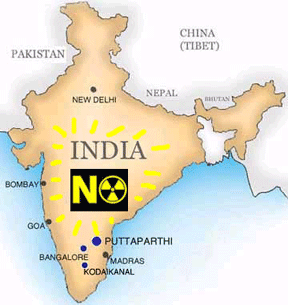
Farmers set for bitter fight over Mithi Virdi nuclear plant Times of India 3 Mar 13, RAJKOT/GANDHINAGAR: Large number of farmers and environmentalists will gather at a mega congregation in Mithi Virdi village of Bhavnagar district on Monday to oppose tooth
and nail the 6,000 MW nuclear power plant proposed at this coastal site. Continue reading
Fukushima nuclear reactors: water pumped in just leaks out
 The melted core cracked the containment vessel, there really is no containment. So as soon as they pump the water in it leaks out again.
Loss of containment of nuclear fuel also exists within the spent fuel pools at Fukushima.
Fukushima Daiichi Reactor 3 Spent Fuel Pool – Fuel racks where refueling  machine mast rests http://www.youtube.com/watch?v=A3A1YA1lt8k&feature=player_embedded
Nuclear Expert: “The Melted Core Cracked The Containment Vessel ” There Really Is No Containment” At Fukushima Reactors http://www.opednews.com/articles/Nuclear-Expert–The-Melte-by-G-Washington-130302-594.html Nuclear Cores and Spent Fuel Pools Have Both Lost Containment Steven Starr – Director of the Clinical Laboratory Science Program at theUniversity of Missouri/Senior Scientist at Physicians for Social Responsibility – said :
The Japanese basically lied about what happened with the reactors for months. They said they were trying to prevent a meltdown, when in fact they knew within the first couple of days Reactors 1, 2, and 3 at Fukushima Daiichi had melted down, and they actually melted through the steel containment vessels.
So there was a worst case scenario that they were trying to hide, they even knew that at that time enormous amounts of radiation were released over Japan and some of it even went over Tokyo […] Continue reading
Fukushima becoming like a totalitarian state
 In his article, Nakajima likens the situation that of an almost totalitarian state, wherein one either adheres to the commonly held belief set or is seen as a potential threat
The government has created an environment wherein people are going about their daily lives, all the time wondering whether their child will develop cancer or leukemia, yet conditioned not to breathe a word about it. It’s like living in wartime Japan again.
Lead Architect of Microsoft Windows 95: Something very much amiss in Fukushima — Like an almost totalitarian state — People now saying “For the sake of my child’s health, I’m not going to think about radiationhttp://enenews.com/lead-architect-of-microsoft-windows-95-something-very-much-amiss-in-fukushima-like-an-almost-totalitarian-state-people-now-saying-for-the-sake-of-my-childs-health-im-not-go Title: Japanese Blogger’s Troubling Insight into the Psyche of Post-Disaster Fukushima Residents
Author: Philip Kendall
Date: Mar. 1, 2013
In just 10 days’ time, two years will have passed since the magnitude-9.03 earthquake […]
According to one former Fukushima resident, however, there is something very much amiss in the prefecture. […] Continue reading
Taiwan’s opposition Democratic Progressive Party launching anti nuclear campaign
 DPP to launch ‘rational’ anti-nuclear campaign Focus Taiwan, By
  Lee Shu-hua and Ann Chen, Taipei, March 3 (CNA) The opposition Democratic Progressive Party (DPP) said Sunday that it will launch a “rational” anti-nuclear campaign after the ruling Kuomintang (KMT) accepted the idea of holding a referendum on the controversial Fourth Nuclear Power Plant project. Continue reading
Misleading information masks true level of radiation received by Fukushima workers
63 workers exposed to higher radiation than logged in their records,
March 02, 2013, THE ASAHI SHIMBUN by Toshio Tada and Jun Sato
Dozens of workers at the crippled Fukushima No. 1 nuclear power plant
were exposed to radiation levels higher than those registered in their
personal records, according to a health ministry investigation. Continue reading
Workers say Fukushima radioactive debris dumped in a river
Fukushima cleanup workers break silence: Ordered to dump ‘debris’ into river — Gov’t “appeared not to believe him”http://enenews.com/fukushima-cleanup-workers-break-silence-ordered-to-dump-debris-into-river-govt-appeared-not-to-believe-him
March 2nd, 2013
Asahi Shimbun,, March 1, 2013: CROOKED CLEANUP: Workers break silence to allege boss ordered corner-cutting […] Three laborers involved in radioactive cleanup around the Fukushima No. 1 nuclear plant have alleged that a supervisor told them to dump debris in a river […] At a news conference in the Diet building on Feb. 28, the men said a foreman ordered them to discard fallen branches and leaves into a river in an upland forest in Tamura, Fukushima Prefecture, in November 2012. […] this is the first time that decontamination workers have publicly come forward. […] The third man, in his 40s, said he related what had happened to officials at the Environment Ministry. He spoke to them for more than an hour, he said, but they appeared not to believe him. […]
See also: Asahi: River turned brown after dumping radioactive waste into water — “I was following an order, I am sorry for polluting
“Radiation leaking” from Kudankulam nuclear power plant
Kudankulam plant ‘leaking radiation’ since Feb 27, Deccan Herald,
Colombo, Mar 2, 2013 Days after India dismissed as “baseless” reports
about radiation leaks at the yet to be commissioned Kudankulam Nuclear
Power Plant in Tamil Nadu, a Sri Lankan interest group on Saturday
alleged that the atomic power station has been leaking radiation since
February 27.
The People’s Movement Against Kudankulam Nuclear Power Plant, in a
statement, urged officials here to bare the truth.They held the
government of Sri Lanka responsible for turning a blind eye to
radiation threats from Kudankulam…..
http://www.deccanherald.com/content/316125/kudankulam-plant-leaking-radiation-feb.html
Ties to International Atomic Energy Agency constrain World Health Organisation’s Fukushima radiation report
 “Shameless”: New World Health Organization report shockingly downplays health risks after Fukushima — “WHO and other organisations must stop hiding the impact” http://enenews.com/shameless-new-world-health-organization-report-shockingly-downplays-health-risks-after-fukushima-other-organisations-stop-hiding-impact
Title: World Health Organisation Downplays Health Impacts of Fukushima Nuclear Disaster
Source: Greenpeace
Date: February 28 2013
Greenpeace today criticised the World Health Organisation for releasing a flawed new report that hides crucial information on the health impacts of the Fukushima nuclear disaster.
“The WHO report shamelessly downplays the impact of early radioactive releases from the Fukushima disaster on people inside the 20 km evacuation zone who were not able to leave the area quickly,” said Dr. Rianne Teule, Greenpeace International nuclear radiation expert.
“The WHO should have estimated the radiation exposure of these people to give a more accurate picture of the potential long-term impacts of Fukushima. The WHO report is clearly a political statement to protect the nuclear industry and not a scientific one with people’s health in mind.”
The people inside the 20 km zone have possibly been exposed to significant radiation doses of hundreds of mSv, according to the work of German nuclear expert Oda Becker. She used modelling based on the data from Fukushima plant operator TEPCO on radioactive releases to calculate potential doses for people 10, 15, 20 and 40 km from the reactors.
The WHO report and its PR spin shockingly downplay the likelihood that thousands of people are at risk of cancer from the Fukushima disaster. They hide the cancer impacts by emphasising small percentage increases in cancers. Those small percentages actually translate into thousands of people being at risk.
“The WHO’s flawed report leaves its job half done,” said Teule. “The WHO and other organisations must stop downplaying and hiding the impact of the Fukushima disaster and call for more emphasis on protecting the millions of people still living in contaminated areas.”
The WHO only releases reports on the impact of radiation releases on a population with the approval of the International Atomic Energy Agency.
See also: Film: World Health Organization beholden to nuclear interests — Physician: “Like having Dracula guard the blood bank” (VIDEOS)
Japan’s Prime Minister keen to restart nuclear reactors, but safety problems remain
skeptics worry that industry supporters in the government will manage to get around the regulations.
According to a report by the newspaper Asahi Shimbun, none of Japan’s 16 undamaged commercial nuclear plants would pass the new standards.
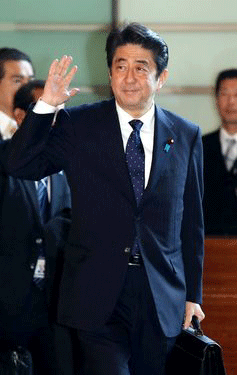 Japan to Begin Restarting Idled Nuclear Plants, Leader Says NYT By MARTIN FACKLER and HIROKO TABUCHI Matthew L. Wald contributed reporting from Washington. February 28, 2013 TOKYO — Japan will begin restarting its idled nuclear plants after new safety guidelines are in place later this year, Prime MinisterShinzo Abe said Thursday, moving to ensure a stable energy supply despite public safety concerns after the Fukushima disaster.
In a speech to Parliament, Mr. Abe pledged to restart nuclear plants that pass the tougher guidelines, which are expected to be adopted by a new independent watchdog agency, the Nuclear Regulation Authority, as early as July. He did not specify when any of the reactors might resume operation, and news reports have suggested that it might take months or even years to make the expensive upgrades needed to meet the new safety standards. Continue reading
Fukushima radiation is transforming Japan’s forest ecosystems
 Japan Scientists: Truly unusual deformities in Fukushima — Forests may be evolving into different ecosystems — “There’s been a sudden, large change” http://enenews.com/japan-scientists-truly-unusual-deformities-in-fukushima-theres-been-a-sudden-large-change-forests-may-be-evolving-into-different-ecosystems
February 27th, 2013
Excerpts from ‘Radiant Wildlands‘ by Winifred Bird and Jane Braxton in the Spring 2013 issue of Earth Island Journal
[…] When Joji Otaki began looking closely at the [pale grass blue butterflies] the size of a silver dollar, however, he was struck by abnormal patterns in the dark dots on their wings. Then he noticed dents in their eyes and strangely shaped wings and legs.
Otaki, a professor at the University of the Ryukyus in Okinawa, was in the Abukuma Mountains west of the disaster site collecting butterflies to study their response to the accident [2 months after 3/11].
[…] the aberrations they found took them by surprise. Abnormalities in the first generation were within normal boundaries. But when Otaki bred these butterflies in his laboratory, mutations in the offspring increased to 18 percent. That suggested inherited genetic damage. Field samples collected in September 2011, representing the fourth or fifth generation of butterflies since the disaster, had even higher abnormality rates. The changes may not all have been caused by radiation; Otaki had previously found evidence that temperature can affect wing markings. But the deformities his team found in antennae, legs, and other body parts are truly unusual, says Hokkaido University entomologist Shin-ichi Akimoto, who is studying the impact of Fukushima fallout on aphids. The abnormalities are troubling not only because insects are commonly assumed to be more resistant to radiation than humans, but also because they suggest the Fukushima nuclear disaster may be changing individual species, even entire forests.
“There is no question that ecosystems as a whole are suffering,” Otaki says. “There has been a sudden, large change.”
[…] As plants and animals continue to live in these irradiated environments, forests themselves may be evolving into different ecosystems. […]See also: Biologist on Mutated Butterflies: Study is overwhelming in its implications for humans — Japan Researcher: Insects were believed to be very resistant to radiation — Irregularly developed eyes, malformed antennae, much smaller wings (PHOTO)
1 This Month
23-25 October – on Zoom – World BEYOND War’s annual global conferenc


Shut down the radiation-damaged Heysham nuclear reactors now
To see nuclear-related stories in greater depth and intensity – go to https://nuclearinformation.wordpress.com

Say No to NASA’s Reckless Nuclear Reactor on the Moon
Say No to NASA’s Reckless Nuclear Reactor on the Moon
-
Archives
- October 2026 (170)
- September 2026 (339)
- August 2026 (330)
- July 2026 (355)
- June 2026 (287)
- May 2026 (306)
- April 2026 (356)
- March 2026 (251)
- February 2026 (267)
- January 2026 (308)
- December 2025 (358)
- November 2025 (359)
-
Categories
- 1
- 1 NUCLEAR ISSUES
- business and costs
- climate change
- culture and arts
- ENERGY
- environment
- health
- history
- indigenous issues
- Legal
- marketing of nuclear
- media
- opposition to nuclear
- PERSONAL STORIES
- politics
- politics international
- Religion and ethics
- safety
- secrets,lies and civil liberties
- spinbuster
- technology
- Uranium
- wastes
- weapons and war
- Women
- 2 WORLD
- ACTION
- AFRICA
- Atrocities
- AUSTRALIA
- Christina's notes
- Christina's themes
- culture and arts
- Events
- Fuk 2022
- Fuk 2023
- Fukushima 2017
- Fukushima 2018
- fukushima 2019
- Fukushima 2020
- Fukushima 2021
- general
- global warming
- Humour (God we need it)
- Nuclear
- RARE EARTHS
- Reference
- resources – print
- Resources -audiovicual
- Weekly Newsletter
- World
- World Nuclear
- YouTube
-
RSS
Entries RSS
Comments RSS

