Tepco’s ‘institutionalized lying’ might prevent restart of huge nuclear power plant
 TEPCO must address ‘institutionalized lying’ before it restarts world’s biggest nuclear power plant – governor Rt.com October 28, 2013 Tokyo Electric Power Co must give a more thorough account of the Fukushima disaster and address “institutionalized lying” in the company, before it will be permitted to restart the Kashiwazaki Kariwa plant, according to a local governor.
 “If they don’t do what needs to be done, if they keep skimping on costs and manipulating information, they can never be trusted,” Niigata Prefecture Governor Hirohiko Izumida told Reuters on Monday, adding that these limitations need to be overcome before the plant is restarted. It is up to Izumida to approve plans to restart the reactor at the TEPCO-run Kashiwazaki Kariwa – the world’s biggest nuclear complex, located on the Japan sea coast, north-west of Tokyo. His personal commission would examine both the causes and handling of the disaster at Fukushima and lay them alongside existing regulatory safeguards to ensure a similar crisis could not reoccur.
If Japanese nuclear safety regulators do lend their approval to the restart plans, Izumida remains able to essentially block TEPCO’s plans for the plant as the facility requires the backing of local officials, allotting Izumida some leverage. …….
Izumida suggested that TEPCO should be fully stripped of responsibility for decommissioning the destroyed Fukushima reactors, and the company subjected to a taxpayer-funded bankruptcy program. Presently, the company remains primarily concerned with funding the process, along with the frequently-occurring and very immediate issue of contaminated water leaking rather than overall nuclear safety.
“Unless we create a situation where 80-90 percent of their thinking is devoted to nuclear safety, I don’t think we can say they have prioritized safety,” he said. ……..
In September, a senior utility expert at Fukushima, Kazuhiko Yamashita, said that the plant was “not under control.” TEPCO downplayed his comments, saying that he had only been talking about the plant’s waste water problem – not the facility as a whole. … http://rt.com/news/tepco-address-lying-governor-879/
Fukushima’s radiation leaks – a slowly unfolding environmental misery

”There is no precedent for what is happening, so we are on untrodden ground.”
The Fukushima plant’s tainted water continues to contaminate the sea, Canberra Times, Martin Fackler and Hiroko Tabuchi, 28 Oct 13, FOR MONTHS now, it has been hard to escape the continuing deluge of bad news from the devastated Fukushima nuclear power plant.
Even after the company that operates the plant admitted this summer that tonnes of contaminated groundwater were leaking into the Pacific Ocean every day, new accidents have added to the uncontrolled releases of radioactive materials. Last month, newly tainted rainwater overflowed dykes. Two weeks before that, workers mistakenly disconnected a pipe, dumping 10 more tons of contaminated water onto the ground and dousing themselves in the process.
Those accidents have raised questions about whether the continuing leaks are putting the environment, and by extension the Japanese people, in new danger more than 2½ years after the original disaster – and long after many had hoped natural radioactive decay would have allowed healing to begin.
Interviews with scientists suggest they are struggling to determine which effects – including newly discovered hot spots on a wide swath of the ocean floor near Fukushima – are from recent leaks and which are leftovers from the original disaster. But evidence collected by them and the plant’s operator, the Tokyo Electric Power Co, or TEPCO, shows worrying trends.
The latest releases appear to be carrying much more contaminated water than before into the Pacific. And that flow may not slow until at least 2015, when an ice wall around the damaged reactors is supposed to be completed. Beyond that, although many Japanese believed that the plant had stopped spewing radioactive materials long ago, they have continued to seep into the air.
”This has become a slowly unfolding environmental misery,” said Atsunao Marui, a geochemist at the Geological Survey of Japan who has studied contaminated groundwater flowing from the plant. ”If we don’t put a stop to the releases, we risk creating a new man-made disaster.”…… Continue reading
AUDIO: Japan’s new Bill to restrict freedom of information
 AUDIO: Japanese secrets legislation prompts rights concerns Radio Australia, 28 October
  2013, A legislative push by Japan’s government to clamp down on intelligence leaks is set to pass the country’s parliament, sparking major concerns about Freedom of Information. Shinzo Abe’s Liberal Democratic Party has given cabinet approval for a State secrets bill, which will give government departments free reign to classify information if they deem it sensitive. Continue reading
Junichiro Koizumi, politician in harmony with Japan’s anti nuclear mood
“There is nothing more costly than nuclear power,” Koizumi said, marking a stunning reversal for an LDP stalwart…….
Koizumi siding with the anti-nuclear movement is important for two reasons. One, he’s an extraordinarily perceptive politician with a unique ability to read the public mood and sell sweeping change to the masses. Two, he’s calling for a kind of Manhattan Project in reverse
A Quake Revives Japan’s Nuclear Nightmare Bloomberg, By William Pesek Oct 28, 2013 As Tokyo shook early Saturday morning and loud shrieks from mobile-phone earthquake-warning alarms filled bedrooms around the city, one word immediately sprung to mind:Fukushima.
Those who don’t reside 135 miles away from the worst nuclear crisis since Chernobyl won’t understand this reaction. But the first thing most of Tokyo’s 13 million residents do once things stop wobbling is check if all’s well at the Fukushima Dai-Ichi plant still leaking radiation into the atmosphere and the Pacific Ocean…… Continue reading
How long can China’s nuclear industry stay “safe”?

 Chinese nuclear disaster ‘highly probable’ by 2030 The Ecologist, He Zuoxiu 25th October 2013 “……But if China sticks to plans to build another 30 third-generation power stations between 2015 and 2020, the risks rocket. No AP1000 reactors – one of the key third-generation designs – have yet been built anywhere in the world, meaning there are no reactor-years of experience. Only the figures of 267 reactor-years from Three Mile Island’s 267 reactor years and Chernobyl’s 162 reactor-years can be used as reference.
Even if we take the larger of those numbers, that brings the “most probable” period for a nuclear accident in China forward to between 2020 and 2030.
Some may say that “theoretically” third-generation reactors are safer than their second-generation equivalents. In fact, these 30 nuclear power plants will use reactors that have not been operationally tested. They are all being built inland and all face problems with water supply. Several third-generation plants, including Pengze in Jiangxi and Taohuajiang in Hunan, each with six reactors, cheated during the environmental impact assessment process, with no action taken by the National Nuclear Safety Administration.
For safety’s sake, it would be better to stop at 41 reactors, a number due to be reached in 2015. The Great Leap Forward mentality
Why did the US and former Soviet Union see nuclear accidents so soon? Apart from a lack of experience and immature technology, another factor was the Cold War mentality – both were fighting to be the world’s number one nuclear power.
Similar attitudes exist in China today. Nuclear decision-makers aim to build up to 500 nuclear power stations by 2050, exceeding the current global total of 443, and allowing the country to claim the world’s number one spot.
This is nothing but Great Leap Forward thinking. If these attitudes continue, we will likely see “most probable” will become the “actual”.
This article was first published by China Dialogue under a Creative Commons “Some Rights Reserved” licence. http://www.theecologist.org/News/news_analysis/2133281/chinese_nuclear_disaster_highly_probable_by_2030.html
Corruption scandals in S Korea make nuclear power future uncertain
Scandal may cause South Korea to abandon nuclear power http://www.salon.com/2013/10/28/scandal_may_cause_south_korea_to_abandon_nuclear_power/singleton/ BY LINDSAY ABRAMS Amid a safety scandal in which 100 people have been indicted for corruption and that has shut down three of the country’s 23 nuclear generators, South Korea is reconsidering its reliance on nuclear power, Reuters reports. The shift from nuclear, which currently provides nearly a third of the country’s power while only accounting for about 3-4 percent of its energy costs, could cost tens of billions of dollars a year in imports of liquified natural gas, oil or coal.
At a congressional hearing today, politicians estimated that the scandals have already cost the country’s nuclear operator $2.8 billion. From Reuters: The chaos in the industry comes as a government working group recommended on October 13 a cut in South Korea’s reliance on nuclear power, pointing to a drop in public confidence in safety that has been exacerbated by Japan’s Fukushima disaster.
The study recommended nuclear power capacity be kept between 22 and 29 percent of the total by 2035, well below existing plans to grow the sector to 41 percent in less than 20 years.
The government will hold public hearings to decide whether to back the recommendation before finalizing its energy policy in December.
Consumers may be asked to shoulder much of the estimated fivefold increase in energy costs by 2030, according to local media reports — or just start using less electricity.
Irradiated horses cared for by compassionate Japanese horse breeder
As Iitate’s population plummeted in the spring of 2011, Hosokawa managed to find new homes for more than 80 of his horses. Then, in January this year, he noticed that several among the 30 that remained, mainly foals, had become unsteady on their feet.
Within weeks, 16 had died in mysterious circumstances. Autopsies on four of the horses found no evidence of disease and tests revealed caesium levels at 200 becquerels per kilo – twice as high as the government-set safety limit for agricultural produce,
Fukushima horse breeder braves high radiation levels to care for animals Despite the departure of all his neighbours and the unexplained deaths of some of his stock, Tokue Hosokawa refuses to budge Justin McCurry in Iitate theguardian.com, Monday 28 October 2013 Until March 2011, Tokue Hosokawa had only to peer through the window of his home in Iitate village to confirm that all was well with his 100-year-old family business.
The 130 or so horses that once roamed this sprawling farm in Fukushimaprefecture have sustained three generations of Hosokawa’s family. Some were sold for their meat – a local delicacy – but his animals were better known for their appearances in commercials, period TV dramas and films, and local festivals celebrating the region’s samurai heritage.
For decades, the 62-year-old horse breeder barely registered that his farm was just 25 miles north-west of the Fukushima Daiichi nuclear powerplant. But the rural idyll was shattered on the afternoon of 11 March 2011, when the facility was hit by a towering tsunami that caused meltdowns in three of its reactors…….
two and half years after the accident, Iitate has become a nuclear ghost town. When Hosokawa looks out of his window these days, it is at empty, irradiated fields. Continue reading
Japan’s nuclear regulator is in an unwinnable position
Nuclear regulators can’t win, Japan Times , 27 Oct 13 THE NUCLEAR REGULATION AUTHORITY – , which observed the first anniversary of its creation on Sept. 19, faces two diametrically opposed criticisms. Proponents of nuclear power generation criticize the NRA as the root cause of the delay in the government’s policy to promote nuclear power, while “no-nuke” groups brand the body as a mouthpiece of the “nuclear power village” (the strong network of public organizations and power companies that work toward expansion of nuclear power).
These bitter criticisms coming from both ends of a spectrum seem to summarize the contradictions of Japan’s nuclear power policy. The NRA has become a skewed organization because the idea behind creating it was to satisfy both proponents and opponents of nuclear power. That has resulted in the lack of capabilities to execute its missions, thus making nuclear power plants in Japan even more dangerous than before. Continue reading
China’s nuclear safety prospects are not good
China is projected to have 71 nuclear power stations by 2020. If we use the figure of 4,922 reactor-years as explained above, then China will “most probably” suffer a major nuclear accident within the next 69 years.
Chinese nuclear technology can be regarded as approaching global levels, with similar design, safety and operational standards. But to reduce costs, Chinese designs often cut back on safety. In the past, earthquake-resilience was lower than in Japan, for example. China also has much less experience of this sector than Japan.
 Chinese nuclear disaster ‘highly probable’ by 2030 The Ecologist, He Zuoxiu 25th October 2013 As the UK prepares to build a fleet of new nuclear power stations with Chinese capital and expertise, a former state nuclear expert warns: China itself is heading for nuclear catastrophe. Some members of the nuclear power industry rely too much on theoretical calculations, when only experience can provide real accuracy.
The lifetime of nuclear reactors is calculated in “reactor-years”. One reactor year means one reactor operating for one year. The world’s 443 nuclear power plants have been running for a total of 14,767 reactor-years, during which time there have been 23 accidents involving a reactor core melting. That’s one major accident every 642 reactor years.
But according to the design requirements, an accident of that scale should only happen once every 20,000 reactor years. The actual incidence is 32 times higher than the theory allows. Continue reading
China’s legacy of radioactive pollution from rare earths processing
Whole villages between the city of Baotou and the Yellow River in Inner Mongolia have been evacuated and resettled to apartment towers elsewhere after reports of high cancer rates and other health problems associated with the numerous rare earth refineries there.
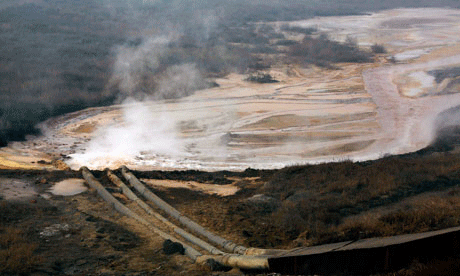
China Tries to Clean Up Toxic Legacy of Its Rare Earth Riches NYT By KEITH BRADSHER : October 22, 2013 TIANJIN, China — In northern China, near the Mongolian border, radioactively contaminated leaks from two decades of rare earth refining have been slowly trickling underground toward the Yellow River, a crucial water source for 150 million people. In Jiangxi province in south-central China, the national government has seized control of rare earth mining districts from provincial officials after finding widespread illegal strip-mining of rare earth metals.
And in Guangdong province in southeastern China, regulators are struggling to repair rice fields and streams destroyed by powerful acids and other runoff from open-pit rare earth mines that are often run by violent organized crime syndicates.
Communities scattered across China face heavy environmental damage that accumulated through two decades of nearly unregulated rare earth mining and refining. While the Chinese government has begun spending billions of dollars to clean up the damage, the environmental impact is becoming an international trade issue, with a World Trade Organization panel in Geneva expected to issue a crucial draft report on Wednesday……. The rare earth case “will be a landmark case in terms of both export restrictions and the environment,” said James Bacchus, the former two-term chairman of the W.T.O. appeals tribunal in Geneva. Continue reading
Japan’s Prime Minister off to Turkey to push sales of nuclear technology
 apan PM heads to Turkey to push nuclear exports, Yahoo 7 News, 28 Oct 13 Japan’s prime minister headed to Turkey Monday to cement nuclear contracts and push the export of more reactors as the industry tries to emerge from the shadow of the Fukushima atomic crisis……
During Abe’s previous visit a Japanese-French consortium won a $22 billion deal to build Turkey’s second nuclear plant on the Black Sea coast, a milestone for the Japanese nuclear industry as it tries to get back on its feet after the 2011 Fukushima crisis.
He and Erdogan also penned an agreement that allows Japanese manufacturers to build nuclear power plants in Turkey.
Abe has travelled the globe since coming to power in December last year selling Japan’s infrastructure as part of his bid to dramatically hike exports and light a fire under the country’s long-slumbering economy.
His drive comes even as all nuclear reactors at home remain offline amid continuing nervousness about atomic power in post-Fukushima Japan…… http://au.finance.yahoo.com/news/japan-pm-heads-turkey-push-083205105.html
Niigata Prefecture Governor not ready to allow Tepco to restart world’s biggest nuclear plant
Tepco can’t yet be trusted to restart world’s biggest nuclear plant: governor (Reuters) 28 Oct 13,– Tokyo Electric Power Co must give a fuller account of the Fukushima disaster and address its “institutionalized lying” before it can expect to restart another nuclear station, the world’s largest, said a local government official who holds an effective veto over the utility’s revival plan.
“If they don’t do what needs to be done, if they keep skimping on costs and manipulating information, they can never be trusted,” Niigata Prefecture Governor Hirohiko Izumida told Reuters in an interview on Monday.
Izumida must approve the embattled utility’s plans to restart the reactors at Kashiwazaki Kariwa, the world’s biggest nuclear complex on the Japan Sea coast some 300 kms (180 miles) northwest of Tokyo.
A former economy and trade ministry bureaucrat who has emerged as a leading critic of Tokyo Electric, or Tepco, Izumida said he would launch his own commission to investigate the causes and handling of the Fukushima crisis and whether strengthened regulatory safeguards were sufficient to prevent a similar disaster.
Izumida, 51, declined to provide a timetable for completing that review – a process that could force the utility to scrap or abandon one of the key assumptions behind its turnaround plan…….http://www.reuters.com/article/2013/10/28/us-japan-nuclear-tepco-idUSBRE99R0KR20131028
China’s nuclear submarines start sea patrols
China nuclear subs ‘gallop to depths of ocean’ Ft.com By Demetri Sevastopulo in Hong Kong and Jennifer Thompson in Tokyo, 27 Oct 13, China has said its first fleet of nuclear submarines has started sea patrols, in the latest sign of the growing confidence of the country’s military that has raised tensions in the region.
Xinhua, the official news agency, released photographs of what appeared to be Xia-class vessels – China’s first generation of nuclear-armed submarines, which are several decades old – saying they were being “declassified” for the first time. It said they would “gallop to the depths of the ocean, serving as mysterious forces igniting the sound of thunder in the deep sea”, and be an “assassin’s mace that would make adversaries tremble”……http://www.ft.com/intl/cms/s/0/ff2cc892-3f2c-11e3-b665-00144feabdc0.html#axzz2j4jstDmK
Potentially ‘Apocalyptic’ consequences in removing Fukushima nuclear reactor’s spent fuel rods
 Fuel Removal From Fukushima’s Reactor 4 Threatens ‘Apocalyptic’ Scenario. Radiation Fuel Rods Matches Fallout of 14,000 Hiroshima Bombs By Common Dreams Global Research, October 25, 2013 by Andrea Germanos
An operation with potentially “apocalyptic” consequences is expected to begin in a little over two weeks from now – “as early as November 8″ – at Fukushima’s damaged and sinking Reactor 4, when plant operator TEPCO will attempt to remove over 1300 spent fuel rods holding the radiation equivalent of 14,000 Hiroshima bombs from a spent fuel storage tank perched on the reactor’s upper floor……
The potential radiation releases in this situation can only be described as apocalyptic. Continue reading
“Nuclear Gypsies” work in Japan’s $150-billion Fukushima radiation clean-up
Radiation, desperation and gangsters: Inside the hidden tragedy of Fukushima The Globe and Mail , 25 Oct 13 ANTONI SLODKOWSKI AND MARI SAITO IWAKI — Reuters , Oct. 25 2013 Tetsuya Hayashi went to Fukushima to take a job at ground zero of the worst nuclear disaster since Chernobyl. He lasted less than two weeks.
Hayashi, 41, says he was recruited for a job monitoring the radiation exposure of workers leaving the plant in the summer of 2012. Instead, when he turned up for work, he was handed off through a web of contractors and assigned, to his surprise, to one of Fukushima’s hottest radiation zones.
He was told he would have to wear an oxygen tank and a double-layer protective suit. Even then, his handlers told him, the radiation would be so high it could burn through his annual exposure limit in just under an hour.
“I felt cheated and entrapped,” Hayashi said. “I had not agreed to any of this.” Continue reading
1 This Month
23-25 October – on Zoom – World BEYOND War’s annual global conferenc

To see nuclear-related stories in greater depth and intensity – go to https://nuclearinformation.wordpress.com

Say No to NASA’s Reckless Nuclear Reactor on the Moon
Say No to NASA’s Reckless Nuclear Reactor on the Moon
-
Archives
- October 2026 (160)
- September 2026 (339)
- August 2026 (330)
- July 2026 (355)
- June 2026 (287)
- May 2026 (306)
- April 2026 (356)
- March 2026 (251)
- February 2026 (267)
- January 2026 (308)
- December 2025 (358)
- November 2025 (359)
-
Categories
- 1
- 1 NUCLEAR ISSUES
- business and costs
- climate change
- culture and arts
- ENERGY
- environment
- health
- history
- indigenous issues
- Legal
- marketing of nuclear
- media
- opposition to nuclear
- PERSONAL STORIES
- politics
- politics international
- Religion and ethics
- safety
- secrets,lies and civil liberties
- spinbuster
- technology
- Uranium
- wastes
- weapons and war
- Women
- 2 WORLD
- ACTION
- AFRICA
- Atrocities
- AUSTRALIA
- Christina's notes
- Christina's themes
- culture and arts
- Events
- Fuk 2022
- Fuk 2023
- Fukushima 2017
- Fukushima 2018
- fukushima 2019
- Fukushima 2020
- Fukushima 2021
- general
- global warming
- Humour (God we need it)
- Nuclear
- RARE EARTHS
- Reference
- resources – print
- Resources -audiovicual
- Weekly Newsletter
- World
- World Nuclear
- YouTube
-
RSS
Entries RSS
Comments RSS

