Fukushima’s record perilous radiation
 Record outdoor radiation level that ‘can kill in 20 min’ detected at Fukushima Rt.com,8 Dec 13,Outdoor radiation levels have reached their highest at Japan’s Fukushima nuclear plant,warns the operator company.Radiation found in an area near a steel pipe that connects reactor buildings could kill an exposed person in 20 minutes,local media reported.The plant’s operator and the utility responsible for the clean-up Tokyo Electric Power Company (TEPCO) detected record radiation levels on a duct which connects reactor buildings and the 120 meter tall ventilation pipe located outside on Friday. TEPCO measured radiation at eight locations around the pipe with the highest estimated at two locations – 25 Sieverts per hour and about 15 Sieverts per hour, the company said.
The ventilation pipe used to conduct radioactive gasses after the nuclear disaster may still contain radioactive substances, TEPCO added. ……http://rt.com/news/fukushima-radiation-record-outdoor-912/
Plan for Fukushima nuclear plant to get UK style decommissioning agency
Japan may set up UK-style decommission agency for Fukushima plant BY YOSHIFUMI TAKEMOTO TOKYO Thu Dec 5, 2013 (Reuters) – Japan’s ruling party could set up a British-style agency to shut down the wrecked Fukushima nuclear plant, taking control of a project now managed by the station’s embattled operator, a senior party policymaker said on Thursday…… Tepco, de facto nationalized after 2011, is still responsible for the ambitious decommissioning of the plant as well as for paying compensation to evacuees and cleaning up affected areas.
A plan to set up a decommissioning agency is controversial as it would reduce Tepco’s responsibility and increase the burden on taxpayers.
Prime Minister Shinzo Abe has so far pledged half a billion dollars in government funds to help stem the flow of contaminated water at the plant after a highly radioactive water leak in August triggered international alarm………http://in.reuters.com/article/2013/12/05/us-japan-fukushima-ldp-idINBRE9B407C20131205
UK Olympic sized nuclear cover up – and it has spread to Japan
 OP – ED Arclight2011 Nuclear-news.net 8 December 2013
The UK has decided to take the cheapest option for decommissioning according to a recent report by the badly named Department of the Environment and Climate Change (DECC), as 65 percent of their annual budget goes just on the costs of decommissioning it should be named British Nuclear Fools.
The processes involved with “decommissioning” are a “corporate secret” but a quick google says that the cheapest option is dissolution that involves melting everything in Nitric acid (or similar) and this has been the cause of high NO2 levels in the UK that are regularly blamed on other industries or countries. Though La Hague in France does contribute.
The UK has been reprimanded by the EU for the deaths caused by this NO2. And in the UK parliament we hear calls to cut the pollution detection monitors as they give the nuclear hazard away and threaten profits. These NO gases and particulates make it to even the arctic region of Russia (as Bellona has reported on many occasion whilst defending Norway from unjust blame)
As EDF and the French government begin the plans to reduce French nuclear and the shutting down of La Hague, they plan to increase use of Sellafield and other sites in the UK for these environmentally polluting nuclear processes.
The Irish Government has not been involved in the decisions for Hinckley, so An Taisce has formally lodged an appeal to the EU. The reaction of the UK and Ed Davey are well documented here… https://nuclear-news.net/2013/12/06/no-objection-by-ireland-uk-nuclear-hearing-told/
And as DECC were threatened with non co-operation if they asked for certain technical details or even the names of people involved, the Irish were likely not to be aware of the processes that the UK was planning to expand nor has their been a proper discussion concerning radionuclide’s and air quality issues being released due to these nuclear processes.
In fact not even the British public could be expected to know. In fact the UK NGO steering group who was supposed to be discussing this very issue over the past two years were not even allowed to know.
Who needs Leveson inquiry to silence information when the corporations and governments are doing the job so well anyway, I find myself asking.
I might point out that DECC also masterminded the Science Media Centre UK (SMC) to cover up or “manage” the Fukushima incident press coverage in 2011, which they then did and were rewarded by their sponsors (The big corporations and nuclear interests).
Bloggers and free press elements in Japan got too much truth out and the Japanese nuclear family had to close ranks with the USA and the Olympic Committee and have came up with the new “Secrets Act” , a shocking attack on free speech from a supposedly western country. It is now up to the Japanese Press to mobilize the people to reject this new Law, there are some signs of dissent in the media. We wish them well!
DECC has contracts of understanding with ROSATOM as well as some dubious eastern nuclear states. China, an authoritarian and pushy country will have the same leverage over DECC as the French and USA partners and therefore the Chinese communist (mostly)will have control of the information we hear on the news etc.. Have you heard the one about the Dalai lama recently? No? And you probably never will again!
Elements of the UK Media have had enough and are beginning to look a little harder at the Pro nuclear spin and analyse the sources of this drive for nuclear. The UK media is beginning to wake up to the deception but how deep will they dig?
It began after the crash of 2008 and 200 billion Euro moved directly into nuclear investments (A Norwegian insurance investment company has just sold its stocks in TEPCO at a massiviely reduced price and has beeen left licking its wounds). The Insurance and banking industry saw this as a safe bet for three more years and are heavily invested, in fact, the UK insurance industry will be proping up this PONZI scheme with a staggering 25 billion investment that is a curiously small amount considering the Total investment accrued in the Nuclear Industry by now. Just the normal monthly “Top Up” perhaps?
And if you dont think the Insurance Corporations view this as their own private nuclear “gravy train” why was the liability capped in Canada to only 1 billion? when the Japanese have paid TEPCO 50 billion in just the first year after the disaster. It seems it is the beleaguered Tax Payer is always the end recipient of this PONZI shaped dept burden.
Finally, the UK corporations have been supporting the Pro nuclear Corporations in Japan from the start and are still supporting Japan as it becomes a fascist state to protect their investments. These investments are very long term, measured in decades, and any country with nuclear power could be facing the same control of the population and of information.
Orwell would be not surprised perhaps at technology being used to enslave people by reducing their knowledge and controlling them totally.. No dissent, no illegal thoughts or 5 years in prison and a criminal history to stop you getting work for the rest of your life. Poor Japan! Poor UK!
Right after the Fukushima disaster, Japan set about to market nuclear power
Japan “will resuscitate nuclear energy, and rebuild the basis for promoting exports of infrastructure facilities,” indicating that the ministry would continue to advance nuclear power generation and further expand nuclear facilities exports.
Because the pro-nuclear Abe administration has said, “We will share our experience of the accident and lessons learned from the disaster with countries of the world,” the ministry’s report can be regarded as a prototype for Prime Minister Shinzo Abe’s nuclear policy.
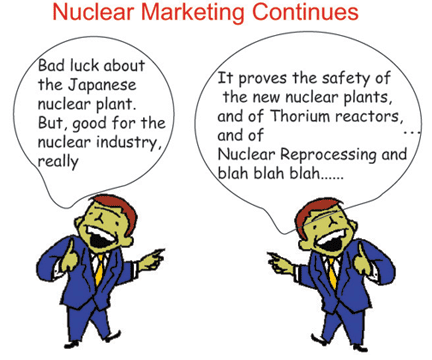
Ministry continued promoting nuclear power right after Fukushima accident December 02, 2013 THE ASAHI SHIMBUN The industry ministry began working to continue promoting nuclear power even immediately following the disastrous meltdowns at the Fukushima No. 1 nuclear power plant in March 2011, sources said.
The Asahi Shimbun has obtained a copy of the ministry’s confidential internal document titled, “Toward the Renaissance of Nuclear Energy,” which was compiled in late March 2011.
The report was written by a senior ministry official familiar with nuclear power facilities and distributed to its executives involved in designing the country’s energy policy, according to the sources.
The in-house document was used as a basis to determine the nation’s future nuclear policy in the aftermath of the disaster triggered by the Great East Japan Earthquake and tsunami on March 11, 2011, the sources said. Continue reading
Japan marketing nuclear technology to India
 Nuclear deal with Japan on the anvil THE HNDU, SANDEEP DIKSHIT , 2 Dec 13 At meeting with Emperor, Manmohan prefers to focus on economic aspects of relationship
Japan has said the main purpose of Emperor Akihito’s ongoing visit to India was to add more ballast to the bilateral relationship.
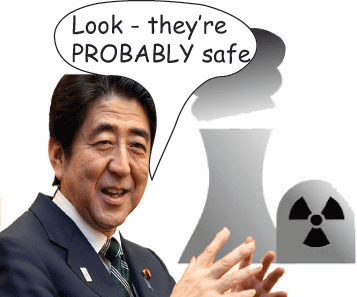 One of the elements that would add greater depth to the ties would be a civil nuclear agreement. “We are close to a bilateral deal on the peaceful use of nuclear energy,’’ said senior Japanese diplomats accompanying the Emperor, who is on a six-day visit to India……http://www.thehindu.com/news/national/nuclear-deal-with-japan-on-the-anvil/article5415157.ece
China marketing nuclear technology to Pakistan
How Pakistan and China Are Strengthening Nuclear Ties http://world.time.com/2013/12/02/how-pakistan-and-china-are-strengthening-nuclear-ties/?iid=gs-main-lead
The reactors are expected to start supplying 2,200 megawatts to the grid by 2019. The complex is not the first energy investment or nuclear project in Pakistan that China has been involved with, but it will be by far the largest.
 The nuclear power relationship between Pakistan and China is widely seen as a continuing effort to respond to the India-U.S. civilian nuclear deal, which, among other things, ended a decades-long moratorium on U.S. companies selling nuclear technology to India, despite India not being a signatory to the Nuclear Non-Proliferation Treaty. The move rankled Pakistan, which has also not signed the treaty and worries about a nuclear buildup by a country it considers its archenemy. China, too, criticized the deal for, it asserted, undermining nonproliferation. That the U.S. was building ties with India to counterbalance China’s growing power in Asia was probably not lost on Beijing either.
Canada joins the scramble of marketing nukes to India
 Canada wants relaxation in India’s nuclear liabilities rules THE
  HINDU, 1 Dec 13 Unless the provisions regarding a plant operators’ liabilities in case of nuclear damages are relaxed, foreign companies will not come in a big way, a senior Canadian government official has said.
“The way the liability has been framed in the Civil Nuclear Liability Act deviates from the global standards and it is our view if it is not modified, it is hard to see any foreign supplier coming in a big way to India,” Canadian consulate general Richard Bale told PTI on the sidelines of the nuclear summit here over the weekend.
As per the Act, an operator of a nuclear plant (so far only NPCIL) will be liable for damages worth up to Rs. 1,500 crore. However, there is a provision for the right of recourse for the operator. If written into the contract, the operator can claim the liabilities from the manufacturer and supplier. Most of the suppliers, domestic as well as international, are concerned over whether they will have to bear over Rs. 1,500 crore towards in the event of nuclear disaster.
“It is the government’s prerogative to determine what the public policy should be. But on the one hand the government is saying it wants to expand the nuclear power programme, on the other they have put in place a framework that makes it difficult to achieve that goal,” Mr. Bale said…… http://www.thehindu.com/news/national/canada-wants-relaxation-in-indias-nuclear-liabilities-rules/article5410644.ece
Leaking acid causes stop-work at Fukushima clean-up
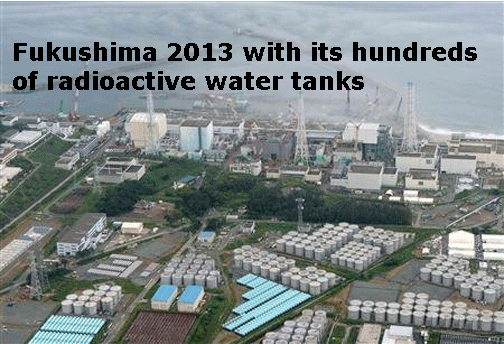 Fukushima nuclear reactor clean-up unit hit by acid leak http://www.theaustralian.com.au/news/world/fukushima-nuclear-reactor-cleanup-unit-hit-by-acid-leak/story-e6frg6so-1226772520045 STAFF WRITERS AFP DECEMBER 02, 2013 THE trouble-prone system used to decontaminate radioactive water at
  Japan’s crippled Fukushima nuclear power plant was switched off yesterday because of a chemical leak, the plant’s operator said.
Hydrochloric acid, used to neutralise the alkaline water being decontaminated, was found seeping from a pipe joint, the Tokyo Electric Power Co said.
The joint was wrapped in a vinyl bag to contain the leakage, TEPCO said, and the company was investigating the cause. About a litre of hydrochloric acid had been contained in the bag. The leak was found at one of three Advanced Liquid Processing System units designed to remove radioactivity from contaminated water at the plant, where a massive earthquake and tsunami in March 2011 sent the nuclear reactors into meltdown.
The systems are expected to play a crucial role in treating the huge amounts of toxic water accumulating at the plant. The troubled system was one of two units that had been in trial operation and were due to go into full operation yesterday.
In late September, plastic padding clogged up a drain in the same system, causing it to shut down. In October, it was halted due to a programming mistake.
Thousands of tonnes of water, used since the meltdown to cool reactors or polluted by other radioactive material, are being stored in huge tanks at the site on Japan’s northeast coast.
Tokyo court accepts withdrawal of libel suit against journalist
 NUCLEAR INDUSTRY BUSINESSMAN WITHDRAWS LIBEL SUIT AGAINST FREELANCER HTTPS://EN.RSF.ORG/JAPAN-NUCLEAR-INDUSTRY-BUSINESSMAN-16-08-2013,45056.HTML 16 AUGUST 2013. Reporters Without Borders welcomes the decision by Shiro Shirakawa, the head of the nuclear security systems company New Tech, to withdraw a libel suit against freelance journalist Minoru Tanaka. A Tokyo court has accepted the withdrawal, announced on 12 August.
 “This libel suit was an attempt by an influential member of Japan’s nuclear industrial complex, known as the ‘nuclear village,’ to harass and intimidate Tanaka into silence and self-censorship,” Reporters Without Borders said. “We are pleased that it did not work but we continue to be concerned for other journalists who try to cover the sensitive issue of Japan’s nuclear industry. There are still too many cases of reporters being pressured or censored when they try to provide information about the Fukushima disaster and its aftermath.
“The damages award Tanaka was facing if found guilty of libelling Shirakawa was clearly out of all proportion. We urge the courts to reject such ‘gag suits’ or ‘SLAPPs’ if they continue to be filed, and to propose proportionate alternatives such as the publication of a response.”
Shirakawa sued Tanaka, 52, over a December 2011 article for the weekly Shukan Kinyobiheadlined “The last big fixer, Shiro Shirakawa, gets his share of the TEPCO nuclear cake” – TEPCO being the owner of the Fukushima-Daiichi nuclear plant that suffered meltdowns after a tsunami in March 2011.
Using information in the public domain, the article accused Shirakawa of making a lot of money by acting as an intermediary between TEPCO, construction companies, politicians such as the leading parliamentarian Kamei Shizuka, and even clandestine organizations.
Ever since the Fukushima-Daiichi disaster, freelance journalists who cover the nuclear industry have had their access to information restricted and have, for example, been prevented from covering anti-nuclear demonstrations. Reporters Without Borders issued several press releases condemning the judicial harassment of Tanaka, who was sued for 67 million yen (600,000 euros) in damages.
Scanning of Japanese babies, for internal radiation exposure
Scanner measures radiation in babies http://the-japan-news.com/news/article/0000834507 1 Dec 13, The Yomiuri Shimbun University of Tokyo researchers and radiation measurement equipment maker Canberra Japan have jointly developed a device to measure internal exposure to radiation in babies, following the outbreak of the crisis at Fukushima No. 1 nuclear power plant in March 2011.
Hirata Central Hospital in Hirata, Fukushima Prefecture, will start to offer free tests using the equipment, dubbed “Baby Scan,” on Monday.
Developers of the device included Ryugo Hayano, 61, a University of Tokyo professor specializing in particle and nuclear physics. The equipment allows babies to be tested for radiation in a lying position, making it the first of its kind in the nation.
Until now, infants’ internal exposure has been measured with equipment for adults, leading to some errors. In addition, as such equipment requires the subject to remain standing for about two minutes, babies in principle cannot take the test.
Radioactive debris spread through Fukushima after typhoons
 Typhoons spreading Fukushima fallout ABC News 29 Nov 2013, Typhoons that hit Japan each year are contributing to the spread of radioactive material from the Fukushima nuclear disaster into the country’s waterways, researchers say.
A joint study by France’s Climate and Environmental Science laboratory (LSCE) and Tsukuba University in Japan shows contaminated soil gets washed away by the high winds and rain and deposited in streams and rivers. ”There is a definite dispersal towards the ocean,” LSCE researcher Olivier Evrard said Wednesday.
The typhoons “strongly contribute” to soil dispersal, he said, though it can be months later, after the winter snow melts, that contamination actually passes into rivers……….
Studies have shown that soil erosion can move the radioactive varieties of cesium-134 and 137 from the northern mountains near Fukushima into rivers, and then out into the Pacific Ocean.
Last year, the radioactive content of Japan’s rivers dropped due to fairly moderate typhoons. However, more frequent and fierce storms in 2013 have brought a new flood of caesium particles.
This is “proof that the source of the radioactivity has not diminished upstream” said Mr Evrard. Tsukuba University has completed a number of studies on Fukushima since November 2011. Scientists “concentrated mostly on the direct fallout from Fukushima yet this is another source of radioactive deposits” that must be taken into account, he warned. Coastal areas home to fishermen or where people bathe in particular face a potential risk…….http://www.abc.net.au/news/2013-11-29/an-typhoons-spreading-fukushima-fallout/5124084
Pakistan Fisherfolk Forum (PFF) oppose Karachi nuclear power projects

 Keamari Town’s nuclear power projects irk fishermen http://tribune.com.pk/story/638482/energy-leap-keamari-towns-nuclear-power-projects-irk-fishermen/ By PPI November 29, 2013 KARACHI:
The Pakistan Fisherfolk Forum (PFF) is unhappy with the two newly inaugurated Karachi nuclear power projects, K-1 and K-2, along the coastal area of the city in Keamari Town.
The officials are of the view that the authorities should have reviewed its environmental and social effects before their launch. In a statement issued on Thursday, the PFF said that the area community should have been taken into confidence with regards to their security to avoid any loss because of the installation of these power plants.
The statement said the projects were located close to the fault line while the people had been facing frequent warnings and threats of cyclone and tsunami. In case of this happening, it could be disastrous for not only the communities but also marine ecology. The project site has already been declared disaster prone, and there was no justification of environmental safety and community protection, it said. Continue reading
Bomb explosion near Kudankulam nuclear reactor – 6 killed
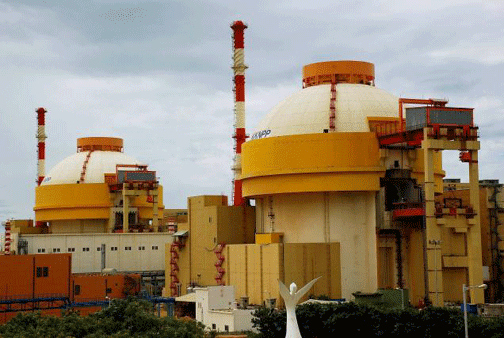 Bomb explodes near Indian nuclear reactor,THE AUSTRALIAN, ROBIN PAGNAMENTA THE TIMES NOVEMBER 29, 2013 A BOMB has exploded close to India’s biggest nuclear power station, killing six people and prompting a police investigation into whether it was linked with anti-nuclear protests in the area. The device exploded in a village close to Kudankulam in the southern state of Tamil Nadu, destroying at least two houses and seriously injuring three people. Among the six killed were a woman and three young children.
Vijayendra Bidari, a police spokesman, said the house in which it exploded was being used as a “bomb-making facility” in a village where anti-nuclear activists had been operating. He said the bomb apparently detonated accidentally as the suspected activists were building it. Two unexploded bombs were recovered from the site. The blast occurred about 1km from the Russian-built plant, which started operating last month – six years later than was planned – despite protests from locals who fear a nuclear accident.
Kudankulam lies in a seismically active area and the coastal zone was affected by the 2004 tsunami. Activists fear there could be a repeat of the 2011 Fukushima nuclear disaster in Japan.
SP Udayakumar, the founder of the People’s Movement Against Nuclear Energy, the main anti-nuclear group in the region, denied involvement in the bomb-making. “We made it clear immediately that we have nothing to do with the bomb blasts,” he said.
- Mr Udayakumar said he believed gangs associated with illegal mining were behind the blasts. – ………:
- –
6 Nuclear reactors now shut down in South Korea
 S.Korea nuclear reactor hit by automatic shutdown; six units now off First Post World, 29 Nov 13, SEOUL (Reuters) – A “safety-related action” automatically shut down one of its 23 nuclear reactors on Thursday, South Korea’s nuclear operator said, bringing the tally of those closed to six and hiking chances of possible power blackouts this winter……. “We are now looking into the cause of the shutdown and it is not yet clear when the reactor will restart,” said a spokesman at operator Korea Hydro & Nuclear Power. Operation of the 587-megawatt Kori No. 1 reactor, over 300 km southeast of Seoul, was suspended early on Thursday morning. The reactor, which started operation in 1978, had recently returned from nearly 180 days of scheduled maintenance through October 5, according to KHNP’s website. (www.khnp.co.kr). The unit’s license to operate was extended another 10 years in end-2007, another KHNP spokesman noted……
India’s Jaitapur nuclear power plans hit financial problems
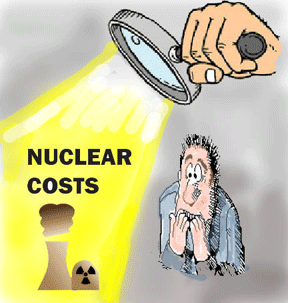 Plans for Western India Nuclear Project Hit Hurdle -Official By Saurabh Chaturvedi MUMBAI--India’s plans for setting up one of the country’s biggest nuclear power projects in its western region have been hampered due to a rise in the cost of equipment to be secured from French supplier Areva S.A. (AREVA.FR), a senior Indian government official said Thursday.
India’s state-owned monopoly Nuclear Power Corp. had signed an initial pact  with Areva in 2010 for the supply and installation of equipment needed for building two nuclear power reactors of 1,650 megawatts each at Jaitapur in the western state of Maharashtra. The plan is to eventually build a total of six reactors with a combined capacity of 9.9 gigawatts, which would be the biggest nuclear power complex in India at a single location.
But the cost of the equipment has risen due to the higher cost of borrowing as well as a slide in the rupee’s value against the U.S. dollar this year, which would more than double the cost of electricity generation from an initial estimate of about 4 rupees (6.4 U.S. cents) per unit.
“The price of electricity from the project once it becomes operational can not be more than 6.50 rupees,” said R.K. Sinha, chairman of India’s Atomic Energy Commission, the country’s top nuclear policy making body. “Negotiations are still on.”
An Areva India executive, who declined to be named, said negotiations on the sale of the equipment are still under way, while Areva India chairman and managing director Erwan Hinault didn’t immediately respond to emailed queries.
Nuclear Power Corp. had earlier expected to sign an agreement with Areva for the supply of equipment for the first two reactors by end-2012, but negotiations remained inconclusive. Global nuclear equipment companies such as Areva, GE Hitachi Nuclear Energy and Westinghouse Electric Co. have been keen to capitalize on India’s plans to spend billions of dollars to boost its nuclear power capacity. More than half of India’s 228 gigawatts of total power generation capacity is based on coal, which is in short supply…. http://online.wsj.com/article/DN-CO-20131128-003020.html?dsk=
1 This Month
19 May – Webinar No To Nuclear: Why Nuclear Power Destroys Lives, Derails Climate Progress and Provokes War

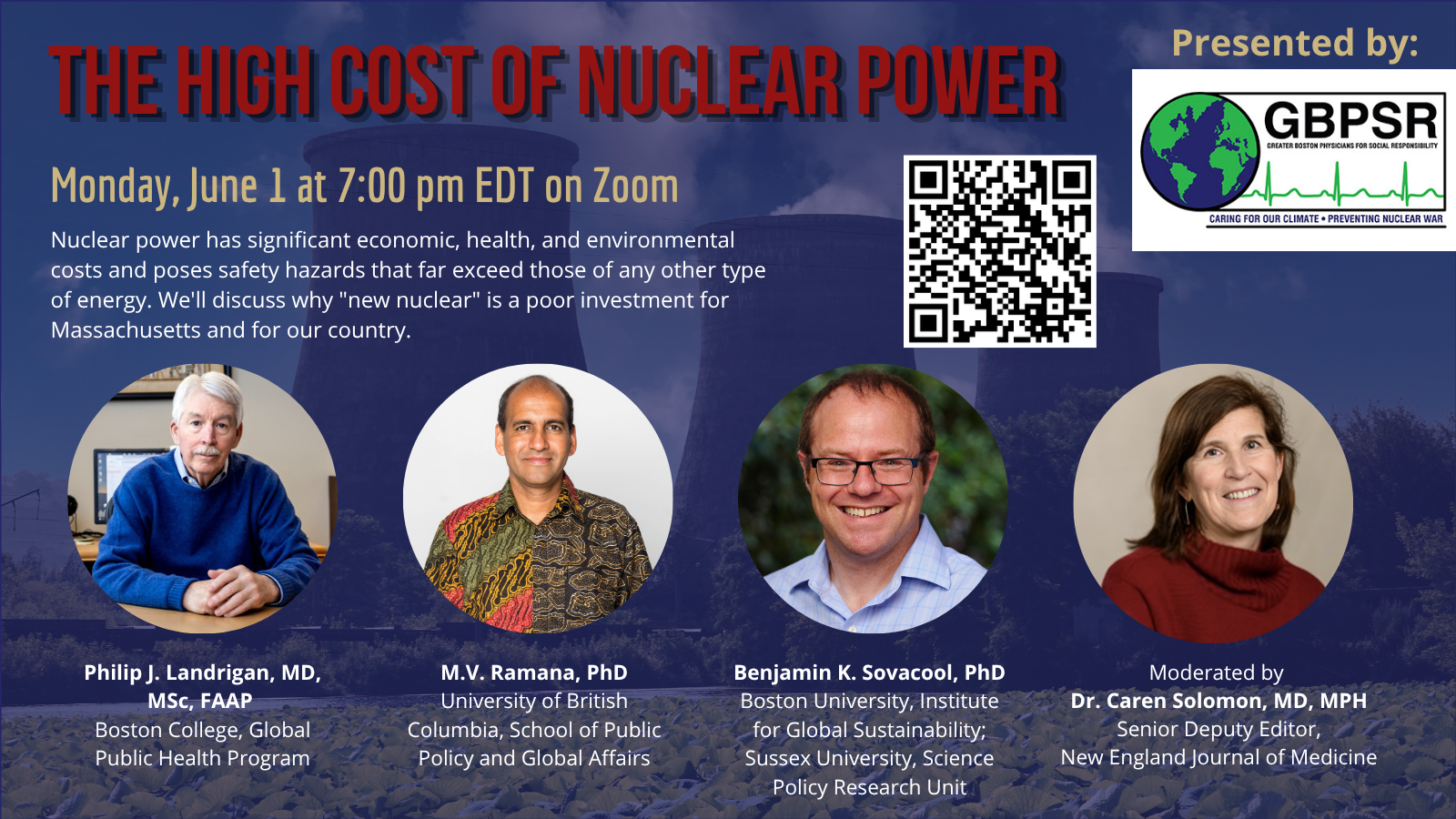
1 June Webinar – The High Cost of Nuclear Power – Register


of the week– Nuclear Reactor Information Task Force
To see nuclear-related stories in greater depth and intensity – go to https://nuclearinformation.wordpress.com
-
Archives
- May 2026 (199)
- April 2026 (356)
- March 2026 (251)
- February 2026 (268)
- January 2026 (308)
- December 2025 (358)
- November 2025 (359)
- October 2025 (376)
- September 2025 (257)
- August 2025 (319)
- July 2025 (230)
- June 2025 (348)
-
Categories
- 1
- 1 NUCLEAR ISSUES
- business and costs
- climate change
- culture and arts
- ENERGY
- environment
- health
- history
- indigenous issues
- Legal
- marketing of nuclear
- media
- opposition to nuclear
- PERSONAL STORIES
- politics
- politics international
- Religion and ethics
- safety
- secrets,lies and civil liberties
- spinbuster
- technology
- Uranium
- wastes
- weapons and war
- Women
- 2 WORLD
- ACTION
- AFRICA
- Atrocities
- AUSTRALIA
- Christina's notes
- Christina's themes
- culture and arts
- Events
- Fuk 2022
- Fuk 2023
- Fukushima 2017
- Fukushima 2018
- fukushima 2019
- Fukushima 2020
- Fukushima 2021
- general
- global warming
- Humour (God we need it)
- Nuclear
- RARE EARTHS
- Reference
- resources – print
- Resources -audiovicual
- Weekly Newsletter
- World
- World Nuclear
- YouTube
-
RSS
Entries RSS
Comments RSS
 nuclear-news