After a nuclear catastrophe, radiation victims become “unpersons”
 When life becomes a shadow – after nuclear catastrophe, Ecologist Robert Jacobs 8th April 2014 Those caught up in nuclear disasters suffer many times over, writes Robert Jacobs. Ill-health and early death aside, they are also cut off from their former communities, identities and family life, and the victims of social and medical discrimination. Radiation makes people invisible. We know that exposure to radiation can be deleterious to one’s health; can cause sickness or even death when received in high doses.
But it does more. People who have been exposed to radiation, or even those who suspect that they have been exposed to radiation that never experience radiation related illnesses may find that their lives are forever changed – that they have assumed a kind of second class citizenship.
They may find that their relationship to their families, to their communities, to their hometowns, to their traditional diets and even traditional knowledge systems have become broken. They often spend the remainder of their lives wishing that they could go back, that things would become normal.
Unpersons
They slowly realize that they have become expendable and that their government and even their society is no longer invested in their wellbeing.
As a historian of the social and cultural aspects of nuclear technologies I have spent years working in radiation-affected communities around the world.
Many of these people have experienced exposure to radiation from nuclear weapon testing, from nuclear weapon production, from nuclear power plant accidents, from nuclear power production or storage, or, like the people in the community that I live, in Hiroshima, from being subjected to direct nuclear attack.
 For the last five years I have been working with Dr. Mick Broderick of Murdoch University in Perth, Australia on the Global Hibakusha Project. We have been working in radiation-affected communities all around the world. In our research we have found a powerful continuity to the experience of radiation exposure across a broad range of cultures, geographies, and populations.
Fukushima – the victims’ future is all too predictable
About half way between beginning this study and this present moment the nuclear disaster at Fukushima Daiichi happened here in Japan.
One of the most distressing things (among so many) since this crisis began is to hear so many people, often people in positions of political power and influence say that the future for those affected by the nuclear disaster is uncertain.
I wish that it were so, but there is actually a deep historical precedence that suggests that the future for the people of Tohoku is predictable.
In this short article I will outline some continuities to the experiences of radiation-affected people. Most of the following is also true for people who merely suspect that they have been exposed to radiation, even if they never suffer any health effects.
Many have already become a part of the experiences of those affected by the Fukushima disaster. There are, of course, many differences and specificities to each community, but there is also much continuity…….. http://www.theecologist.org/blogs_and_comments/Blogs/2351503/when_life_becomes_a_shadow_after_nuclear_catastrophe.html
Fukushima insects have significant and unprecedented deformities
PHOTOS: Study finds deformities “significantly higher” in Fukushima insects — “To my knowledge, such deformations haven’t been reported” in species before — Lower body split in half, 2 tail-like appendages — 1,000% higher death rate in young than other Japan area — Urgent investigations called for, 8 April 14 http://enenews.com/photos-study-finds-deformities-significantly-higher-in-sample-of-fukushima-insects-to-my-knowledge-such-deformations-have-not-previously-been-reported-in-species-lower-body-split-in-ha?utm_source=feedburner&utm_medium=email&utm_campaign=Feed%3A+ENENews+%28Energy+News%29

The world will be changed by China’s renewable energy revolution
 China’s Renewable Energy Revolution Has Global Implications, Clean Technica John Mathews and Hao Tan, 8 April 14, China’s renewable energy revolution is powering ahead, with the year 2013 marking an important inflection point where the scales tipped more towards electric power generated from water, wind and solar than from fossil fuels and nuclear. This means that its energy security is being enhanced, while carbon emissions from the power sector can be expected to soon start to fall.
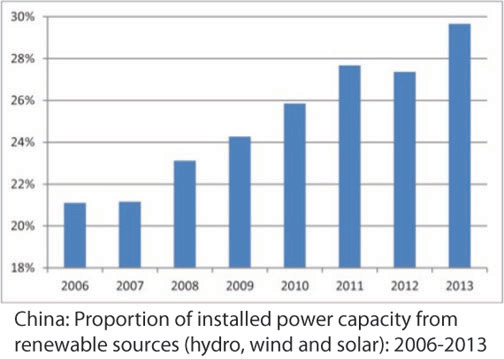
China’s energy revolution, which underpins its transformation into the world’s largest manufacturing system (the new “workshop of the world”), continues to astonish all observers, and terrify some. China is known widely as the world’s largest user and producer of coal, and the world’s largest emitter of carbon dioxide and other greenhouse gases. This is true. Less noticed has been the fact that China is also building the world’s largest renewable energy system – which by 2013 stood at just over 1 trillion kilowatt-hours – already nearly as large as the combined total of electrical energy produced by the power systems of France and Germany.1
The energy landscape continues to give the clearest indication of the trends in industrial dynamics and prospects for the future. China is powering ahead with renewables while at the same time it expands its reliance on fossil fuels; the US by contrast is further locking in its dependence on fossil fuels. The distinction is critical………
We need to sketch in the background to China’s energy revolution, so that the enormity of its commitment to renewables may be appreciated. ……. While coal for thermal power continues to rise, the overall consumption of coal appears to be ‘capped’ at 3,500 million tonnes – a desperate measure taken no doubt in response to the blackening skies and poisoning of water and air
In just the space of eight years, China has become the world’s most important generator of wind power, with the world’s largest capacity and the largest addition of new power capacity in the year 2013. The increase in all three sources of renewables – hydro, wind and solar PV – is shown in Fig. 3, in terms of the proportion of power generated by renewables and its relentless rise (apart from a dip in 2012, following world recession in 2011).
The proportion reached by 2013, of close to 30% of electrical energy generated from renewable sources (hydro, wind and solar), is what gives China its international influence in renewables – and it demonstrates a relentless trend towards greater reliance on manufacturing systems for production of, e.g. wind turbines and solar cells, as opposed to the reliance elsewhere on alternative fossil fuels such as coal seam gas and shale oil…….
The sharp rise in renewables reflects particularly the new commitment to wind power – and it looks set to continue through industrial logistic dynamics. We will develop an argument below for the significance of this date……….
3. Investment trends
Expenditure in building new power generating infrastructure can reveal more than data on capacity and generating additions. The CEC has released investment data for 2013, which reveal the following trends. In terms of investment, China spent more on its grid in 2013 than on new power generation facilities………The significance of this is that China is spending on infrastructure to accommodate more renewable power facilities, as well as on the facilities themselves. Of the new generation facilities, investment in new energy sources accounted for more than 40% of the total investment in new power generation facilities…….
Thus our conclusion that in 2013, China’s leading edge of change in its electric power system is now more “green” than “black”. We have demonstrated above that this is unambiguously so in terms of capacity added and in terms of investment, while in terms of new generation of electrical energy thermal still marginally outranks renewables (180 billion kWh generated to 160 billion kWh)………
at the leading edge, for the year 2013 alone, China added 94 GW of new capacity, of which 55.3 GW came from renewables (59%), and just 36.5 GW (or 39%) came from thermal sources – a dramatic reversal of past trends;…….
our analysis that China’s carbon emissions are set to peak and then to fall – and fall faster than in the US or in Europe……..http://cleantechnica.com/2014/04/08/chinas-renewable-energy-revolution-global-implications/
China’s motives in developing renewable energy
China is serious in its pursuit of renewables, because it seems to believe that its future prosperity depends on building the industries that produce power – complementing its activities in searching for fossil fuels supplies all around the world. There is a lesson here for all other developing countries, and notably for India and Brazil. And not only developing countries.
China’s Renewable Energy Revolution Has Global Implications, Clean Technica John Mathews and Hao Tan, 8 April 14, “……The motives Finally, we need to ask what are the motives for China’s dramatic shift to a renewables trajectory? The common assumption is that it is concern over climate change (global warming) that drives the shift. Important as this motive is, we believe it is the least likely of the explanations for China’s shift. We believe the more plausible explanation for China’s new trajectory – and for the determination with which it is being pursued – is energy security and industrial development. Continue reading
Anxiety over potential radiation risks in North Korea’s nuclear site
 U.S. think tank says North Korea is having radiation issues at primary nuclear site Raw Story, By Agence France-Presse Monday, April 7, 2014 The United States and its allies warned North Korea against provocations as researchers reported potential radiation risks due to problems at the regime’s main nuclear complex…….
Cancer rates nearly four times higher than world average near Fukushima
 Japanese physicians link spike in cancer to Fukushima radiation http://www.naturalnews.com/044619_Fukushima_radiation_cancer_Japanese_physician.html, April 06, 2014 by: Ethan A. Huff, staff writer Cancer rates in many areas of Japan are on the rise following the global catastrophe at the Fukushima Daiichi nuclear power facility back in March 2011.
  And some Japanese doctors now caring for all those radiation refugees who were shipped out from areas surrounding the nuclear plant after it exploded say fallout from the disaster is likely to blame for this massive uptick in disease.
The German media group Deutsche Welle (DW) reports that many radiation refugees are having to watch as their family members and pets suffer gruesome fates at the hands of what appears to be radiation poisoning. One elderly woman told reporters that her dog lost all the hair around his neck, his skin turned black, and he eventually died, all signs that suggest a link to radiation.
Many people are also suffering, as evidenced by tests revealing an increase in thyroid damage among folks who lived in close proximity to the plant. One local doctor from Namie, a town located about 5.6 miles (9 km) from the Fukushima plant, has been examining patients ever since the disaster and is convinced that Fukushima radiation is causing a major public health crisis.
“Children and young people are particularly vulnerable to the uptake in radioactive iodine in their thyroid,” says Dr. Shunji Sekine, a retired physician with a medical practice in the city of Nihonmatsu, which is currently housing some 230 relocated families who evacuated other areas following the Fukushima disaster, as quoted by DW.
“Although comprehensive studies are missing, I see a connection between nuclear accidents and the occurrence of cancer,” adds the specialist in both thyroid and breast cancer, noting that he has observed a significant increase in both conditions following the nuclear catastrophe.
Cancer rates nearly four times higher than world average near Fukushima Cancer rates have been rising all across the region, in fact, with the latest data showing that 13 out of every 100,000 inhabitants, including many young children, are coming down with some form of cancer. Based on world averages for cancer, this represents a cancer rate that is nearly four times higher than the norm.
“According to official figures, 33 cancer cases have been identified in about a quarter of a million children and teenagers since the beginning of February,” reads the DW report. “This translates into 13 cases for every 100,000 inhabitants, a figure almost four times higher than the world average for all age groups.”
Forced evacuations exposed people to more radiation; Japanese government knew all along
The Japanese government has, perhaps not surprisingly, continued to downplay the severity of the situation, advising “further investigations” in order to avoid pinning the rise in disease on Fukushima. But the phenomenon almost exactly matches what occurred following the Chernobyl disaster, as well as the uptick in cancer rates following the dropping of atomic bombs on Hiroshima and Nagasaki by the U.S. during World War II.
Many of the people being diagnosed with radiation-associated diseases were also forced to trek through areas during their evacuation that had become poisoned by radioactive particles that drifted from the stricken plant. According to Dr. Sekine, who out of the kindness of his own heart is now allowing victims in his area to use a full-body screening machine to test for radiation poisoning annually, the forced relocation of these folks by the Japanese government actually exposed them to more radiation.
“Only four days after the explosion of the nuclear reactor, orders were given to evacuate the town of Tsushima in the northwest,” adds DW. “This led to the refugees being transported through the invisible radioactive cloud, resulting in even more exposure to contamination than if they had stayed at home.”
“Officials in Tokyo knew this from their computer models. But they remained silent, as they feared a widespread panic.”
Japan’s nuclear energy policy dangerously adrift
 In the Wake of Fukushima: Japan’s Nuclear Energy Policy Impasse 60% of Japan’s 48 viable nuclear reactors,are not as yet being considered for application to the Nuclear Regulation Agency (NRA) for restart By Andrew Dewit Global Research, April 07, 2014
Asia-Pacific Journal Japan’s energy policy regime appears dangerously adrift in the context of accelerating climate change. The core problem is agency. On the one hand, 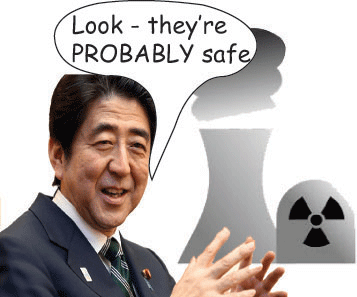 Japanese PM Abe Shinzo and the nuclear village appear obsessed with nuclear power restarts and 20th century paradigms of the power economy. On the other hand, Japan’s anti-nuclear civil society lacks the political vehicle to force a combined nuclear pullout plus drastic reduction of greenhouse gas emissions. Some anti-nuclear forces do not yet understand the urgent need to reduce emissions, and are content to burn coal, despite of the patent threat of climate change. This is precisely what Japan has done in the wake of 3.11. The Abe cabinet is focused on getting restarts and a nuclear-based energy plan. Yet the scope for restarts is surprisingly limited and – incredible in this era of multiple crises and revolutions – the draft new energy plan lacks concrete numbers.1 The country needs better leadership on smart growth, in the context of what McKinsey specialists refer to as a “resource revolution”2 and MIT economists depict as “the second machine age.”3
Nuclear Is Probably No Longer Baseload
All of Japan’s 48 viable nuclear reactors are at present offline, and have been since September of 2013. The Abe cabinet is keen to restart as many of these as possible. But regulatory rules, public opinion and other factors constitute significant barriers to achieving even a third of Japan’s pre-Fukushima 30% reliance on nuclear power. That will mean nuclear will no longer be a “baseload” source of electricity, capable of supplying a reliable load to the grid at all times.
Indeed, an Asahi Shimbun survey of the utilities themselves indicates that fully 60% of Japan’s 48 viable nuclear reactors, meaning 30 reactors, are not as yet being considered for application to the Nuclear Regulation Agency (NRA) for restart. And of these 30 reactors, it appears that at least 13 are write-offs due to age, proximity to a seismic fault, and other factors that render them incapable of satisfying the new safety standards of the NRA.4 For that reason, at present there are only 17 reactors for which restart applications have been filed.
Of these, it appears – even to Japanese supporters of nuclear power – that perhaps only 8 will finally get approval and be restarted. Highly regarded energy specialist Tom O’Sullivan, of Mathyos Japan, concludes this on the basis of a survey of “various established Japanese policy institutes that are close to Japan’s industrial interests.” O’Sullivan notes that “[t]his level of restarts would only amount to 56 TWh of power output or 6% of Japan’s total power requirements and thus may not constitute a baseload power supply.”5
Reuters conducted its own analysis, using a broader set of questionnaires and interviews of over a dozen experts, along with input from the 10 firms that operate nuclear capacity. One suspects these operators painted as optimistic a picture of their restart prospects as possible. Even so, the result of this survey led Reuters’ expert journalists, Mari Saito, Aaron Sheldrick and Kentaro Hamada, to conclude that at best there will be 14 nuclear restarts at some point in time. They add that there is great uncertainty about the remaining 34 nuclear reactors. Their conclusion is that nuclear energy “will eventually make up less than 10 percent of Japan’s power supply.”6
Part of the reason nuclear appears not likely to recover its status as base-load power are the NRA’s new safety rules, in tandem with maintenance schedules and other factors that make a very shrunken fleet unreliable. But another large reason for this likely outcome is the stubbornness of the opposition to nuclear power………. http://www.globalresearch.ca/in-the-wake-of-fukushima-japans-energy-policy-impasse/5376899?utm_source=rss&utm_medium=rss&utm_campaign=in-the-wake-of-fukushima-japans-energy-policy-impasse
US gov’t shredded documents for 4 days while drawing up plans to evacuate Japan
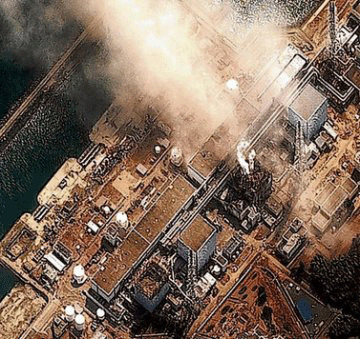 Fukushima Disaster: Professor, “Level of radiation was far worse than Navy officers anticipated”, Conservatve Read, US gov’t shredded documents for 4 days while drawing up plans to evacuate Japan — “Somebody was obviously very worried”
Jeff Kingston of Temple Univ., Apr. 4, 2014: Kyle Cleveland, my colleague […] recently published a report […] a critical, but nuanced picture of a crisis that was closer to careening out of control than is generally acknowledged. […] Naval officers […] discovered the level of radiation was far worse than they anticipated. Radiation gauges on the [USS Reagan] measured levels of radiation at 100 nautical miles off the coast that were 30 times greater than normal. [Sailors report] significant health problems due to exposure to radiation […] Cleveland finds that there was considerable disagreement between various U.S. agencies about the severity of the risk […]
Given that the U.S. government expanded the exclusionary zone in Fukushima to 80 km and developed contingency plans for a massive evacuation while shredding of documents continued for four days at the U.S. Embassy and military bases in Japan, somebody was obviously very worried. […] Some of his insider sources tell him that the crisis was actually far worse than anyone acknowledged at the time and that information was withheld to prevent a panic.
Cleveland concludes that Japan’s nuclear reactors should not be restarted……… http://conservativeread.com/fukushima-disaster-professor-level-of-radiation-was-far-worse-than-navy-officers-anticipated/
Sustained Public Opposition to nuclear power restart in Japan
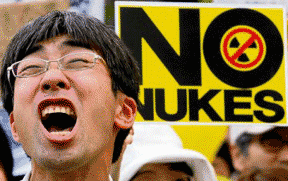 In the Wake of Fukushima: Japan’s Nuclear Energy Policy Impasse 60% of Japan’s 48 viable nuclear reactors,are not as yet being considered for application to the Nuclear Regulation Agency (NRA) for restart By Andrew Dewit Global Research, April 07, 2014
Asia-Pacific Journal “………..The most recent Japanese opinion poll on nuclear restarts is the March 18 survey by the Asahi Shimbun. It indicates that 59% of the Japanese public oppose restarts of any nuclear capacity, whereas only 28% support restarts. The poll’s results not only confirm that the opposition to nuclear is holding; it also shows a great sensitivity to risk. According to the poll, a mere 12% of the Japanese public have either no or only minimal concern regarding the risk of further nuclear accidents at facilities other than the infamous Fukushima Daiichi. By contrast, 50% have a fair degree of concern, and 36% have a very high degree of concern. In addition, the poll shows that only 4% of respondents regard the lack of nuclear waste disposal facilities as of no or only minimal concern. By contrast, 19% believe it is to some extent a problem. And a massive 76% regard it as a serious problem.7
Nationwide, there are 135 local communities that lie within 30 kilometers of a reactor, and 21 prefectures that are host to one or more reactors. The news service Kyodo Tsushin surveyed these 156 local governments in mid- to late-February of 2014, and found that only 13 were ready to agree to restarts without conditions. A further 24 would agree to restarts, but with conditions. Of the remainder, 32 declared their opposition to restarts, 66 replied that they could not decide, and 21 offered no reply at all.8 The NRA decided on March 13 to prioritize Kyushu Electric’s Sendai rectors 1 and 2 (in Kagoshima Prefecture) for restart.9 But that decision itself came under criticism, due to perceptions of undue haste amid suggestions that seismically active zones are nearby………. http://www.globalresearch.ca/in-the-wake-of-fukushima-japans-energy-policy-impasse/5376899?utm_source=rss&utm_medium=rss&utm_campaign=in-the-wake-of-fukushima-japans-energy-policy-impasse
India may abandon its ‘no first use’ policy on nuclear weapons

 India’s BJP puts ‘no first use’ nuclear policy in doubt Yahoo 7 News, April 8, 2014, By Sanjeev Miglani and John Chalmers NEW DELHI (Reuters) –India’s opposition Bharatiya Janata Party (BJP), widely tipped to form the next government, pledged on Monday to revise the country’s nuclear doctrine, whose central principle is that New Delhi would not be first to use atomic weapons in a conflict.
Unveiling its election manifesto, the party gave no details,
but sources involved in drafting the document said the “no-first-use” policy introduced after India conducted a series of nuclear tests in 1998 would be reconsidered……..http://au.news.yahoo.com/world/a/22459963/indias-bjp-puts-no-first-use-nuclear-policy-in-doubt/
Arguments for nuclear power losing credibility,as Japan’s utilities jostle for funding
In the Wake of Fukushima: Japan’s Nuclear Energy Policy Impasse 60% of Japan’s 48 viable nuclear reactors,are not as yet being considered for application to the Nuclear Regulation Agency (NRA) for restart By Andrew Dewit Global Research, April 07, 2014
Asia-Pacific Journal
“…….Hard-Pressed Utilities
 As for the utilities themselves, Tepco is not viable in its current form, having lost a stunning 81.2% of its market capitalization between March 10 of 2011 and April 2 of 2014. It was nationalized in June 2012 via a YEN 1 trillion injection of public capital, “the biggest state intervention into a private non-bank asset since America’s 2009 bail-out of General Motors (Economist, 2012). Resolving pressing matters such as the Fukushima and area clean-up and compensation, the decomissioning of ruined assets and the like are well beyond Tepco’s means. Some specialists question whether the other nuclear-dependent utilities are viable as well (Kaneko, 2013), and in early April of 2014 Kyushu Electric and Hokkaido Electric were revealed to be in discussion with the public sector Development Bank of Japan for bailouts (Financial Times, April 2, 2014). Kyushu Electric’s reliance on nuclear power is 42% of generating assets and Hokkaido Electric’s reliance is 30%. Their respective losses of market capitalization are 38.9% and 58.2%.11
The Japanese public sector has thus long been in a powerful position vis-à-vis the utilities, enabling it to press for reform. But this authority was used sparingly by the central government, even under the previous Democratic Party administration. The Tepco bailout was notable for protracted negotiations between Tepco and its politico-bureaucratic allies and state officials. They were not bargaining about weighty matters such as ownership of the power grid, but rather salaries and the size of increases on rate-payers. Outsiders regarded it as “bewildering” to see such minor items on the table. The Financial Times’ Jonathan Soble, also a close follower of Japan’s post-Fukushima power crisis and politics, argued that it “underscored the depth and resilience of Tepco’s resilience, and that of the ‘nuclear village’ of utility executives, bureaucrats and lawmakers that built Japan’s atomic power industry.“12
But now Tepco’s siblings are lining up for bailout, and this seems unlikely to end. Like big utilities in Europe and North America, Japanese utilities face the existential challenge of the ICT, renewable and efficiency-driven “electricity revolution” summarized nicely by Brookings energy security specialists Charles Ebinger and John Banks.13 A recent very detailed article in Scientific American shows how America’s 3000-plus utilities are fighting a losing battle against solar power and smart grids.14 Centralized power and monopolized conventional-grid ownership are confronting a far larger tsunami than the mobile phone shock to land-line telephony. But Japan’s monopolized and nuclear-reliant utilities have the added conundrum of nuclear power’s delegitimation in a very seismically sensitive country.
After Fukushima, the Japanese public debate received a very accelerated course of instruction on how various political economies were responding to the risks of resource price increases as well as climate change and the opportunities of developing new industries in renewable energy and related fields. The public debate also became apprised of just how far behind Japan was in its deployment of energy alternatives such as solar and wind. Moreover, the old arguments that these forms of power generation were not suited to Japan, because of “unique” winds and lack of space, lost their credibility.
The Push for Local Resilience
In addition, local governments exhibit increasing efforts to seize opportunity in the emergence of alternatives to highly centralized and concentrated nuclear power. Centralized power, such as Tepco’s nuclear reactors, led to concentrated economic benefits for a few communities whereas the risks of accident were distributed among a much broader range of communities. Fukushima Prefecture’s post-3-11 commitment to 100% renewable energy by 2040 encouraged other prefectures and cities, including Tokyo, Kyoto, and Osaka, to adopt ambitious targets.15
Moreover, at the end of 2013, Japan’s 16 trillion yen power market featured 192 independent power producers, including such new entrants as Toyota. That number was 79 at the end of 2012, and there has thus been a 240% increase in the number of firms.16 Japan’s “feed in tariff” policy support for diffusing renewables, effective from July of 2012, saw over four gigawatts (roughly four large nuclear reactors worth) of new renewable capacity deployed in the initial year. Japanese domestic shipments of solar cells and modules during July-September of 2013 leapt to 2.075 gigawatts, over triple the 627 megawatt level of a year earlier.17 The Pew Research April 3, 2014 publication of “Who’s Winning the Clean Energy Race? 2013” argues that China remains the leader, at USD 54.2 billion, but that “Japan experienced the fastest investment growth in the world, increasing 80 percent, to almost $29 billion.”18
Since Japan’s public debate on energy is so polarized between Team Abe and the majority, it seems useful to examine which of the two idealized options – nuclear or green – offers the better return. Table 1 is an aid to this objective by its highlighting of the profoundly skewed energy R&D priorities of all the IEA countries. Over two-thirds of the 1980 peak in energy R&D expenditures by all IEA members was devoted to nuclear fission and fossil fuels. By contrast, only 12.3% was invested in renewables and only 6.4% in efficiency. Yet according to the IEA Energy Efficiency Market Report of 2013, global energy efficiency investment in 2011 was worth roughly USD 300 billion, “a similar scale to renewable energy and fossil fuel power investments.”19 Directly comparative data on nuclear power investments appear not to be available. But Mycle Schneider, and Antony Froggatt’s authoritative “The World Nuclear Industry Status Report 2013” reveals that the 2013 global total of 427 reactors with an installed capacity of 364 GWe was considerably lower than the 2010 peak of 444 reactors with an installed capacity of 375 GWe.20………… http://www.globalresearch.ca/in-the-wake-of-fukushima-japans-energy-policy-impasse/5376899?utm_source=rss&utm_medium=rss&utm_campaign=in-the-wake-of-fukushima-japans-energy-policy-impasse
Inside stories on the continuing Fukushima nuclear crisis
 Inside Sources: Fukushima crisis “actually far worse than anyone acknowledged… information withheld to prevent panic” – Professor: “Level of radiation was far worse than Navy officers anticipated” – US gov’t shredded documents for 4 days while drawing up plans to evacuate Japan — “Somebody was obviously very worried” http://enenews.com/inside-sources-fukushima-crisis-actually-worse-anyone-acknowledged-information-withheld-prevent-panic-professor-level-radiation-worse-navy-officers-anticipated-govt-shredded-documents-4-days-drawing?utm_source=feedburner&utm_medium=email&utm_campaign=Feed%3A+ENENe
Japan Times, Jeff Kingston of Temple Univ., Apr. 4, 2014: Kyle Cleveland, my colleague […] recently published a report […] a critical, but nuanced picture of a crisis that was closer to careening out of control than is generally acknowledged. […] Naval officers […] discovered the level of radiation was far worse than they anticipated. Radiation gauges on the [USS Reagan] measured levels of radiation at 100 nautical miles off the coast that were 30 times greater than normal. [Sailors report] significant health problems due to exposure to radiation […] Cleveland finds that there was considerable disagreement between various U.S. agencies about the severity of the risk […] Given that the U.S. government expanded the exclusionary zone in Fukushima to 80 km and developed contingency plans for a massive evacuation while shredding of documents continued for four days at the U.S. Embassy and military bases in Japan, somebody was obviously very worried. […] Some of his insider sources tell him that the crisis was actually far worse than anyone acknowledged at the time and that information was withheld to prevent a panic. Cleveland concludes that Japan’s nuclear reactors should not be restarted.
Professor Kyle Cleveland, Temple University Japan: “[The navy was] more risk averse than either the NRC (Nuclear Regulatory Commission) or State, and from day one was ringing alarms that were not entirely understood, not completely validated and not well received by the NRC and State. The navy was pushing the other federal agencies to take more aggressive actions because their radiation measurements were indicating dose rates that were more significant than what was implied by the abstract modeling […]”
Unidentified US Nuclear Expert: “Without a qualitatively different regulatory system, and in light of how Japan/Tepco responded to this crisis, Japan has not earned the right to have nuclear energy. No critically minded and informed person can evaluate this disaster and look at how Japan has responded in the aftermath and have any confidence that Japan will use nuclear energy safely. In the most seismically active country […] even if Japan had a robust regulatory structure and thoroughly integrated crisis protocols, nature conspires against the best-laid-plans of human institutions. And what Japan has is certainly not the best plan by any measure.”
China is No.1 in renewable energy investment
 U.S. Lags Behind China in Renewables Investments, Clean Technica, 6 April 14 By Bobby Magill Follow @bobbymagill Don’t let all those Texas wind farms and massive installations of solar panels in California fool you. The U.S. is not the world leader in clean energy investment.
China is.
China Is #1 In Renewable Energy Investment, US #2, Japan #3 (CHART) With record-breaking solar installations in the US, and solar actually coming in as the #2 source of new electricity capacity in 2013, you might think the US was the #1 market in the world for renewable energy investment. Of course, if you follow how much renewable energy China is installing… or if you just read the headline above, you know otherwise. Here are more details from Climate Central:
For the second year, an annual Pew Charitable Trusts report, “Who’s Winning the Clean Energy Race?”, shows that China is the world leader in clean energy investment, with $54 billion in investments in renewables in 2013, well above total U.S. investment of $36.7 billion. No other clean energy market in the world is operating at that scale,” Phyllis Cuttino, director of Pew’s clean energy program, said during a teleconference Thursday, referring to China.
The report was released just days after the Intergovernmental Panel on Climate Change released the second part to its fifth assessment report, which states unequivocally that people will have to adapt to a world in which human fossil fuel emissions have caused the climate to change, threating lives across the globe as temperatures and seas rise and extreme weather becomes more frequent. Developing renewable energy is seen as one of the primary ways to reduce humans’ impact on the climate.
The Pew report says China’s efforts to slash poverty, expand economic development and solve its air pollution problems have driven the country to invest heavily in clean energy…………
Zwindler said the solar and wind power industries worldwide are in a transition period as subsidies for renewables are scaled back, especially in Germany and Italy, but he is confident renewables will be able to compete in the future with few subsidies.
“It does not take place in all places at the same time,” he said. “If you’re in a sunny part of the world with high electricity prices, putting solar on your roof clearly can make more sense.” http://cleantechnica.com/2014/04/05/china-1-renewable-energy-investment-us-2-japan-3-chart/
Radioactive contamination of Japan by Fukushima nuclear disaster
Caldicott: All of Japan contaminated by Fukushima — “Realistic estimate is 60,000 km², occupied by 46 million people” — “Things are grim, it gets worse by the day” — Unheard of in history, 100s of tons of melted fuel may be in earth (VIDEO) http://tinyurl.com/ldeohpa
2014/03/08 【京都】未来を担う子どもたちの為に、今、私たち
Bay FM 99.9 – Byron Bay Australia, Feb. 26, 2014:
Dr. Helen Caldicott: Things are grim — it gets actually worse by the day. […] There have been 3 meltdowns, which is just unheard of in the history of nuclear age, Units 1, 2, and 3, so that means that molten cores of about 100 tons of uranium in 3 reactors have melted their way through 6 inches of steel in the reactor vessel through to the containment floors, possibly through feet of concrete and steel into the earth. >> Full broadcast hereDr. Helen Caldicott in Kyoto, Japan, Mar. 8, 2014:
Dr. Helen Caldicott: A more realistic estimate of contamination is 60,000 square kilometers, occupied by 46 million people including parts of Tokyo and surroundings. As you can see (map on right), the whole land mass is contaminated to a greater or lesser extent.Watch Dr. Caldicott’s Kyoto presentation here
Fukushima nuclear plant will end up an entombed ‘national sacrifice zone’
Former US Gov’t Official: Growing likelihood Fukushima reactors will be entombed — Nuclear ‘sacrifice zone’ where they can only try to reduce contamination from escaping — Unprecedented situation, it’s flowing into Pacific Ocean continually adding to plume soon to hit West Coast (AUDIO) http://enenews.com/former-govt-official-growing-likelihood-fukushima-reactors-will-be-entombed-nuclear-national-sacrifice-zone-only-try-reduce-contamination-escaping-unprecedented-situation-flowing-pacific-ocean-c?utm_source=feedburner&utm_medium=email&utm_campaign=Feed%3A+ENENews+%28Energy+News%
Fukushima at Three: Folklore vs. Facts, Institute for Policy Studies, Mar. 7, 2014:
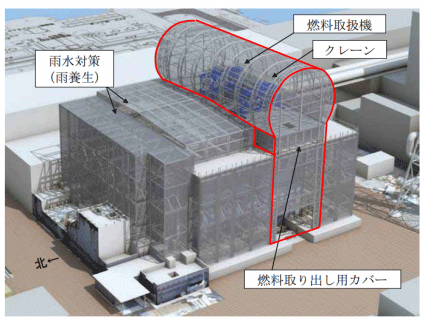 become a nuclear national sacrifice zone where only triage can be done to reduce the contamination.
At 48:30 in — Question: My father comes from the western part of Fukushima […] To this day we don’t know where the corium went, because no one can get close to it — and I think that’s the issue.
At 55:30 in — Alvarez: The technologies simply do not exist to handle and otherwise remove the highly radioactive cores of these reactors right now. We really don’t – this is all uncharted territory. […] I think that the likelihood of there being entombment of these reactors with their cores, it’s growing over time — and again it’s a national sacrifice zone scenario.
1 This Month
15 October. Joint Appeal for Nuclear Abolition Day -presentation to the UN on October 15 will be live on UNWebTV
Endorse the Nuclear Abolition Day Appeal
23-25 October – on Zoom – World BEYOND War’s annual global conference

To see nuclear-related stories in greater depth and intensity – go to https://nuclearinformation.wordpress.com
-
Archives
- October 2026 (149)
- September 2026 (339)
- August 2026 (330)
- July 2026 (355)
- June 2026 (287)
- May 2026 (306)
- April 2026 (356)
- March 2026 (251)
- February 2026 (267)
- January 2026 (308)
- December 2025 (358)
- November 2025 (359)
-
Categories
- 1
- 1 NUCLEAR ISSUES
- business and costs
- climate change
- culture and arts
- ENERGY
- environment
- health
- history
- indigenous issues
- Legal
- marketing of nuclear
- media
- opposition to nuclear
- PERSONAL STORIES
- politics
- politics international
- Religion and ethics
- safety
- secrets,lies and civil liberties
- spinbuster
- technology
- Uranium
- wastes
- weapons and war
- Women
- 2 WORLD
- ACTION
- AFRICA
- Atrocities
- AUSTRALIA
- Christina's notes
- Christina's themes
- culture and arts
- Events
- Fuk 2022
- Fuk 2023
- Fukushima 2017
- Fukushima 2018
- fukushima 2019
- Fukushima 2020
- Fukushima 2021
- general
- global warming
- Humour (God we need it)
- Nuclear
- RARE EARTHS
- Reference
- resources – print
- Resources -audiovicual
- Weekly Newsletter
- World
- World Nuclear
- YouTube
-
RSS
Entries RSS
Comments RSS

