$US1 billion loan for Japanese solar projects, from Deutsche bank and Goldman Sachs
 Deutsche Bank lends $US1 billion in Japan’s solar gold rush, SMH, July 9, 2014 Chisaki Watanabe and Finbarr Flynn Deutsche Bank plans to lend about $US1 billion ($1.06 billion) for Japanese solar projects, joining Goldman Sachs in funding cleaner energy as the government struggles to restart nuclear power plants after the Fukushima disaster.
The bank is ready to provide financing for three to six projects in the next 12 to 18 months, said Hans Van Der Sande, director of Deutsche Bank’s structured products group at its Tokyo branch. The Frankfurt-based lender agreed last month to provide a 11.1 billion yen ($116 million) loan for a solar power project on a former golf course north of Tokyo to be operated by a unit of Spain’s Gestamp Renewables Corp.
Japan may add the most solar power capacity in the world this year, according to Bloomberg New Energy Finance, as a two- year-old incentive program attracted investors including Goldman Sachs…http://www.smh.com.au/business/carbon-economy/deutsche-bank-lends-us1-billion-in-japans-solar-gold-rush-20140709-zt0uh.html#ixzz378jMBQUy
Freezing ducts very slowly built for Fukushima’s ice wall 90 built. 1460 more to go
TEPCO: 90 out of 1,550 freezing ducts built so far http://the-japan-news.com/news/article/0001411769 The Yomiuri Shimbun 10 July 14 Tokyo Electric Power Co. unveiled on Tuesday the construction site of the ice wall at the crippled Fukushima No. 1 nuclear power plant for the first time since work began last month.
As a measure to halt the increase of contaminated water, the ice walls are aimed at freezing the ground around the Nos. 1 to 4 reactor buildings of the plant to block groundwater from flowing into reactor buildings and becoming contaminated.
Contaminated water at the nuclear plant currently amounts to about 500,000 tons. The government and TEPCO have been working on the construction in the hope of completing it early next fiscal year.
On Tuesday evening, about 30 workers drilled small holes about 30 meters deep around the No. 4 reactor building. Ducts to freeze underground soil are to be installed in the holes.
A total of 1,550 freezing ducts must be installed to surround the Nos. 1 to 4 reactor building area, measuring about 1.5 kilometers. However, TEPCO said only about 90 freezing ducts have been installed so far.
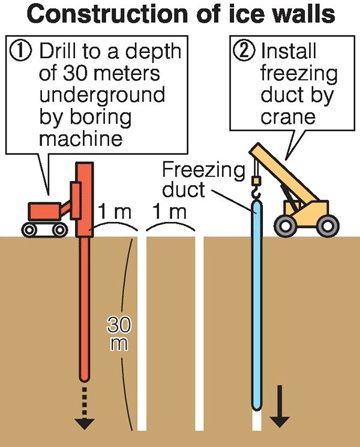
Due to heat exhaustion concerns during summer, workers at the construction site wear vests containing blue ice.
Meanwhile, the task of freezing tunnels filled with contaminated water using the same method involving the construction of an ice wall has been facing difficulties. The Nuclear Regulation Authority has therefore been calling on TEPCO to fundamentally revise construction plans.
Akira Ono, the chief of Fukushima No. 1 nuclear power plant, said: “We’ve already confirmed the effectiveness of ice walls through an on-site experiment. We will push ahead with the construction work forward as fast as we can.”
Solar energy in Japan attracting nuclear workers – for clean, safe, and better paid jobs
Stigmatized nuclear workers quit Japan utility. Bloomberg Business Week, By By Yuri Kageyama July 10, 2014 TOKYO (AP) —”………While TEPCO is out of favor with the public, the skills and experience of its employees that span the gamut of engineers, project managers, maintenance workers and construction and financial professionals, are not.
Energy industry experience is in particular demand as the development of solar and other green energy businesses is pushed along in Japan by generous government subsidies.
Currently the government pays solar plants 32 yen ($0.31) per kilowatt hour of energy. The so-called tariff for solar power varies by states and cities in the U.S., but they are as low as several cents. In Germany, it’s about 15 cents.
Sean Travers, Japan president of EarthStream, a London-based recruitment company that specializes in energy jobs, has been scrambling to woo TEPCO employees as foreign companies do more clean energy business in Japan.
“TEPCO employees are very well trained and have excellent knowledge of how the Japanese energy sector works, making them very attractive,” he said. Two top executives at U.S. solar companies doing business in Japan, First Solar director Karl Brutsaert and SunPower Japan director Takashi Sugihara, said they have interviewed former TEPCO employees for possible posts.
Besides their experience, knowledge of how the utility industry works and their contacts, with both private industry and government bureaucracy, are prized assets.
“It’s about the human network and the TEPCO employees have all the contacts,” said Travers, who says he has recruited about 20 people from TEPCO and is hoping to get more.
Yoshikawa, the former TEPCO maintenance worker, said he has received several offers for green-energy jobs that paid far better than his salary at TEPCO of 3 million yen ($30,000) a year.
Since September 2012, all TEPCO managers have had their salaries slashed by 30 percent, while workers in non-management positions had their pay reduced 20 percent. http://www.businessweek.com/ap/2014-07-10/stigmatized-nuclear-workers-quit-japan-utility
A critical problem: no cooling system now working at Fukushima No.5 fuel pool
 Fox News: “Leak at Fukushima nuclear plant threatens dangerous meltdown… Trouble is looming” — Officials: “No idea when it can resume cooling system for spent fuel pool” (PHOTOS) http://enenews.com/fox-news-leak-at-fukushima-nuclear-plant-threatens-dangerous-meltdown-trouble-is-looming-officials-no-idea-when-it-can-resume-cooling-system-for-spent-fuel-pool-photos
NHK WORLD, Jul. 7, 2014: No prospect to resume cooling No.5 fuel pool — The operator of the Fukushima Daiichi nuclear power plant says it has no idea when it can resume the cooling system for one of the spent fuel pools. [TEPCO] halted the cooling system at the No.5 reactor on Sunday after workers found seawater leaking from a pipe. Seawater is used to lower the temperature of coolant water […] they are still considering how to repair the pipe. […] TEPCO says the temperature will reach the company’s safety limit of 65 degrees in a little over a week. The operator plans to channel seawater into the pool to curb the rise in temperature.
Fox News, Jul. 7, 2014: Leak at Fukushima nuclear plant threatens dangerous meltdown — Trouble is looming at Japan’s Fukushima nuclear plant, as a leak has forced the shutdown of a cooling system that could cause temperatures to exceed dangerous levels. […] If the system is not repaired within the next nine days, temperatures are expected to soar […] Sunday, the temperature in the pool that holds the rods was about 73 degrees Fahrenheit but started increasing by 0.193 degrees per hour, TEPCO says. If no new cold water is pumped in at this rate, it will reach the dangerous threshold of 149 degrees (F) in roughly the next week. Such temperatures would increase the possibility of dangerous reactions and more radiation leaks in the plant.
China’s underground nuclear reactors
 The Untold Story of China’s Forgotten Underground Nuclear Reactor, FP BY JEFFREY LEWIS JULY 8, 2014 How social media and a little sleuthing turned up a Mao-era nuclear program. “……despite official secrecy about China’s production of plutonium for nuclear weapons, my colleague Catherine Dill and I discovered an underground nuclear reactor that China attempted to construct near Yichang in Hubei province during the 1960s and 1970s……..
In the early 1960s, China had one plant to make highly enriched uranium near Lanzhou and was completing one nuclear reactor to produce plutonium at Jiuquan. In 1964, China began the “Third Line” effort — a massive construction effort to relocate all of China’s heavy industries, nuclear and otherwise, in the interior of the country. Often these factories, including things as mundane as steel mills, were placed underground to protect them from Soviet or American attack. As you might expect, the disruption of attempting to relocate the country’s heavy industries to underground caverns in the rural interior was a complete and total cluster… well, you know. Wikipedia calls the Third Line “an economic fiasco,” which seems to me to be an example of the wisdom of crowds.
As part of the Third Line effort, China’s nuclear engineers were supposed to build a copy of the first reactor — the one where Cui worked — in an underground cavern being dug near Fuling. But placing a nuclear reactor under a mountain is about as slow and arduous as you might expect. At some point in 1969, with relations between Moscow and Beijing collapsing, Beijing decided it could not wait for the engineers to finish Fuling. The first proposal suggested physically picking up and moving the reactor near Jiuquan somewhere else. Eventually the technical personnel convinced the Chinese leadership this was total madness. So, instead, China started building a temporary replacement above ground, near a place called Guangyuan in Sichuan.
I always wondered how, in the middle of the paranoia associated with the Cultural Revolution, Chinese leaders came to their senses and ditched the underground reactor at Fuling in favor of the above-ground copy at Guangyuan. It turns out they didn’t. Instead of replacing one crazy project with a more sensible one, the Chinese doubled-down on crazy — continuing the reactor project at Fuling, starting a new one at Guangyuan and, we now know, starting the underground reactor at Yichang. … As best we can tell, China never finished the heavy water at Yichang, just as it never finished Fuling or any other number of wildly implausible Third Line projects. Construction at Yichang lumbered on through the 1970s, before being shut down around 1980 or so. At this point, the Chinese government took a number of steps to transition its nuclear industry to civilian power generation, converting and eventually decommissioning the reactor near Jiuquan, as well as giving up on Fuling and Yichang. China would not build a heavy water reactor until it bought CANDU heavy water reactors from Canada, one in 2002 and another in 2003. (CANDU is a portmanteau of “Canada” and “deuterium oxide,” better known as heavy water.) Yichang is just a footnote. A crazy, implausible footnote…….
Of the two plutonium production reactors that China finished, Jiuquan closed in the late 1980s and Guangyuan closed sometime in the 1990s. China never finished the reactors at Fuling or Yichang. China’s surprisingly small stockpile of plutonium isn’t so surprising once we know this historical context. They tried to make more. They just couldn’t…..
There will be more disclosures. Like yet another unfinished secret underground nuclear reactor that I haven’t mentioned. That’s right, there is a third underground nuclear reactor project that we’ve found. …..http://www.foreignpolicy.com/articles/2014/07/08/the_untold_story_of_chinas_forgotten_underground_nuclear_reactor_yichang_827_plant
Nuclear colonialism- pushing nuclear sales to Vietnam

Meanwhile, Vietnam Plus of the Vietnam News Agency reported that the US Congress began considering a cooperation proposal on May 9. It has 90 days to consider the issue before making a final decision.
Prior to that, the Vietnamese and US representatives signed a Vietnam-US nuclear cooperation agreement in Hanoi on May 6 (Agreement 123).
Vietnamese officials and scientists have expressed their satisfaction about the agreement.Minister of Science and Technology Nguyen Quan said at the signing ceremony that the agreement can be seen as an open door for both the US and Vietnam to accelerate projects on nuclear energy development…….
 The US Nuclear Energy Institute (NEI) and the US nuclear energy firms have unanimously urged the US Congress to ratify the agreement soon, emphasizing that the strengthened cooperation with Vietnam in the sector would help boost exports and create more jobs.
The US firms can expect to earn $10-20 billion from the deals with Vietnam…..David Durham from GE Hitachi Nuclear Energy (GHE) has warned that if the US Congress does not ratify the agreement, US firms will lose the lucrative market of Vietnam……http://english.vietnamnet.vn/fms/science-it/106944/vietnam-nuclear-power-market-eyed-by-three-major-countries.html
India: Two big utilities investing in renewable energy
 Tata, Reliance Power bet big on renewable energy, to spend Rs 1,500 crore each, Economic Times, By Shuchi Srivastava, ET Bureau | 9 Jul, 2014, MUMBAI: Two of the country’s largest power producers Tata PowerBSE -5.04 % and Reliance PowerBSE -7.70 % are betting big on renewable energy and will spend about Rs 1,500 crore each on clean energy projects this fiscal.
“Reliance Power is keen to be a part of the journey to position India as one of the world’s major solar power producers in the coming years. Given the exciting new opportunities such as the ultra mega solar PV projects and the shortfall in meeting the renewable purchase obligations by various state discoms,” said the company. http://economictimes.indiatimes.com/articleshow/38044771.cms?utm_source=contentofinterest&utm_medium=text&utm_campaign=cppst
The enormous and intractable problem of Fukushima’s radioactive soil
 Fukushima’s radioactive soil sparks fights, exposes the enormity and hopelessness of clean-up taskStraight, by MARTIN DUNPHY on JUL 4, 2014 “…….Soil would fill how many B.C. Places?In the months after the 2011 earthquake-and-tsunami catastrophe, environment ministry experts estimated that the amount of radioactive topsoil from parts of four surrounding prefectures that would have to be “decontaminated” and stored could be as high as 29 million cubic metres.
That would be about enough dirt to fill the 59,000-capacity B.C. Place Stadium 23 times.
However, Yuichi Moriguchi, a University of Tokyo environmental-engineering professor, pegged the amount at closer to 100 million cubic metres, enough to fill 80 B.C. Places.
Minister Ishihara had told reporters in Tokyo on June 16 that the dragged-out and often acrimonious soil-storage negotiations between Abe’s Liberal Democratic Party–led administration and local and state governments in Fukushima would be solved once the issue of “monetary value” was settled.
Fukushima residents, evacuees, the governor, and the mayors of Futaba and Okuma—the two towns adjacent to Daiichi that have been tentatively earmarked for storage facilities—were outraged by the comment.
They called it insensitive and said it failed to take into account their dislocation, fears, and sense of helplessness. They said it made them seem to be concerned only with compensation.
Minister underestimated reaction
The environment minister quickly backtracked, saying he was misconstrued, but he refused to retract his statement. After opposition pressure, however, he apologized during a June 19 parliamentary session and retracted his remark………
Many of the sites are already at or near capacity.
Costs could be wildly inaccurate
In December 2013, Tokyo announced that it would spend almost $1 billion to store 132,738 tonnes of radioactive soil already removed from near the crippled power plant. No towns came forward to offer to sell the approximately three to five square kilometres of land estimated to be needed to build the supposedly “interim” facility to house the waste, currently stored temporarily in different locations around Japan.
(That plan covers less than 150,000 tons of soil. Greenpeace International has claimed that as of February 2013, more than fourmillion tons of radioactive waste had been produced.)
The $1-billion cost of this plan might be severely underestimated, however. A disposal centre in Rokkasho, Aomori Prefecture, for low-level radioactive waste from the country’s nuclear plants (including metal parts and work clothing) cost $2 billion to build.
And it holds only 200,000 cubic metres of material.
The true cost for the planned “interim” facility could be in the tens of billions of dollars—or much higher.
Waste needs to be stored for 30 years
Prefecture officials and residents expressed skepticism about the unclear future location of “permanent” storage sites, noting that the material would have to be stored away for a minimum of 30 years and voicing fears that their towns would become the preferred perpetual spots…….
There are many areas outside this district that are contaminated as well, to varying degrees, including isolated “hot spots”. Some of these were found in Tokyo, more than 200 kilometres away from Daiichi. On the other hand, that original clean-up area consists of up to 70 percent woodlands, hills, and mountains, much of which (if not most) will probably never be touched by decontamination efforts.
Some areas may be deserted forever
And if more than five centimetres of topsoil needs to be scraped off to remove radioactive cesium, after years of rain and groundwater movement, the volume of material needing to be stored will rise accordingly. Prof. Tomoko M. Nakanishi, from the University of Tokyo’s graduate school of agriculture, conducted soil research in Fukushima post-disaster and had this to say about how readily radioactive cesium was absorbed by the soil: “It was like pollen with superglue.”
Friends of the Earth, an international network of environmental groups, reported in 2012 that a test soil-decontamination program for only three houses in Fukushima generated 35 tons of soil waste.
In the end, it will probably be areas around parks, residences, schools, hospitals, and other public buildings that will see the most attention from decontamination efforts.
Some parts of the surrounding prefectures may never see a return to levels of human activity to compare with pre-Fukushima. And some areas may remain deserted forever.
Oh, yeah, then there’s the ocean
This is without even mentioning the incalculable amount of radioactive groundwater and cooling water that has flowed into the Pacific Ocean nonstop since the first day of the disaster almost three-and-a-half years ago. Woods Hole Oceanographic Society scientists labelled this “the largest accidental release of radiation to the ocean in history”.
According to Greenpeace International, one month after the meltdowns, cesium-137 levels in the sea near Daiichi were 50 million times higher than pre-disaster measurements. (Cesium-137 has a half-life of 30 years; cesium-134’s is a bit more than two years.)
And Asahi—using data provided by Tokyo Electric Power Co. (TEPCO), the Daiichi plant operator—says that 462TBq (a terabecquerel equals one trillion Becquerels) of radioactive strontium have been dumped into the Pacific. Strontium is potentially far more dangerous to human life than either cesium-134 or cesium-137.
There have been conflicting reports about the amounts of even deadlier plutonium that might have been released into the soil, air, or water……http://www.straight.com/news/680196/fukushimas-radioactive-soil-sparks-fights-exposes-enormity-and-hopelessness-clean-task
Japanese nuclear power plant to restart without a crucial off-site emergency center
 Sendai nuclear plant set to restart without off-site emergency center July 07, 2014 THE ASAHI SHIMBUN by Toshio Kawada and Chikako Kawahara. The Sendai nuclear power plant in Kagoshima Prefecture could restart two reactors in autumn without a crucial emergency facility in place to deal with a possible nuclear accident and evacuations of host communities.
The Sendai plant, operated by Kyushu Electric Power Co., is expected to be the first to resume operations among all plants that have applied for safety screenings by the Nuclear Regulation Authority.
The Cabinet Office in September 2012 instructed all prefectures hosting nuclear power plants to ensure that off-site emergency centers be equipped with ventilation and other systems to prevent radiation contamination and be located between 5 and 30 kilometers from the nuclear plant.
It also mandated host prefectures to designate multiple backup facilities in case the functions of the off-site centers are crippled by a disaster, which is what occurred during the Fukushima nuclear disaster that started in March 2011.
The deadline for completion of the emergency off-site centers is September 2015.
Kagoshima prefectural government officials said construction of the off-site emergency center for the Sendai plant has lagged behind schedule due to delays in discussions with the central government…….
the Nuclear Regulation Authority is set to compile a draft of the safety screening results for the Sendai plant in Satsuma-Sendai as early as July 9. If the plant clears the NRA’s safety screening process, its two reactors will be restarted in autumn at the earliest.
Off-site emergency centers are supposed to function as the bases of operations for officials from the central government, local governments and utilities to combat a nuclear crisis and coordinate evacuations of residents…….
The government’s Investigation Committee on the Accident at the Fukushima Nuclear Power Stations has called for the prompt construction of off-site emergency centers.
But renovations and relocations of the emergency facilities are also behind schedule around Japan.
In addition to the Fukushima plant, off-site centers need to be relocated from the 5-km radius of four other nuclear power plants, including Shikoku Electric Power Co.’s Ikata nuclear plant in Ehime Prefecture.
An official of Ehime Prefecture said if an accident at the Ikata plant cripples the existing off-site center before September 2015, the front-line headquarters will be “relocated to a safe location like in the Fukushima crisis” in a stop-gap measure. http://ajw.asahi.com/article/0311disaster/fukushima/AJ201407070029
Fukushima’s molten nuclear fuel cores – no technology exists to fix them
Top U.S. Official: “The reality is, no technology exists anywhere to solve problem” of Fukushima’s  melted fuel — TV: Molten mass “will scorch into the earth” if not cooled, a ‘China Syndrome’; Geysers of radioactive steam shooting up for miles around (VIDEOS) http://enenews.com/top-official-reality-technology-exists-anywhere-solve-problem-fukushimas-melted-fuel-tv-molten-mass-will-scorch-earth-cooled-china-syndrome-geysers-radioactive-steam-shooting-miles-around-videos?utm_source=feedburner&utm_medium=email&utm_campaign=Feed%3A+ENENews+%28Energy+News%29
 NHK Nuclear Watch: US View on Fukushima Daiichi, July 2, 2014 (at 2:00 in):
- NHK: Experts say that one of the most difficult challenges of decommissioning the plant is removing fuel debris… And Magwood says that there is no magic wand to wipeout this problem.
- William Magwood, US Nuclear Regulatory Commission: I think people have to be realistic how difficult this is, how long it’s going to take. During my visit to Japan this week, people have asked me from time to time, “Are there technologies in the US that can help solve this problem?” The reality is there is no technology that exists anywhere to solve this problem.
- Watch the NHK broadcast here
‘Modern Marvels‘, History Channel (at 11:30 in):
- Narrator: With the [water] pumps off, the core is being uncovered and its temperature is over 2,000 degrees and rising. When the core reaches 5,000 degrees it will melt, becoming a molten mass — metallic lava that will burn through the 8 inch steel containment vessel. Once out of the plant it will scorch into the earth itself. What happens next could become an unrivaled technological disaster.
- Wilborn Hampton, New York Times reporter: They reach the water table, it will immediately turn to steam, boiling steam. There will be geysers of radioactivity steam shooting up in parking lots and driveways and streets and houses for miles around.
- Narrator: The nightmare scenario is known as the ‘China Syndrome’. Land surrounding the plant will become uninhabitable. A study some years earlier has suggested upwards of 40,000 people could die if the ‘China Syndrome’ becomes reality.
- Watch the History Channel broadcast here
Plutonium flows to the Pacific from Fukushima’s ruptured nuclear reactor containments
 Gov’t Expert: Plutonium is certainly being discharged into Pacific Ocean from Fukushima plant; Flowing out of ruptured containments — TV: Reactor water turns into ‘yellowish, fizzing liquid’ from damaged fuel rods… “It actually vibrates” (PHOTO & VIDEO) http://enenews.com/study-plutonium-being-discharged-fukushima-pacific-ocean-flowing-ruptured-containment-vessels-tv-reactor-water-becomes-yellowish-fizzing-liquid-damaged-fuel-rods-actually-vibrates-video?utm_source=feedburner&utm_medium=email&utm_campaign=Feed%3A+ENENews+%28Energy+News%29
P. Bossew, German Federal Office for Radiation Protection, PLUTONIUM EMISSION FROM THE FUKUSHIMA ACCIDENT (pdf), 2013 (emphasis added): While much has since been published on environmental contamination and exposure to radio-iodine and radio-caesium, little is known about releases of plutonium […] The inability to cool the fuel led to melting of parts of the reactor cores (which parts exactly, is not yet well known) […] [Causes of the containment] ruptures and leaks […] are not entirely clarified […] explosion seems to have produced further structural damage in the containments, at the one hand, and on the other hand released large amounts of radionuclides into the environment. […] the fraction of Pu released into the environment can be expected to be higher [than] atmospheric releases only. Certainly some Pu has been released with liquid effluents and discharged into the ocean. […] The liquid discharges certainly also contained Pu. […]
‘Modern Marvels‘ History Channel (at 19:45 in): It is now 28 hours since the accident at Three Mile Island began. The men in the control room have no way of looking into the reactor…. it now seems clear some of the 36,000 slendertubes holding the uranium fuel have cracked, this is allowing radioactivity to escape into the reactor coolant water. It is imperative operators know how much radioactivity is now in the coolant. Too much, and the nuclear chain reaction could restart… Foreman Ed Hauser agrees to risk his life to take the readings. This is allowing radioactivity to enter the coolant water. He is in for an even greater scare when he draws the coolant water sample. The water from the reactor should be clear; instead he stares at a yellowish, fizzing liquid… It actually vibrates in his hand.
Safety and secrecy concerns about China owning and managing Britains nuclear reactors

 CHINA NIGHTMARE http://tomburke.co.uk/2014/07/03/china-nightmare/ July 3, 2014 by tomburke The prospect of the Chinese becoming owners, managers and even constructors of nuclear power stations in Britain has caused anxiety in some unexpected places. Both the right and the left, united in their determination to press ahead with more nuclear, have raised objections. Carefully wrapped in a blanket of security rhetoric, their argument boils down to an Augustinian ‘Bring me nuclear, but not by them’.
Meanwhile, a truly substantial reason why we should worry about Chinese involvement in the nuclear industry is yet to be noticed by anyone but the French Nuclear Safety Authority. They have just complained publicly about the lack of communication with their Chinese counterparts. Explaining this to the French Parliament they pointed out that ‘one of the difficulties in our relations is that the Chinese safety authorities lack means. They are overwhelmed.’
This led one of the French regulators to worry that ‘It’s not always easy to know what is happening at the Taishan site.’ (where Areva are constructing a reactor of the same type as they want to build in Britain). Another French inspector reported seeing big machinery such as steam generators and pumps not being maintained at ‘an adequate level.’
So why does this matter to us? We have very good safety regulators with an impressive track record of managing nuclear facilities well. We should worry about it because the Chinese are currently building only 28 reactors at the same time. This is the fastest rate of reactor build anywhere ever. Even so, they intend to double this build rate before the end of this decade. This is likely to make ‘overwhelmed’ seem like an understatement.
The importance of a rigorous regulatory regime has long been understood by the nuclear industry to be essential to retaining public confidence. ‘ An accident anywhere is an accident everywhere.’ has long been a mantra of industry leaders. Among the many contributors to the seriousness of the accident at Fukushima were failings in the nuclear regulatory culture.
Britain’s nuclear reactor programmes may have been a regulatory success but they have been an economic failure. A former head of the then nationalised electricity industry told Parliament that the AGR programme was ‘the worst civil engineering disaster in British history’. But this had one huge, if unlooked for advantage. No-one else had reactors like them. This meant that when the accidents at Three Mile Island, Chernobyl and Fukushima happened we were well placed to argue that it couldn’t happen here.
If we go ahead with the reactor at Hinkley this comfortable position will no longer be defensible. Hinkley will be a pressurised water reactor (PWR) just like most of the reactors in operation around the world and all those the Chinese are building. If the already stretched Chinese nuclear regulators prove unable to prevent a nuclear accident in China it will have direct repercussions here.
This compounds the gamble that the British government is taking with Hinkley. Not only are we selling 35 years of index linked tax receipts to the French government in return for electricity at twice the price we are currently paying for it but we are also placing the security of our future electricity supply into the hands of China’s ‘overwhelmed’ nuclear regulators.
If they fail to prevent an accident at a PWR in China it is very unlikely that the people of Somerset, or the rest of the country for that matter, will consent to one continuing to operate in Britain.
World’s Largest Floating Solar Power Project planned for India
India Plans World’s Largest Floating Solar Power Project (50 MW) After canal-top solar power projects, India is planning to install the world’s largest floating solar power project.Clean Technica, 4 July 14
India’s leading hydro power generator National Hydro Power Corporation (NHPC) is planning to set up a 50 MW solar photovoltaic project over the water bodies in the southern state of Kerala. Renewable Energy College will provide assistance to the company for implementing the project…….http://cleantechnica.com/2014/07/02/india-plans-worlds-largest-floating-solar-power-project-50-mw/
India’s nuclear deal with USA, Russia and France is a very bad one
India – now nuclear and environmental dissent is a crime Ecologist, Kumar Sundaram 4th July 2014 “…….Nuclear power is the new must-have India made advance promises for reactor purchases from France’s Areva, Russia’s Atomsroy export and US giants like Westinghouse and GE in exchange for these countries’ support for an exemption for India at the Nuclear Suppliers’ Group (NSG) in 2008.
India was thus permitted to engage in international nuclear commerce despite its status as a nuclear weapons state outside the Nuclear Non-Proliferation Treaty.
It is under the pressure of the commitment to the international nuclear lobby that the Indian government has been bulldozing everything that stands in their way:
- undermining and diluting safety norms,
- pushing through environmental clearances at gun-point,,
- neglecting the adverse economics of these projects,
- crushing grassroots democratic dissent, and
- trying to exempt the nuclear suppliers from liability in the event of any accident….http://www.theecologist.org/News/news_analysis/2460076/india_now_nuclear_and_environmental_dissent_is_a_crime.htm
Nuclear Suppliers Group (NSG) has doubts about India becoming a member
Nuclear export group divided over ties with India – diplomats Yahoo 7 news July 2, 2014, By Fredrik Dahl VIENNA (Reuters) – An influential global body that controls atomic exports is divided over establishing closer ties with India, meaning the nuclear-armed Asian power may have to wait a while longer before joining.
Diplomatic sources said different opinions were voiced in a debate on relations with India – a non-signatory to the Non-Proliferation Treaty (NPT) – at an annual meeting of the 48-nation Nuclear Suppliers Group (NSG) last week in Buenos Aires.
The United States, Britain and other members have argued in favour of India joining the trade body, established in 1975 to ensure that civilian nuclear trade is not diverted for military aims……the country would be the only member of the suppliers’ group that has not signed up to the NPT, a 189-nation treaty set up four decades ago to prevent states from acquiring nuclear weapons.
This has caused some NSG states to raise doubts about India joining their club, which plays a pivotal role in countering nuclear threats and proliferation. Some also argue that it could erode the credibility of the NPT, a cornerstone of global nuclear disarmament efforts……..https://au.news.yahoo.com/world/a/24372928/nuclear-export-group-divided-over-ties-with-india-diplomats/
1 This Month
15 October. Joint Appeal for Nuclear Abolition Day -presentation to the UN on October 15 will be live on UNWebTV
Endorse the Nuclear Abolition Day Appeal
23-25 October – on Zoom – World BEYOND War’s annual global conference

To see nuclear-related stories in greater depth and intensity – go to https://nuclearinformation.wordpress.com
-
Archives
- October 2026 (149)
- September 2026 (339)
- August 2026 (330)
- July 2026 (355)
- June 2026 (287)
- May 2026 (306)
- April 2026 (356)
- March 2026 (251)
- February 2026 (267)
- January 2026 (308)
- December 2025 (358)
- November 2025 (359)
-
Categories
- 1
- 1 NUCLEAR ISSUES
- business and costs
- climate change
- culture and arts
- ENERGY
- environment
- health
- history
- indigenous issues
- Legal
- marketing of nuclear
- media
- opposition to nuclear
- PERSONAL STORIES
- politics
- politics international
- Religion and ethics
- safety
- secrets,lies and civil liberties
- spinbuster
- technology
- Uranium
- wastes
- weapons and war
- Women
- 2 WORLD
- ACTION
- AFRICA
- Atrocities
- AUSTRALIA
- Christina's notes
- Christina's themes
- culture and arts
- Events
- Fuk 2022
- Fuk 2023
- Fukushima 2017
- Fukushima 2018
- fukushima 2019
- Fukushima 2020
- Fukushima 2021
- general
- global warming
- Humour (God we need it)
- Nuclear
- RARE EARTHS
- Reference
- resources – print
- Resources -audiovicual
- Weekly Newsletter
- World
- World Nuclear
- YouTube
-
RSS
Entries RSS
Comments RSS

