South Korea’s preparation for pre-emptive nuclear strike against North Korea

 FROM THE POPE TO WAR GAMES IN SOUTH KOREA ORGANISING NOTES, BRUCE GAGNON , AUGUST 19, 2014
Global Network board member Sung-hee Choi, long time activist on Jeju Island, wrote today:
Recently, Pope Francis has visited Korea from Aug. 14 to 18. He left us many moving messages of peace and justice, but the South Korean (ROK) conservative Park Geun-Hye government started the World-biggest war exercise Ulji Freedom Guardian (In government drill, about 480,000 personnel join. In military drill, about 50,000 Korean soldiers and 30,000 US soldiers) started along with the United States on his leaving day. It ends on Aug. 21.
The exercise targets North Korea and the strategy includes preemptive nuclear strike against her. The exercise will be a passage for the US to push for the US-Japan-ROK trilateral military alliance and Missile Defense system. http://space4peace.blogspot.com.au/2014/08/from-pope-to-war-games-in-south-korea.html
Hong Kong still restricting foodstuffs imported from Japan’s irradiated areas
 The government of Hong Kong rejected Japanese request to lift restriction on Japanese imports http://fukushima-diary.com/2014/08/government-hong-kong-rejected-japanese-request-lift-restriction-japanese-imports/ Iori Mochizuki On 8/13/2014, Hayashi, the Minister of Agriculture, Forestry and Fisheries visited Hong Kong to request the government of Hong Kong to lift the restriction on Japanese imports however Ko Wing Man, the chief of the department of food and hygiene rejected the offer.
Since Fukushima accident, the government of Hong Kong stop importing vegetables, fruits, milk, milk based drinks and powdered milk from 5 prefectures to consist of Fukushima, Ibaraki, Tochigi, Gunma and Chiba.
Ko Wing Man commented “Lifting the restriction is difficult at this moment.”.
Japan developing a university-military-industrial nuclear complex
Japan plans fund to develop military technology with universities, Japan Times 17 Aug 14 Ministry plans fund to aid schools engaged in military research The Defense Ministry plans to set up a fund to develop military technology by aiding research projects at universities and other civilian institutions, government sources have revealed.
In a move aimed at keeping down development costs and bolstering civilian-military cooperation, the ministry plans to seek roughly ¥2 billion for the fund in its budget request for fiscal 2015 beginning next April, raising it to ¥6 billion in three years, the sources said Saturday.
The fund, which will be modeled after the U.S. Defense Advanced Research Projects Agency, is part of Prime Minister Shinzo Abe’s drive to expand the nation’s military capabilities……..
A group of university researchers has recently organized a petition opposed to civil-military cooperation, citing the bitter history of academia contributing to the nation’s militarization during World War II……… http://www.japantimes.co.jp/news/2014/08/17/national/japan-plans-fund-develop-military-technology-universities/#.U_KmJsVdUnk
Fukushima and Chernobyl’s plants and animals have suffered from radiation
 No, Fukushima Is Not a Wildlife Haven—and Neither Is Chernobyl http://www.citylab.com/tech/2014/08/no-fukushima-is-no-eden-for-animalsand-neither-is-chernobyl/376046/ A slew of new research reveals the deleterious effects of radiation on Fukushima’s ecology. LAURA BLISS @mslaurabliss Aug 14, 2014
Perhaps you’ve encountered the well-publicized idea that Chernobyl, the world’s worst nuclear disaster of 1986, has become a kind of ‘wildlife haven’ as a result of its abandonment by humans.
So what of Fukushima Daiichi, Japan’s nuclear collapse of 2011—might we expect a happy menagerie there, too? Not so much, according to a slew of new papers out in the Journal of Heredity. And you may want to rethink Chernobyl-as-Eden, too.
The findings of the new studies tell of significant population decline across many different species of animals and plants, as well as a range of expressions of genetic damage and cell mutation.
One paper reports that the pale grass blue butterfly, one of Japan’s most common butterfly species, has suffered from significant size reduction, slowed growth, high mortality and abnormal wing patterns both within the Fukushima exclusion zone and among lab-raised offspring of parents collected at the site. Which is to say, radiation-caused genetic mutations were passed down.
 Researchers also found major declines in populations of birds, butterflies, cicadas, and some small mammals, as well as aberrations and albinism in the feathers of certain birds.
Timothy Mousseau, a prominent biologist and lead author of that population study, has also conducted significant research into radiation’s impacts at Chernobyl. He roundly rejects the claim that the area has become an animal haven, arguing that notion was based on anecdotal evidence rather than scientific data. Mousseau’s own work demonstrates radiation has had similar effects on Chernobyl’s ecology as on Fukushima’s.
Further inquiry into all manner of species living at the Chernobyl site could help scientists better predict Fukushima’s biological trajectory, he says. “There is an urgent need for greater investment in basic scientific research of the wild animals and plants of Fukushima,” Mousseau told the Journal of Heredity.
Japan’s nuclear power restart is just not really happening
 After the Fukushima meltdown, Japan’s nuclear restart is stalled, WP By Daniel Aldrich and James Platte August 15 “……Last month, the two reactors at the Kyushu Electric Power Company’s Sendai nuclear power plant were the first to pass new, stricter safety tests, but the actual restart date has been pushed back into the winter of 2015. Residents within 5 km of the plant now have potassium-iodide pills in the event of another accident, and some nine towns within 30 km of the plant have finally designed evacuation plans in case of a meltdown. These changes were a direct result of the Fukushima accident, which also spurred the creation of a new, independent nuclear industry regulator.
The Nuclear Regulation Authority (NRA) replaced a patchwork of bureaucrats who controlled the industry before the disaster — many of whom were simultaneously tasked with promoting the field through incentives and grants to local communities. ……..
Beyond changing the regulatory environment in Japan, the Fukushima meltdowns caused a sea change in public opinion on nuclear power. Before the accidents, some two-thirds of respondents regularly supported increasing the number of nuclear power plants. Now, the same percentage of residents oppose the use of nuclear power in Japan, and a national poll at the end of July found nearly 60 percent of respondents opposed the restart of the Sendai nuclear plant.
Communities that directly host the facilities continue to — with some exceptions — support the restart of these facilities. Their support derives primarily from financial reasons: the central government provides up to $10 million a year to the small, rural, coastal towns that have these projects in their back yards. Research published by one economist showed that even for these communities the actual benefits to individuals vary widely.
But towns more than 5 km from the plant receive few, if any, financial benefits and have been vocal in their opposition to restarts. Further, because of a longstanding gentlemen’s agreement between utilities and local communities, mayors and governors hold unofficial veto power over the process. Without their support, power utilities will be unable to restart their plants…….
all of Japan’s power utilities that operate nuclear power plants are struggling financially, consistently posting large losses since 2011. TEPCO was effectively nationalized to prevent it from failing, and in April, the state-owned Development Bank of Japan announced a total of nearly$1.5 billion in preferred stock investments into Kyushu Electric Power Company and Hokkaido Electric Power Company. Kyushu and Kansai Electric Power Company both recorded losses of over $900 million last year.
The ultimate question is how many reactors will restart and by when……..
While restarting some reactors will help generate revenue for Japan’s struggling power utilities, the cost of decommissioning about half of Japan’s pre-Fukushima reactor fleet will be significant. Despite the nuclear revival ambitions of the LDP and industrial leaders, Japan’s nuclear sector appears to have a long, difficult road ahead of it. http://www.washingtonpost.com/blogs/monkey-cage/wp/2014/08/15/after-the-fukushima-meltdown-japans-nuclear-restart-is-stalled/
Research slowly showing the harmful effects of Chernobyl and Fukushima radiation on the ecosystem
The Crushing Effects Of Radiation From The Fukushima Disaster On The Ecosystem Are Being Slowly Revealed http://www.businessinsider.com.au/the-serious-biological-effects-of-fukushima-radiation-on-plants-insects-and-animals-is-slowly-being-revealed-2014-8 CHRIS PASH A range of scientific studies at Fukushima have begun to reveal the impact on the natural world from the radiation leaks at the power station in Japan caused by an earthquake and tsunami in 2011.
Biological samples were obtained only after extensive delays following the 1986 Chernobyl nuclear power plant meltdown, limiting the information which could be gained about the impact of that disaster.
Scientists, determined not to repeat the shortcomings of the Chernobyl studies, began gathering biological information only a few months after the meltdown of the Daiichi power plant in 2011.
Results of these studies are now beginning to reveal serious biological effects of the Fukushima radiation on non-human organisms ranging from plants to butterflies to birds.
A series of articles summarising these studies has now been published in the Journal of Heredity. These describe widespread impacts, ranging from population declines to genetic damage to responses by the repair mechanisms that help organisms cope with radiation exposure.
“A growing body of empirical results from studies of birds, monkeys, butterflies, and other insects suggests that some species have been significantly impacted by the radioactive releases related to the Fukushima disaster,” says Dr Timothy Mousseau of the University of South Carolina, lead author of one of the studies. Continue reading
Serious flaws in India-Japan Nuclear Deal
 Reasons to Oppose the India-Japan Nuclear Deal – Nuclear Free by 2045 ? Dennis Riches 14 Aug 14 In late July and early August, a leading member of India’s Coalition for Peace and Nuclear Disarmament, Kumar Sundaram, visited several Japanese cities in order to speak to the mass media and Japanese citizens about the proposed Japan-India nuclear energy agreement. He timed his visit to Japan to precede
  that of Indian Prime Minister Narendra Modi at the end of August. Modi will meet with his Japanese counterpart in hopes of finalizing a deal to allow the purchase of vital components of nuclear power plants that are proposed or under construction
Huge amounts of Fukushima radioactive fallout are still bound to organic material
Gov’t Expert: Fukushima hot particles can’t be dissolved, even with hot nitric acid! — Huge amounts of fallout are still bound to organic material… “we have very little knowledge about this” — “Reaction is irreversible”(PHOTO) http://enenews.com/govt-expert-fukushima-radioactive-material-be-dissolved-hot-nitric-acid-huge-amounts-fallout-bound-organic-material-very-little-knowledge-about-reaction-irreversible?utm_
Journal of Radioanalytical and Nuclear Chemistry,Volume 295, Issue 3, 2013 (emphasis added): […] radionuclides were emitted from the FDNPP as airborne ‘hot’ particles […] Subsequent interaction of the ‘hot’ particles with water (e.g. rainfall) dissolved and strongly fixed the radiocesium on rock and soil particles, thus changing the radiocesium into insoluble forms. […] Consequently, ‘hot spots’ were studded on the rock surface rather than being uniformly distributed. […] Leaching experiments demonstrated that radiocesium in rock, soil and river suspended sediment was fairly insoluble, showing that the adsorption [binding of particles to a surface] reaction is irreversible. The micro-scale heterogeneous distribution of radiocesium […] was due to the presence of ‘hot’ particles in aerosols. […] ‘hot’ particles in the aerosols [experienced] irreversible adsorption onto the soil particle complex […]
Agricultural Implications of the Fukushima Nuclear Accident – Radiocesium Absorption by Rice in Paddy Field Ecosystems (pdf), 2013:Unexpectedly, we found that the fallout was relatively insoluble and only a small percentage of the radiocesium could be extracted by a boiling water treatmentfollowed by nitrate leaching. We have very little knowledge about this fallout, including its chemical form and properties, but huge amounts of this relatively insoluble radioactive fallout are still bound to organic matters […]
Presentation by Yasuhito Igarashi of Japan’s Meteorological Research Institute at IAEA’s expert meeting (pdf), February 2014: Mar. 14-15 sample contained insoluble materials not only in water but hot nitric acid! […] They are insoluble; even refractory to conc. nitric acid. […] They would persist for a long time in the environment as well as in living organisms.
Scientific Reports (Nature Publishing Group) — Emission of spherical cesium-bearing particles from an early stage of the Fukushima nuclear accident, Aug. 30, 2013: We analyzed the water solubility of Cs Particle 1 by comparing the particle’s shape before and after exposure to water. The results show that there was no change in shape, suggesting that the particle was insoluble to water at least during atmospheric transportation.
American Chemical Society Publication, Analytical Chemistry — Detection of uranium and chemical state analysis of individual radioactive microparticles emitted from the Fukushima nuclear accident… (Tokyo Univ., Japan’s Meteorological Research Institute), August 1, 2014: We explored the possible sources of the 14 elements (Cr, Mn, Fe, Zn, Rb, Zr, Mo, Ag, Sn, Sb, Te, Cs, Ba, and U) found within the microparticles […] These particle natures suggest that they could have relatively long-term impact on the environment, i.e., the release of soluble radioactive Cs into the environment as these insoluble glassy particles degrade. Similar radioactive particles have been detected in soils, plants, and mushrooms […] it is probable that [these particles are] the same as the microparticles characterized in our study.
Uranium mining destroys lives
Yet another example of how mining companies destroy local peoples lives Papua New Guinea Mine Watch 14 Aug 14
“The government and the company don’t give a damn whether the tribal people live or die,” said Ghanshyam Birulee. “The government is treating us as guinea pigs to fulfill its greed for Uranium.”
India uranium mining fuels health crisis
Radioactive waste generated in three government owned mines spurs health fears in eastern Jharkhand state.
Sanjay Pandey | Al Jazeera “They took away my land,” 35-year-old Agnu Murmu told Al Jazeera, days before he died. “I begged them to give me a small truck… but they gifted me with cancer.”
Murmu, according to social activist Ghanshyam Birulee, was just the latest casualty of radiation pollution in Jadugoda, a tribal heartland in the eastern Indian state of Jharkhand.
His house sits dangerously close to a tailing pond, where the government-run Uranium Corporation of India Limited (UCIL) discharges waste from its mining operations. Murmu’s mother said the family knew nothing about radiation when mining began here about five decades ago.
“Like other unsuspecting parents, I would also allow my children to play near the tailing pond and catch fish from the canal that I know now is contaminated by radiation pollution,” said Rakhi Murmu, 52, with tears spilling down her creased cheeks.
“Uranium mines have ruined our lives. I know they won’t rest till they bury us all in those pits.”
Spontaneous abortions and miscarriages
Radioactive waste generated by three government owned mines – Narwapahar, Bhatin and Jadugoda – has spurred fears of a health crisis in the region.
Residents say they suffer from a number of diseases linked to radiation pollution, including congenital deformities, sterility, spontaneous abortions and cancer – yet mining continues unabated near these Indian villages, without proper security measures in place.
Dumping of radioactive waste by the roadside or near the villages may be putting even more people at risk………
radiation pollution
Several surveys conducted by independent agencies, including Japan’s Kyoto University and India’s Jadavpur University, have confirmed radiation pollution in the air, water and soil in Jadugoda.
Independent nuclear scientist Sanghmitra Gadekar, who conducted a survey on 9,000 villagers living in and around mines, has documented cases of congenital deformities, infertility, cancer, respiratory problems and miscarriages……..
Guinea pigs?
Nitish Priyadarshi, a geologist who has surveyed radioactivity in Jamshedpur and Ranchi, said while uranium particles cannot travel that far, “its sister elements like radon gas, which damages lungs and kidney, can travel to the city and take the already high radioactivity to alarming levels.”…….
whatever the government policy, Jadugoda’s 50,000 tribal residents continue to stand exposed to a danger which the activists say “nobody cares about”.
“The government and the company don’t give a damn whether the tribal people live or die,” said Ghanshyam Birulee. “The government is treating us as guinea pigs to fulfill its greed for Uranium.” http://ramumine.wordpress.com/2014/08/14/yet-another-example-of-how-mining-companies-destroy-local-peoples-lives/
A truly ‘hot’ export – Japan’s radioactive cars
Japan’s ‘Hottest’ Export This Year – Radioactive Cars Zero Hedge by Tyler Durden on 08/11/2014 At the start of the year, Russia said ‘nyet’ to 132 Japanese cars imported through Vladivostok due to high radiation levels. Fast forward seven months and as AutoWeek reports, it appears the Japanese are up to their old tricks – desperate to make Abenomics look like it’s working by jamming exports higher – a total of 70 used cars imported from Japan and found to have increased levels of radiation are being stored in Bishkek, Kyrgyzstan. The import of used Japanese cars is big business in Central Asia, especially in Mongolia and the Russian far-east regions, but several batches of cars have been seized by the government during the last three years – despite ‘agreements’ from Japan……..http://www.zerohedge.com/news/2014-08-11/japans-hottest-export-year-radioactive-cars
Tepco dumps AREVA’s ineffective radiation decontamination system
” Tokyo Electric has determined that it will cease use of AREVA’s decontamination system, which uses chemicals to remove radioactive materials from water, as it has not lived up to expectations since it was installed. The utility will file an application with the Nuclear Regulation Authority in order to scrap the system.
The decontamination system was set up in June 2011, three months after the onset of the Fukushima Daiichi nuclear disaster. The design was so complicated that it took 50 welders more than a month to put the system together. In the first three months, the system processed 76,000 tons of contaminated water, but was repeatedly forced to be shut down by a variety of problems.
For the last three years the system has been unused and kept out of operations and in the meantime, TEPCO has introduced a new system to process the ever-accumulating amounts of contaminated water…
View original 236 more words
NO, Prime Minister Abe: Japan can and must choose the path to a nuclear-free world.
EDITORIAL: Japan must pursue a path to a nuclear-free world Asahi Shimbun,August 11, 2014 Prime Minister Shinzo Abe visited Hiroshima and Nagasaki this month, both of which marked the 69th anniversaries of the atomic bombings. In the ceremonies in both cities, he emphasized determination to realize a world without nuclear weapons.
However, it seems that the gap between Abe and the cities that were struck by atomic bombs has increased since last year.
In a meeting with Abe in Hiroshima, 85-year-old hibakusha Yukio Yoshioka said, “(The Cabinet’s approval of the exercise of the right to collective self-defense) will make Japan a country that repeats its (past) mistake and can wage a war.”
Miyako Jodai, 75, who served as the representative of atomic bomb survivors in the ceremony in Nagasaki, said, “I want the government not to forget or deny the sufferings of atomic bomb survivors.”
They apparently demanded that Abe withdraw the Cabinet’s approval of the exercise of the right to collective self-defense.
DIFFERENT FROM DESIRES
There are also other causes of concern.
One is the exports of nuclear power generation infrastructure to emerging countries. Another is negotiations to conclude a nuclear power agreement with India, which has conducted nuclear tests without joining the Nuclear Nonproliferation Treaty (NPT). Both could lead to nuclear proliferation.
The Abe administration also plans to maintain the policy of removing plutonium from spent nuclear fuels and reusing it in nuclear power plants. After the March 2011 nuclear disaster in Fukushima Prefecture, the future of nuclear power generation remains unclear. In addition, Japan already holds stocks of more than 40 tons of plutonium whose use has yet to be decided. Anti-nuclear groups in Japan and abroad suspect that Japan has the intention of arming itself with nuclear weapons.
Why are the moves of the government of A-bombed Japan so different from the desires for anti-nuclear policies?………..
TRUST AND DIALOGUE
In the Hiroshima Peace Declaration, Mayor Kazumi Matsui called for the establishment of “a new security system based on trust and dialogue.”
In the world, the Obama administration is losing its centripetal force, and its relations with Russia have cooled due to the Ukrainian situation. China’s maritime advances have intensified friction with neighboring countries. The road to the “new security system based on trust and dialogue” is steep. But is it just a dream?
The Nagasaki Peace Declaration this year again advocated an idea of establishing “nuclear-weapon-free zones.” In the proposal, Japan and the Korean Peninsula are denuclearized, and nuclear powers promise not to attack the areas with nuclear weapons.
The Japanese government is negative to the idea on the grounds that relations of trust, which serve as a prerequisite, do not exist in the areas partly because North Korea has repeatedly conducted nuclear tests. North Korea counters the view, saying that what is a threat is the U.S. nuclear umbrella.
Relations of trust will be established through dialogue. To realize the nuclear-weapon-free zones, Japan should first show its intentions to set up the zones and leave the U.S. nuclear umbrella. Then, it should urge the United States to accept the zones. After that, showing a joint goal, Japan should strongly urge North Korea to take part in the negotiations.
The improvement of relations with China is also indispensable. A council of experts from five countries in the Asia and Pacific region, including former Australian Foreign Minister Gareth Evans, asked Japan and China to hold a summit meeting in its proposal compiled in Hiroshima.
It is not easy to untangle a thread. Unless there is a dialogue, however, nothing will start. http://ajw.asahi.com/article/views/editorial/AJ201408110020
Thyroid cancer in Fukushima children: an inconvenient fact for Japan’s government
 Japan Professor: Outbreak of cancer is now underway in Fukushima children; Clear evidence of an epidemic — All of Japan is still being exposed to nuclear radiation — Gov’t Official: It will be ‘disastrous’ if we have to conclude there’s an actual increase in thyroid cancer from Fukushima http://enenews.com/japan-professor-outbreak-cancer-fukushima-children-clear-evidence-epidemic-underway-all-japan-being-exposed-nuclear-radiation-govt-official-will-be-disastrous-conclude-actual-increase-thyroid-ca?utm_source=feedburner&utm_medium=email&utm_campaign=Feed%3A+ENENews+%28Energy+News%29
Excerpts from a report by Dr. Yuri Hiranuma, a physician specializing neuromusculoskeletal medicine, published by Fukushima Voice version 2e, Aug 3, 2014:
[At the July 16, 2014 Expert Meeting Regarding the Status of Health Management of Residents Following the Tokyo Electric Fukushima Daiichi Nuclear Power Plan Accident, held by the Ministry of the Environment]
- Toshihide Tsuda, a physician and an epidemiologist at Okayama University, has just emphatically stated that in certain Fukushima municipalities there was a clear evidence of a thyroid cancer epidemic […] Calling this an “outbreak, occurring only 3.1 to 3.2 years after the accident” […] “outbreak” of thyroid cancers in Fukushima children cannot be explained by the “screening effect,” when the data is analyzed and compared with the national cancer statistics as well as within Fukushima Prefecture against municipalities with the lowest exposure dose. Critical of the commonly accepted notion that health effects do not occur below 100 mSv, Tsuda presented numerous published studies that proved otherwise. […] “This Expert Meeting has not brought up these studies so I must do it” […] Tsuda also said that the Expert Meeting should consider the fact that all age groups including pregnant women were still being exposed to radiation in Fukushima Prefecture. […] Tsuda said, “We are all being exposed to radiation in Japan” […]
- [Committee] Chairman Shigenobu Nagataki, emeritus professor at Nagasaki University, a former chairman of Radiation Effects Research Foundation, and a mentor to infamousShunichi Yamashita [said] “Committee members, please do not hesitate to ask questions. Given what was just stated, it will be disastrous for this committee to have to conclude that there is an actual increase in thyroid cancer (due to the Fukushima accident).” […] if the Expert Meeting were seriously considerate of the disaster victims […] why would it be disastrous for this Expert Meeting to have a conclusion that cases of thyroid cancers might be increasing? […]
Excerpts from an article by Japanese independent media outlet OurPlanet-TV summarizing the July 16 meeting, translated by Dr. Yuri Hiranuma, Aug. 3, 2014:
- Professor Shinzo Kimura [who conducted] field investigations in Chernobyl, reported that currently there are many cases of thyroid cancer […] more than 250 km away from Chernobyl
- Matsumoto City Mayor Sugenoya, who has provided medical care to children with thyroid cancer in Belarus [said] even in areas contaminated with low-level radiation with an annual radiation level below 1 mSv, residents showed a depressed immune function, hematopoietic disorders, and perinatal abnormalities [and] medical personnel are not allowed to refer to the Chernobyl accident.
- Okayama University Professor Tsuda pointed out that there is no end of the number of researchers who say, “No cancer occurrence is expected from radiation exposure dose under 100 mSv,” after the Fukushima accident. Tsuda candidly said researchers should refrain from making such statements. […] As of the end of March 2014 [Nakadori, the central region of Fukushima that is 40-80 km from the Daiichi plant] had the highest detection rate [of thyroid cancer,] as much as 11 times higher than Aizu [western region of Fukushima, over 80 km from the plant]. […] thyroid cancers from municipalities other than Aizu region showed rates which were 15 to 40 times higher [than data from the National Cancer Center]. He sounded an alarm […] “It’s only been 3.1 to 3.2 years but there are so many cases observed in Fukushima. We need to take immediate countermeasures.” […] “They are still exposed to radiation. We can’t wait until the results come out. […] All of us as well as Fukushima residents are being exposed to radiation.”
- During this session, the audience applauded several times when witnesses spoke.
Ever- increasing radioactive water at Fukushima: they have no idea how to fix this
TV Host: I’m studying Fukushima every day — “They have no idea what they’re going to do… There’s no solution… It’s a nightmare” — Tens of thousands of gallons of radioactive water spill into Pacific Ocean each day — “We really need to shut down all reactors” (VIDEO) http://enenews.com/tv-host-im-studying-fukushima-every-day?utm_source=feedburner&utm_medium=email&utm_campaign=Feed%3A+ENENews+%28Energy+News%29

*NSFW* — Joe Rogan Experience, Aug. 2, 2014 (at 2:21:00 in):
- Abby Martin, host of RT’s ‘Breaking the Set’: I want to ask you, have you seen the VICE special on Fukushima? Oh my good god… Even though I study this sh*t every day I did not realize – until you see it, until you see that VICE special, and you see the tanks — how every day they’re filling this whole reactor up with fresh water, draining the radioactive water multiple times a day, storing it in hundreds of tanks. They’re going to run out of room. All the tanks are leaking. They’re spilling like 30,000 gallons of radioactive water into the Pacific Ocean water every day [According to the Washington Post, “400 (metric) tons of toxic water is flowing daily into the Pacific”, equal to 105,669 gallons]. They have no idea what the f*ck they’re going to do… There’s no solution — and what are they going to f*cking do? … It’s a f*cking nightmare… Look at Chernobyl; they have this giant sarcophagus that’s cracking… Why are we dealing with an energy that we can’t harness properly? … Clearly we don’t what the f*ck we’re doing with it.
- Joe Rogan, host: You know all it does is make steam?
- Martin: Yeah, that’s what’s so crazy, when you see what it really just is.
- Rogan: Ithought that it did something like made electricity with the nuclear — splitting atoms, and it just goes through the wires. No, they’re making steam… Couldn’t they do that in a better way? Seems like a lot of waste to make steam… What are you a**holes doing? You guys are making some sh*t that you can never shut off… They’re all over the place, too. The really bizarre thing is when you drive down the California coast, and you realize that we are on a fault — California moves all the time — then you go on the way to San Diego, there’s a f*cking nuclear power plant that’s right there! … Once those things go bad, they’re bad forever. So you have, as of now there’s only two spots, but those two spots are toast. Chernobyl and Fukushima are f*cking toast. Those areas are f*cked for 100,000 years. Then you have the storage of the nuclear waste from all the other places that are still operational… What the f*ck. This is less than 100 years of splitting atoms… and you already have two spots that are broken. If you could look at the future and you look at potential spots to go wrong… we’re going to f*ck up a huge percentage of the world with this power source… Maybe that solar thing is something you guys want to look at?
Martin: The thing is, it’s not working. I think that we really do need to shut down all the reactors… At the end of the day, is it worth the risk? To have this sh*t out there for a million years — is it worth it, when we do have other sources?
Full interview here
Tepco runnng out of space for radioactive water: it’s to be dumped in Pacific Ocean
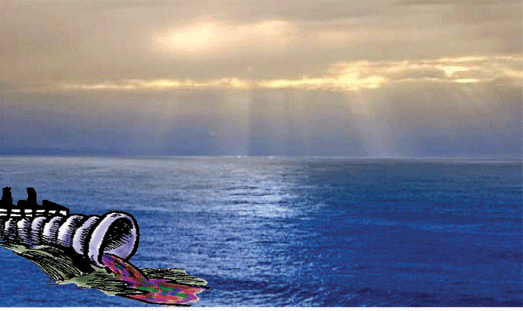 ‘‘Shock’: Water underneath Fukushima reactors to be dumped in ocean — Attempts to deal with problem have ‘failed’ — Officials: It’s better than radioactive substances just “spilling directly into the ocean” like it is now (VIDEO) nenews.com/shock-water-fukushima-reactors-be-dumped-ocean-attempts-deal-problem-failed-officials-better-allowing-contamination-spill-directly-ocean-like-video?utm_source=feedburner&utm_medium=email&utm_campaign=Feed%3A+ENENews+%28Energy+News%29
AFP, Aug. 7, 2014 (emphasis added): Tepco ‘running out of space’ for tainted water — [Tepco] on Thursday unveiled a plan to dump scrubbed water directly into the ocean, sparking concerns over whether it would be properly decontaminated. […] {Tepco] has admitted that it’s running out of space. It is also fighting to contain contaminated groundwater around the plant from seeping into the ocean […] [Tepco] said it now wants to start pumping out the underground water, purify it […] and then release it […] the firm has long faced criticism over delays in disclosing key information […]
NHK, Aug. 6, 2014: Highly radioactive water […] is seeping into the earth and mixing with ground water. Experts estimate around 200 [or 400] tons of contaminated ground water are leaking into the ocean each day. [Tepco wants] to decontaminate ground water collected at wells near reactor buildings before releasing it into the ocean. […] They say their plan is an improvement on the current situation, as contaminated water is spilling directly into the ocean.
Yomiuri Shimbun, Aug 7, 2014: Groundwater to be pumped up from some of the subdrain pits includes high levels of tritium, a radioactive substance thatcannot be removed […] However, TEPCO believes it is possible to […] meet standards if the water is mixed in tanks with water pumped from other subdrain pits.
Kyodo, Aug 7, 2014: Tepco to collect toxic groundwater at Fukushima, dump in ocean after treatment […] it is unclear whether [the plan] will work as smoothly as expected, one of the officials admitted. […] Radioactive substances such as tritium and cesium have been detected [but] TEPCO says it aims to clean the water to a level that would do no harm to the environment, but tritium will remain untreated […]
Asahi Shimbun, Aug 7, 2014: [Tepco] wants to dump decontaminated water […] into the ocean. [TEPCO] is in talks with government ministries to pump contaminated water found around the buildings […] process it […] then release it […] “We would never consider dumping the water into the ocean unless we received the consent of local residents,” a TEPCO official said. […] it would be the first time […] for contaminated water to be dumped into the ocean after it has been purified. […] “The water close to the plant buildings is already contaminated,” the official said. “Fishermen are sure to raise objections” […]
Bloomberg, Aug 4, 2014: [E]stimates […] suggest filtering the isotope strontium out of stored water will take more time [than Tepco’s March 31, 2015 deadline.] Strontium has been linked to leukemia and can enter the food chain […] Delays in the cleanup could extend a South Korean ban on Japanese seafood imports […] Michael Friedlander, a former nuclear engineer [said] “They’re basically accumulating vast quantities of radioactive material that isn’t in control” […] Corrosion has delayed full use of a filtration system known as ALPS […] Tepco said aplan to divert groundwater into the sea […] has so far failed […]
NHK, Aug. 7, 2014: [TEPCO] is running a so-called bypass system […] But groundwater continues to flow into the reactors’ buildings and become contaminated. Part of it is believed to be seeping into the nearby Pacific Ocean. […] In the closed-door meeting, the officials are said to have explained that they plan to collect contaminated groundwater both at wells near reactor buildings and […] a coastal embankment. […] Fisheries association head Hiroyuki Sato told reporters that fishermen were shocked to hear that the measure is needed […]
1 This Month
15 October. Joint Appeal for Nuclear Abolition Day -presentation to the UN on October 15 will be live on UNWebTV
Endorse the Nuclear Abolition Day Appeal
23-25 October – on Zoom – World BEYOND War’s annual global conference

To see nuclear-related stories in greater depth and intensity – go to https://nuclearinformation.wordpress.com
-
Archives
- October 2026 (139)
- September 2026 (339)
- August 2026 (330)
- July 2026 (355)
- June 2026 (287)
- May 2026 (306)
- April 2026 (356)
- March 2026 (251)
- February 2026 (267)
- January 2026 (308)
- December 2025 (358)
- November 2025 (359)
-
Categories
- 1
- 1 NUCLEAR ISSUES
- business and costs
- climate change
- culture and arts
- ENERGY
- environment
- health
- history
- indigenous issues
- Legal
- marketing of nuclear
- media
- opposition to nuclear
- PERSONAL STORIES
- politics
- politics international
- Religion and ethics
- safety
- secrets,lies and civil liberties
- spinbuster
- technology
- Uranium
- wastes
- weapons and war
- Women
- 2 WORLD
- ACTION
- AFRICA
- Atrocities
- AUSTRALIA
- Christina's notes
- Christina's themes
- culture and arts
- Events
- Fuk 2022
- Fuk 2023
- Fukushima 2017
- Fukushima 2018
- fukushima 2019
- Fukushima 2020
- Fukushima 2021
- general
- global warming
- Humour (God we need it)
- Nuclear
- RARE EARTHS
- Reference
- resources – print
- Resources -audiovicual
- Weekly Newsletter
- World
- World Nuclear
- YouTube
-
RSS
Entries RSS
Comments RSS

