U.S. personnel given strict radiation safety orders in Fukushima area March 16 – 19, 2011
 US Official: There were orders to not get within 230 miles of Fukushima Daiichi — Potassium iodide given to all defense personnel and families within 200 miles of plant — Over 1,100 kinds of radioactive material detected http://enenews.com/us-official-there-were-orders-not-to-go-within-230-miles-of-fukushima-daiichi-potassium-iodide-given-to-all-defense-personnel-and-families-within-200-miles-over-1100-kinds-of-radioactive-mater
 Assistant Secretary of Defense Jonathan Woodson, June 19, 2014: Between March 16 and 19, 2011, ships supporting OT [Operation Tomodachi] were directed to remain at least 100 nm [nautical miles] from Fukushima Daiichi and greater than 150 nm from Fukushima Daiichi along a 90 degree arc, or wedge, centered on the direction of wind from Fukushima Daiichi. The standoff distance from Fukushima Daiichi was temporarily increased to 200 nm [230 miles] on March 16, 2011, as a precaution following detection of abnormally high radiation levels above the Fukushima Daiichi Unit 3 containment building by the Japanese military. On March 19, 2011, the wedge was reduced to 125 nm…
Joint Effects Coordination Board/Joint Requirement Review Board Review:
- Mar. 17, 2011 — Personnel entering within the 100 nm radius of Fukushima Daiichi Nuclear Power Plants, KI [potassium iodide] should be administered.
- Mar. 21, 2011 — Mission: Distribute KI to all DOD personnel and families within 200 miles from the Fukushima power plant.
Defense Threat Reduction Agency (pdf), Sept. 2013: The Defense Threat Reduction Agency’s (DTRA) Hazard Prediction and Assessment Capability (HPAC) model was used to generate the radiation exposure rates and air activity concentrations for at-sea crew. Inputs to the HPAC model included data on the isotopes inside [Fukushima Daiichi’s] reactors that had the potential for release to the environment… Although HPAC’s output included over 1,100 isotopes, it was determined that the major contributors to inhalation doses were the following 10 isotopes: I-131, I-132, I-133, Cs-134, Cs-136, Cs-137, Te-129, Te-129m, Te-131m and Te-132.
Asahi Shimbun: about 1,000 kinds of radioactive materials [are in the] water at the crippled Fukushima No. 1 nuclear power plant, sources said.
Looks like global warming is stopping nuclear power, rather than the other way round
 Heavy Rain in South Korea Kills Five, Shuts Nuclear Plant Officials Say Five People Still Missing WSJ, By
JEYUP S. KWAAK 25 Aug 14, SEOUL-Heavy rainfall on Monday killed at least five people and shut down a nuclear reactor in South Korea, pushing the country’s populous southeast region to a near-standstill. …… A 650-megawatt nuclear reactor in Busan, about 330 kilometers (204 miles) southeast of Seoul, was also suspended on Monday after rising water flowed into the facilities, the national nuclear-power-plant operator Korea Hydro & Nuclear Power Co. Ltd said. The reactor remained shut down as of Tuesday morning…….http://online.wsj.com/articles/heavy-rain-in-south-korea-kills-five-shuts-nuclear-plant-1409023982
International companies attempting to remove tritium from toxic water at Fukushima nuclear plant
 Three firms picked to help tackle toxic water at Fukushima No. 1 http://fukushimaemergencywhatcanwedo.blogspot.com.au/2014/08/three-firms-picked-to-help-tackle-toxic.html by dunrenard Aug 26, 2014 The government picked three overseas companies Tuesday to participate in a subsidized project to determine the best available technology for separating radioactive tritium from the toxic water building up at the Fukushima No. 1 nuclear plant.
Thus tritium-laced water is expected to accumulate at the plant in the absence of any method to remove the isotope.
The three firms chosen from 29 applicants are U.S. firm Kurion Inc., which offers technologies to treat nuclear and hazardous waste; GE Hitachi Nuclear Energy Canada Inc., a joint venture of Hitachi Ltd. and U.S. firm General Electric Co.; and Federal State Unitary Enterprise RosRAO, a Russian radioactive waste management firm.
The government will provide up to ¥1 billion for each examination of the technologies and running costs, and consider whether any of them can be applied to treat the water at Fukushima No. 1, the industry ministry said.
The three companies are to conclude their experiments by the end of March 2016, a ministry official said.
The official cautioned there is no guarantee that any of the technologies will be put to practical use.
Source: Japan Times
http://www.japantimes.co.jp/news/2014/08/26/national/three-firms-picked-help-tackle-toxic-water-fukushima-1/
Fukushima situation is a continuing international crisis, requiring international help
“There should be an international consortium of global experts from France, from Russia, from the United States, and Canada, putting their heads together with the Japanese and working out solutions,” she said.
Others believe that Japan needs to look northwest, towards the Kremlin. Chernobyl gave Russia and Ukraine a level of experience in handling nuclear failures that stands apart from most of the world
NO ONE WANTS YOU TO KNOW HOW BAD FUKUSHIMA MIGHT STILL BE VICE By Johnny Magdaleno Aug 19 2014 “…………When I asked past Nobel Peace Prize nominee Dr. Helen Caldicott these questions, she was quick to respond: “Because money matters more than people.”
 Dr. Caldicott was a faculty member at Harvard Medical School when she became president ofPhysicians for Social Responsibility, an American organization of doctors against nuclear warfare, climate change, and other environmental issues, in 1978. The organization, along with its parent body the International Physicians for the Prevention of Nuclear War, won the Nobel Peace Prize in 1985, a year after Caldicott left.
Last September, Caldicott organized a symposium at the New York Academy of Medicine entitled, “The Medical and Ecological Consequences of Fukushima,” and has a book coming out on the issue this October. Her expertise on the subject is founded on academic research, but also her lifelong role as a doctor practicing preventative medicine in the nuclear age.
“Japan produces parts for nuclear reactors, like reactor containment vessels,” she said in an interview with VICE. “They’re heavily invested in nuclear power, even though they actually have access to nine times more renewable energy than Germany.”
Although Caldicott says what separates Fukushima from Chernobyl is the continuous leakage of radioactive material, in her eyes they’re unified by an institutionalized effort to keep the veil from lifting. Continue reading
Long term effects of Fukushima radiation now becoming clear
Studies are revealing the impact that low-dose exposure to radiation is having on plants and animals after the Fukushima disaster in 2011. Biologists commenced research just a few months after the nuclear accident, now three years later the studies have been published in the Journal of Heredity. The research shows the genetic mutations and population declines that are occurring in a variety of non-human organisms.
“A growing body of empirical results from studies of birds, monkeys, butterflies, and other insects suggests that some species have been significantly impacted by the radioactive releases related to the Fukushima disaster,” Timothy Mousseau from the University of South Carolina in the US, who led one of the studies, explained in a press release.
All of the studies indicate that low-dose exposure to ionising radiation (the kind caused by the Fukushima meltdown) leads to increased mutation and genetic damage to both reproductive and non-reproductive cells.

Studies on this pale grass blue butterfly (pictured above) show slowed growth, reduction in size, higher mortality and abnormalities in butterflies from the affected areas and in their offspring. The butterfly on the left is suffering from mutations that stop it from escaping from its own cacoon.
“Detailed analyses of genetic impacts to natural populations could provide the information needed to predict recovery times for wild communities at Fukushima as well as any sites of future nuclear accidents,” Mousseau said in a press release. “There is an urgent need for greater investment in basic scientific research of the wild animals and plants of Fukushima.”
Japan’s “nuclear restart” fades into the doubtful future
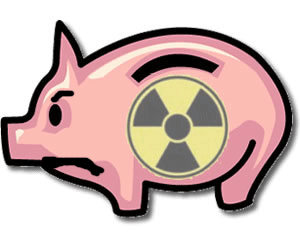
 Don’t bank on nuclear restarts, Japan Times 24 Aug 14 Power companies are moving again to raise their electricity rates to get out of dire financial straits ………..Electricity charges are estimated to have already increased by roughly 20 percent for households and nearly 30 percent for businesses compared with 2010 levels.
Additional hikes could weigh heavily on households and businesses alike, and for that reason many are calling for a quick restart of the idled nuclear reactors — to remove an obstacle to Japan’s economic growth. That, however, does not warrant a return to business as usual for nuclear power in Japan.
While minimizing the inevitable rate hikes by introducing more streamlining and efficiency in their operations, the utility firms should begin an effort to change their cost structure and reduce their reliance on nuclear power by taking a more realistic view of the situation since the Fukushima disaster.
The Abe administration also needs to set down more specific goals in Japan’s energy policy that will incorporate efforts to reduce “as much as possible” the nation’s dependence on nuclear power — as it says in the government’s latest basic energy plan — to set a clear direction for the utility industry……..
When it raised its rates 11 months ago, Hokkaido Electric assumed that its Tomari Nuclear Power Plant would resume operations by June this year.
When Kansai Electric raised its electricity charges in the spring of 2013, it similarly calculated that its Oi and Takahama nuclear plants in Fukui Prefecture would be up and running.
In its reconstruction plans approved by the government last December, Tepco also assumed that it would start reactivating reactors at its Kashiwazaki-Kariwa Nuclear Power Plant in Niigata Prefecture by July this year — adding that it might need to raise its rates again by up to 10 percent if the restart of the plant was delayed.
All of these forecasts by utilities have proven too optimistic. Of the 20 reactors at 13 nuclear power plants under safety review by the Nuclear Regulation Authority since July last year, the two reactors at Kyushu Electric Power Co.’s Sendai plant in Kagoshima Prefecture have effectively cleared the NRA screening, but their actual restart is not likely before the end of this year due to pending procedures…….
The entire process for restarting the nuclear plants, including the necessary approvals from host municipalities and prefectures, is going to be tough and will take a long time. At present, only 20 of the nation’s 48 reactors are under NRA review……
as long as the power companies keep drawing up business plans based on the hope of once again being be able to operate nuclear power plants as they did before 2011, consumers and businesses can bet on the certainty of more hikes in the future. http://www.japantimes.co.jp/opinion/2014/08/24/editorials/dont-bank-nuclear-restarts/#.U_u6scVdUnk
Wind energy shown to be much more scalable than nuclear energy.
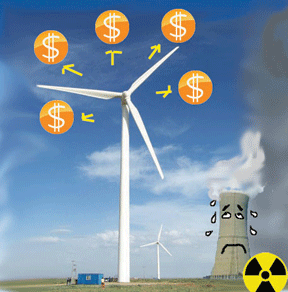 Which Is More Scalable, Nuclear Energy Or Wind Energy? Forbes, 22 Aug 14 Answer by Mike Barnard, Senior Fellow – Wind, E&PI,on Quora,
China is the true experiment for maximum scalability of nuclear vs wind. It has a tremendous gap between demand and generation. It can mostly ignore democracy and social license for nuclear. It is building both wind and nuclear as rapidly as possible. It has been on a crash course for both for about the same period of time. It has bypassed most of the regulatory red tape for nuclear.
So how is it doing?
- China turned on just over 16 GW of nameplate capacity of wind generation in 2013 according to the Global Wind Energy Council.
- Over the four years of 2010 to 2014, China managed to put 4.7 GW of nuclear intooperation at the Qinshan Phase II, Ling Ao Phase II, Ningde, Hongyanhe and Yangjiang plants. This is not their stated plans for nuclear, which had them building almost double this in 2013 alone and around 28 GW by 2015, but the actual plants put into production. The variance between the nuclear roadmap and nuclear reality in China is following the trajectory of nuclear buildout worldwide: delays, cost overruns, and unmet expectations.
- Modern wind turbines have a median 40.35% capacity factor and exceed 50% in the best wind resources according to the US National Renewable Energy Laboratory (NREL) who track the actuals on this sort of thing.
- Taking similarly sourced numbers for nuclear capacity factor from the Nuclear Energy Institute, we see 90.9% capacity factors for nuclear reactors. These are apples-to-apples statistics from the same country.
Running the math, that’s about 6.5 GW of real capacity of wind energy in one year vs 4.3 GW of real capacity for nuclear over four years. That’s roughly six times more real wind energy capacity than nuclear per year. 2014 might be better than average as perhaps 2 GW have been made operational this year. We’ll see what reality brings as wind energy is being expanded rapidly as well. So far nuclear is losing the race badly.
No other geography is capable of building as much nuclear per capita as China is. In the most pro-nuclear geography in the world with the most relaxed regulatory regime, the nuclear industry is being outstripped by the wind industry…………http://www.forbes.com/sites/quora/2014/08/22/which-is-more-scalable-nuclear-energy-or-wind-energy/
Should Japan take the nuclear power risk again?
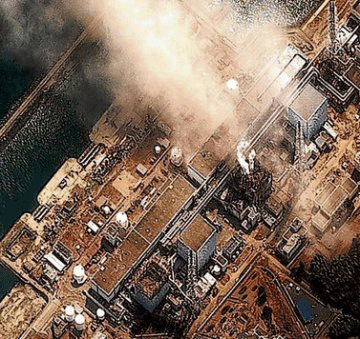 Should Japan restart its nuclear reactors? Cyprus Mail, 22 Aug 14, By Arnie Gundersen Only luck and real courage at 14 nuclear reactors on Japan’s Pacific coast overcame the technical failures of nuclear power and prevented the nation from being destroyed by radiation.
The untold story of March 11, 2011 is how close Japan came to three more spent fuel pool fires at Fukushima Daiichi and four meltdowns at Fukushima Daini.
When the magnitude 9.0 earthquake off the Pacific coast caused a seismic shock wave that reverberated throughout northern Japan, the country’s nuclear plants shut down automatically, as planned, preventing any further nuclear chain reactions.
Therein lies nuclear power’s fatal flaw, because an automatic shutdown does not stop the ongoing heat generated inside each nuclear reactor.
When uranium atoms split (a process called fission), they release tremendous energy, as well as rubble. Even when the chain reaction stops, the highly radioactive rubble emits decay heat that continues for years. Automatic shutdown simply means that no new nuclear fissions will occur……..
When the tsunami struck, the cooling equipment along the shoreline was turned into a scrap yard of twisted metal. Even if they had not been flooded, without operational shoreline pumps, the emergency diesel generators were doomed to fail, making it impossible to cool the nuclear core. In truth, the utter destruction of the shoreline pumps caused the triple meltdown at Fukushima Daiichi.
The tsunami also wrecked cooling pumps at eight other reactors located at Fukushima Daini, Onagawa, and Tokai.
Twenty-four of the 37 emergency diesel generators located at four separate nuclear power sites, which contained a total of 14 nuclear reactors, failed during the tsunami. Of the 24 diesel generators that failed, only nine failures were due to flooding (eight at Fukushima Daiichi and one at Fukushima Daini). The other 15 diesel generators were not flooded, but were disabled when the tsunami wrecked their shoreline cooling pumps.
The situation in Japan was dire when the sun set on March 11, 2011. At Fukushima Daiichi, three reactors were melting down and three spent fuel pools were at risk of catching fire because they could not be cooled. Conditions were also worsening at Fukushima Daini’s four reactors.
It was good fortune and extreme courage that saved Japan and its people from a more tragic catastrophe………
If the earthquake and tsunami had begun at night, only 200 employees would have been working at these plants. With roads and bridges destroyed, none of the necessary staff would have been able to return to work.
Now, more than three years after the Fukushima Daiichi disaster, shoreline cooling pumps throughout the world – including in Japan – remain unprotected from flooding or terrorist attacks.
Japan is prone to earthquakes and tsunamis. Is reopening its nuclear plants worth the risk to its people and their homeland?
The simultaneous technological failure at 14 nuclear reactors due to a single natural phenomenon clearly shows that the nuclear engineers who envisioned and designed nuclear power failed to expect the unexpected.
Unfortunately, the nuclear industry continues to push its message that nuclear power can be made safer. Fukushima, and before it Chernobyl, shows us that nuclear technology will always be able to destroy the fabric of a country in the blink of an eye. http://cyprus-mail.com/2014/08/22/should-japan-restart-its-nuclear-reactors/
Japan thyroid cancer children – crimes against humanity – Tokyo Press Conference
 Tokyo Press Conference: Gov’t is committing crimes against humanity; Fukushima children living in war zone and can’t leave — Childhood cancer developing much faster than Chernobyl; Rate now 14 times higher — Parent: “I’m revealing the reality of what’s going on… it’s only way to get rid of the criminals” (VIDEO) http://enenews.com/tokyo-press-conference-officials-committing-crimes-against-humanity-fukushima-children-living-war-zone-evacuate-childhood-cancer-developing-faster-chernobyl-rate-14-times-higher-parent-im-reveal?utm_source=feedburner&utm_medium=e
Press Conference at The Foreign Correspondents’ Club of Japan, August 18, 2014:
Toshio Yanagihara, attorney representing Fukushima children and their parents
- 5:00 — Thyroid cases after Chernobyl in Belarus — comparing that with the present situation in Fukushima, [here] there’s 14 times [the rate] of children with thyroid cancer.
- 6:00 — Fukushima prefecture’s announced that the massive number of thorough screenings [is the reason why there’s] more numbers of people with cancer — but we found that doubtful. In Fukushima prefecture, the west part of Fukushima compared to those areas that are closer to the nuclear power plant, there are about ¼ or even 1/5 the people who are found with thyroid cancer.
- 7:00 — June 10th of this year, the Fukushima committee in charge of researching thyroid cancer admitted for the first time that the suspicion of malignancy is due to the lymph node metastasis. This is the common thing that was found after the Chernobyl accident.
- 8:00 — In Fukushima right now, we see that the number of the children found with thyroid cancer — and the scale of this catastrophe is ongoing — it is going much faster than it was in the Ukraine after Chernobyl.
- 11:45 — The announcement from the Sendai high court from April 2013 that the Fukushima children’s lives are threatened… this didn’t cause Fukushima or the Japanese government to help provide support.
- 16:15 — We emphasis that the Japanese government is discriminating against the Fukushima children, and in the international [court], we can say this is a crime against humanity. This is Japan’s most important and most criminal human problem that we’re facing right now.
- 17:15 — Fukushima is a war zone, and children have a right to be evacuated to a safer place… In Japan, this present situation is the most harsh child-rearing situation in the world.
- 19:15 — They’re supposed to support and evacuate children from Fukushima during this war zone… It must be argued at the international court that this is a crime against humanity. We would like to take this case to the International Criminal Court, and we’re preparing for that.
Katsumi Hasegawa, parent of two young children who evacuated from Koriyama (60km from Daiichi)
- 22:45 — We currently live in Shizouka prefecture where we evacuated to in August 2011 — my pregnant wife and 5 year-old son… Why did the Japanese government contain us in the no-go zone 20 or 30 km radius, while many foreign countries had told residents within 80 km from Fukushima Daiichi to evacuate?
- 35:00 – I’m a parent of children, and I’m an adult whose living at the time of this accident — this era. I would like to reveal the reality of what is going on. And I would like to do my best, even if I’m starting right now, I would like to do my best. That is my responsibility, and that is the only way to get rid of the criminals — and irresponsibility that we have committed already… Even though raising my voice is hard, I know that there are things that we need to do. Thank you.
- 36:30 — Lucy Birmingham, FCCJ president: Thank you so much. OK… wow.
Propping up Japan’s nuclear industry – with guaranteed electricity prices?
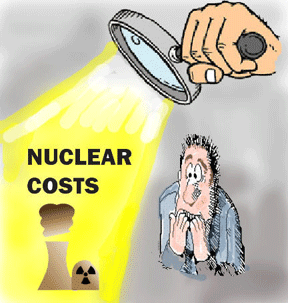 Japan may guarantee price for nuclear power to prop up industry TOKYO Aug 21 (Reuters) – Japan will consider guaranteeing prices for electricity generated by nuclear plants to help the country’s struggling utilities, which have lost about $35 billion in the three years since the Fukushima disaster saddled them with extra costs.
Japan’s nuclear plants are in shutdown with no schedule for restarts after the meltdown at Fukushima in 2011, leading the country’s utilities to turn to expensive fossil fuel imports.
But even if they can get their reactors running they face higher costs to meet new safety requirements just as the government is pushing through plans to allow more competition in the industry. They also face possible costs for decommissioning older units that are too costly to upgrade.
The move was floated by a trade ministry panel as an example of supporting the nuclear industry financially like Britain’s “Contracts for Difference” scheme, which guarantees nuclear operators fixed rates for power.
The panel, which is in charge of making detailed policies in line with the government’s basic energy plan, did not give a schedule for finalising the scheme.
Propping up nuclear power, promoted for decades by Japan’s ruling Liberal Democratic Party as cheap, safe and reliable, is likely to be at odds with public sentiment which has turned against atomic energy since Fukushima. If the market price of electricity falls below a pre-set level, consumers would pay the gap to the utilities, according to the British example discussed on Thursday at the panel……… http://af.reuters.com/article/commoditiesNews/idAFL4N0QR1G120140821
 |
Click here to Reply or Forward
|
Local leaders want full disclosure of testimony of Fukushima nuclear plant manager
Local leaders seek disclosure of testimony by former nuclear plant chief THE ASAHI SHIMBUN 21 Aug 14 Leaders of local governments near the stricken Fukushima No. 1 nuclear power plant want the testimony given by the plant manager months after the accident to be disclosed.
The Asahi Shimbun ascertained that eight local leaders want full disclosure after seeking the views of the Fukushima governor and heads of 13 cities, towns and villages located within 20 kilometers of the plant and areas outside the 20-km radius where radiation levels were more than 20 millisieverts per year.
Masao Yoshida was plant chief when the March 11, 2011, Great East Japan Earthquake and tsunami set off the nuclear accident.
He gave hours of testimony to the government’s Investigation Committee on the Accident at the Fukushima Nuclear Power Stations, and died in July 2013 from esophageal cancer. Tokyo Electric Power Co., operator of the plant, said Yoshida’s cancer was not related to radiation exposure.
The survey also revealed that five of the leaders said there would be no problem if their own interviews with the government investigation panel were made public.
After the onset of nuclear crisis, the government’s investigation panel interviewed 770 officials and others involved in the disaster.
Although the central government currently plans to publicly disclose part of those records by the end of the year, it will not release the contents of Yoshida’s interview, citing Yoshida’s request not to disclose his testimony……http://ajw.asahi.com/article/0311disaster/fukushima/AJ201408210044
Indian Uranium Corporation ordered to probe birth deformities near mines
 The health issue came to the attention of the High Court earlier this year after pictures of Jadugora’s deformed children appeared in the Indian press. The court in February ordered Uranium Corp. to produce documents that might shed light on the health issues. The court noted then that children living near the mines in Jadugora are “born with swollen heads, blood disorders and skeletal distortions.”
India Court Orders Uranium Corp. to Probe Deformities Near Mines Bloomberg By Rakteem Katakey and Tom Lasseter Aug 20, 2014 India’s sole uranium mining company is being ordered by a regional court to disclose radiation levels and the presence of any heavy metals in soil and water in a cluster of villages with reports of unusual numbers of deformed and sick children.
The order by the Jharkhand High Court also mandates thatUranium Corp. of India Ltd.explain how it ensures the safety of nearby civilian populations who may be exposed to its 193-acre (78-hectare) radioactive waste dump near the village of Jadugora in eastern India.
The move comes about a month after a Bloomberg News story chronicled the plight of parents living near the Uranium Corp. mines who are seeking answers to what’s sickening and killing so many of their kids. The story also reported that local residents routinely wander the unfenced dump sites and fish and bathe in a river that receives water flowing from the dumps, known as tailings ponds. The Bloomberg article was submitted to the judges of the High Court by Ananda Sen, the lawyer appointed by the court to review the case.
Uranium Corp. has denied its mining operations have anything to do with village health issues. In 2007, a survey of more than 2,100 households by an Indian physicians group found mothers in villages 1.5 miles from the mines reported congenital deformities more than 80 percent higher than the rates just 20 miles (32 kilometers) away, with reported child death rates from such abnormalities more than five times as high.
Independent Experts
Nuclear-armed hypersonic glider test fails: China.
China’s second test of nuclear-armed hypersonic glider fails SCMP, Minnie Chan
A US-based news website, the Washington Free Beacon, reported on this month’s test on Tuesday, quoting unnamed American government officials.
South Korea – getting “full up” with nuclear radioactive trash
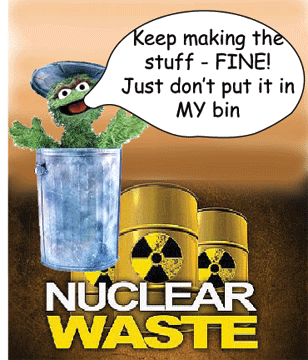

they must just stop making this trash!
South Korea running out of space for nuclear waste http://www.abc.net.au/news/2014-08-18/south-korea-running-out-of-space-for-nuclear-waste/5679626 South Korea is running out of space to store its spent nuclear fuel, with some of its storage facilities set to reach capacity by 2016, according to an independent body that advises the government on nuclear issues.
A Public Engagement Commission, consisting of nuclear experts, professors, and officials, was set up in October 2013 to take account of public opinion on spent nuclear fuel issues and feed into policy decisions.
Commission chairman Hong Doo-seung says it is urgent to find more storage sites for spent fuel.
“We will have to stop nuclear power generation if we fail to find additional temporary space, Continue reading
High radiation levels 60 km from Fukushima nuclear plant
 Gov’t: Radiation level 60 km from Fukushima plant is as high as the most contaminated areas in Chernobyl — “Fukushima far exceeded any crisis previously encountered” — “A risk of destruction of the society” — Expert: “It’s unprecedented in scale and duration” (VIDEOS)http://enenews.com/govt-radiation-level-60-km-fukushima-plant-high-contaminated-areas-chernobyl-fukushima-exceeded-crisis-previo
Interview with Dr. Brad Sample, ecotoxicologist and Hazard/Risk Assessment Editor for ‘Environmental Toxicology and Chemistry’(at 8:10 in): “The event [at Fukushima Daiichi] is unprecedented in scale and duration.” >> Full interview here
IRSN News Magazine – Fukushima special report (pdf): “The Fukushima disaster far exceeded any crisis previously encountered”
Fukushima Accident — Contamination of People and the Environment, IRSN (emphasis added):
- 6:45 in — Didier Champion, IRSN: “Japanese authorities… measured… 15 million Bq/m2 for Cs-137 for example. This isquite comparable to that we see in the most contaminated areas around the Chernobyl accident.”
- 7:00 in — Researchers have mapped the contamination of soil… It goes far beyond the evacuation zone, and extends to more than 80 miles away — agricultural and urban areas inhabited by hundreds of thousands of people.
- Watch video here
Jacques Repussard, IRSN Director General (at 5:15 in): “These are such serious accidents covering so many aspects of life in a country… The ability of associations, of local elected officials, to act in an intelligent and in an efficient manner, is a great resource. And also a factor in social cohesion in a disuniting situation, wherethere is a risk of destruction of the society.” >> Watch video here
Fukushima Accident — Response of the Japanese Society, IRSN (at 1:30 in): 60 kilometers from the power plant, farmers organized themselves collectively [and] turned to a researcher in bioscience from Dokkyu Medical University [Dr. Shingo Kimura]… They travel the region to measure contamination on roadsides, in fields, and even within homes… Along this road the dosimeter shows a gamma wave radiation level at more than 50 microsieverts per hour — a tremendous level akin to the highest contamination from Chernobyl. [0.03 microsieverts per hourbefore 3/11] >> Watch video here
1 This Month
15 October. Joint Appeal for Nuclear Abolition Day -presentation to the UN on October 15 will be live on UNWebTV
Endorse the Nuclear Abolition Day Appeal
23-25 October – on Zoom – World BEYOND War’s annual global conference

To see nuclear-related stories in greater depth and intensity – go to https://nuclearinformation.wordpress.com
-
Archives
- October 2026 (139)
- September 2026 (339)
- August 2026 (330)
- July 2026 (355)
- June 2026 (287)
- May 2026 (306)
- April 2026 (356)
- March 2026 (251)
- February 2026 (267)
- January 2026 (308)
- December 2025 (358)
- November 2025 (359)
-
Categories
- 1
- 1 NUCLEAR ISSUES
- business and costs
- climate change
- culture and arts
- ENERGY
- environment
- health
- history
- indigenous issues
- Legal
- marketing of nuclear
- media
- opposition to nuclear
- PERSONAL STORIES
- politics
- politics international
- Religion and ethics
- safety
- secrets,lies and civil liberties
- spinbuster
- technology
- Uranium
- wastes
- weapons and war
- Women
- 2 WORLD
- ACTION
- AFRICA
- Atrocities
- AUSTRALIA
- Christina's notes
- Christina's themes
- culture and arts
- Events
- Fuk 2022
- Fuk 2023
- Fukushima 2017
- Fukushima 2018
- fukushima 2019
- Fukushima 2020
- Fukushima 2021
- general
- global warming
- Humour (God we need it)
- Nuclear
- RARE EARTHS
- Reference
- resources – print
- Resources -audiovicual
- Weekly Newsletter
- World
- World Nuclear
- YouTube
-
RSS
Entries RSS
Comments RSS

