Japan’s Radioactive Fukushima Water Release – Media Propaganda, Reports from Vanuatu in South Pacific
Nuclear Hotseat, 12 July 23
SPECIAL REPORTS:
With Japan’s pending release of 1.3 million tons of Tritium-contaminated radioactive water from Fukushima into the Pacific Ocean, and the International Atomic Energy Agency (IAEA) approval of that plan, it is time for an examination of the issues behind this wrongheaded assault upon people and the environment. To find out various hidden aspects of the issue, Nuclear Hotseat provides five separate segments.
Nuclear Hotseat Hot Story with Linda Pentz Gunter considers that the IAEA’s vested interest in promoting nuclear power should disqualify the agency as a nuclear safety watchdog.Marine Biologist Tim Deere-Jones takes on the whistleblower leak of an internal IAEA document from June 21, which shows collusion between the agency and the government of Japan over how the announcement of approval of the water release was to be handled to minimize public fear and response. Japan has dismissed the document as a “fraud;” neither TEPCO nor IAEA has said anything else. What’s the bigger story?Filmmaker Philippe Carillo (The Fukushima Disaster: The Hidden Side of the Story) lives in Vanuatu and talks about Japan’s campaign to propagandize south Pacific journalists into only believing the talking points they’ve been fed and not to look further.
The Honorable Andrew Solomon Napuat, a Member of Parliament for Vanuatu, an island nation in the south Pacific, explains how his country and others have been manipulated to not speak out against the water release or risk “friendly” relations with Japan…………… https://nuclearhotseat.com/podcast/japan-radioactive-fukushima-water-dump/?_thumbnail_id=11643
Failed Fukushima Fixes Falling Like Dominoes

CounterPunch BY JOHN LAFORGE, 6 July, 23
“……………………………………………………………………Tepco’s cost-avoidance on its sea wall was only the first in a string of failures that have followed like dominos. The corruption led in July 2022 to convictions of four top Tepco executives for negligence and a fine of $95 billion.
In the 12 years since the meltdowns, Tepco’s disaster response efforts, always heralded as fixes, have been a series of hugely expensive failures: the “advanced” wastewater filter system “ALPS” has failed; the buried “ice wall” groundwater barrier has failed; containers made for the radioactive sludge produced by ALPS have failed; and plans to deal with millions of tons of collected debris — now kept in plastic bags — are being fiercely resisted by Japanese citizens.
Tons of cooling water is still being poured every day into Fukushima’s triple reactor wrecks to keep the hot melted fuel from again running amok. Additionally, groundwater gushes through the reactors’ foundations’ countless cracks and breaks caused by the staggering earthquake into what’s left of the structures’ sub-floors. All this water becomes highly radioactive as it passes over and through three giant masses — totaling at least 880 tonnes — of melted and mangled uranium and plutonium fuel.
You read that right. Fukushima’s destroyed reactor No. 3 was using fuel made partly of plutonium (see below), and so plutonium contaminates not just the ground and cooling water running over the melted fuel, but the ALPS apparatus, its filters, the containers used to store the radioactive sludge extracted by ALPS, and of course the sludge itself. You would think that the word plutonium would appear occasionally in news coverage of this ongoing disaster.
Failed ALPS means million-tonne do-over
Tepco’s jerry-rigged system dubbed Advanced Liquid Processing System or ALPS has never worked as planned. As early as 2013 the machinery was stalled. “The ALPS system failed to reduce radioactive elements, as claimed by the owner,” Power Technology, reported June 2, 2021.
Tepco has repeatedly said ALPS would remove 62 radioactive materials — all but tritium and carbon-14 from the continuously expanding volume of wastewater. Documents on a government committee’s website show that of 890,000 tonnes of water held at Fukushima, 750,000 tonnes, or 84 percent, contain higher concentrations of radioactive materials than legal limits allow, according to Reuters, Oct. 11, 2018. Among the long-lasting and deadly isotopes picked up by the water runs that through melted fuel wreckage are cesium, strontium, cobalt, ruthenium, carbon-14, tritium, iodine, plutonium, and at least 54 others.
In a June 14 op/ed for the China Daily, Shaun Burnie, the Senior Nuclear Specialist at Greenpeace East Asia, reported that the ALPS “has been a spectacular failure” and noted that:
“About 70 percent or 931,600 cubic meters of the wastewater needs to be processed again (and probably many more times) by the ALPS to bring the radioactive concentration levels below the regulatory limit for discharge. Tepco has succeeded in reducing the concentration levels of strontium, iodine, and plutonium in only 0.2 percent of the total volume of the wastewater, and it still requires further processing. But no secondary processing has taken place in the past nearly three years. Neither Tepco nor the Japanese government [have] said how many times the wastewater needs to be processed, how long it will take to do so, or whether the efforts will ever be successful. Greenpeace reported on these problems and why the ALPS failed nearly five years ago, and none of these issues has been resolved.”
Consequently, Tepco says it will re-filter over 70 percent of the 1.37 million tonnes of wastewater stored in giant tanks on site. Approximately 875,000 tons of contaminated water must be put through the system again, a process that will leave behind more of the highly radioactive and corrosive waste sludge.
Hoping to slow the rush to dumping, Ryota Koyama, a professor at Fukushima Univ. in Japan, said in an interview with China Media Group last May, “If the Japanese government or the Tokyo Elec Power Co really wants to discharge contaminated water into the sea, they need to explain in more detail whether the nuclides have really been removed.”
Ice wall also melts
Tepco intended to reduce the volume of groundwater gushing into the reactor building foundations by digging a $350 million “ice wall” into the earth between the destroyed reactors and the mountains behind. The company placed 1,568 heavy pipes filled with coolant 90 feet deep. It was to freeze the ground to form a deep impenetrable barrier, diverting groundwater to either side of the destroyed six-reactor Fukushima complex and prevent it seeping inside. It has failed to do so, The Guardian reported. In 2016, the Times of London reported that the scheme had only a “minor impact” on the volume of groundwater rushing in, which at the time still averaged 321 tonnes a day. Tepco announced then that it would retrofit the system and fix the leaks, but Science/The Wire reported in January 2022 that the company had admitted that its ice wall was “partially” melting. About 150 tonnes per day still gushes in.
Filtered sludge burning through containers
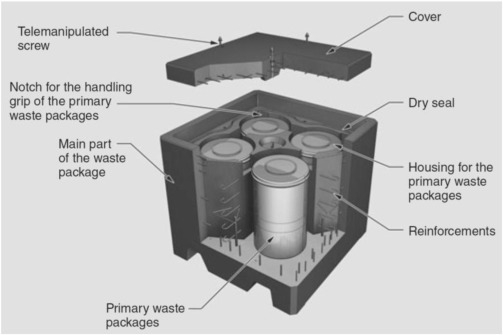
The ALPS filter has produced over 4,000 large containers filled with highly radioactive slurry and sludge left from the treatment.
Like the use of the word “advanced” in the name of the failed ALPS machinery, the cylinders used for the caustic, highly radioactive sludge are called “High Integrity Containers” or HICs, but in fact they are made of plastic and have degraded far faster than Tepco anticipated.
By March 2, Tepco had filled 4,143 containers, according to the daily Asahi Shimbun. At 30 cubic feet each, the cylinders now store a total of about 124,290 cubic feet of the highly radioactive sludge that will soon require expensive repackaging and, eventually, isolation from the biosphere for thousands of years.
Over two years ago, on June 8, 2021, Japan’s Nuclear Regulation Authority (NRA) announced that 31 of the containers had “exceeded their lifespans” and were corroded badly enough by the harsh toxic material that they must be replaced. The NRA also warned that another 56 cylinders would need replacing within two years.
Japan’s Mainichi newspaper reported that the government regulators blamed Tepco for “underestimating the radiation the 31 plastic cylinders were exposed to.” The company then claimed it would start moving the contents to new containers.
The Asahi Shimbun reported April 27, 2023, that the HICs must be stored in concrete boxes that can block radiation evidently being emitted by the HICs. https://www.asahi.com/ajw/articles/14883115
Rad waste to be dumped, deregulated
As early as next month, Japan intends to begin dispersing 1.37 million tonnes of contaminated wastewater into the Pacific Ocean. The government has steadfastly ignored fierce local and international opposition to the plan from the fishing community, marine scientists, Pacific Island nations, environmentalists, South Korea, and China. So far only South Korean politicians have suggested bringing international legal action against the dumping.
Since the 2011 meltdowns spewed radioactive materials broadly across Japan’s main island, some 14-million tonnes of cesium-contaminated soil, leaves, and debris have been scraped from the ground and stored in one-tonne bags. Citizens are struggling desperately prevent authorities from using the radioactive waste in road building or burning it in incinerators. The bags are currently stacked in tens of thousands of piles all over the region.
Even more protest was raised last February 10 when the NRA said it would allow Tepco to severely weaken its monitoring of the wastewater’s radioactivity. The NRA said would but the number of radioactive elements to be measured from 64 to 34.
The environment minister of Hong Kong — a coastal metropolis of 7.5 million people — charged in June that Japan is “violating its obligations under international law and endangering the marine environment and public health.” Minister Tse Chin-wan wrote in the daily Ta Kung Pao that Hong Kong would “immediately prohibit imports of seafood caught off the coast of Fukushima prefecture.”
Plutonium Spread Long Distances from Fukushima
Very few reports of the Fukushima catastrophic releases of radiation have mentioned plutonium contamination. Yet plutonium was used in fuel rods in Fukushima’s reactor number 3 which was destroyed by meltdown and several hydrogen explosions. Plutonium is one of the most toxic substances known to science, and fine particles are far more biologically hazardous than larger particles.
Following the March 14, 2011 explosion, experts worried about the release of extremely dangerous radioactive substances, and then a week later, on March 21 and 22, Tepco announced that it had detected plutonium in soil collected from its compound. (Fukushima Meltdown: The World’s First Earthquake-Tsunami-Nuclear Disaster, Takashi Hirose, Asahi Shimbun Publications, 2011, p. 51)
Now, studies published in the journals Science of the Total Environment, Nov. 15, 2020, and Chemosphere, July 2023, report that researchers found that cesium and plutonium “were transported over long distances,” and that deposits of them were recorded in “downtown Tokyo,” about 142 miles from the meltdowns.
According to the authors, very high concentrations of radioactive cesium were released during the accident as particles referred to as “cesium-rich micro-particles” (CsMPs). The researchers say CsMPs they found are mainly composed of silicon, iron, zinc, and cesium, and minor amounts of radioactive tellurium, technetium, molybdenum, uranium, and plutonium.
The studies, involving scientists from six countries and led by Associate Professor Satoshi Utsunomiya, a researcher at Kyushu University, found that “plutonium was included inside cesium-rich micro-particles that were emitted from the site.”
Radioactive CsMPs released from Fukushima are a potential health risk through inhalation. “Given the small size of the particles, they could penetrate into the deepest parts of the lung, where they could be retained,” Utsunomiya wrote. “The route of exposure of greatest concern is inhalation,” the authors reported, because plutonium, lodged in the lungs, can “remain for years.”
Utsunomiya summed up his team’s work saying, “It took a long time to publish results on particulate [plutonium] from Fukushima … but research on Fukushima’s environmental impact and its decommissioning are a long way from being over.”
John LaForge is a Co-director of Nukewatch, a peace and environmental justice group in Wisconsin, and edits its newsletter. https://www.counterpunch.org/2023/07/06/failed-fukushima-fixes-falling-like-dominoes/
Terrible truths about nuclear energy exposed
“We are all seeing a global political agreement centred in the UN organisations, tie IAEA [International Atomic Energy Agency], the World Health Organisation… All the international agencies are whitewashing what is happening in Fukushima.
By Karl Grossman | 11 July 2023 https://independentaustralia.net/environment/environment-display/terrible-truths-about-nuclear-energy-exposed,17704
A NEW documentary titled The Fukushima Disaster: The Hidden Side of the Story is a powerful, moving, informative film that is superbly made. Directed and edited by Philippe Carillo, it is among the strongest ever made on the deadly dangers of nuclear technology.
Australians featured in the film are Dr Helen Caldicott, former president of Physicians for Social Responsibility, and John Keane, professor of politics at the University of Sydney. Carillo is a resident of the nation of Vanuatu, 1,750 kilometres northeast of Australia.
The documentary begins with the words of U.S. President John F Kennedy from 1961:
“Every man, woman and child lives under a nuclear sword of Damocles, hanging by the slenderest of threads, capable of being cut at any moment by an accident, or miscalculation or by madness.”
It then goes to the March 2011 disaster at the Fukushima Daiichi nuclear power plant in Japan after it was struck by a tsunami. Its backup diesel generators kicked in but “did not run for long,” notes the documentary. That led to three of the six plant reactors exploding – and there’s video of this – “releasing an unpreceded amount of nuclear radiation into the air”.
“Fukushima is the world’s largest ever industrial catastrophe,” then says Professor John Keane. He says there was no emergency plan and, as to the owner of Fukushima, Tokyo Electric Power Company (TEPCO), with the accident its CEO “for five nights and days… locked himself inside his office”.
Meanwhile, from TEPCO, there was “only good news” with two Japanese government agencies also “involved in the cover-up” — the Nuclear Industry Safety Agency and the Ministry of Economy, Trade and Industry.
“Japanese media was ordered to censor information. The Japanese Government failed to protect its people,” the documentary relates.
Yumi Kikuchi of Fukushima, since a leader of the Fukushima Kids Project, recalls:
“On TV, they said that ‘it’s under control’ and they kept saying that for two months. The nuclear power plant had already melted and even exploded but they never admitted the meltdown until May. So, people in Fukushima during that time were severely exposed to radiation.”
Arnie Gundersen, a nuclear engineer and now a principal of Fairewinds Energy Education in Burlington, Vermont in the United States, speaks of being told by Naoto Kan, the Prime Minister of Japan at the time of the accident, that “our existence as a sovereign nation was at stake because of the disaster at Fukushima Daichi”.
Kan then appears in the documentary and speaks of “manmade” links to the disaster.
The documentary tells how Kan, following the accident, became “an advocate against nuclear power… ordered all nuclear power plants in Japan to shut down for safety” and for the nation “to move into renewable energy”.
Subsequently, “a nuclear advocate”, Shinzo Abe, became Japan’s Prime Minister.
Yoichi Shimatsu, a former Japan Times journalist, appears in the film and speaks of “the cruelty, the cynicism of this government”. He speaks of how in the accident’s aftermath, “nearly every member of Parliament and leaders of the major political parties”, along with corporate executives, “moved their relatives out of Japan”.
He says:
“Shanghai is the largest Japanese community outside Japan now… while these same people [had been] telling the people of Fukushima ‘go home’, ten kilometres from Fukushima, ‘go home, it’s safe’, while their families are overseas in Los Angeles, in Paris, in London and in Shanghai.”
“If it’s safe, why they left?” asks Kikuchi.
Gundersen says:
At Fukushima Daichi, the world is already seeing deaths from cancer related to the disaster…There’ll be many more over time. [There has been a] huge increase in thyroid cancer in the surrounding population.
Unfortunately, the Japanese Government is not telling us all the evidence. There’s a lot of pressure on the scientists and the medical community to distort the evidence so there’s no blowback against nuclear power.
There is a section in the documentary on the impacts of radioactivity which includes Dr Caldicott discussing the impacts of radiation on the body and how it causes cancer.
She states:
There is no safe level of radiation. I repeat, there is no safe level of radiation. Each dose of radiation is cumulative and adds to your risk of getting cancer and that’s absolutely documented in the medical literature.
The nuclear industry says, well, there are ‘safe doses’ of radiation and even says a little bit of radiation is good for you and that is called the theory of hormesis. They lie and they lie and they lie.
Maggie Gundersen, who was a reporter and then a public relations representative for the nuclear industry and, like her husband Arnie, became an opponent of nuclear power, speaks of how nuclear power derives from the World War II Manhattan Project program to develop atomic weapons and post-war so-called “Atoms for Peace” push.
Gundersen says in becoming a nuclear industry spokesperson, “the things I was taught weren’t true”. The notion, for example, that what is called a containment at a nuclear plant is untrue because radioactivity “escapes every day as a nuclear power plant operates” and in a “calamity” is released massively.
As to economics, she cited the claim decades ago that nuclear power would be “too cheap to meter”.
The president of Fairewinds Energy Education says:
Regarding the radioactive waste produced by nuclear power, she says “there is literally no technology” to safeguard it for the many years it remains lethal. “It does not exist.”
As to international oversight, the documentary presents the final version of the Report of the United Nations Scientific Committee on the Effects of Atomic Radiation issued in 2014 which finds that the radiation doses from Fukushima ‘to the general public during the first year and estimated for their lifetimes are generally low or very low… The most important effect is on mental and social well-being’.
Shimatsu says it is not only in Japan but on an international level that the consequences of radioactive exposure have been completely minimised or denied:
“We are all seeing a global political agreement centred in the UN organisations, tie IAEA [International Atomic Energy Agency], the World Health Organisation… All the international agencies are whitewashing what is happening in Fukushima. We take dosimeters and Geiger counters in there, we see a much different story.”
In Germany, says Maggie Gunderson, “the politicians chose” to do a study to substantiate that no health impacts “happened around nuclear power plants… But what they found was the radiation releases cause significant numbers of childhood leukemia”.
A summary of that 2008 study comes on the screen. The U.S. followed up on that research, she says, but recently “the [U.S.] Nuclear Regulatory Commission said it was not going to do that study,” that “it doesn’t have enough funding; it had to shut it down”. She said the real reason was that it was producing “data they don’t want to make public”.
Beyond the airborne releases of radiation after the Fukushima accident, now, says the documentary, there is the growing threat of radioactivity through water that has and still is leaking from the plant as well as more than a million tons of radioactive water stored in a thousand tanks built at the plant site.
After the accident, TEPCO released 300,000 tons of radioactive water into the Pacific Ocean. Now there is no land for more tanks, so the Japanese Government, the documentary relates, has decided, starting this year, to dump massive amounts of radioactive water over a 30-year period into the Pacific.
Arnie Gundersen speaks of the cliché that “the solution to pollution is dilution,” but with the radiation from Fukushima being sent into the Pacific, there will be “bio-accumulation” — with vegetation absorbing radiation, little fish eating that vegetation and intensifying it and bigger fish eating the smaller fish, further bio-accumulating the radioactivity. Already, tuna off California have been found with radiation traced to Fukushima. With this planned further and yet greater dispersal, thousands of people “in the Pacific basin will die from radiation,” he says.
Andrew Napuat, a member of the Parliament of Vanuatu, an 83-island archipelago in the Pacific, says in the documentary:
“We have the right to say no to the Japan solution. We can’t let them jeopardise our sustenance and livelihood.”
Vanuatu, along with 13 other countries, has signed and ratified the South Pacific Nuclear Free Zone Treaty.
As the documentary nears its end, Arnie Gundersen says that considering the meltdown at the Three Mile Island nuclear plant in Pennsylvania in 1979, the meltdown at the Chernobyl nuclear plant in Ukraine in 1986, and now the three Fukushima meltdowns in 2011, there has been “a meltdown every seven years roughly”.
He says:
“Essentially, once every decade the world needs to know that there might be an atomic meltdown somewhere.”
And, he adds:
“The nuclear industry is saying they want would like to build as many as 5,000 new nuclear power plants.”
(There are 440 in the world today.)
Meanwhile, he says:
“Renewable power is no longer alternative power. It’s on our doorstep. It’s here now and it works and it’s cheaper than nuclear.”
The cost of producing energy from wind, he says, is three cents a kilowatt hour, for solar, five cents and for new nuclear power plants, 15 cents. Nuclear “makes no nuclear economic sense”.
Maggie Gundersen says, with tears in her eyes:
“I’m a woman and I feel it’s inherent for us as women to protect our children, our grandchildren, and it’s our job now to raise our voices and have this madness stop.”
Philippe Carillo, who worked for 14 years in Hollywood and who since 2017 has lived in Vanuatu, has worked on several major TV documentary projects for the BBC, 20th Century Fox and French National TV as well as doing independent productions. He says he made The Fukushima Disaster: The Hidden Side of the Story to “expose the nuclear industry and its lies”.
His previous award-winning documentary, Inside the Garbage of the World, has made changes regarding the use of plastic.
The Fukushima Disaster, The Hidden Side of the Story can be viewed at Amazon (UK and U.S.), Apple TV, iTunes, Google Play and Vimeo on demand.
N Korea slams US move to deploy nuclear submarines to peninsula
Pyongyang also accused US spy planes of violating its airspace and warns such aircraft may be shot down.
North Korea has condemned a United States plan to deploy a nuclear missile submarine to waters near the Korean peninsula, warning the move could incite a devastating atomic conflict.
In a statement carried by the Korean Central News Agency (KCNA) on Monday, a spokesperson for the North Korean defence ministry said Washington’s plan – agreed to by the leaders of the US and South Korea during an April summit – would introduce US strategic nuclear weapons to the Korean peninsula for the first time since 1981………………………………………………… more https://www.aljazeera.com/news/2023/7/10/n-korea-slams-us-move-to-deploy-nuclear-submarines-to-peninsula
Global Impact: Japan, nuclear watchdog under intense scrutiny over discharge of Fukushima nuclear-contaminated water
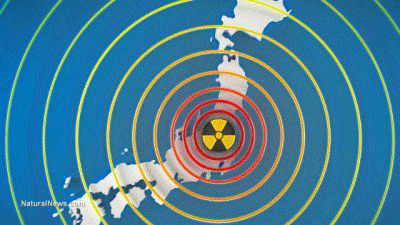
SCMP, 10 July 23, This week, the International Atomic Energy Agency (IAEA) said that Japan’s plan to release radioactive water from the Fukushima nuclear disaster in 2011 into the ocean meets international safety standards.
But instead of allaying concerns of neighbouring countries and activists, the stamp of approval from the global nuclear watchdog has drawn howls of disapproval, particularly from China, and even within Japan.
………………. The China Atomic Energy Authority said that more than 70 per cent of nuclear-contaminated water at the Fukushima nuclear power plant fails to meet discharge limits after going through a filtration system and requires further treatment.
Its secretary general, Deng Ge, said that even if international standards are met, the IAEA cannot prove that the discharge is the only or the best option for the disposal of nuclear-contaminated water………………………………………………………..
Not letting their own government off the hook, Japanese activists said they are very disappointed by the IAEA decision, arguing that Tokyo has gone back on its promise that the water would not be released until the plan received the public’s widespread acceptance.
Even though South Korea said that it respects the nuclear watchdog’s endorsement of Japan’s plan to release treated water into the ocean, Seoul also made it clear that it would issue its own assessment of the IAEA’s findings.
The IAEA report and an earlier offer by South Korean Prime Minister Han Duck-soo to drink treated Fukushima water had clearly done little to convince the country’s activists, fisheries and seafood industries, even its consumers, many of whom had stockpiled sea salt and other seafood items…………………..
Earlier this year, Pacific island nations also called on Japan to delay the release of water from the destroyed Fukushima nuclear power plant over fears that fisheries will be contaminated…………………………
more https://www.scmp.com/economy/global-economy/article/3227113/global-impact-japan-nuclear-watchdog-under-intense-scrutiny-over-discharge-fukushima-nuclear
The Fukushima Disaster: The hidden side of the story
Arnie Gundersen speaks of the cliché that “the solution to pollution is dilution,” but with the radiation from Fukushima being sent into the Pacific, there will be “bio-accumulation”—with vegetation absorbing radiation, little fish eating that vegetation and intensifying it and bigger fish eating the smaller fish and further bio-accumulating the radioactivity. Already, tuna off California have been found with radiation traced to Fukushima. With this planned further, and yet greater dispersal, thousands of people “in the Pacific basin will die from radiation,” he says.
Exposing the nuclear industry and its lies. https://www.telegraph.co.uk/politics/2023/07/08/labour-explore-ai-ban-decisions-nuclear-weapons-david-lammy/
“The Fukushima Disaster, The Hidden Side of the Story,” is a just-released film documentary, a powerful, moving, information-full film that is superbly made. Directed and edited by Philippe Carillo, it is among the strongest ever made on the deadly dangers of nuclear technology.
It begins with the words in 1961 of U.S. President John F. Kennedy: “Every man, woman and child lives under a nuclear sword of Damocles, hanging by the slenderest of threads, capable of being cut at any moment by an accident, or miscalculation or by madness.”
It then goes to the March 2011 disaster at the Fukushima Daichi nuclear power plants in Japan after they were struck by a tsunami. Their back-up diesel generators were kicked in but “did not run for long,” notes the documentary. That led to three of the six plants exploding—and there’s video of this—“releasing an unpreceded amount of nuclear radiation into the air.”
“Fukushima is the world’s largest ever industrial catastrophe,” says Professor John Keane of the University of Sydney in Australia. He says there was no emergency plan and, as to the owner of Fukushima, Tokyo Electric Power Company, with the accident its CEO “for five nights and days…locked himself inside his office.”
Meanwhile, from TEPCO, there was “only good news” with two Japanese government agencies also “involved in the cover-up”—the Nuclear Industry Safety Agency and Ministry of Economy, Trade and Industry.
“Japanese media was ordered to censor information. The Japanese government failed to protect its people,” the documentary relates.
Yumi Kikuchi of Fukushima, since a leader of the Fukushima Kids Project, recalls: “On TV, they said that ‘it’s under control’ and they kept saying that for two months. The nuclear power plant had already melted and even exploded but they never admitted the meltdown until May. So, people in Fukushima during that time were severely exposed to radiation.”
Arnie Gundersen, a nuclear engineer and now a principal of Fairewinds Energy Education in Burlington, Vermont, speaks of being told by Naoto Kan, the prime minister of Japan at the time of the accident, that “our existence as a sovereign nation was at stake because of the disaster at Fukushima Daichi.”
Kan then appears in documentary and speaks of “manmade” links to the disaster.
The documentary tells how Kan, following the accident, became “an advocate against nuclear power….ordered all nuclear power plants in Japan to shut down for safety” and for the nation “to move into renewable energy.”
But, subsequently, “a nuclear advocate,” Shinzo Abe, became Japan’s prime minister.
Yoichi Shimatsu, a former Japan Times journalist, appears in the film and speaks of “the cruelty, the cynicism of this government.” He speaks of how in the accident’s aftermath, “nearly every member of Parliament and leaders of the major political parties” along with corporate executives, “moved their relatives out of Japan”
He says “Shanghai is the largest Japanese community outside Japan now…while these same people” had been “telling the people of Fukushima go home, 10 kilometers from Fukushima, go home it’s safe, while their families are overseas in Los Angeles, in Paris, in London and in Shanghai.”
“If it’s safe, why they left?” asks Kikuchi. “They tell us it’s safe to live in Fukushima, and to eat Fukushima food to support Fukushima people. There’s a campaign by Japanese government…and people believe it.”
Gundersen says: “At Fukushima Daichi, the world is already seeing deaths from cancer related to the disaster…There’ll be many more over time.” He adds that there’s been a “huge increase in thyroid cancer in the surrounding population.”
“Unfortunately,” he goes on, “the Japanese government is not telling us al the evidence. There’s a lot of pressure on the scientists and the medical community to distort the evidence so there’s no blowback against nuclear power.”
There is a section in the documentary on the impacts of radioactivity which includes Dr. Helen Caldicott, former president of Physician for Social Responsibility, discussing the impacts of radiation on the body and how it causes cancer. She states: “There is no safe level of radiation. I repeat, there is no safe level of radiation. Each dose of radiation is cumulative and adds to your risk of getting cancer and that’s absolutely documented in the medical literature.”
“The nuclear industry says, well, there are ‘safe doses’ of radiation and even says a little bit of radiation is good for you and that is called the theory of hormesis,” notes Dr. Caldicott. “They lie and they lie and they lie.”
Maggie Gundersen, who was a reporter and then a public relations representative for the nuclear industry and, like her husband Arnie became an opponent of nuclear power, speaks of how nuclear power derives from the World War II Manhattan Project program to develop atomic weapons and post-war so-called “Atoms for Peace” push.
Gundersen says in becoming a nuclear industry spokesperson, “the things I was taught weren’t true.” The notion, for example, that what is called a containment at a nuclear plant is untrue because radioactivity “escapes every day as a nuclear power plant operates” and in a “calamity” is released massively.
As to economics, she cited the claim decades ago that nuclear power would be “too cheap to meter.” The president of Fairewinds Energy Education, she says: “Atomic power is now the most expensive power there is on the planet. It is not feasible. It never has been.” Regarding the radioactive waste produced by nuclear power, she says “there is literally no technology to do that…It does not exist.”
As to international oversight, the documentary presents the final version of a “Report of the United Nations Scientific Committee on the Effects of Atomic Radiation” issued in 2014 which finds that the radiation doses from Fukushima “to the general public during the first year and estimated for their lifetimes are generally low or very low….The most important effect is on mental and social well-being.”
Shimatsu says it is not only in Japan but on an international level that the consequences of radioactive exposure have been completely minimized or denied. “We are all seeing a global political agreement centered in the UN organizations, tie IAEA [International Atomic Energy Agency], the World Health Organization…All the international agencies are whitewashing what is happening in Fukushima. We take dosimeters and Geiger counters in there, we see a much different story,” he says.
In Germany, says Maggie Gunderson, “the politicians chose” to do a study to “substantiate” that no health impacts “happened around nuclear power plants….But what they found was the radiation releases cause significant numbers of childhood leukemia.” A summary of that 2008 study comes on the screen. The U.S. followed up on that research, she says, but recently “the [U.S.] Nuclear Regulatory Commission said it was not going to do that study,” that “it doesn’t have enough funding; it had to shut it down.” She said the real reason was that it was producing “data they don’t want to make public.”
Beyond the airborne releases of radiation after the Fukushima accident, now, says the documentary, there is the growing threat of radioactivity through water that has and still is leaking from the plants as well as more than a million tons of radioactive water stored in a thousand tanks built at the plant site. After the accident, TEPCO released 300,000 tons of radioactive water into the Pacific Ocean. Now there is no land for more tanks, so the Japanese government, the documentary relates, has decided that starting this year to dump massive amounts of radioactive water over a 30-year period into the Pacific.
Arnie Gundersen speaks of the cliché that “the solution to pollution is dilution,” but with the radiation from Fukushima being sent into the Pacific, there will be “bio-accumulation”—with vegetation absorbing radiation, little fish eating that vegetation and intensifying it and bigger fish eating the smaller fish and further bio-accumulating the radioactivity. Already, tuna off California have been found with radiation traced to Fukushima. With this planned further, and yet greater dispersal, thousands of people “in the Pacific basin will die from radiation,” he says.
Andrew Napuat, a member of the Parliament of the nation of Vanuatu, an 83 island archipelago in the Pacific, says in the documentary: “We have the right to say no to the Japan solution. We can’t let them jeopardize our sustenance and livelihood.” Vanuatu along with 13 other countries has signed and ratified the South Pacific Nuclear Free Zone Treaty.
As the documentary nears its end, Arnie Gundersen says that considering the meltdown at the Three Mile Island nuclear plant in Pennsylvania in 1979, the meltdown at the Chernobyl nuclear plant in Ukraine in 1986, and now the three Fukushima meltdowns in 2011, there has been “a meltdown every seven years roughly.” He says: “Essentially, once every decade the world needs to know that there might be an atomic meltdown somewhere.” And, he adds, the “nuclear industry is saying they want would like to build as many as 5,000 new nuclear power plants.” (There are 440 in the world today.)
Meanwhile, he says, “renewable power is no longer alternative power. It’s on our doorstep. It’s here now and it works and it’s cheaper than nuclear.” The cost of producing energy from wind, he says, is three cents a kilowatt hour, for solar five cents, and for new nuclear power plants 15 cents. Nuclear “makes no nuclear economic sense.”
Maggie Gundersen says, with tears in her eyes: “I’m a woman and I feel it’s inherent for us as women to protect our children our grandchildren, and it’s our job now to raise our voices and have this madness stop.”
Philippe Carillo, from France, who worked for 14 years in Hollywood and who since 2017 has lived in Vanuatu, has worked on several major TV documentary projects for the BBC, 20th Century Fox and French National TV as well as doing independent productions. He says he made “The Fukushima Disaster, The Hidden Side of the Story” to “expose the nuclear industry and its lies.” His previous award-winning documentary, “Inside the Garbage of the World,” has made changes regarding the use of plastic.
“The Fukushima Disaster, The Hidden Side of the Story” can be viewed at Amazon, Apple TV, iTunes, Google Play and Vimeo on demand. Links are: iTunes; Apple TV; Amazon UK; USA; Google Play, and Video on demand.
‘Grave concerns’ as Japan’s plan to release Fukushima water into the sea approved by nuclear watchdog
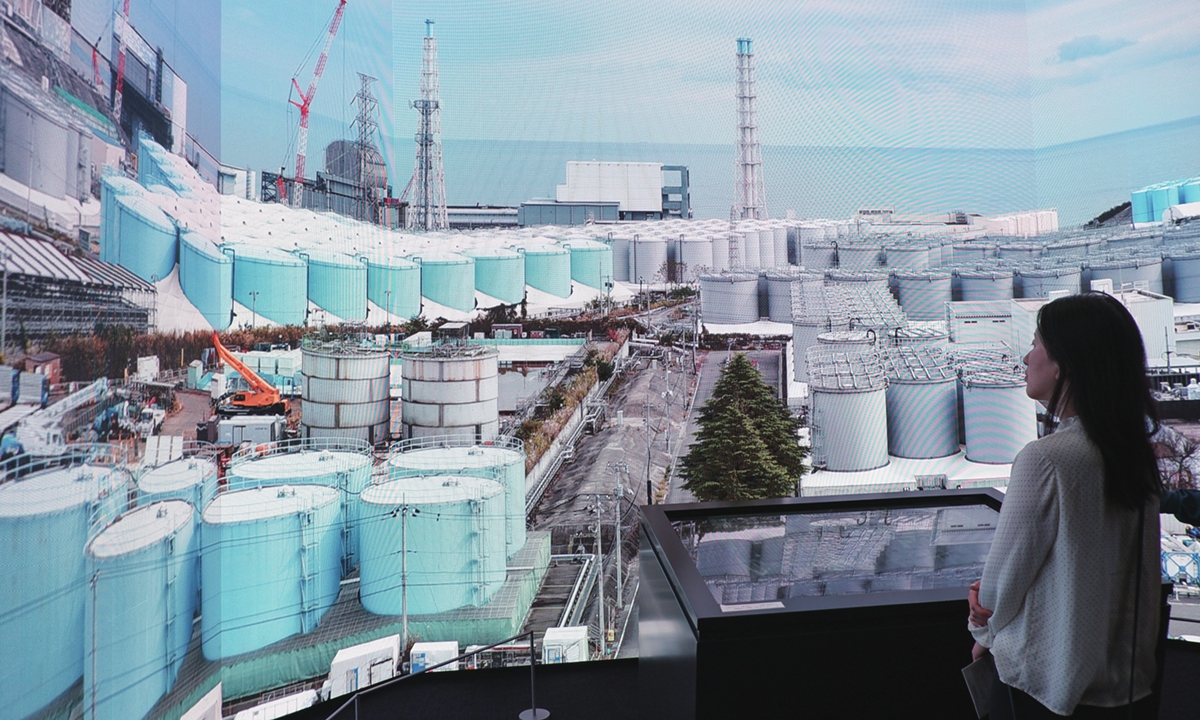
Japan’s nuclear meltdown 12 years ago led to a bandaid solution for radioactive waste. Now, time has run out and the next option is unthinkable.
Alex Blair, news.com.au 11 July 23
The UN’s international nuclear watchdog has come under heavy criticism after green-lighting Japan’s controversial plan to slowly dump radioactive water used to stem the 2011 Fukushima disaster.
When three reactors first went into meltdown over 12 years ago, nuclear authorities around the globe knew what was at stake. But a hasty bandaid fix — 1000 massive containment tanks built onsite — was never going to solve the issue long term. And now it appears time has run out for authorities looking to move forward.
Two years ago, Japan announced plans to gradually release the 1.33 million cubic metres of contaminated water into the sea over the next 30 to 40 years. Their strategy has now been approved after a lengthy review phase by the Atomic Energy Agency (IAEA), which claims the water will be processed to remove almost all radioactive elements, except tritium.
Efforts are now being made by nuclear and political authorities to ease public suspicion, with IAEA chief Rafael Grossi meeting with Fukushima residents this week in an effort to quell concerns.
However, one thing in particular has sparked intense backlash from surrounding nations and a portion of the global nuclear field. Within all the official box-ticking and PR campaigns urging confidence from the public, nuclear officials cannot be 100 per cent certain their plan will be safe and effective.
“These are global issues and need to address in a holistic manner,” Professor of Genetic Toxicology Awadhesh Jha told news.com.au. “Very limited information is available and we need to do more to assess the long-term effects, both with respect to human and environmental health.”
His criticisms echoed those from the Secretary General of the Pacific Islands Forum, Henry Puna, who said the release should be stalled “until we are certain about the implications of this proposal on the environment and on human health”.
In an article penned earlier this year, Mr Puna accused the Japanese government and international watchdogs of negligence, claiming there was no way to know the full impact until after decades of dumping nuclear material.
“The discussions this past year have not been encouraging,” he wrote.
We have uncovered serious information gaps and grave concerns with the proposed ocean release. Simply put, more data is needed before any ocean release should be permitted.
“Despite this, Japan is continuing with plans for discharge in the spring of 2023, relying on the next four decades of discharge to figure it out.
“It would be unconscionable for us as a region to once again allow ourselves to be lulled into a false sense of security.”
China, South Korea call for ‘transparent, convincing response’
China has been the most critical of Japan’s closest neighbouring nations, accusing Tokyo of turning the ocean into its “private sewer” and calling on more safety data from the nuclear watchdog.
Chinese officials have also accused the Japanese government of breaching “international moral and legal obligations”, warning that if the plan goes ahead, Japan “must bear all consequences”.
“Japan should stop the plan to release the water into the sea, but seriously consult with the international community and consider a scientific, safe, transparent and convincing response,” China’s ambassador to Japan said on Tuesday.
Meanwhile in South Korea, public polls revealed 80 per cent of the country are deeply concerned about the unknown long-term effects of the water release………………………
Tetsu Nozaki, chairman of the Fukushima Prefectural Federation of Fisheries Co-operative Associations, argued Japan’s government was misrepresenting local sentiment, which he said remained strongly opposed to the plan……………………………………
A radioactive isotope of hydrogen, tritium is one the most expensive, rare, and potentially harmful elements in the world, according to nuclear engineer Arjun Makhijani, a prominent anti-nuclear campaigner and president of the Institute for Energy and Environmental Research.
In his book Exploring Tritium’s Danger, Makhijani claims that “one teaspoon of tritiated water would contaminate about 100 billion gallons of water to the US drinking water limit; that is enough to supply about 1 million homes with water for a year”………………….
How will Japan’s plan work?
The diluted water will be discharged into the Pacific Ocean to Japan’s east via an undersea tunnel located off the coast.
With the IAEA’s approval, pumping could commence as early as August…………………………
But according to Professor Jha, further research is essential to comprehensively assess the potential risks posed by tritium to the marine food chain.
Professor Jha’s laboratory experiments indicate that tritium has the ability to accumulate in the tissues of shellfish, such as mussels and oysters.
He believes actual consequences of real-world exposure remain largely unexplored and require closer investigation.
“It needs an international research effort,” he said.
Professor Jha’s criticism came as the Tokyo Electric Power Company, the firm that runs the site, admitted the giant mass of water will need additional, “secondary” treatment to reduce the presence of other isotopes including ruthenium-106, cobalt-60 and strontium-90.
But there are still concerns over whether the water being released will have been completely cleansed before coming into contact with sea life.
“Unlike tritium, cobalt-60 is 300,000 times more likely to accumulate on the seafloor at the outlet of the pipes,” Ken Buesseler of the Woods Hole Oceanographic Institution said.
“It will build up over time, it will accumulate. So whatever amount you put in, it doesn’t just dilute away.”
What are the other solutions?
…………………..Buesseler on the other hand advocates for the treated water to be used in concrete production for massive buildings around the Fukushima plant.
Buesseler argues this would generate the least risk, with “little potential for human contact, as the concrete being used on the Fukushima Daiichi site and/or tsunami barriers for coastal protection”.
“Since contaminated water is still being generated, this ocean dumping – that is what it would be called if the water were put in a barrel and thrown overboard – of radioactive water would continue for 30 years (possibly more),” Buesseler writes.
“The water would still contain some strontium-90 and other radionuclides with attendant risks of uptake associated with seafloor sediments.
“Besides the radioactivity exposure, which TEPCO estimates will be well below 1 millisievert per year, the dumping would also create reputation damage to the fishing and tourist industries, not only in Japan but across other countries in the Pacific region.” https://www.news.com.au/technology/environment/grave-concerns-as-japans-plan-to-release-fukushima-water-into-the-sea-approved-by-nuclear-watchdog/news-story/854cc5d9618a2a5bde1de2f657f49a89
Backlash builds as Japan prepares to release wastewater from Fukushima nuclear plant
July 9, 2023 The Associated Press
SEOUL, South Korea — South Korean opposition lawmakers sharply criticized the head of the United Nations’ nuclear watchdog on Sunday for its approval of Japanese plans to release treated wastewater from the damaged Fukushima nuclear power plant.
They met with Rafael Grossi in a tense meeting in Seoul that took place while protesters screamed outside the door.
Grossi, the International Atomic Energy Agency’s director general, arrived in South Korea over the weekend to engage with government officials and critics and help reduce public concerns about food safety……………………
“Our conclusion has been that this plan, if it is carried out in the way it has been presented, would be in line, would be in conformity with the international safety standards,” Grossi said.
The lawmakers responded by harshly criticizing IAEA’s review, which they say neglected long-term environmental and health impacts of the wastewater release and threatens to set a bad precedent that may encourage other countries to dispose nuclear waste into sea. They called for Japan to scrap the discharge plans and work with neighboring countries to find safer ways to handle the wastewater, including a possible pursuit of long-term storage on land.
The party has also criticized the government of South Korean President Yoon Suk Yeol for putting people’s health at risk while trying to improve relations with Japan.
“If you think (the treated wastewater) is safe, I wonder whether you would be willing to suggest the Japanese government use that water for drinking or for industrial and agricultural purposes, rather than dumping it in the sea,” Woo Won-shik, a Democratic Party lawmaker who attended the meeting, told Grossi. The party said Woo has been on a hunger strike for the past 14 days to protest the Japanese discharge plans.
Further details from the meeting weren’t immediately available after reporters were asked to leave following opening statements. Closely watched by parliamentary security staff, dozens of protesters shouted near the lobby of the National Assembly’s main hall where the meeting was taking place, holding signs denouncing the IAEA and Japan.
Grossi was to fly to New Zealand later on Sunday and would then travel to the Cook Islands as he further tries to reassure countries in the region about the Japanese plans.
Hundreds of demonstrators had also marched in downtown Seoul on Saturday demanding that Japan scrap its plans………………..
In a statement released by state media on Sunday, North Korea also criticized the Japanese discharge plans, warning against “fatal adverse impact on the human lives and security and ecological environment.” The statement, which was attributed to an unidentified official in North Korea’s Ministry of Land and Environment Protection, also criticized Washington and Seoul for backing the Japanese plans.
“What matters is the unreasonable behavior of IAEA actively patronizing and facilitating Japan’s projected discharge of nuclear-polluted water, which is unimaginable,” it said. “Worse still, the U.S. and (South) Korea openly express unseemly ‘welcome’ to Japan’s discharge plan that deserves condemnation and rejection, provoking strong anger of the public.” https://www.google.com/url?q=https://www.npr.org/2023/07/09/1186677021/japan-fukushima-nuclear-plant-wastewater-release&source=gmail&ust=1689045728026000&usg=AOvVaw0yQeOwHGuLqJqRrbIjNedx
Nagasaki to take shot at G-7 over its nuclear deterrence stance
THE ASAHI SHIMBUN
July 9, 2023
NAGASAKI–Nagasaki’s annual peace declaration this summer is expected to take issue with a nuclear disarmament document adopted at the Group of Seven summit held in Hiroshima in May for trying to maintain nuclear deterrence.
In doing so, it will reflect the critical voices of “hibakusha” atomic bomb survivors.
On July 8 the city presented a preliminary draft of the declaration to the third meeting of the drafting committee, which is comprised of 15 members, including scholars and hibakusha.
Mayor Shiro Suzuki will read the declaration during a ceremony on Aug. 9 to mark the 78th anniversary of the city’s 1945 atomic bombing.
The G-7 Leaders’ Hiroshima Vision on Nuclear Disarmament states: “Our security policies are based on the understanding that nuclear weapons, for as long as they exist, should serve defensive purposes, deter aggression and prevent war and coercion.”………………………………………
Shigemitsu Tanaka, 82, who heads the Nagasaki Atomic Bomb Survivors Council, said at the second meeting of the drafting committee on June 17 that the Hiroshima Vision “justified” the argument for nuclear deterrence.
He called on city authorities to revise an earlier draft to echo the low regard hibakusha atomic bomb survivors have for the G-7 document………………………………….’Nagasaki city expects to compile a draft outline of the peace declaration by the end of July after gauging opinions about the preliminary draft. https://www.asahi.com/ajw/articles/14952502
UN report on Japan’s Fukushima water plans fails to placate opponents

“The concern is not over external exposure,” Burnie said. “It is internal exposure to organically bound tritium that is the problem – when it gets inside fish, seafood, and then humans. When tritium gets inside cells, it can do damage.
“Tepco and the Japanese government are making a conscious decision to increase marine pollution with radioactivity, and they have no idea where that will lead.”
While South Korea offers official support, China and other voices in region continue to express concerns over discharge from nuclear plant
Justin McCurry in Tokyo, 7 July 23 https://www.theguardian.com/environment/2023/jul/07/un-report-on-japans-fukushima-water-plans-fails-to-placate-opponents
The publication this week of the UN nuclear watchdog’s positive assessment of Japanese plans to pump more than 1m tonnes of water from the wrecked Fukushima Daiichi nuclear power plant into the ocean has failed to placate opponents.
China is fiercely opposed to the plans, despite a report by the International Atomic Energy Agency (IAEA) backing the scheme, while the support of the government of South Korea has failed to quell widespread public opposition to the idea in the country.
The government in Seoul said on Friday that it “respected the IAEA’s review of plans by Japan and the plant’s operator, Tokyo Electric Power (Tepco), to pump water from the plant into the Pacific over the next 30 to 40 years”.
The discharge would have “negligible consequences” for South Korea, it said in an attempt to win over a deeply sceptical public. The country’s ban on food and seafood products from the Fukushima region will remain in place, however.
But South Korea, whose conservative president, Yoon Suk Yeol, is attempting to mend diplomatic fences with Japan over the countries’ wartime legacy, is a lone voice of support in the region.
On the same day, China announced a ban on food imports from 10 of Japan’s prefectures over “safety concerns”, and said it would conduct stringent radiation tests on food from the rest of the country.
“The Japanese side still has many problems in the legitimacy of sea discharge, the reliability of purification equipment and the perfection of monitoring programmes,” Chinese customs said.
Japan’s top government spokesperson, Hirokazu Matsuno, responded to criticism of the plan by saying that Fukushima Daiichi would pump far less tritium into the ocean than Chinese and South Korean nuclear facilities.
Japan’s standard for the release of tritium, at below 22tn becquerels a year, is far stricter than that of its neighbours, Matsuno said.
According to Japan’s trade and industry ministry, the Yangjiang nuclear plant in China discharged about 112tn becquerels of tritium in 2021, while the Kori power station in South Korea released about 49tn becquerels.
That is unlikely to placate opponents in Fukushima, where fishing communities have warned the water discharge will undo more than a decade of work to repair the damage the meltdown inflicted on the reputation of the region’s seafood, which is subject to one of the world’s strictest radiation testing regimes.
“We here in Fukushima have done absolutely nothing wrong, so why do they have to mess up our ocean?” said Haruo Ono, a fisher in Shinchimachi, 34 miles north of Fukushima Daiichi. “The ocean doesn’t belong to only us humans – and it isn’t a rubbish tip.
“It’s been 12 years [since the meltdown] and fish prices are rising, so we were finally hoping to really get down to business. Now they’re talking about releasing the water and we’re going to have to go back to square one again. It’s unbearable.”
Fisheries cooperatives in three prefectures were due to submit a petition with 33,000 signatures on Friday expressing their opposition to the water discharge.
While their government has given Japan breathing room, many South Koreans remain sceptical of Tokyo’s safety assurances. Some are panic-buying salt amid contamination fears, while a Gallup poll conducted in June found 78% of South Koreans were either “very worried” or “somewhat worried” about potential harm to the marine environment.
“It’s much more difficult to make sales now, as customers are asking more questions as they worry a lot,” said Jin Wol-sun, a stallholder at Seoul’s Noryangjin market, where market officials carried out random radiation tests on seafood in an attempt to reassure shoppers.
Rafael Grossi, the head of the IAEA, conceded there had been a lack of unanimity among the IAEA scientists, who come from 11 countries, including China, involved in the safety review. One or two “may have expressed concerns” over the plan, he said in an interview with Reuters. “I heard that being said … but again, what we have published is scientifically impeccable.”
China’s state-run Global Times newspaper on Thursday said Liu Senlin, a Chinese expert in the IAEA’s technical working group, was disappointed with the “hasty” report and had said the input from experts was limited and only used for reference.
Other experts openly voiced concerns about the impact the discharge could have on marine and human life, and accused Tepco and the IAEA of cutting corners.
“We have repeatedly pointed out to Tepco and IAEA substantive concerns we have with Japan’s approach and flaws in their methodology,” said Ferenc Dalnoki-Veress, an adjunct professor at Middlebury Institute of International Studies at Monterey in the US.
Dalnoki-Veress, a member of a panel of scientists that advised the Pacific Islands Forum, cited Tepco’s controlled tritium-exposure experiments on fish, which he said included only three species that were being fed on commercial fish pellets rather than exposed smaller fish, which would normally be their food source.
“We have repeatedly offered to help advise on how to conduct these experiments, but each time Tepco rejected them,” he said. “We take as proof that they are not truly interested in collecting relevant data that may demonstrate and confirm concerns regarding their present plans.”
The “dumping” of treated water into the ocean, he said, would cause potentially irreversible damage to the local fishing industry.
“When we think about the effect of radiation we can’t just think about the effect on the environment, we have to consider the effect on cultures, societies and peoples who suffer psychological effects, a sense of fear, and reputational damage. Trust has been broken, and it will be difficult to repair.”
Shaun Burnie, a senior nuclear specialist with Greenpeace who regularly visits Fukushima, said claims that tritium posed no risk to human health were “scientifically bankrupt”.
“The concern is not over external exposure,” Burnie said. “It is internal exposure to organically bound tritium that is the problem – when it gets inside fish, seafood, and then humans. When tritium gets inside cells, it can do damage.
“Tepco and the Japanese government are making a conscious decision to increase marine pollution with radioactivity, and they have no idea where that will lead.”
Japan claims that China and South Korea both pour radioactive waste-water , worse than Japan’s, into the oceans

Japan said Thursday that China and South Korea have both discharged liquid
waste containing high levels of tritium, a radioactive material, countering
Beijing’s criticism of Tokyo’s plan to release treated water from the
Fukushima nuclear power plant. Chief Cabinet Secretary Hirokazu Matsuno
also said Japan will explain to China “based on scientific perspectives”
the planned water discharge into the sea from the nuclear complex, crippled
by a devastating earthquake and ensuing tsunami in March 2011. Japan’s
standard for the release of tritium, at below 22 trillion becquerels per
year, is far stricter than that of other nations including its neighbors
China and South Korea, Matsuno, the top government spokesman, said at a
regular press conference.
In 2021, the Yangjiang nuclear plant in China
discharged around 112 trillion becquerels of tritium, while the Kori power
station in South Korea released about 49 trillion becquerels of the
radioactive material, Japan’s industry ministry said.
Japan Today 6th July 2023
Huge protest against Rafael Grossi at Gimpo airport, Seoul, South Korea
Sung-Hee Choi , 7 July 23
Most western mainstream media says that the [right wing] South Korea government agrees with the IAEA draft that the Japanese government’s decision to discharge nuclear contaminated water into the ocean fits to standard.
However, it does seldom say that just last night(July 7/8), Grossi, the director-general of the IAEA was hugely unwelcomed, stranded for hours in the Gimpo airport, Seoul, thanks to protestors with the signs including the one which read, “Did you leak the draft for 1 million euroes?” Around 280 policemen were mobilized to fence Grossi from the righteously angry South Korean protesters.
See the photos
https://www.kukinews.com/newsView/kuk202307080001?skin=news
Please watch the videos
https://www3.nhk.or.jp/nhkworld/en/news/20230708_04/. (English)
https://www.ytn.co.kr/_ln/0101_202307080504347351
“More than 80 percent of respondents in 11 countries in the Asia-Pacific region except for Japan said Japan’s plan of dumping nuclear-contaminated water into the sea is “irresponsible” and nearly 90 percent of respondents showed negative sentiments such as worries and shock toward the plan, and 94 percent of them deemed such move will have a negative effect not only on Japan and Pacific Rim countries but also the whole world, a survey conducted by the Global Times Research Center found.”
https://www3.nhk.or.jp/nhkworld/en/news/20230630_20/?fbclid=IwAR3CNvbsTp_
Better, safer, alternatives for managing Fukushima’s radioactively polluted wastewater.
independent marine biologists and, ecosystem specialists have been opposed across the planet, to dumping this partially treated water since the ALPS system was exposed as an inadequate treatment program. All nuclear advocates do is parrot, the limited, legal liability mantra all corporations do.
When did, anyone, read, any BURNING FUEL FOR ENERGY FIRM EVER ADMIT LEGAL LIABILITY over, its production or waste they dump into the ecosystems on a global scale?
Advanced Liquid Processing System (ALPS) largely chosen because it was cheaper than treating it with the more expensive systems offered outside of TEPCO, on the international market.
REVERSE OSMOSIS-RO
TEPCO considered implementing a reverse osmosis system to remove radioactive contaminants from the water. RO is a widely used technology for desalination and purification. But the process was far too expensive given the volumes of water that needed processing, completely removing various radionuclides, including cesium, strontium, and cobalt, from the contaminated water.
CONCRETE ENCAPSULATION
Solidifying the wastewater in concrete has multiple benefits over ocean dumping, would allow all the water to be processed and removed from the tanks in as little as 5 years, considerably faster than the 30+ year timeframe for ocean disposal.
The tritium (which along with carbon-14 is not removed from the water) would remain trapped inside the concrete with negligible dose outside or on its surface since tritium betas cannot penetrate the skin.
Japan consumes approximately 40 million tons of cement annually, according to the Japanese Cement Association. If cement usage patterns in Japan are comparable to those in the United States, roughly one third of that amount, or 13 million tons, is likely used for making concrete for applications with minimal human contact or exposure.
Given this, a significant portion of the ALPS-treated wastewater could potentially be utilized for concrete required for various purposes at the Fukushima Daiichi power plant site itself.
This could include concrete for barrier walls, storage containers, stabilizing radioactive soil piles, and other similar applications.
Therefore, using concrete for low human contact is not without precedent as Japan plans to recycle far more radioactive soil for civil works projects which is another controversial topic domestically.
In addition, fresh water would be conserved since it is not used for manufacturing providing environmental benefits.
As a non-transboundary alternative, concrete encapsulation would likely be advantageous for Japan in its relations with other countries and domestically especially its fishing industry which would likely be severely affected.
UNDERGROUND INJECTION
Another option that was suggested involved injecting the treated water deep underground, into a geological layer that could safely contain the contaminants. This method would require careful consideration of the geology and hydrology of the area to ensure long-term safety.
ADVANCED LIQUID PROCESSING SYSTEM-ALPS
Was developed, in-house, by TEPCO, ALPS and designed to be a more cost-effective system, than on offer by outside developers, claimed to remove various radionuclides, including caesium, strontium, and cobalt, from the contaminated water.
The hope was the treated water, would meet the revised regulatory standards for safe discharge. TEPCO admitted publicaly, not all the caesium, strontium, and cobalt, were removed from the contaminated water.
Tritium was reduced, there is no doubt, even though the testing was reported as flawed and demonstrated in press releases by TEPCO themselves.
Japanese regulator greenlights discharge of nuclear waste from Fukushima plant.

(Rafael Grossi – the consummate hypocrite)
Grossi, however, stressed that the report does not signify support for Japan’s decision to discharge the nuclear-contaminated water into the ocean.
‘IAEA’s conclusion largely limited, incomplete, fails to respond to international community’s concerns,’ says China
AA, Necva Taştan |07.07.2023, ISTANBUL
Japan’s nuclear regulator Friday approved the release of treated radioactive water from the crippled Fukushima nuclear power plant, thus allowing the country to begin discharge of the waste into the sea this summer.
The plant’s operator, Tokyo Electric Power Company Holdings Inc., received certification from the Nuclear Regulation Authority of Japan after the International Atomic Energy Agency (IAEA) approved Japan’s water discharge plan through a comprehensive assessment, Tokyo-based Kyodo News reported.
Neighboring China has fiercely opposed the plan and on Friday imposed a ban on the import of seafood from Japan’s 10 regions.
However, the IAEA its two-year-long safety review report concluded the discharge of nuclear waste will have a “negligible” impact on people and the environment.
However, Beijing disagrees.
The report was submitted to Japanese Prime Minister Fumio Kishida early this week by IAEA chief Rafael Grossi.
“The IAEA conclusion is largely limited and incomplete and failed to respond to the international community’s concerns over Japan’s plan to dump nuclear-contaminated wastewater into the ocean,” said Wang Wenbin, a spokesman for China’s Foreign Ministry, Beijing-based Global Times reported.
Grossi, however, stressed that the report does not signify support for Japan’s decision to discharge the nuclear-contaminated water into the ocean.
Wang said Grossi’s remarks that “one or two experts” of the IAEA team had concerns over the agency’s report on Japan’s nuclear waste, “once again prove the report was hastily released and failed to fully reflect views from experts who participated in the review.”……….
“China urges Japan not to take the report as the greenlight,” but suspend the dumping plan and dispose of the nuclear-contaminated wastewater in a responsible way, Wang added.
Grossi is now traveling to South Korea, New Zealand, and Cook Islands, which is the current chair of the Pacific Islands Forum, to “address concerns, hear views, clarify IAEA role” on Japan’s nuclear waste, the IAEA chief said on Twitter.
Japan’s water discharge plan, announced in April 2021, faced significant criticism from China, South Korea, North Korea, Taiwan, and international organizations, including the UN.
The US supported the proposal, following years of discussions on dealing with over 1 million tons of water stored at the Fukushima nuclear complex since the 2011 disaster.
Despite the pressure, Japan last month initiated the injection of seawater into a drainage tunnel at the damaged Fukushima Daiichi Nuclear Power Plant, marking the initial stage of releasing treated radioactive wastewater into the ocean. https://www.aa.com.tr/en/asia-pacific/japanese-regulator-greenlights-discharge-of-nuclear-waste-from-fukushima-plant/2939518
IAEA chief Rafael Grossi says he’s satisfied with Japan’s plans to release Fukushima wastewater
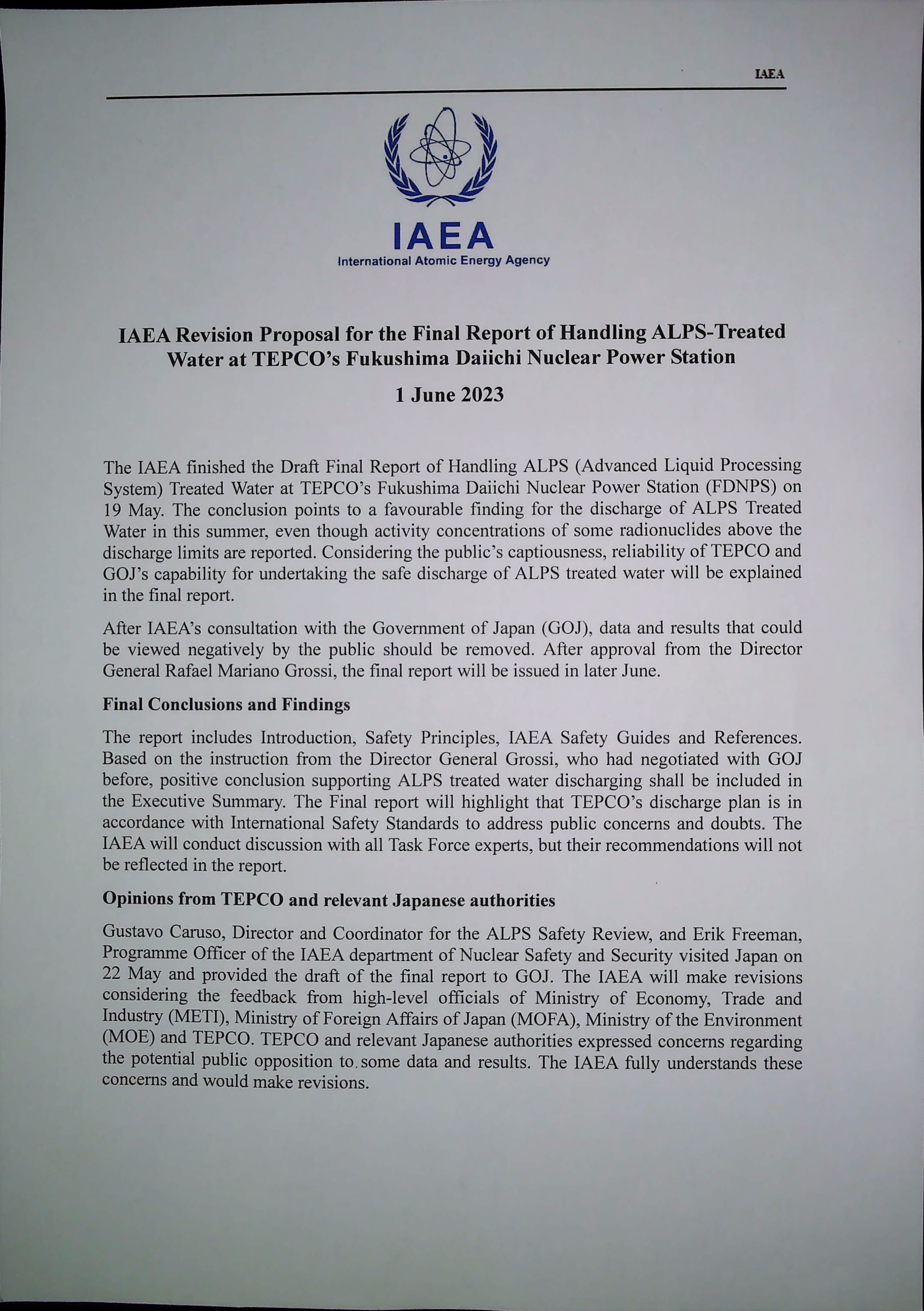
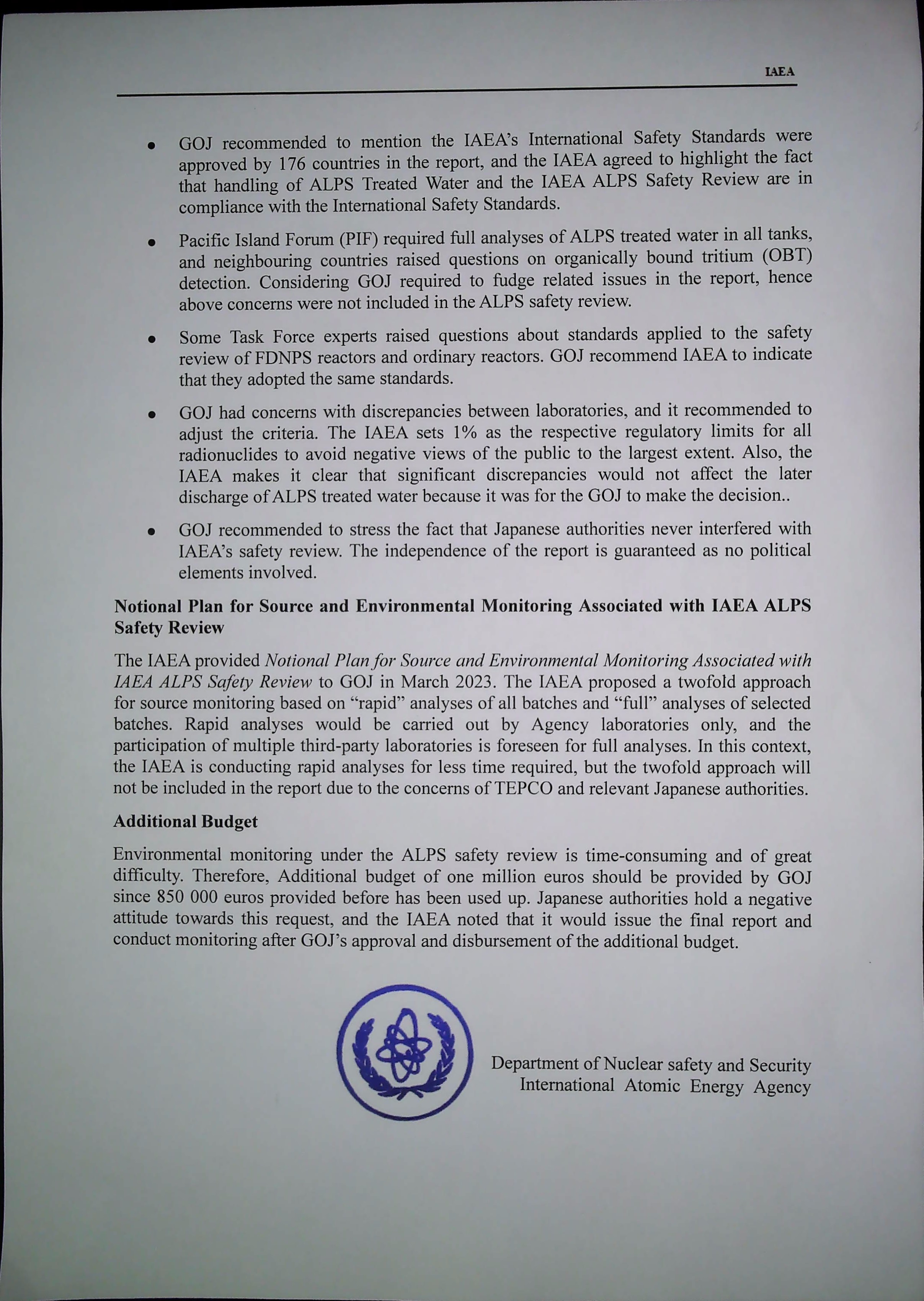
[Ed note. In this IAEA’s internal document the IAEA is seen coaching TEPCO about what to tell and what not tell to the public regarding the « treated » water to be soon discharged into the Pacific Ocean.
One thing that can be drawn from that document’s content is that the IAEA and TEPCO have no intention to be fully transparent about the radioactive contamination of the said « treated water », only the one to cushion insidiously the real facts to the public eyes.]
BY MARI YAMAGUCHI, July 5, 2023
FUTABA, Japan (AP) — The head of the U.N. atomic agency toured Japan’s tsunami-wrecked Fukushima nuclear power plant on Wednesday and said he is satisfied with still-contentious plans to release treated radioactive wastewater into the Pacific Ocean…………………………………

The wastewater release still faces opposition in and outside Japan.
Earlier Wednesday, Grossi met with local mayors and fishing association leaders and stressed that the IAEA will be present throughout the water discharge, which is expected to last decades, to ensure safety and address residents’ concerns. He said he inaugurated a permanent IAEA office at the plant, showing its long-term commitment.
The water discharge is not “some strange plan that has been devised only to be applied here, and sold to you,” Grossi said at the meeting in Iwaki, about 40 kilometers (25 miles) south of the plant. He said the method is certified by the IAEA and is followed around the world…………………….
Local fishing organizations have rejected the plan because they worry their reputation will be damaged even if their catch isn’t contaminated. It is also opposed by groups in South Korea, China and some Pacific Island nations due to safety concerns and political reasons.
Fukushima’s fisheries association adopted a resolution on June 30 reaffirming its rejection of the plan.
The fishery association chief, Tetsu Nozaki, urged government officials at Wednesday’s meeting “to remember that the treated water plan was pushed forward despite our opposition.”
Grossi is expected to also visit South Korea, New Zealand and the Cook Islands to ease concerns there. He said his intention is to explain what the IAEA, not Japan, is doing to ensure there is no problem.
In an effort to address concerns about fish and the marine environment, Grossi and Tomoaki Kobayakawa, president of the plant operator, Tokyo Electric Power Company Holdings, signed an agreement on a joint project to determine whether they are impacted by tritium, the only radionuclide officials say cannot be removed from the wastewater by treatment.
In South Korea, officials said in a briefing Wednesday that it’s highly unlikely that the released water will have dangerous levels of contamination. They said South Korea plans to tightly screen seafood imported from Japan and that there is no immediate plan to lift the country’s import ban on seafood from the Fukushima region.
Park Ku-yeon, first vice minister of South Korea’s Office for Government Policy Coordination, said Seoul plans to comment on the IAEA findings when it issues the results of the country’s own investigation into the potential effects of the water release, which he said will come soon.
China doubled down on its objections to the release in a statement late Tuesday, saying the IAEA report failed to reflect all views and accusing Japan of treating the Pacific Ocean as a sewer.
“We once again urge the Japanese side to stop its ocean discharge plan, and earnestly dispose of the nuclear-contaminated water in a science-based, safe and transparent manner. If Japan insists on going ahead with the plan, it will have to bear all the consequences arising from this,” the Chinese Foreign Ministry said.
Grossi said Wednesday he is aware of the Chinese position and takes any concern seriously. “China is a very important partner of the IAEA and we are in close contact,” he said…………………. https://apnews.com/article/japan-fukushima-radioactive-water-a4dcc4457c95f15ac7636fde4aca1df3
—
1 This Month



26 September – International Day for the Total Elimination of Nuclear Weapons


PLEASE OPPOSE HR 8255 AND S.3639 – bills would accelerate satellite deployment, with no environmental review or safeguards – https://ncstd5li.quorum.us/campaign/169331/
To see nuclear-related stories in greater depth and intensity – go to https://nuclearinformation.wordpress.com
-
Archives
- September 2026 (219)
- August 2026 (330)
- July 2026 (355)
- June 2026 (287)
- May 2026 (306)
- April 2026 (356)
- March 2026 (251)
- February 2026 (267)
- January 2026 (308)
- December 2025 (358)
- November 2025 (359)
- October 2025 (375)
-
Categories
- 1
- 1 NUCLEAR ISSUES
- business and costs
- climate change
- culture and arts
- ENERGY
- environment
- health
- history
- indigenous issues
- Legal
- marketing of nuclear
- media
- opposition to nuclear
- PERSONAL STORIES
- politics
- politics international
- Religion and ethics
- safety
- secrets,lies and civil liberties
- spinbuster
- technology
- Uranium
- wastes
- weapons and war
- Women
- 2 WORLD
- ACTION
- AFRICA
- Atrocities
- AUSTRALIA
- Christina's notes
- Christina's themes
- culture and arts
- Events
- Fuk 2022
- Fuk 2023
- Fukushima 2017
- Fukushima 2018
- fukushima 2019
- Fukushima 2020
- Fukushima 2021
- general
- global warming
- Humour (God we need it)
- Nuclear
- RARE EARTHS
- Reference
- resources – print
- Resources -audiovicual
- Weekly Newsletter
- World
- World Nuclear
- YouTube
-
RSS
Entries RSS
Comments RSS
 nuclear-news