Indonesia calls for destruction of the world’s nuclear arsenals.
THE ASAHI SHIMBUN, by Yoshiaki Kasuga, Naoko Handa and Tadao Onaga. Rizki Akbar Hasan contributed to this story. May 19, 2023
BOGOR, Indonesia–Indonesian President Joko Widodo will call on the nuclear powers at the Group of Seven summit being held in Japan to destroy their nuclear arsenals.
In an exclusive interview with The Asahi Shimbun at Bogor on May 18, Joko said: “The Indonesian position is clear and firm. Nuclear weapons must be destroyed because they are a threat in the world.”
Joko and leaders of seven other non-member nations were invited to the G-7 summit that began May 19 in Hiroshima.
“Hiroshima is the symbol of peace,” Joko said. “I’m very happy that the G-7 is held in Hiroshima. This is very important.”
Joko was due to arrive May 19 for his first visit to this western Japan city. He expressed an interest in visiting the Hiroshima Peace Memorial Museum….
Indonesia, along with the other ASEAN nations, has signed the Treaty on the Southeast Asia Nuclear Weapon-Free Zone……..
Indonesia’s foreign policy is non-alignment and neutrality, which the government describes as “free and active.” For example, Jakarta has refused to take sides in the war between Russia and Ukraine, and Joko himself has met with both Ukrainian President Volodymyr Zelenskyy and Russian President Vladimir Putin to promote dialogue between the two nations.
Joko became the first Asian leader to visit the two nations in June 2022.
Indonesia’s neutral stance means it has not gone along with economic sanctions against Russia pushed by the United States and adopted by Western allies.
“The war (has been in place) one year already and (sanctions have not proved) effective to stop the war,” Joko said. “Dialogue is very important, and it must continue to be maintained.”
He added that Indonesia was prepared to serve as a bridge between Russia and Ukraine.
“Indonesia stands ready to contribute to bridge the differences and the collective leadership required to end the war,” Joko said. “Peace must be reached as soon as possible because in the end, the people are the victims.”
Indonesia was invited to the G-7 summit because it is considered one of the leaders of the Global South, mainly developing nations located in the Southern Hemisphere……………..
Referring to growing confrontation between the United States and China in the Asia-Pacific region, Joko emphasized that Indonesia continues with its “non-bloc” stance.
“Many said that Indonesia is close with the United States,” the Indonesian president said. “Many also said that Indonesia is close with China. I want to say that both statements are correct. The United States and China are important partners of Indonesia, just like Japan.” ……………………… https://www.asahi.com/ajw/articles/14911780
Anti-nuclear activists protest Japanese government plans to release radioactive water into the Pacific Ocean
DOZENS of anti-nuclear activists protested today to demand Japan scrap its plan to release radioactive water from a tsunami-damaged nuclear power plant into the sea, which may begin this summer.
”Don’t dump contaminated water into sea,” protesters chanted outside the Tokyo Electric Power Company Holding’s (Tepco) headquarters in Tokyo, holding banners with their demands such as “Don’t nuke the Pacific,” and “Stop contaminated water.”………………………………………………………………..
Several activists from South Korea joined Tuesday’s rally.
“The Pacific Ocean does not belong to Japan. It belongs to all living things in the ocean and everyone who depends on it for their livelihoods,” said Kyoungsook Choi, a Korea Radiation Watch co-ordinator.
“We are here today to send the message that Japan does not have the right to dump the radioactive water…………………. more https://morningstaronline.co.uk/article/w/anti-nuclear-activists-protest-japanese-government-plans-release-radioactive-water
Drink Fukushima water if it’s clean, South Korea tells Japanese officials
South Korea’s opposition leader has challenged Japanese officials to
drink treated radioactive water from the destroyed Fukushima nuclear power
plant amid concerns over Tokyo’s plan to release the water into the sea.
Lee Jae-myung, the leader of the Democratic Party of Korea, implored
Japanese officials to make good on their claims that the radioactive water
is filtered and safe to be released into the sea. There are fierce protests
from local fishing communities as well as neighbouring countries such as
South Korea, China, and the Pacific Island nations following concerns over
the consequences of releasing the water.
Independent 16th May 2023
Fukushima fishermen speak out against nuclear-contaminated wastewater dumping plan
Global Times, Xu Keyue and Xing Xiaojing in Iwaki May 17, 2023
Located at the confluence of cold and warm currents, the coastal area of Fukushima Prefecture, Japan, has a rich variety of sea life and a long history of local fishing.
In the 12 years since the accident at the Fukushima Daiichi Nuclear Power Plant, the fishing industry in the area has started to recover thanks to the efforts of local fishermen and other groups.
However, the Japanese government and the Tokyo Electric Power Company (TEPCO) have gone back on their promises and arbitrarily decided to release nuclear-contaminated wastewater into the sea, in a big blow to the Fukushima fishing industry and the prefecture’s revitalization.
As the scheduled plan to dump the nuclear-contaminated wastewater from Daiichi plant approaches, Global Times reporters went to Fukushima. In this second installment of this field investigation, the Global Times reveals the helpless fishermen who are speaking out.
Silenced Fukushima fishermen
Fishermen in Fukushima were banned from fishing after the March 11 earthquake and tsunami in 2011, which caused leaks at the Fukushima Daiichi Nuclear Power Plant. In 2015, the Japanese government, TEPCO, the Fukushima Prefectural Federation of Fisheries Cooperative Associations, and the National Federation of Fisheries Cooperative Associations of Japan signed an agreement, stating nothing would be done “about the nuclear-contaminated water from Fukushima without the understanding and consent of the relevant people.” However, in April 2021, the Japanese government blatantly broke its promise and announced that it had decided to dump the nuclear-contaminated wastewater from the Daiichi plant into the sea in two years, which has sparked strong dissatisfaction from fishery associations and the wider public.
As the most direct stakeholders, the voices of Fukushima fishermen are indispensable in the opposition to the disposal of nuclear-contaminated wastewater. However, when contacting them before the trip to Fukushima, Global Times reporters were surprised to find that the local fishermen were not allowed to speak.
Global Times reporters contacted industry groups such as the Fukushima Prefectural Federation of Fisheries Cooperative Associations and Fukushima Prefecture’s Soma Futaba Fisheries Cooperative Association for help in reaching fishermen in their areas, but were told that “individual fishermen are not allowed to give interviews.” Toshimitsu Konno, president of the Soma Futaba Fisheries Cooperative Association, told the Global Times that fishermen have different views and need to unify their opinions to form a single position on behalf of the association before negotiating with the Japanese government and TEPCO.
The voices of fishermen are at the heart of a series of field investigations into the issue of nuclear-contaminated wastewater at Fukushima. Global Times reporters tried other ways to contact the fishermen for interviews, but were either rejected or ignored.
It is understood that Japan’s trade associations are highly hierarchical and an extremely closed society. If members are excluded for offending the trade associations, it is equivalent to losing their jobs. When asked for an interview, one fisherman said, “we have to fish here for generations.”
The voices of fishermen are at the heart of a series of field investigations into the issue of nuclear-contaminated wastewater at Fukushima. Global Times reporters tried other ways to contact the fishermen for interviews, but were either rejected or ignored.
It is understood that Japan’s trade associations are highly hierarchical and an extremely closed society. If members are excluded for offending the trade associations, it is equivalent to losing their jobs. When asked for an interview, one fisherman said, “we have to fish here for generations.”
However, Haruo Ono, a fisherman from the town of Shinchi in Fukushima, said he was willing to be interviewed. He had something to say about the dumping of nuclear-contaminated wastewater.
The town is the northernmost part of Fukushima’s coastline, where rivers run eastward into the Pacific Ocean. Since Iwaki city where the Global Times reporters stayed is in the southernmost part of Fukushima Prefecture, to interview Ono, they set out early and drove north through towns of Hirono, Tomioka, Futaba and Namie, near the Daiichi and Daini nuclear power plants, and through Minamisoma and Soma cities, for more than 100 kilometers before arriving at Shinchi……………..
After the accident, fishermen were unable to fish normally for a long time and have not fully recovered until now. For years, Ono has been pressing for answers from the Japanese government and TEPCO…………………………………
the 71-year-old walked briskly, holding forth without waiting for a reporter’s question.
“When will Fumio Kishida, the Japanese prime minister, come and listen to our voices? When can he come to know the real situation in Fukushima?” asked Ono, speaking quickly in the Fukushima dialect.
“Does the government think that by issuing leaflets telling people that the nuclear-contaminated wastewater is OK, it can be released into the sea? Is that really safe? The sea is not a dustbin! In Japan, where people are fined for throwing rubbish into the sea, how can the wastewater containing radioactive materials be discharged into the sea? It is really strange that the Japanese government and TEPCO chose the easiest and cheapest way to throw out the wastewater when there were other options,” Ono said with a puzzled face………………………………………………………………………………………………….
Global Times reporters also visited seafood shelves in local supermarkets and found many imported products from areas such as the US, Chile and Russia, but those from Fukushima were nowhere to be found……………………………………………………….
“There is no change in the Fukushima fisheries association’s clear stance against the discharge plan,” Sawada said, stressing that he will continue to express his opposition to the plan to the Japanese government and TEPCO in collaboration with the national fishery association and other organizations.
………………………… World’s responsibility to protect the sea
Why would the association prohibit individual fishermen from speaking out when it also opposes the dumping plan? What is the “unified position” of the association, and how did the negotiations with the Japanese government go?……………………………………..more https://www.globaltimes.cn/page/202305/1290843.shtml
Japanese protesters call for US military to be evicted
https://www.rt.com/news/576288-okinawa-protesters-us-bases-china/ 15 May 23
Increasingly hostile relations between Washington and Beijing have dialed up the urgency of Okinawan protesters’ demands
Thousands of Japanese protesters assembled near Kadena Air Base in Okinawa to protest the US occupation of the island on Saturday, on the 51st anniversary of the island returning to Japanese control.
The annual demonstration comes amid rising regional tensions as the US supplies Taiwan with weapons in what China views as open provocation.
Chanting slogans including “Give us back our peaceful life” and “Osprey get out,” the latter being a reference to US military helicopters, the demonstrators demanded the closure of the US’ Okinawa bases. The island’s inhabitants are weary of the pollution – both chemical and aural – produced by Washington’s military outposts, as well as the high number of crimes committed by American servicemembers, from petty theft and drunk driving to rape and murder.
Governor Denny Tamaki has urged the Japanese and US governments to reduce the Pentagon’s footprint on the island, which hosts 70% of all US military facilities in Japan despite comprising just 1% of the country’s total land area.
The protests come as an increasingly militarized Japan becomes a focal point in the great-power rivalry between the US and China. The US recently fast-tracked a $500 million defense package to Taiwan, just a month after hosting Taiwanese President Tsai Ing-Wen for a hugely controversial “unofficial” visit, eliciting warnings and massive military maneuvers from Beijing.
Last year, Japan’s Ground Self-Defense Force held its first-ever large-scale maritime drill with US troops stationed in Okinawa, enacting scenarios aimed at deterring “competitor and adversary aggression.”
NATO is reportedly even planning to open a liaison office in Tokyo, as the bloc last year discarded the pretense of limiting itself to the ‘North Atlantic’ part of North Atlantic Treaty Organization by inviting its regional allies – Japan, Australia, South Korea, and New Zealand – to its annual summit in a signal of increased focus on Beijing.
Should war break out between the two countries, it is widely understood that the US would use its Japanese bases to stage operations, making Japan a likely target of Chinese retaliation.
Japan approved its largest defense budget ever last year and plans to double defense spending to 2% of GDP by 2027, making its defense budget the world’s third-largest after the US and China, in a drive to acquire “counterstrike capability.” This represents a significant strategic shift away from the solely defensive posture Tokyo has been legally required to maintain since the end of World War II, though the constitution’s language was relaxed in 2017.
Fukushima greets summer with dread as nuclear-contaminated wastewater dumping approaches
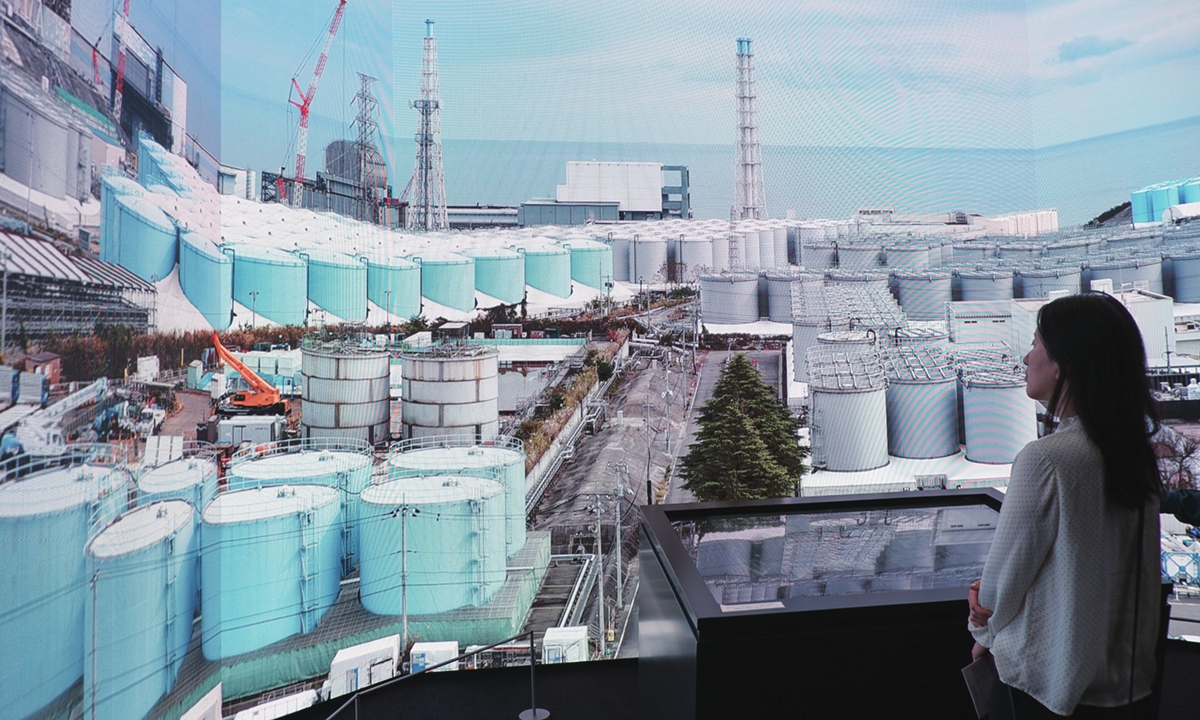
Global Times, By Xu Keyue and Xing Xiaojing in Iwaki, May 15, 2023
The Fukushima Prefecture in northeastern Japan is known as “the island of happiness,” which embodies people’s longing for a better life. Summer began in Fukushima in early May when locals normally look forward to intimate contact with the sea.
However, despite strong opposition at home and abroad, the Japanese government and the Tokyo Electric Power Company (TEPCO) are set to go ahead with the plan to dump the nuclear-contaminated wastewater from the Fukushima Daiichi Nuclear Power Plant into the sea this summer.
As summer approaches, the Global Times reporters went to the Fukushima Prefecture. In this first installment of this field investigation, the Global Times reveals the palpable sense of fear and unease hanging over Fukushima, paired with intense opposition from locals who chanted “Never allow arbitrary dumping into the sea!”………………………………………………………………………………………………………
About 54 kilometers away from the Fukushima Daiichi Nuclear Power Plant, the city looks subdued with few passersby along the streets. The excavation of an underwater tunnel for the project to drain the nuclear-contaminated wastewater from the Fukushima Daiichi Nuclear Power Plant was completed in April, and TEPCO announced that it is expected to complete the construction of the tunnel by the end of June. Measuring 1,031 meters long and 1 kilometer away from the coast, the tunnel will allow radioactive wastewater to be dumped into the sea.
…………………………………………………….. Chiyo Oda, co-chairperson of an environmental NGO and city assembly “Stop polluting the oceans!” was one of them.
“Summer is coming. What’s going to happen? Fukushima greets summer with fear!” said Oda, who expressed strong concern about the dumping of nuclear-contaminated wastewater at a conference themed “Don’t Nuke the Pacific” on May 7. “The Japanese government has reached an agreement with the fishing community that nothing will be done without [the fishing community and other stakeholders’] understanding.” Nevertheless, the Japanese government is apparently breaking its promise and is preparing to dump the water which is likely to start this summer.
When the Global Times reporters met Oda, the 68-year-old woman had just returned to Iwaki from Fukushima city, the capital of Fukushima Prefecture. Early that day, with Kazuyoshi Sato, another co-representative of the city assembly, Oda had driven for two hours to the Fukushima prefectural office to hold a press conference to announce that a mass rally called “May 16 Tokyo Action” will be held in Tokyo on May 16 to urge the Japanese government and TEPCO to stop dumping the nuclear-contaminated wastewater.
Oda told the Global Times that the campaign will last all day on May 16, when anti-sea pollution campaigners from all over Japan are meant to gather in Tokyo. As planned, they will gather in front of the TEPCO headquarters at 10:30 am, and then head to the House of Representatives with lawmakers to hold the rally. The rally and petition to the Japanese government and parliament will be followed by a speech at the Hibiya Open Air Concert Hall in the evening. It will then be followed by a massive demonstration in Ginza, Tokyo, which is expected to be attended by more than 1,000 people.
“The sea of my hometown, the Sea of Japan, and the seas of the world must not be polluted,” said Oda.
Oda noted that the Japanese government, TEPCO, the Fukushima Prefectural Federation of Fisheries Cooperative Associations, and the National Federation of Fisheries Cooperative Associations of Japan signed an agreement in 2015, stating it would not “do anything about the nuclear-contaminated water from Fukushima without the understanding and consent of the relevant people,” but now the Japanese government and TEPCO insist on dumping the water despite opposition from all parties, including fishermen. …………………………………………………………………………………………………………………………………………………………………..
“Look! This is the sea we want to protect!” Ikarashi told the Global Times that he and his family have fond memories of living by the sea, eating the catch from the same sea, surfing, and frolicking with their children. The people of Fukushima live just like them, having enjoyed the bounty of the sea for generations. If the nuclear-contaminated wastewater is dumped into the sea, future generations will no longer be able to enjoy the beautiful nature.
Ruiko Muto, who lives in Tamura, Fukushima, is the head of the association for the victims of the Fukushima nuclear accident. After the accident, she worked hard to hold the former management of TEPCO accountable as a member of the legal team for the Fukushima nuclear accident and the criminal prosecution team.
Muto told the Global Times in an email that “ALPS-treated water” used by the Japanese government and TEPCO contains many other radioactive substances besides tritium, making it “not safe at all.” Under such circumstances, attempts to release the radioactive wastewater from Fukushima into the sea must not be allowed.
Muto said that as summer approaches, her group will join forces with other civic groups and continue to express opposition through protests and rallies.
Dumping not only way
In an on-the-spot interview, Global Times reporters noted the intense concern over whether “ALPS-treated water,” as the Japanese government and TEPCO refer to it, is safe, and whether there is an alternative to dealing with the wastewater.
Hideyuki Ban, a Japanese nuclear expert and co-director of the Tokyo-based Citizens’ Nuclear Information Center (CNIC), told the Global Times that “the nuclear-contaminated wastewater contains 64 radionuclides, including tritium, some of which are very long-lived and cannot necessarily be diluted. [The compounds] can accumulate in the ocean and attach to fish and shellfish, and some of them can enter the body of marine organisms, causing human beings to be exposed to nuclear radiation after consumption. Even if [the wastewater] is treated and released into the sea, it is not safe.”
“There is no precedent in the world for dumping such wastewater containing 64 radionuclides into the sea,” he said.
“The capacity of ALPS to remove radionuclides and the amount of the nuclear-contaminated wastewater to be discharged are not fully understood, let alone gaining the understanding and consent of stakeholders. Under such circumstances, it is not allowed to arbitrarily discharge the wastewater,” he said.
Ban noted that there are other ways to dispose of the wastewater. For example, there is the option of “mortar solidification,” where the nuclear-contaminated wastewater is mixed, solidified, and stored in mortar as in cement production. What the Japanese government has done is based on a political decision, not one based on scientific research, Ban criticized……………………………………………………………………….
The problem, however, is that even if the nuclear-contaminated wastewater is disposed of, key issues such as whether nuclear fuel debris can be removed from the Daiichi plant remain unresolved. The government plans to decommission the reactor in the next 30 to 40 years, but it has yet to give a clear explanation of how long it will take to complete the project and in what condition the facility will have to be in order to qualify as successfully decommissioned, according to Muto.
Surrounded by the sea, Japan gives thanks to the gracious sea as a prosperous maritime nation, on “Sea Day” held annually on the third Monday of July, which is one of the statutory holidays in the country.. Born by the sea, the locals reached by the Global Times could not help but express their deep concern and fear that if the sea is polluted, it will be difficult to enjoy the sea’s succor in the future. https://www.globaltimes.cn/page/202305/1290745.shtml
 |
China’s nuclear ambitions get a boost from Russia, but is energy the only goal?

- Moscow is feeding Beijing’s growing appetite for highly enriched uranium, but observers say those supplies could be used for nuclear weapons
- China will replace the US to become the world’s top uranium buyer by 2030, experts say
Liu Zhen, 13 May, 2023, SCMP,
China is importing highly enriched uranium from Russia to produce energy, but observers caution that Beijing also plans to expand its nuclear arsenal. Photo: Shutterstock
The confirmation came last week when Russia said it had agreed to supply highly enriched uranium-235 to energy-hungry China over the next three years.
The announcement backed up reports that the shipments of nuclear fuel – enriched up to 30 per cent – were part of a deal to supply a demonstration fast-neutron power plant, a technology that could help China ease its shortage of nuclear fuel.
…….. with the enriched uranium fuelling a demonstration project for the new technology, China could improve its output of nuclear fuel and go some way to overcoming itst supply problem.
The final product would be plutonium 239, an artificial element that is primarily used in nuclear warheads – and that worries the West.
Although never officially admitted, Beijing is believed to be expanding the country’s nuclear arsenal, in line with President Xi Jinping’s pledge at last October’s 20th Communist Party congress to “strengthen strategic deterrence” as military tensions with the United States and its allies rise.
The US Department of Defence (DOD) has estimated China will increase from 400 warheads today to 1,500 by 2035.
……………………………………………………… With its two 600 megawatt power generators, the CFR-600 is not particularly large and is only considered a “demonstration project”. By comparison, the Daya Bay Nuclear Power Plant near Hong Kong, which has been operating since the 1990s, has two 944 megawatts generators.
In March, US DOD official John Plumb described the China-Russia cooperation deal as “very troubling”, but China’s foreign ministry has defended the arrangement as “perfectly normal and we do not see anything wrong about it”.
………………………… Fast-neutron reactors are an advanced fourth-generation nuclear power plant technology, which function to generate power, multiply nuclear fuel, and incinerate long-lived radionuclides, according to Xue Xiaogang, head of the China Institute of Atomic Energy Science.
……………………………………………. Russia has for decades been a leader in fast-neutron reactor technology, and last year its Beloyarsk BN-800 reactor began running completely on reprocessed spent fuel known as MOX.
But China’s imports of 30 per cent concentrated uranium-235 fuel for the Xiapu CFR-600 meant it was still at an earlier stage of technological development with many obstacles to overcome, said the researcher. https://www.scmp.com/news/china/military/article/3220391/chinas-nuclear-ambitions-get-boost-russia-energy-only-goal
Understanding The Highly Complex World Of Western China Analysis

CAITLIN JOHNSTONE, MAY 15, 2023 https://caitlinjohnstone.substack.com/p/understanding-the-highly-complex?utm_source=post-email-title&publication_id=82124&post_id=121463595&isFreemail=true&utm_medium=email
—
Former Pentagon official Elbridge Colby was interviewed on The National Review’s Charles CW Cooke Podcast, where he provided some very high-level analysis on the tensions around China, Taiwan, and the United States.
I will here attempt to explain some of Colby’s comments for the benefit of the average reader, because Colby has been studying these things for many years and his commentary can be a bit advanced and esoteric for the casual punditry consumer.
“The analogy I use is… Taiwan is like a man with a cut in the ocean, and China is like a great white shark, and America is like a man in a boat,” Colby said in the interview.
“The problem is once that great white shark starts moving, you got no time,” added Colby. “You’re done. You know, if you’re not already by the side of the boat, right? Because it’s a great white shark.”
Now bear with me if Colby’s incisive observations went a bit over your head here, but if we break it down I’m confident that we can all catch up to this man’s towering intellect enough to catch a glimpse of his understanding on the matter.
What Colby appears to be saying — and please correct me of you think I’m reading this wrong — is that China is like a Great White Shark, which as we all know is an extremely dangerous aquatic predator with a voracious appetite, capable of gulping down a human being in a few swift bites.
Now, try to imagine being in a situation where you’re out there in the ocean, and there’s a Great White Shark right there with you in the water. And to make matters worse, you’re bleeding — a problem not only due to the wound from whence the blood is emanating, but also because sharks can smell blood in the water! That would be pretty bad, right?
Okay, so are you with me so far? Remember, this is very advanced stuff, so feel free to read back and review as much as you need.
Now, imagine you’re in that situation with the cut and the shark, and there’s a boat that you can go to to get away from the shark. You’d want to hop aboard that vessel as swiftly as possible, don’t you think? I know I would!
So to put it all together, what the esteemed Elbridge Colby is telling us is that China is analogous to the Great White Shark which is eyeing the bleeding man in the water, and the man can be compared to Taiwan, and the United States of America is comparable to the boat that is coming to the rescue of the man.
Make sense? If you’re still struggling to comprehend Colby’s scalpel-like geopolitical analysis, don’t worry, because I’ve obtained this helpful infographic above, to further illuminate your understanding:
Interestingly enough, this is not the first time China has been compared to a Great White Shark in recent western punditry. The Hoover Institution’s Matt Pottinger, a former advisor to President Donald Trump, made a similar comparison in an interview with Nikkei Asia earlier this month:
“We saw a baby shark and thought that we could transform it into a dolphin over time, to become a friendly sort of system,” Pottinger said. “Instead, what we did was we kept feeding the shark and the shark got bigger and bigger and bigger and bigger. And now we’re dealing with a formidable, great white.”
“With a shark you put up a shark cage,” added Pottinger. “The shark doesn’t take it personally. It bumps into the cage. It respects those barriers.”
Again, this is very complicated for the uninitiated layperson, but what Pottinger appears to be saying is that China is not at all comparable to a dolphin, which is an oceanic mammal known to be friendly toward people and easily trained to do tricks in aquatic theme parks. Rather, in Pottinger’s understanding, China is more comparable to a Great White Shark, which as you’ll recall from our discussion earlier in this essay is actually known to be rather dangerous.
If you’re still struggling to make sense of Pottinger’s luminous understanding, here’s another illustration to help make things a bit clearer:
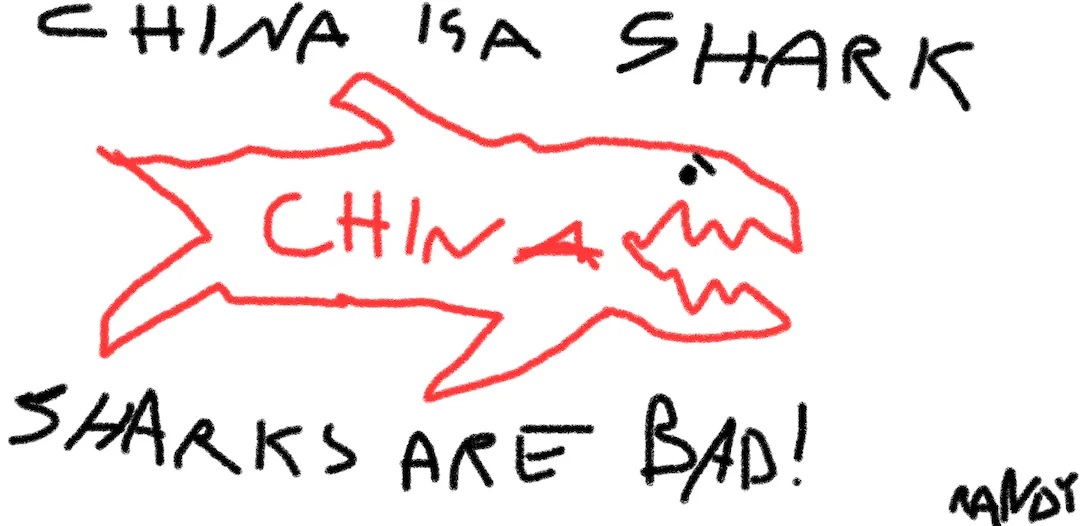
If you need it simplified even further, another way to put it might be, CHINA BAD. SHARK BAD. CHINA LIKE SHARK. CHINA VERY, VERY BAD. BAD CHINA. BAD.
Again, don’t be hard on yourself if you can’t quite wrap your head around the high-level analysis of intellectual giants like Matt Pottinger and Elbridge Colby. If we could understand these things as well as they do, we’d be the ones earning big bucks from Washington think tanks, not them!
Well I think that’s enough work for your gray matter today. Have a rest and a nice sleep and come back fresh tomorrow, where we’ll be discussing some mind-blowing comparisons western analysts have been drawing between Vladimir Putin and Adolf Hitler.
What to Know About Fukushima’s Exclusion Zone and Nuclear Mutations
The Fukushima exclusion zone is the result of a nuclear disaster in 2011. Keep reading to learn more about nuclear mutations and the earthquake that started it all.
BY RAYNA SKIVER. MAY 8 2023, https://www.greenmatters.com/clean-energy/fukushima-exclusion-zone
Back in 2011, a coastal city in Japan was hit by a powerful earthquake and tsunami. When this disaster struck Fukushima, reactors at a nuclear power plant overheated melted, causing radioactive materials to be released into the environment.
Soon after the catastrophe, the Fukushima exclusion zone was created.
After the disaster, the area surrounding the power plant was closed off due to the dangers of radiation— this site is called an exclusion zone. Today, a few places are still closed even after all of these years.
Some people might think that Fukushima is completely unsafe to visit, but that’s actually not the case. In fact, it’s possible to tour the area and learn more about the disaster. Real Fukushima is one of the many organizations that are working to change the public’s perception — they want people to see the city as hopeful, not dark.
The Fukushima disaster resulted in nuclear mutations.
Another result of the 2011 catastrophe was nuclear mutations. According to NBC News, researchers found mutations in butterflies near the Daiichi power plant. This observation was a sign of potential changes to the local ecosystem.
Nearby forests were also affected by the nuclear disaster. Studies showed that leaves had high concentrations of radiation and that there were “growth mutations of fir trees,” according to Greenpeace. The organization voiced concern about the potential consequences that the disaster might have on plants and animals.
The Fukushima nuclear disaster had terrible consequences for the surrounding communities and the environment. According to BBC, the earthquake and the tsunami that followed killed over 18,000 people, with many still missing. Over 150,000 had to evacuate the area as well, due to radiation leaks.
After the event, many countries began correcting design flaws — such as having the generators in the basement — and conducting stress tests in order to minimize future risks. On the other hand, Japan decided to phase out nuclear energy altogether.
The country’s citizens were uncomfortable with their dependence on atomic energy after the disaster, understandably so. Most nuclear power plants in Japan have been idle since 2011. Before the incident, nuclear energy accounted for about a third of the country’s power, but in 2020, the number significantly decreased to less than 5 percent, according to The Guardian.
But now, the country is reconsidering its reliance on nuclear power. Japan is looking for a secure energy supply — the war in Ukraine and rising energy costs have made the feat difficult. Not only might this be an unpopular move with the country’s citizens, but it’s also a loss for the environment.
Nuclear energy produces radioactive waste. This waste can end up harming both humans and the environment, according to the Energy Information Association. Nuclear power plants are also water hungry — they require a lot of water for cooling, Greenpeace explained.
With all of the risks involved, it might be best to turn away from nuclear energy and toward renewable energy.
Abolish Nukes, Kishida, G7! — limitless life

Secretariat for the G7 Hiroshima Summit Ministry of Foreign Affairs, Japan 2-2-1 Kasumigaseki, Chiyoda-ku Tokyo 100-8919
Dear Members of the Secretariat:
Ever since the summer of 1955, the Japan Council Against Atomic and Hydrogen Bombs (Gensuikyo) has actively campaigned to prevent nuclear war and abolish nuclear weapons. All of humanity is indebted to them for making significant contributions to world peace, such as when they organized the largest anti-nuclear protest ever, i.e., the antinuclear petition initiated by women and eventually signed by 32 million people, that came in the aftermath of March 1954 when U.S. nuclear testing irradiated people of the Bikini Atoll and the crew of a Japanese fishing boat called the “Lucky Dragon.” That international nuclear crime was only one in a long list of such crimes that began with President Harry Truman’s decision to drop the bombs on Hiroshima and Nagasaki in August 1945, ultimately killing hundreds of thousands of Japanese as well as tens of thousands of Koreans, not to mention the
people of other countries or the U.S. who were in those cities at the time.
Sadly, despite Gensuikyo’s foresight and decades-long, diligent efforts, we, all the members of our species, have been living under the threat of nuclear war for three quarters of a century. And during the last year that threat has been greatly elevated by the war in Ukraine, a war in which two nuclear powers, Russia and NATO, could possibly come into direct conflict in the near future.
Daniel Ellsberg, the famous whistleblower who sadly will not be with us much longer due to terminal cancer, paraphrased on the first of May the words of Greta Thunberg: “The adults are not taking care of this, and our future absolutely depends on this changing somehow fast, now.” Thunberg spoke of global warming while Ellsberg was warning about the threat of nuclear war.
With the high stakes of the war in Ukraine in mind, we must now, for the sake of young people, be “the adults in the room” during the G7 Summit in Hiroshima (19-21 May 2023). And we must voice our demands to the elected leaders of the G7 countries (essentially, the NATO side of the conflict).
World BEYOND War agrees with Gensuikyo that one “cannot build peace through nuclear weapons”. And we do endorse Gensuikyo’s main demands, which we understand as the following:
- Japan must pressure the other G7 nations to abolish nuclear weapons once and for all.
- Japan and the other G7 countries must sign and ratify the TPNW (Treaty on the Prohibition of Nuclear Weapons).
- In order to do so, the Japanese government must take the lead and promote the TPNW.- (Treaty for the Prohibition of Nuclear Weapons)
- Japan must not engage in military buildup under pressure from the United States.
…………………………………………………… more https://limitlesslife.wordpress.com/2023/05/07/abolish-nukes-kishida-g7/
US Sells Taiwan 400 Harpoon Anti-Ship Missiles – Profits and Provocations, Not Protection
There are no clear solutions for Taiwan if it continues down the path of US-sponsored separatism and antagonism toward the rest of China, so much so that the only logical solution to “defeat” a Chinese blockade of the island is to not provoke one in the first place.
US Sells Taiwan 400 Harpoon Anti-Ship Missiles as US-Chinese Tensions Rise
03.05.2023 Author: Brian Berletic
As the US continues its proxy war against Russia in Ukraine, it also continues preparations for a similar conflict with China using the island province of Taiwan as its proxy of choice in Asia.
Toward this end, the US continues flooding the island province with billions of dollars worth of weapons.
One of the more recent announced weapon sales was 400 Harpoon anti-ship missiles.
Washington’s Flawed “Porcupine Strategy” for Taiwan
The anti-ship missiles manufactured by Boeing would presumably be part of developing much wider anti-access area denial (A2AD) capabilities for the administration’s armed forces on the island.
A Taiwan-based analyst, Pei-Shiue Hsieh, in an article for The Diplomat titled, “Building Taiwan’s Own Area Denial Capabilities,” would claim:
While some assert that Taiwan cannot counter a Chinese invasion on its own, the results of my analytical wargames show the opposite. The drills by the Chinese People’s Liberation Army (PLA) last month likely demonstrated Beijing’s intentions to impose a naval blockade on the island in the event of a military confrontation. Taiwan’s military needs to prevent Chinese fleets from moving into their tactical positions or, if unable to prevent the blockade’s establishment, to disrupt ongoing PLA Navy (PLAN) operations.
In order to do so, the author suggests:
Taiwan must develop its own anti-access/area denial (A2/AD) strategy, which incorporates guided weapons and reconnaissance systems. Currently, Taiwan’s military possesses two possible options for guided anti-ship weapons: the ground-launched Hsiung Feng II/III and the ground- or air-launched AGM-84 Harpoon. With the reconnaissance information gathered by naval surveillance radars and MQ-9B SeaGuardian unmanned aerial vehicles, these legacy anti-ship missiles remain potent defenders of the island. However, as the PLAN is rapidly growing, Taiwan needs more than short- and medium-range options to cope with the PLA threat.
The Hsiung Feng III and Harpoon anti-ship missiles have ranges of 400 km and 139 km respectively. While these ranges may seem like more than enough to target and destroy Chinese warships imposing a sea blockade on the island of Taiwan, the problem is that while the missiles themselves have active radar homing, finding Chinese ships to home in on in the first place will be very difficult for Taiwan’s armed forces…………………………………………..
In a scenario where China is attempting to blockade Taiwan and China feels its surface vessels are at risk from anti-ship missiles, it can also employ submarines while using its formidable missile force to strike at and destroy not only military capabilities based on Taiwan, but also ports receiving military aid from abroad as well as ships attempting to deliver it. A blockade by any other name is still a blockade.
The other problem Taiwan’s administration faces is the time frame purchased weapons would actually reach the island. The 400 purchased Harpoon anti-ship missiles will take years at the earliest to arrive……………………
According to most estimates, the gap in military capabilities between China and the United States is set to close somewhere around 2025. By 2029, the gap would be in the process of widening, but this time in China’s favor.
Contracts for munitions like the LRASM are not even being publicly discussed, but should such contracts be signed, it’s likely Taiwan will be waiting as long or longer for the missiles to arrive, and that is assuming the missiles are developed into ground-launched systems to adapt to the reality Taiwan’s air force will not play a role in any hostilities with the rest of China.
Profits and Provocations, Not Protection
While Boeing is certainly profiting from the sale of 400 Harpoon anti-ship missiles to Taiwan, the move hardly enhances Taiwan’s military capabilities relative to the rest of China, nor does it do so within the window of opportunity the US seeks to provoke an armed conflict with China over Taiwan. If any blockade imposed by China around the island province of Taiwan is to be broken, it will have to be by the US military using a combination of anti-ship missiles and anti-submarine warfare.
US policymakers having wargamed an armed conflict between the US and China noted that the US would likely exhaust its arsenal of long-range anti-ship missiles of all kinds, a result of America’s limited military industrial capacity, a shortfall on demonstration amid its proxy war with Russia in Ukraine at the moment.
But even if the US didn’t run out of missiles and if the US was successful in thwarting China’s use of naval vessels to impose a blockade, a de facto blockade can still be imposed through the use of China’s long-range missiles fired from the mainland at Taiwan’s ports and any ships attempting to utilize them.
There are no clear solutions for Taiwan if it continues down the path of US-sponsored separatism and antagonism toward the rest of China, so much so that the only logical solution to “defeat” a Chinese blockade of the island is to not provoke one in the first place.
Brian Berletic is a Bangkok-based geopolitical researcher and writer, especially for the online magazine “New Eastern Outlook”. https://journal-neo.org/2023/05/03/us-sells-taiwan-400-harpoon-anti-ship-missiles-as-us-chinese-tensions-rise/
Kim Jong Un’s influential sister says North Korea determined to develop nuclear arsenal following US-South Korea summit
ABC News 1 May 23
The powerful sister of North Korea’s leader says her country will stage more provocative displays of its military might in response to a new US-South Korean agreement to intensify nuclear deterrence on the Korean Peninsula.
Key points:
- Kim Yo Jong, sister of Kim Jong Un, is a top foreign policy official for the regime
- She says the new US-South Korea agreement only strengthens the North’s resolve to develop nuclear arsenal
- North Korea’s nuclear deterrence doctrine emphasise pre-emptive strike capabilities
According to Kim Yo Jong, the new agreement between Washington and Seoul to counter North Korea’s nuclear threat shows their “extreme” hostility toward Pyongyang………………………………………………………………………..
North Korean leader Kim Jong Un is widely expected to up the ante in coming weeks or months as he continues to accelerate a campaign aimed at cementing the North’s status as a nuclear power and eventually negotiating US economic and security concessions from a position of strength. https://www.abc.net.au/news/2023-05-01/north-korea-rebukes-us-south-korea-summit-/102285574
G-7 Expected to Focus on Nuclear Dangers in Hiroshima
Arms Control Association, May 2023, By Daryl G. Kimball
The leaders of the Group of Seven (G-7) industrialized nations, who will convene this month in Hiroshima, the city destroyed in 1945 by the world’s first nuclear attack, are expected to emphasize measures to address rising nuclear dangers.
Japanese Prime Minister Fumio Kishida, who will preside over the summit, chose Hiroshima as the venue “to deepen discussions so that we can release a strong message toward realizing a world free of nuclear weapons.” In response to concerns that Russia might use nuclear weapons in its war in Ukraine, Kishida also said on Jan. 9 that the G-7 needs to “demonstrate a firm commitment to absolutely reject the threat or use of nuclear weapons.”
………………………. According to The Japan Times, the Japanese government is arranging for a meeting between the G-7 leaders and some of the remaining hibakusha, the survivors of the atomic bomb attacks, during a visit to the peace museum on May 19.
………………… Kishida also met representatives from the “Civil 7” group of nongovernmental organizations from 72 countries on April 13 to hear their recommendations on how the G-7 leaders could advance progress on nuclear risk reduction and nuclear disarmament. Among other measures, the civil society group recommended that G-7 leaders meet atomic bombing survivors, unequivocally condemn threats to use nuclear weapons, and endorse urgent negotiations to achieve the complete elimination of nuclear weapons before 2045……………….
https://www.armscontrol.org/act/2023-05/news/g-7-expected-focus-nuclear-dangers-hiroshima
—
India needs ‘space-based’ weapons – top generals
The space arms race is already ongoing, according to the chiefs of the Air Force and the Defense Staff.’
https://www.rt.com/news/575556-india-space-based-weapons/ 30 Apr 23
India must boost its defensive and offensive capabilities in the space domain, as the “future lies in having space-based platforms,” Air Chief Marshal Vivek Ram Chaudhari told a national security and geopolitics forum on Saturday.
“
In the future, instead of having purely land-based offensive systems, we should also have space-based offensive systems,” Chaudhari said, according to The Economic Times.
The competition and rivalry between the global powers in space “will have its effects across all other domains of warfare,” he said, predicting that his Air Force will soon turn into an Air Space Force, and “will be called upon to take part in space situational awareness, space denial exercises or space control exercises.”
“The race to weaponize space has already started and the day is not far when our next war would spread across all domains of land, sea, air, cyber and space,” the air force chief warned back in March. On Saturday he stated that the race has actually been ongoing ever since Nazi Germany first launched its V-2 rocket almost 80 years ago.
India’s Chief of Defense Staff, General Anil Chauhan, also recently stated that the “military applications of space is the dominant discourse from which we cannot remain divorced.”
“The aim for all of us should be developing dual-use platforms with special focus on incorporating cutting-edge technology,” he told the Indian DefSpace Symposium on April 11.
It remains unclear what kind of futuristic space weapons the military seeks to obtain, but Chaudhari said India should capitalize on the success of its 2019 anti-satellite missile test. The so-called Mission Shakti destroyed a satellite some 300km away in low-Earth orbit and was hailed at the time as an “unprecedented achievement” by Prime Minister Narendra Modi.
ndia has become the fourth “space superpower” after the US, Russia, and China, to openly demonstrate its ASAT missile capability. The space club members have regularly accused each other of weaponizing space, voicing suspicions over secretive military launches and dual-purpose tests, but have never admitted to possessing any orbital weapons systems.
1 This Month

of the week – Shut Down Drone Warfare!


Tell the Ukrainian Government to Drop Prosecution of Peace Activist Yurii Sheliazhenko

Petition to revoke the licensing of the Near Surface Nuclear Disposal Facility (NSDF) at Chalk River. https://www.ourcommons.ca/petitions/en/Petition/Details?Petition=e-7247
To see nuclear-related stories in greater depth and intensity – go to https://nuclearinformation.wordpress.com
-
Archives
- April 2026 (79)
- March 2026 (251)
- February 2026 (268)
- January 2026 (308)
- December 2025 (358)
- November 2025 (359)
- October 2025 (376)
- September 2025 (257)
- August 2025 (319)
- July 2025 (230)
- June 2025 (348)
- May 2025 (261)
-
Categories
- 1
- 1 NUCLEAR ISSUES
- business and costs
- climate change
- culture and arts
- ENERGY
- environment
- health
- history
- indigenous issues
- Legal
- marketing of nuclear
- media
- opposition to nuclear
- PERSONAL STORIES
- politics
- politics international
- Religion and ethics
- safety
- secrets,lies and civil liberties
- spinbuster
- technology
- Uranium
- wastes
- weapons and war
- Women
- 2 WORLD
- ACTION
- AFRICA
- Atrocities
- AUSTRALIA
- Christina's notes
- Christina's themes
- culture and arts
- Events
- Fuk 2022
- Fuk 2023
- Fukushima 2017
- Fukushima 2018
- fukushima 2019
- Fukushima 2020
- Fukushima 2021
- general
- global warming
- Humour (God we need it)
- Nuclear
- RARE EARTHS
- Reference
- resources – print
- Resources -audiovicual
- Weekly Newsletter
- World
- World Nuclear
- YouTube
-
RSS
Entries RSS
Comments RSS
 nuclear-news