Photos, videos of dead robot abandoned in Fukushima reactor No 1

On 4/13/2015, Tepco announced the dead robot had reported it measured approx. 10 Sv/h in Reactor 1 before it went out of order.
The robot was investigating the ground floor of PCV (Primary Containment Vessel) in Reactor 1.
The report shows the atmospheric dose was 7 〜 10 Sv/h. Temperature was around 20℃.
The video of 2:39 length shows steam coming up from the basement floor of PCV, where Tepco assumes molten fuel is retained, and grating was covered with something like yellow glue. The screen is full of white spots due to the extremely high level of radiation.
Tepco announced they gave up collecting the robot. They will cut off the cable and will not send the second robot until they figure out the reason why the robot went out of order.
Radiation within Fukushima reactor enough to kill a human within an hour

 Radiation measured at deadly 9.7 sieverts in Fukushima reactor, Japan Times, JIJI APR 13, 2015 Tokyo Electric Power Co. said Monday that radiation in the primary containment vessel of the No. 1 reactor of the Fukushima No. 1 power station gets as high as 9.7 sieverts per hour — enough to kill a human within an hour.
The radiation levels at six locations in the western section of the first floor of the PCV ranged from 7.0 to 9.7 sieverts per hour, the beleaguered utility said in disclosing data collected by a remote-controlled robot on Friday.
By contrast, the temperatures at the six locations monitored were cool, ranging from 17.8 to 20.2 degrees.
Tepco sent the robot into the primary containment vessel on Friday, expecting it to stay alive for 10 hours. But the robot failed within three hours after completing about two-thirds of its planned route. Tepco has given up on recovering the robot.
The survey involved eight Tepco employees and 36 other workers who were hired by contractors. The maximum radiation dose logged was 1.73 millisieverts…….http://www.japantimes.co.jp/news/2015/04/13/national/radiation-measured-at-deadly-9-7-sieverts-in-fukushima-reactor/#.VS3jUNyUcnk
French authorities warn China on safety issues regarding rectors under construction in Guangdong
 The French reactor, at the Flamanville EPR nuclear power plant, is a third-generation pressurised water reactor of similar design and build to the two reactors being installed at a new plant in Taishan. Quality inspectors at Flamanville found an abnormally high concentration of carbon in steel parts capping the reactor vessel’s top and bottom during a series of tests carried out by French nuclear company Areva, which is building the reactor.
The excessive carbon would lead to “lower than expected mechanical toughness values”, nuclear regulator ASN said in a press statement on its website, without giving more details.
The toughness of the reactor shell was crucial because it relates to the ability of the material to withstand the propagation of cracks. The steel shell of a reactor has to be extremely tough to withstand decades of operation.
It was unknown whether the Taishan reactors had the same problem, but the issue might be worth China’s concern, the French authorities said. ASN had “informed” relevant foreign counterparts, the statement said.
“The vessel of a pressurised water reactor is equipment that is particularly important for safety,” the ASN added. “It contains the fuel and takes part in the radioactivity second containment barrier.”
The problematic steel parts at Flamanville were made by Creusot Forge, a subsidiary of Areva, which also made the same parts for the two reactors in Taishan with similar manufacturing technology, according to a Reuters report. It was unclear whether the Taishan reactors had undergone similar tests before they were shipped to China……..http://www.scmp.com/news/china/article/1762861/french-warning-nuclear-reactors-being-built-guangdong
Danger of nuclear tensions in volatile South Asia
This part of the world, according to analysts, is fast becoming a race for nuclear supremacy between three powers – India, Pakistan and China (while technically not classified as South Asia, the country shares borders with both India and Pakistan). This rivalry in the eyes of many analysts is dangerous in itself but is made even more complex by the mutual suspicions and historical enmities that bedevil the region………
Lethal cocktail?
The fierce nuclear competition in South Asia is seen by many as a recipe for instability in a region already burdened with problems.
Narendra Modi recently confirmed India’s No First Use doctrine
It is a potentially lethal addition to the cocktail of territorial disputes and cross-border terrorism. The capacity of other world powers to influence the situation is hampered by the fact that neither India nor Pakistan belong to the NPT.
Pakistan’s economic and political instability also poses huge and troubling questions. The country is persistently challenged by militant groups and fears persist that these groups could get their hands on nuclear materials, despite strong insistence from Pakistani officials that its nuclear facilities are secure.
America and Russia still possess more than 90% of the world’s nuclear weapons but South Asia, home to three nuclear states, remains a growing worry, perhaps one that will get more attention in the coming months. http://www.bbc.com/news/world-south-asia-32289368
Wind power rising fast in China, once again producing more electricity than nuclear power is
 Wind Power Beats Nuclear Again in China. Earth Policy Institute
J. Matthew Roney. 5 Mar 15 China, the country that is building more nuclear reactors than any other, continued to get more electricity from the wind than from nuclear power plants in 2014. This came despite below-average wind speeds for the year. The electricity generated by China’s wind farms in 2014—16 percent more than the year before—could power more than 110 million Chinese homes.

China added a world record 23 gigawatts of new wind power capacity in 2014, for a cumulative installed capacity of nearly 115 gigawatts (1 gigawatt = 1,000 megawatts). Some 84 percent of this total—or 96 gigawatts—is connected to the grid, sending carbon-free electricity to consumers.
As China’s wind power installations took off in the mid-2000s, electric grid and transmission infrastructure expansion could not keep pace. But the situation is improving: China is building the world’s largest ultra-high-voltage transmission system, which is connecting remote, wind-rich northern and western provinces to the more populous central and eastern ones. At the same time, the government is providing incentives for wind farm development in less-windy areas nearer to population centers. Advances in wind power technology can allow greater capture of energy in spots without the strongest wind resources.wind resources.
China’s wind power goal is to have 200 gigawatts connected to the grid by 2020. According to China’s National Energy Administration, the country has some 77 gigawatts of wind capacity now under construction, bringing this goal that much closer to being realized. Efforts to bolster the grid and connect more turbines are reducing the amount of potential wind generation lost each year due to curtailment, when turbines must stop producing because the grid cannot take on any more electricity. Since 2012, the rate of this curtailment at China’s wind farms has dropped by more than half; however, further improvements are still needed……..ttp://www.earth-policy.org/data_highlights/2015/highlights50 http://www.environmental-expert.com/news/wind-power-beats-nuclear-again-in-china-472349
TEPCO to abandon the failed robot stuck inside Fukushima nuclear reactor
Fukushima Containment Robot To Be Abandoned Inside, Simply Info http://www.fukuleaks.org/web/?p=14680 April 12th, 2015
TEPCO announced that the robot stuck in containment will not be recovered. They will send a team into the reactor building today to cut the cable for the robot and leave it in containment. Entry of the second robot was postponed. TEPCO has not made the data collected by the first robot public yet……..
Why China should avoid the doubtful dream of commercial nuclear reprocessing
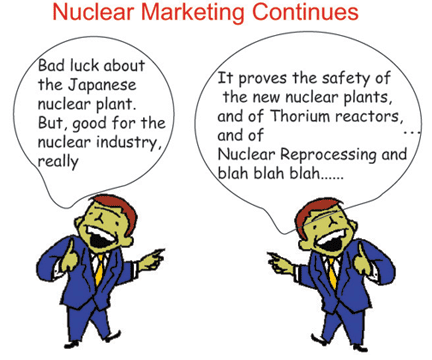 Reprocessing in China: A long, risky journey, Bulletin of the Atomic Scientists, April 15 Hui Zhang“………Should China continue pursuing its plans for fast breeder reactors and commercialized reprocessing? Good reasons exist for avoiding this course of action. First, because most of China’s power reactors are newly built, Beijing will face little pressure over the next two decades to reduce its spent fuel burden. And spent fuel can be stored safely, at low cost, in dry casks—or disposed of safely in a deep geological repository.
Second, China faces no shortage of uranium resources for the foreseeable future. The nation’s identified resources more than tripled between 2003 and 2012, to 265,500 metric tons from 77,000 metric tons. China’s potential uranium reserves amount to more than 2 million tons. Beijing in recent times has also secured huge overseas uranium resources—about three times as large as its own identified uranium reserves. More such reserves could easily be added.
In any event, the cost of uranium accounts for only a small percentage of the cost of power that reactors generate. Simply put, the cost of uranium will not increase in the foreseeable future to levels that would justify the cost of reprocessing and breeder reactors. To the extent that China is concerned about potential disruptions in its uranium supply, it could easily and inexpensively establish a “strategic” uranium stockpile.
China should carefully examine the experiences of nations that have launched large reprocessing programs and built demonstration breeder reactors in the expectation that the commercialization of these reactors would follow. Commercialization did not follow in those countries—but huge expenses were incurred for cleaning up reprocessing sites and disposing of separated plutonium. For China, there is no urgent need to go down this risky road.
Plutonium recycling is much more expensive, and much less safe and secure, than operating light water reactors with a once-through fuel cycle. As for nuclear waste, dry cask storage is a safe, flexible, and low-cost option that can postpone for decades the need either to reprocess spent fuel or to dispose of it directly—allowing time for technology to develop. China has no convincing rationale for rushing to build commercial-scale reprocessing facilities or plutonium breeder reactors. http://thebulletin.org/reprocessing-poised-growth-or-deaths-door8185
Taiwan’s nuclear waste storage problem may cause early retirement of nuclear reactor
Nuclear generator may be retired early: Taipower CNA April 13, 2015 TAIPEI--The state-owned Taiwan  Power Co. (Taipower, 台電) warned Sunday that the No. 1 generator at the country’s first nuclear power plant may have to go offline sooner than expected because of limited storage space for spent nuclear fuel. On Feb. 17, Taipower issued an invitation for foreign companies to tender for the reprocessing of spent nuclear fuel from Taiwan’s first and second nuclear power plants but withdrew the request on April 2 amid a budget controversy.
Taipower had allocated NT$11.257 billion (US$360 million) for the overseas reprocessing of 1,200 clusters of spent fuel rods, 300 of which were to be shipped out by the end of the year.
But lawmakers failed to approve the budget in March, saying that Taipower and the Ministry of Economic Affairs were trying to initiate a bidding process with foreign companies without legislative oversight and were accessing the nation’s nuclear back-end management fund before the establishment of legal guidelines for its use……..
Taipower said that if the fuel storage problem is not resolved in time, the No. 1 generator would have to go offline in mid-2016, ahead of the decommissioning of the first nuclear power plant in New Taipei City, which is scheduled to begin in 2018 and be completed by 2023.
The generator, in fact, has been down since last December due to a component failure, and the Atomic Energy Council has not yet given approval for it to be put back online……..
Several civic groups, including Mom Loves Taiwan and Green Citizens’ Action Alliance, have lodged strong protests against Taipower’s proposed reprocessing of nuclear fuel.
The groups have said is “absurd” to consider sending fuel rods overseas for reprocessing since Taiwan should be phasing out nuclear power.http://www.chinapost.com.tw/taiwan/national/national-news/2015/04/13/433515/Nuclear-generator.htm
Nuclear reprocessing has NOT gone according to plan, in China
Reprocessing in China: A long, risky journey, Bulletin of the Atomic Scientists, Hui Zhang , April 15 Since 1983, a closed fuel cycle has been an official element of China’s nuclear energy policy. According to proponents, plutonium reprocessing and breeder reactors will allow full utilization of China’s uranium resources, drastically reduce the volume of radioactive waste that must be stored in an underground repository, and establish a way to dispense with the spent fuel accumulating in China’s reactor pools.
But Beijing’s attempts to develop commercially viable reprocessing facilities and breeder reactors have been afflicted with technological difficulties, serious delays, and cost overruns. At this point—especially taking into account China’s ample uranium resources and its easy access to additional resources abroad—it appears very doubtful that reprocessing and fast reactors are the proper way forward for China’s nuclear energy sector.
Not according to plan………..
 Parallel with development of the pilot reprocessing plant, China has been working to establish commercially viable plutonium breeder reactors. According to a plan in place until 2013, development of breeder reactors was to be a three-stage process. The first stage was to complete a project known as the China Experimental Fast Reactor. The second stage would involve building, by about 2020, a few demonstration fast reactors. Finally, commercialized fast reactors would be deployed around 2030. Progress always ran far behind schedule.
The China Experimental Fast Reactor is a sodium-cooled experimental fast reactor using technology developed for Russia’s BN-600 reactor. The project, with a planned capacity of 20 megawatts, was approved in 1995. Construction began in 2000. As with the pilot reprocessing plant, the experimental fast reactor encountered many difficulties during construction. Capital cost estimates had to adjusted twice, with each estimate double the previous one. The reactor went critical in July 2010 and, by July 2011, 40 percent of its full power was incorporated into the grid. The reactor, however, was online for only 26 hours during the remainder of 2011, and it produced the equivalent of just one full power-hour. Not until December 2014 did the reactor manage to operate at full capacity for 72 hours. So 19 years passed between project approval and operation at full capacity.
As for the second stage of the pre-2013 plan, CNNC in 2009 signed an agreement with Russia’s Rosatom to jointly construct two copies of Russia’s BN-800 fast neutron reactor in China. But Beijing has not officially approved the project. As with the French reprocessing plant, Chinese experts complain that Russia is demanding too high a price. It is not clear when or if the project will go forward. Instead, CNNC in 2013 began focusing on the development of the indigenous 600-megawatt China Fast Reactor (CFR-600). The start of construction is envisioned for 2017, with operations to commence in 2023—but the government has not approved the project yet.
Experts from CNNC have also, since 2013, urged the development of China’s first commercial fast reactor—a 1,000-megawatt reactor based on experience gained from the CFR-600. But CNNC expert Gu Zhongmao—an advocate of the closed fuel cycle—said at a recent workshop on nuclear energy in East Asia that “China needs at least another 20 to 30 years of effort before commercialization of fast reactor energy systems, and there are so many uncertainties ahead. It is beyond our ability to draw a clear picture 20 years ahead.”…………. http://thebulletin.org/reprocessing-poised-growth-or-deaths-door8185
China’s energy development: renewables now looking more likely than nuclear
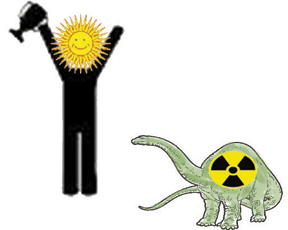 As China looks to energy solutions to reduce the air pollution choking its cities, to conserve water, and to rein in its carbon emissions, it is becoming clear that renewables offer a more expeditious path than nuclear power does.
Wind Power Beats Nuclear Again in China. Earth Policy Institute, J. Matthew Roney. 5 Mar 15 “…………Even as it pursues the world’s most ambitious wind power goal, China also undeniably has the world’s most aggressive nuclear construction program, currently accounting for 25 of the 68 reactors being built worldwide. Six reactors totaling 6 gigawatts of capacity went online in China in 2013 and 2014. Another reactor connected to the grid in January 2015, bringing national nuclear capacity to 20 gigawatts at 24 reactors. But to meet the government’s nuclear target of 58 gigawatts by 2020, China will not only need to complete the reactors now under construction—most of which are behind schedule—it will need to start and finish another dozen or so by then.
Several factors stack the odds against China meeting its nuclear power goal. After a massive earthquake and tsunami induced the 2011 nuclear meltdown in Fukushima, Japan, the Chinese government suspended approvals for new reactors as it conducted safety reviews of those operating and under construction at the time. The moratorium was lifted in late 2012, yet for more than two years no new reactors received permission to build. In February 2015, a nuclear plant in northeastern Liaoning province reportedly got the go-ahead for a two-reactor expansion. Once construction begins, it typically takes six years to complete a reactor in China (compared with one year or less for the average wind farm).
Further complicating China’s nuclear picture is that suitable real estate for new reactors along the coast—with ready access to cooling water—is in increasingly short supply. Following the Fukushima disaster, public opposition to reactors in China’s earthquake-prone inland provinces grew, prompting officials to put off consideration of proposed reactors in non-coastal provinces until 2015 at the earliest. Regardless of when the government decides to begin approving inland reactors, nuclear developers will face dwindling freshwater resources.
Perhaps the biggest question facing the future of nuclear power in China is the fate of the 1-gigawatt Sanmen reactor under construction in Zhejiang province. Designed by Westinghouse, this is a “Generation III” reactor billed as much safer than previous nuclear technologies, due to its earthquake and flood resistance features and its ability to continue cooling in the event of a prolonged loss of power. Sanmen is both the basis for Chinese-designed third generation reactors and a test case for the technology closely watched worldwide.
When construction got under way at Sanmen in 2009, completion was projected by the end of 2013. Blaming increased safety concerns and design changes post-Fukushima, the developer pushed this date back to 2015. Then in January 2015, the chief engineer of China’s State Nuclear Power Technology Corp., Wang Zhongtang, announced that Sanmen would not generate electricity until 2016, if that soon. As the project runs further behind schedule and goes further over-budget, more doubt is cast on the design’s ability to catalyze faster nuclear power growth in China.
China’s energy landscape is changing rapidly. Consumption of coal, which supplies about 75 percent of Chinese electricity, dropped nearly 3 percent in 2014, according to official datafrom China’s National Bureau of Statistics. Meanwhile, in addition to the impressive growth in wind power, China is quickly expanding its solar generating capacity. With 28 gigawatts by the end of 2014 and plans for another 15 gigawatts in 2015, China may overtake Germany for the top solar spot in a matter of months. As China looks to energy solutions to reduce the air pollution choking its cities, to conserve water, and to rein in its carbon emissions, it is becoming clear that renewables offer a more expeditious path than nuclear power does.
J. Matthew Roney is a Research Associate with Earth Policy Institute and co-author of The Great Transition: Shifting from Fossil Fuels to Solar and Wind Energy . (W.W. Norton, 2015). Visit the Table of Contents to download Chapter Changing Direction, or pre-order your copy from the EPI Bookstore. More resources are available at www.earth-policy.org.
China’s new nuclear reactors lack required modern safety features
 Chinese nuclear reactors ‘did not receive latest safety tests before installation’ French manufacturer said recent test detected fault that could lead to cracks in reactor shell, South China Morning Post , 11 April, 2015 Stephen Chen chen.binglin@scmp.com Two new nuclear reactors in Taishan, Guangdong, did not undergo the same quality tests as a similar reactor in France that was found to have weak spots prone to cracks.
Special tests at the Flamanville EPR nuclear power plant were only carried out last year after France tightened its nuclear safety regulations, France’s Nuclear Safety Authority (ASN) told the South China Morning Post.
No such tests were conducted on the two third-generation EPR Taishan reactors before French nuclear manufacturer Areva shipped them to China. That meant the 50-billion yuan (HK$63 billion) Taishan plant, located about 80km west of Zhuhai and Macau, could be plagued by the same problem and not be detected.
 Weak spots in a reactor’s steel shell is a serious defect – once installed, the shell cannot be replaced throughout the reactor’s 60-year lifespan.
The tests in France found that excessive carbon in the steel that formed the reactor’s top and bottom could lead to unexpected cracks that could later spread.
The news comes as a shock to China’s burgeoning nuclear sector. With the completion date of the first project phrase expected by the end of this year, the Taishan EPR plant was a landmark project for China’s nuclear sector.
The plant’s two advanced 1.75GW pressurised water reactors were to be the world’s largest single-piece electric generators and their operation was said to be the safest, too.
Now it is not certain whether the Taishan reactors would comply with France’s stricter standards……….http://www.scmp.com/news/china/article/1763315/taishan-nuclear-reactors-did-not-receive-most-updated-safety-tests
Robot fails, in effort to inspect inside of Fukushima reactor no 1
Fukushima Unit 1 Robot Dies In Containment During Inspection Simply Info April 10th, 2015
Kyodo News is reporting the robot died inside unit 1′s containment during the inspection. It stopped functioning part way through the inspection…….http://www.fukuleaks.org/web/?p=14672TEPCO has provided no other information about this yet.
India’s government acts to cut off funding for Greenpeace: freezes its bank accounts
The Union Home Ministry on Thursday suspended the official registration for foreign funding of Greenpeace India for six months and froze seven bank accounts connected with the organisation, The Hindu, a local newspaper, reported.
Samit Aich, the executive director of Greenpeace, said the move was “an attack on democracy”.

“They don’t like the questions we are raising. We are environmental activists asking questions about the environment. There has been intimidation, illegal attacks for some time now,” he said……..
In January a Greenpeace campaigner was stopped by Indian officials from travelling to the UK to deliver a talk to MPs about the impact of mining on a poor communities and the environment in central India.
Government agencies had also found that “in the past couple of years, several UK nationals, including cyber experts and activists, had visited Greenpeace’s offices in India allegedly to help it organise protest activities”, the newspaper said.
In January the Indian government was told by judges to unblock funds received by Greenpeace which have been frozen by authorities since June.
The high court in Delhi, the capital, ruled that the previous freeze on funds that Greenpeace India had received from abroad was “arbitrarily illegal” and “unconstitutional”.
Over the past year, there have been a series of measures targeting Greenpeace and several other international NGOs working on similar environmental issues in India.
An intelligence report prepared for the incoming government of Narendra Modi, which took power after a landslide electoral win in May, accused several foreign-funded NGOs of stalling major infrastructure projects at the behest of unidentified foreign powers.
The report, which was leaked to the press, claimed that “people-centric” campaigns organised by NGOs blocked projects in seven sectors – nuclear power, uranium mining, thermal and hydroelectric power, farm biotechnology, extractive industries, and mega industrial projects – were aimed at keeping India in “a state of underdevelopment”.
In June, the government barred Greenpeace from receiving funds from Greenpeace International and Climate Works Foundation – some 30% of its funding. The remaining 70% is raised from local supporters in India. About £180,000 was frozen, before courts ordered its release.
Modi’s predecessor, Manmohan Singh, had complained that foreign-funded NGOs were blocking the expansion of nuclear power and the introduction of genetically modified products. http://www.theguardian.com/world/2015/apr/10/greenpeace-bank-accounts-frozen-by-indian-government
Despite opposition and problems about liability, Prime Minister Narendra Modi aims to buy nuclear reactors
 Modi goes shopping for nuclear power in France and Canada Reuters | Apr 8, 2015, Times of India, NEW DELHI: Prime Minister Narendra Modi aims to advance the purchase of massive nuclear reactors and fuel from France and Canada to power a resurgent economy, overriding domestic opposition and concerns over liability laws as he embarks on a foreign tour.
In France, where Modi is making his first visit since taking office last year, he will seek to speed up price negotiations for the building of two reactors by state-run Areva SA of 1,650 megawatts each in the western state of Maharashtra………
New legal case: sick USA sailors against Tokyo Electric Power
 U.S. Sailors Sick From Fukushima Radiation File New Suit Against Tokyo Electric Power, EcoWatch Harvey Wasserman | February 9, 2014 Citing a wide range of ailments from leukemia to blindness to birth defects, 79 American veterans of 2011’s earthquake/tsunami relief Operation Tomadachi (“Friendship”) have filed a new $1 billion class action lawsuit against Tokyo Electric Power.
The suit includes an infant born with a genetic condition to a sailor who served on the USS Ronald Reagan as radiation poured over it during the Fukushima melt-downs, and an American teenager living near the stricken site. It has also been left open for “up to 70,000 U.S. citizens [who were] potentially affected by the radiation and will be able to join the class action suit.”
The re-filing comes as Tepco admits that it has underestimated certain radiation readings by a factor of five. And as eight more thyroid cancers have surfaced among children in the downwind region. Two new earthquakes have also struck near the Fukushima site.
The amended action was filed in federal court in San Diego on Feb. 6, which would have been Reagan’s 103rd birthday. It says Tepco failed to disclose that the $4.3 billion nuclear-powered aircraft carrier was being heavily dosed from three melt-downs and four explosions at the Fukushima site. The Reagan was as close as a mile offshore as the stricken reactors poured deadly clouds of radiation into the air and ocean beginning the day after the earthquake and tsunami. It also sailed through nuclear plumes for more than five hours while about 100 miles offshore. The USS Reagan (CVN-76) is 1,092 feet long and was commissioned on July 12, 2003. The flight deck covers 4.5 acres, carries 5,500 sailors and more than 80 aircraft.
Reagan crew members reported that in the middle of a snowstorm, a cloud of warm air enveloped them with a “metallic taste.” The reports parallel those from airmen who dropped the Bomb on Hiroshima, and from central Pennsylvanians downwind from Three Mile Island. Crew members drank and bathed in desalinated sea water that was heavily irradiated from Fukushima’s fallout.
As a group, the sailors comprise an especially young, healthy cross-section of people. Some also served on the amphibious assault ship Essex, missile cruiser Cowpens and several others.
The plaintiffs’ ailments parallel those of downwinders irradiated at Hiroshima/Nagasaki (1945), during atmospheric Bomb tests (1946-1963), and from the radiation releases at Three Mile Island (1979) and Chernobyl (1986). Among them are reproductive problems and “illnesses such as Leukemia, ulcers, gall bladder removals, brain cancer, testicular cancer, dysfunctional uterine bleeding, thyroid illnesses, stomach ailments and a host of other complaints unusual in such young adults.”
One 22-year-old sailor declared to the court that “Upon my return from Operation Tomodachi, I began losing my eyesight. I lost all vision in my left eye and most vision in my right eye. I am unable to read street signs and am no longer able to drive. Prior to Operation Tomodachi, I had 2/20 eyesight, wore no glasses and had no corrective surgery.” Additionally, he said, “I know of no family members who have had leukemia.”
Plaintiff “Baby A.G.” was born to a Reagan crew member on Oct. 15, 2011—seven months after the crew members exposure—with multiple birth defects.
The suit asks for at least $1 billion to “advance and pay all costs and expenses for each of the Plaintiffs for medical examination, medical monitoring and treatment by physicians,” as well as for more general damages……..
Filed on Dec. 12, 2012, the initial suit involved just eight plaintiffs. It was amended to bring the total to 51.
That action was thrown out at the end of 2013 by federal Judge Janis S. Sammartino on jurisdictional grounds.
A January deadline for re-filing this second amended complaint was delayed as additional plaintiffs kept coming forward. Attorneys Paul Garner and Charles Bonner say still more are being processed.
The suit charges Tepco lied to the public—including Japan’s then Prime Minister Naoto Kan—about the accident’s radioactive impacts. Kan says Unit One melted within five hours of the earthquake, before U.S. fleet arrived. Such news is unwelcome to an industry with scores more reactors in earthquake zones worldwide.
The Plaintiffs say Tepco negligently leveled a natural seawall to cut water pumping expenses. The ensuing tsunami then poured over the site’s unprotected power supply, forcing desperate workers to scavenge car batteries from a nearby parking lot to fire up critical gauges. Tepco belatedly dispatched 11 power supply trucks that were immediately stuck in traffic.
Similar reports of fatal cost-cutting, mismanagement and the use and abuse of untrained personnel run throughout the 65-page complaint.
Attorney Bonner will explain much of it on the Solartopia Radio show at 5 p.m. EST on Tuesday, Feb. 11.
Some 4,000 supporters have signed petitions at nukefree.org, moveon.org, Avaaz and elsewhere.
Feb. 11—like the eleventh day of every month—will be a worldwide fast day for those supporting the victims of Fukushima’s deepening disaster.
The future of the U.S. Seventh Fleet, the nuclear power industry and a growing group young sailors tragically afflicted by Fukushima’s secret fallout will be hanging in the balance.
Visit EcoWatch’s FUKUSHIMA page for more related news on this topic. Harvey Wasserman edits www.nukefree.org, where petitions calling for the repeal of Japan’s State Secrets Act and a global takeover at Fukushima are linked. He is author of SOLARTOPIA! Our Green-Powered Earth. http://ecowatch.com/2014/02/09/u-s-sailors-fukushima-radiation/
-
Archives
- October 2026 (129)
- September 2026 (339)
- August 2026 (330)
- July 2026 (355)
- June 2026 (287)
- May 2026 (306)
- April 2026 (356)
- March 2026 (251)
- February 2026 (267)
- January 2026 (308)
- December 2025 (358)
- November 2025 (359)
-
Categories
- 1
- 1 NUCLEAR ISSUES
- business and costs
- climate change
- culture and arts
- ENERGY
- environment
- health
- history
- indigenous issues
- Legal
- marketing of nuclear
- media
- opposition to nuclear
- PERSONAL STORIES
- politics
- politics international
- Religion and ethics
- safety
- secrets,lies and civil liberties
- spinbuster
- technology
- Uranium
- wastes
- weapons and war
- Women
- 2 WORLD
- ACTION
- AFRICA
- Atrocities
- AUSTRALIA
- Christina's notes
- Christina's themes
- culture and arts
- Events
- Fuk 2022
- Fuk 2023
- Fukushima 2017
- Fukushima 2018
- fukushima 2019
- Fukushima 2020
- Fukushima 2021
- general
- global warming
- Humour (God we need it)
- Nuclear
- RARE EARTHS
- Reference
- resources – print
- Resources -audiovicual
- Weekly Newsletter
- World
- World Nuclear
- YouTube
-
RSS
Entries RSS
Comments RSS

