Japanese court to rule on injunction to block restart of 2 nuclear reactors
Japan nuclear ruling to show whether legal fight emboldened By Reuters | 21 Apr, 2015,KAGOSHIMA (JAPAN): A Japanese court will rule on Wednesday on an injunction to block the restart of two more nuclear reactors, a decision that could determine whether a legal drive by citizens to prevent the reopening of the sector on safety grounds will gather steam.
A court order preventing Kyushu Electric Power Co from operating Sendai would risk tying up the industry in legal battles for months or years.
Last week’s ruling “certainly sets a precedent and it will cause some of the other governors and other courts to think twice” about nuclear, said Michael Jones, Senior Analyst at consultancy Wood Mackenzie,
Local residents who submitted a suit against the restart of the restart of the Sendai reactors argue the utility and regulator has underestimated the risk of nearby volcanoes and operational plans lack credible evacuation measures. …….
Should the injunction request be rejected, as many expect, Japan’s biggest utilities still face the possibility of being forced to mothball their reactors amid mounting legal challenges, Jones said.
“It is not totally unreasonable to think that, to imagine, that the three largest utilities, Tepco, Chubu and Kans .. http://economictimes.indiatimes.com/articleshow/47004245.cms?utm_source=contentofinterest&utm_medium=text&utm_campaign=cppst
Fukushima radiation raises cancer risk for millions of people
Report says 32 million people in Japan are exposed to radiation from the Fukushima nuclear disaster (PRWEB UK) 11 March 2015 Geneva: Approximately 32 million people in Japan are affected by the radioactive fallout from the nuclear disaster in Fukushima, according to the 2015 Fukushima Report now available from Green Cross. This includes people who were exposed to radiation or other stress factors resulting from the accident, and who are consequently at potential risk from both long and short-term consequences.
The 2015 Fukushima Report is available for download in English at http://www.greencross.ch/en/news-info-en/case-studies/fukushima-report.html. Continue reading
Call to Australian and Canadian govts not to sell uranium to India
International call not to sell uranium to India http://www.acfonline.org.au/news-media/media-release/international-call-not-sell-uranium-india April 15, 2015
 Canadian and Australian governments not to further advance controversial plans for uranium sales to India.
The call comes as Australian nuclear free campaigners join Indigenous landowners affected by uranium projects to present at the World Uranium Symposium in Québec.
The conference takes place against the backdrop of Indian Prime Minister Narendra Modi’s visit to Canada and Australian Foreign Minister Julie Bishop’s trip New Delhi to advance planned uranium sales.
“Canada and Australia should show responsibility restraint and prudence, as India has been criticised widely over the safety, security and transparency of its nuclear industry,” ACF’s Dave Sweeney said. “Australia and Canada should not rush into uranium sales agreements with India while serious concerns about safety and security remain unresolved.”
Australia’s controversial uranium deal with India has been widely criticised, including by former safeguards director John Carlson, who was for two decades head of Australia’s safeguards regime and was a keen nuclear promoter. Mr Carlson has raised concernsthat the new treaty’s administrative arrangements could substantially depart from Australia’s usual safeguards conditions, meaning Australia may be unable to keep track of what happens to uranium supplied to India.
Speaking from Québec ACF’s Dave Sweeney called on the Canadian and Australian governments not to further fuel instability in South Asia by selling uranium into the already volatile region.
“Uranium is not like other minerals. It is the fuel for nuclear weapons and creates carcinogenic waste that lasts for thousands of years,” he said. “Fuelling danger and instability in India is not in the interests of Canada or Australia.”
Obama keen to sell USA nuclear technology to China
 Obama Submits to Congress 30-year Civil Nuclear Power Agreement With China Obama submitted to Congress a 30-year civil nuclear cooperation agreement between the United States and China for approval.
The US Congress has to approve the nuclear cooperation agreement for it to go into effect. http://sputniknews.com/us/20150421/1021197861.html#ixzz3Xz1ERlru
Fukushima nuclear catastrophe goes on – worst may not be over
CBS: Worst may not be over from Fukushima — “Effects of radiation have become much more severe” — “Enormous decline” seen in animal species — “Striking drop-off… really dramatic impacts” due to nuclear disaster (VIDEO)http://enenews.com/cbs-worst-be-fukushima-effects-radiation-become-severe-enormous-decline-animal-species-really-striking-drop-dramatic-impacts-video?utm_source=feedburner&utm_medium=email&utm_campaign=Feed%3A+ENENews+%28Energy+News%29
University of South Carolina, Apr 15, 2015 (emphasis added): Dwindling bird populations in Fukushima… as several recent papers from University of South Carolina biologist Tim Mousseau and colleagues show, the avian situation there is just getting worse… They recently published a paper in the Journal of Ornithology showing results from the first three years…Many populations were found to have diminished in number as a result of the accident, with several species suffering dramatic declines… What might be most disheartening to the researchers involved, and bird-lovers in general, is how the situation is progressing in Fukushima. Despite the decline in background radiation in the area over these past four years,the deleterious effects of the accident on birds are actually increasing.
Dr. Tim Mousseau, USC biologist: “The declines have been really dramatic… now we see thisreally striking drop-off in numbers of birds as well as numbers of species of birds. So both thebiodiversity and the abundance are showing dramatic impacts in these areas with higher radiation levels, even as the levels are declining.”
CBS News, Apr 16, 2015: Near site of Fukushima disaster, birds still in peril… birds are becoming a rarity around the damaged nuclear site… “There are dramatic reductions in the number of birds”… Mousseau told CBS News. “In terms of barn swallows in Fukushima, there had beenhundreds if not thousands in many of these towns where we were working. Now we are seeing a few dozen of them left. It’s just anenormous decline.”… Around Fukushima, Mousseau predicts the worst may not be over… “So now we see this really striking drop-offin numbers of birds as well as numbers of species of birds. So both the biodiversity and the abundance are showing dramatic impacts in these areas with higher radiation levels, even as the levels are declining.” Mousseau said the reason comes down to the long-term impact of the radiation. “It takes multiple generations for the effects of mutations to be expressed…”
Journal of Ornithology, A. Møller, I. Nishiumi and T. Mousseau, March 2015: Cumulative effects of radioactivity from Fukushima on the abundance and biodiversity of birds… overall abundance and diversity of species on average decreased with increasing levels of background radiation… the relationship became more strongly negative across years… Although there has been great public interest concerning the ecological, genetic and potential health consequences of the Fukushima radiological disaster, basic research to date has been surprisingly limited… Recent seminal studies of butterflies exposed to radioactive contaminants associated with the Fukushima disaster found strong evidence for increased mutation rates, developmental abnormalities and population effects as a direct consequence of exposure to radionuclides… Murase et al. (2015) made an equally compelling case for radiation having a negative impact on reproductive performance in the decline of Japanese goshawks.
Environmental Indicators (Journal), A. Møller and T. Mousseau, 2015: Many species occur both at Chernobyl and Fukushima, allowing a test of similarity in the effect of radiation on abundance….among the 14 species occurring at both sites [the] slope of the relationship between abundance and radiation for the 14 common species was… much stronger at Fukushima… [Since 2011] the effects of radiation on abundance became much more severe.
Watch the researchers bird counting in Fukushima at a “very hot and quiet site”
530 Minamisoma residents sue government over hot spot delisting
530 Minamisoma residents sue government over hot spot delisting KYODOSome 530 residents of a city near the Fukushima No. 1 nuclear plant filed a lawsuit Friday demanding that the central government revoke a decision to remove their districts from a list of radiation hot spots, ending their entitlement to handouts… (registered readers only) http://www.japantimes.co.jp/news/2015/04/17/national/crime-legal/530-minamisoma-residents-sue-government-hot-spot-delisting/#.VTQwstKqpHw
Nearly 200,000 Japan documents designated as special secrets in 2014
Some 190,000 documents designated as special secrets in 2014, Mainichi 17 Apr 15 The government had 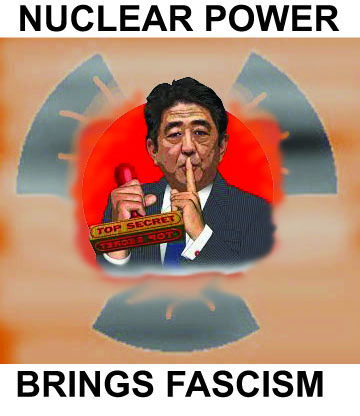 designated 189,193 administrative documents as confidential under the state secrecy law as of the end of last year, the Cabinet Secretariat announced on April 17.
This was the first time that the agency released the number of such governmental documents since the Act on the Protection of Specially Designated Secrets came into force in December of last year.
According to the Cabinet Secretariat, the documents are owned by 13 ministries and agencies. The actual number of documents designated as special secrets has not been disclosed, however, since the released figure includes duplicated documents that are shared among several ministries and agencies.
The Defense Ministry tops the list of classified document holders, with 60,173 individual documents, followed by the Cabinet Secretariat with 55,829, the Foreign Ministry with 35,783, the National Police Agency with 17,874, the Public Security Intelligence Agency with 9,297, and the Japan Coast Guard with 9,174.
In January, the Cabinet Secretariat announced that 10 ministries and agencies had classified 382 individual pieces of information as special state secrets as of the end of last year — all of which are found within the aforementioned 189,193 documents………http://mainichi.jp/english/english/newsselect/news/20150418p2a00m0na004000c.html
Damaging effect of prolonged low level radiation, on birds and animals (?us too)
 “There are so few barn swallows left,” Mousseau added. “We know that there were hundreds in a given area before the disaster, and just a couple of years later we’re only able to find a few dozen left.”
“Both the biodiversity and the abundance are showing dramatic impacts in these areas with higher radiation levels, even as the levels are declining.”
For Fukushima Birds, Things are Getting Worse Even as Radiation Abates, Nature World News, By Brian Stallard follow Brian on Twitter @BS_ButNoBS Apr 17, 2015 The destructive earthquake and tsunami that triggered a catastrophe at Japan’s Fukushima-Daiichi nuclear power plant are now four years behind us, but the effects of that disaster are still being felt today. Now a new study has revealed that even as ecosystems slowly recover, Fukushima’s native bird population is actually dwindling more than ever – and researchers think they know why………
“A growing body of empirical results from studies of birds, monkeys, butterflies, and other insects suggests that some species have been significantly impacted by the radioactive releases related to the Fukushima disaster,” Timothy Mousseau, a lead researcher behind one of many ongoing investigations, announced last August.
He explained that a common theme researchers have noticed is that prolonged exposure to low doses of radiation has a very different effect on organisms compared to sudden high-level exposure, as seen at Chernobyl. This came to be called Fukushima’s “insidious effect” and was expected to abate, with lingering radiation levels, by 2016.
Unfortunately, new research detailed in the Journal of Ornithology shows that birds may be facing trouble for even longer. “The declines have been really dramatic,” study author and biologist Tim Mousseau, of the University of South Carolina, said in a recent statement. Continue reading
Nuclear power – a really dirty form of energy – big mistake for Japan to restart it
‘Fukushima lessons: Any notion that nuclear power is clean is obsolete’ Rt.com : April 17, 2015 The world must phase out nuclear power because it is absolutely not clean from the mining processing of uranium to the generation of high-level radioactive waste, Kevin Kamps for the radioactive waste watchdog Beyond Nuclear, told RT.
It’s been four years since the most powerful earthquake in Japan’s history struck the Fukushima nuclear power plant. All of Japan’s 43 operable reactors have been shut down since 2013, because of safety checks required after the accident. The operator of the nuclear plant has sent a second robot inside the Fukushima reactor to collect data from it. The first robot became immovable after recording some footage from inside the reactor.
RT: Since the disaster, Japan has allocated more than $15 billion to an unprecedented project to lower radiation in towns near the power plant. However few locals believe Tokyo’s assurances that the site will eventually be cleaned up. Do you think their fears are reasonable?
Kevin Kamps: Yes, it is an unprecedented catastrophe. Of course there was Chernobyl, but in this area of Japan – it is so densely populated all over. So when they are trying to clear the landscape down to a certain depth, it is going to be more and more expensive. When you add all of the projects from decommissioning of the nuclear power plant to trying to clean up the landscape to loss of economic activity – we’re talking hundreds of billions of dollars all together. It is going to be very difficult for anything like normal life ever to return there.
RT: In addition to massive radioactive remains, Japan’s greenhouse gas emissions are on the rise following the increase in coal-fired power. Should environmentalists sound the alarm here?
KK: Just in recent days there have been the admissions by high-ranking Tokyo Electric officials that the decommissioning of the nuclear power plant could take more like 200 years because of the lack of technology to do the job. They are going to have to invent all of these robotic systems and engineering processes to try to remove the melted cores at Fukushima Daiichi because that is their current plan unlike Chernobyl with the sarcophagus. The current plan in Japan is to remove those melted cores to somewhere else – perhaps to geologic disposal, they haven’t said. But it is going to be very challenging…………http://rt.com/op-edge/250509-fukushima-nuclear-power-danger-disaster/
Increased risk of nuclear weapons proliferation, with Canada-India uranium sales deal
Canada-India uranium deal will spur proliferation, experts warn Arms control experts say Canada sends the wrong signal to countries that play by the rules By Evan Dyer, CBC News 17 Apr 15 India test-fired a nuclear-capable ballistic missile Thursday, just hours after signing a deal to buy 3,000 tons of Canadian uranium.The Agni-III missile, which has a range of over 3,000 kilometres, was fired from the Indian army’s test range on Wheeler Island in the Bay of Bengal. India declared the test a success…….While the terms of this week’s deal are not public, the nuclear cooperation agreement, first announced in 2010 and finalized in 2013, includes assurances that India use Canadian material for civilian purposes only……..
some nuclear proliferation experts say India has been able to make such a deal without abiding by the rules set out for most other countries that abide by the international non-proliferation regime. And they warn that countries the West has been attempting to bring into the rules-based system — such as Iran — will be less inclined to submit when they see the rules don’t apply to India.
Canadian technology used to gain bomb…..Of particular concern to the rest of the world was that India developed its bomb using nuclear material from a reactor it had acquired from Canada ostensibly for civilian use……..
Some experts fear Canada appears to be selling India uranium with fewer controls and conditions than it typically demands from NNPT member countries that do play by the rules.
“Normally there’s some sort of tracking and accounting system so that Canada would be receiving information from India very specifically about what Canada-sourced material is being used for,” says Trevor Findlay, a senior research fellow at Harvard University’s Managing the Atom project.
“In this case, because the agreement [to buy the uranium] is secret, we have no idea whether that’s in place, and it probably isn’t because the Indians have been pushing against that,” he told The Current.
Findlay and other experts warn that the special treatment for India shows other governments a country can ignore the rules, build the bomb, tough it out for a few decades and emerge on the other side as an accepted nuclear weapons power.
Already, Pakistan says the deals give India a strategic advantage, and Pakistan has blocked preliminary talks on the most important arms control initiative in years: a Fissile Material Cutoff Treaty that would ban future production of weapons-grade material.http://www.cbc.ca/news/politics/canada-india-uranium-deal-will-spur-proliferation-experts-warn-1.3036540
Strange and extreme tissue damage in dead dolphins near Fukushima
Japan Scientist: “I’ve never seen this before” — White lungs found in dolphins that died during mass stranding near Fukushima — Interruption of blood supply leading to death of tissue — Disease has been  linked to radiation exposurehttp://enenews.com/dead-dolphins-washed-fukushima-entirely-white-lungs-head-scientist-ive-never-before-interruption-blood-supply-leading-tissue-death-disease-linked-radiation-exposure-large-spike-after-chernoby?utm_source=feedburner&utm_medium=email&utm_campaign=Feed%3A+ENENews+%28Energy+News%29
Asahi Shimbun, Apr 11, 2015 (emphasis added):
- Google Translate: Ibaraki Prefecture… for a large amount of dolphin which was launched on the shore… the National Science Museum… investigated… researchers rushed from national museums and university laboratory, about 30 people were the anatomy of the 17 animals in the field. [According to Yuko Tajima] who led the investigation… “the lungs of most of the 17… was pure white ischemic state, visceral signs of overall clean and disease and infections were observed”… Lungs white state, that has never seen before.
- Systran: The National Science Museum… investigated circumstance and cause etc concerning the mass dolphin which is launched to the seashore of Ibaraki prefecture… the researchers ran from the museum and the university laboratory… approximately 30 people dissected 17… [Yuko Tajima] of the National Science Museum which directed investigation research worker [said] “the most lung 17 was state with true white, but as for the internal organs being clean”… The lung true white as for state, says… have not seen.
Fukushima Diary, Apr 12, 2015: According to National Science Museum, most of the inspected 17 dolphins had their lungs in ischaemia state… The chief of the researching team stated “Most of the lungs looked entirely white”… internal organs were generally clean without any symptoms of disease or infection, but most of the lungs were in ischaemia state. She said “I have never seen such a state”.
Wikipedia: Ischemia is a vascular disease involving an interruption in the arterial blood supply to a tissue, organ, or extremity that, if untreated, can lead to tissue death.
Many reports have been published on the links between ischemia and radiation exposure:
- “It has been shown that the ionizing radiation in small doses under certain conditions can be considered as one of starting mechanisms of… IHD [ischemic heart disease].” –Source
- “Radiation risks on non-cancer effects has been revealed in the [Chernobyl] liquidators… Recently, the statistically significant dose risk of ischemic heart disease… was published.” –Source
- “Incidence of and mortality from ischemic heart disease (IHD) have been studied in a cohort of 12210 workers [at] Mayak nuclear facility… there was statistically significant increasing trend in IHD incidence with total external gamma dose.” –Source
- “Numerous studies have been published concerning non cancer diseases in liquidators… Risk of ischemic heart disease… seems increased.” –Source
- “In 1990 the International Chernobyl Project has been carried out under the aegis of the IAEA… It is known that the international experts who had taken part in the International Chernobyl Project were aware of the report by the Minster of the Ministry of Health Care of Belarus delivered at an informal meeting arranged by the IAEA… The Belorussian Minister reported about… the worsening of the general health state of the affected population… “Among adults in 1988 there was a two- to fourfold increase, in comparison with preceding years, in the number of persons suffering from… ischemic heart diseases” –Source
- “In a study on a Russian cohort of 61,000 Chernobyl emergency workers… a statistically significant risk of ischemic heart disease was observed.” –Source
Radiation has wreaked havoc with Fukushima’s birds
No birdsong in Fukishima: ‘Dramatic’ decline of birds linked to radiation from 2011 disaster
- Researchers find that bird species are continuing to drop in Fukushima
- The barn swallow, for example, dropped from hundreds to dozens
- This is despite radiation levels in the region starting to fall
- And comparing it to Chernobyl could reveal what the future holds
By JONATHAN O’CALLAGHAN FOR MAILONLINE, 16 April 2015
Bird numbers have dramatically declined in Fukushima, research has revealed Scientists analysed 57 species in the region and found that the majority of populations had diminished as a result of the nuclear accident. They found that one breed in particular had plummeted from several hundred before the 2011 disaster to just a few dozen today.
The research, published in the Journal of Ornithology, was carried out by scientists at the University of South Carolina including biologist Dr Tim Mousseau.
They showed that the situation has steadily worsened since the disaster on 11 March 2011………
And while background radiation has declined in the region in recent years, the negative effects of the accident on birds are actually increasing.
‘The relationship between radiation and numbers started off negative the first summer, but the strength of the relationship has actually increased each year,’ Dr Mousseau said.‘So now we see this really striking drop-off in numbers of birds as well as numbers of species of birds.
‘So both the biodiversity and the abundance are showing dramatic impacts in these areas with higher radiation levels, even as the levels are declining.’…….http://www.dailymail.co.uk/sciencetech/article-3041695/No-birdsong-Fukishima-Dramatic-decline-birds-linked-radiation-2011-disaster.html
Efforts by India’s government to shut down Greenpeace
India government trying to shut us down: Greenpeace ABC 16 Apr 15 Greenpeace believes the Indian government has blocked donations from being deposited in its bank accounts, both locally and internationally.
 GREENPEACE INDIA accused the government Tuesday of preventing local donors from funding its
activities, saying the move was aimed at shutting down its operations in the country.
The latest allegation comes less than a week after the right-wing government suspended the environmental watchdog’s foreign funding licence and blocked several of its bank accounts, citing violations of rules governing international financial transactions.
Following the ban, Greenpeace said, many donors even in India were unable to deposit money into the group’s local accounts. It said it suspected the accounts had been blocked by the government.
The group described the fresh step as an all-out attack by the government to “suppress democracy and silence those with an alternative vision of development”. The government has also blocked our domestic accounts and is now preventing ordinary Indians from supporting our work for clean air, healthy forests, pesticide-free food and a liveable environment,” Samit Aich, executive director of Greenpeace India, said in a statement………http://www.abc.net.au/environment/articles/2015/04/15/4217058.htm
How investments are damaged by the continuing nuclear radiation crisis at Fukushima
5 Ways Fukushima The radiation Emits Tend to be Poisoning Ventures. International Health Insurance and Medical Health 16 Apr 15 (? weird translation)
“…….1. Investors with Uranium are usually Hurt:
The purchse price for every lot associated with uranium has tanked since the 03, 2011 nuclear meltdown with Fukushima, which in turn brought about cutbacks for anybody invested in uranium exploration gives. ……..
 |
Click here to Reply or Forward
|
Japan court says NO to restart of two nuclear reactors

 Japan court blocks restarting of two nuclear reactors Tokyo (AFP) – A Japanese court on Tuesday issued a landmark injunction against the restarting of two atomic reactors, after the country’s nuclear watchdog had given the green light to switch them back on.
The district court in the central prefecture of Fukui made the temporary order in response to a bid by local residents to halt the restart of the No. 3 and No. 4 reactors at the Takahama nuclear power plant, a court official said……..”the safety of the reactors hasn’t been secured”, the court ruled, saying the watchdog’s new standards were “lacking rationality”, according to public broadcaster NHK.
The reactors could be damaged by an earthquake even smaller than that envisaged in the safety standards, the court said……..
Two other reactors at Takahama also remain offline.
Greenpeace hailed the court decision, saying it “could have a nationwide ripple effect on similar pending injunction cases — threatening to derail the Japanese government?s nuclear reactor plans”.
A separate court ruling on the restart of two other reactors in southern Japan is expected later this month.
– ‘Warning from the court’ – Hiroshi Miyano, a nuclear expert and visiting professor at Hosei University in Tokyo, said the court decision would affect the timing of future reactor restarts.
“This can be seen as a warning from the court, which told the (plant) operator that it has to better explain its resumption plans,” Miyano said……..
But Japan has seen a groundswell of public opposition to the technology since Fukushima, where reactors went into meltdown after a tsunami swamped their cooling systems — setting off the worst atomic disaster since Chernobyl in 1986.
Japan’s entire stable of nuclear power stations was gradually switched off following the disaster, while tens of thousands of people were evacuated due to concerns about radiation exposure.
Many are still unable to return to their homes and scientists have warned that some areas around the plant may remain uninhabitable for decades or more.https://au.news.yahoo.com/world/a/27100653/japan-court-blocks-restarting-of-two-nuclear-reactors/
- AFP
-
Archives
- October 2026 (129)
- September 2026 (339)
- August 2026 (330)
- July 2026 (355)
- June 2026 (287)
- May 2026 (306)
- April 2026 (356)
- March 2026 (251)
- February 2026 (267)
- January 2026 (308)
- December 2025 (358)
- November 2025 (359)
-
Categories
- 1
- 1 NUCLEAR ISSUES
- business and costs
- climate change
- culture and arts
- ENERGY
- environment
- health
- history
- indigenous issues
- Legal
- marketing of nuclear
- media
- opposition to nuclear
- PERSONAL STORIES
- politics
- politics international
- Religion and ethics
- safety
- secrets,lies and civil liberties
- spinbuster
- technology
- Uranium
- wastes
- weapons and war
- Women
- 2 WORLD
- ACTION
- AFRICA
- Atrocities
- AUSTRALIA
- Christina's notes
- Christina's themes
- culture and arts
- Events
- Fuk 2022
- Fuk 2023
- Fukushima 2017
- Fukushima 2018
- fukushima 2019
- Fukushima 2020
- Fukushima 2021
- general
- global warming
- Humour (God we need it)
- Nuclear
- RARE EARTHS
- Reference
- resources – print
- Resources -audiovicual
- Weekly Newsletter
- World
- World Nuclear
- YouTube
-
RSS
Entries RSS
Comments RSS

