North Korea claims that it can make mini nuclear weapons
 North Korea says it has technology to make mini-nuclear weapons WP By Anna Fifield May 20 TOKYO — North Korea claimed Wednesday that it has been able to make nuclear warheads small enough to fit on a missile — a development that, if verified, would mark a major advance in the country’s military capabilities and the threat it can pose to the world.
Pyongyang has a habit of exaggerating its technical abilities, and the latest assertion comes amid widespread doubts about its purported test of a submarine-launched ballistic missile this month.
But Kim Jong Un’s regime is known to have been working simultaneously on a nuclear weapons program and missile technology, and analysts widely believe that it is just a matter of time until North Korea puts the two together through “miniaturization.”
The North’s National Defense Commission, or NDC — its top military authority, chaired by Kim — said it was able to make a nuclear warhead small enough to fit on an intercontinental ballistic missile, designed to be fired at the mainland United States.
“It is long since [North Korea’s] nuclear striking means have entered the stage of producing smaller nukes and diversifying them,” a spokesman for the NDC said in a statement carried by the North’s official Korean Central News Agency………http://www.washingtonpost.com/world/pyongyang-says-it-has-technology-to-make-small-submarined-mounted-nuclear-warheads/2015/05/20/0e96d0bc-fec0-11e4-833c-a2de05b6b2a4_story.html
Japan’s Nuclear Regulatory Authority (NRA) approves restart of a third plant – but more hurdles remain
NRA approves restart for third nuclear plant, Japan Times, 20 May 15 REUTERS, KYODO, BLOOMBERG, AFP-JIJI Japan’s nuclear regulator signed off on the basic safety of a reactor at a third nuclear plant on Wednesday, as the country inches toward rebooting its atomic industry more than four years after the crisis began at Tepco’s Fukushima No.1 facility….
But the reactor is not expected to go back online before winter, as Shikoku Electric has yet to obtain local approval and finish other necessary procedures….
The safety approval is still only one of three needed before the Nuclear Regulatory Authority (NRA) gives its final sign off. The consent of local authorities, which is seen as a formality, is also required, along with operational checks.
At a meeting on Wednesday, the NRA’s commissioners signed off on a provisional assessment that says the Ikata reactor meets new design standards introduced in the wake of Fukushima. The decision will be open to public comment for about a month before being formalized…..
Operators also have to overcome legal hurdles. Anti-nuclear activists have stepped up petitioning the judiciary to block restarts, with a majority of the public opposed to atomic power.
Residents near the Ikata plant filed a lawsuit in December 2011 to mothball the station, but a decision has yet to be made.
In a related move, the Fukui District Court has rejected Kansai Electric Power Co.’s appeal of a ruling that prevents the utility from restarting two reactors at its Takahama plant in Fukui Prefecture, according to Tadashi Matsuda, a representative for the plaintiffs who won the case.
The court dismissal was decided Monday but not announced to the media. A court official declined to comment when contacted Tuesday. Kansai Electric representatives couldn’t be reached for comment.
The Fukui District Court issued an injunction in April preventing the utility from moving ahead with plans to restart the reactors.
The court said at the time that new safety regulations introduced following the Fukushima disaster of 2011 are still too lax to ensure the safety of the two reactors at the Takahama station….The rejected appeal throws yet another roadblock in the utility’s path to resuming operations at its nuclear plants……http://www.japantimes.co.jp/news/2015/05/20/national/japan-approves-third-nuclear-plant-restart/#.VV5O1rmqpHx
Japan’s Abe government relinquishing responsibility for health of Fukushima residents and workers
Fukushima; The Beginning Of The End, A series of announcements over the last two weeks have shown the Abe administration’s true plan for Fukushima & Japan. As the political class pushes for reactor restarts, their commitment towards Fukushima has turned to outright betrayal.
Starting in 2016 local governments will be forced to pay for part of the reconstruction costs.
Last week the central government announced they plan to reopen any area below 50 mSv/year for people to return by 2017. Areas at 20 mSv/year or below would be reopened in 2016. 20 mSv/year is the international maximum annual radiation exposure for nuclear workers. Now adults and children would be expected to expose themselves to radiation levels at and even above what is permissible for nuclear workers. ICRP cites that the public should not be exposed to more than 1 mSv/year.
The central government plans to end housing assistance for voluntary evacuees by 2017. …….http://www.fukuleaks.org/web/?p=14764
Press freedom very much compromised in Japan
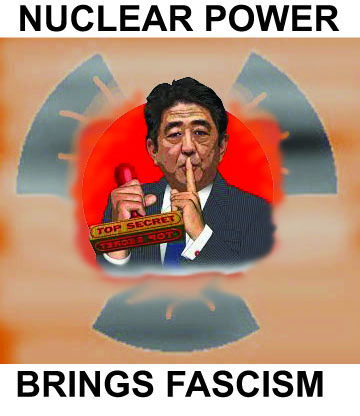 The Threat to Press Freedom in Japan, NYT By SHIGEAKI KOGAMAY 20, 2015 TOKYO — During a press conference in March, Chief Cabinet Secretary Yoshihide Suga expressed concern over comments I had made during a program on TV Asahi, a major private broadcasting network: I had announced that I would no longer be appearing on the show after being subjected to “fierce bashing” from the prime minister’s office. According to the daily Asahi Shimbun, Mr. Suga said, “We will closely watch how the TV station handles the issue in line with the Broadcast Law” — a veiled threat to revoke the station’s license.
On April 17, a special panel of the ruling Liberal Democratic Party (L.D.P.) held a special meeting at party headquarters and summoned executives of both TV Asahi and NHK, a public broadcaster, to discuss two TV programs the party thought had been critical of the administration of Prime MinisterShinzo Abe.
After I appeared on Tokyo MX TV, a local station, on April 25, an executive member of the L.D.P. reportedly told some journalists, “I heard that there was a TV station which allowed Mr. Koga to appear on a program. What a courageous TV station, I should say!”
And so it is that the Japanese government tampers with the media’s independence. This is happening partly because of longstanding structural characteristics that govern the relationship between the media and the state in Japan. But the Abe government has been especially aggressive in using those to its advantage, and major segments of the industry are quickly internalizing its preferences.
Instead of pushing back against Mr. Suga’s intimidation, for example, TV Asahi reprimanded the employees who had produced the TV program during which I criticized the government. And instead of invoking the anti-interference provisions of the broadcasting laws to resist questioning by the L.D.P., those TV executives complied with the party’s summons.
In Japan, relations between the state and journalists are formally maintained through a network of reporters’ clubs, or kisha kurabu. There is a reporters’ club for each ministry, each local government, each political party, each industry association. Membership in the clubs is generally limited to reporters at major media companies. Typically, only members are allowed to attend the press conferences, and only members have access to the organizations’ officials. In return for endowing reporters with this privileged status, the officials take it for granted that their organizations will get favorable coverage. And very often they do.
Another problem is that the media in Japan is not regulated by an independent agency. For example, it is the government itself — specifically the Ministry of Internal Affairs and Communications — that grants licenses to TV stations, and these are up for renewal regularly. Consequently, TV stations are under constant supervision and fear losing their right to operate if they challenge the government. Given Japan’s parliamentary system, this means that the ruling political parties themselves have a large influence over broadcasting.
What’s more, there is virtually no separation of management and the newsroom at major media companies…..http://www.nytimes.com/2015/05/21/opinion/the-threat-to-press-freedom-in-japan.html?referrer=&_r=1
Neurological and heart disease – huge rise in Fukushima evacuees
Huge spike in neurological diseases after Fukushima — 600% rise in disorders among evacuees — Similar abnormalities reported post-Chernobyl — Cases of heart disease, brain infarction also up — Physicians: “Great concern there will be additional health hazards” http://enenews.com/study-reveals-large-spike-neurological-diseases-fukushima-600-increase-disorders-causing-hearing-loss-dizziness-people-evacuation-area-cases-heart-disease-brain-infarction-physicians-great-co?utm_source=feedburner&utm_medium=email&utm_campaign=Feed%3A+ENENews+%28Energy+News%29
Journal article by authors from Soma General Hospital and Tohoku University, Apr 7, 2015 (emphasis added): Change in and Long-Term Investigation of Neuro-Otologic Disorders in Disaster-Stricken Fukushima Prefecture
[Neuro-otology: Branch of clinical medicine which treats neurological disorders of the ear]
- Soma City [is] 44 km north of Fukushima Daiichi… almost all patients who require hospitalization for ear, nose, and throat (ENT) care were referred to our department… We thus investigated the influence of the disaster on internal ear diseases.
- Regarding the evacuation area, the total number of patients [in the ENT department]increased 4.64 times [364% in 1st year], 4.24 times [324% in 2nd year], and 4.54 times[354% in 3rd year] compared with the number before the disaster.
- New patients [with vertigo, Meniere’s disease, and acute low-tone sensorineural hearing loss] in Shinchi Town… increased by 64.3%, 114.3%, and 46.4% [in years 1, 2, and 3] respectively… In the case of Minami-Soma City, except the evacuation area… increased by 84.2%, 152.6%, and 142.1%, respectively… Regarding the evacuation area… the numbers of patients with vertigo, MD, or ALHL became 7 times [600% increase in 1st year], 5 times [400% increase in 2nd year], and 7 times [600% increase in 3rd year].
- Although the causes for MD and ALHL are still unknown [the rise] might be due to increased tension and stress… As for the cases [of vertigo] we were unable to establish the neuro-otologic pathogeneses in… 72% [and] there may have been cases of psychogenic dizziness… administration of an anti-vertigenous drug or advice to keep calm and to have a sound mind did not help… There were some difficult cases where ENT treatment alone did not work, presumably because these cases were complicated with some mental diseases… In some serious cases, we… referred the patients to psychiatric care or prescribed psychosomatic medicine. Some patients refused our advice… or to admit that they had a mental problem.
- The number of reported cases of heart disease and brain infarction have increased in the devastated area… Diabetes, osteoporosis, and psychiatric illnesses were feared to have worsened… There is a great concern that there will be additional health hazards, and we strongly feel the need for administrative support.
Journal of the American Academy of Audiology (pdf), 1995: Ototoxicity and Irradiation — Additional Etiologies of Hearing Loss in Adults… The article [discusses] the effects of irradiation on hearing [in patients] exposed to excessive radiation as a result of theChernobyl nuclear disaster… Shidlovckaya of the Kiev Research Institute of Otolaryngology has been studying [cleanup workers from] Chernobyl… her patients have evidenced a number of disorders, including hearing loss… When Shidlovckaya divided her population into three groups – [those] who worked directly at the disaster site; residents… nearby; and residents… some distance from the disaster site – an interesting pattern in the auditory resultsemerged… analysis indicated that, in 100 percent of [workers] examined, there aredisturbances or abnormalities… Furthermore, the… lesser radiation exposure… the less likely it was that these deviations would be present… Obviously, this is an important area of further research and could have a significant impact on our reaction to patients who have been exposed to radiation…
Annals of the New York Academy of Sciences, 2009: Diseases of Sense Organs — Throughout the more contaminated territories [around Chernobyl,] hearing abnormalities occur with greater frequency… Between 46 and 69% of surveyed liquidators had some hearing disorder.
Watch: St. Louis Children’s Hospital on radiation-induced hearing loss
Court rules to keep injunction on restart of Takahama nuclear reactors

 Japan court upholds nuclear power plant injunction Phys Org News, 20 May 15 A Japanese court upheld an injunction banning the restart of two nuclear reactors, a report said Tuesday, in a blow to the government’s ambitions to return to atomic power generation.Fukui District Court in central Japan dismissed Kansai Electric Power’s motion for a stay on an earlier decision to temporarily bar the restart of the No. 3 and No. 4 reactors at plant in Takahama, Kyodo News said.
The decision made Monday comes as the government and Japan’s powerful utility companies work to get reactors back online, more than four years after the disaster at Fukushima……..
Issuing the injunction on the restart, the Fukui court earlier said the safety of the reactors at Takahama had not been proved, despite a green light from industry watchdog the Nuclear Regulation Authority (NRA), whose guidelines, the court said, were “too loose” and “lacking in rationality”.http://phys.org/news/2015-05-japan-court-nuclear-power-injunction.html#jCp
North Korea not willing to end its nuclear programme
North Korea ‘not even close’ to meeting standards on nuclear weapons, says Kerry, Guardian, 28 May 15
Secretary of state says US is talking to China about boosting sanctions and highlights ‘grotesque’ public executions on whim of leader Kim Jong-un The US is talking to China about imposing further sanctions against North Koreaas the reclusive country is “not even close” to taking steps to rein in its nuclear weapons programme, the US secretary of state, John Kerry, has said.
Speaking on Monday in the South Korean capital, Kerry said Washington continued to offer North Korea the chance for an improved relationship in return for signs of a genuine willingness to end its nuclear programme.
“To date, to this moment, particularly with recent provocations, it is clear the DPRK [Democratic People’s Republic of Korea] is not even close to meeting that standard,” Kerry told a joint news conference with the South Korean foreign minister, Yun Byung-se. “Instead it continues to pursue nuclear weapons and ballistic missiles.”
North Korea is already under heavy US and UN sanctions for its missile and nuclear tests but Kerry said further penalties were being considered…….http://www.theguardian.com/us-news/2015/may/18/north-korea-may-face-further-sanctions-john-kerry-indicates
Trying to cut costs, TEPCO to sell uranium stockpile
Tepco looking to sell some uranium stockpiles to cut costs Japan Times, 19 May 15 Tokyo Electric Power Co. is planning to sell part of its uranium stockpiles for nuclear power generation in the current business year to cut costs amid uncertainty over the restart of idled nuclear plants, a company document obtained by Kyodo News showed Monday.
Tepco has not consumed uranium since the 2011 nuclear crisis started at its Fukushima No. 1 complex that eventually resulted in all of Japan’s nuclear reactors being taken offline amid safety concerns. By reducing the stockpiles, the utility is seeking to slash costs for managing them as it faces funding difficulties stemming from the nuclear crisis.
According to the document, Tepco aims to reduce the amount of uranium to levels prior to the Fukushima disaster by the end of fiscal 2015 through March. The company estimated in the paper it can secure ¥12.3 billion ($103.13 million) by selling around half of the planned amount……..
Major utilities including Tepco procure uranium, which could be diverted to military use, under long-term contracts from overseas suppliers in Canada and elsewhere.
As of the end of March, Tepco had a total of 17,570 tons of uranium (tU), equivalent to the amount used at the Kashiwazaki-Kariwa plant for 10 years, compared with 16,805 tU at the time of the nuclear disaster in March 2011.
The amount would increase to 19,317 tU in fiscal 2015 if the company does not sell some of the stockpile.The utility will likely return it to the suppliers or pay for the costs of uranium enrichment in kind, while it will also consider terminating uranium purchase contracts and reducing purchase volumes to streamline its business, according to the document.
Japan Atomic Power Co. has also taken the rare step of selling some of its uranium, apparently to raise money to repay loans amid its faltering business conditions. http://www.japantimes.co.jp/news/2015/05/19/business/corporate-business/tepco-looking-sell-uranium-stockpiles-cut-costs/#.VVv7z7mqpHw
Danger to Jaitapur Nuclear Plant In Earthquake Zone
Nothing can be done to prevent earthquakes, considering that the Indian subcontinent is on a moving tectonic plate that is constantly crashing into the Himalayan range and pushing under the Eurasian plate at the rate of 5cm per year. Some areas are thus seriously earthquake-prone owing to aggravated faultlines and fissures in the earth.
Mixing earthquakes and nuclear power plants, therefore, would seem like courting a nightmare, which is what Jaitapur may be facing. This town, located on the unspoilt Ratnagiri coast of Maharashtra, is at the confluence of seismic zones 3 and 4, the latter the penultimate category in the national system for assessing earthquake-sensitive areas and identified as a “High Damage Risk Zone”. It is also the site prospectively for the largest nuclear power complex in the world, expected to pump 9,900 MW of electricity into the national grid………http://www.huffingtonpost.in/bharat-karnad-/post_9370_b_7303336.html
Ministry plans to end TEPCO compensation to 55,000 Fukushima evacuees in 2018

The government will instruct Tokyo Electric Power Co. to terminate compensation payments to 54,800 evacuees from the Fukushima nuclear disaster in March 2018, regardless of radiation levels in their hometowns, sources said.
The new compensation plan of the Ministry of Economy, Trade and Industry is based on the assumption that decontamination work will lower radiation levels and enable the government to lift evacuation orders in those areas, the sources said May 18.
Currently, the homes of about 80,000 evacuees are located in three zones designated by the government in terms of severity of radiation contamination.
Around 31,800 evacuees’ homes are in “zones being prepared for the lifting of evacuation order,” while 23,000 people have fled their homes in what are now “no-residence zones.”
TEPCO currently pays each of these 54,800 evacuees 100,000 yen(about $834) in compensation a month.
The new plan will affect evacuees from these two zones.
The remaining 24,400 people have homes located in“difficult-to-return zones,” where there are no prospects of lifting the evacuation orders. TEPCO has paid a total of 14.5 million yen to each of these evacuees.
The government’s current guidelines on compensation stipulate that payments should end one year after evacuation orders are lifted.
Under the new plan, the government and ruling parties assume that the evacuation period for people in the first two zones will end “six years after the March 2011 nuclear accident.” That assumption is based on another assumption that decontamination work will be completed by March 2017 and evacuation orders can be called off by that time.
As a result, compensation payments for people from the two zones will end in March 2018. Each of the evacuees will have received atotal of 8.4 million yen during the seven years since the accident started at the Fukushima No. 1 nuclear plant.
The current compensation system allows evacuees to receive additional compensation payments if their evacuation periods are extended. Some critics say evacuees are hoping for a continuation of evacuation orders so that they can receive more money.
But the new plan will terminate compensation payments for the two zones in 2018 without exception. If the evacuation order is lifted five years after the nuclear accident, the evacuees from the area can still receive compensation for two more years, even though they are qualified for only one additional year under the current system.
Adoption of the new plan will make it easier for the government to work out support measures for people who return to their hometowns in the two zones, the sources said.
“The lifting of evacuation orders will proceed,” a government official said. “We will be able to construct houses and attract plants and firms (to the areas) more positively.”
However, it is not clear whether radiation levels will drop as expected by March 2018.
Even if evacuation orders remain in place because of delays in decontamination work, the compensation payments will still end in 2018 for the two zones, the sources said.
Source: Asahi Shimbun
http://ajw.asahi.com/article/0311disaster/fukushima/AJ201505190055
Survey:Large majority of Fukushima evacuees have family members with healthproblems

Nearly 70 percent of evacuees from areas around the damaged Fukushima No. 1 nuclear power plant have family members complaining of physical or mental problems, a recent survey showed.
Released by the Fukushima prefectural government, the survey covering fiscal 2014 revealed that 66.3 percent of households that fled the disaster area–after the nuclear crisis triggered by the March 2011 Great East Japan Earthquake and tsunami–have at least one member suffering health problems. The figure was 67.5 percent in the previous survey covering fiscal 2013.
In February, the prefecture sent questionnaires to all 59,746 households that evacuated for the latest study–the second of its kind–and received responses from 18,767 households, or 33.6 percent.
Of the respondents, 13,703 households, or 73 percent, said they were forced to evacuate, while 5,054, or 27 percent, said they voluntarily evacuated.
The survey covered about 20 categories, such as the state of the lives of the evacuees, their health conditions and their intent to return to their homes.
Asked about what bothers them, 57.9 percent said they cannot sleep well. While 56.6 percent said they are unable to enjoy their daily lives as they did before the disaster, 49.3 percent said they tire more easily.
Households that are still in temporary housing or rented apartments for evacuees accounted for 62.1 percent, a 10-percentage-point decrease from the previous survey. Meanwhile,19.7 percent–10 points higher than the first study–said they live in their own homes.
Although in the fiscal 2013 survey, 40.4 percent hoped they would be allowed to continue living in temporary housing longer than originally planned, 48.7 percent hope so in the latest findings.
In the latest study, 55.8 percent said they hope to continue living in temporary housing because the evacuation order has yet to be lifted for their hometowns. While 42.1 percent said they are currently unable to rebuild their homes on their own, 40.0 percent said they do not have sufficient funds to leave temporary housing.
In March, the central government released results of its survey of nine municipalities ordered to evacuate since the onset of the Fukushima crisis. The prefectural survey asked evacuees from areas other than the nine municipalities where they hoped to reside in the future. The latest findings show 37.3 percent of households that are evacuees living within Fukushima Prefecture said they hope eventually to return to their homes. Those who want to settle where they currently reside accounted for 16.5 percent, and 11.7 percent said they have yet to decide where to live in the future.
In contrast, 31.6 percent of households that evacuated outside the prefecture said they have not determined where to live in the future, whereas respondents who want to settle where they now live or return to their hometowns accounted for 24.2 percent and 19.8 percent, respectively.
Source: Asahi Shimbun
http://ajw.asahi.com/article/0311disaster/fukushima/AJ201505190054
Fukushima finds 16 new cases of thyroid cancer in young people – “unlikely” a direct result of the nuclear accident

Sixteen young people who lived near the crippled Fukushima No. 1 nuclear power plant have been diagnosed with thyroid cancer, prefectural authorities said May 18, although they added it is “unlikely” a direct result of the nuclear accident.
Fukushima Prefecture has been conducting thyroid tests on about 385,000 residents and others who were 18 years old or younger at the time of the onset of the March 2011 nuclear disaster caused by the Great East Japan Earthquake and tsunami.
A prefectural panel said the results of the first round of tests that concluded in March 2014 revealed the ratio of those diagnosed orsuspected of having thyroid cancer who live near the Fukushima plant was no different than the ratio of the same age group from elsewherein Japan.
The 16 new cases were detected between January and March, and bring the total number of young people diagnosed with the disease in the testing program to 103. Thyroid cancer can be confirmed only after surgery.
The prefecture is currently conducting its second survey of test subjects, which will be concluded in March 2016.
The latest 16 include 12 individuals who were suspected of having the disease during the first study, and four who were believed to have the disease during the second study.
According to prefectural officials, 112 young people were diagnosed or suspected of having thyroid cancer during the first study, with the figure at 15, thus far, in the second survey, bringing the total to date to 127 people.
Because babies and small children are particularly susceptible to the effects of radiation, many cases of thyroid cancer in infants were reported after the 1986 Chernobyl disaster. However, this has not proven to be the case so far with regard to the Fukushima nuclear crisis.
The prefectural panel will further study the impact of radiation exposure on the frequency of thyroid cancer cases by comparing the findings of the first survey with results of the second study and future check-ups.
http://ajw.asahi.com/article/0311disaster/fukushima/AJ201505190041
Fukushima Contamination Found In Tap Water Around Japan
Testing conducted in February and March of 2015 found cesium in many tap water samples collected around Japan. In the readings, Tokyo had higher tap water contamination levels than Fukushima City.
One reading that may cause confusion is the reading for Ichihara Chiba. It indicated iodine 131 was found in that tap water sample. The reading is isolated, no other cities found iodine 131 in their water. This same problem was encountered in the US soon after the disaster were iodine 131 was being found in some east coast municipal water supplies. What may be happening is linked to medical treatments.
People receiving iodine 131 radiation therapy treatments, used for certain thyroid disorders excrete the substance in their urine. This is intended to allow any iodine 131 in the waste water to decay away. If a containment system is not used or not properly operating, iodine 131 can flow into waste treatment plants and eventually to the waterways. This directly adds contamination to waste water.
If that treated waste water is released into a water way and picked up soon enough downstream it could then contaminate public drinking water supplies.
Source: http://radioactivity.nsr.go.jp/en/contents/10000/9766/24/194_20150512.pdf
Fukushima may end free housing for voluntary nuclear evacuees in 2017

FUKUSHIMA – The Fukushima Prefectural Government may stop providing free accommodations at the end of March 2017 for people who voluntarily left areas in the prefecture not subject to nuclear evacuation advisories, sources said.
Officials hope to encourage people who evacuated on their own to return home, but the proposed end to the assistance will certainty draw objections from them.
There have been calls in some Fukushima municipalities that are worried about the lack of progress in the return home of evacuees for an end to the support program.
The prefecture will decide after listening to the opinions of local officials later this month, the sources said.
Of about 115,000 people who have taken refuge in and outside the prefecture, some 36,000 are believed to be from areas that are not covered by the central government’s evacuation advisories for radiation from the nuclear crisis that started in 2011.
Many voluntary evacuees are people with children as well as former residents of such areas as the town of Hirono, the village of Kawauchi and the city of Minamisoma, all geographically close to the government-designated evacuation zones.
They sought refuge outside their hometowns mainly due to concerns over exposure to radiation from the reactor meltdowns at Tokyo Electric Power Co.’s Fukushima No. 1 plant.
Under the Disaster Relief Act, the prefectural government provides prefabricated temporary housing for nuclear evacuees for free and fully finances their rent for private apartments.
The aid program was originally supposed to run two years, but it was extended by a year twice, with the current version set to expire at the end of next March. For voluntary evacuees, the prefecture hopes to terminate the assistance after another one-year extension, the sources said.
It is looking at continuing the free accommodations for people who fled the designated evacuation areas, the sources said.
http://www.japantimes.co.jp/news/2015/05/18/national/fukushima-may-end-free-accommodations-voluntary-nuclear-evacuees-2017/#.VVoO40ZZNBR
Crowdfunding and recuperation programs for Fukushima children
 Fukushima c’est eux Fukushima c’est nous
A group of parents who has been hosting children from Fukushima since summer 2012 are now organizing another round of crowd funding for summer 2015.
Details on their crown funding site.
http://fr.ulule.com/fukushima-nous/
Here is the information about the previous year’s achievement.
http://fr.ulule.com/fukushima/
JCSシドニーレインボープロジェクト JCS Sydney Rainbow Project
2015年夏、東北の震災孤児・遺児を10人、シドニーに保養に呼ぶ計画です
Summer camp 2015 for children who lost parents/family members
詳細はこちら For donation details https://readyfor.jp/projects/sydney
FUKUSHIMA KIDS DOLPHIN CAMP 2015 フクシマドルフィンキャンプ2015 御蔵島
“Dear eARThist family,
Oak to all relations Tokyo would like to present 2015 Fukushima Kids Dolphin Camp in Mikura Island this summer for children to release their stress from radiation fear caused by 2011 Tohoku earthquake and tsunami and give them an opportunity to play in the mother nature. And WE ARE COLLECTING DONATIONS!
See more at http://www.oak-to-all-relations.org/fukushima-kids-dolphin-camp2015/
Source: Save Children From Radiation
http://www.save-children-from-radiation.org/events/

1 This Month


of the week– Nuclear Reactor Information Task Force

14 May – online event From Bombs to Data Centres: the Face of Nuclear Colonialism
To see nuclear-related stories in greater depth and intensity – go to https://nuclearinformation.wordpress.com
-
Archives
- May 2026 (173)
- April 2026 (356)
- March 2026 (251)
- February 2026 (268)
- January 2026 (308)
- December 2025 (358)
- November 2025 (359)
- October 2025 (376)
- September 2025 (257)
- August 2025 (319)
- July 2025 (230)
- June 2025 (348)
-
Categories
- 1
- 1 NUCLEAR ISSUES
- business and costs
- climate change
- culture and arts
- ENERGY
- environment
- health
- history
- indigenous issues
- Legal
- marketing of nuclear
- media
- opposition to nuclear
- PERSONAL STORIES
- politics
- politics international
- Religion and ethics
- safety
- secrets,lies and civil liberties
- spinbuster
- technology
- Uranium
- wastes
- weapons and war
- Women
- 2 WORLD
- ACTION
- AFRICA
- Atrocities
- AUSTRALIA
- Christina's notes
- Christina's themes
- culture and arts
- Events
- Fuk 2022
- Fuk 2023
- Fukushima 2017
- Fukushima 2018
- fukushima 2019
- Fukushima 2020
- Fukushima 2021
- general
- global warming
- Humour (God we need it)
- Nuclear
- RARE EARTHS
- Reference
- resources – print
- Resources -audiovicual
- Weekly Newsletter
- World
- World Nuclear
- YouTube
-
RSS
Entries RSS
Comments RSS
 nuclear-news