‘Animals could become MUTATED’ from the 1.3 million tons of radioactive waste dumped from Japan’s nuclear power plant in the Pacific
Japan started dumping more than 1.3 million tons of radioactive water into
the Pacific Ocean Thursday – and an expert has warned it ‘has the potential
to cause mutations as seen in Chernobyl.
‘The wastewater is currently being
held in the nation’s Fukushima nuclear plant, which is set to be
decommissioned and must be cleaned to prevent accidental leaks. The
contaminated water has been filtered to remove isotopes, leaving only
tritium and carbon-14, which are radioactive isotopes of hydrogen and
carbon that cannot be easily removed from water.
Timothy Mousseau, a
researcher at the University of South Carolina, told DailyMai.com: Tritium
and carbon-14, along with the other radionuclides [that cause cancer] to be
released, all have the potential to cause mutations, cancers and
developmental deformities, as seen in Chernobyl.’
Daily Mail 24th Aug 2023
China outraged at water release from wrecked Fukushima nuclear power plant
Japan started releasing treated radioactive water from the wrecked
Fukushima nuclear power plant into the Pacific Ocean yesterday, a
polarising move that prompted China to announce an immediate blanket ban on
all aquatic products from Japan.
Irish Independent 25th Aug 2023
Fukushima waste-water decision disregards scientific evidence, violates the human rights of Pacific region communities

Japan announces date for Fukushima radioactive water release
Greenpeace International, 22 August 2023 https://www.greenpeace.org/international/press-release/61364/japan-announces-date-for-fukushima-radioactive-water-release/
Tokyo – Greenpeace Japan criticises the Japanese government’s announcement of the start date for radioactive water discharges from the Fukushima Daiichi nuclear station into the Pacific Ocean.
The decision disregards scientific evidence, violates the human rights of communities in Japan and the Pacific region, and is non-compliant with international maritime law. More importantly it ignores its people’s concerns, including fishermen. The Japanese government and Tokyo Electric Power Company (TEPCO) – the nuclear power plants’ operators – falsely assert that there is no alternative to the decision to discharge and that it is necessary to move towards final decommissioning. This further highlights the failure of the decommissioning plan for the nuclear plants destroyed in the 2011 earthquake, stating that tens of thousands of tons of contaminated water will continue to increase with no effective solution.
“We are deeply disappointed and outraged by the Japanese Government’s announcement to release water containing radioactive substances into the ocean. Despite concerns raised by fishermen, citizens, Fukushima residents, and the international community, especially in the Pacific region and neighboring countries, this decision has been made,” said Hisayo Takada, Project Manager at Greenpeace Japan.
The increasing volumes of and the pending release of the radioactive water demonstrate the failure of the decommissioning plan for the Fukushima Daiichi. The contaminated water will continue to accumulate for many years without effective measures to stop it. The Japanese Government and TEPCO falsely claim that discharge is the only viable option necessary for eventual decommissioning. Nuclear power generation, which experiences shutdowns due to accidents and natural disasters, and perpetually requires thermal power as a backup, cannot serve as a solution to global warming.
“The deliberate pollution of the Pacific Ocean through these radioactive waste discharges is a consequence of the 2011 nuclear disaster and Japan’s decades long nuclear power program. Instead of acknowledging the flaws in the current decommissioning plan, the ongoing nuclear crisis, and the massive amount of public funds required, the Japanese government intends to restart more nuclear reactors despite evidence of major earthquakes and safety risks. The current government energy plan fails to deliver secure and sustainable renewables such as wind and solar energy that the climate emergency demands,” said Takada.
As of 8 June 2023, there were 1,335,381 cubic meters of radioactive wastewater stored in tanks[1], but due to the failure of the ALPS (Advanced Liquid Processing System) processing technology, approximately 70% of this water will have to be processed again. Scientists have warned that the radiological risks from the discharges have not been fully assessed, and the biological impacts of tritium, carbon-14, strontium-90 and iodine-129, which will be released in the discharges, have been ignored.[2]
The International Atomic Energy Agency (IAEA) endorsed Japan’s plans for discharge. However, the IAEA has failed to investigate the operation of the ALPS, has completely ignored the highly radioactive fuel debris that melted down which continues every day to contaminate ground water – nearly 1000 cubic meters every ten days. Furthermore, the discharge plan has failed to conduct a comprehensive Environmental Impact Assessment, as required by its international legal obligations, given that there is a risk of significant transboundary harm to neighboring countries. The IAEA is not tasked with protecting the global marine environment but it should not encourage a state to violate it.
“The myth is being perpetuated that discharges are necessary for decommissioning. But the Japanese government itself admits that there is sufficient water storage space in Fukushima Daiichi.[3] Long-term storage would expose the current government decommissioning roadmap as flawed, but that is exactly what needs to happen. The Fukushima Daiichi nuclear station is still in crisis, posing unique and severe hazards, and there is no credible plan for its decommissioning,” emphasized Shaun Burnie, Senior Nuclear Specialist at Greenpeace East Asia.
Member states at the United Nations Human Rights Council in Geneva, as well as UN Special Rapporteurs, have opposed and criticized Japan’s discharge plans.[4] Japan’s discharge plans also disregard the groundbreaking Human Rights Council resolution 48/13, which in 2021 determined that it is a human right to have a clean, healthy and sustainable environment.[5] Furthermore, Japan has failed to comply with its legal obligations under the United Nations Convention for the Law of the Sea (UNCLOS), to protect the marine environment including its legal requirement to conduct a comprehensive Environmental Impact Assessment into the discharges into the Pacific Ocean, given the risk of significant transboundary harm to neighboring countries.[6]
“Instead of engaging in an honest debate about this reality, the Japanese government has opted for a false solution – decades of deliberate radioactive pollution of the marine environment – during a time when the world’s oceans are already facing immense stress and pressures. This is an outrage that violates the human rights of the people and communities of Fukushima, and other neighboring prefectures and the wider Asia-Pacific region,” said Burnie.
Fukushima Daiichi Nuclear Power Station is still continuing to release radioactive materials

A new argument for considering the issue of contaminated ALPS water release .
This brief examines the amount of radioactive material that has been
leaking from the Fukushima Daiichi Nuclear Power Station ever since the
meltdowns occurred more than 12 years ago.
It is huge. Both TEPCO and the
government are undoubtedly aware of this reality. Despite this, they are
now attempting to release even the radioactive materials they have been
able to manage in tanks to the outside world. While attention focuses on
this release, this brief attempts to highlight the even larger problems of
Fukushima Daiichi and the irresponsible way the authorities are dealing
with them.
CNIC 23rd Aug 2023
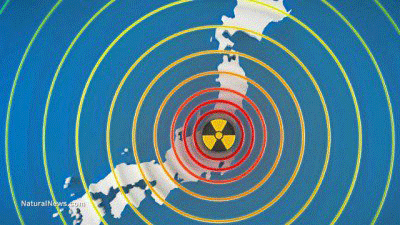
Fukushima: What are the concerns over waste water release?
By Tessa Wong, Asia Digital Reporter, BBC News, 23 Aug 23,
Japan’s controversial plan to release treated waste water from the Fukushima nuclear plant into the Pacific Ocean has sparked anxiety and anger at home and abroad.
Since the 2011 tsunami which severely damaged the plant, more than a million tonnes of treated waste water has accumulated there. Japan has said it will start discharging it from 24 August.
Despite an endorsement from the UN nuclear watchdog, the International Atomic Energy Agency (IAEA), the plan has been deeply controversial in Japan with local communities expressing concerns about contamination.
Fishing industry groups in Japan and the wider region are also worried about their livelihoods, as they fear consumers will avoid buying seafood.
China has accused Japan of treating the ocean as its “private sewer”, and criticised the IAEA of being “one-sided”. While South Korea’s government has said it has no objections to the plan, many of its citizens are opposed to it.
So what is Japan’s plan and how exactly has it churned the waters?
What is Japan doing with the nuclear waste water?
Since the disaster, power plant company Tepco has been pumping in water to cool down the Fukushima nuclear reactors’ fuel rods. This means every day the plant produces contaminated water, which is stored in massive tanks.
More than 1,000 tanks have been filled, and Japan says that it needs the land occupied by the tanks to build new facilities to safely decommission the plant. It has also pointed out concerns that the tanks could collapse in a natural disaster.
Releasing treated waste water into the ocean is a routine practice for nuclear plants – though critics have pointed out that the amount from Fukushima is on an unprecedented, far vaster scale.
Tepco filters the Fukushima water through its Advanced Liquid Processing System (ALPS), which reduces most radioactive substances to acceptable safety standards, apart from tritium and carbon-14…………………………………………….
What do critics say?
Despite years of government assurances, the plan remains deeply controversial to the Japanese public. Only 53% said they support it, while 41% said they did not, in a survey conducted in August by the newspaper Asahi Shimbun.
UN-appointed human rights experts have opposed the plan, as have environmental activists. Greenpeace has released reports casting doubt on Tepco’s treatment process, alleging it does not go far enough in removing radioactive substances.
Critics say Japan should, for the time being, keep the treated water in the tanks. They argue this buys time to develop new processing technologies, and allow any remaining radioactivity to naturally reduce.
There are also some scientists who are uncomfortable with the plan. They say it requires more studies on how it would affect the ocean bed and marine life.
“We’ve seen an inadequate radiological, ecological impact assessment that makes us very concerned that Japan would not only be unable to detect what’s getting into the water, sediment and organisms, but if it does, there is no recourse to remove it… there’s no way to get the genie back in the bottle,” marine biologist Robert Richmond, a professor with the University of Hawaii, told the BBC’s Newsday programme.
Tatsujiro Suzuki, a nuclear engineering professor from Nagasaki University’s Research Center for Nuclear Weapons Abolition, told the BBC the plan would “not necessarily lead to serious pollution or readily harm the public – if everything goes well”.
But given that Tepco failed to prevent the 2011 disaster, he remains concerned about a potential accidental release of contaminated water, he said.
What have Japan’s neighbours said?
China has been the most vocal, accusing Japan of violating “international moral and legal obligations” and “putting its selfish interests above the long-term wellbeing of the entire humanity”.
It has also warned that Tokyo “must bear all consequences”, and has already banned seafood from Fukushima and surrounding prefectures…………….
n contrast to China, Seoul – which has been keen to build ties with Japan – has soft-pedalled its concerns. It says it “respects” the IAEA’s findings and has endorsed the plan.
But this approach has angered the South Korean public, 80% of whom are worried about the water release according to a recent poll.
“The government enforces a strong no-littering policy at sea… But now the government is not saying a word (to Japan) about the wastewater flowing into the ocean,” Park Hee-jun, a South Korean fisherman told BBC Korean………….
Thousands have attended protests in Seoul calling for government action, as some shoppers fearing food supply disruptions have stockpiled salt and other necessities.
In response, South Korea’s parliament passed a resolution in late June opposing the water release plan – though it is unclear what impact this would have on Japan’s decision. Officials are also launching “intense inspections” of seafood, and are sticking to an existing ban of Japanese seafood imports from regions around the Fukushima plant……………………………
the biggest vindication may lie with the IAEA report, released by the agency’s chief Rafael Grossi while visiting Japan in July.
The report, which came after a two year investigation, found that Tepco and Japanese authorities were meeting international safety standards on several aspects including facilities, inspections and enforcement, environmental monitoring, and radioactivity assessments.
Mr Grossi said the plan would have a “negligible radiological impact on people and the environment”.
Yet, Japan’s decision to start discharging the Fukushima water has set the stage for an intensified showdown with its critics.
Additional reporting by Yuna Ku and Chika Nakayama. https://www.bbc.com/news/world-asia-66106162
China bans Japanese seafood after Fukushima wastewater release
Water containing radioactive tritium being pumped into Pacific via tunnel from Tepco plant, amid protests from China, South Korea and fishing communities
Guardian, Justin McCurry, 24 Aug 23
Japan has begun discharging more than 1m tonnes of tainted water into the Pacific Ocean from the wrecked Fukushima Daiichi nuclear power plant in a move that has move that prompted China to announce an immediate blanket ban on all seafood imports from Japan and sparked anger in nearby fishing communities.
The plant’s operator, Tokyo Electric Power (Tepco), pumped a small quantity of water from the plant on Thursday, two days after the plan was approved by Japan’s government.
Tepco said the release began at 1:03pm local time (0403 GMT) and it had not identified any abnormalities with the seawater pump or surrounding facilities. Live video showed engineers behind computer screens and an official saying – after a countdown – that the “valves near the seawater transport pumps are opening.”
Monitors from the UN atomic watchdog, which has endorsed the plan, were due to be on site for the procedure, while Tepco workers were scheduled to take water samples later on Thursday.
The discharge, which is expected to take 30 to 40 years, has caused anger in neighbouring countries and concern among fishers that it will destroy their industry as consumers steer clear of seafood caught in and around Fukushima.
On Thursday, China criticised the release, branding it “extremely selfish and irresponsible”.
“The ocean is the common property of all humanity, and forcibly starting the discharge of Fukushima’s nuclear wastewater into the ocean is an extremely selfish and irresponsible act that ignores international public interests,” Beijing’s foreign ministry said in a statement…………………
How to dispose of wastewater that has built up at the site on Japan’s north-east coast has proved a diplomatic headache for the government, despite support for its approach from the UN’s nuclear watchdog, the International Atomic Energy Agency (IAEA)…………………………
Critics of the discharge say a lack of long-term data means it is impossible to say with certainty that tritium poses no threat to human health or the marine environment. Greenpeace said the radiological risks had not been fully assessed, and that the biological impacts of tritium, carbon-14, strontium-90 and iodine-129 – which will be released as part of the discharge – “have been ignored”…………………………
Hong Kong’s chief executive, John Lee, said releasing the water into the ocean was “irresponsible”, adding that the city would activate import controls on Japanese seafood from regions including Fukushima and Tokyo from Thursday. The ban will cover live, frozen, refrigerated, and dried seafood, as well as sea salt and seaweed.
South Korea, once an outspoken critic of the plans, has said that it accepts the science behind the discharge, but has stopped short of publicly supporting Japan’s approach amid concerns over food safety among the South Korean public……………………
Japanese students urge end to nuclear weapons in 1st visit to U.N. Geneva in 4 years
Japan Today 23 Aug 23
A group of Japanese high school students called for the abolition of nuclear weapons on Tuesday as they visited the U.N. office in Geneva as peace messengers for the first time in four years after the COVID-19 pandemic halted any trips.
The 22 female students from 16 prefectures, aged 15 to 18, submitted some 625,000 signatures that they had collected since 2020 to push for the abolition of nuclear weapons and attended the U.N. conference on disarmament, dedicated to a discussion on the elimination of nuclear weapons.
The members are selected each year to convey the messages of the two Japanese cities of Hiroshima and Nagasaki, which were devastated by U.S. atomic bombs in the final days of World War II.
“The peace maintained by the presence of nuclear weapons is not sustainable,” said Koharu Osawa, a 16-year-old student from Nagasaki during a meeting with Carolyne-Melanie Regimbal, chief of service of the U.N. Office for Disarmament Affairs’ Geneva Office.
Noting that “Nuclear weapons continue to be tremendous risks to our society,” Regimbal said that “Japan has a long-standing commitment to peace, disarmament but also youth leadership,” adding, “The U.N. remains determined to find solutions” with the peace messenger initiative………………………………….
The Peace Messenger initiative dates back to 1998, when India and Pakistan conducted nuclear tests, and since then more than 2,620,000 signatures have been collected and delivered to the United Nations https://japantoday.com/category/national/japan-students-urge-end-to-nukes-in-1st-visit-to-u.n.-geneva-in-4-yrs
The Fukushima nuclear plant will start releasing treated wastewater. Here’s what you need to know.
The Canadian Press, Mari Yamaguchi, The Associated Press 23 Aug 23,
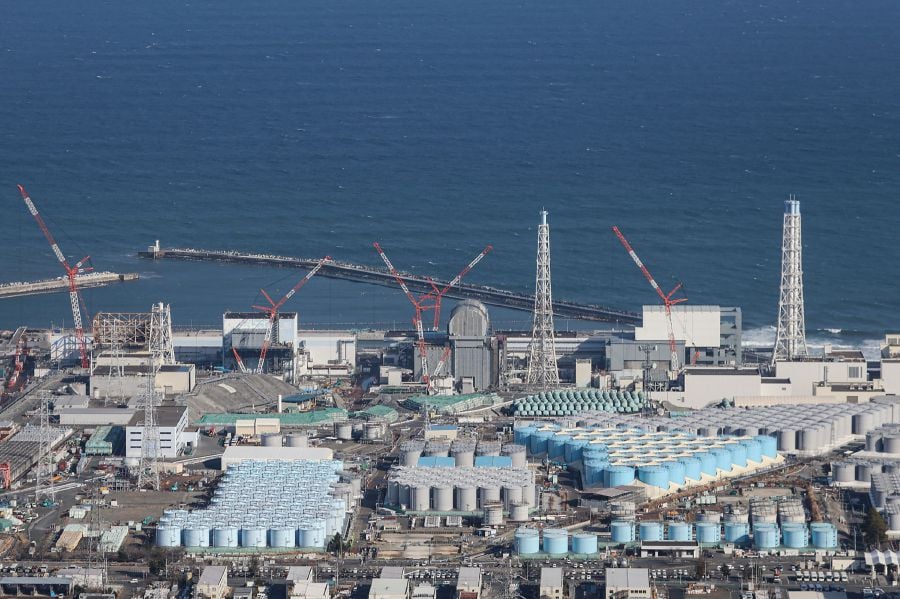
TOKYO (AP) — Japanese officials plan to start discharging treated radioactive wastewater from the damaged Fukushima Daiichi nuclear power plant into the Pacific Ocean on Thursday, a contentious step more than 12 years after a massive earthquake and tsunami set off a battle against ever-increasing amounts of radioactive water at the plant.
The government and plant operator say the release is an unavoidable part of its decommissioning and will be safely carried out, but the plan faces opposition in and outside Japan. Here is a look at the controversy.
WHY IS THERE SO MUCH WASTEWATER?
The March 2011 earthquake and tsunami destroyed the plant’s cooling systems, causing three reactors to melt. Highly contaminated cooling water applied to the damaged reactors has leaked continuously to building basements and mixed with groundwater.
The plant operator, Tokyo Electric Power Company Holdings (TEPCO), has taken steps to limit the amount of groundwater and rainwater entering the reactor area, and has reduced the increase in contaminated water to about 100 tons a day, 1/5 of the initial amount. The water is collected and partly recycled as cooling water after treatment, with the rest stored in around 1,000 tanks, which are already filled to 98% of their 1.37 million-ton capacity.
WHY IS TEPCO RELEASING THE WATER NOW?
The government and TEPCO say they need to make room for the plant’s decommissioning and prevent accidental leaks from the tanks.
Japan has obtained support from the International Atomic Energy Agency to improve the transparency and credibility of the release and ensure it meets international safety standards. The government has also stepped up a campaign promoting the plan’s safety at home and through diplomatic channels.
WHAT’S IN THE TREATED WATER’?
The water is being treated by what’s called an Advanced Liquid Processing System, which can reduce the amounts of more than 60 selected radionuclides to government-set releasable levels, except for tritium, which officials say is safe for humans if consumed in small amounts.
About 70% of the water held in the tanks still contains cesium, strontium, carbon-14 and other radionuclides exceeding government-set levels. It will be retreated until the concentrations meet those limits, then diluted by more than 100 times its volume of seawater before it is released. That will bring it way below international safety limits, but its radioactivity won’t be zero.
HOW SAFE IS IT?
IAEA concluded in a report that the plan, if conducted as designed, will have negligible impact on the environment and human health. IAEA chief Rafael Grossi visited the plant and said he was satisfied with preparations.
Japan’s government says the release of tritium into the sea is a routine practice by nuclear plants around the world and that the amount will be several times lower than from plants in China and South Korea.
Scientists generally support the IAEA’s conclusion, while some call for more attention to dozens of low-dose radionuclides that remain in the water, saying data on their long-term effects on the environment and marine life are insufficient.
HOW WILL IT BE RELEASED?
TEPCO executive Junichi Matsumoto says the release will begin with the least radioactive water to ensure safety. After samples are analyzed in final testing, the water will be transported through a thin black pipe to a coastal area where it will be diluted with hundreds of times its volume of seawater.
The diluted water will enter an undersea tunnel and be released a few minutes later from a point 1 kilometer (0.6 mile) off the coast. The release will be gradual and will continue for decades until the decommissioning of the plant is finished, TEPCO officials say. Matsumoto said the slow release will further reduce the environmental impact.
Final preparation for the release began Tuesday when just 1 ton of water was sent for dilution with 1,200 tons of seawater, and the mixture was to be kept in the primary pool for two days for final sampling to ensure safety, Matsumoto said. A batch of 460 tons will be sent to the mixing pool Thursday for the actual discharge.
The company plans to release 31,200 tons of treated water by the end of March 2024, which would empty only 10 tanks because of the continued production of wastewater at the plant. The pace will later pick up.
WHY ARE PEOPLE WORRIED?
Fukushima’s badly hit fisheries, tourism and economy are still recovering from the disaster. Fisheries groups worry about a further damage to the reputation of their seafood. Fukushima’s current catch is only about one-fifth its pre-disaster level due to a decline in the fishing population and smaller catch sizes.
The head of the National Federation of Fisheries Cooperatives, Masanobu Sakamoto, said on Monday that “scientific safety and the sense of safety are different.”
Groups in South Korea and China have also raised concerns, turning the release into a political and diplomatic issue. China has stepped up radiation testing of fishery and agricultural products from Fukushima and nine other prefectures, halting exports at customs for weeks, Fisheries Agency officials say.
WHAT IF SOMETHING GOES WRONG?
The Japanese government says potential risks from the release of treated water are limited to reputational damage resulting from rumors, rather than scientific study. It has allocated 80 billion yen ($550 million) to support fisheries and seafood processing and combat potential reputation damage. TEPCO has also promised to deal with reputational damage claims.
More nuclear challenges await Japan after Fukushima water release
By Kiyoshi Takenaka, TOKYO, Aug 24 (Reuters) https://www.reuters.com/world/asia-pacific/more-nuclear-challenges-await-japan-after-fukushima-water-release-2023-08-24/ Twelve years after the Fukushima nuclear disaster, Japan has started to release treated radioactive water into the sea, a key step in the process of decommissioning the stricken plant, but much tougher tasks lie ahead, such as molten fuel removal.
Here are the challenges facing the government and plant operator Tokyo Electric Power Co (Tepco) (9501.T) as they try to draw a line by the middle of the century under the world’s worst nuclear accident since Chornobyl.
MOLTEN FUEL REMOVAL
Tepco has described the effort to remove highly radioactive fuel debris from reactor cores as an “unprecedented and difficult challenge never attempted anywhere in the world”.
Trial-based retrieval at the No.2 reactor, the first at the plant to go through such a step, has been delayed twice from an initially scheduled date of 2021, and is now set for a six-month period starting in October.
At Three Mile Island (TMI), the U.S. nuclear plant in Pennsylvania that partly melted down in 1979 after a failure, fuel debris was kept under water during retrieval work, providing a shield against radiation.
That was the worst nuclear plant accident before the 1986 Chornobyl tragedy in Ukraine, then part of the Soviet Union.
Japan and Tepco plan to remove molten fuel while it is exposed to air because it is difficult to fill the badly damaged reactor cores with water.
But that will also make it hard to protect workers and retrieval gear from strong radiation.
The Fukushima plant suffered triple meltdowns, compared to the single fuel core meltdown at Three Mile Island, which means the debris retrieval operation will be much larger and more complicated this time around.
The retrieval will be done by a remotely controlled, 22-metre-long (72-foot) robot arm. The initial stage aims to extract only a few grammes of fuel debris, although the total molten fuel at the plant is estimated to be 880 metric tonnes.
RADIOACTIVE SOIL
The 2011 accident spewed radiation into the air, which eventually contaminated the soil. Part of that tainted soil is stored at an interim site more than four times as big as New York’s Central Park.
But the law requires the soil stored at the interim site, located next to the tsunami-wrecked power plant, to be moved out of Fukushima within 30 years from when it began operating in 2015.
More than a quarter of that interval has elapsed with no clear sign the government is nearer to securing permanent storage, though the environment ministry says the earliest the search for specific locations will start is 2025.
BALLOONING COSTS
In 2016, the government doubled to 21.5 trillion yen ($148.60 billion) its estimate of the costs of responding to the Fukushima disaster, including compensation, decommissioning and decontamination efforts.
About 12.1 trillion yen had been spent on such activities by March 2022, Japan’s audit panel, which reviews government expenditures, has said.
That represents an expenditure of more than half of the government’s estimate, even before really tough tasks such as fuel debris retrieval have begun, in turns raising concerns about cost overruns.
Tepco’s continuing payouts to the victims hits its bottom line.
In 2019, a private think tank, the Japan Center for Economic Research, said compensation, decommissioning and decontamination costs were expected to reach 41 trillion yen in a scenario in which Fukushima water was diluted and discharged into the sea.
($1 = 144.6800 yen)
Japan’s nuclear wastewater – should we be worried?
August 22, 2023 https://www.nst.com.my/opinion/leaders/2023/08/945792/nst-leader-japans-nuclear-wastewater
FUKUSHIMA is a dreaded word in the region because what happens there doesn’t stay there. There in Japan on March 11, 2011, an earthquake and tsunami, in that order, knocked out the Fukushima Daiichi nuclear-power plant, releasing untreated radioactive water into the sea.
Given the state of the nuclear plant technology then — or even now — there wasn’t the time for the radioactive elements to self-destruct. The human mind, including the Japanese ones, for some reason didn’t perceive that calamities can happen all at once.
The Fukushima disaster is such a tale of instantaneous conjunction of calamities. On a visit to the disaster zone on Sunday, Japanese Prime Minister Fumio Kishida was quoted by news agency AFP as saying that he was refraining from “commenting on a concrete timing of the release into the ocean at this point in time”, leaving ample room for a prime ministerial hint that it will be soon.
Some 500 Olympic-size swimming pools of wastewater, accumulated over 12 years after the disaster, are expected to be released into the Pacific Ocean. The fact that it would be a slow release over 10 years registered no effect in the region’s dread meter.
The region is on dread-watch, but much of it is coated with diplomatic niceties. China has been the most vociferous in opposing the release of the wastewater into the ocean. In China, dread comes mixed with geopolitical anger, given that Tokyo is a tango partner of Washington.
If a taste of Chinese animus is needed, here is one quote from a Beijing official, gleefully circulated by the Western media: Japan is treating the sea as its sewer. An interesting take, we must say, now that all nations without exception are treating the seas as their sewer.
How many marine lives were destroyed or how many people have ingested radioactive materials through seafood after the accident 12 years ago is hard to tell. Nuclear literature tells us if the water isn’t treated properly, dangerous isotopes can have devastating effects, including DNA-damaging ones. Should we fear? Yes and no. Start with yes.
The Tokyo Electric Power Company (Tepco), the operator of the crippled nuclear plant, and Japanese regulators stand accused of negligence, notwithstanding the earthquake and tsunami. Now that Tepco and the government are saying the 1.34 million tonnes of wastewater planned to be released into the Pacific Ocean is safe, many in Japan don’t believe them. Both are victims of trust deficit.
Kishida, though he wasn’t prime minister when disaster struck in 2011, is in need of reputation management advice. Not just to repair the trust deficit at home, but also abroad.
China has banned seafood from Fukushima and considering a wider ban. Others in the region are beginning to be infected by China’s isotope fear, not because of Beijing’s geopolitics, but because of the nightmarish outcome of radioactive contamination. If the dread grows, it will cripple more than Fukushima.
Now for the no, our second response to Japan’s release of the treated wastewater into the ocean. The world shouldn’t fear because the Japanese guarantee that the dangerous radioactive elements have been filtered out and comes stamped with the approval of the United Nations’ International Atomic Energy Agency
Unless, of course, if the world has reasons to believe that the IAEA, too, comes branded with a trust deficit.
Japanese fishing industry leader is “greatly concerned” over the pending disharge of Fukushima radioactive water into the ocean.

The leader of a Japanese fisheries industry group told officials on Monday
he was “greatly concerned” about the discharge of treated radioactive water
set to be released into the sea from the wrecked Fukushima nuclear plant.
The government is expected to decide soon, perhaps within days, when to
start releasing the water, equivalent to the contents of 500 Olympic-size
swimming pools, despite objections at home and abroad to the plan.
Reuters 21st Aug 2023
Threat from the skies: India steps up the fight against a major space danger.

By B R Srikanth, a veteran Bengaluru-based journalist reporting on space and defense, 21 Aug 23, https://www.rt.com/india/581397-india-space-debris-cleaning-mission/
New Delhi’s ambitious space plans include tackling the problem of floating debris, countless pieces of which orbit the Earth
A spectacular display of celestial fireworks? The momentous arrival of aliens? Or was it a work-in-progress sci-fi flick?
These questions weighed heavily on many minds as Melbourne’s night sky lit up for almost a minute on the night of August 7. The flame raced across the sky before breaking into blazing fragments. A sonic boom shook the ground for a couple of seconds, setting off a panic among residents. A day later, the Australian Space Agency confirmed it was space junk, likely “remnants” of a giant Russian rocket which had hoisted a new navigational satellite into orbit.
A few weeks earlier, a six-foot high cylindrical object, perhaps the fuel tank of an Indian rocket, had washed ashore at Green Head Beach, 250 km north of Perth, Australia. The artificial lighting, the loud explosion, and the large fuel tank found there reignited one question: How to vacuum-clean the graveyard in the deep, dark heavens to safeguard assets worth billions of dollars?
Such assets include satellites circling the Earth at 300 km to 36,000 km, in support of telecommunications, broadcasting, meteorology, civil aviation, telemedicine, distance education, and even espionage (by military satellites launched without fanfare).
Space junk
Outer space contains hundreds of dead satellites, millions of fragments of old satellites and rockets, and even paint flakes; each is hurtling through space at an incredible speed of 10 km a second, with a lethal punch of a 550-pound object. NASA estimates there are around 23,000 pieces of debris larger than a softball, half a million pieces the size of a marble or up to a centimeter, 100 million pieces one millimeter and larger.
Example of space junk include a glove lost by Edward Higgins White during America’s first spacewalk, Michael Collins’ camera lost near Gemini 10, a thermal blanket lost during STS-88, the first space shuttle mission, garbage bags jettisoned by cosmonauts during Mir’s 15-year life, a wrench, and a toothbrush.
Indian-American astronaut Sunita Williams lost her camera during her spacewalk from the space shuttle in 2007, and astronaut Heidemarie Stefanyshyn-Piper lost a briefcase-sized tool bag during her spacewalk the following year.
And if you think the Hollywood film ‘Gravity’, where a spacecraft is hit by a cloud of space debris (killing George Clooney’s character, and nearly marooning Sandra Bullock) was fiction, then consider that in 1996, a French satellite was hit and damaged by a French rocket that had exploded a decade earlier. Or that on February 10, 2009, a defunct Russian spacecraft collided with and destroyed a USA Iridium commercial spacecraft. The collision over northern Siberia added 2,300 pieces of large trackable debris and a bigger quantity of smaller trash to the existing space junk.
China did not help matters when in 2007 it used a missile to destroy an old weather satellite, creating 3,500 pieces of large debris. In 2016, a tiny piece of debris punched a hole in the solar panel of the European Space Agency (ESA) observation satellite, Copernicus Sentinel 1A. Even the Hubble Telescope’s solar array shows hundreds of tiny holes caused by dust-sized debris.
The risk of trash colliding with satellites could spiral higher in the future, K R Sridhara Murthy, Honorary Director and former vice president of Paris-based International Institute of Space Law (IISL), and a former senior scientist of the Indian Space Research Organisation (ISRO), told RT.
This is because a large number of private companies – SpaceX, OneWeb, Amazon Kuiper, Guo Wang (China), Samsung (Korea), and Astrome Tech (India) plan to add a whopping 75,000 satellites within a decade to provide global communication networks (superfast internet services), and Automatic Identification Systems (AIS) to track ships (including those of pirates) among other benefits.
Though smaller than conventional satellites, they will crowd the low earth orbit (LEO), about 400 km from the ground, and multiply the number already in this sphere. “More companies are joining the race to position their satellites in orbit because the economics of satellite launch are changing drastically owing to reduction in the cost of putting a satellite into orbit and the deployment of reusable rockets,” Murthy added.
Need for self-discipline
Nations have not been unmindful of the hazards of space junk. The USA and the former USSR tracked objects measuring four inches or more from the Cold War era using a string of radars. NASA and the US Defense Department’s Space Surveillance Network (SSN) have cataloged more than 27,000 pieces of debris, and track each piece’s trajectory.
Not surprisingly, nations with ambitions in space, including India, are setting up facilities to track the burgeoning amount of trash.
The importance of tracking can be gauged when even the voyage of a rocket into space is delayed by a couple of minutes to prevent debris from causing a disastrous impact on missions, Dr. Mylswami Annadurai, the “Moon man of India” and former director of ISRO’s Prof. U R Rao Satellite Centre in Bengaluru, told RT. He said that ISRO delayed the launch of its rockets three times to avoid a piece of space junk: a one-minute delay in the blast-offs in 2011 and 2016 and a three-minute hold in 2014
All space agencies realize the need for self-discipline in outer space and try not to disturb the operations of other satellites when decommissioning an old and defunct one. “For example, we (ISRO) brought down Megha-Tropiques (a satellite designed jointly and launched by ISRO and CNES of France in 2011 to study tropical atmosphere in the context of climate change) last year with the help of fuel available onboard without causing damage to any other satellite,” Rao said.
Last month, Indian space scientists reduced the altitude of the last stage of the Polar Satellite Launch Vehicle (PSLV) rocket as part of its initiative to avoid creating more space junk. “Left alone at a 536 km circular orbit, the PSLV4 stage would orbit the Earth for over 25 years. As the number of satellites in LEO (low earth orbit) is growing and the space around this orbit is of particular interest, the orbit of the spent PSLV4 was reduced to 300 km,” said the ISRO’s spokesperson.
“Everybody wants to clear outer Space of debris, but how to do it is a billion-dollar question,” K Sivan, former Chairman of ISRO, explained to RT. “We are part of the Inter-Agency Space Debris Coordination Committee (IADC). This international governmental forum coordinates global efforts to reduce debris by sharing research and identifying debris mitigation options.”
When Sivan was at the helm, ISRO established a radar at the Deep Space Network Station on the outskirts of Bengaluru as part of a project, called ‘Nethra’, to track junk in outer space and to share the data with other space agencies. Earlier, ISRO established the Multi-Object Tracking Radar at Satish Dhawan Space Centre, Sriharikota, the country’s spaceport just off the eastern coast in Odisha, to track the trajectory of 10 pieces of space junk and share the data with IADC.
According to Sivan’s predecessor, Gopalan Madhavan Nair, options include preventing new debris, designing satellites to withstand the impact of minor pieces, and improving procedures such as using orbits with less trash.
“Earlier, we used to allow the last stage of our PSLV rocket, along with some fuel, to drift away after launching the satellite, but now we make sure that the fuel (propellant) is exhausted to prevent an explosion of the last stage, or it is used to push the last stage closer to the Earth. Eventually, the last stage will drift further down and burn on re-entering the Earth’s atmosphere,” he said, alluding to the recent manoeuver.
Clearing efforts
In 2018, the United Nations Institute for Disarmament Research (UNDIR) proposed three A-SAT (anti-satellite) test guidelines for preventing junk in outer space. No consensus, however, has been reached among space-faring nations on the policies.
To mitigate the hazards of vast amounts of junk in outer space, the Japanese Space Agency, JAXA, has launched a project to develop a sprawling net akin to the one used by fishermen, to trap and drag down the trash. Many private companies are working on similar methods to cart away the garbage through operations that could fetch them millions of dollars.
ESA has teamed up with a consortium led by Swedish start-up, ClearSpace, to remove all ESA-owned, defunct satellites in the LEO. Their mission, ClearSpace1, will be launched in 2025 to capture a 100-kg upper-stage left orbit after the second flight of ESA’s Vega launcher in 2013. During follow-up missions, ESA will attempt multi-object captures.
Other space agencies and private enterprises could follow suit, each with unique techniques to reduce the trash in outer space by 2050. Space scientists, however, feel new satellite observation methods, too, ought to be developed to forecast the trajectory of orbiting satellites and debris to avoid collisions.
Poisoning the planet
Radioactive water dump is just latest example our reckless destruction of habitat
By Linda Pentz Gunter, 20 Aug 23, https://beyondnuclearinternational.org/2023/08/20/poisoning-the-planet/
Much has been made — and rightly so — about the potential impact on human health and the Japanese fishing industry if Japan moves forward with its proposal to dump 1.2 million cubic meters — that’s 1.3 million tons —of radioactively contaminated water into the Pacific Ocean from the destroyed Fukushima Daiichi nuclear power plant site.
Unfortunately, this looks likely to happen sometime this month or next despite the worldwide outcry. But when I say “happen”, that rather suggests a one-off dump. Instead, the discharge of these liquid nuclear wastes could go on for at least 17 years according to the Atomic Energy Society of Japan, but likely longer as decommissioning work at the site is expected to take at least 30-40 years.
It is perfectly right and reasonable that the Japanese fishing community sees its livelihood under threat from this proposal. Indeed, it has already taken a hit, as imports of Japanese fish stock to South Korea were down by 30% in May, before the dumping even began. This was clearly driven by jitters around the on-going safety of Japanese fish supplies once those radioactive discharges get underway.
And Pacific Island nations, along with an international team of scientific experts, have equally decried the plan as premature, unnecessary and in need of far greater confidence and further study before such discharges are executed, if ever.
But there is a greater moral issue here, one that speaks to humankind’s reckless and selfish behavior on planet Earth ever since mechanization and the various so-called industrial revolutions began.
For almost three centuries in the developed world, we have continuously and wantonly destroyed vast areas of precious habitat for numerous species. We have clear cut forests, sliced the tops off mountains, broken open the earth to mine minerals, exploded atomic weapons, spewed mercury and carbon into our air, drilled for oil, sprayed pesticides at will and filled the oceans with plastics, to name just a few environmental atrocities.
The toxic mess these activities leave behind has been dumped into rivers, streams, lakes and oceans, or on the lands where the less influential and powerful amongst us live — in the United States almost always in communities of color or on Native American reservations.
One of the worst offenders on this list is nuclear waste. In keeping with our heedless irresponsibility we have kept making lethal radioactive waste without the slightest idea how to safely manage or store it for the longterm. For years, barrels of the stuff were dumped into the sea, until a 1994 amendment to the London Dumping Convention, put an end to it.
But of course the nuclear industry found a way around this. Routine liquid discharges through a pipe circumvented this law. Institutions such as the LaHague reprocessing site on the northern French coast, have discharged radioactive liquids (and gases) for decades. Didier Anger, the now retired expert activist on the environmental crimes at La Hague, uses this history to warn us urgently and eloquently of the folly of discharging nuclear waste into our oceans.
At times, the liquid wastes from La Hague, measured at the discharge point by vigilant groups such as Greenpeace, could have been classified as high-level radioactive waste that would normally require a deep geological repository.
As we approach the moment when radioactive liquids are once more poured into the sea, this time in Japan, imposing a toxic burden on the creatures who are already struggling to survive there, we must ask whether human beings have some sort of divine right of kings to trash the habitat of other living things?
The answer should surely be ‘no’. That humans can generate a radioactive mess and “dispose” of it into some other creatures’ habitat, poisoning their environment is, frankly, both arrogant and abhorrent.
We have already done this everywhere and it has come with a terrible price to other creatures as well as to ourselves. The destruction and contamination of habitat has led to mass extinctions. The US has lost three billion birds since 1970. That’s one in four birds. We may have thought the birds were back in abundance during the start of the covid pandemic, but that was just us hearing what’s left of them more clearly, in the quiet of lockdown.
Bees, who perform around 80% of all pollination, are dying out and hives collapsing, all due to human activities. These include pesticides, drought, habitat destruction, nutrition deficit, air pollution, and, of course, the climate crisis.
Absent these and other essential members of the web of life, our own extinction is not far behind.
We need to stop this behavior and we need to stop it now. We should do it not only for ourselves but for the countless innocent creatures who should not be expected to offer up their homes as our dustbins.
Loading up the Pacific Ocean with liquid radioactive waste — whether it dilutes and disperses or not — is a crime of immorality representative of so many that have come before. If we are truly to change our plundering, polluting and profligate ways, banning the radioactive water dump at Fukushima would be an excellent place to start.
Linda Pentz Gunter is the international specialist at Beyond Nuclear and writes for and curates Beyond Nuclear International.
Japan’s nuclear plants are short of storage for spent fuel. A remote town could have the solution.
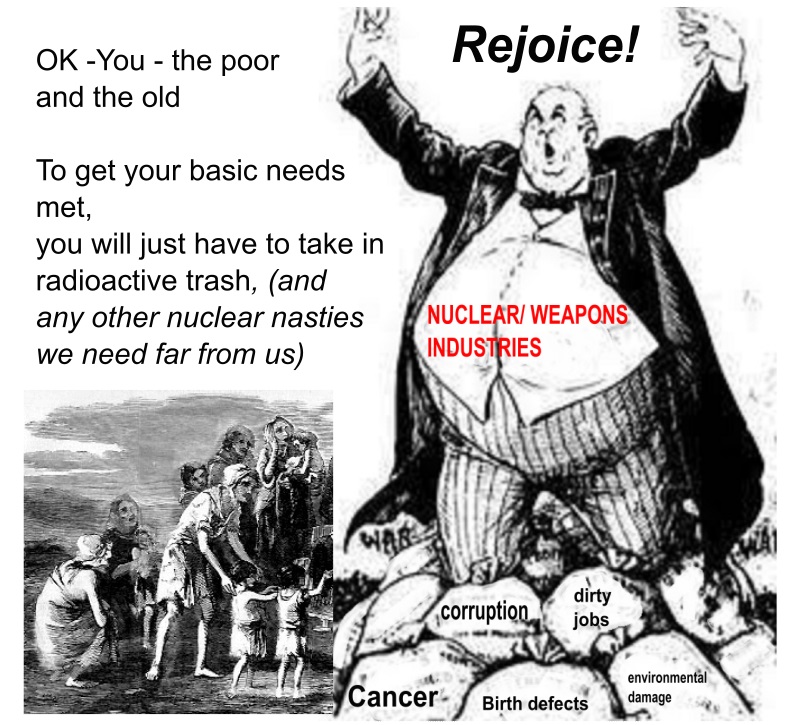
Chugoku Electric’s plan to build a nuclear power plant in Kaminoseki has been stalled for more than a decade since the Fukushima Daiichi disaster, delaying subsidies for the remote town, whose population is aging and shrinking.
“The town will only get poorer if we just keep waiting,” Kaminoseki Mayor Tetsuo Nishi – “We should do whatever is available now.”
ByMARI YAMAGUCHI Associated Press, https://abcnews.go.com/Business/wireStory/japans-nuclear-plants-short-storage-spent-fuel-remote-102373016 August 19, 2023
TOKYO — A Japanese town said Friday it has agreed to a geological study to determine its suitability as an interim storage site for spent nuclear fuel.
Kaminoseki, a small town in the southwestern prefecture of Yamaguchi, said it would accept the offer of a survey by Chugoku Electric Power Co., one of two major utility operators, along with Kansai Electric Power Co., whose spent fuel storage pools are almost full.
The Japanese government is promoting the greater use of nuclear power as a low-carbon energy source, but the country’s nuclear plants are running out of storage capacity.
The problem stems from Japan’s stalled nuclear fuel recycling program to reprocess plutonium from spent fuel for reuse. The government has continued to pursue the program, despite serious technical setbacks. A plutonium-burning Monju reactor failed and is being decommissioned, while the launch of the Rokkasho reprocessing plant in northern Japan has been delayed for almost 30 years.
After the meltdown of the Fukushima Daiichi nuclear power plant in 2011, many reactors were temporarily taken offline and their restarts delayed, helping to reduce the spent fuel stockpile.
However, when Prime Minister Fumio Kishida’s government decided to reverse a phaseout and maximize nuclear power as clean energy, concerns over the lack of storage space were rekindled.
Earlier this month, Chugoku put forward a proposal to build a storage facility jointly with Kansai Electric, but the plan was met by angry protests from residents, who surrounded the mayor and yelled at him.
Chugoku Electric’s plan to build a nuclear power plant in Kaminoseki has been stalled for more than a decade since the Fukushima Daiichi disaster, delaying subsidies for the remote town, whose population is aging and shrinking.
“The town will only get poorer if we just keep waiting,” Kaminoseki Mayor Tetsuo Nishi told a televised news conference Friday. “We should do whatever is available now.”
Kansai Electric, Japan’s largest nuclear plant operator, is urgently seeking additional storage for spent fuel: the cooling pools at its plants are more than 80% full. The company pledged to find a potential interim storage site by the end of this year.
About 19,000 tons of spent fuel, a byproduct of nuclear power generation, is stored at power plants across Japan, taking up about 80% of their storage capacity, according to the economy and industry ministry.
The continuation of spent fuel reprocessing program and the delay have only added to Japan’s already large plutonium stockpile, raising international concern. Japan also lacks a final repository for high-level nuclear waste.
An intermediate facility is designed to keep nuclear spent fuel in dry casks for decades until it is moved to a reprocessing or to a final repository. Experts say it is a much safer option than keeping it in uncovered cooling pools at their plants.
If the storage is actually built, it will be the second such facility in Japan. The only other one is in Mutsu, near Rokkasho, which is reserved for Tokyo Electric Power Co. and a smaller utility.
Fukushima water release poses test for Japan-South Korea unity
TOKYO/SEOUL – Japan Times , BY TIM KELLY, SAKURA MURAKAMI AND HYONHEE SHIN
REUTERS 18 Aug 23
U.S. President Joe Biden wants to lock in friendly ties between Japan and South Korea at a summit on Friday, but their readiness to shelve grievances will be tested when Tokyo begins pumping water from its wrecked Fukushima nuclear plant into the sea.
Japan already delayed the release to avoid stirring up political opposition in South Korea before President Yoon Suk-yeol joins Prime Minister Fumio Kishida for a meeting with Biden at the Camp David retreat on Friday, four officials in Japan and South Korea said.
The dumping of radioactive water may happen days after the summit, which the United States is billing as a “historical” trilateral meeting that will deliver a “bold counter” to regional rival China.
That puts less domestic political pressure on Yoon, said one of the officials, who asked not to be identified because of the sensitivity of the issue.
Washington needs its Asian allies to work together because they see the military power balance in East Asia, including around Taiwan, shifting in China’s favor.
…………………….. Even if Fukushima fades as an issue, the risk of bad blood remains real. As relations soured in 2019, for example, Moon nearly scrapped a critical intelligence-sharing deal with Japan, reversing the decision at the last minute under U.S. pressure.
By accepting an International Atomic Energy Agency (IAEA) report last month that greenlit Japan’s Fukushima water release, Yoon could encourage fresh dissent that China will try to amplify, analysts say.
“There is certainly some possibility that Yoon will come under pressure over this, particularly if there is data that shows that the water is more dangerous than we otherwise thought,” said Christopher Johnstone, a former East Asia director of Biden’s National Security Council who is now with the Center for Strategic and International Studies.
Japan says it will remove most radioactive elements from the water except for tritium, a hydrogen isotope that must be diluted because it is difficult to filter.

U.S. Secretary of State Antony Blinken on Tuesday expressed satisfaction with Japan’s plans.
………………….a Gallup poll in late June showed that 78% of South Koreans worry about potential contamination of the ocean and seafood…………………………
more https://www.japantimes.co.jp/news/2023/08/18/japan/politics/south-korea-fukushima-radioactive-water/
1 This Month



26 September – International Day for the Total Elimination of Nuclear Weapons


PLEASE OPPOSE HR 8255 AND S.3639 – bills would accelerate satellite deployment, with no environmental review or safeguards – https://ncstd5li.quorum.us/campaign/169331/
To see nuclear-related stories in greater depth and intensity – go to https://nuclearinformation.wordpress.com
-
Archives
- September 2026 (219)
- August 2026 (330)
- July 2026 (355)
- June 2026 (287)
- May 2026 (306)
- April 2026 (356)
- March 2026 (251)
- February 2026 (267)
- January 2026 (308)
- December 2025 (358)
- November 2025 (359)
- October 2025 (375)
-
Categories
- 1
- 1 NUCLEAR ISSUES
- business and costs
- climate change
- culture and arts
- ENERGY
- environment
- health
- history
- indigenous issues
- Legal
- marketing of nuclear
- media
- opposition to nuclear
- PERSONAL STORIES
- politics
- politics international
- Religion and ethics
- safety
- secrets,lies and civil liberties
- spinbuster
- technology
- Uranium
- wastes
- weapons and war
- Women
- 2 WORLD
- ACTION
- AFRICA
- Atrocities
- AUSTRALIA
- Christina's notes
- Christina's themes
- culture and arts
- Events
- Fuk 2022
- Fuk 2023
- Fukushima 2017
- Fukushima 2018
- fukushima 2019
- Fukushima 2020
- Fukushima 2021
- general
- global warming
- Humour (God we need it)
- Nuclear
- RARE EARTHS
- Reference
- resources – print
- Resources -audiovicual
- Weekly Newsletter
- World
- World Nuclear
- YouTube
-
RSS
Entries RSS
Comments RSS
 nuclear-news