Japan Increases Limits on Radiation Exposure Before Nuke Reactors Restart
Amid preparations to restart nuclear reactors shut down following the 2011 Fukushima meltdown, the Japanese government plans to set a new standard for the permissible upper limit of radiation exposure for those in charge of anti-disaster operations.
The list of those affected by the change in standards includes local government officials, police and fire department officials, as well as bus drivers, who would be charged with securing the steady evacuation of local residents in case of a nuclear accident.
The Japanese government plans to set a new standard for the permissible upper limit of radiation exposure for those in charge of anti-disaster operations.
The list of those affected by the change in standards includes local government officials, police and fire department officials, as well as bus drivers, who would be charged with securing the steady evacuation of local residents in case of a nuclear accident.
Currently, the maximum permissible radiation dose is 1 millisievert per year for ordinary residents, 50 millisieverts per year for decontamination workers, and 100 millisieverts per year for nuclear plant workers; the upper limit for police and fire department officials as well as national public servants and other relevant personnel, previously subject to the same standard as that for ordinary local residents, will be raised to 100 millisieverts per year in emergency situations. During the crisis at the Fukushima No. 1 Nuclear Power Plant, a considerable number of necessary people, such as government staff, were not secured for the local task force near the damaged nuclear power complex, which rendered evacuations and the transport of necessary emergency supplies difficult. The new standard is aimed at preventing similar obstacles in future, The Mainichi reported. “As it is possible that local officials and bus drivers will carry out their duty where radiation levels are relatively high, we need a new standard in order to provide effective evacuation guidance as well,” a Cabinet Office official said. Discussion of the new standard by a working group within the Cabinet Office is scheduled for next month.
Source: Sputnik News
Looking Inside Fukushima Prefecture
Because of Japan’s unconscionable open-ended new secrecy law, it is very likely journalism in the nation has turned tail, scared of its own shadow. Nevertheless, glimmers of what has happened, of what is happening, do surface when brave people come forward.
On May 22nd 2015 Hiromichi Ugaya, a photojournalist who is well-informed, insightful, and engaging, was interviewed about what he witnessed in the aftermath of one of the world’s most horrendous disasters.
Hiromichi Ugaya was born in Kyoto City, Japan in 1963. He is an accomplished photojournalist with experience in both Japan and the United States, receiving his bachelor’s degree at Kyoto National University and his master’s degree at Columbia University.
Naïveté of Public
Hiromichi first visited Fukushima within two weeks of the disaster, and he has returned nearly 50 times to photograph scenes. His is a personal mission because the tragedy does not receive adequate media coverage. According to him, very few journalists cover the aftermath; television in Japan has lost interest; the public is blasé and dangerously naïve; Japanese publishers do not entertain stories about Fukushima, and the mainstream media in Japan ignores the impact of the aftermath.
Curiously, it’s as if a news blackout has been covertly instituted, and maybe it has. What people do not see, do not hear becomes invisible, out of sight out of mind, similar to the after-affects of radiation exposure, which are not felt, not smelled, not tasted, not physically recognized by people, until it’s too late, until it’s too late, until it’s too late.
Then again, maybe The Act on the Protection of Specially Designated Secrets, Act No. 108 promulgated on December 13, 2013 is quelling public opinion?
According to a leading Japanese newspaper, the law “almost limitlessly widens the range of what can be considered confidential,” and the new secrecy law allows bureaucrats and politicians to “designate state secrets to their liking,” Nobuyuki Sugiura, Managing Editor, Tokyo Head Office, Asahi Shimbun will continue to respond to the public’s right to know, The Asahi Shimbun, December 7, 2013.
Those who leak state secrets face up to 10 years in prison.
And, repeating that standardized rule: Bureaucrats and politicians can “designate state secrets to their liking.” Is this a world’s first? Does this mean that bureaucrats and politicians can determine the fate of anybody and/or everything?
In the face of cowardly authoritarianism, history teaches lessons of harsh reality, for example, Chernobyl is an example of the long-term tragedy associated with nuclear accidents, thirty years later, nearly one million dead (source: Alexey V. Yablokov, Center for Russian Environmental Policy, Moscow, Chernobyl: Consequences of the Catastrophe for People and the Environment, The New York Academy of Sciences, Vol. 1181, December 2009).
Chronicling the first four years of Fukushima, Hiromichi Ugaya composed a photo book about the tragedy as a personal countermeasure to widespread public apathy: Portrait of Fukushima: 2011-2015: Life After Meltdown, which is a treasure trove of over 200 unpublished photos, telling the story from the beginning to the present.
Regions of Fukushima persist ghostlike: “America Tonight journeyed to the affected areas, which are separated into zones of higher and lower radiation risk. In the hardest-hit area, known as the “exclusion zone,” the streets remain virtually empty, eerily silent and frozen in time at the moment residents fled the quaking earth and incoming sea. The garbage and debris that litter the area defy the kempt and pristine neighborhoods for which Japan is famous,” Michael Okwu, Inside Fukushima’s Ghost Towns, Aljazeera America, Jan.6, 2014.
An Insider’s Story- the interview
The government’s initial reaction to the disaster is scandalous. According to Hiromichi, the authorities should have been “more open to the public.” Because of failure to communicate the danger, unnecessary radiation exposure was widespread. Minimal information was provided and evacuations were delayed much too long.
In essence, he believes the authorities were probably concerned about public panic. Regrettably, that concern may serve to haunt and endanger lives for many years. For example: “The most serious leakage of radiation took place March 15th, which was day-five of the nuclear accident, but still, within the radius of 10-20 kilometers, many citizens were still there… They were exposed to the radiation. The number of the people who got exposed to the radiation comes up to like 230,000, which is ten times bigger than Three Mile Island of 1979. So, it’s huge and all the population on Fukushima, two million, have to go for medical checks every year.”
Hiromichi suspects an outbreak of thyroid cancer over the next few years. Already, according to local reports, 107 cases of thyroid cancer have been confirmed. Yet, the gestation period for radiation’s effect is 5-40 years. And, this is only the fourth year.
He believes the Japanese people are not well informed. They only see the limited thyroid cancer cases so far even though those are merely an early harbinger, only foreshadowing the beginning of a long process of widespread complications for years to come. As well, it is doubtful people want to face the brutal truth; avoidance is an easy way out when fear reigns supreme.
Additionally, it is likely that widespread health problems will occur well beyond the limits of Fukushima Prefecture. The radioactive plume traveled notably beyond the immediate area. In March, in the immediate aftermath of the explosions, the plume traveled to Tokyo. “The area between Fukushima and Tokyo has some huge hotspots. In the northern Tokyo metropolitan area, also huge hotspots. Over the eastern region of Japan, the radioactive plume spread across a huge area.”
Hiromichi met with families of Fukushima Prefecture. The accident triggered bizarre behavior amongst families and within communities. The first reaction of family members was to evacuate their children to the next prefectures. But, complications arose, for example, “The problem happened because… first fathers tried to evacuate with their families… in those places where the evacuees reached, the fathers could not find a job. So, the fathers went back to their hometowns to their former jobs although the hometown was contaminated.”
The families of Fukushima squabbled and divided over issues of whether to leave their homes, sometimes leaving behind stubborn family members who refused to leave their lifetime residence. As well, entire communities divided into camps of pro-evacuation versus anti-evacuation, leading to conflict, arguments with old friends labeled as traitors.
Along the way, people experience horrible depression, drinking problems, headaches, vomiting, and loss of appetite, symptoms which are outside of physical normality.
Hiromichi’s story leaves one dangling, wondering what’s to become of the tens of thousands who are homeless to this day, what happens to those who live in fear, to the depressed who now view life as meaningless. And, to those who have already returned to fringe areas.
His is the inside story, the bitter truth behind the recklessness inherent within the complexity of nuclear power generation, toying with enormous untamed power, like wild horses on the plains, originated from e=mc2.
Still, to this day, purportedly, “More people have died from stress-related causes than from the initial disasters in Fukushima,” Alexis Dudden, professor of history, University of Connecticut, The Fourth Winter of Fukushima, Truthout, Jan. 4, 2015.
Beyond that, as time marches on, it is almost certain to bring on a perniciousness of cancer-related complications of unconscionable consequence, look at Chernobyl (1986) where to this day, in the still-contaminated villages and towns of Ukraine and Belarus children are horribly deformed without torsos and babies genetically mutated born without thighs or without fingers and where the “Chernobyl necklace” or thyroid cancer is universally widespread (Source: John Vidal, Nuclear’s Green Cheerleaders Forget Chernobyl at Our Peril, The Guardian, April 1, 2011). It’s 30 years later, and it continues!
The Health Impact
Green Cross International, which is committed to phasing out nuclear energy worldwide, issued a report d/d March 9, 2015: Fukushima Daiichi Power Plant Disaster: How many people were affected? 2015 Report. According to Adam Koniuszewski, Chief Operating Office of Green Cross International: “Our local presence and ongoing activities to help the communities… gives us a first-hand experience of the human and environmental consequences of nuclear disasters.”
Mikhail Gorbachev, former Communist Party General Secretary, formed Green Cross International in 1993. According to the former Soviet Union President and Nobel Peace Prize laureate: “We are facing a global environmental crisis, a conflict between man and nature,” Alexei Yablokov, Heroes of the Environment, Time Magazine, October 17, 2007. Chernobyl happened on his watch.
Estimates of radiation fallout, as obtained by Green Cross Int’l, show that 80% of the released radiation was deposited in the ocean and the other 20% dispersed within a 50 km radius. Over time, the overall risk of cancer will increase, especially for children at risk for entire lifetimes.
“Approximately 32 million people in Japan are affected by the radioactive fallout from the nuclear disaster in Fukushima.”
“The number of deaths from the nuclear disaster attributed to stress, fatigue and hardship of living as evacuees is estimated to be around 1,700 so far.”
So it goes, the long reach of radiation exposure is only starting as the gestation period runs 5-to-40 years. Not only that but the Fukushima Power Plant is still white hot, very hot. Despairingly, the melted core is somewhere inside of or outside of the nuclear containment vessels, nobody knows where, an enormous problem riddled with unforeseen danger for the environment, for humanity, maybe forever.
Why is Japan brazenly restarting nuclear power plants in the face of Fukushima’s continuing calamity, a tragedy that has only just started?
Postscript: According to journalist Kentaro Hamada, Kagoshima, Japan, “Japan Court Approves Restart of Reactors in Boost for Abe’s Nuclear Policy,” Reuters, April 22, 2015.
Source: Counterpunch
Fuel is loaded into Kagoshima reactor as first restart nears

Kyushu Electric Power Co. on Tuesday afternoon began loading fuel into the No. 1 reactor at its Sendai power station in preparation for a restart in mid-August, the first under safety standards adopted in response to the Fukushima crisis.
The 890,000-kilowatt unit in the city of Satsumasendai, on the west coast of Kagoshima Prefecture, will also be the first to be brought back on line since 2012.
But local concerns remain about the possibility of damage due to volcanic activity and how people living within 30 km of the two-reactor plant would be evacuated if a disaster hits.
A spokeswoman for Kyushu Electric said the fuel loading is a 24-hour operation and involves inserting into the reactor 157 fuel rod assemblies currently stored in an adjacent fuel pool. The first fuel was loaded early Tuesday afternoon, she said, and the last of the assemblies are expected to be inserted by Friday.
If there are no problems with loading the fuel and starting up the reactor, further safety checks of the electricity grid will be conducted. If given the all-clear, Kyushu Electric will begin selling nuclear-generated electricity by mid-September.
The Sendai No. 1 reactor passed the Nuclear Regulation Authority’s safety standards last September, making it the first reactor since the March 11, 2011, quake and tsunami and three meltdowns at the Fukushima No. 1 plant to be cleared for restart under the new rules.
With the exception of Kansai Electric Power Co.’s Oi No. 3 and No. 4 reactors in Fukui Prefecture, which were online from July 2012 to September 2013, all of Japan’s commercial reactors have been offline since the disaster.
The NRA has also cleared the Sendai No. 2 reactor, which Kyushu Electric hopes to restart by mid-October. Since the stricter requirements for restarts went into effect in July 2013, operators have applied for safety inspections on 25 reactors at 15 plants nationwide.
The loading of the fuel into the Sendai No. 1 reactor came the same day as the government announced revisions to the basic disaster response plan that, it says, will improve communications and coordination between Tokyo and local entities if a natural and nuclear disaster occur at the same time.
But Ryoko Torihara, a resident of Satsumasendai and a long-term anti-nuclear activist, said that the NRA, Kyushu Electric and local officials are rushing to a restart without a thorough analysis of the risk of volcanic damage and with questions remaining about evacuation plans.
“It’s quite strange the NRA did not have any volcanic experts on its committee when it accepted the word of Kyushu Electric that the possibility of a gigantic volcanic eruption, called a caldera eruption, was extremely small,” she said. In addition, evacuation plans for those within 30 km of the plant are vague. There are questions about how to assist the infirm, or even whether there would be enough bus drivers to help get people out, she said.
Source: Japan Times
http://www.japantimes.co.jp/news/2015/07/07/national/fuel-loaded-kagoshima-reactor-first-restart-nears/#.VZxMhfmFSM_
Fukushima town residents protest official’s comment about radiation safety

Nuclear evacuees from the Fukushima Prefecture town of Naraha have protested over a government official’s comment that he thinks the safety of the town’s drinking water is “a psychological issue.”
The whole town was designated as a no-entry zone after the Fukushima No.1 Nuclear Power Plant disaster, but is set to have its evacuation order lifted on Sept. 5, as announced by Vice-Minister of Economy, Trade and Industry Yosuke Takagi on July 6 when he visited the town. After the announcement, he held a press conference where, in response to a reporter’s question he pointed out that radioactive cesium amounts in Naraha tap water are below the detectable level, and said, “People differ in how they think about radiation. I think whether you think (the water source is) safe or not is a psychological issue.”
There is deep-rooted concern among town residents after sampling in July last year by the Ministry of the Environment found up to 18,700 becquerels of radioactive cesium per kilogram of soil at the bottom of the reservoir at the Kido Dam. That reservoir is the source of tap water for the town.
After Takagi’s comment, a Naraha resident in his 60s who has already finished reconstructing his house in preparation for returning to the town said, “That comment makes me lose my desire to go back. Does he intend to say it’s people’s own fault (that they feel unsafe)?”
Another resident in her 50s said, “If he (vice-economy minister Takagi) could understand the feeling of wanting to return to one’s hometown, he would not have said such a thing.”
Naraha will be the third no-go zone to have its evacuation order rescinded, after the withdrawal of one for the Miyakoji district of the city of Tamura in April last year, followed by the eastern part of the village of Kawamura in October. It will be the first of the seven municipalities in the prefecture where all residents had been ordered to evacuate to have the order lifted.
At first, the government was aiming to have Naraha’s order lifted in early August, but after criticism that there were not enough measures in place to help residents live there, the government delayed the lifting of the evacuation order by around a month to prepare additional measures such as increasing the number of free buses.
“We are reminded once again that the government can’t be trusted,” said Naraha resident Noboru Endo, 43, who is living in the western Tokyo suburb of Musashino as an evacuee with his 9-year-old son Shota. He feels that the national government is not listening to the voices of those calling for the safety and ease of mind of Naraha residents.
Endo’s wife Katsuko, 40, stayed behind in Iwaki, Fukushima Prefecture for her job, but Endo, who worked as a cook in Naraha, decided to evacuate with Shota, a kindergartener at the time of the disaster, for the sake of his son’s health.
These days, Shota is enjoying school in Musashino. He has made many friends there and says he doesn’t want to leave. With over four years having passed since the nuclear disaster, life as evacuees is changing into the norm for this family.
Every day, however, Endo wants more to return to his hometown and live there with his family. There was a briefing in late June held in Tokyo by the national government for Naraha residents ahead of the scheduled lifting of the evacuation order. Endo brought Shota with him to let him know about the current situation in Naraha and so he wouldn’t forget about going back to their hometown.
However, Endo is dissatisfied with the national government not showing any concrete measures for what it will do about the high levels of radioactive cesium at the bottom of the reservoir.
“Even if the government tells us our tap water is safe, how can we relax? If my generation, who have children, do not return, my hometown will not recover. That’s why I want to return, and I want the government to do everything it can to prepare a safe living environment there,” Endo says.
Source: Mainichi
http://mainichi.jp/english/english/newsselect/news/20150707p2a00m0na019000c.html
Evacuation of Fukushima town of Naraha to be lifted Sept. 5
The Japanese government has decided to lift in early September its evacuation order for the deserted town of Naraha near the destroyed Fukushima Daiichi nuclear plant.
Economy and industry state minister Yosuke Takagi informed Naraha Mayor Yukiei Matsumoto of the decision on Monday. Takagi serves as head of the government’s local task force on the nuclear disaster.
Takagi said lifting the evacuation order on September 5th would meet the expectations of residents who wish to return home. He said it would also help post-disaster rebuilding efforts.
Mayor Matsumoto accepted the government’s decision.
The central government had earlier planned to lift the evacuation order by mid-August. But the plan was postponed because residents expressed concerns over radiation and shortages of medical clinics and other infrastructure.
All of the town’s approximately 7,400 residents were forced to relocate because of the nuclear accident.
The town is the first municipality totally emptied after the disaster to have its evacuation order lifted.
Some residents of the town of Naraha near the crippled Fukushima Daiichi nuclear power plant believe the September 5th expiration of the government-ordered evacuation is too early.
All of the town’s residents were forced to relocate because of the nuclear accident. On Monday, some of them living in temporary housing in the city of Iwaki in Fukushima Prefecture voiced their concerns.
An 81-year-old man said many houses in the town have not yet been repaired, and the government is irresponsible for making the decision to lift the evacuation order. He said the town has no doctors or shops where residents can buy goods.
A 73-year-old woman said she does not understand why the government is lifting the order as soon as September 5th. She said public housing has not yet been built for people who lost their homes in the March 11th disaster.
A 39-year-old mother of a 9-year-old girl said she is concerned about radiation and the safety of water. She says senior residents without vehicles may have difficulty visiting hospitals.
A man aged 68 says it is hard for him to judge whether the decision is proper, but even if the order is lifted, nothing would change. He says that even after decontamination efforts, there are still some spots with high levels of radiation.
A 75-year-old man said he went to Naraha on Monday and couldn’t imagine when reconstruction would be finished. He says he wants to return as soon as the government creates an environment residents can return to without worries.
Residents who have been temporarily staying at their homes in Naraha expressed mixed reactions to the government’s lifting of the evacuation order in September.
All residents of the town near the troubled Fukushima Daichi nuclear plant were evacuated after the 2011 disaster. They are allowed to visit their homes or stay there temporarily.
An 82-year-old resident visiting her home said she welcomes the lifting of the evacuation order. She said the decision about whether to return should be left to each resident.
Another woman who had been staying at her Naraha home for 4 days said that hospitals, stores and other facilities are still not open. She said it is too early to lift the evacuation order. She also said it is scary at night as no one lives in the houses in her neighborhood.
Haruo Suzuki and his wife returned home in April when the government allowed residents to temporarily stay. The couple said that if the evacuation order is lifted, they can return to a quiet life at home.
Suzuki’s wife still buys bottled water for preparing meals and tea because she is concerned about radioactive materials in local water. The couple said they go to a supermarket in Iwaki City once or twice a week to buy meat, vegetables, fish and more. They said shopping is their biggest problem and that they want the issue to be resolved soon.
Sources: NHK
http://www3.nhk.or.jp/nhkworld/english/news/20150706_25.html
http://www3.nhk.or.jp/nhkworld/english/news/20150707_04.html
http://www3.nhk.or.jp/nhkworld/english/news/20150707_05.html
Fukushima is already a global disaster – USA National Lab
 US Gov’t Contractor: Fukushima so fragile it can turn globally catastrophic at any moment — Concern about impact to West Coast from another meltdown — Danger of something “far worse” than initial event — “Substantial risk to stability of Asia-Pacific” — National Lab: Fukushima already a global disaster (VIDEO) http://enenews.com/govt-contractor-fukushima-fragile-turn-globally-catastrophic-moment-concern-about-another-meltdown-affecting-west-coast-poses-substantial-risk-stability-asia-pacific-national-lab-fukushima-al
Banyan Analytics, an institute that assists the U.S. Government in developing strong emergency preparedness and response systems in the Asia-Pacific; Founded by ANSER, a security and defense analysis group that works with the U.S. government and miltary, Nov. 14, 2013 (emphasis added):
Few issues on the Asia-Pacific security horizon are more worrying and potentially more destabilizing to the region than the decommissioning and cleanup of the Fukushima Daiichi nuclear power plant… the situation is dangerous enough that a single mistakecould potentially lead to a radiological disaster far worsethan the initial disaster… That there has not yet been a major disruption in Fukushima that could cause another meltdown and potentiallyaffect the lives of millions in the Asia-Pacific and on the western coast of the United States is an incredible relief to all. But, as some scientists have asserted, the situation in Fukushima is so fragile that a number of things could go wrong at any moment to make the currently risky situation turnglobally catastrophic. An earthquake or severe storm… could cause damage… leading to the massive radiological contamination of the Pacific region, which would endanger the lives of millions of people andforce mass evacuations… In the context of regional security, it is important to acknowledge that the situation in Fukushima poses a substantial risk to the stability of the Asia-Pacific. If an incident occurred during the decommissioning of… the nuclear facility, it would impact systems such as the social and political stability of Japan as well as countries in the region; food security; public health; trade and commerce; the global environment; and regional politics. Governments in the Asia-Pacific would do well to anticipate a variety of emergency scenarios that could unfold during the upcoming and most fragile phases of decommissioning.
Sandia National Laboratories, Nov. 21, 2013: Cleaning Contaminated Water at Fukushima — “As the tragedy unfolded, a unique partnership came together to help solve the problems related to this global disaster.”
Michael Snyder’s 11 horrible inconvenient facts about Fukushima
11 Facts About The Ongoing Fukushima Nuclear Holocaust That Are Almost Too Horrifying To Believe http://collectivelyconscious.net/articles/11-facts-about-the-ongoing-fukushima-nuclear-holocaust-that-are-almost-too-horrifying-to-believe/ by Michael Snyder of www.thetruthwins.com Is Fukushima the greatest environmental disaster of all time? Every single day, 300 tons of radioactive water from Fukushima enters the Pacific Ocean. The radioactive material that is being released will outlive all of us by a very wide margin, and it is constantly building up in the food chain.
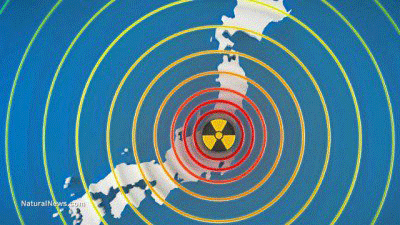
Nobody knows for sure how many people will eventually develop cancer and other health problems as a result of the Fukushima nuclear disaster, but some experts are not afraid to use the word “billions”. It has been well over two years since the original disaster, and now they are telling us that it could take up to 40 more years to clean it up.
It is a nightmare of unimaginable proportions, and there is nowhere in the northern hemisphere that you will be able to hide from it. The following are 11 facts about the ongoing Fukushima nuclear holocaust that are almost too horrifying to believe. Continue reading
Sendai reactor fuel to be loaded from July 7
Officials at the Sendai nuclear power plant in southwestern Japan say they plan to start loading fuel into one of the reactors next Tuesday.
The Kyushu Electric Power Company reported the plan to the Nuclear Regulation Authority on Friday. Earlier the same day, pre-loading inspections were completed at the Number 1 reactor.
The utility expects it will take 4 days to insert 157 nuclear fuel assemblies into the reactor. Workers will use a crane to transfer the fuel rods one by one from a storage pool in an adjacent building.
Kyushu Electric will then check emergency equipment to inject coolant into the reactor and a device to insert control rods.
Workers will also undergo a drill to rehearse their response to a severe accident.
If all goes as planned, the utility will remove the control rods to activate the reactor in mid-August.
The Sendai plant’s Number 1 and Number 2 reactors became the first to clear safety screenings last year.
The screenings were required under the country’s new, stricter regulations introduced after the 2011 Fukushima nuclear accident.
The Number 1 reactor began undergoing equipment inspections in late March ahead of the Number 2 reactor.
All of Japan’s 43 reactors are currently offline.
Source: NHK
http://www3.nhk.or.jp/nhkworld/english/news/20150703_36.html
Experts slam closed-door nuclear briefings
A panel of experts has criticized Japan’s industry ministry for discussing its new policy for disposing of high-level nuclear waste in closed-door sessions.
The ministry-appointed experts said at a meeting on Friday their call for information disclosure on the basic waste disposal policy has fallen on deaf ears.
They also said that holding sessions behind closed doors could have a negative impact on the issue.
The government decided in May to select prospective sites for burying high-level radioactive waste from nuclear power plants and to ask local authorities for their cooperation in building the facilities.
The new policy was implemented following 13 years of failed efforts to solicit candidate sites due to strong safety concerns.
The ministry said it decided to hold closed-door briefings so that local government officials would feel free to speak out.
The ministry had held briefings in 39 prefectures by the end of June. They were attended by nearly 70 percent of local authorities nationwide. But some refused to attend to protest the closed-door policy.
The head of the panel, Hiroya Masuda, said the ministry must convince local authorities that the briefings don’t necessarily indicate candidacy for waste disposal sites.
Source: NHK
http://www3.nhk.or.jp/nhkworld/english/news/20150703_31.html
Fukushima rejects briefing for nuclear waste site
Japan’s industry ministry is holding briefing sessions across the country. It’s struggling to secure disposal sites for high-level radioactive waste generated by nuclear plants.
But it will skip the session in Fukushima Prefecture, at least for now, due to strong opposition there.
The government plans to bury high-level radioactive waste at a depth of 300 meters or more in final disposal facilities. But the effort to solicit candidate sites has made no progress because of strong safety concerns among municipalities.
In May, the industry ministry decided to name appropriate candidate sites instead of waiting for municipalities to voluntarily apply.
Since then, it has been holding briefing sessions in 39 prefectures over how to process the highly radioactive waste and how it will select appropriate sites, to deepen understanding of the facilities.
But officials in Fukushima Prefecture rejected the ministry’s request to hold such a session. They cited the burden of the on-going scrapping of the crippled Fukushima Daiichi nuclear plant.
They also referred to building of intermediate storage facilities in the prefecture for contaminated soil and other materials from cleaning-up work in Fukushima.
Source: NHK
Tepco seeks foreign seal of approval to restart nuclear plant
Tokyo Electric Power Co.’s invitation to the world’s top nuclear agency to review the safety of its Kashiwazaki-Kariwa facility signals the utility’s desire to win international backing to resume operations at the world’s largest atomic power plant.
Kashiwazaki is Tepco’s best bet of returning to nuclear power generation, after the plant was shuttered along with the rest of Japan’s nuclear capacity following the unprecedented meltdowns at the company’s Fukushima No. 1 plant in 2011.
Firing up its reactors would boost Tepco’s profit by as much as ¥32 billion a month, according to Tepco spokesman Tatsuhiro Yamagishi.
“They want a foreign seal of approval,” said Robert Dujarric, a director at the Institute of Contemporary Asian Studies of Temple University in Tokyo. “No one trusts what Tepco says. The only way they can convince Japanese residents that this is not risky is to get a foreign institution to certify them being acceptable.”
The International Atomic Energy Agency began its 11-day evaluation on Tuesday and will report its findings to Japan’s watchdog, the Nuclear Regulation Authority, which has the final say on a plant’s safety. A restart would still need local government approval, which presents difficulties as the region’s governor remains a vociferous critic of Tepco.
Tepco expects to spend at least ¥270 billion to bring Kashiwazaki back online, although it says the cost is a secondary consideration. What is needed and what the IAEA brings is the “knowledge, ingenuity, and engineering capabilities to get there,” Takafumi Anegawa, Tepco’s chief nuclear officer, told a news conference at the plant on Tuesday. “Randomly spending money doesn’t assure safety.”
The NRA has visited Kashiwazaki three times since agreeing to check its reactors in 2013, although it has not given a timeline for approval, according to Tepco’s Yamagishi. NRA spokesman Taro Komine declined to comment on Kashiwazaki and the IAEA’s safety study there.
The IAEA was created in 1957 and one of its goals is to promote the safe use of nuclear energy. Tepco, meanwhile, is struggling to convince the Japanese public of improvements in its attitudes to safety amid worker deaths and irradiated water leaks at the ruined Fukushima plant.
“Of course Tepco would like them to come online,” Tom O’Sullivan, founder of Tokyo-based energy consultant Mathyos, said by email. However, “I have normally categorized it as a plant that is extremely unlikely to come online. There is huge local opposition.”
Hirohiko Izumida, three-term governor of Niigata Prefecture where the plant is located, has said restarting Kashiwazaki shouldn’t even be considered until Tepco’s safety record and handling of Fukushima are properly reviewed.
Niigata Prefecture spokesman Kenji Kiuchi declined to comment on the governor’s opinion of the IAEA review.
Restarting Kashiwazaki would boost Prime Minister Shinzo Abe’s plan for nuclear energy to account for as much as 22 percent of the country’s total electricity supply by 2030.
Thus far, Kyushu Electric Power Co.’s Sendai reactors are the only ones to pass the NRA’s safety requirements and clear local courts. Kyushu is aiming to restart the two units this year. While the NRA judged two reactors at Kansai Electric Power Co.’s Takahama station as safe, legal hurdles have since obstructed any restart.
Tepco is seeking to restore two of the seven reactors at Kashiwazaki, which is located about 220 km northwest of Tokyo on coast of the Sea of Japan. Its only other nuclear plants are Fukushima No. 1, which is being decommissioned, and the nearby Fukushima No. 2 facility, which may be too tainted by its association with the 2011 disaster to ever restart.
In order to ensure Kashizawaki’s safety, Tepco says it has bolstered staff levels, built a 15 meter flood-prevention wall, and built a reservoir to store 20,000 tons of water to cool reactors in case of pump failures.
The IAEA said its primary focus will be assessing the plant’s internal operations. Three months after its review, the agency will send its report to Tepco, the NRA and the Ministry of Economy, Trade and Industry.
The review will not replace Japan’s regulatory process, said Peter Tarren, the IAEA’s team leader at Kashiwazaki. “Decisions about restarts of the plant are not the authority of the IAEA,” he said.
Source: Japan Times
NRA warns it may halt inspections at Mihama reactor Kepco aims to restart
Although Kansai Electric Power Co. aims to extend the life of the Mihama plant’s No. 3 reactor by 20 years, the operator may be forced to scrap the 39-year-old facility instead.
On Wednesday, Shunichi Tanaka, chairman of the Nuclear Regulation Authority, warned that if Kepco has not decided on the basic ground motion standards used as a basis for plant safety standards in the event of an earthquake by the end of August, inspections now underway will be cut off. The surveys are part of Kepco’s efforts to restart the unit and extend its operating life.
“If the ground motion standards aren’t set by the end of August, a major decision will have to be made,” Tanaka
The 826-megawatt Mihama No. 3 reactor will turn 40 years old at the end of 2016. Ending safety inspections would likely force Kepco to reconsider whether revenues generated over a span of 20 years would cover the costs of restarting it. That’s of particular concern given the reforms taking place in the electricity sector over the next few years, which are expected to boost competition.
Twenty years is the maximum extension possible for a 40-year-old
Kepco has already announced plans to decommission the Mihama No. 1 and 2 reactors, which have roughly the same combined power output as the No. 3 reactor. To decommission these reactors would cost at least ¥67 billion. It would also take at least two decades, and would produce about 5000 tons of nuclear waste, whose final location for long-term disposal remains unclear.
Officials in Fukui Prefecture, especially in Mihama, are also concerned about the fiscal impact of the plant’s decommissioning. Since the mid-1970s, the town of Mihama, which has a population of only 10,000 people, has received ¥27.5 billion in nuclear-related government subsidies.
In 2013, about one third of the town’s budget was funded from such subsidies. Officials and businesses worry that decommissioning the No. 3 reactor will mean less official funding from Tokyo, and the potential loss of various “voluntary subsidies” Kepco has made over the years to the town.
Kepco officials said they will make every effort to restart the No. 3 plant as soon as possible. But the utility, which suffered a net loss of ¥148.3 billion in fiscal 2014, faces growing criticism from shareholders, including the cities of Osaka and Kobe, over its management of nuclear power plants and future energy plans.
Kepco announced at its June 25 shareholders meeting that it was necessary to build new nuclear plants. That’s despite advancements in renewable energy and a government proposal to reduce the nation’s reliance on nuclear power, which provided about one-third of Japan’s electricity in 2010, to about 20 to 22 percent by 2030.
Source: Japan Times
TEPCO: Radioactive water removed from tunnels
Tepco says it has finished removing highly radioactive water from underground tunnels connected to one of the facility’s reactor buildings.
Tepco said on Tuesday that workers removed about 4,500 tons of the water from the tunnels linked to the No. 2 reactor building.
Underground space of the building is filled with highly contaminated water that had contact with melted nuclear fuel, raising concerns that the water could flow out to the nearby sea through the tunnels.
Since November, workers had been filling in the tunnels with cement to remove the water.
Officials say they hope to finish similar work at underground tunnels connected to the plant’s No. 3 reactor in July.
The company estimates that more than 10,000 tons of such water has flowed into underground tunnels of both reactors.
In April last year, Tepco tried to create ice walls just outside the reactor buildings to keep tainted water out of the tunnels. But the plan did not work, and the utility decided to fill them with cement.
Tepco and the government say “they attach the highest priority to removing contaminated water from the tunnels, to avoid polluting the sea.”
Source: NHK
http://www3.nhk.or.jp/nhkworld/english/news/20150630_29.html
1.2 Sv/h measured on unidentified substance overflowing of Reactor 2 / Two parts concealed on Tepco’s source
 The picture captured by “PackBot”. Black substance is overflowing from the lid connected to Reactor 2 vessel. The composition is not announced. The radiation level was overscale.
On 6/29/2015, Tepco announced they detected 1197 mSv/h near unidentified substance overflowing from PCV 2 (Primary Containment Vessel of Reactor 2). Because the highest detectable level of the used dosimeter was 1000 mSv/h, the actual radiation level can be higher than 1197 mSv/h.
In order to collect image data of the inside of PCV 2, Tepco was investigating the access hole on the wall.
The substance was found overflown from the lid of the hole by a remote control robot called “PackBot”.
The second highest reading was 1150 mSv/h. The composition of the substance has not been announced.
Additionally, on Tepco’s source to indicate the location of the issued hole, there are two parts concealed. (Blue circled on the photo attached below)
It is not known what they tried to hide from the press release.


http://photo.tepco.co.jp/date/2015/201506-j/150629-01j.html
http://www.tepco.co.jp/nu/fukushima-np/handouts/2015/images/handouts_150629_05-j.pdf
Source: Fukushima Diary
Fukushima Evacuees Harder Access To Housing

Back in 2011 PM Kan told Fukushima evacuees they could go home very soon. This was probably not what he meant.
The current Japanese government has been in the process of a push to force evacuees to return to the evacuation zone through a number of measures. Compensation payments would be cut and efforts to reopen some services in the disaster area were implemented. While this would leave many with no further aid, a new effort will make it even harder to not return to the evacuation zone.
In 2013 the Reconstruction Agency told local municipalities to not exempt evacuees from tough requirements to obtain public housing when their compensated housing expires. The Reconstruction Agency admitted that the plan is to force people to return home, they made this statement in that meeting “basically the policy is for a return to Fukushima”.
So not only will they cut off people’s compensation funding and aid, they will do whatever possible to make it harder for them to leave on their own or stay evacuated.
For more information about how Japan’s public housing system works, the Yen for Living blog at Japan Times has some helpful information.
Central gov’t wanted voluntary Fukushima evacuees to enter draws for public housing
The central government told prefectural governments in October 2013 to not exempt Fukushima nuclear disaster voluntary evacuees from having to enter draws for access to public housing after the free rent period for their current residences ends, it has been learned.
Voluntary evacuees are living in regular residences recognized as temporary homes, for which they pay no rent until the end of March 2017. The central government’s instruction came in regards to a policy called “Smoothing of (evacuees’) entrance into public housing,” which is based on an evacuee support law passed in June 2012 under the Democratic Party of Japan administration. The policy is supposed to loosen tough requirements defined by the Act on Public Housing for entrance into local government-run homes, such as income caps, and was included in fundamental policies of the support law that were approved by the Cabinet on Oct. 11, 2013.
The day before the Cabinet decision, the Reconstruction Agency and the Ministry of Land, Infrastructure, Transport and Tourism summoned representatives from the governments of municipalities with many Fukushima evacuees, like those of Tokyo and Saitama and Niigata prefectures, for a meeting. The Mainichi Shimbun obtained minutes of the meeting recorded by multiple municipal governments.
According to the minutes, a representative from the Reconstruction Agency explained that “basically the policy is for a return to Fukushima” and then gave details about the support law and the policy, and responded to questions from municipal government representatives.
When representatives from prefectures including Saitama asked about how to handle voluntary evacuees who want to move into public housing after their free rent period for their current residences ends, a ministry representative said the ministry wanted them to not give those evacuees any exemption from having to enter draws for entrance into the housing.
If voluntary evacuees have to enter draws for access to public housing, they might not succeed, and will be stuck without cheap public housing when free rent at their evacuation home runs out.
When a representative asked about the demand among evacuees for the “Smoothing of (evacuees’) entrance into public housing” policy, a government representative said, “The amount of demand is unknown,” suggesting that the policy was made without being based on studies of evacuees’ desires.
Many municipalities are restricting application for public housing to evacuees who did not originally live in those areas. A question regarding whether these restrictions needed to be changed came up at the meeting, but a central government representative said, “We don’t want changes (to the restrictions),” and asked municipal governments to operate regulations regarding public housing application according to their interpretation.
In June 2014, the land ministry distributed to municipal governments a collection of questions and answers about the policy, indicating strict requirements for allowing voluntary evacuees entrance into public housing without having to enter draws. The questions and answers were not released to the public. The Mainichi Shimbun made an information disclosure request and found that publically released documents on the policy make no mention at all of entering public housing without entering draws.
The policy went into effect in October 2014. According to the Reconstruction Agency, 40 prefectural and major city governments are accepting applications for public housing, but due to factors including lack of publicity on the policy, they have only given out 50 applications.
A land ministry representative says, “We cannot treat voluntary evacuees the same as forced evacuees, who are allowed entrance into public housing without entering draws. In the end, the methods taken are the decision of municipal governments.”
On June 15, the Fukushima Prefectural Government announced it would consider its own support measures to accompany the end of free rent period for the around 25,000 estimated voluntary evacuees using apartments and the like as temporary evacuation residences.
Source: Mainichi
http://mainichi.jp/english/english/newsselect/news/20150624p2a00m0na009000c.html
-
Archives
- October 2026 (120)
- September 2026 (339)
- August 2026 (330)
- July 2026 (355)
- June 2026 (287)
- May 2026 (306)
- April 2026 (356)
- March 2026 (251)
- February 2026 (267)
- January 2026 (308)
- December 2025 (358)
- November 2025 (359)
-
Categories
- 1
- 1 NUCLEAR ISSUES
- business and costs
- climate change
- culture and arts
- ENERGY
- environment
- health
- history
- indigenous issues
- Legal
- marketing of nuclear
- media
- opposition to nuclear
- PERSONAL STORIES
- politics
- politics international
- Religion and ethics
- safety
- secrets,lies and civil liberties
- spinbuster
- technology
- Uranium
- wastes
- weapons and war
- Women
- 2 WORLD
- ACTION
- AFRICA
- Atrocities
- AUSTRALIA
- Christina's notes
- Christina's themes
- culture and arts
- Events
- Fuk 2022
- Fuk 2023
- Fukushima 2017
- Fukushima 2018
- fukushima 2019
- Fukushima 2020
- Fukushima 2021
- general
- global warming
- Humour (God we need it)
- Nuclear
- RARE EARTHS
- Reference
- resources – print
- Resources -audiovicual
- Weekly Newsletter
- World
- World Nuclear
- YouTube
-
RSS
Entries RSS
Comments RSS

