Despite the hype, India’s Kudankulam nuclear plant isn’t working out too well
2 years on, Kudankulam isn’t working. Where are its cheerleaders now?Catch News, KUMAR SUNDARAM
The promises
- Kudankulam nuclear power plant was built despite opposition from locals, scientists
- It was projected as the answer to Tamil Nadu’s power woes
The reality
- Tamil Nadu continues to be short of electricity
- The Kudankulam plant has worked in first and starts and remains shut for 3 months now
More in the story
- How the project is proving to be ineffective – a white elephant
- Who is responsible for this mess
After all the brouhaha, however, the reality is that the plant has not been working for the last three months: Reactor No. 1 of the plant was shut down for “annual maintenance” on 26 June this year. It was to restart on 22 August, but the date was initially pushed back to 23 September.
Then the Nuclear Power Corporation of India, which operates the project, postponed the reopening to 7 October and then again to 15 October. The plant is yet to start, despite a public assurance from MR Srinivasan, former chariman of Department of Atomic Energy.
In fact, after a much-celebrated start, the power plant near Idinthakarai – a hamlet by the Bay of Bengal – has been under “routine maintenance” or has tripped and shut down, leaving the authorities red-faced.
Kudankulam has abnormally high ‘trip rate’. Basically, it fails much more than other N-power plants
After being commissioned, the plant took a long time to function at full capacity and was declared commercially operational only in 31 December, 2014. In these 14 months, the reactor shut down 19 times due to tripping and there were three maintenance outages.
Soon after the outset, the rotor of the power went into ‘reverse power’ mode and tripped. Instead of adding power to the grid, it started sucking power back. In reality, the NPCIL had declared the project to be commercially open in a hurry as the unending tests became an embarrassment………
Manmohan Singh govt made it an ego issue. But Kudankulam is now proving to be a non-starter
The issue can earn the BJP some brownie points against the Congress. But it also seems to be avoiding the issue as it supports nuclear energy in principle and as it may also expose Modi’s global nuclear shopping spree to uncomfortable questions……..
Can we rethink?
The world is moving towards sustainable and renewable energy sources which have become increasingly more efficient and viable.
After all the heavy investment in Kudankulam, deliberate neglect of environmental and safety concerns and the bulldozing of local people’s dissent, India has got a nuclear reactor that’s not working. Will policy-makers and their cheerleaders now stop and re-think?
It’s too dangerous to allow Kudankulam to fade away as it doesn’t suit the dominant interests that underpin the public gaze in India. The issue may have become unattractive for them or have simply outlived its shelf-life as a headline, but it concerns safety of Indian citizens, larger public policy on an issue of national importance and the emptiness of promises made to people to sell the expensive and dangerous project to them. http://www.catchnews.com/environment-news/kudankulam-is-not-working-where-are-its-cheerleaders-now-1445501297.html
A warning to COP21 on dubious safety of China’s nuclear gamble
He Zuoxiu, a leading Chinese physicist, has called China’s plans for a bubble in nuclear reactors “insane.”
China’s nuclear ambitions have the tacit approval of many COP21 participants amid calls for the biggest polluter to forsake coal. But this should be a moment of caution for global nuclear authorities who should be urging China to increase safety standards and emphasize more benign energy sources. Ditto for investors sensing a no-brainer profit opportunity. One reason China considers the nuclear option cheaper than solar, windmill and water sources, He says, is that staffing is sparser than in other nations and cost-cutting is de rigor. Just something for David Cameron to consider as the U.K. prime minister gloats over hosting a Chinese-designed reactor……
Nuclear power, industry cheerleaders claim, is cheap, safe and clean. In theory, perhaps, but ask the 100,000-plus Japanese in the Tohoku region who can’t return home. Or the Fukushima farmers and fishermen who can’t sell their wares. Just some food for thought for officials in Paris this week figuring a comparable scenario near the Yangtze is unthinkable. Think again.
 China’s ‘insane’ gamble on nuclear power, Japan
  Times, BY WILLIAM PESEK, BARRON’S ASIA, DEC 3, 2015 When I contemplate China’s plan to build as many as 135 nuclear reactors, I’m transported back to that harrowing March 2011 week when Fukushima No. 1 was melting down……
only in the months that followed did we learn how close the world actually came to losing Tokyo. Tepco was preparing to abandon the wrecked facility. Leaving the reactors to melt down unencumbered would have meant the immediate evacuation of 13 million-plus people. On March 15, then-Prime Minister Naoto Kan literally stormed Tepco headquarters and demanded its technicians contain the crisis. Thanks to the government’s collusion with the media, it’s taken years for we in Tokyo to realize we probably owe Kan our lives.
I retrace Japan’s March 2011 because it is as clear and cautionary a tale as Beijing will find as it goes nuclear in a hurry. The number 100, China’s ranking on Transparency International’s corruption perceptions index, tells the story. Continue reading
Japan’s PM Abe visiting India to market nuclear reactors

 Ahead of PM Abe’s visit, India-Japan racing to seal nuclear pact http://www.hindustantimes.com/india/ahead-of-pm-abe-s-visit-india-japan-racing-to-seal-nuclear-pact/story-TwhHbjC7kPuNYNSWoU6iUK.html Jayanth Jacob, Hindustan Times, New Delhi Dec 04, 2015
India and Japan are working to seal a nuclear pact during the visit of Prime Minister Shinzo Abe from December 11-13 for the annual summit between the two countries.
“We hope it will be a done deal this time. But considering the complex nature of negotiations that mark the civil nuclear agreements till the last moment, we should be guided by caution till the pact is finally sealed,” said a senior official.
Japanese firms play a crucial role in the US and French nuclear industries. An Indo-Japanese pact is crucial for fully realising the ongoing civilian nuclear cooperation India has with these two countries. Japanese forging major, Japan Steel Works (JSW), is a supplier of the critical reactor equipment of reactor pressure vessel for most firms worldwide.
But the sides have to agree upon the text of the agreement that will satisfy both countries. Nuclear issue is a sensitive one in Japan — the only country to have suffered a nuclear attack. For instance, Japan wants explicit commitment on testing clauses —the deal will be off in event of a nuclear test by India. India says this touches upon the issue of ‘strategic autonomy’, which is outside the purview of civil nuclear pact that the country has been negotiating with Japan.
But sources said Japan has stopped pressuring India into signing the non-proliferation treaty (NPT) that New Delhi finds discriminatory.
Abe will visit Varnasai, the constituency of PM Narendra Modi who is likely to accompany him on the visit.
In 1999 Pakistan planned to drop nuclear bomb on India
 Kargil war: Pakistan planned to drop nuclear bomb on India during conflict, says former CIA officer http://www.independent.co.uk/news/world/asia/pakistan-india-nuclear-bomb-kargil-war-former-cia-officer-sandy-berger-bruce-riedel-a6758501.html Emma Henderson , 3 Dec 15
The information was revealed after former CIA analyst, Bruce Riedel, wrote an obituary for Sandy Berger who died of cancer on Wednesday. Mr Berger and was a former national security advisor to the then American President Bill Clinton.
The CIA had warned President Clinton of the plans, which formed part of the daily top secret classified briefing on July 4, 1999, when he was scheduled to meet visiting Pakistan Prime Minister Nawaz Sharif.
Mr Riedel wrote: “The morning of the Fourth, the CIA wrote in its top-secret Daily Brief that Pakistan was preparing its nuclear weapons for deployment and possible use. The intelligence was very compelling. The mood in the Oval Office was grim.
“Berger urged Clinton to hear out Sharif, but to be firm.
“Pakistan started this crisis and it must end it without any compensation. The president needed to make clear to the prime minster that only a Pakistani withdrawal could avert further escalation.
“Sandy knew Clinton better than anyone, his natural inclination was to find a deal. This time, no deal was possible, it must be an unequivocal Pakistani climbdown.
“It worked. Sharif agreed to pull back his troops. It later cost him his job: the army ousted him in a coup and he spent a decade in exile in Saudi Arabia. But the risk of a nuclear exchange in south Asia was averted.
“It was Berger’s finest hour.”
The Kargil war took place along the Pakistan-India Line of Control (LOC) in Ladakh, in the northern Indian state of Jammu and Kashmir.
The infiltration of Pakistani armed forces into Indian Territory, led by General Ashraf Rashid initiated the conflict.
The Indian army managed to recapture the majority of the Indian side of the LOC.
Troubling indications of recurring nuclear criticality at Fukushima Daiichi
 Former Japan Ambassador: Uncontrolled nuclear chain reactions could be underway at Fukushima — “Troubling indications of recurring criticality” as Tellurium-132 detected over 100 miles from plant — ‘Recriticality’ discussed by Japan’s top nuclear official http://enenews.com/former-japan-ambassador-uncontrolled-nuclear-chain-reactions-suspected-fukushima-troubling-indications-recurring-criticality-tellurium-132-detected-100-miles-plant-recriticality-issue-discussed
Japan Times, Nov 4, 2015 (emphasis added): The former Japanese ambassador to Switzerland,Mitsuhei Murata, recently suggested that Japan should stage an ‘honorable retreat’ from hosting the 2020 Olympics due to the unpredictable situation at the crippled Fukushima No. 1 nuclear power plant.
Japan Times (Hotline to Nagatacho — Brian Victoria, Kyoto), Nov 4, 2015: [F]ormer Japanese ambassador to Switzerland, Mitsuhei Murata, recently proposed… for Japan to stage an “honorable retreat” from hosting the 2020 Olympics… [I]n the September issue of Gekkan Nippon, Murata… noted the danger still posed by large numbers of spent fuel rods suspended in spent fuel pools in reactors 1, 2 and 3 [which] can’t be removed from the damaged reactor buildings due to the high levels of radioactivity surrounding these reactors… Murata’s gravest concern is a number of troubling indications of recurring criticality [ i.e. uncontrolled nuclear chain reactions] in one or more of the reactors at Fukushima No. 1. For example, he notes that in December 2014, both radioactive iodine-131 and tellurium-132 were reported as having been detected in Takasaki city, Gunma Prefecture [~130 miles SW of Fukushima Daiichi]. Given the short half-lives of these radioactive particles, their presence could not be the result of the original meltdowns at Fukushima.
Ambassador Murata to Dr. Thomas Bach (President of the International Olympic Committee), Jun 15, 2015: Allow me to send you a letter, motivated by my sense of mission to inform you of the worsening situation in Fukushima, which regrettably is being downplayed by our Government and does not seem to be well known internationally… Contrary to the assurances of the Japanese Government and [TEPCO], the situation at the site of the Fukushima Daiichi Nuclear Power Plant is not at all under control… Not only do we have a continued contamination of the groundwater and the Pacific Ocean… but the brittle structure of the damaged plant represents itself a serious threat, in particular in our earthquake prone region.
Ambassador Murata to Susana Malcorra (United Nations Chef de Cabinet), Aug 27, 2015: I am sending you my fourth message to President Bach of The IOC. I inform him of my message addressed to Prime Minister Abe. In my message… I ask for the first concrete international cooperation concerning the method of cooling spent fuel rods making use of zinc instead of water. This is crucially important. The Pacific Ocean is more and more contaminated with the daily release of more than 300 tons radioactive groundwater. I remind Prime Minister Abe that the decision to retreat from the Tokyo Olympic Games and carry out an international verification of the suspected re-criticality is urgently needed… My interview article was published in the magazine “Monthly Japan” (September). The article entitled “An honorable retreat from the Tokyo Olympic Games” is given a central place. Reactions are noteworthy and encouraging. Conscientious citizens start questioning the integrity of the IOC. Please convey my warmest greetings to Secretary-General Ban-kimoon.
Interestingly, two weeks ago the head of Japan’s Nuclear Regulation Authority addressed the recriticality issue:
Fukushima Minpo, Oct 20, 2015: Nuclear regulator chief says Fukushima Daiichi recriticality“physically impossible” — Shunichi Tanaka, chairman of the Nuclear Regulation Authority, visited the Minamisoma city government for talks with Mayor Katsunobu Sakurai on Oct. 22. Regarding Tokyo Electric Power Co.’s crippled Fukushima Daiichi nuclear power plant, Tanaka said, “We are no longer in a situation that prevents residents from returning (to their evacuated hometowns). Recriticality is physically impossible.”
Despite bribes offered, 47 Prefectures not keen to host Japan’s 166,000 tons of nuclear waste
 Japan’s 166,000 tons of nuclear waste still waiting to be buried, Digital Journal, By Karen Graham 29 Nov 15 In a survey conducted last month by the Kyodo News survey, none of the 47 prefectures showed much interest in hosting a nuclear waste dump site, with 14 saying “absolutely no.”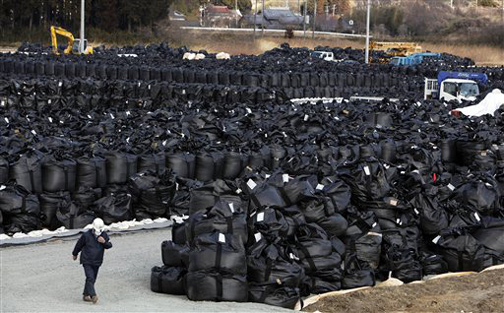
Being that the government considered the situation an “emergency,” temporary sites were set up in a number of prefectures, with the government promising landowners to only lease the land for a period of two years. The waste has been stored in polyvinyl buildings.
But the government has reneged on those promises. Shigetaro Chiba, a 73-year-old farmer who leased land to the government for two years, said, “I was made to agree to extend the lease after the initial two-year period promised by the government expired. The new contract no longer specifies a deadline.”
In 2014, the Nuclear Waste Management Organization (NUMO) started work on updating guidelines, as well as working to design, construct, and operate an underground storage facility nearly 4 square miles in area, which would be operated for 50 years and monitored for an additional 300 years before being shut down.
Work on updated guidelines for a nuclear waste site
NUMO is funded by every power company in Japan that has nuclear power plants, with their fees based on how much radioactive waste they produce each year. The agency has worked on getting communities to express interest in a waste disposal site, but have had no takers despite being told they would receive billions in subsidies.
‘NO to nuclear waste dumping’ say 13 Japanese Prefectures
 Thirteen prefectures say no to hosting nuclear waste depository, Japan Times, 29 Nov 15 KYODO A total of 13 out of the nation’s 47 prefectures say they would refuse to host a final disposal site for highly radioactive nuclear waste, a Kyodo News survey showed Saturday.
In the survey conducted between late October and early November, 13 local governments said they would “never accept” such a facility, eight sounded negative, while 24 declined to clarify their position and two said they will “carefully consider the possibility.” None showed a positive stance toward hosting the site.
In May, the government introduced a plan in which it will choose candidate sites for burying high-level radioactive waste based on scientific analysis, rather than waiting for municipalities to express a willingness to host a final depository.
The change of policy reflects the lack of progress made in the process of soliciting candidate sites that began in 2002 due to safety concerns.
For permanent disposal, high-level nuclear waste needs to be stored in a final depository more than 300 meters underground for up to 100,000 years until radiation levels fall and it no longer poses a threat to humans and the environment.
Among the 13 prefectures opposed to accommodating a disposal site, four host nuclear power plants…….http://www.japantimes.co.jp/news/2015/11/29/national/thirteen-prefectures-say-no-hosting-nuclear-waste-depository/#.VltoWNIrLGh
China marketing nuclear technology etc to Czech Republic
 China, Czech pledge closer nuclear power, finance cooperation BEIJING, Nov. 27 (Xinhua) — Chinese Premier Li Keqiang and his Czech counterpart Bohuslav Sobotka pledged to boost cooperation in nuclear power, finance and other sectors during talk on Friday.
“China’s nuclear power technology and equipment are safe and inexpensive, which has made them competitive globally,” Li said, adding that the Chinese side is willing to participate in Czech’s nuclear power business.
Sobotka, who is making his first official visit to China, said he welcomes China’s participation in Czech’s nuclear power business. He added that the two sides can study the feasibility of conducting nuclear power cooperation in markets outside of the two territories.
Earlier this week, Sobotka attended the fourth summit of China and Central and Eastern European (CEE) countries in east China’s Suzhou city, where Li proposed to set up a multilateral financial firm between China and the 16 CEE countries.
On the financial front, Li said on Friday that he hopes China and Czech will innovate and expand the mode of financial cooperation within the framework if the “16+1” financial firm in discussion, which he said will strongly support practical cooperation between the two countries.
China stands ready to talk with Czech on establishing a RMB settlement mechanism in Prague, Li added……..http://news.xinhuanet.com/english/2015-11/27/c_134862920.htm
India again tests a Nuclear-Capable Missile
India Completes Agni-I Nuclear-Capable Missile Test, defense World, November 27, 2015 India has test fired home-made nuclear capable Agni-I missile that can hit target from a distance of 700kms.
The missile was launched from off the Odisha coast as a part of Strategic Forces Command (SF) training centre, NDTV reported today.
The surface-to-surface, single-stage missile, was powered by solid propellants. It was test-fired from a mobile launcher at 1002 hours from launch pad-4 of the Integrated Test Range (ITR) at Abdul Kalam Island (Wheeler Island)…….he missile, which has already been inducted into armed forces, weighs 12 tonnes. The 15-metre-long missile is designed to carry a payload of more than one tonne. Moreover, its strike range can be extended by reducing the payload…….http://www.defenseworld.net/news/14714/India_Completes_Agni_I_Nuclear_Capable_Missile_Test#.Vli4odIrLGg
Fukushima: pressure of groundwater causing underground wall around reactors to lean and crack
 TV: Underground wall around Fukushima reactors started “leaning” — Cracks developing due to rising water levels — Problems seen along almost entire length of sea wall — Trying to make repairs to keep groundwater from surging (VIDEO) http://enenews.com/nhk-underground-wall-around-fukushima-reactors-started-lean-rising-water-levels-causing-cracks-develop-problems-occuring-along-almost-entire-length-sea-wall-tepco-trying-make-repairs-keep-gro?utm_source=feedburner&utm_medium=email&utm_campaign=Feed%3A+ENENews+%28Energy+News%29
NHK World, Nov 25, 2015 (emphasis added): Groundwater wall at Fukushima plant leans slightly — The operator of the damaged Fukushima Daiichi nuclear plant has found that a wall it built 30 meters into the ground to block the flow of radioactive water is leaning slightly. {TEPCO] built the steel barrier along a coastal embankment to stop contaminated groundwater from seeping into the sea… TEPCO inspectors found that the wall is leaning up to some 20 centimeters toward the sea. They say this is due to the pressure of the groundwater flow. The officials also blamed rising groundwater levels for cracks found in the embankment’s pavement. The utility says workers are buttressing the wall with steel pillars…
NHK (Google translation), Nov 25, 2015: In TEPCO Fukushima Daiichi nuclear power plant, it can be seen that the equipment called “impervious wall”, which was completed last month in order to reduce the outflow of the contaminated groundwater, are slightly tilted to the sea side… [T]he pavement of the seawall also cracked… When depends on the Tokyo Electric Power Company, after the “impervious wall” has been completed, it is that it’s because thewater level of the land side of the groundwater is rising.
Fukushima Minyu Shimbun (Google translation), Nov 26, 2015: … sea side wall is inclined about 20 centimeters at the maximum to the sea side, cracks of up to about 1 centimeter has occurred in the pavement of the seawall. That inclination and cracks have occurred in almost the entire sea side wall… TEPCO, rain water enters the cracks of the pavement, so that the groundwater does not surge, is promoting the repair to block the cracks spraying resin.
Nuclear giants AREVA and Hitachi to help dismantle Japan’s nuclear recators
Areva was involved in the Fukushima clean-up, but that reactor is not covered by the new agreement, the French group said in a statement. It has been working with Hitachi to improve Japanese reactors’ safety for the past two years.
Areva’s role will now be to participate in preliminary studies for dismantling boiling-water reactors.
Prime Minister Shinzo Abe’s government has been pushing for a return to nuclear power to generate electricity after Japan’s several dozen reactors went offline in the wake of the 2011 disaster.
The resource-poor nation’s energy bill has soared since it was forced to turn to fossil-fuel imports to plug the gap.
But the Japanese public remains wary of atomic power, and Abe’s push has prompted rare protests and damaged his popularity.
Declaration of the World Nuclear Victims Forum in Hiroshima
The world nuclear victims forum was held at Hiroshima.
“A charter of world Nuclear Victim’s rights” was adopted. https://www.facebook.com/permalink.php?story_fbid=10154396267119937&id=685379936
世界核被害者フォーラム
Declaration of the World Nuclear Victims Forum in Hiroshima
(Draft Elements of a Charter of World Nuclear Victims’ Rights)
November 23, 2015
1. We, participants in the World Nuclear Victims Forum, gathered in Hiroshima from November 21 to 23 in 2015, 70 years after the atomic bombings by the US government.
2. We define the rights of nuclear victims in the narrow sense of not distinguishing between victims of military and industrial nuclear use, including victims of the atomic bombings in Hiroshima and Nagasaki and of nuclear testing, as well as victims of exposure to radiation and radioactive contamination created by the entire process including uranium mining and milling, and nuclear development, use and waste. In the broad sense, we confirm that until we end the nuclear age, any person anywhere could at any time become a victim=a Hibakusha, and that nuclear weapons, nuclear power and humanity cannot coexist.
3. We recall that the radiation, heat and blast of the atomic bombings of Hiroshima and Nagasaki sacrificed not only Japanese but also Koreans, Chinese, Taiwanese and people from other countries there as a result of Japan’s colonization and invasion, and Allied prisoners of war. Continue reading
Indonesia’s fires – enormous output of greenhouse emissions
 Indonesia: fires threaten to send even modest climate ambitions up in smoke The Conversation, Sonny Mumbunan Economist and research scientist at the Research Centre for Climate Change, University of Indonesia , 26 Nov 15 At the Paris climate negotiations, Indonesia will bring to the table a target of an unconditional 29% emissions reduction by 2030, increasing to 41% on condition of international assistance.
Indonesia’s emission reduction plan (or Intended Nationally Determined Contribution) is therefore slightly higher than its 2009 commitment to reduce emissions by 26% by 2020.
There are three problems with Indonesia’s INDC. The target is not ambitious; the plan is incoherent; and with the recent massive forest fires in Indonesia that have yet to be accounted for in the INDC it does not accurately reflect emissions for Indonesia.
Such a problematic INDC would affect the global efforts to adequately tackle climate change, since Indonesia is one of the biggest carbon emitters in the world. The forest fires have pushed the country into the top ranks of global greenhouse gas emitters……https://theconversation.com/indonesia-fires-threaten-to-send-even-modest-climate-ambitions-up-in-smoke-49155
Russia keen to market nuclear power to impoverished Cambodia
Russia to help Cambodia build capacity for nuclear power, REUTERS, YEKATERINBURG,  RUSSIA/PHNOM PENH 26 Nov
  Russia will help Cambodia work towards building a nuclear power plant under an agreement the two countries signed this week, said Sergei Kirienko, the head of state nuclear firm Rosatom.
Cambodia depends heavily on imported fuel and power. Electricity in the country is among the most expensive in Southeast Asia and a common source of complaint from investors.
“The Cambodian government is mulling, in future, a nuclear power station construction,” Kirienko told reporters on Wednesday when asked about the agreement.
Cambodian energy officials declined to comment on the deal on Thursday.
The agreement was signed during a visit by Russian Prime Minister Dmitry Medvedev to Cambodia this week. His visit was the first to Cambodia by a senior Russian politician since 1986.
Under the terms of the agreement, Russia will provide expertise, research and training to Cambodia…… http://www.reuters.com/article/2015/11/26/us-cambodia-russia-nuclear-idUSKBN0TF0W220151126#siJ8T6T4vdeKAEm8.97
Talks between officials of North Korea and South Korea
North Korea, South Korea Hold Rare Talks Following Clashes, IBT, By Aditya Kondalamahanty on November 26 2015 North Korean and South Korean officials met in a demilitarized village on the border Thursday, to hold talks aimed at initiating sustainable communication between the two countries, according to reports. The rare meeting is the first intergovernmental interaction since August when the two sides met to defuse a crisis that had pushed them to the brink of an armed conflict.
Held in the border village of Panmunjom, about 34 miles north of Seoul, the meeting saw the two sides ironing out a framework to resume high-level talks, although they did not arrive at a precise timeline. Both countries signed a joint agreement agreeing on details such as who would represent their respective governments and the issues that would be on the agenda…….
Yoo Ho-yeol, a professor of North Korean studies at Korea University, said, according to Yonhap News Agency: “The North will likely call on Seoul to lift its sanctions against the North and to reopen the Kumgang tour program. The South is expected to raise the issue of family reunions.”
In October, the two Koreas conducted reunion of families, separated by the 1950-53 Korean War, as part of a deal signed in August. South Korea seeks to regularize the reunions while the cash-strapped North Korea has demanded that Seoul allow South Korean tour groups to its scenic Mount Kumgang resort.
Earlier in November, South Korean President Park Geun-hye said she was open to a summit with North Korean leader Kim Jong Un if the latter agreed to give up nuclear weapons and focus sincerely on inter-Korean ties. http://www.ibtimes.com/north-korea-south-korea-hold-rare-talks-following-clashes-2201165
1 This Month

of the week– Nuclear Reactor Information Task Force

14 May – online event From Bombs to Data Centres: the Face of Nuclear Colonialism
To see nuclear-related stories in greater depth and intensity – go to https://nuclearinformation.wordpress.com
-
Archives
- May 2026 (126)
- April 2026 (356)
- March 2026 (251)
- February 2026 (268)
- January 2026 (308)
- December 2025 (358)
- November 2025 (359)
- October 2025 (376)
- September 2025 (257)
- August 2025 (319)
- July 2025 (230)
- June 2025 (348)
-
Categories
- 1
- 1 NUCLEAR ISSUES
- business and costs
- climate change
- culture and arts
- ENERGY
- environment
- health
- history
- indigenous issues
- Legal
- marketing of nuclear
- media
- opposition to nuclear
- PERSONAL STORIES
- politics
- politics international
- Religion and ethics
- safety
- secrets,lies and civil liberties
- spinbuster
- technology
- Uranium
- wastes
- weapons and war
- Women
- 2 WORLD
- ACTION
- AFRICA
- Atrocities
- AUSTRALIA
- Christina's notes
- Christina's themes
- culture and arts
- Events
- Fuk 2022
- Fuk 2023
- Fukushima 2017
- Fukushima 2018
- fukushima 2019
- Fukushima 2020
- Fukushima 2021
- general
- global warming
- Humour (God we need it)
- Nuclear
- RARE EARTHS
- Reference
- resources – print
- Resources -audiovicual
- Weekly Newsletter
- World
- World Nuclear
- YouTube
-
RSS
Entries RSS
Comments RSS
 nuclear-news