Japan lifts evacuation order for city near nuclear plant
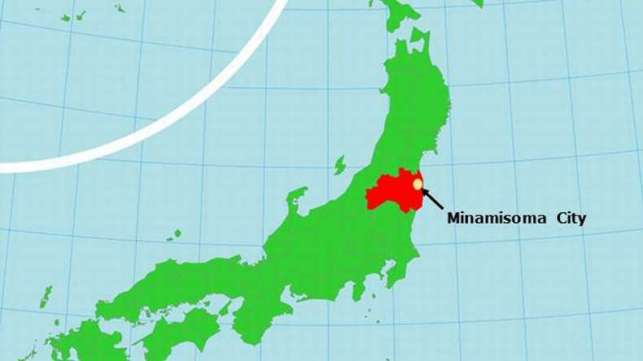
Minamisoma is one of the most contaminated places in Fukushima. Decontamination is never permanent. Some places already have been decontaminated up to 5 times already, but the contamination always coming back gradually to the pre-decontamination levels thanks to the ruisseling rain and the wind bringing it from the forested hills where it has accumulated. Fukushima prefecture is 80% forested hills/mountains, all heavily contaminated.
The Japanese Government insists on perpetuating the decontamination lie, pushing the people to return to live in the previously evacuated areas, hammering in the media that low-radiation exposure is not harmful to health. Economic priorities prevailing above people lives.
Quoting Bo Jacobs: “This is entirely about removing legally obligated compensation. When you are forced to evacuate, the government is liable for the costs. When the government says that the radiation in your community is acceptable, then there is no more legal obligation to compensate you for living someplace that is safe. “
Tokyo: The Japanese government on Friday lifted an evacuation order for the entire city of Minamisoma, located near the disabled nuclear plant in Fukushima.
The decision, which is awaiting approval from the local council, will allow the return of 12,000 people to the municipalities included in the restricted area around the plant due to the nuclear disaster in 2011.
Minamisoma, with a population of 46,000, is located north of Fukushima Daiichi nuclear plant, and the southern and western part of the city is still under the evacuation order, affecting around 11,700 people.
The government has decided to lift the restriction after completing the decontamination work in the residential and surrounding areas, a government spokesperson told state broadcaster NHK.
From next month onwards, Japan intends to allow evacuees to return to the Katsurao and Kawauchi villages too, which means that around 1,480 and 1,040 people will be able to return to their homes respectively.
The last municipality where the evacuation order was completely lifted was Naraha in September 2015, although the inhabitants have returned in small batches due to fear of persisting radiation, a shattered local economy and scarce availability of services.
Around 74,200 citizens throughout the Fukushima prefecture remain evacuated as a result of the earthquake and tsunami of March 11, 2011, out of which only around 4,500 have returned to the areas where the evacuation order has been lifted, according to the local government in February.
http://www.newsx.com/world/28364-japan-lifts-evacuation-order-for-city-near-nuclear-plant
School to close in Fukushima as too few children able to attend
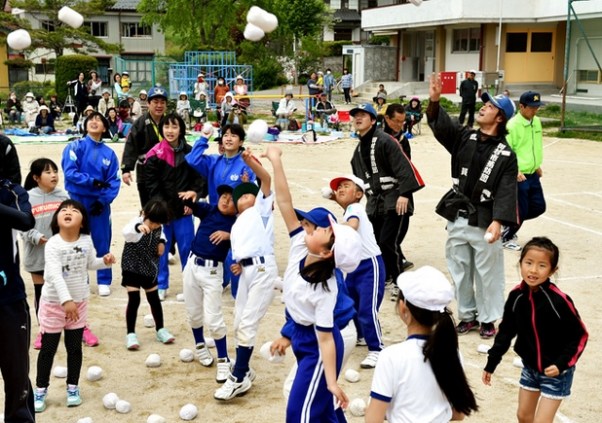
Graduates and local residents attend the last athletic meet at Iwaisawa Elementary School in Tamura, Fukushima Prefecture, on May 14.
TAMURA, Fukushima Prefecture–Despite a proud 140-year history, the Iwaisawa Elementary School here has to close–as not enough children come to classes any more due to the 2011 nuclear disaster.
The school held its last annual athletic meet on May 14. It will merge with another school after this academic year ends next March.
The school currently has 19 pupils, down from 52 before the disaster at the Fukushima No. 1 nuclear power plant.
In the lead-up to the athletic meet, the school, located in the Miyakoji district of Tamura, Fukushima Prefecture, sent out about 500 invitation letters to its graduates and local residents. About 150 people turned up.
After the nuclear accident, residents in the district were forced to evacuate to other areas. Although the evacuation order was lifted in April 2014, many of them opted to stay where they were while keeping their resident registries in the district.
As of the end of April this year, 2,564 people were officially registered as residents in the district. But of that number, only 1,600 or so actually lived there.
After the nuclear accident, pupils at Iwaisawa Elementary School temporarily took classes using classrooms of a different school in central Tamura, which had been already closed. In April 2014, they returned to their original school.
But only 29 came back, compared with the pre-accident figure of 52. The number has since further declined to 19. Because of that, it was decided the school will be merged with another school next spring.
Sendai Nuclear Plant Against All Odds
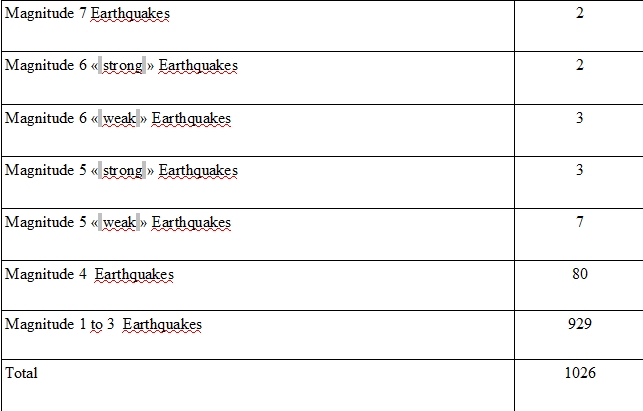
On May 8, 2016 already more than 3 weeks have passed since the start of the earthquakes in Kumamoto and Kumatomoto prefecture, or they are still continuing. Below are the numbers from 14 to 28 April 2016. In just 14 days 1026 earthquakes from various magnitudes.
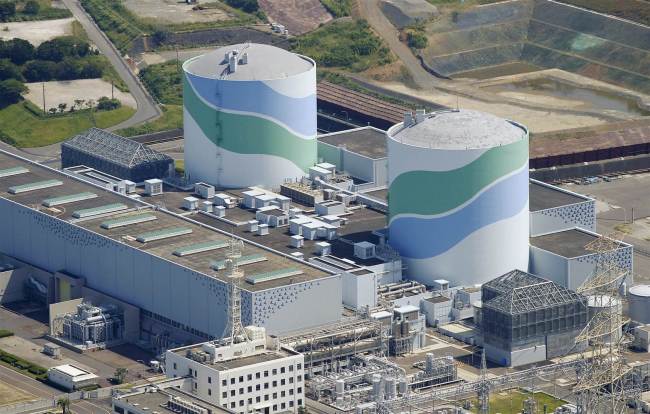
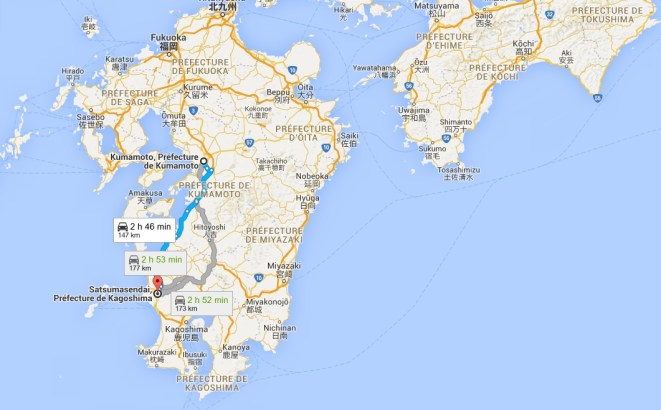
The Sendai nuclear plant in Satsumasendai, Kagoshima prefecture is just 147kms southward from Kumamoto. The whole Kyushu island is earthquake prone due to a main fault.
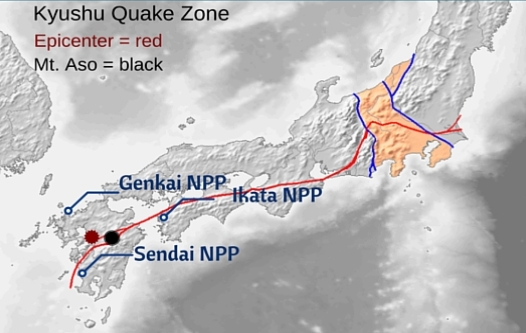
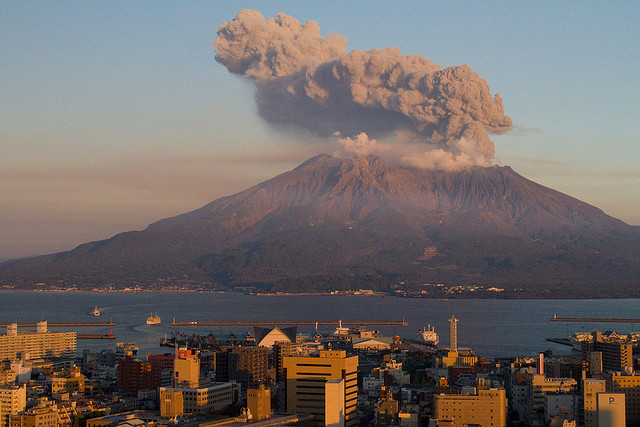
There is also a nice very active volcano in the vicinity, Sakurajima volcano, 72 kms from the Sendai nuclear plant, that is not counting the other eight volcanos on the island.
What you think, isn’t it the perfect place to build a nuclear plant?
Source:
Des dommages énormes pour la vie à Kumamoto
http://www.fukushima-blog.com/2016/05/des-dommages-enormes-pour-la-vie-a-kumamoto.html
No one knows where the Fukushima nuclear reactor melted cores are
At 44:30 — Howe: “In the first days of the March 2011 catastrophe, [nuclear engineer Arnie Gundersen] told media that Fukushima was ‘Chernobyl on Steroids’. Arnie meant that the Fukushima disaster would turn out to be much worse than the April 1986 core explosion at the Ukraine’s Chernobyl nuclear power plant. Many experts believe now that the three missing Fukushima cores have melted right through the concrete floors, and are contaminating any water that reaches them — going down, perhaps touching, the groundwater.”
At 45:30 in — Arnie Gundersen, nuclear engineer: “Scientists and engineers knew exactly where the nuclear core was at Chernobyl a year later, but at Fuksuhima we’ve got three nuclear cores that are in direct contact with groundwater. Now that mean the containment broke and water is coming in and is contaminating the groundwater — so clearly the liquid releases from Fukushima are way, way more severe than Chernobyl.”
At 57:30 in — Howe: “The concept is… when water from mountain run-off reaches the ice wall, it will freeze or flow around the frozen ground out to the Pacific Ocean without passing by the highly radioactive melted cores. But everybody says, ‘How do you know that’s going to work because no one knows where the cores are, or how deep they are in the ground right now?’”
At 1:16:45 in — Howe: “[Fukushima] is a cleanup challenge that is now expected to take decades more, into the end of the 21st century — re-enforcing what Arnie Gundersen said five years ago in that very first week, that ‘Fukushima is Chernobyl on steroids’. And so far over these five years, it appears that he has been right.”
Coast to Coast AM – ‘Fukushima & Nuclear Issues‘, Mar 31, 2016 (emphasis added):
EDF desperate for business? trying to quickly sell 6 nuclear reactors to India
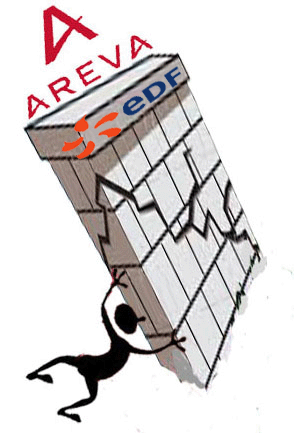
 EDF to propose deal for six nuclear reactors in India by year-end By Reuters | 12 May, 2016 PARIS: EDF will deliver a proposal to theIndian government by year’s end to build six nuclear reactors, an executive at the French utility said on Thursday, in what could be the world’s biggest nuclear deal.
“Hinkley Point will help us continue our activities and preserve our skills base and jobs,” he said. ……..
Chief Executive Jean-Bernard Levy told shareholders that EDF needs growth in international markets because European power markets are stagnant. http://economictimes.indiatimes.com/articleshow/52240726.cms?utm_source=contentofinterest&utm_medium=text&utm_campaign=cppst
China General Nuclear Power Corporation denies plan to take over Hinkley nuclear project build

 China nuclear company will not build Hinkley alone if EDF drops out CGN, which is helping French energy company with Hinkley Point C scheme, denies it will build reactors independently, Guardian, Terry Macalister, 13 May 16, The Chinese company helping EDF with plans to build new nuclear reactors at Hinkley Point in Somerset has flatly dismissed the idea it would go it alone if the largely state-owned French company dropped out.
“As a partner to EDF supporting the Hinkley Point project, CGN [China General Nuclear Power Corporation] has no independent plans to build reactors at Hinkley Point C,” it said in a statement.
The Department of Energy and Climate Change reiterated the message with its own statement, which said: “There is no proposal for the Chinese to build a reactor at Hinkley.”
The denials come after George Osborne’s father-in-law, Lord Howell, told the House of Lords that the Chinese were working on a “plan B” to step in if, as some expect, EDF abandons the controversial scheme…….https://www.theguardian.com/business/2016/may/13/hinkley-point-cgn-china-general-nuclear-power-corporation-edf-energy
Tepco to put some Fukushima decommissioning work on hold during G-7 summit
The majority of decommissioning work at the damaged Fukushima No. 1 nuclear plant will be put on hold while the Group of Seven summit takes place in Shima, Mie Prefecture, on May 26 to 27, according to Tokyo Electric Power Co.
Satoshi Togawa, a spokesman for Tepco, told The Japan Times on Friday that the planned suspension was a precaution to reduce “risks” that could disturb the meeting of leaders from the seven major advanced nations.
Such risks could include unexpected leaks of contaminated water from tanks or airborne radioactive material monitoring alarms being triggered, Togawa said.
Tepco will continue other essential operations, such as injecting water to keep melted nuclear fuel cool and processing contaminated water, Togawa said.
The spokesman said the suspension was not designed to reduce the risk of terrorism.
“We have made the decision without any request from the government,” he said.
A 2011 massive earthquake and ensuing tsunami knocked out critical cooling functions for three of six reactors at the plant, triggering a triple meltdown.
The decommissioning effort, which involves some 7,000 workers, is expected to take more than 40 years.
French prosecutors launch probe into Tokyo’s 2020 Olympic bid
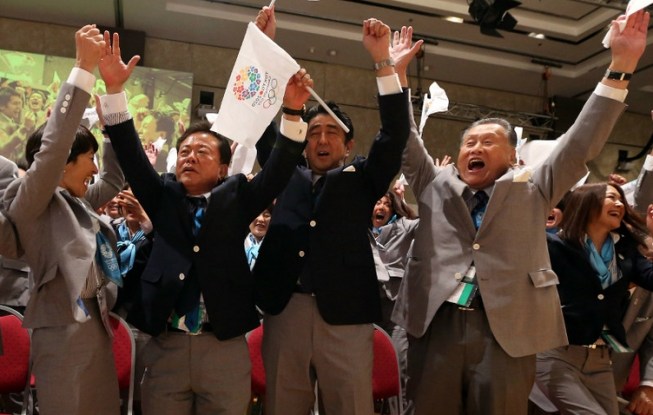
In this Sept. 7, 2013, file photo, Japan’s Prime Minister Shinzo Abe, center, Governor of Tokyo and Chairman of Tokyo 2020, Naoki Inose, second from left, and other members of the Japanese delegation celebrate as International Olympic Committee (IOC) President Jacques Rogge announces that Tokyo will host the 2020 Olympic Games during the 125th IOC session in Buenos Aires, Argentina.
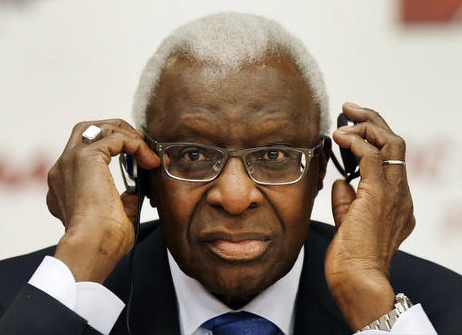
In this Aug. 21, 2015, file photo, then-IAAF president Lamine Diack adjusts his headphones during a joint IOC and IAAF news conference on the site of the World Athletic Championships in Beijing. French prosecutors say $2 million associated with Tokyo’s bid for the 2020 Olympics was apparently paid to an account linked to the son of the disgraced former IAAF president Diack in the months immediately before and after the Japanese capital won the games.
PARIS/TOKYO (Kyodo) — French prosecutors announced Thursday they have launched an investigation into Tokyo’s campaign to host the 2020 Olympics for alleged corruption and money laundering.
A statement from the prosecutors said a total of 2.8 million Singapore dollars ($2.04 million) has been transferred from a Japanese bank to one in Singapore related to Papa Massata Diack, the son of former International Association of Athletics Federations President Lamine Diack, in July and October 2013 under the name of “Tokyo 2020 Olympic Games Bid.”
The prosecutors said they have confirmed there were huge outlays by Diack’s side during the same time in Paris. Tokyo was awarded the Games in September 2013 when Diack was an International Olympic Committee member and was known as an influential power broker in the committee.
“How much influence the former president could have had on other committee members will be the focal point of the investigation,” a French judicial authority member told reporters.
“We carried out our bidding campaign fairly. There’s no issue or things to get worried about,” said Japanese Olympic Committee President Tsunekazu Takeda, who was the chief of the bidding team. “We’ll reply properly if we get asked (by the IOC).”
Olympic minister Toshiaki Endo also said in a TV program he takes pride in Tokyo making a clean bid and denied the allegations.
Japan’s top government spokesman earlier Thursday denied allegations of bribery, saying the government understands the organizing committee conducted the campaign in an appropriate manner.
“We understand the campaign for the 2020 Tokyo Games was conducted in a clean way,” Chief Cabinet Secretary Yoshihide Suga said at a news conference after British newspaper the Guardian reported the Tokyo Olympics organizing committee paid 1.3 million euros ($1.48 million) to the account of Diack’s son.
Suga said he was “not aware of” the report, which also said French authorities were investigating the allegations. “If we receive a request (for investigation) from French judicial authorities, our country will respond appropriately,” he added.
Suga said the Japanese government has no plan to question the Tokyo Organizing Committee of the Olympic and Paralympic Games or conduct its own investigation into the allegations.
The account in question became a vital piece of the puzzle related to what has been alleged as being institutional corruption at athletics’ governing body.
Complicating the scandal further, the report said Japanese marketing and advertising behemoth Dentsu Inc. has previously been linked to the Diack clan through its long-running sponsorship contract with the IAAF, a deal that was extended by Diack just months before his presidency ended. Dentsu has been previously linked to scandals at both the IAAF and world soccer’s governing body FIFA.
The prosecutors launched an investigation into corruption in the IAAF and Diack was arrested in December, accused of accepting bribes to cover up doping offenses.
A report in January from the prosecutors claimed that Diack did not support the bid from Tokyo’s rival Istanbul as Turkey didn’t pay similar sponsorship money to the IAAF.
http://mainichi.jp/english/articles/20160513/p2g/00m/0dm/002000c
Seniors mull share house to keep Fukushima evacuee community intact
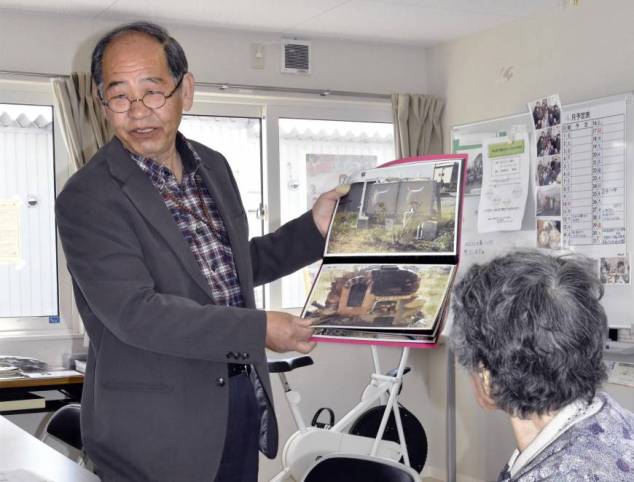
Masaharu Fujishima, who is proposing to build a share house for temporary housing residents, explains his plan to residents in a meeting in April in Minamisoma, Fukushima Prefecture.
FUKUSHIMA – As the government looks to lift the evacuation zone for part of Minamisoma, Fukushima Prefecture, elderly people currently living in temporary dwellings are considering a share house so they can stay together.
If the no-go zone is lifted, residents at temporary housing units are likely to be asked to leave. One option is to return to their hometown of Minamisoma’s Odaka district — a choice few are likely to make. Another option is to move in to city-provided public housing where they would have to start again in unfamiliar surrounds.
In Odaka, residents will be allowed to stay inside the evacuation zone to prepare for their permanent return after the designation is lifted. But of the area’s 11,700 residents, only 1,870 have registered to go back, suggesting few plan to return permanently.
It’s for this reason that Masaharu Fujishima, 70, a resident at Minamisoma’s temporary housing complex, is pitching a plan to create a share house with individual rooms and common space that will allow temporary housing residents who have bonded since the March 2011 Fukushima nuclear disaster to live together.
Fujishima evacuated from Odaka to temporary housing in the city center. Serving as head of the community association until January, he was able to talk with many residents about the troubles they faced as they attempted to rebuild their lives.
Many were worried about leaving a community of friends they bonded with over the past five years for a new one they would need to create from scratch.
“After the nuclear disaster, many people had to move around before they finally settled in the temporary housing,” said Fujishima. “I’m worried that if they leave here, they would have to go through all the trouble again of searching for a new place to live.”
So far, Fujishima has held three meetings for temporary housing residents to explain his proposal. While some feedback has been positive, with residents saying it will prevent them from becoming senile, others have voiced concern about what will happen when one of the dwellers becomes ill or dies.
To put the plan in motion, Fujishima submitted about 16,000 signatures to the Minamisoma Municipal Assembly.
The city is expected to consider the proposal, though a city official in charge of housing construction was not sure if the idea is feasible.
“It is difficult because public houses are not designed for many people to live together like a share house,” the official said.
Collision on the Joban Expressway in Fukushima
On May 4, 2016, a head-on collision between a car and a bus on the Joban Expressway in Fukushima killed a mother and her daughter on the passeger car. *link for Yahoo Japan article
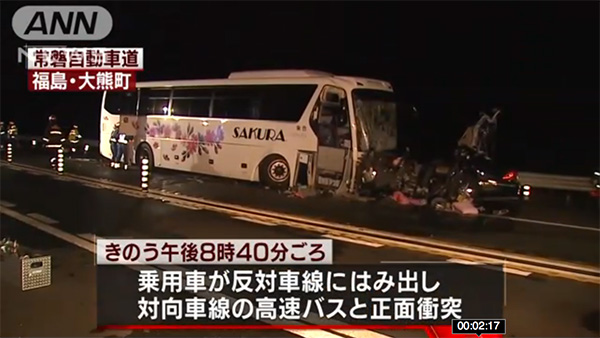
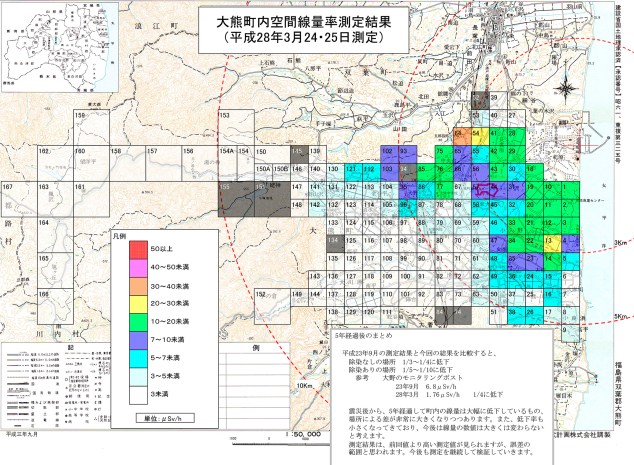
The accident happened in Okuma town which is within “Difficult-to-return” zones, due the nuclear accident at Fukushima Daiichi Nuclear Power Plant.
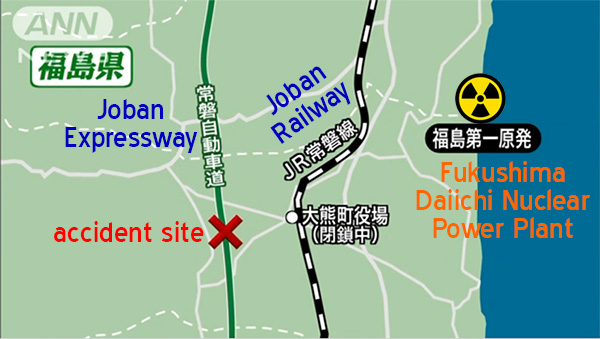
The designated area has been exposed to more than 50 millisieverts per year of radiation from the melted-down power plant. It is considered difficult for local residents to return possibly for the next several decades.
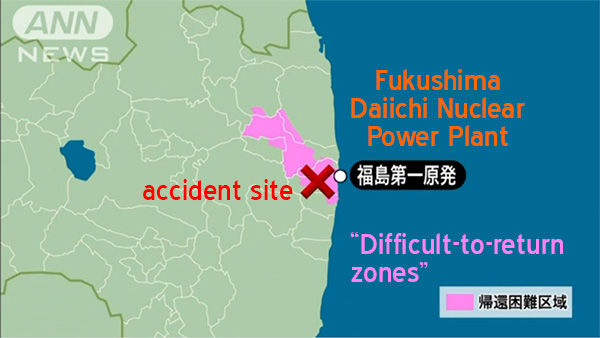
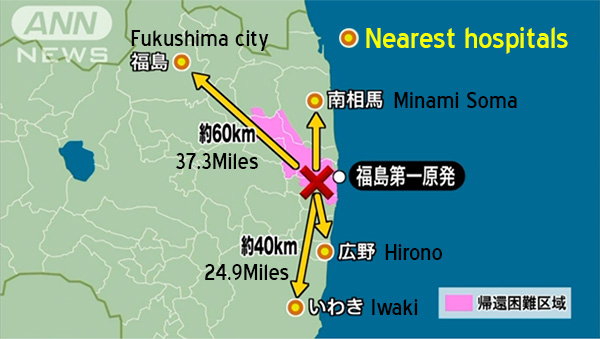
Since the entire area has been evacuated, the injured passengers on the crashed bus had be transported as far as 37Miles.
40 passengers including the bus driver had to wait for the ambulance for two hours on the side of the road. No face masks were provided.
(Cars and buses are allowed around this section of Joban Expressway, but not motorcycles due to the extreme level of radioactive contamination.)
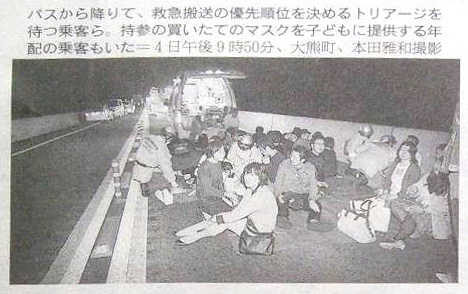
*Photo of the Japanese newspaper article courtesy of Facebook group, “NPO法人チェルノブイリへのかけはし“.

Background radiation level in Okuma town as of March 24, 25 of 2016, measured by Okuma town.

Source: http://www.mp-nuclear-free.com/main-articles/news-snippets_20160507.html
Arnie Gundersen measured 4,000 Bq/kg on a Tokyo street
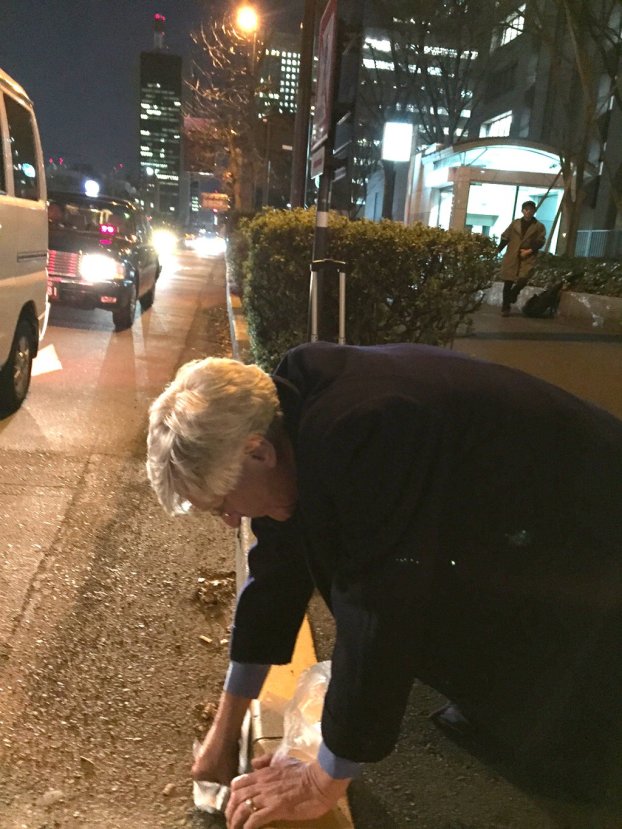
Arnie Gundersen measured 4,000 Bq/kg on a Tokyo street outside METI, Japan nuclear regulator…Olympics anyone?
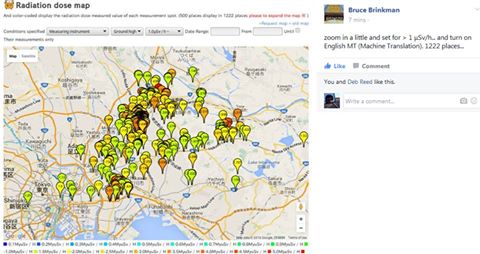
76 measurements that are over 5µS/h in the “Kashiwa hotspot”

Kashiwa city, Chiba prefecture, nearby Tokyo
Some screen caps of the new background radiation tests from Japan. Kashiwa hot spots. Thanks to Bruce Brinkman
Hakatte Geiger users have uploaded 76 measurements that are over 5µS/h in the “Kashiwa hotspot” area. You can see how they are distributed as the plume came over Kasumigaura and into eastern Tokyo. I travel through that on my way to and from work. I have to go through Matsudo and Kashiwa which are buried under the map pins.

Zoom in a little and set for > 1 μSv/h… 1222 places.
Abe’s questionable handling of the Kumamoto quakes
The series of earthquakes that has hit central Kyushu since April 14 pose a variety of problems for us. The Meteorological Agency has explained that this chain of temblors is unprecedented in that the location of the hypocenter has moved. But one has to realize that it was only recently in the long history of the Earth that humans began their observations of seismic activities — and that it should come as no surprise if such a pattern of earthquakes had happened frequently in the past. In short, we humans know very little about the movements of the Earth. In Japan, earthquakes can hit anytime and anywhere.
Serious questions have been raised about the Abe administration’s response to the Kumamoto quakes. The first is why it didn’t try to listen to people who were suffering from the devastation brought by the temblors. The government’s call on evacuees to take shelter indoors following the initial quake that hit on April 14 drew the ire of the Kumamoto governor, who felt that officials in Tokyo didn’t understand the feelings of local residents.
The second question deals with the administration’s policy on the operation of nuclear power plants following the quakes. The government has declared that it won’t shut down the reactors at Kyushu Electric Power Co.’s Sendai plant in Kagoshima Prefecture — currently the sole nuclear plant in operation in this country. After clearing the Nuclear Regulation Authority’s screening of the plant for a restart, Kyushu Electric scrapped its plan to build a new facility with a seismically isolated structure that would serve as a command center in the event of an emergency. One of the assumptions in judging the safety of restarting the Sendai plant was that people would be able to evacuate the area by using bullet trains and the expressway network in case of a nuclear crisis. The Kumamoto quakes knocked those transportation means out of service, raising doubts about the workability of the evacuation scenario. That alone should be reason enough to halt the Sendai plant and rethink the safety measures. We need to consider carefully whether it is wise to have so many nuclear plants in this quake-prone country.
The third question is on the government’s intension to take advantage of the disaster to achieve its political goals — instead of focusing on relief for people in the disaster zone. Right after the temblors hit, Chief Cabinet Secretary Yoshihide Suga said the quakes highlighted the importance of amending the Constitution to give the government emergency powers to respond to such crises. Two U.S. Marine MV-22 Osprey tilt-rotor aircraft were dispatched to transport relief supplies in an apparent attempt at what Canadian author Naomi Klein calls the Shock Doctrine — taking advantage of a disaster to push a political agenda that has nothing to do with disaster response.
It is false to say that the government’s response to a disaster cannot proceed quickly because the Constitution does not grant emergency powers. Existing laws, such as the basic law on disaster response, provides a variety of powers that enables the government to take various actions if it wants to. Requesting the Osprey aircraft had nothing to do with providing relief for the disaster-hit people. I have heard nothing about Self-Defense Forces helicopters having been mobilized to their full capacity to transport relief goods to Kumamoto. I believe that using the Osprey was only a ploy to impress the public that strengthening defense cooperation between Japan and the United States under the Abe administration’s security legislation is helping ordinary citizens.
As memories of the 3/11 disasters fade away, the Abe administration is trying to divert public attention from the damage brought by the Fukushima nuclear disaster and create the impression that everything is back to normal. Its policy of restarting nuclear plants idled in the wake of the Fukushima crisis is part of such attempts. The Kumamoto quakes have exposed the questionable nature of Prime Minister Shinzo Abe’s politics.
When it comes to risks to people’s lives and their safety, natural disasters at home and the weakening of society as manifested by the aging and shrinking of the population pose a much more real threat than changes in the security environment surrounding Japan. The government is about to invest trillions of yen in Tokyo as it prepares to host the Summer Olympics in 2020. What significance does building a posh new national stadium in Tokyo and pursuing large urban redevelopment projects carry when people in other parts of the country suffer from the devastation caused by natural disasters? Can the government secure sufficient financial resources for reconstruction of the disaster-hit areas?
It is difficult to criticize the government when it is engaged in efforts to help people affected by a major disaster. But objections need to be clearly raised against any attempt to take advantage of a disaster to promote an unrelated political agenda. The mass media in particular bear a heavy responsibility to do that.
40-year-old Shikoku reactor to be sixth unit scrapped under stricter safety regimen
MATSUYAMA, EHIME PREF. – Shikoku Electric Power Co. on Tuesday ended operation of a nearly 40-year old nuclear reactor in western Japan, making it the sixth unit to be scrapped under stricter safety regulations introduced after the 2011 Fukushima disaster started.
The utility decided in March to decommission the idled reactor 1 at its Ikata nuclear complex in Ehime Prefecture, as it would be too costly to reboot the aging reactor.
The company estimates more than ¥170 billion ($1.59 billion) would be needed to beef up safety measures for restarting the reactor, which started operation in 1977.
It is expected to take about 30 years to complete the decommissioning of the reactor at a total cost of ¥40 billion, according to Shikoku Electric.
The company is banking on technology cooperation that it agreed on with three other regional utilities last month to cut decommissioning costs.
The tougher safety rules prohibit the operation of nuclear reactors beyond 40 years in principle. But operation for an additional 20 years is possible if operators make safety upgrades and pass the regulator’s screening.
The government is looking to reactivate more reactors to meet a goal of generating at least 20 percent of Japan’s overall electricity with nuclear power generation by 2030.
The shutdown of the Ikata reactor 1 reduced the number of commercial reactors in Japan to 42, of which four have been restarted under the post-Fukushima safety rules. But two of the four were shut down earlier this year following a court decision banning them from resuming operations.
With new reactor construction difficult amid public concern over the safety of nuclear power, the country would need a dozen of the aging reactors to operate beyond the 40-year limit to accomplish the government goal, industry observers say.
Shikoku Electric has said it would not make economic sense to restart the unit 1 given the cost and the fact that it has a relatively small output capacity of 566,000 kw, while the company aims to reboot the larger and newer reactor 3 at the same power plant.
The town of Ikata expects the scrapping of the aging reactor to reduce state subsidies that it receives for hosting the nuclear complex by ¥300 million to ¥400 million to around ¥1 billion.
Overemphasis on economic growth led to Minamata, Fukushima: NPO forum
TOKYO — Marking the 60th anniversary of the official recognition of Minamata disease, speakers hosted by a nonprofit organization say that an overemphasis on economic growth was behind the mercury-poisoning illness as well as the nuclear disaster in Fukushima.
“Japan has put priority on economic development, rather than valuing human life, and such an attitude caused the problems of Minamata and Fukushima as well as grave fatal accidents, such as explosions at coal mines,” said Kunio Yanagida, a freelance journalist.
“The problem is that lawmakers and bureaucrats have tried to avoid their responsibility, rather than determining the truth behind the incidents, and they have failed to make the lessons learned from them universal,” he told an audience of around 1,000 at the event in Tokyo last week.
“Japan is still driven by a wartime policy of increasing its wealth and military power,” he said.
Tatsuya Mori, a film director and writer, referred to a Minamata disease patient who once said, “I was aware that I am Chisso.” The patient meant that while he is a victim of the disaster caused by Chisso Corp, a chemical maker which dumped industrial waste into the sea, he himself had enjoyed the benefits of its products and might have gone along with its actions if he had belonged to the company himself.
Mori said, “In a similar way, we could say, ‘I am Fukushima,’ or ‘I am Tokyo Electric Power Co.,’ as we have depended on the crippled Fukushima Daiichi nuclear plant” operated by the utility.
“We need to realize we have supported the system that caused the issues of Minamata and Fukushima,” he added.
The Tokyo forum was organized by Minamata Forum to mark the 60th anniversary since a public health center in Minamata in the southwestern Japan prefecture of Kumamoto received a report from a local doctor about four people with unexplained neurological disorders—considered later to be when Minamata disease was first recognized.
Before starting the session, the audience observed a moment of silence before 500 portraits of Minamata disease victims put up behind the speakers on the stage.
So far, only around 3,000 among over 33,500 applicants have been officially recognized as Minamata disease patients in Kumamoto and neighboring Kagoshima prefectures as well as Niigata Prefecture, where a similar disease was confirmed in 1965, caused by wastewater from a Showa Denko K.K. plant.
Critics claim that six decades after Minamata disease was first recognized, the issue has still not been resolved with the full number of sufferers yet to be fully acknowledged. Several damages suits are still pending.
1 This Month





PLEASE OPPOSE HR 8255 AND S.3639 – bills would accelerate satellite deployment, with no environmental review or safeguards – https://ncstd5li.quorum.us/campaign/169331/
To see nuclear-related stories in greater depth and intensity – go to https://nuclearinformation.wordpress.com
-
Archives
- October 2026 (67)
- September 2026 (339)
- August 2026 (330)
- July 2026 (355)
- June 2026 (287)
- May 2026 (306)
- April 2026 (356)
- March 2026 (251)
- February 2026 (267)
- January 2026 (308)
- December 2025 (358)
- November 2025 (359)
-
Categories
- 1
- 1 NUCLEAR ISSUES
- business and costs
- climate change
- culture and arts
- ENERGY
- environment
- health
- history
- indigenous issues
- Legal
- marketing of nuclear
- media
- opposition to nuclear
- PERSONAL STORIES
- politics
- politics international
- Religion and ethics
- safety
- secrets,lies and civil liberties
- spinbuster
- technology
- Uranium
- wastes
- weapons and war
- Women
- 2 WORLD
- ACTION
- AFRICA
- Atrocities
- AUSTRALIA
- Christina's notes
- Christina's themes
- culture and arts
- Events
- Fuk 2022
- Fuk 2023
- Fukushima 2017
- Fukushima 2018
- fukushima 2019
- Fukushima 2020
- Fukushima 2021
- general
- global warming
- Humour (God we need it)
- Nuclear
- RARE EARTHS
- Reference
- resources – print
- Resources -audiovicual
- Weekly Newsletter
- World
- World Nuclear
- YouTube
-
RSS
Entries RSS
Comments RSS

