Kepco loses challenge to Takahama nuclear injunction

Residents on Friday hold a banner that reads: “Kepco’s request has been rejected; Court rejects restart of Takahama reactors.” The protesters are seen in front of the Otsu District Court in Shiga Prefecture.
OTSU, SHIGA PREF. – The Otsu District Court on Friday rejected a bid by Kansai Electric Power Co. to lift an injunction against restarting reactors at a nearby plant, dealing yet another setback to attempts by the utility and the central government to return swiftly to nuclear power.
The move means the No. 3 and No. 4 reactors at the Takahama nuclear plant, in Fukui Prefecture, will remain idled.
In a statement, Kepco condemned the court’s action.
In his decision, Judge Yoshihiko Yamamoto said Kepco failed to provide sufficient evidence to back up its claims that the two reactors were safe.
“The very first article of the law that established the Nuclear Regulation Authority says a fundamental point of Japan’s nuclear power administration is clearly establishing the understanding that the maximum effort must be made at all times to prevent an accident involving the use of nuclear power,” said Yamamoto. “But unless the operator shows that there is nothing lacking in regards to safety, it’s presumed some safety points are lacking.”
The decision was welcomed by citizens’ groups fighting the restart of the two reactors, but it was also expected. Yamamoto was the same judge who had granted their initial request back in March that shut down the reactors, also citing a lack of convincing evidence on the part of Kepco that the plants were safe. The reactors were originally restarted at the beginning of the year.
“It was a just decision, very direct. We hope it will provide a spark to other legal efforts in other parts of Japan to stop nuclear power plants from being restarted,” Yoshinori Tsuji said after the ruling. Tsuji was one of the plaintiffs who filed for an injunction in March.
Legal wrangling over the two reactors continues. Kepco has filed a separate legal challenge to the Otsu court’s decision, and said Friday it hoped that when that ruling came, possibly in July or August, it will lead to restarts.
Shiga residents seeking to keep the reactors offline have said Friday’s decision did not mean their court battles were over.
“If the Otsu court rules against Kepco, it could end up in the Osaka High Court, possibly next year,” said Hidenori Sugihara, another one of the plaintiffs who sought the injunction.
The Otsu court case has demonstrated the difficulty of restarting nuclear power plants in a timely manner. Under laws drawn up by the NRA that went into effect in 2012, localities within a 30 kilometer radius of a nuclear power plant are supposed to establish evacuation plans in the event of an emergency.
But the expanded radius has greatly increased the number of local governments and residents who are concerned about a rush by the utilities to restart as many plants as possible.
In the Kansai region, where parts of Kyoto and Shiga prefectures lie within 30 kilometers of Fukui Prefecture’s plants, lawsuits by residents like the one in Otsu have the potential to slow down, if not halt, Kepco’s plans for restarts.
The original injunction was brought by Shiga residents who fear an accident at the plant would have a damaging impact on Lake Biwa, the nation’s largest freshwater lake and the source of water for about 14 million residents in cities such as Kyoto and Osaka.
Financially imprudent for India to let Westinghouse build nuclear reactors
 The cost of nuclear diplomacy, THE HINDU, SUVRAT RAJU, 20 JUNE 16 The government’s decision to let Westinghouse build six nuclear reactors in India smacks not only of arbitrary use of executive authority but is also financially imprudent
 In their recent joint statement, Prime Minister Narendra Modi and President Barack Obama “welcomed the start of preparatory work… in India for six AP1000 reactors to be built by Westinghouse…” Judging by the cost of similar reactors under construction in the U.S., these six reactors may cost as much as Rs.4 lakh crore. This makes the deal potentially the largest commercial contract in the offing between the two countries.
Economically unviable When the United Progressive Alliance government announced its intention to start work on two reactors each from Westinghouse and General Electric (GE) in the 12th Plan period (2012-2017), it did little to pretend that these contracts made sense on their own merits. Instead, as the former chairperson of the Atomic Energy Commission, Anil Kakodkar, explained, India had “to keep in mind the commercial interests of foreign countries and of the companies there” and was obliged to purchase these reactors in return for U.S. diplomatic support on other issues.
Last year, GE backed out of this arrangement citing concerns about India’s liability law. This was good riddance; GE was offering India an untested design that it has not yet managed to sell anywhere in the world. But the government’s decision to deepen India’s investment in Westinghouse — even as negative news about the company has accumulated — makes little sense.
In April, Toshiba, which acquired Westinghouse in 2006, announced a $2.3 billion write-down in its value, largely because of persistent concerns about the economic viability of Westinghouse’s AP1000 design. Of more than a dozen orders that Westinghouse expected from within the U.S. a decade ago, only four have materialised. Just last month, a utility called Florida Power and Light postponed its plans for two AP1000 reactors by at least four years. And in February, the Tennessee Valley Authority, a U.S. government company, cancelled its plans for two AP1000 reactors explaining that this was “the fiscally responsible action”.
- the government has persisted in making concessions to Westinghouse. In February, it ratified the “Convention on Supplementary Compensation” (CSC) for Nuclear Damage that contradicts India’s domestic liability law and protects nuclear suppliers from liability for an accident. Now, in the event of a disaster, Indian courts may find it difficult to exercise jurisdiction over Westinghouse that is not based in India and could point to India’s international commitments under the CSC to block any potential claims against it.
- For example, Dow Chemicals has rebuffed attempts to make it contribute to a clean-up in Bhopal by arguing that Indian courts have “no jurisdiction over it”. And in a cautionary tale about how flawed international agreements can subvert the domestic legal system, in 2011, an international arbitration tribunal awarded White Industries Australia Ltd. AU$4 million under a bilateral investment treaty even as its dispute with the Indian government was sub judice in India’s Supreme Court……..http://www.thehindu.com/opinion/op-ed/the-cost-of-nuclear-diplomacy/article8748864.ece
Nuclear Suppliers Group should say NO to India’s try for membership
The Nuclear Suppliers Group’s Critical India Decision An upcoming meeting will decide whether India will be allowed to join. Member states should think carefully. The Diplomat, By Mark Hibbs June 18, 2016 Beginning on Monday, the Nuclear Suppliers Group, or NSG – 48 countries that export most of the world’s nuclear material, equipment, and technology – will meet in Seoul to decide whether India should now be allowed to join. The United States has strongly urged the NSG to say yes.
The NSG should not say yes next week. It should tell India that there are good reasons to include it, but also that the group needs to complete an internal fact-finding and consensus-forming process in part to prepare the NSG for the consequences of possible Indian membership.
The United States has argued that bringing India into the group would be good for nuclear nonproliferation. So far it isn’t clear what the net overall benefit would be, especially because the White House is prepared to go forward without India having made non-proliferation commitments that many others in the group have made and virtually all say are important.
All NSG members are parties to the Nuclear Nonproliferation Treaty, or NPT. For the group’s 43 states without nuclear arms, NPT membership commits them not to possess these weapons. For the five states in the NSG with nuclear weapons, NPT membership means that they have legally committed themselves to nuclear disarmament and not to assist others in obtaining nuclear weapons. In addition, NSG members have taken other important steps toward a nuclear weapon-free future, by joining the Comprehensive Nuclear Test Ban Treaty (CTBT), by joining treaties that create nuclear weapons-free zones, and/or by permitting the International Atomic Energy Agency to verify that no aspect of their nuclear programs are being used to produce uranium or plutonium for nuclear weapons.
India is a nuclear-armed state. India is not a party to the NPT, it is not a party to a nuclear weapon-free zone treaty, it will not join the CTBT, and it will not make legal commitments identical to NPT articles concerning its nuclear arms. NSG members therefore are compelled to think harder than in previous cases about what will be the consequences of admitting India into the group. Those consequences include the impact on current NSG rules that discourage assistance to nuclear weapons programs in four non-NPT countries, as well as the impact on global efforts to strengthen specific NPT norms……..
The United States advocates Indian NSG membership for commercial and geostrategic reasons largely unrelated to nuclear export controls. Neither ground justifies forcing a decision now. In 2008, the NSG elected to permit civilian nuclear trade with India, meaning that India can import a raft of reactors its wants to buy from vendor Westinghouse. ……http://thediplomat.com/2016/06/the-nuclear-suppliers-groups-critical-india-decision/
Solar power brings free irrigation to a Gujarat Village
 With Solar Power, A Gujarat Village Is Irrigating Its Fields For Free NDTV, All India |Written by Rohit Bhan | Updated: May 22, 2016 DHUNDI:
HIGHLIGHTS
- Farmers formed cooperative to install solar panels in their fields
- Solar panels power irrigation, surplus power sold to electricity board
- Project funded by farmers and non-profit group IWMI
Around seven months ago, about a dozen farmers in Ramabhai’s village about 90 km from Ahmedabad came together to form a solar cooperative and set up solar panels in the fields to generate electricity.
“We used to spend 500 rupees on diesel for pumping sets for drawing water for irrigation. But now we do it with solar energy,” Rambhai said.
“We also make money by selling solar power when we not irrigating our fields. We can sell excess electricity to the power board for Rs. 4.63 per unit,” he added…….http://www.ndtv.com/india-news/with-solar-power-a-gujarat-village-is-irrigating-its-fields-for-free-1408800
Japan’s nuclear industry reels as court upholds injunction to halt reactors

 Japan court upholds injunction to halt reactors in blow to nuclear power industry, Reuters, TOKYO | BY OSAMU TSUKIMORI 17 June 16, A Japanese court on Friday upheld an order to keep two reactors at the Takahama nuclear plant closed, operator Kansai Electric Power said, leaving efforts to get a struggling nuclear industry up and running in limbo.
 , upholding a petition from residents living near the plant concerned about safety, keeps the legal battle center stage in a struggle by Prime Minister Shinzo Abe’s government to restore atomic power five years after the Fukushima disaster.
The Otsu District Court on March 9 ordered Kansai Electric, Japan’s second-biggest utility, to shut down the reactors in Fukui prefecture west of Tokyo, in the country’s first injunction to halt an operating nuclear plant.
The nuclear industry has only recently started to get reactors in a nuclear sector, which used to supply about a third of the country’s power, back online amid widespread public opposition after the melt downs at Fukushima in 2011.
Friday’s decision denied the utility’s attempt to temporarily halt the shutdown order……….
Amid mounting public scepticism over nuclear safety, local residents have lodged injunctions against nuclear plants across Japan…….http://www.reuters.com/article/us-japan-nuclear-court-idUSKCN0Z306R
Japan Lawmaker Denies Pressuring TEPCO Not to Say ‘Meltdown’

Yasuhisa Tanaka, center, chairman of an outside investigation team appointed by the operator of Japan’s damaged Fukushima nuclear plant, speaks during a press conference in Tokyo Thursday. Two other lawyers of the team are: Zenzo Sasaki, left, and Toshiki Nagasaki.
A Japanese opposition leader who was a senior official during the 2011 Fukushima nuclear plant crisis denied Friday that he or the prime minister at the time pressured the president of Tokyo Electric Power Co. not to use the term “meltdown.”
Democratic Party Secretary-General Yukio Edano called a special news conference to refute a finding in a new report that then-TEPCO President Masataka Shimizu apparently came under political pressure not to use the word. The report did not find direct evidence of that.
“The fact that I or then-Prime Minister (Naoto) Kan ordered or requested then-President Shimizu to avoid using the term ‘meltdown’ under any circumstance does not exist,” Edano said. He said the timing of the report was suspicious ahead of an Upper House election next month.
The report released Thursday by a team of three lawyers appointed by TEPCO found that an instruction from Shimizu to avoid using the term “meltdown” delayed full public disclosure of the status of the nuclear plant, which suffered three reactor meltdowns after a major earthquake and tsunami hit the northeastern Japanese coast on March 11, 2011.
The utility used the less serious phrase “core damage” for two months after the disaster.
TEPCO reported to authorities three days after the tsunami that the damage, based on a computer simulation, involved 25 to 55 percent of the fuel but did not say it constituted a “meltdown,” the report said. Yet the company’s internal manual defined a meltdown as damage to more than 5 percent of the fuel.
In May 2011, TEPCO finally used “meltdown” after another computer simulation showed fuel in one reactor had almost entirely melted and fallen to the bottom of the primary containment chamber, and that the two other reactor cores had melted significantly.
TEPCO has been accused of softening its language to cover up the seriousness of the disaster, though the investigation found TEPCO’s delayed acknowledgement did not break any law.
In the 70-page report, the lawyers said Shimizu instructed his deputy not to use the word “meltdown” during news conferences immediately after the crisis. TEPCO’s vice president at the time, Sakae Muto, used the phrase “possibility of meltdown” until March 14, 2011.
Video of a news conference that day shows a company official rushing over to Muto when he was about to respond to a question, showing him a memo and hissing into his ear, “The prime minister’s office says never to use this word.”
Yasuhisa Tanaka, the lawyer who headed the investigation, said interviews of 70 former and current TEPCO officials, including Muto and Shimizu, showed that Muto had planned to use the word “meltdown” until he saw the memo, which has not been found.
“Mr. Shimizu’s understanding was the term ‘meltdown’ could not be used without permission from the prime minister’s office,” Tanaka said at a news conference at TEPCO headquarters. “The notion that the word should be avoided was shared company-wide. But we don’t believe it was a cover-up.”
Edano criticized the report as “inadequate and unilateral,” and said the team didn’t talk to him or Kan.
Tanaka said his investigation, which did not interview any government officials, could not track down what exactly happened between Shimizu and the prime minister’s office.
The Nuclear and Industrial Safety Agency, Japan’s nuclear regulatory unit at the time, was also reluctant to use the word. Two spokesmen were replaced between March 12 and 13, 2011, after suggesting meltdowns had occurred.
TEPCO has said the delay in confirming the meltdowns didn’t affect the company’s response to the emergency.
The issue surfaced earlier this year in a separate investigation in which TEPCO acknowledged that a company manual had been overlooked, reversing its earlier position that it had no internal criteria for a meltdown. TEPCO has eliminated the definition of a meltdown from the manual in revisions after the Fukushima disaster.
Radioactive Dust Vacuumed in Iwaki House
Cs 137 4440 Bq/kg
Cs 134 718 Bq/kg
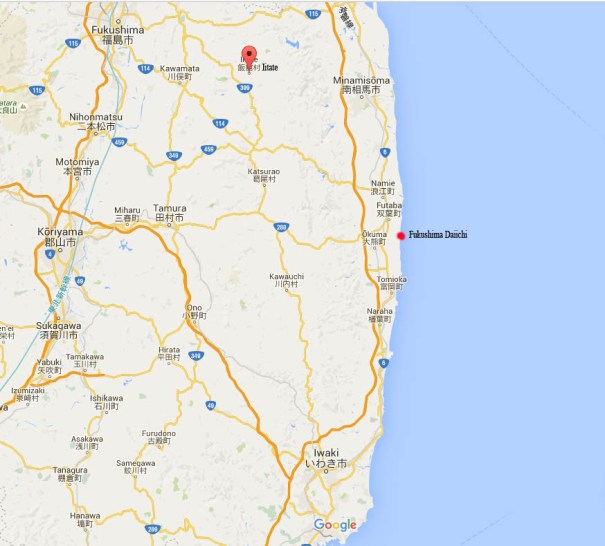
40,26 km from Fukushima Daiichi to Iwaki city

State to lift evacuation order for most of Fukushima village of Iitate from March 31
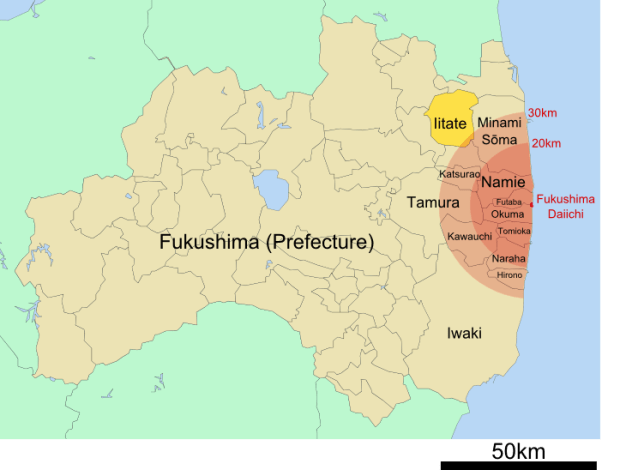
FUKUSHIMA – The central government has said it is considering plans to lift its evacuation order for most of the village of Iitate, Fukushima Prefecture, effective March 31.
The village is nearby the Fukushima No. 1 nuclear power plant, which experienced a meltdown disaster in 2011.
Yosuke Takagi, state minister of economy, trade and industry, conveyed the plan to Mayor Norio Kanno and other officials of the Fukushima Prefecture village at a meeting on Wednesday.
The government plans to make an official decision on the lifting shortly, along with a program to be launched in July to allow residents to stay overnight at their homes as part of preparations for permanent returns.
The evacuation order will be lifted for areas with less radiation from the three reactor meltdowns at the Tokyo Electric Power Co. Holdings Inc. plant, which was damaged in the March 2011 earthquake and tsunami.
As of the end of May, 5,917 residents in 1,770 households, or over 90 percent of the overall population of the village, were registered as citizens of such areas.
The government plans to finish decontamination work on houses by the end of this month and on farmland, roads and other facilities by the end of this year.
Visiting the village’s temporary office in the city of Fukushima on Wednesday, Takagi said the government aims to get the residents to return home by “resolving a series of challenges one by one.”
Kanno said, “We still have a long way to go and have to rebuild our village in a new form.”
The evacuation order will remain in place for highly contaminated areas, where 268 residents in 75 households are registered as local citizens.
DPJ leaders deny urging cover-up of Fukushima meltdown

Naomi Hirose, president of Tokyo Electric Power Co., speaks in Tokyo on June 16 after an investigation team released its report on the 2011 Fukushima nuclear disaster.
Former government leaders vehemently rejected suggestions in a report that they were pulling the strings behind a suspected meltdown cover-up when the Fukushima nuclear disaster was unfolding in 2011.
The report, compiled by an investigation panel commissioned by Tokyo Electric Power Co., operator of the crippled nuclear power plant, said Masataka Shimizu, who was TEPCO president at the time of the accident, instructed employees not to use the term “meltdown,” leading to a delay in the official announcement.
But the report also implied that Shimizu was acting on orders from high up in the government.
Yukio Edano, who was chief Cabinet secretary of the Democratic Party of Japan-led government when the Great East Japan Earthquake and tsunami triggered the nuclear crisis on March 11, 2011, described the report as preposterous.
“As far as I know, it is unthinkable for government officials back then to ask TEPCO to do such a thing,” Edano, now the secretary-general of the opposition Democratic Party, told reporters on June 16.
He accused the panel of merely skimming the surface of the matter and sidestepping the truth behind the instructions to avoid using the term “meltdown.”
“It is utterly irresponsible for the panel to say that it did not uncover that (Shimizu) was instructed by who and what,” he said.
The third-party panel of legal experts said in the report released on June 16 that it can be assumed that Shimizu understood that he was requested by the prime minister’s office to seek its approval beforehand if the company were to announce the “meltdown.”
The panel also said it would be difficult to conclude that TEPCO’s delay in declaring the meltdown was a “deliberate cover-up.”
“Since TEPCO released information on radiation levels inside the reactors and other related data at that time, just not using the term meltdown cannot be described as an act of a deliberate cover-up,” the panel said.
TEPCO declared the meltdown at three reactors at the Fukushima No. 1 plant in May 2011, two months after it occurred.
According to the report, Shimizu entered the chief Cabinet secretary’s office, which is located at the prime minister’s office building, by himself on March 13, 2011. The following day, Sakae Muto, vice president of TEPCO, explained the conditions of the reactors at the plant.
During the news conference, Shimizu handed a memo to Muto through a TEPCO public relations official, telling him not to use the word “meltdown” on the instructions of the prime minister’s office, according to the panel.
Naoto Kan, who was prime minister at the time of the disaster, denied giving the instruction to TEPCO.
“I myself have never given directions to TEPCO not to use the expression ‘meltdown,’” Kan, a member of the Democratic Party, said in a statement.
One reason for the lack of clarity in the report is that Shimizu, who was interviewed twice for a total of four hours, said, “I do not remember very well” with regard to who gave what instructions.
Another TEPCO employee interviewed by the panel said Shimizu “was under tremendous pressure and must not have a detailed recollection.”
The panel interviewed about 60 former and current TEPCO officials but no government officials and bureaucrats who were involved in dealing with the crisis.
“Our authority to investigate is limited, and it is difficult (to uncover the entire truth) in such a short time,” said Yasuhisa Tanaka, the lawyer who headed the investigation.
Tanaka and another panel member, Zenzo Sasaki, a former prosecutor at the Tokyo District Public Prosecutors Office, were also in charge of the third-party investigation into the accident conducted in 2013.
That investigation, based on interviews of TEPCO officials, came under fire for “only arbitrarily presenting TEPCO’s argument that is convenient to the company.”
The findings by the latest panel showed TEPCO officials looking into the nuclear disaster were aware of Shimizu’s order not to use “meltdown,” but TEPCO’s in-house investigation team did not include it in its report in 2012, apparently believing it was not significant enough to mention.
“TEPCO’s efforts to share information inside the company were insufficient,” Tanaka said. “It lacked consideration for local governments, which should have been top priority.”
The revelation that Shimizu ordered the avoidance of “meltdown” fueled feelings of distrust toward TEPCO among local governments hosting TEPCO nuclear power plants.
“We are still in this stage of the investigation even five years after the accident,” said Toshitsuna Watanabe, mayor of Okuma, which co-hosts the crippled Fukushima plant.
Hirohiko Izumida, governor of Niigata Prefecture, home to TEPCO’s Kashiwazaki-Kariwa nuclear power plant, called for a further investigation to reveal the whole picture of the Fukushima disaster.
“We need to step up efforts to uncover what has not been sufficiently investigated before,” he said. “TEPCO, as an organization, should make a sincere response without hiding anything.”
The latest panel was established in March at the request of the Niigata prefectural government’s technology committee, which aims to determine why TEPCO waited until May 2011 to announce the triple meltdown.
TEPCO initially said it did not have the criteria for defining and determining a meltdown.
But it announced in February this year that the company “found” an in-house manual that explained whether a meltdown was taking place.
TEPCO’s nuclear commercials draw disgust from evacuees

A TV commercial about the Kashiwazaki-Kariwa nuclear power plant (Provided by Tokyo Electric Power Co.)
The narration over uplifting music boasts of repeated safety drills and enhanced capabilities to judge and act in nuclear plant emergencies.
Workers in blue uniforms and hard hats appear, declaring: “We will devote our entire energy to drills so that we can deal with any circumstance.”
This TV commercial in Niigata Prefecture never fails to draw a look of disgust from a 41-year-old woman.
The woman and her two children, then aged 1 and 3, were forced to flee their home in Fukushima Prefecture to Niigata Prefecture after the 2011 triple meltdown at the Fukushima No. 1 nuclear power plant.
The crippled plant is operated by Tokyo Electric Power Co., the producer of that commercial.
“The mess caused by the nuclear accident has yet to be cleaned up,” she said. “There are still evacuees facing hardships because they have no prospects for the future. If TEPCO has money to use for commercials, it should use it to support the evacuees.”
TEPCO, in fact, created six different commercials for an advertising campaign that started in June last year. The commercials have been aired a total of 320 times a month on four private broadcasting stations based in Niigata Prefecture, according to the utility.
By promoting the safety of nuclear power through the commercials, TEPCO hopes to gain support for its plan to resume operations at some of the seven reactors of its now-idle Kashiwazaki-Kariwa nuclear power plant in the prefecture.
The commercials have drawn the opposite reaction from many of about 3,000 evacuees from Fukushima Prefecture who currently live in Niigata Prefecture.
In April this year, residents and evacuees in Niigata Prefecture visited TEPCO’s head office in Tokyo and submitted a letter of protest along with about 1,900 signatures. They demanded the company suspend the commercials and disclose the costs for the campaign.
Complaints have also been directed at Chubu Electric Power Co.’s TV commercials for nuclear power generation in Shizuoka Prefecture.
The company’s first post-3/11 commercial started airing on four private broadcasting stations in 2012, mainly explaining the company’s safety measures.
In July 2015, the utility began to air an eight-part series of commercials, in which employees working at a nuclear power plant appear with the lovely voice of a female vocalist in the background.
“In order to protect this place even at midnight,” and “We will engage in a drill again today” are among the captions shown in one part titled, “Nighttime training.”
After the Fukushima nuclear disaster unfolded, Nagoya-based Chubu Electric Power suspended all reactors at its Hamaoka nuclear power plant in Omaezaki, Shizuoka Prefecture, under the request of the then Democratic Party of Japan-led government headed by Prime Minister Naoto Kan.
The utility is preparing to resume operations at some of the Hamaoka reactors, despite anxieties about the safety of the nuclear plant. The plant has been described as the most dangerous in Japan, given its proximity to a long-expected huge earthquake off the prefecture.
In 2012, a civic group made a request to Shizuoka Governor Heita Kawakatsu to hold a referendum on whether the Hamaoka plant should be restarted.
The group also presented about 165,000 signatures.
“The commercials on nuclear power plants are a unilateral strategy to improve image they project,” Shigeki Nishihara, mayor of Makinohara, located next to Omaezaki, said. “It is necessary for Chubu Electric Power to repeatedly hold dialogue and discussions with the people who have anxieties and doubts about nuclear power plants in order to educate itself.”
Japan court rejects appeal, keeps ban on restarting 2 nuclear reactors
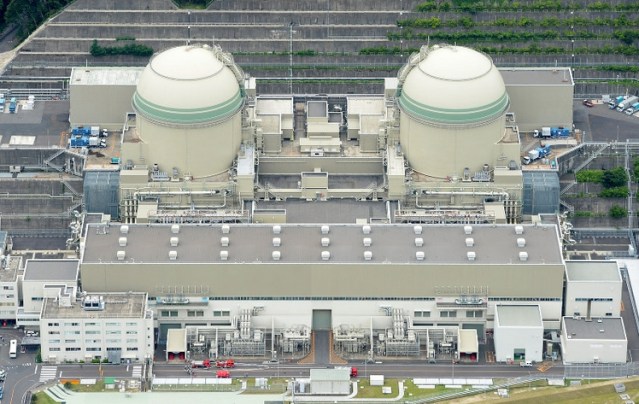
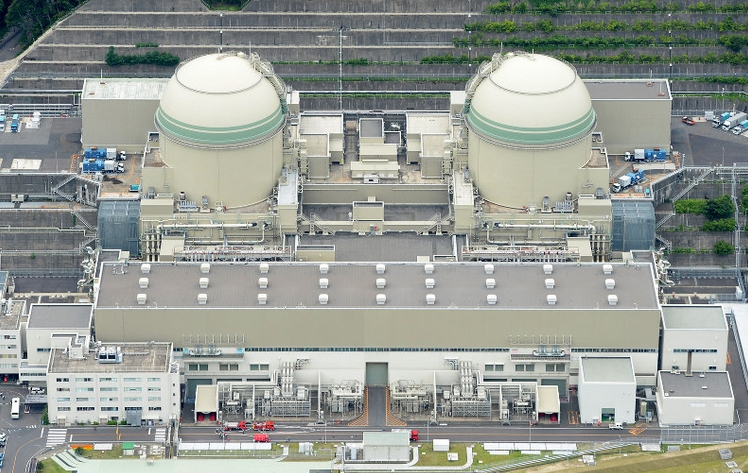
The No. 3 and No. 4 reactors at the Takahama Nuclear Power Plant, from left to right, are pictured in this photo taken from a Mainichi helicopter in Takahama, Fukui Prefecture, on June 15, 2016.
OTSU, Japan (Kyodo) — A Japanese court kept its ban on operation of two nuclear reactors at the Takahama power plant in Fukui Prefecture on Friday by rejecting the plant operator’s request to suspend an injunction it had issued over the reactivated reactors.
The Otsu District Court’s decision concerns the injunction issued in March over the Nos. 3 and 4 units at the Kansai Electric Power Co. plant that marked a major setback for the government’s push to ramp up nuclear power generation. Local residents had filed for the injunction on safety concerns.
In Friday’s decision, the court said it “cannot conclude that (the reactors) are safe, merely because they have met new regulatory standards on nuclear power plants.” New, more stringent safety rules were introduced in 2013 in the wake of the meltdowns at the Fukushima Daiichi nuclear power plant in 2011.
“Kansai Electric should at least explain how the regulations on operation and designs of nuclear power plants were toughened and how it responded to them,” the decision said.
The decision, issued under the same presiding judge, Yoshihiko Yamamoto, as the injunction in March, marks the final word on one process regarding the injunction because Kansai Electric cannot take further action on it.
The two reactors will remain offline as long as the injunction is not invalidated through a separate track examining an objection filed by Kansai Electric when the court issued the injunction. This track is also being presided over by the same judge.
The March 9 injunction was the first of its kind affecting operating reactors. One of the reactors was taken offline one day after the order. The other reactor was already offline.
The court said then there are “problematic points” in planned responses for major accidents and “questions” on tsunami countermeasures and evacuation planning, in light of the 2011 Fukushima disaster.
The Osaka-based utility subsequently sought to suspend the injunction, saying its safety measures are thoroughly proven and the court’s decision was scientifically and technologically groundless. It also said the suspension of the reactors has cost the company 300 million yen ($2.88 million) in losses daily.
The Takahama plant had cleared the post-Fukushima safety regulations in February last year, allowing Kansai Electric to reactivate the Nos. 3 and 4 reactors on Jan. 29 and Feb. 26, respectively. But their operations were beset with problems, with the No. 4 unit shutting down automatically due to a trouble just three days after it was rebooted.
The residents of Shiga Prefecture living within 70 kilometers of the four-reactor plant had filed the injunction as they worried about their safety in the event of a nuclear accident or disaster.
The plaintiffs argued that safety measures are insufficient and feared residents’ exposure to radiation in case of a severe accident.
A part of Shiga falls within a 30-kilometer radius of the plant, which is set by the central government as an evacuation preparedness zone.
http://mainichi.jp/english/articles/20160617/p2g/00m/0dm/039000c
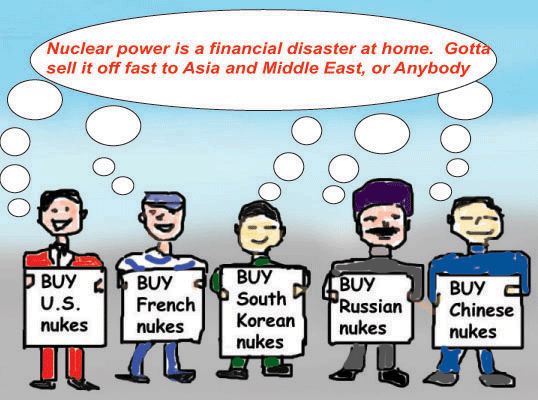
Nuclear marketers see India as a saviour of nuclear industry
U.S. President Barack Obama and Indian Prime Minister Narendra Modi agreed at a June 7 summit that U.S. nuclear reactor maker Westinghouse Electric, a subsidiary of Japan’s Toshiba, would build power plants in the South Asian nation. In a statement following their meeting in Washington, Modi and Obama said they welcomed the announcement by the Nuclear Power Corp. of India and Westinghouse that they would finalize a contract by June 2017. The two companies had said they would immediately begin the work of designing reactors and selecting locations.
As the nation opens its market for nuclear plants, competition is likely to intensify between the U.S., France, Japan and other countries seeking a greater market share.
France reached an agreement early this year to start a development project in western India in 2017. Although a formal agreement has yet to be signed, the country will compete with the U.S. to become the first Western country in about 40 years to deliver a reactor to India. Japan also reached a broad agreement with India in late 2015……..http://asia.nikkei.com/magazine/20160616-POWER-PERFORMERS-of-the-Asia300/Business/Nuclear-power-plant-builders-see-new-opportunities-in-India
India paying high cost to save Westinghouse’s nuclear business
 The Cost of Modi’s US Visit: Offering Rs. 2.8 lakh crore to Westinghouse, News Click, Prabir Purkayastha, June 09, 2016
The 4th visit of Modi to the US has very little to show as achievements. No wonder, the headlines screamed about “the start of the preparatory work” on six nuclear reactors as a major achievement. Not content with this, the Westinghouse AP 1000 reactors were even hyped as 5th generation reactors, skipping two whole generations of reactors in between. The earlier AP 600 reactors are recognised as 2nd generation reactors, making the AP 1000 the 3rd generation, which is how they are known in the rest of the world – except to certain gentlemen in the Indian media.
The reality is that after 8 years of negotiations on the Westinghouse reactors, India has now shifted the location from Mithivirdhi in Gujarat to Srikakulam in Andhra Pradesh. The negotiations for the deal with Westinghouse are still stuck, and only a new beginning is being sought with this new site. All that Westinghouse has agreed is that they will do some preliminary work for this new site — “start of the preparatory work”.
In today’s world, nuclear energy is a dying technology. Its costs are too high, its ability to build to schedule is non existent and it faces the challenge of renewables – wind and solar – the costs of which are dropping rapidly. The US, after a brief flirtation with nuclear energy – the so-called nuclear renaissance – has pretty much decided not to invest any further in this technology.
It is only China and India that can revive the dying nuclear industry of the US. Both Westinghouse and GE are without any further orders in the US and in the EU. So it is not the US showing its willingness to “give” us nuclear reactors to India that is the issue; it is India helping to revive a patient – the US nuclear industry – which has currently one foot already in the grave.
How much are we committing to pay to revive a dying Westinghouse? Continue reading
South Korea’s nuclear waste dilemma: will have to build waste dump
 South Korea looks to build used fuel store http://www.neimagazine.com/news/newssouth-korea-looks-to-build-used-fuel-store-4907688 30 May 2016 South Korea will select a site for an underground storage facility to permanently dispose used nuclear fuel, or high-level radioactive waste, by 2028 and complete the construction of the facility by 2053, according to the first roadmap for the project released by the Ministry of Trade, Industry and Energy on 25 May.
“A further delay in building the facility will put a drag on future generations, considering the saturation level of interim storage units located in the nuclear power complexes nationwide, ” Chae Hee-bong, the ministry’s energy policy director, told a press briefing.
Korea has 24 nuclear power units which produce more than 700t of used nuclear fuel annually. According to ministry data, the first used fuel storage unit to become full will be at the Wolsong NPP in Gyeongju, North Gyeongsang Province, in 2019.

Korea has no other choice than storage as it is strictly banned from reprocessing under a 1973 treaty with the USA. The government has been trying to find a site for the wastes since 1983, but has failed nine times because of local protests. The government said the country is running out of storage units.
To minimize public resistance in the course of a site selection, the ministry will adopt an open competition among geologically qualified sites. It will launch an independent committee to lead the site selection next year, following an approval by the National Assembly on the roadmap in the latter part of this year. The roadmap will be updated in five years embracing changing external conditions, the ministry added.
The ministry’s ‘road map’ is based on recommendations from the Public Engagement Commission, an independent advisory group set up in 2013. The ministry will hold a public hearing next month, followed by an inter-agency meeting chaired by the prime minister in July.
Park Dong-il, director of the nuclear power environment division at the ministry said: “It will take about 12 years to select the location and we will hear what they want to receive from the government and make deals during this period,” said. He added that the government will decide what kind of benefits or incentives to give to areas that want to build storage facilities.
According to the ministry, it will take the government about eight years to select the site and get feedback from local residents, and another four years to investigate the geological chracteristics of the site. The project was expected to cost some KRW53,000bn ($44.8bn) in 2013 but a government official said it is now looking at an estimated cost of KRW63,000bn.
Meanwhile, the Korean government opened its first low-and intermediate-level radioactive waste facility in Gyeongju, North Gyeongsang, last year. The government wanted to build a high-level facility there but faced opposition from residents.
Taiwan’s nuclear waste problem – sees overseas reprocessing as the answer
 Taiwan wants to send nuclear waste overseas for reprocessing, Japan Times, AFP-JIJI 16 June 16 TAIPEI – Taiwan has unveiled a plan to process nuclear waste overseas for the first time as it runs out of storage space at its power plants, sparking criticism from environmental groups.
The state-run Taiwan Power Co. on Tuesday began soliciting bids from overseas reprocessing companies for 1,200 used fuel rods from the island’s first and second nuclear plants.
The two plants, which currently store the spent fuel rods, were launched in 1978 and 1981 and will each be decommissioned once they have been operational for 40 years.
But Taipower has said it may be forced to shut down or decommission the plants earlier than scheduled, as they are reaching storage capacity for spent nuclear fuel.
Some environmental groups accused Taipower of seeking ways to keep the two plants in operation even though they are set to be decommissioned.
“We strongly protest the plan. It’s absurd to send the fuel rods abroad to be reprocessed since Taiwan is no longer building nuclear power plants,” said the National Nuclear Abolition Action Platform.
“It’s clear that Taipower is in a rush to ship the nuclear waste abroad because the first nuclear power plant will be shut down if it fails to do so, which will mean that its plan to push for extended operation of the plant will fall through.”
The government is under growing public pressure over its unpopular nuclear facilities as safety concerns have mounted since the Fukushima No. 1 nuclear disaster in 2011.
Like Japan, Taiwan regularly suffers earthquakes. In September 1999 a magnitude-7.6 quake killed around 2,400 people in the island’s deadliest natural disaster in recent history.
Last year the authorities were forced to seal off a new power plant due to open in 2015, pending a referendum on its future…….
Companies from England, France and Russia have expressed interest in bidding for the work, which is expected to cost $11.25 billion New Taiwan dollars ($356 million), local media reported. http://www.japantimes.co.jp/news/2015/02/18/asia-pacific/taiwan-wants-to-send-nuclear-waste-overseas-for-reprocessing/#.V2Mxz9J97Gj
1 This Month





PLEASE OPPOSE HR 8255 AND S.3639 – bills would accelerate satellite deployment, with no environmental review or safeguards – https://ncstd5li.quorum.us/campaign/169331/
To see nuclear-related stories in greater depth and intensity – go to https://nuclearinformation.wordpress.com
-
Archives
- October 2026 (49)
- September 2026 (339)
- August 2026 (330)
- July 2026 (355)
- June 2026 (287)
- May 2026 (306)
- April 2026 (356)
- March 2026 (251)
- February 2026 (267)
- January 2026 (308)
- December 2025 (358)
- November 2025 (359)
-
Categories
- 1
- 1 NUCLEAR ISSUES
- business and costs
- climate change
- culture and arts
- ENERGY
- environment
- health
- history
- indigenous issues
- Legal
- marketing of nuclear
- media
- opposition to nuclear
- PERSONAL STORIES
- politics
- politics international
- Religion and ethics
- safety
- secrets,lies and civil liberties
- spinbuster
- technology
- Uranium
- wastes
- weapons and war
- Women
- 2 WORLD
- ACTION
- AFRICA
- Atrocities
- AUSTRALIA
- Christina's notes
- Christina's themes
- culture and arts
- Events
- Fuk 2022
- Fuk 2023
- Fukushima 2017
- Fukushima 2018
- fukushima 2019
- Fukushima 2020
- Fukushima 2021
- general
- global warming
- Humour (God we need it)
- Nuclear
- RARE EARTHS
- Reference
- resources – print
- Resources -audiovicual
- Weekly Newsletter
- World
- World Nuclear
- YouTube
-
RSS
Entries RSS
Comments RSS

