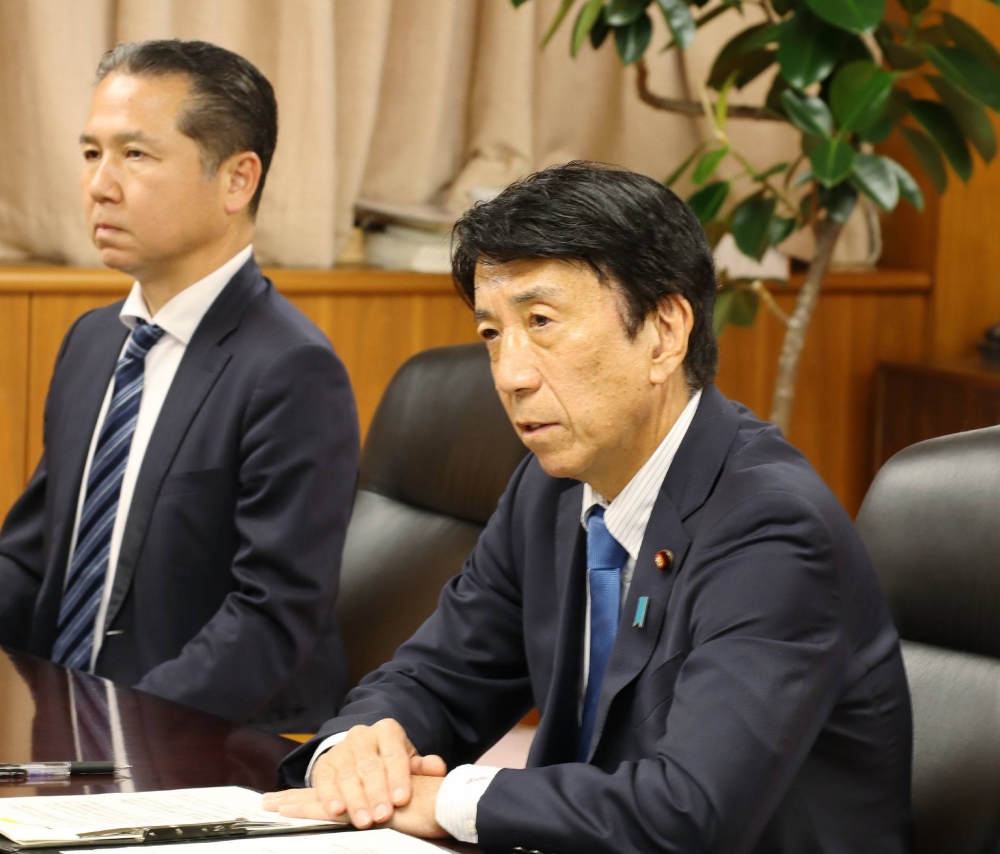
Government asks Genkai mayor to accept site survey to host nuclear waste
Industry minister Ken Saito has asked the mayor of the town of Genkai in Saga Prefecture to accept a so-called literature survey, as part of the process for selecting a final disposal site for high-level radioactive waste from nuclear plants.
Saito sought understanding from Genkai Mayor Shintaro Wakiyama at a meeting in Tokyo on Tuesday, saying that “the literature survey is not directly connected to the selection.”
Last month, the Genkai town assembly approved a petition submitted by local business groups asking for the literature survey request to be accepted.
“I’m torn between the town assembly’s decision and my thinking,” Wakiyama told reporters after the meeting with Saito. The mayor said that he will make a decision by the end of this month.
A literature survey is the first of three stages in the selection process for disposal sites, and involves the condition of geological strata being examined on paper, based on maps and other data.
So far, a literature survey has been accepted only by the town of Suttsu and the village of Kamoenai, both in Hokkaido.
For a literature survey to be conducted, a local government must apply for or accept a central government request.
Inside abandoned ghost town at Fukushima after nuclear power plant meltdown
Tokyo Matilda from Sheffield is one of the few to visit the nuclear ghost town of Fukushima in Japan
Mirror UK, Cecilia Adamou, 5 May 24
Tokyo Matilda, a 20-year-old from Sheffield, England, embarked on a mission to delve into this deserted ghost town of Fukushima in Japan. The area was subject to disaster when the Fukushima Daiichi Nuclear Power Plant nearby went into meltdown following the 2011 earthquake and subsequent tsunami, leaking toxic nuclear waste into the environment and deeming it uninhabitable due to radiation.
As residents evacuated the town, never to return, it is now frozen in time and has been left subject to the elements for the 13 years since the catastrophe. What remains is an abandoned, apocalyptic wasteland similar to the setting of the Fallout games and TV series. The only people that remain are those trying to bring it back from extinction.
While visiting the disaster site, Tokyo explored a theme park, a school and even a ramen café that have all been empty since 2011. She said: “It reminded me of Fallout as it had such a heavy apocalyptic feeling. The only people who were walking around were the workers who try everyday to get rid of the radiated soil and to make it safe once again.”
The danger of radiation poisoning was a very real risk for Tokyo as she explored the many sights. She explained: “The hospital was the highest radiated place we explored located in the Red Zone. We had the fear of staying too long and having radiation sickness, I have never been as scared as I was in there.”…………………. more https://www.mirror.co.uk/news/weird-news/inside-abandoned-ghost-town-fukushima-32696396
Brutal 48C heatwave takes its toll on east Asia

East Asia is in the throes of an intense heatwave that is causing deadly
heatstroke, damaging crops, and has exposed an old town at the bottom of a
dried-up reservoir in the Philippines. The record temperatures are the
result of climate change, made worse by the El Niño weather phenomenon.
The town of Chauk in Myanmar recorded a temperature on Monday of 48.2C —
the highest ever measured there, and one of numerous records set across the
region. In the capital of the Philippines, Manila, a new high of 38.8C was
recorded. Some 48,000 state schools across the Philippines were closed all
week, as the authorities advised people to avoid going outside. The
increased use of air conditioning is putting pressure on the electricity
grid in the nation’s largest island, Luzon.
Times 3rd May 2024
https://www.thetimes.co.uk/article/brutal-48c-heatwave-takes-its-toll-on-east-asia-ct70rrg0p
A Closer Look at Two Operational Small Modular Reactor Designs
There are literally dozens of small modular reactor (SMR) and microreactor designs being developed by different companies around the world, and some of the work has been going on for decades. Yet, only two designs have actually been built and put into commercial operation. POWER takes a closer look at both of them.
Power, by Aaron Larson 1 May 24
Many nuclear power supporters have long thought small modular reactors (SMRs) would revolutionize the industry. Advocates expect SMRs to shorten construction schedules and bring costs down through modularization and factory construction. They often cite numerous other benefits that make SMRs seem like no-brainers, and yet, only two SMR designs have ever been built and placed in commercial operation.
The International Atomic Energy Agency (IAEA) publishes booklets biennially on the status of SMR technology. In the IAEA’s most recent booklet, it notes 25 land-based water-cooled SMRs and another eight marine-based water-cooled designs are under development globally. It also lists 17 high-temperature gas-cooled SMRs, eight liquid-metal-cooled fast-neutron-spectrum SMRs, 13 molten-salt SMRs, and 12 microreactors. If you do the math, that’s 83 SMR designs under development, but only the KLT-40S and HTR-PM are actually operational.
KLT-40S
The KLT-40S is a pressurized water reactor (PWR) that was developed in Russia. It is an advanced version of the KLT-40 reactor, which has been used in nuclear-powered icebreakers. The first KLT-40S units, and, to date, the only two of these units to enter commercial operation, were deployed in the Akademik Lomonosov—the world’s first purpose-built floating nuclear power plant (FNPP, Figure 1 on original).
Main Design Features.………………………………………………………………………………………………………….
Deployment Details.…………………………….
Construction and testing of the FPU was completed in 2017 at the Baltic shipyard. In May 2018, the vessel was towed 4,000 kilometers (km), around Finland and Sweden, to Murmansk, completing the first leg of its journey to Pevek. Fuel loading was completed in Murmansk in October 2018. First criticality was achieved in November 2018, then in August 2019, the vessel embarked on the second leg of its journey—a distance of 4,700 km—towed by two tugboats to the Arctic port town of Pevek, where it was connected to the grid on Dec. 19, 2019. Akademik Lomonosov was fully commissioned on May 22, 2020, and it currently provides heat to the town of Pevek and supplies electricity to the regional Chaun-Bilibino power system.
HTR-PM
On Dec. 6, 2023, China National Nuclear Corp. announced it had commenced commercial operation of the high-temperature gas-cooled modular pebble bed (HTR-PM) reactor demonstrator. The HTR-PM project was constructed at a site in Rongcheng, Shandong Province, roughly midway between Beijing and Shanghai in eastern China…………………………………
Main Design Features.…………………………………………………………………………………………………..
Deployment Details.……………………………………………………………………. The civil work for the nuclear island buildings was completed in 2016 with the first of two reactor pressure vessels installed in March that year. The fuel plant reached its expected production capacity in 2017. Startup commissioning and testing of the primary circuit were finished by the end of 2020. The HTR-PM achieved first criticality in September 2021, and was ultimately grid connected on Dec. 20, 2021.
Spotty Results at Best
While it is laudable that these SMRs—the KLT-40S and HTR-PM—have been placed in commercial operation, their performance since entering service has come under fire. In The World Nuclear Industry Status Report 2023 (WNISR), a Mycle Schneider Consulting Project, co-funded by the German Federal Ministry for the Environment, Nature Conservation, Nuclear Safety, and Consumer Protection, it says both designs have operated at low capacity factors recently.
Concerning the Chinese HTR-PM, the WNISR says, “Between January and December 2022, the reactors operated for only 27 hours out of a possible maximum of 8,760 hours. In the subsequent three months, they seem to have operated at a load factor of around 10 percent.” The Russian units’ performance has been nearly as dismal. “The operating records of the two KLT-40S reactors have been quite poor. According to the IAEA’s PRIS [Power Reactor Information System] database, the two reactors had load factors of just 26.4 and 30.5 percent respectively in 2022, and lifetime load factors of just 34 and 22.4 percent. The reasons for the mediocre power-generation performance remain unclear,” the report says.
Meanwhile, the promises of shortened timelines and lower costs were not borne out by these projects. “The experience so far in constructing these two SMRs as well as estimates for reactor designs like NuScale’s SMR show that these designs are also subject to the historical pattern of cost escalations and time overruns. Those cost escalations do make it even less likely that SMRs will become commercialized, as the collapse of the Carbon Free Power Project involving NuScale reactors in the United States illustrated,” the WNISR says………….. https://www.powermag.com/a-closer-look-at-two-operational-small-modular-reactor-designs/
The Fight Over THAAD in Korea

An anti-ballistic missile system can easily be overwhelmed by a full-scale enemy attack. The system’s primary purpose is to support a first-strike capability, in which the United States takes out as many of the enemy’s missiles as possible, leaving the anti-ballistic missile system to counter the few surviving missiles.
In essence, that makes the radar in the THAAD system a first-strike weapon
The effect is to enlist South Korea, willingly or not, in U.S. war plans against China. When residents in Seongju argue that THAAD makes them a target, they are not mistaken.
CounterPunch, BY GREGORY ELICH, 1 May 24
Since the U.S. military brought its Terminal High Altitude Area Defense (THAAD) system to South Korea in 2017, it has met with sustained local resistance. THAAD is the centerpiece of the numerous actions the United States has undertaken to enmesh South Korea in its hostile anti-China campaign, a course that Korean peace activists are fighting to reverse.
In a unanimous decision at the end of March, South Korea’s Constitutional Court dismissed two challenges lodged by residents of Seongju County against the deployment of THAAD. [1] Since its arrival, the THAAD system has met with recurring demonstrations in the nearby village of Soseong-ri. The hope in the Yoon and Biden administrations is that the court’s decision will dishearten opponents of THAAD. In this expectation, they are already disappointed, as anti-THAAD activists responded to the court’s decision by vowing to “fight to the end.” [2]
Although protestors have regularly held rallies on the road leading to the THAAD site, swarms of Korean police cleared them away to allow free passage for U.S. military supply trucks. Opposition to THAAD has angered U.S. officials, leading the Biden administration to dispatch Secretary of Defense Lloyd Austin to Seoul to deliver the message that it deemed the situation “unacceptable” and progress on establishing the base needed to accelerate. Austin also raised objections to protests by residents in Pohang over noise from U.S. Apache attack helicopters conducting live-fire exercises. [3] Predictably, the Yoon administration responded by prioritizing U.S. demands over the welfare of the Korean people and promised “close cooperation for normalizing routine and unfettered access to the THAAD site” and “improvement of the combined training conditions.” [4]
THAAD is billed as an anti-missile defense system consisting of an interceptor missile battery, a fire control and communications unit, and an AN/TPY-2 X-band radar. The ostensible purpose of THAAD in Seongju is to counter incoming North Korean missiles, but serious doubts exist about its efficacy in that role. In terms of coverage, THAAD’s position in Seongju puts it in range to cover the main U.S. military base in South Korea, Camp Humphreys in Pyeongtaek, but out of range to protect Seoul, which at any rate is indefensible due to its proximity to the border. Even so, it is questionable how much utility the system offers even for Pyeongtaek.
THAAD’s missiles are designed to intercept incoming ballistic missiles at an altitude of 40 to 150 kilometers. The THAAD battery would have less than three and a half minutes to detect and counter-launch against a high-altitude ballistic missile fired from the farthestpoint in North Korea. By then, the incoming missile would have fallen below the lower-end altitude range of 40 kilometers, leaving it invulnerable to interception. [5] That would be the best-case scenario, as in the event of a war, the North Koreans are not likely to be so accommodating as to launch ballistic missiles from as far away as possible.
Furthermore, the THAAD battery in Seongju is equipped with six launchers and 48 interceptor missiles. With a thirty-minute THAAD battery launcher reload time, incoming missiles would not take long to deplete THAAD’s ability to respond, even under the most accommodating circumstances.
An upgrade was recently made to integrate THAAD with Patriot PAC-3 defense to intercept ballistic missiles at a lower altitude. This enhancement is of doubtful utility, as the radar’s response would still be constrained by the short flight time of an incoming missile. For all the hype about the successful interception of Iranian missiles fired at Israel, the Patriot’s showing in a more suitable scenario was less than stellar. It had an advantage there, as Iranian and Yemeni launch sites were situated much farther away from their target than in the Korean case. Yet, out of 120 Iranian ballistic missiles, the Patriot system shot down only one. The others were intercepted primarily by U.S. warplanes. [6]
North Korea’s development of a solid-fuel hypersonic intermediate-range missile has added another unmeetable challenge for THAAD. Because of its proximity, it is doubtful that North Korea would target US forces with high-altitude ballistic missiles in case of war. Instead, it would likely rely on its long-range artillery, cruise missiles, and short-range ballistic missiles, flying well below the lower limit of THAAD’s altitude coverage.
Despite its doubtful defensive effectiveness on the Korean Peninsula, the United States attaches enormous importance to THAAD’s deployment in South Korea, which suggests an unstated motivation. A clue is provided by the stationing in Japan of two stand-alone AN/TPY-2 radars without an accompanying THAAD system. [7] In other words, it is the radar that matters to the U.S. military, and the linkage to THAAD interceptors is primarily a pretense made necessary by popular feeling in Korea.
What makes the AN/TPY-2 special is its ability to operate in two modes. In terminal mode, it feeds tracking data to the THAAD missile battery, allowing it to target an incoming ballistic missile as it descends toward its target. In forward-based mode, the THAAD missile battery is not involved, and the role of the radar is to detect a ballistic missile as it ascends from its launching pad, even from deep into China. In this mode, the radar is integrated into the U.S. missile defense system and sends tracking data to interceptor missiles stationed on U.S. territory and Pacific bases. [8] As a U.S. Army publication points out, when in forward-based mode, a field commander may use the radar system “to concurrently support both regional and strategic missile defense operations.” [9]
There are hints that preparations may already be underway to establish the conditions necessary for THAAD to operate in forward-based mode. Last year, South Korea and Japan agreed to link their radars to the U.S. Indo-Pacific Command in Hawaii. [10] The ostensible purpose is to enhance the tracking accuracy of missiles fired from North Korea, but the concept applies equally well to Chinese missiles. It is not a stretch to imagine that if South Korean and Japanese radars have been linked to the United States, the same may be true with the THAAD’s AN/TPY-2. Certainly, if the U.S. Army switches the mode, it will not be informing South Korean authorities, so sure are the Americans that they can freely treat Korean sovereignty with contempt. Switching an AN/TPY-2 radar from one mode to the other takes only eight hours, a quick process that is opaque to outsiders. [11]
An anti-ballistic missile system can easily be overwhelmed by a full-scale enemy attack. The system’s primary purpose is to support a first-strike capability, in which the United States takes out as many of the enemy’s missiles as possible, leaving the anti-ballistic missile system to counter the few surviving missiles. In essence, that makes the radar in the THAAD system a first-strike weapon.
The closer the radar is stationed to an adversary’s ballistic missile launch, the more precise the tracking provided to the U.S.-based anti-missile system. South Korea is ideally located for the AN/TPY-2, where its radar can cover much of eastern China. [12] The effect is to enlist South Korea, willingly or not, in U.S. war plans against China. When residents in Seongju argue that THAAD makes them a target, they are not mistaken.
The Yoon administration is taking integration with the U.S. missile defense system one step further in planning to spend an estimated $584 million to procure American SM-3 interceptor missiles, suitable for protecting the United States and its bases in the Pacific.[13] The SM-3 interceptors are to be deployed on South Korean Aegis destroyers, which will need to be upgraded at additional cost to handle them. [14]
Residents in Seongju are also concerned about potential health risks associated with living adjacent to the THAAD installation.
Continue readingUS vs China, Israel vs Iran, India vs Pakistan: Asia plays with fire as nuclear war safety net frays
- From the Korean peninsula to the Middle East, a string of nuclear flashpoints has emerged with the unravelling of the global post-Cold War detente
- Amid arms races, sky-high tensions – and the removal of guardrails to avert danger – proliferation ‘threatens to destabilise everywhere’, experts warn
A high-stakes game of geopolitical brinkmanship is playing out across the Middle East and Asia, with Israel and Iran trading missile strikes; India and Pakistan locked in a multi-headed rocket arms race; and power struggles on the Korean peninsula and in the South China Sea combining to create a perilous chain of potential nuclear-conflict zones.
In the past couple of weeks alone, Iran and Israel’s tit-for-tat exchanges amid the war in Gaza have highlighted their ability to target each other’s uranium-enrichment facilities, while the US has deployed mid-range ballistic missiles to the Philippines for the first time since the Cold War…………………………………………………. https://www.scmp.com/week-asia/politics/article/3260551/us-vs-china-israel-vs-iran-india-vs-pakistan-asia-plays-fire-nuclear-war-safety-net-frays?campaign=3260551&module=perpetual_scroll_0&pgtype=article
IAEA clears Japanese reactor for 60-year lifetime
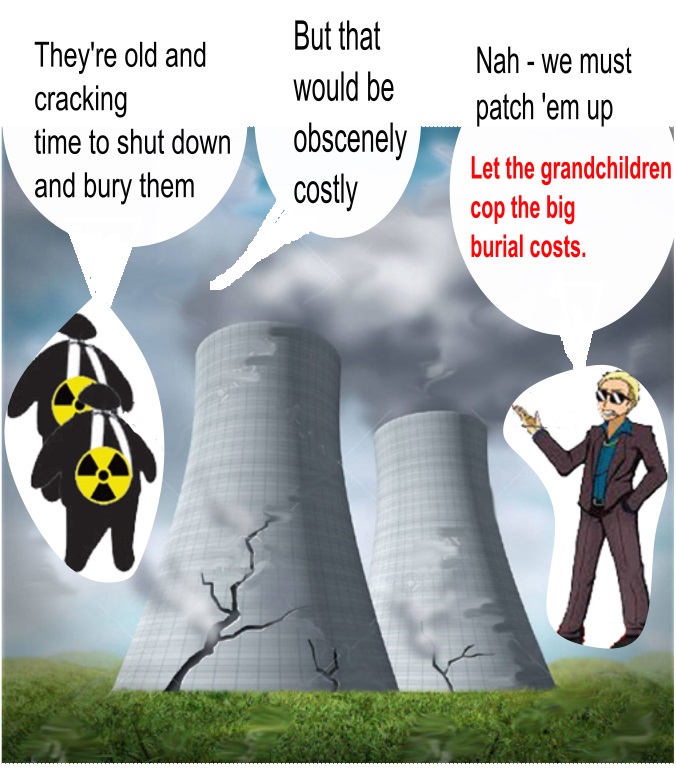
Following a review, unit 3 at the Mihama nuclear power plant (NPP) has been deemed fit for further operation.
Alfie Shaw, April 26, 2024
Ateam of experts from the International Atomic Agency (IAEA) has found that Japanese utility Kansai Electric Power Company is implementing timely measures for the safe long-term operation of unit 3 at its Mihama NPP.
Under regulations that came into force in July 2013, Japanese reactors have a nominal operating period of 40 years; 20-year extensions can be granted once, but this is contingent on exacting safety requirements.
Kansai’s Mihama unit 3, a 780MW pressurised water reactor that entered commercial operation in 1976, was granted an extension by Japan’s Nuclear Regulation Authority (NRA) in November 2016, giving the unit a licence to operate until 2036. Unit 3 at Mihama was the third Japanese unit to be granted a licence extension enabling it to operate beyond 40 years under the revised regulations, following Takahama units 1 and 2, which received NRA approval in June 2016.
Following the disaster at the Fukushima Daiichi plant in 2011, Mihama shut down, lying idle until restarting in June 2021. It became the first Japanese reactor to operate beyond 40 years…………………………………………….
Power Technology 26th April 2024 https://www.power-technology.com/news/mihama-nuclear-unit-sees-extension-to-60-year-lifetime/
.
Blinken threatens China over Russia ties (VIDEO)
https://www.sott.net/article/490922-Blinken-threatens-China-over-Russia-ties-VIDEO 26 Apr 24
The US Secretary of State says Washington is prepared to impose more sanctions on Beijing over the alleged transfer of military components.
Washington is ready to introduce more sanctions against China over its alleged transfer of dual-use goods and components, which can supposedly be used by the Russian military industrial complex, US Secretary of State Antony Blinken said on Friday.
Speaking at a press conference in Beijing following his meeting with Chinese President Xi Jinping, the US official recalled that Washington has already imposed sanctions against more than 100 Chinese entities and is “fully prepared to act” and “take additional measures.”
Blinken claimed that China’s alleged support for the Russian defense industry raises concerns not only about the situation in Ukraine, but also about a “medium to long-term threat that many Europeans feel viscerally that Russia poses to them.”
Earlier this week, the Wall Street Journal had also reported that the US was drafting sanctions that could cut off some Chinese banks from the global financial system unless Beijing severs its economic ties with Russia.
Earlier this week, the Wall Street Journal had also reported that the US was drafting sanctions that could cut off some Chinese banks from the global financial system unless Beijing severs its economic ties with Russia.
The outlet claimed that US officials believe trade with China has allowed Russia to rebuild its military industrial capacity and could help it defeat Ukraine in a war of attrition.
Beijing has vehemently rejected accusations of “fueling” the Ukraine conflict and has instead blamed NATO for instigating the crisis by continuing its expansion in Europe and refusing to respect Russia’s national security concerns.
Following his meeting with Blinken, President Xi suggested that the US and China “should be partners, not rivals” and should strive towards achieving “mutual success and not harm each other.”
“I proposed three major principles: mutual respect, peaceful coexistence, and win-win cooperation. They are not only a summary of past experience, but also a guide to the future,” the Chinese leader was quoted as saying.
Beijing has maintained a policy of neutrality on the Ukraine conflict, with Chinese officials repeatedly stating that the country is not selling weapons to either Russia or Ukraine. Earlier this month, Chinese Foreign Ministry spokesman Mao Ning insisted that China “regulates the export of dual-use articles in accordance with laws and regulations,” urging “relevant countries” not to “smear or attack the normal relations between China and Russia.”
In December last year, US President Joe Biden issued a decree which enabled sanctions on foreign financial institutions that continue to deal with Russia. It targeted lenders outside US and EU jurisdictions that help Russia source sensitive items, which reportedly include semiconductors, machine tools, chemical precursors, ball bearings, and optical systems.
Nuclear-waste dams threaten Central Asia heartland
Dams holding large amounts of nuclear waste can be found in Kyrgyzstan’s
scenic hills. However, following a 2017 landslide they have become
unstable, threatening a possible Chernobyl-scale nuclear disaster if they
collapse.
Reuters 24th April 2024
Japan city assembly OKs request for nuclear waste site survey

If the mayor gives the green light, the Saga Prefecture town that hosts Kyushu Electric Power Co.’s four-reactor Genkai Nuclear Power Station will receive up to 2 billion yen ($12.9 million) in state subsidies for allowing the survey,
Three local associations in the construction, restaurant and accommodation sectors submitted separate requests for the survey to the assembly, with some hoping the subsidies and survey activity will prop up the local economy.
April 26, 2024 (Mainichi Japan) https://mainichi.jp/english/articles/20240426/p2g/00m/0na/027000c
SAGA, Japan (Kyodo) — The municipal assembly of Genkai in southwestern Japan gave the go-ahead Friday for the town to request a preliminary survey by the state to gauge its suitability to host an underground disposal site for highly radioactive waste.
The Genkai assembly is the first in the country hosting a nuclear plant to approve such a survey request. Mayor Shintaro Wakiyama said he plans to make the final decision in May regarding whether to request the survey, the first part of a three-stage, 20-year process to select a permanent storage site for waste from nuclear power generation.
If the mayor gives the green light, the Saga Prefecture town that hosts Kyushu Electric Power Co.’s four-reactor Genkai Nuclear Power Station will receive up to 2 billion yen ($12.9 million) in state subsidies for allowing the survey, which will check ground conditions and volcanic activity based on published geological sources.
After the nine-member assembly adopted the request by a majority vote, Wakiyama told reporters the decision “reflects the will of the people. I take it seriously.”
Saga Gov. Yoshinori Yamaguchi, meanwhile, expressed reluctance about locating a waste disposal site in Genkai. With the prefecture already hosting a nuclear plant, he told a press conference, “It would be unbalanced for (Saga) to shoulder such a burden.”
Three local associations in the construction, restaurant and accommodation sectors submitted separate requests for the survey to the assembly, with some hoping the subsidies and survey activity will prop up the local economy.
The associations called on the town, as a host of a nuclear power plant, to proactively cooperate with the central government.
Japan, like other countries, is struggling to find permanent disposal sites for nuclear waste. Only two municipalities — Suttsu and Kamoenai in Hokkaido in northern Japan — have approved preliminary site surveys, which commenced in 2020.
But the surveys have taken longer than the scheduled two years, and it remains unclear whether either process will move to the second stage as local opposition remains strong.
High-level radioactive waste, produced when extracting uranium and plutonium from spent fuel, must be stored in bedrock at least 300 meters underground for tens of thousands of years until radioactivity declines to levels that are not harmful to human health or the environment.
The waste, solidified by mixing with glass, is currently housed in metal containers stored at the Vitrified Waste Storage Center operated by Japan Nuclear Fuel Ltd. in Rokkasho, Aomori Prefecture.
Indian Nuclear Sites Impact South Tibetan Plateau Radioactivity
Chinese Academy of Sciences, 24 Apr 24 https://www.miragenews.com/indian-nuclear-sites-impact-south-tibetan-1222069/
A recent study published in Environmental Science & Technology Letter has shed light on the long-range transboundary transport of radioactive iodine-129 (129I) from the Indian nuclear fuel reprocessing plants (NFRPs) to the Southern Tibetan Plateau (STP).
This study, conducted by researchers from the Institute of Earth Environment of the Chinese Academy of Sciences (CAS), provides a new understanding of the transport of airborne radioactive pollutants from low to high altitudes, and may have implications for environmental protection on the Tibetan Plateau.
The Tibetan Plateau, known as the “Third Pole of the Earth” and the “Roof of the World,” is a remote, isolated, and presumably pristine region. Previous studies of radioactive contamination have focused primarily on the northern TP, leaving little knowledge of the STP. Primarily originating from human nuclear activities, iodine-129, with its properties of high volatility and radiation risk of short-lived radioiodine, serves as a key radionuclide for nuclear environmental safety monitoring.
In this study, the researchers have meticulously investigated the spatial variation of 129I in the bioindicators, moss and lichen, from the STP.
They found that 129I in the STP was significantly higher than the pre-nuclear levels and those in Chinese inland cities, but two-four orders of magnitude lower than those in the vicinity of the Indian and European NFRPs.
Analysis of the 129I discharge history in conjunction with the wind field indicates that the Indian NFRPs are the primary sources of 129I in the STP. The prevailing ISM plays a crucial role in the transport of 129I from the lowland to the high-altitude STP. The transport process is further enhanced by the summertime overlying heat pump, but is weakened by topographic blocking, forest adsorption, and cold trapping.
The spatial distribution of 129I and 127I in lichens distributed on Mt. Galongla shows that the Yarlung Zangbo Grand Canyon serves as a key transport channel.
“It is much beyond our expectation that Indian NFRPs have such a significant impact on the Tibetan Plateau. Since there are many nuclear facilities in operation and under construction in India, the radiation risk is just there. So we still need more data to find out the extent and scope of such impacts,” said Dr. ZHANG Luyuan, corresponding author of this study.
This work was supported by the second comprehensive scientific expedition to the Qinghai-Tibetan Plateau, CAS and the National Natural Science Foundation of China.
Heatwave in India: TV host faints during live broadcast as swaths of country reel from sweltering temperatures
India’s federal weather agency
has issued “severe heatwave” alerts for parts of India with
temperatures soaring to 42-44C. India witnessed the early onset of an
intense heatwave in March and April, leading to a huge impact on
agriculture production. A heatwave alert has been issued for Odisha and
West Bengal till 22 April with temperature peaking above 40C.
Independent 22nd April 2024
North Korea’s Kim Jong Un Oversees Simulated ‘Nuclear Counterattack’
The drill took place on Monday, according to the report. Seoul’s military had earlier announced that the North had fired several short-range ballistic missiles on Monday, with Tokyo confirming the launch.
World NewsAgence France-Presse April 23, 2024 https://www.ndtv.com/world-news/north-koreas-kim-jong-un-oversees-simulated-nuclear-counterattack-5501429
According to report, Kim Jong Un “appreciated the high hit and accuracy” of the rockets.
North Korean leader Kim Jong Un has overseen a drill simulating a “nuclear counterattack,” state-run KCNA news agency said Tuesday, the latest in a volley of tests by Pyongyang this year.
The drill took place on Monday, according to the report. Seoul’s military had earlier announced that the North had fired several short-range ballistic missiles on Monday, with Tokyo confirming the launch.
The drill involved “super-large multiple rocket units” which “hit their island target” some 352 kilometres (219 miles) away, the report said.
It added that Kim “appreciated the high hit and accuracy” of the rockets.
South Korea’s military said Monday that the missiles flew from the Pyongyang area for about 300 kilometres before splashing down in the waters east of the Korean peninsula.
The launch is the second in less than a week by Pyongyang, which on Friday tested a “super-large warhead” designed for a strategic cruise missile, state media said. Seoul’s military confirmed it had detected cruise missile launches at the time.
Tens of thousands evacuated from massive China floods
Authorities have evacuated nearly 60,000 people from their homes in
Guangdong, as days of heavy rain caused massive flooding in China’s most
populous province. Eleven people have gone missing, while no casualties
have been reported so far.
Footage on state media and online show large
swathes of land inundated by the floods and rescuers ferrying people on
lifeboats in waist-deep water. Several major rivers have burst their banks,
and authorities are closely monitoring “dangerously high” water levels.
They had warned that the level of a river in northern Guangdong could hit a
“once in 100 years” peak on Monday morning, though this had yet to
materialise by noon.
BBC 22nd April 2024
Pakistan issues flood alert and warns of heavy loss of life due to glacial melting
A Pakistani province is warning of heavy loss of life due to glacial melting
Riaz Khan Independent 20th April 2024
A Pakistani province has issued a flood alert due to glacial melting and
warned of heavy loss of life, officials said Saturday. The country has
witnessed days of extreme weather, killing scores of people and destroying
property and farmland. Experts say Pakistan is experiencing heavier rains
than normal in April because of climate change. In the mountainous
northwest province of Khyber Pakhtunkhwa, which has been hit particularly
hard by the deluges, authorities issued a flood alert because of the
melting of glaciers in several districts.
more https://www.independent.co.uk/climate-change/news/pakistan-flooding-climate-change-latest-b2531924.html
1 This Month



26 September – International Day for the Total Elimination of Nuclear Weapons


PLEASE OPPOSE HR 8255 AND S.3639 – bills would accelerate satellite deployment, with no environmental review or safeguards – https://ncstd5li.quorum.us/campaign/169331/
To see nuclear-related stories in greater depth and intensity – go to https://nuclearinformation.wordpress.com
-
Archives
- September 2026 (206)
- August 2026 (330)
- July 2026 (355)
- June 2026 (287)
- May 2026 (306)
- April 2026 (356)
- March 2026 (251)
- February 2026 (267)
- January 2026 (308)
- December 2025 (358)
- November 2025 (359)
- October 2025 (375)
-
Categories
- 1
- 1 NUCLEAR ISSUES
- business and costs
- climate change
- culture and arts
- ENERGY
- environment
- health
- history
- indigenous issues
- Legal
- marketing of nuclear
- media
- opposition to nuclear
- PERSONAL STORIES
- politics
- politics international
- Religion and ethics
- safety
- secrets,lies and civil liberties
- spinbuster
- technology
- Uranium
- wastes
- weapons and war
- Women
- 2 WORLD
- ACTION
- AFRICA
- Atrocities
- AUSTRALIA
- Christina's notes
- Christina's themes
- culture and arts
- Events
- Fuk 2022
- Fuk 2023
- Fukushima 2017
- Fukushima 2018
- fukushima 2019
- Fukushima 2020
- Fukushima 2021
- general
- global warming
- Humour (God we need it)
- Nuclear
- RARE EARTHS
- Reference
- resources – print
- Resources -audiovicual
- Weekly Newsletter
- World
- World Nuclear
- YouTube
-
RSS
Entries RSS
Comments RSS
 nuclear-news