Still no end in sight for Fukushima nuke plant decommissioning work
January 27, 2024 (Mainichi Japan), https://mainichi.jp/english/articles/20240127/p2a/00m/0na/003000c
OKUMA, Fukushima — Nearly 13 years since the triple-meltdown following the March 2011 Great East Japan Earthquake and tsunami, it is still unclear when decommissioning of the Fukushima Daiichi Nuclear Power Station’s reactors will be completed.
Operator Tokyo Electric Power Company (TEPCO) Holdings Inc. showed the power plant to Mainichi Shimbun reporters on Jan. 26 ahead of the 13th anniversary of the nuclear accident. Radiation levels in many areas are almost normal, and people can move in ordinary work clothes. However, the most difficult part of the work, retrieving melted nuclear fuel, has been a challenge. The management of solid waste, which is increasing daily, also remains an issue. The decommissioning of the reactors, which is estimated to take up to 40 years, is still far from complete.
Meltdowns occurred in reactor Nos. 1, 2 and 3. The start of nuclear fuel debris removal at reactor No. 2, which had been scheduled to begin by the end of fiscal 2023, has just been postponed for the third time. Reactor buildings are still inaccessible due to high radiation, meaning the work has to be done remotely.
More than 1,000 tanks for storing treated wastewater are lined up next to reactor Nos. 1 through 4, and new facilities to stably store and process approximately 520,000 cubic meters of existing solid waste are being built by reactor Nos. 5 and 6.
Treated wastewater began being discharged into the ocean in 2023, and the tanks are gradually being removed, but there is no timetable for the disposal of the solid waste. A TEPCO representative said, “The final issue that remains is how to deal with the radioactive waste that continues to be produced even as the decommissioning of the plant progresses.”
Japanese original by Yui Takahashi, Lifestyle, Science & Environment News Department)
Japan’s Fukushima nuclear plant: further delays for removal of melted fuel debris
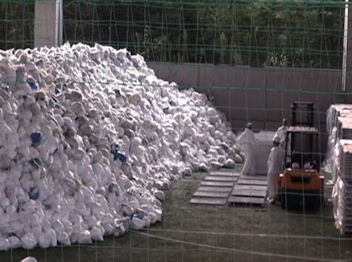
About 880 tons of highly radioactive melted nuclear fuel remain inside the three damaged reactors. Critics say the 30- to 40-year cleanup target set by the government and TEPCO for Fukushima Daiichi is overly optimistic. The damage in each reactor is different and plans need to be formed to accommodate their conditions.
NewsDay, By The Associated Press, January 25, 2024
TOKYO — The operator of the tsunami-hit nuclear plant in Fukushima announced Thursday a delay of several more months before launching a test to remove melted fuel debris from inside one of the reactors, citing problems clearing the way for a robotic arm.
The debris cleanup initially was supposed to be started by 2021, but it has been plagued with delays, underscoring the difficulty of recovering from the plant’s meltdown after a magnitude 9.0 quake and tsunami in March 2011.
The disasters destroyed the Fukushima Daiichi nuclear plant’s power supply and cooling systems, causing three reactors to melt down, and massive amounts of fatally radioactive melted nuclear fuel remain inside to this day.
The government and the Tokyo Electric Power Company Holdings, or TEPCO, initially committed to start removing the melted fuel from inside one of the three damaged reactors within 10 years of the disaster.
In 2019, the government and TEPCO decided to start removing melted fuel debris by the end of 2021 from the No. 2 reactor after a remote-controlled robot successfully clipped and lifted a granule of melted fuel during an internal probe.
But the coronavirus pandemic delayed development of the robotic arm, and the plan was pushed to 2022. Then, glitches with the arm repeatedly have delayed the project since then.
On Thursday, TEPCO officials pushed back the planned start from March to October of this year.
TEPCO officials said that the inside of a planned entryway for the robotic arm is filled with deposits believed to be melted equipment, cables and other debris from the meltdown, and their harder-than-expected removal has delayed the plan.
TEPCO now is considering using a slimmer, telescope-shaped kind of robot to start the debris removal.
About 880 tons of highly radioactive melted nuclear fuel remain inside the three damaged reactors. Critics say the 30- to 40-year cleanup target set by the government and TEPCO for Fukushima Daiichi is overly optimistic. The damage in each reactor is different and plans need to be formed to accommodate their conditions.
TEPCO has previously tried sending robots inside each of the three reactors but got hindered by debris, high radiation and inability to navigate them through the rubble, though they were able to gather some data in recent years.
Getting more details about the melted fuel debris from inside the reactors is crucial for their decommissioning. TEPCO plans to deploy four mini drones and a snake-shaped remote-controlled robot into the No. 1 reactor’s primary containment vessel in February to capture images from the areas where robots have not reached previously……… more https://www.newsday.com/news/nation/Japan-Fukushima-nuclear-plant-melted-fuel-decommissioning-v83291
A new ‘Cold War’ on a deadly hot planet?
China and the US must cut war-like posturing and face a world in desperate danger
By Tom Engelhardt, Tom Dispatch/Common Dreams
Tell me, what planet are we actually on? All these decades later, are we really involved in a “second” or “new” Cold War? It’s certainly true that, as late as the 1980s, the superpowers (or so they then liked to think of themselves), the United States and the Soviet Union, were still engaged in just such a Cold War, something that might have seemed almost positive at the time. After all, a “hot” one could have involved the use of the planet’s two great nuclear arsenals and the potential obliteration of just about everything.
But today? In case you haven’t noticed, the phrase “new Cold War” or “second Cold War” has indeed crept into our media vocabulary. (Check it out at Wikipedia.) Admittedly, unlike John F. Kennedy, Joe Biden has not actually spoken about bearing “the burden of a long, twilight struggle.” Still, the actions of his foreign policy crew — in spirit, like the president, distinctly old Cold Warriors — have helped make the very idea that we’re in a new version of just such a conflict part of everyday media chatter.
And yet, let’s stop and think about just what planet we’re actually on. In the wake of August 6 and August 9, 1945, when two atomic bombs destroyed the Japanese cities of Hiroshima and Nagasaki, there was little doubt about how “hot” a war between future nuclear-armed powers might get. And today, of course, we know that, if such a word can even be used in this context, a relatively modest nuclear conflict between, say, India and Pakistan might actually obliterate billions of us, in part by creating a — yes, brrr — “nuclear winter,” that would give the very phrase “cold” war a distinctly new meaning.
These days, despite an all too “hot” war in Ukraine in which the U.S. has, at least indirectly, faced off against the crew that replaced those Soviet cold warriors of yore, the new Cold War references are largely aimed at this country’s increasingly tense, ever more militarized relationship with China. Its focus is both the island of Taiwan and much of the rest of Asia. Worse yet, both countries seem driven to intensify that struggle.
In case you hadn’t noticed, Joe Biden made a symbolic and much-publicized stop in Vietnam (yes, Vietnam!) while returning from the September G20 summit meeting in India. There, he insisted that he didn’t “want to contain China” or halt its rise. He also demanded that it play by “the rules of the game” (and you know just whose rules and game that was). In the process, he functionally publicized his administration’s ongoing attempt to create an anti-China coalition extending from Japan and South Korea (only recently absorbed into a far deeper military relationship with this country), all the way to, yes, India itself.
And (yes, as well!) the Biden administration has upped military aid to Japan, Taiwan (including $85 million previously meant for Egypt), Australia (including a promise to supply it with its own nuclear attack submarines), and beyond. In the process, it’s also been reinforcing the American military position in the Pacific from Okinawa, Guam, and the Philippines to — yes again — Australia. Meanwhile, one four-star American general has even quite publicly predicted that a war between the U.S. and China is likely to break out by 2025, while urging his commanders to prepare for “the China fight”! Similarly, Director of National Intelligence Avril Haines has called China the “leading and most consequential threat to U.S. national security” and the Biden foreign policy team has been hard at work encircling — the Cold War phrase would have been “containing” — China, both diplomatically and militarily.
On the Chinese side, that country’s military has been similarly ramping up its air and naval activities around and ever closer to the island of Taiwan in an ominous fashion, even as it increases its military presence in places like the South China Sea (as has the U.S.). Oh, and just in case you hadn’t noticed, with a helping hand from Russia, Beijing is also putting more money and effort into expanding its already sizable nuclear arsenal.
Yes, this latest version of a Cold War is (to my mind at least) already a little too hot to handle. And yet, despite that reality, it couldn’t be more inappropriate to use the term “new Cold War” right now on a globe where a previously unimagined version of a hot war is staring us all, including most distinctly the United States and China, in the face.
As a start, keep in mind that the two great powers facing off so ominously against each other have long faced off no less ominously against the planet itself. After all, the United States remains the historically greatest greenhouse gas emitter of all time, while China is the greatest of the present moment (with the U.S. still in second place and Americans individually responsible for significantly more emissions than their Chinese counterparts). The results have been telling in both countries…………………………………………………………… more https://beyondnuclearinternational.org/2024/01/21/a-new-cold-war-on-a-deadly-hot-planet/
US urges discussions with China on practical nuclear risk reduction steps
Reuters, January 19, 2024
WASHINGTON, Jan 18 (Reuters) – The United States does not expect formal nuclear arms-control negotiations with China anytime soon, but does want to see a start of discussions on practical risk-reduction measures, a senior White House official said on Thursday.
Pranay Vaddi, the senior White House official for arms control and non proliferation, told a Washington think tank it had been important to have initial arms-control talks in November with China, but stressed the need for them to involve key Chinese decision makers or influencers on the country’s nuclear posture………………………..
The U.S. and China held their first talks on nuclear arms control in nearly five years on Nov. 6, amid growing U.S. concerns about China’s nuclear build up, but the meeting produced no specific results…………………………………………..
The U.S. and China held two days of military talks in Washington last week, their latest engagement since agreeing to resume military-to-military ties.
In its annual report on the Chinese military in October, the Pentagon said China has more than 500 operational nuclear warheads and will probably have over 1,000 warheads by 2030.
The U.S. has a stockpile of about 3,700 nuclear warheads, of which roughly 1,419 strategic nuclear warheads were deployed.
Reporting by David Brunnstrom; Editing by Sandra Maler, https://www.reuters.com/world/us-urges-discussions-with-china-practical-nuclear-risk-reduction-steps-2024-01-18/
North Korea says it tested underwater nuclear attack drone in response to rivals’ naval drills
By Associated Press Jan 19, 24, https://www.9news.com.au/national/north-korea-says-it-tested-underwater-nuclear-attack-drone-in-response-to-rivals-naval-drills/c2549630-f1b1-47f9-a510-0c1352a6ca97
North Korea vows to back Russia after meeting between leaders
North Korea said on Friday it had tested a purported underwater nuclear attack drone in response to a combined naval exercise between South Korea, the United States and Japan this week, as it continues to blame its rivals for raising tensions in the region.
The alleged drone test came days after North Korean leader Kim Jong Un declared he would scrap his country’s long-standing goal of a peaceful unification with South Korea and that his country would rewrite its constitution to define South Korea as its most hostile foreign adversary.
Tensions on the Korean Peninsula have risen to their highest point in years, with Kim accelerating his weapons testing activity and threatening nuclear conflict.
The United States and its Asian allies have responded by strengthening their combined military exercises, which Kim calls rehearsals for invasion.
North Korea’s alleged nuclear attack drone, which the North first tested last year, is among a broad range of weapon systems demonstrated in recent years as Kim expands his arsenal of nuclear-capable weapons.
South Korea’s military has insisted the North has exaggerated the capabilities of the drone, which is supposedly designed to carry out strikes on enemy vessels and ports.
The North’s military said it conducted the test in the country’s eastern waters in response to the US, South Korean and Japanese joint naval drill, which ended on Wednesday in waters south of Jeju island.
“Our army’s underwater nuke-based countering posture is being further rounded off and its various maritime and underwater responsive actions will continue to deter the hostile military maneuvers of the navies of the US and its allies,” the North’s Defence Ministry said in a statement.
“We strongly denounce the US and its followers for their reckless acts of seriously threatening the security of the DPRK from the outset of the year and sternly warn them of the catastrophic consequences to be entailed by them,” it said, using the initials of North Korea’s formal name, the Democratic People’s Republic of Korea.
The North in recent months has also tested various missile systems designed to target the United States and its Asian allies, and announced an escalatory nuclear doctrine that authorises the military to conduct preemptive nuclear strikes if the leadership in Pyongyang is under threat.
The North conducted its first ballistic missile test of 2024 on Sunday, which state media described as a new solid-fuel, intermediate-range missile tipped with a hypersonic warhead, likely intended to target US military bases in Guam and Japan.
At an emergency meeting of the UN Security Council on Thursday, South Korea called on the council “to break the silence” over North Korea’s escalating missile tests and threats. Two of the council’s permanent members, Russia and China, have blocked US-led efforts to increase sanctions on Pyongyang over its recent testing activity, underscoring a divide deepened over Russia’s war on Ukraine. South Korea is serving a two-year term on the council
Fukushima Nuclear Waste Water Disputes Continued: International Law in Japanese Court?
Written by Grace Nishikawa and Dr. Marlies Hesselman, https://www.ejiltalk.org/fukushima-nuclear-waste-water-disputes-continued-international-law-in-japanese-court/ 16 Feb 24
On 24th August 2023, Tokyo Electric Power Company (TEPCO) started releasing the ALPS-treated waste water from the Fukushima nuclear power plant into the Pacific Ocean over a period of 30 years. As discussed on this blog before, here and here, the decision led to strong international responses from neighbouring States, such as China and South Korea, as well as reactions by several UN human rights bodies. One legal question currently attracting attention in several fora, is whether Article 4 of the Protocol to the London Convention on the Prevention of Marine Pollution by Dumping of Wastes and Other Matters forbids the ‘dumping’ of the waste water into the sea, because it still contains radioactive matter, such as tritium.
This blog post draws attention to the interpretative controversy under the Londen Protocol by noting that the question is not only on the agenda of the Governing Bodies of the London Convention (LC) and its Protocol (LP), but also of the Fukushima District Court. In September, a group of Japanese citizens initiated a domestic lawsuit calling for an injunction to stop the release of the waste water. Their complaint is in large part based on personal rights under the constitution, but also invokes various international environmental law provisions, including Article 4 LC/LP. This post considers the interpretative controversy at hand, including whether the Japanese courts could play a role in addressing it.
Continue readingNuclear Continues To Lag Far Behind Renewables In China Deployments
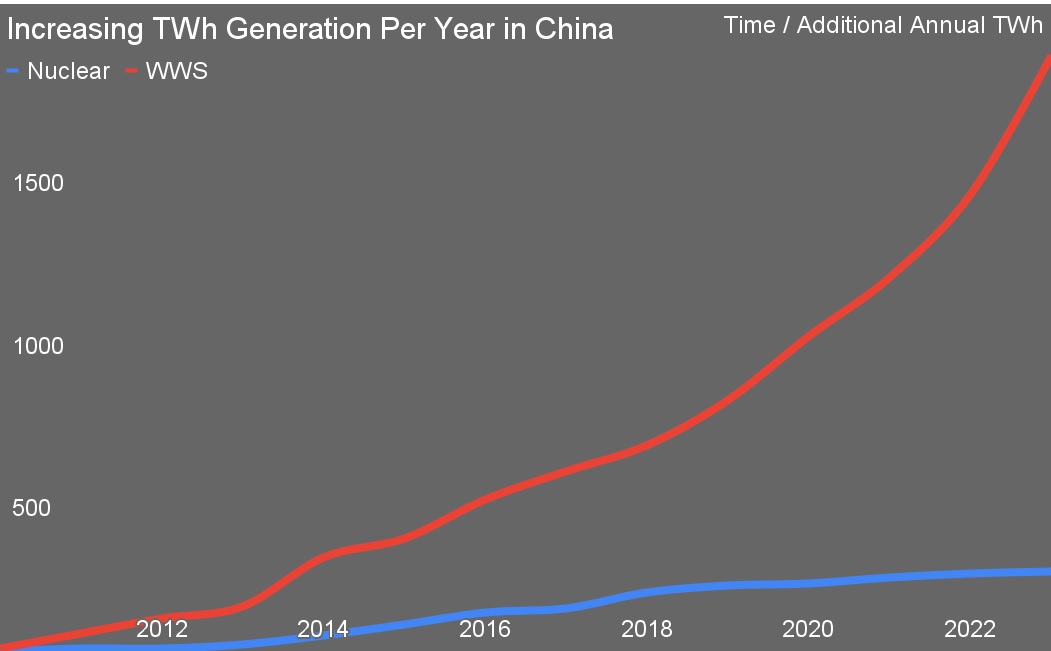
China can’t scale its nuclear program at all. It peaked in 2018 with 7 reactors with a capacity of 8.2 GW. For the five years since then then it’s been averaging 2.3 GW of new nuclear capacity, and last year only added 1.2 GW between a new GW scale reactor and a 200 MW small modular nuclear reactor.
Michael Barnard 13 Jan 24, https://cleantechnica.com/2024/01/12/nuclear-continues-to-lag-far-behind-renewables-in-china-deployments/
Since 2014 I’ve been tracking the natural experiment in China regarding the ability to scale nuclear generation vs renewables. My hypothesis was that the modularity and manufacturability of wind and solar especially meant that it would be much easier for them to scale up to massive sizes.
That hypothesis was strongly confirmed when I first published the results in 2019, and again in 2021 and 2022 when I updated them. In what is becoming a dog bites man annual article, here are the 2023 results. Once again, China’s nuclear program barely added any capacity, only 1.2 GW, while wind and solar between them added about 278 GW. Even with the capacity factor difference, the nuclear additions only mean about 7 TWh of new low carbon generation per year, while wind and solar between them will contributed about 427 TWh annually, over 60 times as much low carbon electricity.
As a note, there were no new hydroelectric dams commissioned in China, so that continued acceleration of deployment is solely due to wind and solar. That’s going to change when the absurdly massive Tibetan Yarlung Tsangpo river dam is commissioned, likely in the mid 2030s. That dam will generate three times the energy annually as the Three Gorges Dam, making it by far the biggest dam in the world by every measure.
A few points. First, what’s a natural experiment? It’s something which is occurring outside of a laboratory or research setting in the real world that coincidentally controls for a bunch of variables so that you can make a useful comparison. An often referenced example was of a specific region where half was without electricity for a few months. Researchers posited that the blackout region would have seen more pregnancies starting in that period, and sure enough, that’s what they found.
So why is China a natural experiment for scalability of wind and solar? Well, it controls for a bunch of variables. Both programs were national strategic energy programs run top down. I started the comparison in 2010 because the nuclear program had been running for about 15 years by then and the renewables program for five years, so both were mature enough to have worked out the growing pains.
One of the things that western nuclear proponents claim is that governments have over-regulated nuclear compared to wind and solar, and China’s regulatory regime for nuclear is clearly not the USA’s or the UK’s. They claim that fears of radiation have created massive and unfair headwinds, and China has a very different balancing act on public health and public health perceptions than the west. They claim that environmentalists have stopped nuclear development in the west, and while there are vastly more protests in China than most westerners realize, governmental strategic programs are much less susceptible to public hostility. And finally, western nuclear proponents complain that NIMBYs block nuclear expansion, and public sentiment and NIMBYism is much less powerful in China with its Confucian, much more top down governance system.
China’s central government has a 30 year track record of building massive infrastructure programs, so it’s not like it is missing any skills there. China has a nuclear weapons program, so the alignment of commercial nuclear generation with military strategic aims is in hand too. China has a strong willingness to finance strategic infrastructure with long-running state debt, so there are no headwinds there either.
Yet China can’t scale its nuclear program at all. It peaked in 2018 with 7 reactors with a capacity of 8.2 GW. For the five years since then then it’s been averaging 2.3 GW of new nuclear capacity, and last year only added 1.2 GW between a new GW scale reactor and a 200 MW small modular nuclear reactor.
So what’s going on? As I noted late in 2023, nuclear energy and free market capitalism aren’t compatible, but China isn’t capitalist, according to a lot of westerners. But it very definitely is a market and export capitalist economy, albeit with more state intervention and ownership, and the nuclear program is suffering as a result. That lone small modular reactor is a clear signal of that.
Japanese nuclear plant admits 20,000 litres of oil leaked when it was hit by 10ft tsunami sparked by New Year’s Day earthquake – as officials call for drones to monitor radiation levels
- Hokuriku Electric Power reported second oil leak at Shika nuclear power station
Daily Mail, By JAMES CALLERY, 12 January 2024
A Japanese nuclear power station has admitted that 20,000 litres of oil leaked when 10ft tsunami waves slammed into the plant after the 7.6-magnitude New Year’s Day earthquake.
Shika nuclear power plant, which contains two reactors, was hit by the huge waves shortly after the powerful earthquake struck the central Ishikawa region on January 1.
Around 19,900 litres of insulating oil leaked after the transformers in the two nuclear reactors were damaged in the quake, Hokurika Electric Power, which runs the facility, said. A second oil leak was reported yesterday, raising yet more safety fears.
Water used to cool spent fuel rods was spilt and the plant’s electricity power was temporarily knocked out as a result of the 7.6-magnitude quake, which killed more than 200 people.
Though Hokuriku Electric claims that no that radiation leaked from the plant, a small number of nearby monitoring stations were taken offline by the earthquake, raising fears that there could in fact be more damage.
Nobuhiko Ban, a safety panel member at Japan’s nuclear watchdog NRA, said this is a ‘huge problem’ and proposed utilising drones and aircraft to measure radiation levels until the operator’s monitoring stations could be repaired………………………………………………………………………. https://www.dailymail.co.uk/news/article-12951991/Japanese-nuclear-power-station-admits-10ft-tsunami-waves-slammed-plant-7-6-magnitude-New-Years-Day-earthquake-facility-battles-contain-oil-leaks-amid-fears-safety.html
Japan’s NRA orders probe on quake damage at Shika nuclear power plant
Japan Times, 11 Jan 24
The Nuclear Regulation Authority has ordered its secretariat to thoroughly investigate the cause of damage to a nuclear power plant from the 7.6 magnitude earthquake that struck the Noto Peninsula on Jan. 1.
The regulatory watchdog gave the order at a regular meeting on Wednesday.
According to Hokuriku Electric Power, the quake measured an upper 5 on the Japanese seismic intensity scale at the basement of the No. 1 reactor building of its Shika nuclear power plant in Ishikawa Prefecture.
The temblor caused oil to leak from two transformers. The company also could no longer measure radiation levels at up to 18 of its 116 monitoring posts around the plant after the earthquake.
At Wednesday’s meeting, the NRA secretariat presented data from Hokuriku Electric showing ground movements resulting from the quake at the plant’s two reactors had experienced sharper accelerations than the maximum levels expected for the facilities, although it did not find any immediate threats to safety.
Both reactors have been idled since 2011, the company said, adding that the quake did not cause any radiation leaks or have any effect on cooling operations in their spent fuel pools……………………………………………………………. https://www.japantimes.co.jp/news/2024/01/11/japan/science-health/japan-regulator-probe-on-nuke-plant/
Japan’s Hokuriku Elec reports second oil leak from Shika nuclear plant
Reuters, January 11, 2024
TOKYO, – Japan’s Hokuriku Electric Power (9505.T) on Wednesday reported a second oil leak at its Shika nuclear power station which was shaken by a powerful earthquake on New Year’s Day.
External radiation levels were not affected, the company said.
The magnitude 7.6 quake, which killed more than 200 people in the Hokuriku region, shook the idled Shika power station, which is located around 65 kilometres (40 miles) from the quake’s epicentre.
After a first oil leak detected on Sunday, a film of oil was detected on Wednesday in several gutters surrounding the main transformer of the No.2 reactor, the company said.
Also, an oil slick measuring about 100 meters by 30 meters was found floating on the sea in front of the power station, near the area where the first slick was observed.
Hokuriku Electric said it had placed oil absorption mats in the gutters and on oil fences in the coastal areas, and closed the drainage gate for rainwater after the latest leak.
The gate was opened on Tuesday because no additional oil was detected during monitoring patrols conducted three times a day.
“We regret that we should have been more careful in our decision,” Masayuki Nunotani, general manager of Hokuriku Electric’s nuclear energy division, told reporters.
The utility believes the second oil leak originated from a transformer during the Jan. 1 quake, but said it was still analysing further details…………………….. more https://www.reuters.com/world/asia-pacific/japans-hokuriku-elec-reports-second-oil-leak-shika-nuclear-plant-2024-01-10/
Setback for Japan’s Nuclear Revival as Reactor Restart Delayed

Shoko Oda, Bloomberg News, 9 Jan 24, https://www.bnnbloomberg.ca/setback-for-japan-s-nuclear-revival-as-reactor-restart-delayed-1.2019978
Japanese utility Tohoku Electric Power Co. has delayed the restart of a key nuclear power plant by several months, a setback to the nation’s climate goals and efforts to become more self-sufficient in energy.
The company said Wednesday that it needs more time to fireproof electric cables at its Onagawa No. 2 reactor, as part of safety work which it had planned to finish by next month. It had earlier expected to resume commercial operation of the unit around May and said it would publish an updated safety work and restart schedule later.
The Japanese government is doubling down on the use of nuclear in an effort to curb costly imports of fossil fuels, achieve energy security and cut emissions. The restart of Onagawa No. 2 is especially symbolic as it would be the first unit in the east of the nation to restart since the 2011 Fukushima disaster.
Japan currently has 33 commercially available reactors, and has restarted 12 units in the western part of the country since the Fukushima tragedy. Tohoku had in September also pushed back the completion of safety work, leading to a drop in its shares. The utility fell as much as 2.9% on Wednesday.
Japan quake stressed nuclear plant beyond design limit: panel

 KYODO NEWS, 11 Jan 24
Last week’s powerful earthquake in central Japan inflicted stress on parts of a local nuclear power plant that exceeded the limit anticipated in the facility’s design, according to a report shared in a safety panel meeting on Wednesday.
The report, discussed at a regular session of the Nuclear Regulation Authority, indicated the potentially alarming readings of ground acceleration did not appear to pose an immediate safety threat to the facility in Shika on the Noto Peninsula……………………………………………………………..
Shinsuke Yamanaka, chief of the authority, told reporters that such seismic research by experts may take years, and that the activity in undersea faults which triggered the latest quake “must be factored in as new knowledge” in updating safety standards.
Yamanaka, an expert on nuclear power engineering, also urged the operator to get to the bottom of a breakdown of electric transformers installed at its Nos. 1 and 2 reactors that has partially prevented the Shika plant from receiving power supplied from outside………………….
Nobuhiko Ban, another panel member and expert on protection from radiation exposure, called it “a huge problem” that real-time radiation levels have not been monitored at some locations near the Shika plant after the quake, and proposed using aircraft and drones for the purpose………… https://english.kyodonews.net/news/2024/01/79c47d437001-japan-quake-stressed-nuclear-plant-beyond-design-limit-panel.html
Japan’s Hokuriku Elec reports oil leak from Shika nuclear plant
The magnitude 7.6 quake, which has killed more than 120 people in the Hokuriku region, shook the idled Shika power station, which is located around 65 kilometres (40 miles) from the quake’s epicentre.
The utility had already reported temporary power outages, oil leaks at the transformers, and water spill-over from spent nuclear fuel pools following Monday’s jolt, but no radiation leakage.
On Sunday, a small amount of oil film was detected in the gutter and on the road surrounding the main transformer of the No. 2 reactor, it said.
Additionally, an oil slick measuring about 5 meters by 10 meters was observed floating on the sea surface in front of the power station, Hokuriku Electric said, adding it promptly treated the oil film using a neutralizing agent.
The utility believes the oil slick resulted from a transformer insulating oil leak during the Jan. 1 quake, which triggered the fire extinguishing system, dispersing oil and spraying water around the transformer.
Subsequently, the oil appears to have entered the gutter due to rainfall, the company said, adding it was still analysing further details.
The oil slick is not within the radiation-controlled area and there are no external radiation effects, the company said.
Key external power supplies, monitoring facilities, and cooling systems at the plant are functioning normally, it added. (Reporting by Yuka Obayashi Editing by Mark Potter)
Japan earthquake casts cloud over push to restart nuclear plants
January 5, 2024
TOKYO, Jan 4 (Reuters) – The powerful earthquake that hit Japan’s western coast on New Year’s Day has underscored the country’s exposure to natural disasters, casting fresh doubt over a push to bring its nuclear capacity back online.
Nuclear power plants dot the coast of mountainous Japan, which is prone to earthquakes and tsunamis due to its location on the seismically active “Ring of Fire” around the Pacific Ocean.
Monday’s magnitude 7.6 earthquake, which has killed more than 80 people in the Hokuriku region, destroyed infrastructure and left homes without power, struck days after regulators lifted an operational ban on Tokyo Electric’s (9501.T) Kashiwazaki-Kariwa nuclear power plant.
Tepco hopes to gain local permission to restart the plant, which is around 120 kilometres from the quake’s epicentre and has been offline since 2012. The utility was banned in 2021 from operating the plant due to safety breaches including a failure to protect nuclear materials.
“The Japanese public is still generally less positive toward nuclear power now than they were before the Fukushima disaster,” analysts at Rystad Energy wrote in a client note.
“As a result, public sentiment – and potentially government policy – is likely to be sensitive to any new power-plant disruptions caused by the most recent quake or any future ones.”
Japan had planned to phase out nuclear power after the March 2011 tsunami and Fukushima meltdown, but rising energy prices and repeated power crunches have prompted a shift towards restarting idled capacity and developing next-generation reactors.
After the Jan. 1 quake Tepco reported water had spilled from nuclear fuel pools at the Kashiwazaki-Kariwa plant – the world’s largest – but said radiation levels were normal.
“Citizens had felt that Tepco could probably be able to restart reactors by the end of 2024, but this earthquake seems to have reignited a sense of fear,” said Yukihiko Hoshino, a Kashiwazaki city assembly member opposing the plant restart.
Monday’s tsunami warning reminded him of the Fukushima disaster, he said.
Tepco shares fell as much as 8% on Thursday, the first trading day since the earthquake, before closing up 2.2%.
Hokuriku Electric (9505.T), whose idled Shika plant is located around 65 kilometres from the earthquake’s epicentre, slid as much as 8% before paring losses to end down 2.2%.
The company, which reported water spill-over from spent nuclear fuel pools and oil leaks at the plant after the quake, hopes to restart the No.2 reactor there sometime after April 2026, it said in October………………………………… Reporting by Kantaro Komiya, Sudarshan Varadhan, Mariko Katsumura and Sam Nussey; Editing by Hugh Lawson
Rokkasho redux: Japan’s never-ending nuclear reprocessing saga

By Tatsujiro Suzuki | December 26, 2023, https://thebulletin.org/2023/12/rokkasho-redux-japans-never-ending-reprocessing-saga/
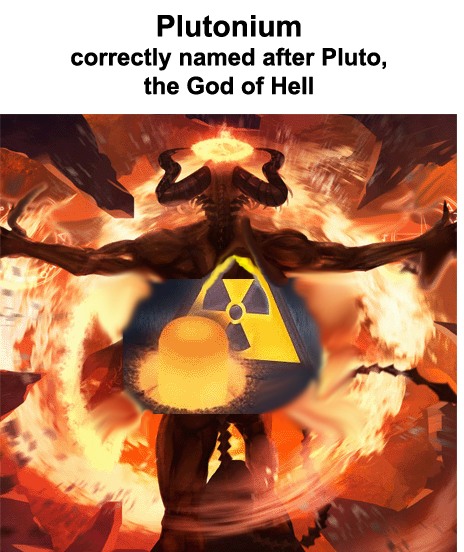
The policy seeks to at least begin to deal with the huge stocks of plutonium Japan has amassed
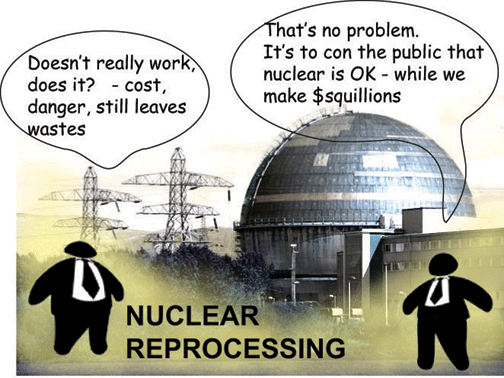
According to a recent Reuters report, Japan Nuclear Fuel Ltd (JNFL) still hopes to finish construction of Japan’s long-delayed Rokkasho reprocessing plant in the first half of the 2024 fiscal year (i.e. during April-September 2024). The plant—which would reprocess spent nuclear fuel from existing power plants, separating plutonium for use as reactor fuel—is already more than 25 years behind schedule, and there are reasons to believe that this new announcement is just another wishful plan that will end with another postponement.
One indication of further possible delays: On September 28, 2023, Naohiro Masuda, president of JNFL, stated that the safety review of the reprocessing plant by Japan’s Nuclear Regulation Authority will be difficult to complete by the end of 2023. He nevertheless insisted that the company could still meet completion target date in 2024.
Here is a partial history of past key developments that make completion in 2024 seem unlikely:
1993: Construction starts.
1997: Initial target for completion.
2006-2008: Hot tests conducted, revealing technical problems with the vitrification process for dealing with waste produced during reprocessing.
2011: Fukushima Dai-ichi nuclear plant accident.
2012: New safety regulation standards introduced.
2022: Completion target date postponed to June 2024)
The 2022 postponement was the 26th of the Rokkasho project.
Why so many postponements? There seem to be at least five underlying reasons for the postponements for the Rokkasho plant. First, JNFL lacks relevant expertise to manage such a technologically complex and hazardous project, which is owned by nine nuclear utilities plus all other major companies associated with nuclear power in Japan. Most of the firm’s senior executives are from shareholding companies (especially utility companies) and are not necessarily experts in the field of reprocessing spent nuclear fuel.
Second, the technologies in the plant came from different companies and institutions. The management of the project is therefore technically complex.
Third, the post-Fukushima-accident nuclear facility safety licensing review process is much more stringent than what existed before the accident. For example, the Nuclear Regulation Authority told JNFL at their November 25, 2023 meeting: “JNFL should immediately make improvements because it is clear that JNFL does not understand the contents of the permit well enough to confirm the adequacy of the design of the facilities on site and has not visited the site.”
Fourth, the financial costs to JNFL of postponement are covered by the utilities’ customers, because the utilities must pay a “reprocessing fee” every year, based on the spent fuel generated during that year, whether or not the reprocessing plant operates. The system by which the Nuclear Reprocessing Organization of Japan decides the reprocessing fee is not transparent.
Fifth, the project lacks independent oversight. Even though JNFL’s estimate of the cost of building and operating the Rokkasho plant has increased several-fold, no independent analysis has been done by a third party. One reason is that some of the shareholders are themselves contractors working on the plant and have no incentive to scrutinize the reasons for the cost increases or the indefinite extension of the construction project.
After so many postponements, there is reason to wonder whether the plant will ever operate, but the government and utilities continue to insist that the plant will open soon. Even if Rokkasho were to operate, it may suffer from the same kinds of problems that marked Britain’s light-water reactor spent fuel reprocessing experience, as described in Endless Trouble: Britain’s Thermal Oxide Reprocessing Plant (THORP).
Why does Japan’s commitment to reprocessing continue?
Despite the serious and longstanding problems the Rokkasho plant has faced (and continues to face), Japanese regulators and nuclear operators have doggedly pursued the project. There are four reasons:
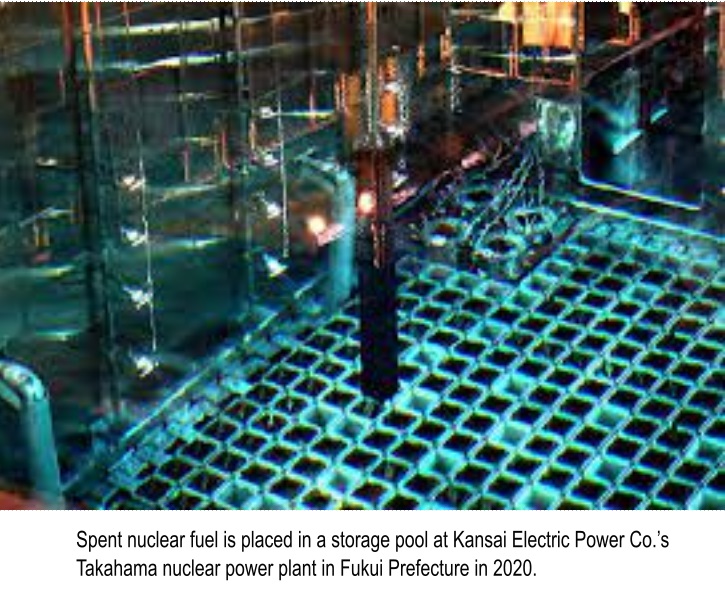
Spent fuel management. Currently, most of Japan’s spent nuclear fuel is stored in nuclear power plant cooling pools. But the pool capacities are limited, and the 3,000-ton-capacity Rokkasho spent fuel pool is also almost full. The nuclear utilities must therefore start operating the Rokkasho plant unless they can create additional spent fuel storage capacity, either on- or off-site. The Mutsu spent fuel storage facility is a candidate for additional capacity, but due to the concern that spent fuel could stay there forever, Mutsu city refuses to accept spent fuel unless the Rokkasho reprocessing plant begins to operate. The Rokkasho plant design capacity is 800 tons of spent fuel per year.
Legal and institutional commitments. Under Japan’s nuclear regulations, utilities must specify a “final disposal method” for spent fuel. The law on regulation of nuclear materials and nuclear reactors states that “when applying for reactor licensing, operators must specify the final disposal method of spent fuel” (Article 23.2.8). In addition, there was a clause that “disposal method” should be consistent with implementation of the government policy, which specified reprocessing as the disposal method. Although that clause was deleted in the 2012 revision of the law after the Fukushima accident, the Law on Final Disposal of High-Level Radioactive Waste still bans direct disposal of spent fuel. In addition, the 2016 Law on Reprocessing Fees legally requires utilities to submit reprocessing fees for all spent fuel generated every year since they stated in their applications that “final disposal method” for their spent fuel would be reprocessing.
Commitments to hosting communities. The nuclear utilities committed—albeit tacitly—to the communities hosting nuclear power plants that they would remove the spent fuel to reprocessing plants, since that was the national policy. Separately, JNFL signed an agreement with Rokkasho village and Aomori prefecture that says that if the Rokkasho reprocessing plant faces “severe difficulties,” other measures will be considered—including the return of spent fuel stored at Rokkasho to the nuclear power plants.
Local governments hosting nuclear power plants were not involved in this deal, however. They could therefore just refuse to receive spent fuel from Aomori.
In fact, after the Fukushima accident, when the government was considering amending the nuclear fuel cycle policy to include a “direct disposal option” for spent fuel in a deep underground repository, the Rokkasho village parliament (at the behind the scenes suggestion by the then JNFL president, Yoshihiko Kawai), issued a strong statement asking for “maintenance of the current nuclear fuel cycle policy.”
The statement continued that, if Japan’s fuel cycle policy changed, Rokkasho would: refuse to accept further waste from the reprocessing of Japan’s spent fuel in the UK and France; require the removal of reprocessing waste and spent fuel stored in Rokkasho; no longer accept spent fuel; and seek compensation for the damages caused by the change of the policy.
Institutional and bureaucratic inertia. In Japan, bureaucrats rotate to new positions every two or three years and are reluctant to take the risk of changing existing policies. They therefore tend to stick with past commitments. Institutional inertia becomes stronger as a project becomes bigger. The Rokkasho reprocessing project is one of the largest projects ever in Japan. Changing the project is therefore very difficult.
Will Japan’s new plutonium capping policy have any real impact? In 2018, Japan’s Atomic Energy Commission announced a new policy on “Basic Principles on Utilization of Plutonium” (see also this post). Under the new policy, the commission proposed that Japan would reduce its stockpile of separated plutonium, starting with a commitment not to increase it, and that reprocessing would take place only when a credible plan to use the separated plutonium existed.
The policy seeks to at least begin to deal with the huge stocks of plutonium Japan has amassed, both in European separation facilities (some 36.7 tons) and in Japan (10.5 tons), in anticipation of using the plutonium widely to fuel nuclear reactors—which so far has not materialized. In conjunction with the new Reprocessing Fee Law, the new plutonium policy gives the government legal authority to control the pace of reprocessing.
But it is not clear how the “capping policy” will be implemented. It is not a legally binding document, and no regulation has been introduced to control reprocessing. Utilities must submit specific plans for plutonium use to the Atomic Energy Commission for its review before reprocessing of their fuel begins. But the commission can only give advice to the government about the credibility of these plans, giving rise to questions about whether the policy will lead to sustained changes in reprocessing activity. A similar “paper rule” on plutonium has existed since 2003.
A way out. Japan could extricate itself from its reprocessing and plutonium problems in several ways. All involve significant changes in policy that would:
Find additional spent fuel storage capacity, on- or off-site. Local communities may be more willing to accept on-site dry cask storage of spent fuel if they are told that it is safer than spent fuel pool storage. For example, Saga Prefecture and Genkai-town, which host Kyushu Electric’s Genkai Nuclear Power Plant, have agreed to host dry cask storage starting in 2027. Host communities may want guarantees that spent fuel will be removed after a specified storage period. Such a guarantee could be given by the central government.
Amend the law on final disposal of high-level radioactive waste. An amendment could allow direct disposal of spent nuclear fuel in a deep underground repository. This would provide more flexibility in spent fuel management and make it easier for communities to host interim spent fuel storage.
Amend the Reprocessing Fee Law and shut down Rokkasho. An amendment to the law on reprocessing fees could allow the government to use reprocessing funds to implement a shutdown of the Rokkasho reprocessing plant. Such a plan could include payment of the debt JNFL has incurred while pursuing the Rokkasho project and funds for dry cask interim storage. This would enable the government to finally end the problem-plagued Rokkasho reprocessing plant project.
1 This Month

of the week – Shut Down Drone Warfare!


Tell the Ukrainian Government to Drop Prosecution of Peace Activist Yurii Sheliazhenko

Petition to revoke the licensing of the Near Surface Nuclear Disposal Facility (NSDF) at Chalk River. https://www.ourcommons.ca/petitions/en/Petition/Details?Petition=e-7247
To see nuclear-related stories in greater depth and intensity – go to https://nuclearinformation.wordpress.com
-
Archives
- March 2026 (251)
- February 2026 (268)
- January 2026 (308)
- December 2025 (358)
- November 2025 (359)
- October 2025 (376)
- September 2025 (257)
- August 2025 (319)
- July 2025 (230)
- June 2025 (348)
- May 2025 (261)
- April 2025 (305)
-
Categories
- 1
- 1 NUCLEAR ISSUES
- business and costs
- climate change
- culture and arts
- ENERGY
- environment
- health
- history
- indigenous issues
- Legal
- marketing of nuclear
- media
- opposition to nuclear
- PERSONAL STORIES
- politics
- politics international
- Religion and ethics
- safety
- secrets,lies and civil liberties
- spinbuster
- technology
- Uranium
- wastes
- weapons and war
- Women
- 2 WORLD
- ACTION
- AFRICA
- Atrocities
- AUSTRALIA
- Christina's notes
- Christina's themes
- culture and arts
- Events
- Fuk 2022
- Fuk 2023
- Fukushima 2017
- Fukushima 2018
- fukushima 2019
- Fukushima 2020
- Fukushima 2021
- general
- global warming
- Humour (God we need it)
- Nuclear
- RARE EARTHS
- Reference
- resources – print
- Resources -audiovicual
- Weekly Newsletter
- World
- World Nuclear
- YouTube
-
RSS
Entries RSS
Comments RSS
 nuclear-news
