Shaky friendship between China, North Korea: clash over nuclear and chemical weapons

 Friendship on the rocks? China, North Korea clash over nuclear and chemical weapons
North Korea’s reaction was so strong that some Chinese experts initially thought the commentary was fake By Saša Petricic, CBC News Feb 28, 2017 “…..China’s patience may be wearing thin, as frustrations double up over North Korea’s development of nuclear weapons and apparent willingness to use chemical weapons.
South Korea has accused North Korean leader Kim Jong-un of ordering the assassination of his half-brother, Kim Jong-nam, and Malaysia suspects several North Korean officials may have been involved in a plot that used the banned VX nerve agent.
It’s creating an unprecedented rift between the two neighbours and ideological soulmates. China’s support dates back to the 1950s and the Korean war.
Last week, Beijing imposed a ban on coal imports from North Korea that could deprive it of much needed foreign funds until the end of 2017. Pyongyang has replied with one of the nastiest insults one socialist state can throw at another, accusing China of “dancing to the tune of the U.S.”
“The hostile forces are shouting ‘bravo’ over this,” says a commentary published by North Korea’s state news agency, accusing its neighbour of “mean behaviour.”…….
Pyongyang has defied some of the toughest sanctions imposed by the United Nations Security council, meant to not only deprive North Korea of the parts and expertise it needs to develop a nuclear arsenal, but also to punish the country’s leadership by blocking travel and access to luxury goods.
Officially, China endorses the UN sanctions and condemns Kim Jong-un’s nuclear and missile sabre-rattling.
But it is walking a fine line, trying to avoid weakening the regime so badly that it collapses, causing unrest in North Korea and a possible flood of refugees into China.
Beijing has been accused of turning a blind eye to a network of North Korean shell companies and middlemen who operate just over the land border in China, working to circumvent sanctions……..
while Pyongyang’s ongoing nuclear and missile program worries China, it’s the apparent assassination of Kim Jong-un’s half-brother Kim Jong-nam that has sharpened the divisions between it and North Korea…….
Stockpile of deadly toxins
China is reportedly upset because Jong-nam was under its implicit protection, living in the country’s gambling enclave of Macau for years.
It was also rattled by North Korea’s apparent ready use of such a potent and prohibited chemical weapon beyond its borders. Pyongyang is known to have a large stockpile of various deadly toxins, and it hasn’t signed on to international conventions agreeing not to engage in chemical warfare…….http://www.cbc.ca/news/world/north-korea-china-weapons-petricic-1.4000631
Time to transform Japan’s nuclear plant inspection system
Japan lies at the middle of 4 tectonic plates. The pressure of the plates has produced 113 active fault lines in Japan’s crust. It has also 118 active volcanoes. 10% of the world earthquakes occur in Japan.
To talk about nuclear safety there is like taking bets with people lives, is like talking about a death wish.

The government has submitted to the Diet a bill to revise the Act on the Regulation of Nuclear Source Material, Nuclear Fuel Material and Reactors. The bill includes the introduction of surprise inspections at nuclear plants by inspectors from the Secretariat of the Nuclear Regulation Authority, which would allow them to enter any part of a nuclear plant at any time, as well as a system where the state gives an overall evaluation to each plant based on the results of the inspections and other factors and release the data. These new systems are expected to come into operation in fiscal 2020.
With surprise inspections, it will be difficult for power companies to hide problems at their nuclear plants. And since evaluation results will be published and comparison among nuclear plants will be possible, the principle of competition comes into play, which is expected to encourage utilities to voluntarily develop safety measures at their own plants.
In the meantime, the Nuclear Regulation Authority (NRA) should work on boosting the number of nuclear plant inspectors and training such officials so that the revisions will lead to the improvement of nuclear plant safety.
The NRA was established in the wake of the March 2011 nuclear disaster at the Fukushima No.1 Nuclear Power Plant and new safety standards subsequently came into effect. Restarts of idled nuclear reactors based on the new standards are underway. At the same time, reviews on nuclear plant inspection systems had been put on the back burner.
The pillars of nuclear plant inspections conducted by the government and power companies are regular checkups, which are carried out about once every 13 months, and security examinations done four times a year. With regular inspections, facilities with higher levels of importance are screened, while security examinations mainly judge whether a nuclear plant is operated safely.
The dates and contents of these checks are set prior to the actual inspections, however, and the system lacks flexibility, preventing the government from acting on a case-by-case basis to check problems at each plant.
NRA Chairman Shunichi Tanaka has said that there is corporate culture within power companies where they think their nuclear plants are fine as long as they pass safety checks by government regulators. The International Atomic Energy Agency has also pointed out that this way of thinking is problematic and the agency recommended Japanese authorities improve nuclear plant inspection systems in the pre-disaster year of 2007 and again in January 2016.
Under the proposed bill, the division of roles shared by the government and power companies will be clarified. Utilities would be solely responsible for making sure that facilities at their nuclear plants meet safety standards, while the government would take the role of a watchdog, monitoring power companies’ safety measures and how inspections are being carried out to give an overall evaluation for each plant. The results of surprise inspections will be included in a nuclear plant’s overall grade, which will be reflected in the next inspection.
The new inspection system was inspired by those employed in the United States and other countries with nuclear power. While Japan will catch up with those countries in terms of the system after the law is revised, that alone is not enough.
In the United States, where around 100 nuclear reactors are in operation, there are some 1,000 inspectors at the U.S. Nuclear Regulatory Commission, and they undergo a two-year training program. In Japan, on the other hand, there are only around 100 inspectors for more than 40 reactors, and they receive a mere two weeks of training.
Unless the quality and quantity of the nuclear plant inspectors are secured, the effectiveness of the new system would become questionable.
Furthermore, the overall grades for each nuclear plant should be released in a way to make it easier for the public to understand. The government should also consider ways to make good use of the system such as changing the premiums of liability insurance policies for potential nuclear accidents depending on the nuclear plants’ safety grades.
http://mainichi.jp/english/articles/20170227/p2a/00m/0na/010000c
Global action is needed, NOW, to defeat the out-of-control Fukushima nuclear disaster.
Over the past few weeks, the Japanese have attempted to send their Scorpion robot into the damaged containment vessel areas. These attempts have resulted in the rapid destruction of these specially designed radiation-detecting robots — but not before measurements were made… reliable measurements, that indicate radiation leaking at 530 seiverts per hour. Such readings were described as “unimaginable.” Why? Because human death is likely at just 10 seiverts per hour of radiation exposure.
This is all current news — yet our national media and federal government will not investigate it, talk about it, or help in developing a strategy to defeat the problem.
There is no greater clear and present danger to the future of humanity and other life on this earth than the out-of-control Fukushima disaster.
If we get to work on the problem, I am absolutely confident that our human ingenuity and resourcefulness will defeat it. We are, in our human potentiality, that good — if we will only do it.
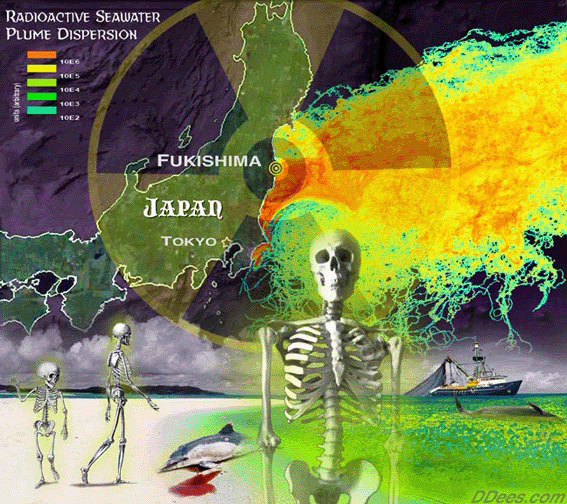
The Ongoing Fukushima Disaster http://pagosadailypost.com/2017/02/23/essay-the-ongoing-fukushima-disaster/ BY · FEBRUARY 23, 2017
The material of the melted cores, called corium, has sunk down into the earth below their shattered former containment vessels, and resides within the shallow water table below — which results in an ongoing flow of radioactive material pouring into the ocean. Apparently, there is no existing technological solution to this issue, and there are increasing measurements of radioactive material within the vast Pacific Ocean and all along the western coasts of the North and South American continents.
The Federal Government of the United States does not (publicly) monitor such radiation inflows, and therefore, any information about the contamination comes from various activities funded by crowd-source financing of various private and public-good organizations, etc.
This I find somewhat odd — in that the United States has, in recent days, deployed their radiation-sniffing jet to fly about over Europe in the hopes of identifying the source of highly abnormal radioactive particles of Iodine-131 that have been wafting about upon the winds since (apparently) early January 2017. At this moment, there is no explanation. So… we’ll deploy United States taxpayer resources to help track down the source of a European Iodine-131 leak — which, incidentally, has a half-life of about eight days — and will discuss the problem publicly … but we won’t (publicly) monitor our western coasts and air for an ongoing radiation catastrophe now six years old, emitting radioactive particles with half-lives of thousands of years. The Federal Government of the United States won’t even talk about it.
Is the idea (or attitude) then that since we have no ability to arrest or fix the unrelenting Fukushima poisoning of our planetary environment, that we will just not talk about or acknowledge it in a public way? Are we going to continue to buy the demonstrably false notion put forth by the U.S. government that the vast waters of the Pacific ocean will act to “dilute” the radioactive poison over time — when it is a scientific fact that radioactive particles are not “dilutable” and are, instead, cumulative?
Are we going to continue to disassociate the massive die-offs and poisoning of ocean life from the obvious source, the cumulative effects of Fukushima radiation? Are we going to continue to enjoy our seafood because the Federal Government says that the radioactive levels within it are “within safe limits”? Are we going to continue to label people like myself (of which there are many) as “conspiracy theorists” and uneducated alarmists who have been expressing concern over the Fukushima catastrophe since it occurred — people like me who know from objective observed and scientific fact that all is not well with what is going on (or not going on) at Fukushima?
Over the past few weeks, the Japanese have attempted to send their Scorpion robot into the damaged containment vessel areas. These attempts have resulted in the rapid destruction of these specially designed radiation-detecting robots — but not before measurements were made… reliable measurements, that indicate radiation leaking at 530 seiverts per hour. Such readings were described as “unimaginable.” Why? Because human death is likely at just 10 seiverts per hour of radiation exposure.
This is all current news — yet our national media and federal government will not investigate it, talk about it, or help in developing a strategy to defeat the problem. I would submit that the ongoing Fukushima environmental catastrophe is — by far — the most urgent danger to humanity that we face. This is not a localized Japanese problem — it is a world-wide environmental emergency that is getting worse every day.
If humanity does not have the current technology to defeat this problem, then we need to get our best and brightest minds together from across the world and develop technology to defeat it, immediately. It is absolutely unacceptable and irresponsible for the world to simply ignore what it going on — indeed, it is eventually suicidal. If President Trump does not begin to openly talk about the ongoing global emergency threat of Fukushima and advocate for a solution, then I, for one, will publicly part ways with him — on this issue alone.
There is no greater clear and present danger to the future of humanity and other life on this earth than the out-of-control Fukushima disaster. All other issues of debate and controversy are small potatoes in comparison. President Trump needs to rally support for an effective response on this—indeed, the sheer gravity of the destruction being done to the world provides a superb opportunity to bring together a truly unified global response to an issue that threatens humanity. Japan does not have the resources or technological ability to solve this problem by itself — and no individual nation does, or could. Just as if humanity found itself mortally in danger from a source beyond the Earth and would therefore unify to defeat it, so too must it view the Fukushima situation as a mortal danger to humanity from within.
If we get to work on the problem, I am absolutely confident that our human ingenuity and resourcefulness will defeat it. We are, in our human potentiality, that good — if we will only do it.
Solar power for 7,000 Railway Stations In India
7,000 Railways Stations In India To Go Solar https://cleantechnica.com/2017/02/21/7000-railways-stations-india-go-solar/ February 21st, 2017 by Saurabh Mahapatra Almost every railway station in India will soon be fed with solar power if the plans announced in India’s latest union budget are implemented.

The Indian Finance Minister Arun Jaitley announced that the 7,000 railway stations across the country will be fed with solar power as per the Indian Railways mission to implement 1,000 megawatts of solar power capacity. The minister made the announcement during the union budget speech on 1 February 2017.
The minister stated that work to set up rooftop solar power systems at 300 stations has already started, and soon this number will increase to 2,000 stations. According to data released by the Minister of Railways, India had 7,137 railway stations at the end of March 2015.
These rooftop solar power systems are expected to be implemented through developer mode, wherein the project developer will sign long-term power purchase agreement with Indian Railways.
In addition to rooftop solar power systems, the Indian Railways is expected to set up large-scale projects as well. Last year, it announced plans to launch a tender for 150 megawatts (MW) of rooftop systems. Late last year, it announced a partnership with the United Nations Development Programme (UNDP) to set up 5 gigawatts of solar power capacity.
The Indian Railways has managed to identify the solar power resource in two states so far — Gujarat and Rajasthan — where 25 MW of rooftop and 50 MW of ground-mounted capacity is to be commissioned in the first phase of the program. In the second phase, 60 MW of rooftop and 660 MW of ground-mounted capacity will be installed in nine other states. During the third phase, 400 MW of rooftop and 3,800 MW of ground-mounted capacity will be installed in the rest of the country.
Toshiba’s c rippling burden of its overseas nuclear business
 Overseas nuclear business a huge burden on Toshiba ,
  Japan News, February 22, 2017 By Miho Yokoi / Yomiuri Shimbun Staff Writer Toshiba Corp. has been facing a need to review its nuclear business because it has been a drag on the company’s reconstruction efforts, mostly caused by the huge loss booked in reactor building projects in the United States and construction delays in other countries.
Nonetheless, it will not be easy for the major electronics and machinery maker to considerably shrink its nuclear business overseas because there are only a handful of entities that can build such facilities.
Toshiba will likely book a loss of more than ¥700 billion for the April-December 2016 period, and U.S. subsidiary Westinghouse Electric Co. is a major factor behind the result…….
It is likely that Toshiba will face a ballooning loss if construction for the reactors [Plant Vogtle in Georgia, USA) continues to be delayed. “It would be a lie if we say there’s no risk at all,” said Corporate Vice President Mamoru Hatazawa.
Toshiba won contracts for building two reactors in Texas in 2009, but their construction has not yet started. The projects have been affected by the increase in the amount of U.S. shale gas production, which has caused fuel prices for thermal power generation to nosedive, thereby boosting needs for a method with cheaper running costs.
Meanwhile, Toshiba’s nuclear businesses in countries other than the United States have also been facing an uphill battle.
In China, for example, Westinghouse has undertaken construction of four nuclear reactors, originally with an aim to put them into operation between 2013 and 2015. However, none of them has been completed because of delays in the work.
The U.S. subsidiary also hoped to win contracts for developing six reactors in India, but the plan has been stalled because it is so risky for a builder to sign a contract under the current Indian law, which obliges the entity to assume liability for compensation in the event of a nuclear accident……..http://the-japan-news.com/news/article/0003536775
Nuclear station restart at Oi, Japan, approved – but local consent is needed

 Local consent needed despite OK to restart Oi nuclear plant, Asahi Shimbun February 23, 2017 The Nuclear Regulation Authority on Feb. 22 published a draft safety inspection report saying measures taken at the Nos. 3 and 4 reactors of Kansai Electric Power Co.’s Oi nuclear power plant in Fukui Prefecture meet the new stricter anti-disaster standards.
In 2014, however, the Fukui District Court ordered the operator to keep the two reactors offline, raising serious questions about their safety.
Some 160,000 people in Fukui, Kyoto and Shiga prefectures reside within 30 kilometers from the plant. It is also questionable whether local residents can be evacuated quickly and smoothly if a serious accident occurs at the plant.
In a recent Asahi Shimbun survey, 57 percent of the respondents expressed their opposition to the restart of offline nuclear reactors, nearly double the number of those who supported the idea.
Come next month, six years will have passed since the catastrophic accident broke out at the Fukushima No. 1 nuclear power plant. Many Japanese remain unconvinced of the safety of nuclear reactors.
Kansai Electric Power is hoping to bring the two reactors back on line as early as this summer. But we find it difficult to support the plan.
There are multiple faults around the Oi plant. The biggest worry cited in the district court ruling was the possibility that a stronger earthquake than assumed could seriously damage the reactors or the spent fuel pool.
The electric utility has since appealed the ruling. But the company has also raised the estimated maximum ground acceleration that could occur in an earthquake at the location.
The utility will spend 122 billion yen ($1.07 billion) on measures to enhance the safety of the plant.
But Kunihiko Shimazaki, a seismologist and former acting chairman of the NRA, has warned against the plan. Using observation data about the powerful earthquakes that hit areas around Kumamoto Prefecture in April last year, he has argued that the utility’s calculation method may have underestimated the biggest potential shaking of a quake at the location.
After reviewing the data, the NRA dismissed Shimazaki’s argument, with Chairman Shunichi Tanaka calling it “groundless.”
But the scientist’s warning has deepened anxiety among local residents.
The spent fuel pools at Kansai Electric Power’s three nuclear power plants including Oi are almost filled to the brim.
The utility says it will build an interim storage facility outside Fukui Prefecture around 2030 so that used fuel rods can be removed from the pools.
But the company has yet to map out a specific and workable plan to build such a facility…….http://www.asahi.com/ajw/articles/AJ201702230032.html
Smoke emerges at TEPCO’s Niigata nuclear plant

NIIGATA, Japan (Kyodo) — Smoke emerged at a service building of the Kashiwazaki-Kariwa nuclear power plant in Niigata Prefecture on Thursday but it quickly halted after a firefighting effort by workers, its operator said.
Tokyo Electric Power Company Holdings Inc. said there was no radiation leak in the incident. The utility has not identified the cause of the incident.
The plant operator confirmed smoke coming out around 3:25 p.m. from a locker room inside the service building, located near the No. 6 and No. 7 reactors at the plant. The building is not a radiation controlled area, according to the company.
The two reactors on the Sea of Japan coast are being screened by the Nuclear Regulation Authority as TEPCO is seeking to resume their operation after they were halted following the 2011 nuclear meltdowns at the Fukushima Daiichi power plant, also operated by TEPCO.
http://mainichi.jp/english/articles/20170223/p2g/00m/0dm/083000c
Governor likely to OK Sendai plant operation

The governor of Kagoshima in western Japan is expected to approve the continued operation of a nuclear plant in the prefecture. Experts have found no irregularities at the facility following last year’s strong earthquakes.
Governor Satoshi Mitazono had called for the operation of the Sendai nuclear plant to be suspended after a series of earthquakes centered in nearby Kumamoto Prefecture.
He noted public concern and also asked for an inspection of the plant.
Kyushu Electric Power Company officials rejected his call to halt operations, but they carried out a special inspection. They say they found the quakes caused no abnormalities.
Last Thursday, an expert panel set up by the prefecture also reported that the quakes left no effects on the plant.
Mitazono said on Wednesday that there is currently no need for strong measures against the plant. He said he will remain vigilant if troubles arise.
There were mixed reactions to Mitazono’s decision.
A man in his 70s says the governor may have found that he cannot prevail over the central government in his anti-nuclear battle. He says there was no other choice but to continue operating the plant.
A woman in her 30s says she wanted the governor to stick to the anti-nuclear policy he pledged in the campaign.
She says she wants him to ensure that Kagoshima is a place where children will be able to live safely, now and in the future.
113 Major Active Faults across Japan
Japan is located in the seismically active zone and that is where more than 10% of all earthquakes in the world. The ideal place to build many nuclear plants if you have a death wish!!!

16 locations in Kanto, Chugoku, Kyushu added to list of ‘major active faults’
The government’s Headquarters for Earthquake Research Promotion held a task-force meeting on Feb. 21 and decided to add 16 locations in the Kanto, Chugoku, and Kyushu regions to the list of “major active faults” that could cause heavy damage.
The decision is expected to help with regional disaster prevention efforts as the newly listed active faults will be subject to priority research to be conducted by the government and other relevant entities. The latest addition has brought the total number of locations listed as “major active faults” across the country to 113.
Detailed research had been conducted in the three regions ahead of other areas since 2013 to check the possibility of earthquakes occurring in each of the three regions. The number of major active faults could increase further as the headquarters is also planning to conduct similar research in other regions.
The newly added major active faults include: the Minobu fault straddling Yamanashi and Shizuoka prefectures; the Okubo fault in Gunma and Tochigi prefectures; the Shikano-Yoshioka fault in Tottori Prefecture; the Saga plain northern fault zone; and the Midorikawa fault zone in Kumamoto Prefecture. The Shinji fault, that stretches from east to west about 2 kilometers south of Chugoku Electric Power Co.’s Shimane Nuclear Power Plant in Matsue, was also added to the list.
Since the 1995 Great Hanshin Earthquake, the headquarters had designated active faults with high seismicity stretching at least 20 kilometers that could cause earthquakes with a magnitude of 7 or higher as major active faults.
However, in response to a series of major tremors such as the 2004 Chuetsu earthquakes caused by faults that had not been listed as major active faults, the headquarters has conducted survey research on active faults including non-listed faults. As a result, even some of those faults that were considered to fall short of meeting the criteria for being called major active faults have been added to the list.
Kojin Wada, an official of the Earthquake and Disaster-Reduction Research Division at the Education, Culture, Sports, Science and Technology Ministry, said, “We expect that the general public’s awareness of regional active faults is going to rise (with the latest addition to the list).”
http://mainichi.jp/english/articles/20170222/p2a/00m/0na/005000c
The Fukushima Daichi nuclear power complex is a continuing, permanent, catastrophe

 HELEN CALDICOTT: The Fukushima nuclear meltdown continues unabated https://independentaustralia.net/politics/politics-display/helen-caldicott-the-fukushima-nuclear-meltdown-continues-unabated,10019 3 February 2017, Dr Helen Caldicott, explains recent robot photos taken of Fukushima’s Daiichi nuclear reactors: radiation levels have not peaked, but have continued to spill toxic waste into the Pacific Ocean — but it’s only now the damage has been photographed.
RECENT reporting of a huge radiation measurement at Unit 2 in the Fukushima Daichi reactor complex does not signify that there is a peak in radiation in the reactor building.
All that it indicates is that, for the first time, the Japanese have been able to measure the intense radiation given off by the molten fuel, as each previous attempt has led to failure because the radiation is so intense the robotic parts were functionally destroyed.
The radiation measurement was 530 sieverts, or 53,000 rems (Roentgen Equivalent for Man). The dose at which half an exposed population would die is 250 to 500 rems, so this is a massive measurement. It is quite likely had the robot been able to penetrate deeper into the inner cavern containing the molten corium, the measurement would have been much greater.
These facts illustrate why it will be almost impossible to “decommission” units 1, 2 and 3 as no human could ever be exposed to such extreme radiation. This fact means that Fukushima Daichi will remain a diabolical blot upon Japan and the world for the rest of time, sitting as it does on active earthquake zones.
What the photos taken by the robot did reveal was that some of the structural supports of Unit 2 have been damaged. It is also true that all four buildings were structurally damaged by the original earthquake some five years ago and by the subsequent hydrogen explosions so, should there be an earthquake greater than seven on the Richter scale, it is very possible that one or more of these structures could collapse, leading to a massive release of radiation as the building fell on the molten core beneath. But units 1, 2 and 3 also contain cooling pools with very radioactive fuel rods — numbering 392 in Unit 1, 615 in Unit 2, and 566 in Unit 3; if an earthquake were to breach a pool, the gamma rays would be so intense that the site would have to be permanently evacuated. The fuel from Unit 4 and its cooling pool has been removed.
But there is more to fear.
The reactor complex was built adjacent to a mountain range and millions of gallons of water emanate from the mountains daily beneath the reactor complex, causing some of the earth below the reactor buildings to partially liquefy. As the water flows beneath the damaged reactors, it immerses the three molten cores and becomes extremely radioactive as it continues its journey into the adjacent Pacific Ocean.
Every day since the accident began, 300 to 400 tons of water has poured into the Pacific where numerous isotopes – including cesium 137, 134, strontium 90, tritium, plutonium, americium and up to 100 more – enter the ocean and bio-concentrate by orders of magnitude at each step of the food chain — algae, crustaceans, little fish, big fish then us.
Fish swim thousands of miles and tuna, salmon and other species found on the American west coast now contain some of these radioactive elements, which are tasteless, odourless and invisible. Entering the human body by ingestion they concentrate in various organs, irradiating adjacent cells for many years. The cancer cycle is initiated by a single mutation in a single regulatory gene in a single cell and the incubation time for cancer is any time from 2 to 90 years. And no cancer defines its origin.
We could be catching radioactive fish in Australia or the fish that are imported could contain radioactive isotopes, but unless they are consistently tested we will never know.
As well as the mountain water reaching the Pacific Ocean, since the accident, TEPCO has daily pumped over 300 tons of sea water into the damaged reactors to keep them cool. It becomes intensely radioactive and is pumped out again and stored in over 1,200 huge storage tanks scattered over the Daichi site. These tanks could not withstand a large earthquake and could rupture releasing their contents into the ocean.
But even if that does not happen, TEPCO is rapidly running out of storage space and is trying to convince the local fishermen that it would be okay to empty the tanks into the sea. The Bremsstrahlung radiation like x-rays given off by these tanks is quite high – measuring 10 milirems – presenting a danger to the workers. There are over 4,000 workers on site each day, many recruited by the Yakuza (the Japanese Mafia) and include men who are homeless, drug addicts and those who are mentally unstable.
There’s another problem. Because the molten cores are continuously generating hydrogen, which is explosive, TEPCO has been pumping nitrogen into the reactors to dilute the hydrogen dangers.
Vast areas of Japan are now contaminated, including some areas of Tokyo, which are so radioactive that roadside soil measuring 7,000 becquerels (bc) per kilo would qualify to be buried in a radioactive waste facility in the U.S..
As previously explained, these radioactive elements concentrate in the food chain. The Fukushima Prefecture has always been a food bowl for Japan and, although much of the rice, vegetables and fruit now grown here is radioactive, there is a big push to sell this food both in the Japanese market and overseas. Taiwan has banned the sale of Japanese food, but Australia and the U.S. have not.
Prime Minister Abe recently passed a law that any reporter who told the truth about the situation could be gaoled for ten years. In addition, doctors who tell their patients their disease could be radiation related will not be paid, so there is an immense cover-up in Japan as well as the global media.
The Prefectural Oversite Committee for Fukushima Health is only looking at thyroid cancer among the population and by June 2016, 172 people who were under the age of 18 at the time of the accident have developed, or have suspected, thyroid cancer; the normal incidence in this population is 1 to 2 per million.
However, other cancers and leukemia that are caused by radiation are not being routinely documented, nor are congenital malformations, which were, and are, still rife among the exposed Chernobyl population.
Bottom line, these reactors will never be cleaned up nor decommissioned because such a task is not humanly possible. Hence, they will continue to pour water into the Pacific for the rest of time and threaten Japan and the northern hemisphere with massive releases of radiation should there be another large earthquake.
Global nuclear catastrophe waits in the wings, as Japan plans for Olympics
Fukushima: a Lurking Global Catastrophe? http://nation.com.pk/international/21-Feb-2017/fukushima-a-lurking-global-catastrophe Robert Hunziker – Year over year, ever since 2011, the Fukushima Daiichi nuclear meltdown grows worse and worse, an ugly testimonial to the inherent danger of generating electricity via nuclear fission, which produces isotopes, some of the most deadly poisonous elements on the face of the planet.
As it happens, “”inventing technology” is experimental stage stuff. Still, there are several knowledgeable sources that believe the corium, or melted core, will never be recovered. Then what?
According to a recent article, “Potential Global Catastrophe of the Reactor No. 2 at Fukushima Daiichi,” d/d Feb. 11, 2017 by Dr. Shuzo Takemoto, professor, Department of Geophysics, Graduate School of Science, Kyoto University: The Fukushima nuclear facility is a global threat on level of a major catastrophe.
Meanwhile, the Abe administration dresses up Fukushima Prefecture for the Tokyo 2020 Olympics, necessitating a big fat question: Who in their right mind would hold Olympics in the neighborhood of three out-of-control nuclear meltdowns that could get worse, worse, and still worse? After all, that’s the pattern over the past 5 years; it gets worse and worse. Dismally, nobody can possibly know how much worse by 2020. Not knowing is the main concern about holding Olympics in the backyard of a nuclear disaster zone, especially as nobody knows what’s happening. Nevertheless and resolutely, according to PM Abe and the IOC, the games go on.

“A short-term, whole-body dose of over 10 sieverts would cause immediate illness and subsequent death within a few weeks, according to the World Nuclear Association” (Emi Urabe, Fukushima Fuel-Removal Quest Leaves Trail of Dead Robots, The Japan Times, Feb. 17, 2017).
Although Fukushima’s similar to Chernobyl Exclusion Zone in some respects, where 1,000 square miles has been permanently sealed off, Fukushima’s different, as the Abe administration is already repopulating portions of Fukushima. If they don’t repopulate, how can the Olympics be held with food served from Fukushima and including events like baseball held in Fukushima Prefecture?
Making matters worse yet, Fukushima Diiachi sets smack dab in the middle of earthquake country, which defines the boundaries of Japan. In that regard, according to Dr. Shuzo Takemoto, professor, Department of Geophysics, Graduate School of Science, Kyoto University: “The problem of Unit 2… If it should encounter a big earth tremor, it will be destroyed and scatter the remaining nuclear fuel and its debris, making the Tokyo metropolitan area uninhabitable. The Tokyo Olympics in 2020 will then be utterly out of the question,” (Shuzo Takemoto, Potential Global Catastrophe of the Reactor No. 2 at Fukushima Daiichi, February 11, 2017).
Accordingly, the greater Tokyo metropolitan area remains threatened for as long as Fukushima Diiachi is out of control, which could be for generations, not years. Not only that, Gee-Whiz, what if the big one hits during the Olympics? After all, earthquakes come unannounced. Regrettably, Japan has had 564 earthquakes the past 365 days. It’s an earthquake-ridden country. Japan sits at the boundary of 4 tectonic plates shot through with faults in zigzag patterns, very lively and of even more concern, the Nankai Trough, the candidate for the big one, sits nearly directly below Tokyo. On a geological time scale, it may be due for action anytime within the next couple of decades. Fukushima Prefecture’s not that far away.
Complicating matters further, the nuclear site is located at the base of a mountain range. Almost daily, water flows from the mountain range beneath the nuclear plant, liquefying the ground, a sure-fire setup for cascading buildings when the next big one hits. For over five years now, radioactive water flowing out of the power plant into the Pacific carries isotopes like cesium 134 and cesium 137, strontium 90, tritium, plutonium americium and up to 100 more isotopes, none of which are healthy for marine or human life, quite the opposite in fact as those isotopes slowly cumulate, and similar to the Daleks of Doctor Who fame (BBC science fiction series, 1963-present) “Exterminate! Exterminate! Exterminate!”
Isotopes bio-concentrate up the food chain from algae to crustaceans to small fish to big fish to bigger humans. Resultant cancer cells incubate anytime from two years to old age, leading to death. That’s what cancer does; it kills.
Still, the fact remains nobody really knows for sure how directly Fukushima Diiachi radiation affects marine life, but how could it be anything other than bad? After all, it’s a recognized fact that radiation cumulates over time; it’s tasteless, colorless, and odorless as it cumulates in the body, whether in fish or further up the food chain in humans. It travels!
An example is Cesium 137 one of the most poisonous elements on the planet. One gram of Cesium 137 the size of a dime will poison one square mile of land for hundreds of years. That’s what’s at stake at the world’s most rickety nuclear plant, and nobody can do anything about it. In fact, nobody knows what to do. They really don’t.
The Fukushima nuclear meltdown presents a special problem for the world community. Who knows what to believe after PM Abe lied to the IOC to get the Olympics; see the following headline from Reuters News: “Abe’s Fukushima ‘Under Control’ Pledge to Secure Olympics Was a Lie: Former PM,” Reuters, Sept. 7, 2016.– COUNTERPUNCH
“Abe gave the assurances about safety at the Fukushima plant in his September 2013 speech to the International Olympic Committee to allay concerns about awarding the Games to Tokyo. The comment met with considerable criticism at the time… Mr. Abe’s ‘under control remark, that was a lie,’ Koizumi (former PM) now 74 and his unruly mane of hair turned white, told a news conference where he repeated his opposition to nuclear power,” Ibid.
As such, a very big conundrum precedes the 2020 games: How can the world community, as well as Olympians, believe anything the Abe administration says about the safety and integrity of Fukushima?
Still, the world embraces nuclear power more so than ever before as it continues to expand and grow. Sixty reactors are currently under construction in fifteen countries. In all, 160 power reactors are in the planning stage and 300 more have been proposed. Pro-Nuke-Heads claim Fukushima proves how safe nuclear power is because there are so few, if any, deaths, as to be inconsequential. That’s a boldfaced lie.
Opposition to nuclear power grows, in China
As the plans circulated online, opposition to the plan appeared to be mounting in the wake of Chinese public reaction to rising radiation levels at the crippled Fukushima nuclear plant in Japan.
“Last year, 100,000 people took to the streets of Lianyungang in protest against a nuclear power plant there, and they successfully blocked [its] construction”
The growing concerns over China’s nuclear power program came as the Hong Kong-listed arm of a state-owned nuclear power company announced further delays to controversial reactors at Taishan in the southern province of Guangdong.
 Plans to Build Four New Nuclear Power Plants in China’s Henan Spark Outcry, Radio Free Asia, 21 Feb 17 Reported by Ding Wenqi for RFA’s Mandarin Service, and by Goh Fung for the Cantonese Service. Translated and edited by Luisetta Mudie. Plans by authorities in the central province of Henan to move ahead with four new nuclear power stations in the wake of the Fukushima disaster have sparked growing public fears in China.
In a directive dated Jan. 25, the provincial government was ordered to move ahead with the implementation of power generation plans that include new nuclear reactors at Nanyang, Xinyang, Luoyang and Pingdingshan, according to a statement on its official website.
“[We must make] steady progress with preliminary work for nuclear power projects,” the statements said. “We must complete onsite protection work for nuclear power projects at Nanyang, Xinyang and the other nuclear power projects,” it said. “We should proceed with the planning and construction of inland nuclear power projects on behalf of our country, and strive to continue to be included in the national nuclear long-term development plan,” the directive said.
It called on government departments to “strengthen public awareness of nuclear power projects, nuclear power project planning and construction to create a good atmosphere.”
As the plans circulated online, opposition to the plan appeared to be mounting in the wake of Chinese public reaction to rising radiation levels at the crippled Fukushima nuclear plant in Japan.
“An old issue in Japan has sent ripples across the East China Sea to shake China,” the Global Times newspaper, the sister paper of ruling Chinese Communist Party mouthpiece The People’s Daily, reported.
“The news has been traveling fast on the Chinese internet … Many Chinese became worried, some even canceling their trips to Japan,” the paper said.
A resident surnamed Li of Henan’s Anyang city told RFA that the news is causing great concern among local people.
“I am extremely worried about this; they definitely shouldn’t go ahead with building them,” Li said. “I heard the pollution from nuclear plants is very serious.”
“I expect there to be a public outcry in Anyang and in Henan about the plans to build nuclear power stations.”
Chernobyl fears
While one resident of Luoyang said they hadn’t heard of the plans, another Henan resident Yang Chunxia, hit out at the plans online.
“Last year, 100,000 people took to the streets of Lianyungang in protest against a nuclear power plant there, and they successfully blocked [its] construction,” Yang wrote.
“The whole of Eastern Europe was polluted by the Chernobyl nuclear disaster in 1983,” the user added. “Now, they’ve got their eye on Henan. What will Henan people do about it? Please, everyone who lives in Henan, please pass this on!”
Meanwhile, authorities in Anyang detained local resident Wang Shoufeng for five days’ administrative detention for “making things up to disrupt public order” after he posted on social media in a similar vein.
Wang told RFA on Tuesday that he was innocent.
“I don’t believe that I did anything to disrupt public order,” he said. “A lot of people here in Henan want the government to go public with the information on this, and clarify whether they are planning to go ahead with it.”
“We want to understand everything about this and to catch the attention of as many people as possible.”
Wang’s friend Feng Lei said local people have a right to know about the dangers of nuclear power.
“They had that huge nuclear leak in Japan, and people here in Henan want a safe environment for their children and grandchildren to live in,” Feng said.
“They will be pushing for that.”
Repeated calls to the Henan provincial government offices rang unanswered during office hours on Tuesday.
Iitate village in Fukushima prefecture radioactively contaminated
 Greenpeace exposes high radiation risks in Fukushima village as govt prepares to lift evacuation order http://www.newkerala.com/news/fullnews-228867.html Tokyo/ New Delhi, Feb 21 : The Japanese government will soon lift evacuation orders for 6,000 citizens of Iitate village in Fukushima prefecture where radiation levels in nearby forests are comparable to the current levels within the Chernobyl 30km exclusion zone – an area that more than 30 years after the accident remains formally closed to habitation.
The relatively high radiation values, both inside and outside houses, show an unacceptable radiation risk for citizens if they were to return to Iitate. Citizens returning to their irradiated homes are at risk of receiving radiation equivalent to one chest X-ray every week. This is not normal or acceptable, said Ai Kashiwagi, energy campaigner with Greenpeace Japan .
As Japan nears the six year anniversary of the nuclear disaster, the Japanese government last week confirmed that it has not yet conducted any assessments of lifetime exposure risks for citizens if they were to return to Iitate.
Life can never go back to normal for people living near nuclear power plants. But clearly, the world has failed to learn its lessons from nuclear accidents like those in Chernobyl and Fukushima. India, for instance, seems determined to add on to its nuclear power capacity despite putting the lives of millions of people at risk, says Nandikesh Sivalingam, climate and energy campaigner, Greenpeace India.
The fact remains that nuclear power is neither safe nor economical, and that India is grossly ill-prepared to handle a nuclear disaster. This was pointed out by Red Alert, a Greenpeace India report that released last year.
Last years Indo-Japan nuclear deal also negated the lessons learnt from Fukushima.
Greenpeace India stand by the victims of Fukushima who are being forced to return to the accident site for economic reasons. India must learn from the Fukushima disaster and its long lasting impacts on peoples lives and livelihoods and move away permanently from highly risky and economically unviable nuclear energy to safer, greener and cheaper energy sources like solar and wind.
Greenpeace has launched a public petition in solidarity with the Fukushima survivors campaigning for the restitution/protection of their human rights.
China stalls in its push for nuclear power
China Nuclear Push Stalled by Next-Generation Reactors, Bloomberg, by Stephen Stapczynski and Aibing Guo, February 21, 2017,
-
Aims to approve eight new nuclear reactor projects this year
-
CGN’s Taishan units see further delay in commercial operations
China’s decision to approve its first new nuclear reactors in two years may need to wait for its success starting up the world’s first next-generation units.
Plans to green-light eight reactors this year in the world’s fastest-growing nuclear market, announced last week, could depend on whether it’s able to complete some of the world’s most-advanced facilities, including Westinghouse Electric Co.’s AP1000 and Areva SA’s EPR. The first such reactors may come online as early as the first half, followed by new approvals, according to Karl Liu, an analyst at BOC International Holdings Ltd. in Hong Kong.
“There are indications that Chinese policy makers want to wait for the AP1000s and EPRs under construction to come online and see how they do operationally before approving new projects,” said M.V. Ramana, a professor at the University of British Columbia. “I am not entirely sure that this plan will actually translate into reality.”
China is seeking to be the first country to bring online either an AP1000 or EPR, so-called generation III+ reactors, which have suffered costly delays in the U.S. and Europe. The world’s second-biggest economy, and largest energy consumer, is aiming to boost its nuclear power capacity and develop its own next-generation technology for export.
Construction delays for third-generation units are among reasons the Chinese government approved no new reactors last year, according to BOC’s Liu.
“The country wants to wait until the first AP1000 reactor successfully starts commercial operations before approving reactors using the same or similar technologies,” he said. …….
Originally designed to be cheaper and safer than earlier technology, growing complexity and new safety requirements of third-generation reactors are among cost issues that contributed to Westinghouse’s parent company Toshiba Corp. taking a multi-billion dollar writedown this year and Areva seeking a government bailout.
Oversupply
China’s power-generation overcapacity is another possible risk to new approvals, according to Ramana at the University of British Columbia. The country began showing signs of a glut as early as 2013, and hit a high in 2015, according to IHS Markit…….https://www.bloomberg.com/news/articles/2017-02-20/china-nuclear-ambitions-seen-stalled-by-next-generation-reactors
Pakistan and India have agreed to extend their bilateral nuclear safety agreement


 Pakistan, India extend nuclear safety agreement, By Our Correspondent, Express Tribune, February 21, 2017 ISLAMABAD: Pakistan and India have agreed to extend their bilateral agreement on reducing the risk from accidents relating to nuclear weapons in a move suggesting the two rivals are still mindful of nuclear dangers despite currently strained ties.
The key agreement was extended for the next five years (2017-2022), said a statement issued by the Foreign Office on Tuesday.
The agreement came into force in 2007. It was subsequently extended for a period of five years in 2012. The accord is part of the nuclear confidence building measures agreed between Pakistan and India. The aimed of the agreement is to promote a stable environment of peace and security between the two countries, reads the official handout.
“It is premised on the recognition that the nuclear dimension of the security environment of the two countries adds to their responsibility for avoidance of conflict,” the statement added.
The agreement provides for immediate exchange of information between the two countries in the event of any accident relating to nuclear weapons, under their respective jurisdiction and control, which could create the risk of radioactive fallout, with adverse consequences for both sides, or create the risk of an outbreak of a nuclear war…….https://tribune.com.pk/story/1334606/pakistan-india-extend-nuclear-safety-agreement/
1 This Month




PLEASE OPPOSE HR 8255 AND S.3639 – bills would accelerate satellite deployment, with no environmental review or safeguards – https://ncstd5li.quorum.us/campaign/169331/
To see nuclear-related stories in greater depth and intensity – go to https://nuclearinformation.wordpress.com
-
Archives
- September 2026 (339)
- August 2026 (330)
- July 2026 (355)
- June 2026 (287)
- May 2026 (306)
- April 2026 (356)
- March 2026 (251)
- February 2026 (267)
- January 2026 (308)
- December 2025 (358)
- November 2025 (359)
- October 2025 (375)
-
Categories
- 1
- 1 NUCLEAR ISSUES
- business and costs
- climate change
- culture and arts
- ENERGY
- environment
- health
- history
- indigenous issues
- Legal
- marketing of nuclear
- media
- opposition to nuclear
- PERSONAL STORIES
- politics
- politics international
- Religion and ethics
- safety
- secrets,lies and civil liberties
- spinbuster
- technology
- Uranium
- wastes
- weapons and war
- Women
- 2 WORLD
- ACTION
- AFRICA
- Atrocities
- AUSTRALIA
- Christina's notes
- Christina's themes
- culture and arts
- Events
- Fuk 2022
- Fuk 2023
- Fukushima 2017
- Fukushima 2018
- fukushima 2019
- Fukushima 2020
- Fukushima 2021
- general
- global warming
- Humour (God we need it)
- Nuclear
- RARE EARTHS
- Reference
- resources – print
- Resources -audiovicual
- Weekly Newsletter
- World
- World Nuclear
- YouTube
-
RSS
Entries RSS
Comments RSS

