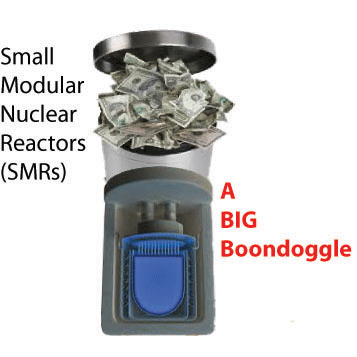
Forgotten Fact: Russia and China Almost Started a Nuclear War in 1969, National Interest, Kyle Mizokami, 2 Jul 17, In 1969 the two pillars of the communist bloc, the Soviet Union and the People’s Republic of China, nearly went to full-scale war. Years of deteriorating ties between the two countries, once the staunchest of allies, finally led to skirmishing on the long mutual border between the two countries. While tensions were eventually de-escalated, what if the two countries had gone to war?
On March 2, 1969 Soviet troops patrolling Damansky Island (Zhenbao) on the Ussuri River came under fire from Chinese troops. The attack, just 120 miles from the major Soviet city of Khabarovsk, killed fifty Soviet troops and wounded many more. The Moscow believed that the attack was premeditated, with Beijing bringing in a special combat unit to ambush Soviet forces. Alleged atrocities against wounded Soviet troops made the Soviet leadership furious.
Soviet border guards counterattacked Chinese forces in and around the island on March 15,
according to the CIA killing “hundreds” of Chinese troops. Clashes continued through the spring and summer, and by August, CIA director Richard Helms had informed the press that the Soviet leadership had been discreetly inquiring with foreign governments about their opinion on a preemptive strike on China………
The de-escalation of the Sino-Soviet crisis in 1969 avoided what could have been yet another large, destructive war of the twentieth century. The current friendship between Moscow and Beijing is a reflection of that crisis and the realization that it’s much better for both countries to be allies than enemies. This is particularly in Moscow’s interests: given Beijing’s rapid military and economic progress over the past thirty years, next time, the Kremlin may find the tables turned. http://nationalinterest.org/blog/the-buzz/forgotten-fact-russia-china-almost-started-nuclear-war-1969-21398
July 3, 2017
Posted by Christina Macpherson |
China, history, Russia, weapons and war |
Leave a comment

As a reminder a transport of 16 assemblies of MOX (between 8 and 10 tons) is being prepared.
This MOX is destined for the nuclear reactor of Takahama n ° 4.
The Pacific Egret and the Pacific Heron, “armed to the teeth” are on the departure of Barrow-In-Furness in England to come to Cherbourg.
The transfer of brand new trucks (equipped with shielding type protection) loaded with MOX will take place late on Tuesday evening.
The loading will take place on Wednesday 5th (as I had announced a few weeks ago at the meeting of the CLI Areva de La Hague) in the morning at the Quai des Mielles and the boats should leave the port of Cherbourg in the evening.
Source: Yannick Rousselet – Greenpeace France

July 1, 2017
Posted by dunrenard |
Japan | Mox Fuel, Takahama N°4 |
Leave a comment
 Rosatom to build Nuclear Technology Centre in Vietnam http://russianconstruction.com/news-1/28150-rosatom-to-build-nuclear-technology-centre-in-vietnam.html 29.06.2017 Rosatom State Atomic Energy Corporation and the Ministry of Science and
  Technology of Vietnam will create a Center of Nuclear Science and Technology in Vietnam, as it follows from documentation published on the Kremlin’s website.
“The Memorandum of understanding between Rosatom State Atomic Energy Corporation and the Ministry of Science and Technology of the Socialist Republic of Vietnam on a plan of the implementation of a project for construction Nuclear Science and Technologies Center in Vietnam”, the document reads.
The announcement came following a meeting of Russian President Vladimir Putin and President of Vietnam Tran Dai Quang.
July 1, 2017
Posted by Christina Macpherson |
marketing, Russia, Vietnam |
1 Comment
No Indonesian market for SMRs http://thebulletin.org/no-indonesian-market-smrs10868 28 June 17, M. V. RAMANA Ramana is the Simons Chair in Disarmament, Global and Human Security at the Liu Institute for Global…
In May 2017,
Indonesia’s government announced that Russia’s Rosatom State Atomic Energy Corporation had offered to develop nuclear power plants in Indonesia. But the person making the announcement, Luhut Pandjaitan—the coordinating maritime affairs minister—said he had told them that Indonesia was not ready yet because “we need to raise public awareness, which takes time.”
Saying it “takes time” is an understatement. The country’s National Nuclear Energy Agency, or BATAN as it is known from its acronym in the Indonesian language (Badan Tenaga Nuklir Nasional), was set up in the late 1950s and has been advocating nuclear power for Indonesia ever since. In 1972, BATAN started the process of selecting specific sites for nuclear plants when—in conjunction with the ministry in charge of public works and electricity—it established the Preparatory Commission for Development of a Nuclear Power Plant. That eventually led to various sites being chosen for nuclear plant construction on the Muria Peninsula on Indonesia’s most populated island, Java. But in each case, these efforts were stopped—primarily by local opposition, but partly also because of widespread skepticism about BATAN’s claims about the seismic safety of sites on the peninsula.
BATAN then turned its attention to other locations in the country, but with little success. To date, BATAN has conducted site studies on at least 16 potential locales.
BATAN’s efforts at setting up a nuclear power plant in Indonesia have not gone unnoticed. Many reactor vendors have beaten a path to Jakarta’s doorstep, hoping to sell their wares. The list includes South Korea, France, China and, of course—given its status as the leading reactor vendor in this decade—Russia. In recent years, all these countries’ offers have focused on one specific kind of reactor that BATAN has expressed an interest in: Small Modular Reactors (SMRs).
Why SMRs for Indonesia? Small Modular Reactors have electrical power outputs of less than 300 megawatts. They are being heavily promoted by many countries’ nuclear establishments as having several desirable characteristics when compared to traditional large reactors—in particular, cheaper construction costs per unit, higher safety levels, lower rates of radioactive waste generation, and less likelihood that these reactors and their fuel production facilities could be used to make fissile materials (plutonium or highly enriched uranium) for nuclear weapons. There are no operating SMRs, and it remains to be seen whether any real-world reactor would be built that features any, let alone all, of these characteristics. Indeed, of the different major SMR designs under development, none simultaneously fulfills the key requirements of lower cost, higher safety, less radioactive waste, and reduced opportunity for nuclear weapons proliferation. These are the key problems confronting nuclear power today and constraining its future. It is likely that addressing one or more of these four problems will involve design choices that make some of the other problems worse.
Among the target markets for such reactors are developing countries such as Indonesia. The International Atomic Energy Agency considers SMRs as a good option to electrify “remote regions with less developed infrastructures” because the low-capacity electricity grid that is typical of such areas makes it difficult to introduce a nuclear power plant with large power capacity—say 1,000 megawatts—without destabilizing the grid itself. Indeed, one of the reasons that BATAN claims to be interested in SMRs is that there are many islands in the Indonesian archipelago that require electricity or energy but do not have a high enough level of electrical demand to support the construction of a large nuclear reactor. One of the areas highlighted by BATAN officials as particularly suitable for SMRs is the province of West Kalimantan because its “grid capacity [is]… still limited.” BATAN also suggested that an attractive aspect of SMRs is the lower cost—due in large part to the fact that a small modular reactor will generate only a fraction of the power generated by a large reactor.
Among the SMR designs that have been offered by vendors, and explored by BATAN, are high temperature gas-cooled reactors, submarine-based reactors, floating power plants, and light water reactors.
Who’s in the competition? South Korea was the first to pitch the idea of SMRs to Indonesia: In October 2001, with IAEA approval, BATAN signed an agreement with the Korea Atomic Energy Research Institute to undertake a joint study titled “A preliminary economic feasibility assessment of nuclear desalination in Madura Island.” The Korea Atomic Energy Research Institute had been developing a small modular reactor called the System-Integrated Modular Advanced Reactor since 1996; it had the bonus feature of incorporating additional equipment that could desalinate water in addition to generating electricity.
In the case of China, BATAN signed an agreement with the China Nuclear Engineering Group Corporation in 2016 to jointly develop high temperature gas reactors and train Indonesian professionals to run them—an agreement that resulted from Chinese officials scouting around potential reactor markets.
With France, BATAN signed an agreement with DCNS, a company that has traditionally been involved in a range of naval defense systems but more recently has been developing a submarine-based electricity generating reactor project called Flexblue. (Link in Indonesian.) The idea is to park the submarine on the ocean floor and run a cable from it to land to supply electricity.
Russia, however, has been the most determined suitor. In the mid-2000s, Rosatom proposed a small Russian floating nuclear power plant to supply electricity to Gorontalo province on the Indonesian island of Sulawesi. Rosatom’s floating nuclear power plants are modeled after the reactors that have been used to power a small fleet of Russian nuclear-powered icebreakers for decades. The idea of a civilian floating nuclear power plant project has been around in Russia since the 1990s, but progress has been slow and erratic. China and the United States have also explored the idea of commercial floating nuclear power plants, but the United States abandoned the idea as uneconomical after spending millions of dollars in research and development.
In October 2006, the governor of Gorontalo announced that the province already had an agreement with Russia’s then state-owned Unified Energy System of Russia to buy a floating power plant.
But despite enthusiasm for the proposal from the provincial government, the Indonesian minister of Research and Technology rejected the idea of using a floating nuclear power plant. As Natio Lasman, then-deputy chairman of Indonesia’s nuclear agency and later chair of Indonesia’s Nuclear Regulatory Agency, told the Wall Street Journal: “I don’t want Indonesia to be used as an experiment.”
Public opposition: A major problem. Many problems may afflict nuclear proposals, regardless of whether the building plans are based on SMRs or large reactors. A key challenge has been public acceptance. Because of the potential for catastrophic accidents and the production of long-lived radioactive waste, nuclear power is perceived as a risky technology, and those living near areas selected to house a nuclear plant—such as the Muria Peninsula—often push back.
And apart from local opposition, the unpopularity of nuclear power among the general population nationwide is often a factor in whether a country develops nuclear power. A poll commissioned by the International Atomic Energy Agency in October 2005 found that only 33 percent of those Indonesians questioned felt that nuclear power was safe and that more plants should be built. In comparison, 28 percent felt that nuclear power was dangerous and all plants should be closed—while 31 percent agreed with the “middle opinion” that what was already in place should be used but that no new plants should be constructed. In the case of Indonesia, of course, that middle opinion is in practice the same as the 28 percent who wanted to close all reactors, because there was (and still is) no operating nuclear power plant in the country.
In 2011, an IPSOS poll conducted after the Fukushima nuclear reactor accident in Japan found that two-thirds of the Indonesian population expressed opposition: 33 percent of Indonesians strongly oppose nuclear power while 34 percent were somewhat opposed. About two-thirds of those polled said that their opinion was not influenced by Fukushima.
BATAN, not surprisingly, feels differently. And it has conducted a series of polls that show greater levels of support. But the proof of the pudding is in the eating. Nuclear power continues to be controversial in Indonesia, and there is widespread public opposition. Indeed, in December 2015, when then-Energy and Mineral Resources minister Sudirman Said publicly announced that the government had concluded that “this is not the time to build up nuclear power capacity,” one of his stated reasons for avoiding nuclear power was that he did not want “to raise any controversies.”
So, when people like Luhut Pandjaitan—Indonesia’s coordinating maritime affairs minister—talk about the “need to raise public awareness,” it’s reasonable to ask what they mean. Is raising public awareness really just code for coaxing or bribing the people in some areas to allow the construction of a nuclear power plant? The history of the many attempts to site nuclear reactors in Indonesia shows quite clearly that the public is already aware of the hazards involved in nuclear power. The Indonesian public’s longstanding opposition to nuclear power, especially in areas that have been earmarked for potential construction, include concerns about the security of reactor operations, the reliability of reactor designs, radioactive waste, the potential for nuclear proliferation, Indonesia’s geographical position within the seismically active Pacific Ring of Fire, and the proximity of nuclear sites to seismic faults or volcanoes. Many Indonesians are also concerned about nuclear power’s high economic costs and future dependence on foreign parties for nuclear technology or fuel, and they prefer local renewable energy resources.
 Other problems with SMRs. My collaborators at the Indonesian Institute of Energy Economics and at the Nautilus Institute for Security and Sustainability and I recently issued a report that detailed the many challenges that would have to be overcome before any small modular reactors are constructed in Indonesia. These challenges include a lack of support for nuclear power at the highest political levels, the absence of tested SMR designs, and the higher electricity-generation costs of SMR technology. We also identified legislative regulations that could become obstacles for specific SMR technologies such as floating power plants, and the political and regulatory problems with SMR construction plans that involve fabricating the bulk of the reactor at off-site factories.
The cost of electricity generated by SMRs is high compared to large conventional nuclear power plants, and high compared to the range of readily available alternatives in Indonesia. The rapidly declining cost of photovoltaic technology is particularly relevant. Studies testify to the large potential of solar energy in Indonesia, and the government has been adopting policies that promise to accelerate the construction of significant amounts of solar capacity.
The lower power level of SMRs also implies that more reactors would have to be built using this technology to produce the same amount of electricity as a few larger reactors—meaning that planners would have to deal with public resistance at many more sites. Public opposition has played a major role in stopping the construction of nuclear power plants so far; small modular reactors might face even more of controversy.
For small modular reactors, the potential benefits accruing from electricity generation come at a higher economic and social cost than other energy sources would require. As a result, it would seem that the construction of SMRs is unlikely, especially in large enough numbers to make a sizeable contribution to Indonesia’s electricity generation.
July 1, 2017
Posted by Christina Macpherson |
Indonesia, marketing, Russia, technology |
Leave a comment
BFM TV 29th June 2017 [Machine Translation] The manufacturing defects encountered in France also
exist on the two reactors of Taishan, in the south-east of China. The
decision of the nuclear safety authority prompts China to emulate it.
Barely the problem of Flamanville settled, the looks turn to China. The CGN
industrialist built in Taishan, in the south-east of the country, two EPRs
with EDF. These two tanks were manufactured in France, in the factory of Le
Creusot, like those of Flamanville. And obviously have the same
manufacturing defects.
“The same parts are concerned and have been
manufactured with the same process, explained the ASN president,
Pierre-Franck Chevet, but it is the responsibility of the Chinese to
decide. For two years, they have been associated with all the tests and
works of the French authority. On Monday and Tuesday, the representatives
of the Chinese authority and the industrialist CGN were in Paris to follow
the conclusions on the Flamanville EPR. They will have to decide whether
they also impose changes to the lids of the Taishan EPRs. These two
reactors must start between the end of 2017 and the end of 2018.
http://bfmbusiness.bfmtv.com/entreprise/apres-flamanville-la-surete-des-epr-chinois-en-question-1197282.html
July 1, 2017
Posted by Christina Macpherson |
China, safety |
Leave a comment
THE ASAHI SHIMBUN June 29, 2017 SHIZUOKA–The re-elected governor here has given an emphatic “No” to the question of whether the Hamaoka nuclear power plant, often described as the most dangerous facility of its kind in Japan, should be restarted.
Heita Kawakatsu declared his opposition to the planned restart at a news conference June 27, two days after he was re-elected for a third term as governor……
At his own news conference, Kawakatsu said there are no signs that the Hamaoka plant will resume operations during the coming four years of his term in office. “I will definitely oppose the restart if there is any move to bring it online,” he said.
He cited danger in the event of an accident and the utility’s limited reliance on nuclear power generation as reasons for his objection. ….
The Hamaoka plant has been described as the most dangerous nuclear plant in Japan because of its proximity to a long-anticipated huge earthquake under the Nankai Trough off the prefecture. http://www.asahi.com/ajw/articles/AJ201706290045.html
July 1, 2017
Posted by Christina Macpherson |
Japan, politics |
Leave a comment

 Nuclear experts warn of a march to war with North Korea, Salon,com Ex-nuclear commanders from around the world are urging Trump to engage in talks with North Korea instead, MATTHEW ROZSA, 29 June 17, A group of ex-nuclear commanders issued a strong warning on Wednesday that pointed out the world is at the precipice of a potential nuclear war, and urged America to open up dialogue with North Korea.
Hailing from China, India, Pakistan, Russia and the United States, the Nuclear Crisis Group determined “that the risk of nuclear weapons use, intended or otherwise, is unacceptably high and that all states must take constructive steps to reduce these risks.” They called on the United States and NATO to establish military-to-military talks with Russia and recommended that India and Pakistan set up a nuclear hotline.
The group was created earlier in 2017 with the approval of Global Zero, an arms control group that ultimately wants to abolish nuclear weapons.
The letter came as H. R. McMaster, President Donald Trump’s national security adviser, told reporters during a security conference with Homeland Security Chief John Kelly on Wednesday that “the [North Korean] threat is much more immediate now and so it’s clear that we can’t repeat the same approach – failed approach of the past.”…. http://www.salon.com/2017/06/29/nuclear-experts-warn-of-a-march-to-war-with-north-korea/
June 30, 2017
Posted by Christina Macpherson |
North Korea, politics international, USA |
Leave a comment
 Kepco confirms talks with Toshiba over UK nuclear — but only with its own reactors, Telegraph Jillian Ambrose 28 JUNE 2017 South Korea’s largest power company is in talks with Toshiba to prop up its plans to build Europe’s largest new nuclear plant in the UK.
Jong-hyuck Park, an executive from Kepco, confirmed the group’s interest in buying a stake of the embattled Moorside nuclear project on the sidelines of an industry event, but said Kepco would want to use its own reactor design.
The South Korean state-backed utility is one of the world’s strongest nuclear developers and has harboured an interest in Moorside since 2013. Its appetite for a UK nuclear project was revived following the collapse of Toshiba’s US nuclear business, Westinghouse, which was supposed to provide the reactor design for the project.
A deal with Toshiba, the last remaining group behind the NuGeneration venture, could rescue the £10bn project. But a change in reactor design would also derail the 2025 start date by at least two years in a further blow to the UK’s new nuclear ambitions.
Earlier this week a French newspaper reported that EDF’s internal review of the Hinkley Point C new nuclear plant is expected to show a €3bn (£2.6bn) overspend and a two year delay, which would also push the start-date back to 2027.
The slow progress in securing new investment in baseload power generation raises questions over the UK’s energy supplies in the middle of the next decade. More than two thirds of the country’s power generation capacity will have retired between 2010 and 2030.
Moorside was plunged into doubt in recent months due to the Japanese conglomerate’s financial woes which threatened to derail the use of the Westinghouse 1000 reactor and cost the project its junior partner Engie. ….
Kepco’s renewed interest in Moorside emerged the same day that South Korean president Moon Jae-in suspended construction of two of Kepco’s partially built nuclear reactors to consult on whether they should move forward.
The decision comes following Mr Moon’s pledge to stop building nuclear reactors, and rid the country of nuclear power entirely by 2060. http://www.telegraph.co.uk/business/2017/06/28/kepco-confirms-talks-toshiba-uk-nuclear-but-reactors/
June 30, 2017
Posted by Christina Macpherson |
business and costs, politics, South Korea, UK |
Leave a comment
FT 28th June 2017, South Korea’s nuclear shares took a hit from the new government’s
anti-nuclear policy, a day after president Moon Jae-in decided to suspend
construction of two partially built nuclear reactors. Mr Moon said on
Tuesday the construction of Shin Kori No 5 and Shin Kori No 6 in Busan, the
country’s second-largest port city, would be halted for three months,
during which the government would seek views from the public on their
future.
Shares of Kepco, the state-run utility at the forefront of the
country’s efforts to export nuclear reactors, fell 1.8 per cent while those
of Doosan Heavy Industries & Construction, which is leading a consortium to
build the two nuclear reactors, dropped 4.4 per cent. The suspension of the
construction of the two reactors – wi th about one-third of construction
already finished – came after Mr Moon pledged to stop building nuclear
reactors, with the goal of making the county nuclear free by 2060.
Kepco had been seen by industry experts as the only potential acquirer of the
bankrupt US nuclear power plant builder Westinghouse because of security
reasons. But experts caution the political shift on nuclear energy will
probably discourage the state-run company from pursuing any attempt to buy
Westinghouse. Kepco has not ruled out buying Westinghouse but said on
Wednesday it was mulling how the government’s changed nuclear stance may
affect its bid. Kepco is in talks to join a UK consortium called NuGen that
is using Westinghouse’s technology to build a new nuclear power station in
Cumbria, England. “It would be difficult for the state-run company to even
raise the possibility of bidding for Westinghouse, when the government sees
nuclear energy as a doomed industry,” said Suh Kyun-ryul, professor of
atomic engineering at Seoul National University. https://www.ft.com/content/a5d7ab48-5bd6-11e7-9bc8-8055f264aa8b
June 30, 2017
Posted by Christina Macpherson |
business and costs, politics, South Korea |
1 Comment
 This article is surely meant as a promotional boost for small nuclear reactors, SMRs. BUT – it doesn’t quite read that way. We learn that only the most enthusiastically pro-nuclear nations are interested in SMRs.
Another giveaway is that remarkable confession at the end – that success of SMRs hinges on investors seeing new large-scale plants coming online and building on those successes.
Well, seeing that large nuclear reactors projects are now stalling, all over the place, with delays, safety problems, and ballooning costs – those successes are looking very unlikely. Which leaves SMRs very much in the fantasy world – waiting for investors who never appear.
China looks to small nuclear reactors, news.com.au, JUNE 27, 2017. David Stanway, Reuters China is betting on new, small-scale nuclear reactor designs that could be used in isolated regions, on ships and even aircraft as part of an ambitious plan to wrest control of the global nuclear market.
Within weeks, state-owned China National Nuclear Corporation (CNNC) is set to launch a small modular reactor (SMR) dubbed the “Nimble Dragon” with a pilot plant on the island province of Hainan, according to company officials.
 …..But these so-called “third-generation” reactors have been mired in financing problems and building delays, deterring all but the most enthusiastically pro-nuclear nations.
The challenges of financing and building large, expensive reactors contributed to the bankruptcy of Toshiba Inc’s nuclear unit, Westinghouse, and to the financial problems that forced France’s Areva to restructure.
SMRs have capacity of less than 300 megawatts (MW) – enough to power around 200,000 homes – compared to at least 1 gigawatt (GW) for standard reactors.
China aims to lift domestic nuclear capacity to 200 GW by 2030, up from 35 GW at the end of March, but its ambitions are global.
CNNC designed the Linglong, or “Nimble Dragon” to complement its larger Hualong or “China Dragon” reactor and has been in discussions with Pakistan, Iran, Britain, Indonesia, Mongolia, Brazil, Egypt and Canada as potential partners.
“The big reactor is the Hualong One, the small reactor is the Linglong One – many countries intend to co-operate with CNNC’s ‘two dragons going out to sea’,” Yu Peigen, vice-president of CNNC, told a briefing in May.
…….The success of new small-scale reactors hinges on investors seeing new large-scale plants coming online and building on those successes, said Christopher Levesque, Terrapower’s president.
“We’re not competing with those folks, we’re rooting for them,” he told an industry forum in Shanghai last month. http://www.news.com.au/finance/business/breaking-news/china-looks-to-small-nuclear-reactors/news-story/fa30465507d75bb2efef3bb1de827eca
June 28, 2017
Posted by Christina Macpherson |
business and costs, China, technology |
Leave a comment
S.Korea to suspend construction of 2 nuclear reactors while decides fate, http://www.reuters.com/article/southkorea-nuclear-idUSL3N1JO2KT
* Will gather public opinion on the two reactors
* New president wants to address public concern over atomic safety
* Country’s oldest reactor was permanently closed last Monday (Adds detail, background)
SEOUL, June 27 South Korea’s government said on Tuesday it would suspend construction of two partially-completed nuclear reactors while it gathers public opinion on the facilities and decides whether they should be scrapped.
The government said in a statement that it would form a committee that would spend about three months deciding whether or not construction of the plants should continue.
The move comes after the country’s new president, Moon Jae-in, said South Korea would stop building new nuclear power plants and not extend the lifespan of old reactors to address public concerns over atomic safety.
The part-completed Shin Kori No.5 and Shin Kori No.6 are located near the city of Busan, some 300 km (186 miles) southeast of Seoul. They were scheduled to be completed by March 2021 and March 2022 respectively.
If construction was scrapped, potential costs including compensation would be about 2.6 trillion won ($2.3 billion), South Korea’s Office for Government Policy and Coordination said in the statement.
South Korea is currently running 24 nuclear reactors after it permanently closed its oldest nuclear reactor, Kori No.1, last week. Nuclear power generates about one-third of the nation’s electricity
June 28, 2017
Posted by Christina Macpherson |
politics, South Korea |
Leave a comment
No plan yet on mothballed nuclear plant debts: Cabinet 2017/06/27 Taipei, June 27 (CNA) The government has yet to reach a conclusion about how to deal with Taiwan’s mothballed fourth nuclear power plant or the debts it incurred, said Cabinet spokesman Hsu Kuo-yung (徐國勇) on Tuesday.
While the government remains committed to phasing out nuclear energy and will not open the fourth nuclear power plant, what to do with it has yet to be decided, he said…..http://focustaiwan.tw/news/aeco/201706270016.aspx
June 28, 2017
Posted by Christina Macpherson |
politics, Taiwan |
Leave a comment
 Tomoaki Kobayakawa
Dealing with the aftermath of nuclear disaster at Fukushima No.1 power plant remains the most important mission for Tokyo Electric Power Company Holdings Inc., Tomoaki Kobayakawa, Tepco’s new president, said Friday, but he also stressed the need to restart nuclear plants for the sake of continuing the utility’s business.
“To fulfill responsibilities over (disaster in) Fukushima is the fundamental (policy) for our company, and that will never change at all,” Kobayakawa, the former chief of the Tepco’s electricity retail arm, said at a news conference at the firm’s headquarters in Tokyo.
Kobayakawa officially took the helm as head of the ailing power giant after the reshuffle of top management was approved at a shareholder’s meeting earlier on Friday.
Struggling financially amid ballooning costs for dealing with the aftermath of the nuclear accident caused by the devastating earthquake and tsunami in 2011, Tepco is effectively under control of the state with the state-backed Nuclear Damage Compensation and Decommissioning Facilitation Corp. holding the majority of its shares.
Ten of 13 board directors were replaced with new members, including honorary chairman of Hitachi Ltd. Takashi Kawamura. Kawamura was appointed the new chairman to back Kobayakawa.
Under the new board, Tepco will proceed with the new revitalization program it mapped out in May. The plan includes reactivating Kashiwazaki-Kariwa nuclear power plant in Niigata Prefecture, so as to make up for the estimated ¥22 trillion cost of dealing with damage, including decommissioning of Fukushima No.1 and compensation for disaster-hit areas.
“I believe securing safety and gaining the understanding of local people are our utmost priorities” in order to reactivate the nuclear plant, Kobayakawa said.
In October 2016 in the Niigata gubernatorial election, voters elected doctor and lawyer Ryuichi Yoneyama, whose anti-nuclear stance is firmly against any restart of Kashiwazaki-Kariwa plant, over a pro-nuclear candidate from the Liberal Democratic Party.
At the shareholder’s meeting in Tokyo’s Shibuya Ward earlier Friday, which was attended by about 1,200 people, some expressed diverse opinions on the company’s intention to restart nuclear power plants.
One suggested that restarting a nuclear power plant could be a “ray of hope” that stands as the symbol of recovery from the disaster, while another claimed Tepco’s financial recovery will “never be possible” without reactivating ceased plants.
Others were concerned about the firm’s plan to continue its nuclear power business.
One shareholder called the proposed restart of the Kashiwazaki-Kariwa plant as “a long-shot gamble” repeatedly saying that the Niigata plant is “good-for-nothing”, and that it has only caused the utility to incur costs of ¥680 billion for safety measures.
Another shareholder urged the utility to abandon its plan to reactivate Fukushima No.2 and Kariyazaki-Kariwa, and open them for engineers worldwide to use as research centers for decommissioning technologies.
These proposals were turned down at the end of the three-hour meeting after facing opposition from board members.
http://www.japantimes.co.jp/news/2017/06/23/business/corporate-business/new-tepco-chief-reaffirms-fukushima-commitment-underscored-need-plant-restarts/
June 26, 2017
Posted by dunrenard |
Japan | Fukushima Daiichi, Kashiwazaki-Kariwa NPP, Tepco |
Leave a comment
 PM Modi-Trump talks: Civil nuclear deal to figure, no pact on reactors,Time of India.| Jun 25, 2017,
 HIGHLIGHTS
June 26, 2017
Posted by Christina Macpherson |
India, politics international, USA |
Leave a comment
The Man Who Saved Japan,Yoshida’s Dilemma, One Man’s Struggle to Avert a Nuclear Catastrophe Asia Times, 25 June 17 “…….Almost nobody associated with the Fukushima disaster came out of it looking good, not Kan, not the regulators (such as they were), and certainly not the executives at Tepco’s downtown headquarters.
The exception was Yoshida, often touted as the “hero” of the Fukushima disaster, although he was too modest to claim the title for himself.
Yoshida is the central figure in a new book on the nuclear meltdowns called Yoshida’s Dilemma, One Man’s Struggle to Avert a Nuclear Catastrophe by Rob Gilhooly, a Japan-based journalist and photographer.
Gilhooly’s book is the best and most comprehensive account of the nuclear disaster in English so far (a Japanese translation is under discussion). Much of the subject matter is technical, but the author is skillful enough to make it readable and accessible to the general reader……
Yoshida explained to a government investigation committee that he had ordered the evacuation of nonessential personnel from the plant, but kept back 50 to 60 engineering staff to tackle the cascading disaster and at no time contemplated abandoning the plant on Japan’s Pacific coast.
He and his group of engineers became known as the “Fukushima 50” that risked their own lives to contain the calamity.
By most accounts, Yoshida, who had worked for Tepco for 32 years, was a typical Japanese company man, but he surmounted the stereotype in the way he handled the accident.
For example, massive amounts of water were being pumped into the damaged reactors for cooling and as all sources of fresh water were depleted at the site, Tepco executives ordered him not to use sea water as a replacement.
The executives, still apparently under the delusion that the reactors could be brought back into service some day, opposed salt water as it would have contaminated the reactors beyond all repair.
Yoshida ignored these orders from head office and ordered his plant workers to pump seawater into the damaged reactors. This was a critical decision at a critical moment in the disaster.
Just keep pumping,” he told subordinates. “Pretend you didn’t hear me [tell Tepco executives he was pumping fresh water] and just keep pumping.”
The Fukushima Nuclear Accident Independent Investigation Commission established by the parliament later concluded that (Yoshida’s) disregard for corporate headquarters instructions was possibly the only reason that the reactor cores did not explode.
It was Masao Yoshida’s finest hour.http://www.atimes.com/article/yoshidas-dilemma-one-mans-struggle-avert-nuclear-catastrophe/
June 26, 2017
Posted by Christina Macpherson |
Japan, PERSONAL STORIES |
Leave a comment

 Russia, however, has been the most determined suitor. In the mid-2000s, Rosatom proposed a small Russian floating nuclear power plant to supply electricity to Gorontalo province on the Indonesian island of Sulawesi. Rosatom’s floating nuclear power plants are modeled after the reactors that have been used to power a small fleet of Russian nuclear-powered icebreakers for decades. The idea of a civilian floating nuclear power plant project has been around in Russia since the 1990s, but progress has been slow and erratic. China and the United States have also explored the idea of commercial floating nuclear power plants, but the United States abandoned the idea as uneconomical after spending millions of dollars in research and development.
 Other problems with SMRs. My collaborators at the Indonesian Institute of Energy Economics and at the Nautilus Institute for Security and Sustainability and I recently issued a report that detailed the many challenges that would have to be overcome before any small modular reactors are constructed in Indonesia. These challenges include a lack of support for nuclear power at the highest political levels, the absence of tested SMR designs, and the higher electricity-generation costs of SMR technology. We also identified legislative regulations that could become obstacles for specific SMR technologies such as floating power plants, and the political and regulatory problems with SMR construction plans that involve fabricating the bulk of the reactor at off-site factories.