Nuclear marketing agreement between Russia and Vietnam, (but Vietnam turning away from nuclear)

 Russia signs MOU for Vietnam nuclear research centre,WNN, 04 July 2017 A memorandum of understanding (MOU) has been signed by Russian state nuclear corporation Rosatom and Vietnam’s Ministry of Science and Technology on the construction of a nuclear science and technology centre in Vietnam. An inter-governmental agreement to build the centre was signed between Russia and Vietnam in 2011.
The MOU was signed in Moscow on 29 June by Rosatom director general Alexey Likhachov and Vietnam’s deputy minister of science and technology Tran Dai Thanh. The signing was witnessed by Russian President Vladimir Putin and the President of Vietnam Tea Dan Quang.
Vietnam and Russia intend to promote further cooperation in the construction of the nuclear science and technology centre, in particular to work out the next steps once the Vietnamese government approves the project’s pre-feasibility study. The MOU also provides for consultation on the terms and conditions for financing the project. In addition, the two sides will develop a plan for further cooperation in the development of Vietnam’s nuclear infrastructure.
The nuclear science and technology centre will be equipped with Russian-designed research reactors, a multipurpose cyclotron, as well as research laboratories, an engineering complex, equipment and infrastructure to ensure the safe operation of the centre. It will be used for training staff for Vietnam’s nuclear power program………
The Ninh Thuan 2 plant at Vinh Hai, on Cam Ranh Bay about 20 kilometres northeast of Phouc Dinh, was to be developed under a partnership with Japan.
However, last November Vietnam’s legislature endorsed the government’s decision to abandon plans to build the country’s first two nuclear power plants in favour of renewable energy and power imports amid lower crude oil and coal prices……http://www.world-nuclear-news.org/NN-Russia-signs-MOU-for-Vietnam-nuclear-research-centre-0407175.html
Sixth MOX nuclear shipment leaves France for Japan
 Protesters say the nuclear shipment is too dangerous
A cargo of reprocessed nuclear fuel containing highly radioactive plutonium left the French port of Cherbourg for Japan under heavy security on Wednesday as demonstrators protested against the transport.
The controversial shipment from a plant of the French nuclear group Areva located some 20 kilometres (12 miles) away arrived at the port before dawn aboard two trucks escorted by dozens of security vehicles as a helicopter flew overhead.
Around 20 Greenpeace activists carried protest banners and threw smoke bombs at the convoy shortly before it arrived at the port.
It is the sixth shipment of mixed oxide (MOX), a blend of plutonium and uranium, from France to Japan since 1999.
“We are warning of how dangerous this shipment is and especially the risk of nuclear proliferation and the possible diversion for military purposes,” Greenpeace France activist Yannick Rousselet told AFP.
Areva spokesman Alexandre Marinot described the cargo as being of “a maximum safety level.”
Uranium reactors produce a mixture of depleted uranium and plutonium as a by-product of fission. These can be re-processed into MOX fuel, which can then be used in other reactors to generate more power.
Japan has few energy resources of its own and relied on nuclear power for nearly one-third of its domestic electricity needs until the 2011 meltdowns at the tsunami-crippled Fukushima plant.
On Tuesday, the Reseau Sortir du Nucleaire (Nuclear Phase-Out) said in a statement: “Areva profits from selling this dangerous fuel to a country devastated by a nuclear accident to supply reactors whose resumption the Japanese people reject.”
There are currently five reactors in operation in Japan compared with 54 before the Fukushima accident.
https://m.phys.org/news/2017-07-sixth-mox-nuclear-shipment-france.html?utm_source=nwletter&utm_medium=email&utm_campaign=daily-nwletter
Donald Trump has few real options in dealing with North Korea

 For Trump, Threats but Few Options in Confronting North Korea, NYT, JULY 4, 2017 When then-President-elect Trump said on Twitter in early January that a North Korean test of an intercontinental ballistic missile capable of reaching the United States “won’t happen!” there were two things that he still did not fully appreciate: how close Kim Jong-un, the North’s leader, was to reaching that goal, and how limited any president’s options were to stop him.
North Korea Fired Intercontinental Ballistic Missile – USA administration confirms
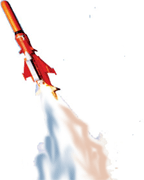 U.S. Confirms North Korea Fired Intercontinental Ballistic Missile, NYT 点击查看本文中文版 JULY 4, 2017 SEOUL, South Korea — The Trump administration on Tuesday confirmed North Korea’s claim that it had launched an intercontinental ballistic missile, and it told Pyongyang that the United States would use “the full range of capabilities at our disposal against the growing threat.”
China calls for calm and restraint on North Korea
China calls for calm after North Korea claims first successful launch of ICBM that can ‘strike any place in the world’ If this type of missile becomes fully operational, it could potentially deliver a nuclear warhead to the US mainland http://www.scmp.com/news/asia/east-asia/article/2101193/north-korea-says-it-has-successfully-tested-icbm, Agence France-Presse, Reuters, Associated Press 05 July, 2017,
The United States on Tuesday requested an emergency meeting of the UN Security Council after North Korea declared that it had successfully tested its first intercontinental ballistic missile, the US mission said. The meeting is expected to take place on Wednesday.
US Ambassador Nikki Haley on Tuesday spoke by phone with China’s Ambassador Liu Jieyi, who holds the council presidency this month, to convey the US request for an urgent meeting.
North Korea’s announcement Tuesday came after the launch of a ballistic missile in the morning. It flew about 39 minutes and reached an altitude of 2,802 kilometres, before landing in waters within Japan’s exclusive economic zone, according to the announcement.
North Korea’s claims the missile reached that altitude could not be verified. However Japan’s Defence Ministry said it reached an altitude that “greatly exceeded” 2,500 kilometres.
A test-launch of an intercontinental ballistic missile, if confirmed, would be considered a game-changer by countries looking to check North Korea’s push for a nuclear-armed missile that can reach anywhere in the United States.
The test still may be the North’s most successful yet; a weapon analyst says missile could be powerful enough to reach Alaska. The “landmark” test of a Hwasong-14 missile was overseen by leader Kim Jong-un, an emotional female announcer said. It flew 933 kilometres, she added. The North was “a strong nuclear power state” and had “a very powerful ICBM that can strike any place in the world” she said.
There are still doubts whether the North can miniaturise a nuclear weapon sufficiently to fit it onto a missile nose cone, or whether it has mastered the technology needed for it to survive the difficult re-entry into the Earth’s atmosphere.
In his New Year’s address, Kim said his country had reached the final stage of preparing to test-launch the long-range missile.
Officials from South Korea, Japan and the United States said the missile landed in Japan’s Exclusive Economic Zone (EEZ) after being launched near an airfield in Panghyon, about 100 km northwest of the North’s capital, Pyongyang.
Japan said on Monday the United States, South Korea and Japan will have a trilateral summit on North Korea at the G20. China’s leader Xi Jinping will also be at the July 7-8 meeting in Hamburg, Germany.
Trump, responding to the latest launch, wrote on Twitter: “North Korea has just launched another missile. Does this guy have anything better to do with his life?” an apparent reference to North Korean leader Kim Jong-un. “Hard to believe South Korea and Japan will put up with this much longer. Perhaps China will put a heavy move on North Korea and end this nonsense once and for all!”, Trump said in a series of tweets.
North Korea has conducted nuclear and missile tests to show defiance in the face of international pressure and to raise the stakes when Pyongyang sees regional powers getting ready for talks or sanctions, analysts say.
White House officials said Trump was briefed on the latest launch, which took place hours before Independence Day celebrations in the United States. North Korea has previously fired missiles around this holiday.
Pyongyang has conducted missile-related activities at an unprecedented pace since the start of last year, but analysts had thought it was years away from having a nuclear-tipped ICBM. capable of hitting the United States.
North Korea is also trying to develop intermediate-range missiles capable of hitting US bases in the Pacific. The last North Korean launches before Tuesday were of land-to-sea cruise missiles on June 8.
David Wright, co-director of the Global Security Programme at the US-based Union of Concerned Scientists, said the assessments of the flight time and distance suggest the missile might have been launched on a “very highly lofted” trajectory of more than 2,800 km.
The same missile could reach a maximum range of roughly 6,700 km on a standard trajectory, Wright said in a blog post.“That range would not be enough to reach the lower 48 states or the large islands of Hawaii, but would allow it to reach all of Alaska,” he said.
South Korea’s President Moon said on Monday in a meeting with former US president Barack Obama that North Korea now faces its “last opportunity” to engage in talks with the outside world.
North Korea has conducted four missile tests since Moon took office in May, vowing to use dialogue as well as pressure to bring Pyongyang’s nuclear and missile programmes under control.
Earlier this week, North Korea was a key topic in phone calls between Trump and the leaders of China and Japan. Leaders of both Asian countries reaffirmed their commitment to a denuclearised Korean Peninsula. Trump has recently suggested he was running out of patience with China’s modest steps to pressure North Korea.
Russia and China propose negotiation plan to lessen North Korea tensions
 Russia, China offer plan to ease N.Korea tension, abc news, 4 July 17 Russia and China have proposed that North Korea declare a moratorium on nuclear and missile tests while the United States and South Korea refrain from large-scale military exercises.
The call was issued in a joint statement by the Russian and Chinese foreign ministries on Tuesday following talks between Russian President Vladimir Putin and Chinese President Xi Jinping.
The statement came after North Korea tested a missile that flew higher and longer than previous ones, sparking concerns around the world.
Moscow and Beijing suggested that if North Korea halts nuclear and missile tests while the U.S. and South Korea freeze military maneuvers, the parties could sit down for talks that should lead to obligations not to use force and to refrain from aggression………..
North Korea says its latest missile test reached a height of 2,802 kilometers (1,740 miles) and flew 933 kilometers (580 miles) for 39 minutes before falling into the sea.
The country’s Academy of Defense Science said Tuesday in a statement that it was a successful test of an intercontinental ballistic missiles called Hwasong-14.
The statement was distributed by North Korea’s KCNA news service.
The reported trajectory was similar to that announced earlier by U.S., South Korean and Japanese officials, though the U.S. judged it to be an intermediate-range missile.
Either way, it would be a longer and higher flight than similar tests previously reported.
The U.S military says it tracked a North Korean missile for 37 minutes before it landed in the Sea of Japan.
The Hawaii-based U.S. Pacific Command said in a statement Tuesday that an intermediate-range ballistic missile was launched from near an airfield in North Korea.
NORAD, or the North American Aerospace Defense Command, said the missile did not pose a threat to North America.
South Korean and Japanese officials reported the North Korean missile launch earlier Tuesday. It is part of a string of recent tests as the North works to build a nuclear-tipped missile that could reach the United States………http://abcnews.go.com/International/wireStory/latest-north-korea-height-distance-missile-48430348
———
Rotten resin gas ‘most likely’ cause of Ibaraki nuclear accident
 The fuel research building of the Japan Atomic Energy Agency’s Oarai Research and Development Center in Oarai, Ibaraki Prefecture, where the accident occurred June 6
The Japan Atomic Energy Agency (JAEA) now considers the most likely cause of last month’s nuclear contamination accident at its Oarai research center to be gas produced by decomposing resin containing plutonium and other radioactive substances.
The June 6 incident at the facility in Ibaraki Prefecture, northeast of Tokyo, exposed five workers to plutonium when they handled 26-year-old radioactive waste stored there.
Resin was used to stick the radioactive waste on an aluminum sheet and stored in a tightly sealed polyethylene container, which was wrapped in plastic bags and placed in a stainless steel container.
The accident occurred when the workers opened the steel container and were exposed to radioactive particles that seeped out of the polyethylene container in gas that ruptured the plastic coverings and escaped into the room they were in.
“Decomposition of resin by a radioactive substance is considered as the most likely cause of the gas’s formation,” said Toshio Kodama, JAEA president, at a July 3 meeting with the science and technology ministry’s special investigation team that was set up to determine the cause of the accident.
JAEA found that the polyethylene container inside the plastic bags contained powdered plutonium set in pieces of epoxy resin.
The agency is looking at other possibilities, but now considers decomposition of the resin as the most likely cause.
On the same day, the National Institute of Radiological Sciences in Chiba announced that three of the five workers have been admitted to its facility for the third time to receive medication via an intravenous drip that speeds the excretion of radioactive substances from their bodies as urine.
The health of the five workers has not changed, according to NIRS.
Utilities reject shareholders’ calls for nuclear power phase-out
 Anti-nuclear demonstrators gather in front of the venue hosting Kansai Electric Power Co.’s annual meeting as shareholders of the company head to the site in Kobe’s Chuo Ward on June 28.
Japan’s eight major nuclear power plant operators rejected all proposals from their shareholders to abolish nuclear reactors at their annual meetings on June 28.
The heads of each utilities company emphasized the need for nuclear power generation as a vital energy source, citing the regional nuclear facilities which have gradually resumed operations after their shutdown in the aftermath of the nuclear disaster in 2011.
At Kansai Electric Power Co.’s general meeting, the utility dismissed anti-nuclear proposals by major shareholders, including the Osaka and Kyoto city governments.
Kansai Electric brought its Takahama No. 3 and No. 4 reactors in Fukui Prefecture back online in May and June.
“Electric power distribution systems which aren’t dependent on nuclear energy should be established,” Kyoto Mayor Daisaku Kadokawa urged.
But Kansai Electric President Shigeki Iwane shot back, “Nuclear power plants are essential in terms of environmental issues as well (as financial).”
“We will reduce electric rates in August and raise our corporate value, too,” Iwane added.
Meanwhile, one of Kyushu Electric Power Co.’s shareholders asked the company at its meeting whether it plans to pursue either nuclear energy or renewable energy.
A company executive shied away from answering directly and only replied: “Nuclear power generation is a vital electricity source. We would also like to consider renewable energy as a growing business.”
Utilities executives painted a positive picture at the other general shareholders’ meetings.
One from Hokkaido Electric Power Co. said, “As the deregulation of the electric power industry moves forward, it is necessary to resume operations of nuclear power plants as soon as possible to succeed in a competitive industry.”
A Chubu Electric Power Co. executive also said, “Even if safety measures incur costs, they can be recovered once nuclear power plants resume operations.”
Shareholders’ proposals to end nuclear power generation at Tokyo Electric Power Co. Holdings Inc. (TEPCO) were also rejected at its annual general shareholders’ meeting on June 23.
Costs of building Rokkasho nuclear fuel reprocessing plant now 4 times greater
Cost of building nuclear fuel reprocessing plant up 4-fold, THE ASAHI SHIMBUN, July 4, 2017 Construction costs for the long-delayed spent nuclear fuel reprocessing plant in Rokkasho, Aomori Prefecture, are likely to rise to 2.9 trillion yen ($25.67 billion), about four times the initial estimate, Japan Nuclear Fuel Ltd. (JNFL) has disclosed.
The company attributes the latest cost estimate increase of 750 billion yen, revealed July 3, to the necessity of meeting more stringent safety standards introduced after the 2011 nuclear crisis in Fukushima Prefecture.
Estimated construction costs previously stood at 2.193 trillion yen as of 2005.
The total cost of the project, including operating the plant for 40 years and then decommissioning it, was initially estimated at 12.6 trillion yen.
However, it is expected to rise to 13.9 trillion due to the increase in maintenance and personnel costs.
The major electric power companies that jointly set up JNFL have to cover those costs, but ultimately consumers will shoulder the burden in the form of electricity rates.
JNFL is constructing the plant in the village of Rokkasho, with the Nuclear Reprocessing Organization of Japan (NURO) contracted to handle the fuel reprocessing…….. Even if the NRA approves the new safety measures in the screening, the approval is expected to be made this autumn at the earliest, meaning the latest completion target of September 2018 is likely to be missed. http://www.asahi.com/ajw/articles/AJ201707040050.html
Australia now in reach of North Korea’s new intercontinental ballistic missile (ICBM)
 Australia now within range of new North Korean missile, as calculations show it could fly far enough to hit Darwin
- The ‘landmark’ test of a Hwasong-14 missile was overseen by leader Kim Jong-Un
- It was fired from a site in the North Phyongan province into the Sea of Japan
- It is believed to have reached an altitude of 2802 km and flew 933 km
- The North has long sought to build nuclear missiles capable of reaching the US
- Weapons analysts say the missile has the capability to travel up to 6,700km
- Darwin is only 5,750km from Pyongyang, putting Australia into the firing line
Experts say the missile could reach a maximum range of 6,700km on a standard trajectory, meaning it would be able to hit Darwin, which is 5,750km from Pyongyang.
David Wright, of the Union of Concerned Scientists, wrote on the organisation’s allthingsnuclear blog that the available figures implied the missile ‘could reach a maximum range of roughly 6,700 km on a standard trajectory’.
‘That range would not be enough to reach the lower 48 states or the large islands of Hawaii, but would allow it to reach all of Alaska.’ …………http://www.dailymail.co.uk/news/article-4664328/Australia-range-new-North-Korean-missile.html#ixzz4ltt8SE9M
Timeline of North Korea’s missiles tests in 2017
North Korea’s missiles tests in 2017: A timeline http://www.straitstimes.com/asia/east-asia/north-koreas-missiles-tests-in-2017-a-timeline, 4 Jul 17 North Korea has conducted missile and nuclear weapons related activities at an unprecedented rate since the beginning of 2017 and is believed to have made some progress in developing intermediate-range and submarine-launched missiles.
Here’s a timeline of the missile launches and tests the regime is known to have carried out this year:
Feb 12, 2017: North Korea fires its first ballistic missile in 2017, in what is seen as a show of force against the leaders of the United States and Japan reaffirming their security alliance. The missile is believed to be a mid-range Rodong or something similar, flying 500km and landing in the East Sea, also known as Sea of Japan.
March 6, 2017: North Korea fires four ballistic missiles, with three falling into Japan’s exclusive economic zone.
April 16, 2017: North Korea fires an unidentified ballistic missile that explodes almost immediately after launch, defying warnings from the Trump administration to avoid any further provocations
April 29, 2017: In an apparent defiance of a concerted US push for tougher international sanctions to curb Pyongyang’s nuclear weapons ambitions, the country test-fires a ballistic missile from the Pukchang region in a north-easterly direction. The missile reaches an altitude of 71 km before disintegrating a few minutes into flight.
May 14, 2017: Only four days after the inauguration of South Korea’s new leader Moon Jae In, North Korea fires a ballistic missile in an apparent bid to test the liberal president and the US, which have both signalled an interest in negotiations to ease months of tensions.
The missile flies for 700km and reaches an altitude of more than 2,000km before landing in the Sea of Japan or East Sea, further and higher than an intermediate-range missile North Korea successfully tested in February from the same region of Kusong, north-west of Pyongyang.
While the US Pacific Command says it does not appear to be an intercontinental ballistic missile, the successful launch of a mid-to-long range missile indicated a significant advance in North Korea’s drive for an intercontinental ballistic missile (ICBM), monitors say.
The North boasts that the launch is aimed at verifying the capability to carry a “large scale heavy nuclear warhead”.
May 22, 2017: North Korea launches medium-range ballistic missile Pukguksong-2, Pyongyang’s state media reported, adding the weapon was now ready to be deployed for military action.
The test sparks a fresh chorus of international condemnation and threats of tougher United Nations sanctions.
May 29, 2017: North Korea fires at least one short-range ballistic missile that lands in the sea off its east coast. The missile is believed to be a Scud-class ballistic missile and flew about 450km. North Korea has a large stockpile of the short-range missiles, originally developed by the Soviet Union.
North Korea is likely showing its determination to push ahead in the face of international pressure to rein in its missile programme and “to pressure the (South Korean) government to change its policy on the North”, South Korea’s Joint Chiefs of Staff spokesman Roh Jae Cheon said.
June 8, 2017: A volley of surface-to-ship cruise missiles are fired off North Korea’s east coast, less than a week after the United Nations expanded sanctions against Kim Jong Un’s regime in response to recent ballistic missile tests.
The short range missiles fly some 200km before falling into the Sea of Japan, says South Korea’s defence ministry.
June 22, 2017: North Korea conducts a “small rocket engine test on or around June 22, the respected 38 North analysis group says, after a US official reportedly suggested the test could be a step to develop an intercontinental ballistic missile (ICBM).
It is not clear whether the test, conducted at the North’s Sohae satellite launch site, involved an ICBM engine.
July 4, 2017: Just days after South Korea President Moon Jae In and US President Donald Trump focused on the threat from Pyongyang in their first summit, North Korea fires a ballistic which flies for 930km and exceeds 2,500km in altitude in 40 minutes before falling into Japan’s exclusive economic zone, Seoul and Tokyo say.
The US military says the missile is an intermediate range ballistic missile and does not pose a threat to North America, but analysts say the missile is able to reach Alaska.
SOURCES: AGENCE FRANCE-PRESSE, REUTERS
Cause of Japan’s Oarai research center nuclear accident is thought to be decomposing resin
Rotten resin gas ‘most likely’ cause of Ibaraki nuclear accident http://www.asahi.com/ajw/articles/AJ201707040020.html July 4, 2017 The Japan Atomic Energy Agency (JAEA) now considers the most likely cause of last month’s nuclear contamination accident at its Oarai research center to be gas produced by decomposing resin containing plutonium and other radioactive substances.
The June 6 incident at the facility in Ibaraki Prefecture, northeast of Tokyo, exposed five workers to plutonium when they handled 26-year-old radioactive waste stored there.
Resin was used to stick the radioactive waste on an aluminum sheet and stored in a tightly sealed polyethylene container, which was wrapped in plastic bags and placed in a stainless steel container.
The accident occurred when the workers opened the steel container and were exposed to radioactive particles that seeped out of the polyethylene container in gas that ruptured the plastic coverings and escaped into the room they were in.
“Decomposition of resin by a radioactive substance is considered as the most likely cause of the gas’s formation,” said Toshio Kodama, JAEA president, at a July 3 meeting with the science and technology ministry’s special investigation team that was set up to determine the cause of the accident.
JAEA found that the polyethylene container inside the plastic bags contained powdered plutonium set in pieces of epoxy resin.
The agency is looking at other possibilities, but now considers decomposition of the resin as the most likely cause.
On the same day, the National Institute of Radiological Sciences in Chiba announced that three of the five workers have been admitted to its facility for the third time to receive medication via an intravenous drip that speeds the excretion of radioactive substances from their bodies as urine.
The health of the five workers has not changed, according to NIRS.
Scrapping Tokai facility will cost 1 trillion yen and take 70 years
 The Tokai reprocessing site in Tokai village, Ibaraki Prefecture
The planned decommissioning of the Tokai spent nuclear fuel reprocessing plant in Ibaraki Prefecture will take 70 years and cost taxpayers about 1 trillion yen ($8.9 billion), according to the Japan Atomic Energy Agency.
The JAEA submitted its estimate to the Nuclear Regulation Authority on June 30 for approval.
By any measure, it will be a Herculean task to dismantle the facilities in the village of Tokai. Whether it will be possible to remove the high-level radioactive waste liquids and materials according to schedule is by no means certain.
Under the JAEA plan, the immediate task will be to assess the level of on-site contamination, decontaminate facilities and implement measures to secure safety of the site and workers, including enhancing earthquake-resistance of the facilities. That alone would take 10 years.
At the same time, the agency said it would start work to vitrify about 400 cubic meters of high-level radioactive waste liquids, a by-product of the reprocessing process.
Total costs during the first 10 years were calculated to come to 217 billion yen. Over the subsequent 60 years, the JAEA said it planned to demolish the facilities and decontaminate buildings at a total estimated cost of 770 billion yen.
That figure was broken down as follows: 250 billion yen to process the radioactive waste materials; 380 billion yen to dispose of the waste; and 140 billion yen to dismantle the facilities.
The NRA will first check safety and other issues before reaching a decision. If it gives the nod, the JAEA will start the project.
France is among countries that already have experience with dismantling reprocessing facilities, but it would be the first time to do it in Japan.
The Tokai reprocessing facilities were constructed at a total cost of 190 billion yen. It started full-scale operations in 1981, and has reprocessed 1,140 tons of spent nuclear fuel since then.
In 1997, the plant was rocked by an explosion at its bituminization facility to solidify waste.
Decommissioning of the Tokai plant was decided in 2014.
http://www.asahi.com/ajw/articles/AJ201707010038.html
Russia and China came close to nuclear war in 1969
Forgotten Fact: Russia and China Almost Started a Nuclear War in 1969, National Interest, Kyle Mizokami, 2 Jul 17, In 1969 the two pillars of the communist bloc, the Soviet Union and the People’s Republic of China, nearly went to full-scale war. Years of deteriorating ties between the two countries, once the staunchest of allies, finally led to skirmishing on the long mutual border between the two countries. While tensions were eventually de-escalated, what if the two countries had gone to war?
On March 2, 1969 Soviet troops patrolling Damansky Island (Zhenbao) on the Ussuri River came under fire from Chinese troops. The attack, just 120 miles from the major Soviet city of Khabarovsk, killed fifty Soviet troops and wounded many more. The Moscow believed that the attack was premeditated, with Beijing bringing in a special combat unit to ambush Soviet forces. Alleged atrocities against wounded Soviet troops made the Soviet leadership furious.
The de-escalation of the Sino-Soviet crisis in 1969 avoided what could have been yet another large, destructive war of the twentieth century. The current friendship between Moscow and Beijing is a reflection of that crisis and the realization that it’s much better for both countries to be allies than enemies. This is particularly in Moscow’s interests: given Beijing’s rapid military and economic progress over the past thirty years, next time, the Kremlin may find the tables turned. http://nationalinterest.org/blog/the-buzz/forgotten-fact-russia-china-almost-started-nuclear-war-1969-21398
16 Assemblies of Mox to be shipped to Japan from France

As a reminder a transport of 16 assemblies of MOX (between 8 and 10 tons) is being prepared.
This MOX is destined for the nuclear reactor of Takahama n ° 4.
The Pacific Egret and the Pacific Heron, “armed to the teeth” are on the departure of Barrow-In-Furness in England to come to Cherbourg.
The transfer of brand new trucks (equipped with shielding type protection) loaded with MOX will take place late on Tuesday evening.
The loading will take place on Wednesday 5th (as I had announced a few weeks ago at the meeting of the CLI Areva de La Hague) in the morning at the Quai des Mielles and the boats should leave the port of Cherbourg in the evening.
Source: Yannick Rousselet – Greenpeace France

1 This Month
26 April – Chernobyl: Inside the Meltdown airs on National Geographic on Sunday 26th April from 4pm

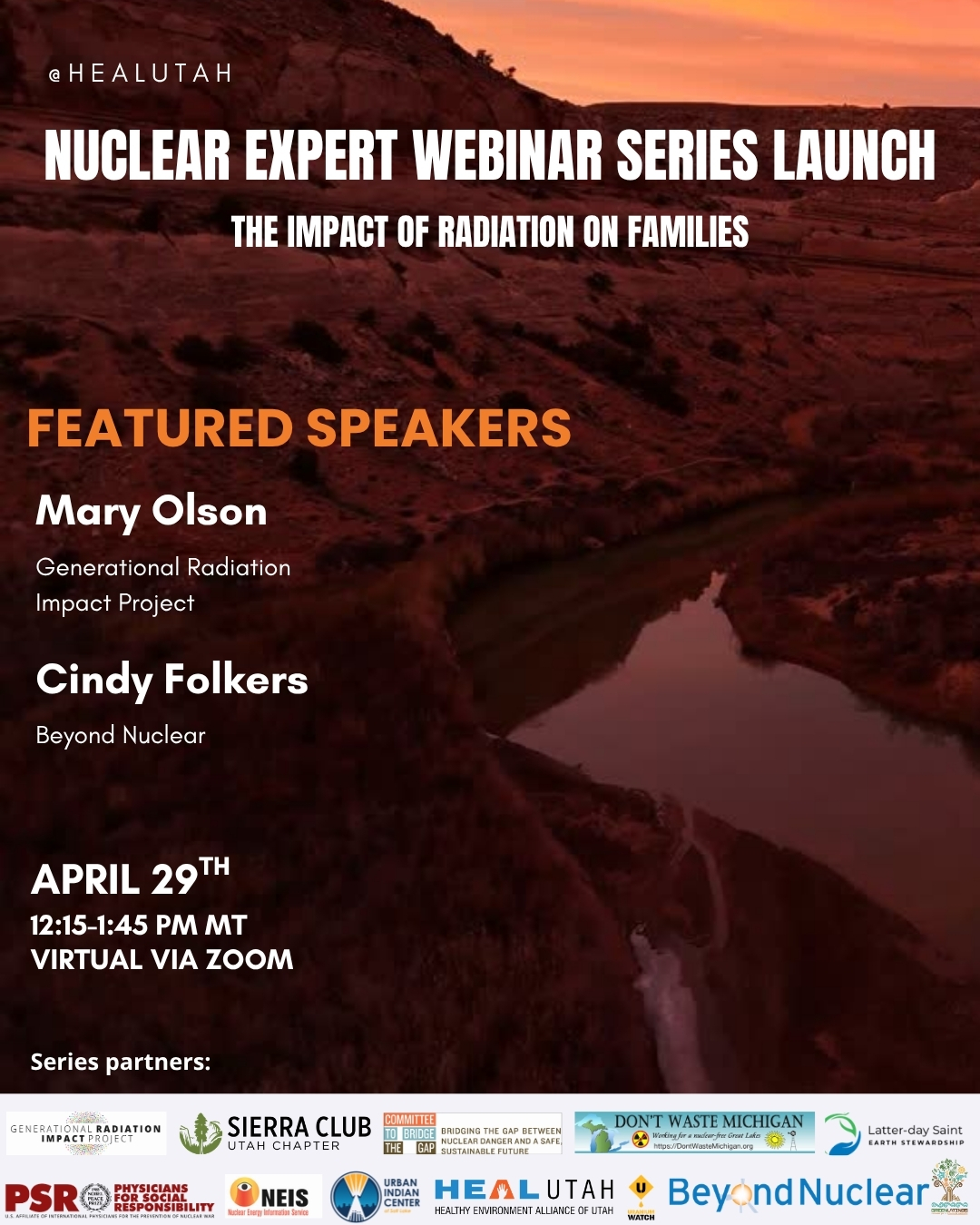
29 April – Nuclear Expert Webinar #1 – Radiation Impacts on Families with Mary Olson and Cindy Folkers
- 12:15 PM MT – 1:45 PM MT
- Location: Virtual – REGISTER TODAY

4 May -West Suburban Peace Coalition to discuss Iran war at May Educational Forum
Monday, May 4, 7:00 – 8:00 PM Central Standard Time
Title: : How Trump’s Narrative Tries to Shape the Reality of the War on Iran.
Contact Walt Zlotow, zlotow@hotmail.com 630 442 3045 for further information
14 May – online event From Bombs to Data Centres: the Face of Nuclear Colonialism

Pine Ridge Uranium is the real threat, not Tehran- Tell Burgum: Stop the Extraction.
Chernobyl: The Lost Tapes – A good documentary on Chernobyl on SBS available On Demand for the next 3 weeks– https://www.sbs.com.au/ondemand/tv-program/chernobyl-the-lost-tapes/2352741955560
To see nuclear-related stories in greater depth and intensity – go to https://nuclearinformation.wordpress.com
-
Archives
- April 2026 (317)
- March 2026 (251)
- February 2026 (268)
- January 2026 (308)
- December 2025 (358)
- November 2025 (359)
- October 2025 (376)
- September 2025 (257)
- August 2025 (319)
- July 2025 (230)
- June 2025 (348)
- May 2025 (261)
-
Categories
- 1
- 1 NUCLEAR ISSUES
- business and costs
- climate change
- culture and arts
- ENERGY
- environment
- health
- history
- indigenous issues
- Legal
- marketing of nuclear
- media
- opposition to nuclear
- PERSONAL STORIES
- politics
- politics international
- Religion and ethics
- safety
- secrets,lies and civil liberties
- spinbuster
- technology
- Uranium
- wastes
- weapons and war
- Women
- 2 WORLD
- ACTION
- AFRICA
- Atrocities
- AUSTRALIA
- Christina's notes
- Christina's themes
- culture and arts
- Events
- Fuk 2022
- Fuk 2023
- Fukushima 2017
- Fukushima 2018
- fukushima 2019
- Fukushima 2020
- Fukushima 2021
- general
- global warming
- Humour (God we need it)
- Nuclear
- RARE EARTHS
- Reference
- resources – print
- Resources -audiovicual
- Weekly Newsletter
- World
- World Nuclear
- YouTube
-
RSS
Entries RSS
Comments RSS
 nuclear-news
China has called for calm and restraint after North Korea claimed to have test-launched its first intercontinental ballistic missile that is capable of hitting anywhere in the world.