Defector: US strike would trigger automatic North Korea retaliation, Miltary Times, By: Matthew Pennington, The Associated Press WASHINGTON 2 Nov 17 — A high-ranking North Korean defector told a congressional hearing Wednesday that a pre-emptive U.S. military strike on the country would trigger automatic retaliation, with the North unleashing artillery and short-range missile fire on South Korea.
The testimony from Thae Yong Ho, former deputy chief of mission at the North Korean Embassy in London, underscored the high risk in using military force against North Korea. The Trump administration has said this is among its options in stopping leader Kim Jong Un from perfecting a nuclear-tipped missile that could strike the United States.
Thae, the highest-level North Korean defector in two decades, appeared to confirm what has long been suspected but rarely articulated by U.S. officials — that even a selective American strike could rain a potentially devastating North Korean military response on the South Korean capital and its environs, about 25 miles (40 kilometers) south of the heavily militarized frontier.
Thae, who is making his first visit to Washington since his defection last year, said the U.S. and allied South Korea would win a war after a preventive military strike on the North, but there would be a “human sacrifice” inflicted on the South from the “tens of thousands” of artillery guns and short-range missiles the North has at the frontier.
“North Korean officers are trained to press their button without any further instructions from the general command if anything happens on their side,” Thae told the House Foreign Affairs Committee, referring to a U.S. bombing or military strike. “We have to remember that tens of millions of South Korean population are living 70 to 80 kilometers away from this military demarcation line.”
He urged Washington to use “soft power” instead …….
Thae’s comments come ahead of President Donald Trump’s five-nation trip to Asia that will include a stop in South Korea. The U.S. administration says it seeks a diplomatic solution to the nuclear standoff but “all options” are on the table. Trump has threatened the total destruction of North Korea if the U.S. is forced to defend itself or its allies.
A Congressional Research Service report published last week said that conservative estimates anticipate that in the first hours of a conflict, North Korean artillery situated along the frontier could cause tens of thousands of casualties in South Korea, where at least 100,000 and possibly as many as 500,000 Americans live — including nearly 30,000 U.S. troops. It said a protracted conflict, particularly one in which North Korea uses its nuclear, biological or chemical weapons, could cause enormous casualties on a greater scale.
Some analysts contend the risk of Kim acquiring a nuclear weapon capable of targeting the U.S. homeland is greater than the risks associated with the outbreak of a regional war, the report said.
KIM Jong-un could test another nuclear weapon “at any time” after his September launch which caused three aftershocks, South Korean spies say.The Sun News Corp Australia Network NOVEMBER 3, 2017 NORTH Korea could be preparing another ballistic missile test amid “brisk activity” at one of Kim Jong-un’s nuclear research facilities, according to local media.
South Korea’s spy agency is anticipating another rocket launch, insisting the crackpot state would continuously push to develop “miniaturised, diversified” warheads, The Sun reports.
The South’s National Intelligence Service (NIS) has spotted “active movement” of vehicles at Kim’s research centre in Pyongyang — indicating the war-hungry despot is preparing another test.
The NIS said “the North will carry out additional nuclear tests and continue to push for the development of miniaturised, diversified nuclear warheads,” adding that a tunnel at a test site was ready to be used “at any time”.
The NIS also mentioned damage to the Punggye-ri nuclear site in the northeast of the country after three aftershocks following the North’s sixth and most powerful nuclear test on September 3.
Last month, a tunnel at the underground nuclear site reportedly collapsed, killing up to 200 people. The disaster happened at the remote Punggye-ri site on October 10, according to Japan’s TV Asahi.
The disaster has prompted fears of a massive radioactive leak which could spark a Chernobyl- or Fukushima-style disaster. The disaster has prompted fears of a massive radioactive leak which could spark a Chernobyl- or Fukushima-style disaster.
A North Korean official said the collapse happened during the construction of an underground tunnel, South Korea’s Yonhap news agency reports. Some 100 people are said to have been trapped by the initial tunnel collapse, with a further 100 lost in a second collapse during a rescue operation, Asahi reported on Tuesday.
The accident is believed to have been caused by Kim’s sixth nuclear test which weakened the mountain, according to the report. It was reported earlier this year that the mountain under which the base is believed to be hidden was at risk of collapsing and leaking radiation into the region. Experts said if the peak crumbles, clouds of radioactive dust and gas would blanket the region, the South China Morning Post reported.
The Punggye-ri test site is carved deep into the side of Mount Mantap.
Report: North Korea runs hospital to treat nuclear radiation patients, By Elizabeth Shim | Nov. 1, 2017 (UPI)—North Korea operates a hospital that treats soldiers exposed to radiation at its nuclear test site in Punggye-ri, according to a Japanese press report.
The Asahi Shimbun reported Wednesday the hospital is located near Pyongyang, in North Hwanghae Province. Patients include soldiers who work at Punggye-ri and their families. The North Korea source who spoke to the Asahi on the condition of anonymity did not disclose the number of North Korea radiation patients at the hospital.
But according to the report, the Kim Jong Un regime retains “hundreds of thousands” of North Korean soldiers who are responsible for digging underground tunnels at Punggye-ri or guarding the site.
North Korea has conducted nuclear tests at the site for more than a decade, starting in October 2006, and most recently in September, when it announced its sixth nuclear test.
The test and recent missile launches earned North Korea universal condemnation and heavy economic sanctions.
The Asahi previously reported rumors were circulating among North Koreans residing near the site a “phantom disease” could be spreading “because of the nuclear tests.”
U.S. pursues direct diplomacy with North Korea despite Trump rejectionArshad Mohammed, Matt Spetalnick WASHINGTON (Reuters) 1 Nov 17, – The United States is quietly pursuing direct diplomacy with North Korea, a senior State Department official said on Tuesday, despite U.S. President Donald Trump’s public assertion that such talks are a waste of time.
Using the so-called “New York channel,” Joseph Yun, U.S. negotiator with North Korea, has been in contact with diplomats at Pyongyang’s United Nations mission, the official said, at a time when an exchange of bellicose insults between Trump and North Korean leader Kim Jong Un has fueled fears of military conflict.
While U.S. Secretary of State Rex Tillerson on Oct. 17 said he would continue “diplomatic efforts … until the first bomb drops,” the official’s comments were the clearest sign the United States was directly discussing issues beyond the release of American prisoners, despite Trump having dismissed direct talks as pointless.
There is no sign, however, that the behind-the-scenes communications have improved a relationship vexed by North Korea’s nuclear and missile tests, the death of U.S. university student Otto Warmbier days after his release by Pyongyang in June and the detention of three other Americans.
Word of quiet engagement with Pyongyang comes despite Trump’s comments, North Korea’s weapons advances and suggestions by some U.S. and South Korean officials that Yun’s interactions with North Koreans had been reined in.
“It has not been limited at all, both (in) frequency and substance,” said the senior State Department official………
At the start of Trump’s presidency, Yun’s instructions were limited to seeking the release of U.S. prisoners.
“It is (now) a broader mandate than that,” said the State Department official, declining, however, to address whether authority had been given to discuss North Korea’s nuclear and missile program.
In Beijing, Foreign Ministry spokeswoman Hua Chunying said China welcomed any dialogue between the United States and North Korea.
“We encourage North Korea and the United States to carry out engagement and dialogue,” Hua told reporters, adding that she hoped talks could help return the issue to a diplomatic track for resolution.
…… Speaking at the United Nations on Sept. 19, Trump vowed to “totally destroy” North Korea if it threatened the United States or its allies, raising anxieties about the possibility of military conflict.
Twelve days later, after Tillerson said Washington was probing for a diplomatic opening, Trump said on Twitter that his chief diplomat was “wasting his time trying to negotiate with Little Rocket Man” – his mocking nickname for the North Korean leader.
Democratic U.S. senators introduced a bill on Tuesday they said would prevent Trump from launching a nuclear first strike on North Korea on his own, highlighting the issue days before the Republican’s first presidential trip to Asia.
…… The New York channel is one of the few conduits the United States has for communicating with North Korea, which has itself made clear it has little interest in serious talks before it develops a nuclear-tipped missile capable of hitting the continental United States.
The last high-level contact between Yun and the North Koreans was when he traveled to North Korea in June to secure the release of Warmbier, who died shortly after he returned home in a coma, the State Department official said.
……. The official said, however, that “the preferred endpoint is not a war but some kind of diplomatic settlement” and suggestions that Washington is setting up a binary choice for Pyongyang to capitulate diplomatically or military action were “misleading.”
Diplomacy, the official said, “has a lot more room to go.”
But Trump’s threats against North Korea are believed to have complicated diplomatic efforts.
, November 02, 2017 Under maintenance for the past three months, Unit 2 of the Kudankulam nuclear power plant has had its restart date postponed multiple times. This has once again raised safety concerns among activists who claim that substandard equipment has been used and are demanding that the expansion of the nuclear plant be stopped.
The second reactor was shut down on August 4 due to hydrogen concentration in the stator. It was originally expected to restart generation on September 4. However, the restart date was postponed to October 7, then to November 3 and now to November 15.
SV Jinna, Site Director at Kudankulam Nuclear Power Project (KNPP) has, however, blamed the delay on the overhaul of system.
With the 1000 MW second unit beginning commercial operations in March this year, activists wonder why the nuclear power plant had to be shut down so early on. “It is a very new plant. It has run only for a few weeks and such a plant need to be overhauled,” said G Sundarrajan, coordinator of Poovulagin Nanbargal, an NGO.
Arguing that the overall quality of different components and equipment used in the Kudankulam Nuclear Power plant is substandard, Sundarrajan points to the fact that the Russian Federal Prosecutors had in 2007 arrested the procurement director of ZiO-Poldolsk, a subsidiary of Rosatom, the country’s state-owned nuclear energy corporation on accusations of corruption. ZiO-Poldolsk was accused of knowingly selling inferior equipment manufactured for nuclear reactors. The same Russian company had supplied material and reactor parts to the Kudankulam Nuclear Power Plant.
But it’s not just Unit 2 that has faced maintenance problems. Since its inception in 2013, the 1000 MW Unit 1 of KNPP has shutdown multiple times.
The activist alleged that to camouflage the failures of Unit 1 and Unit 2, the project is being expanded further. “Unit 1 and 2 have already been a failure because they have used substandard components and the project was not properly implemented. They are trying to make Unit 3 and 4 a successful project because one and two will definitely die a natural death,” said Sundarrajan.
Construction for units 3 and 4 is presently going on and is expected to become operational by 2022-23.
Demanding that the Centre scraps the decision to expand the project, he explained, “The nuclear plant is itself a risky proposition. This is a nuclear park. Nowhere in the country do we have a nuclear park installed with 6000 MW power.”
While arguing that the government focus on renewable energy instead, he said, “Unit 1 and 2 has been installed but at least they should stop expanding. Second thing is disposing nuclear waste is becoming an issue in the entire world and there is no place to dispose it. Other countries are reducing use of nuclear power.”
Meanwhile, NPCIL SK Sharma had justified he maintenance shutdown at Unit 2 stating that “certain uncertainties” could crop up in the initial days of a new reactor.
Hitting out at the BJP and the previous Congress government, activist SP Udayakumar, who spearheaded the protests against the project in 2011, said, “They claimed it was brand new technology and started it. After five months, they are saying there could be some uncertainties once they start again. What is the real problem? Why can’t they tell us? They are accountable to the nation. The Congress and BJP government have been hiding all the irregularities.”
Calling the government anti-people, Udayakumar said, “Thousands of people have been protesting against the Unit 1 and 2 for more than two-and-half years if there is any kind of respect for democracy, the central government should hear the people and stop it.”
The collapse happened at the Punggye-ri nuclear test site in the northeast of the country on October 10, according to Japan’s TV Asahi. The disaster has prompted fears of a massive radioactive leak which could spark a Chernobyl- or Fukushima-style disaster, The Sun reported.
A North Korean official said the collapse happened during the construction of an underground tunnel, South Korea’s Yonhap news agency reports.
Some 100 people are said to have been trapped by the initial tunnel collapse, with a further 100 lost in a second collapse during a rescue operation, Asahi reported.
Lee Eugene, a spokeswoman at South Korea’s unification ministry, said: “We are aware of the report but do not know anything about it.”
The accident is believed to have been caused by Kim Joing-un’s sixth nuclear test which weakened the mountain, according to the report. It was reported earlier this year that the mountain under which the base is believed to be hidden was at risk of collapsing and leaking radiation into the region.
Experts said if the peak crumbles, clouds of radioactive dust and gas would blanket the region, the South China Morning Post reported.
The Punggye-ri test site is carved deep into the side of Mount Mantap. Geophysicist Wen Lianxing and his team at the University of Science and Technology of China in Hefei, Anhui province, said they were “confident” underground detonations were occurring underneath the mountain.
They posted an analysis of data collected from more than 100 seismic monitoring sites across China.
This has narrowed down the location of Pyongyang’s nuclear tests with a margin of error of just 100m. They’ve all been under the same mountain.
Seismic data showed the underground test triggered an earthquake of magnitude 6.3, around 10 times more powerful than the fifth test a year ago.
Satellite images showed the blast caused numerous landslides around the Punggye-ri test site, according to the Washington-based 38 North monitoring project.
But Chinese nuclear weapons researcher and chair of the China Nuclear Society Wang Naiyan told the Morning Post a collapse could spark a major environmental disaster.
He said: “We call it ‘taking the roof off’. If the mountain collapses and the hole is exposed, it will let out many bad things.
“A 100 kiloton bomb is a relatively large bomb. The North Korean government should stop the tests as they pose a huge threat not only to North Korea but to other countries, especially China.”
Satellite photos taken just a day after the blast reveal new gravel and scree fields shaken loose by the blasts at an elevation of about 2205m.
Analysts said these appeared more numerous and widespread than those caused by previous detonations — which would be in keeping with the increased size of the bomb.
Wang said there are limited mountains in North Korea that are “suitable” to conduct a nuclear test.
He said if the North had simply drilled into the side of the mountain, this increased the risk of “blowing the top off”.
News of the tunnel collapse comes after it emerged Russia and the US have both flown nuclear bombers near the country as tensions grow over Kim’s nuke threats.
Nuclear devices are often tested underground to prevent radioactive material released in the explosion reaching the surface and contaminating the environment.
This method also ensures a degree of secrecy.
A test site is carefully geologically surveyed to ensure suitability — usually in a place well away from population centres.
The nuclear device is placed into a drilled hole or tunnel usually between 200-800m below the surface, and several metres wide.
A lead-lined canister containing monitoring equipment is lowered into the shaft above the chamber.
The hole is then plugged with gravel, sand, gypsum and other fine materials to contain the explosion and fallout underground.
The release of radiation from an underground nuclear explosion — an effect known as “venting” — would give away clues to the technical composition and size of a country’s device.
South Korea and China move to normalize relations after THAAD dispute, WP, By Adam TaylorOctober 31 ,SEOUL— After a year of frosty diplomacy and economic pressure, South Korea and China announced Tuesday that they would put aside their differences out of a joint desire to denuclearize the Korean Peninsula.
South Korea’s Foreign Ministry said the two countries will resume normal relations. “The two sides attach great importance to the Korea-China relationship,” a statement from the ministry said.
In its own coordinated statement, China’s Foreign Ministry said the two nations would work to put their relationship back on a normal track “as soon as possible.”
China and South Korea have historically deep ties and over the past few decades had enjoyed a close relationship. However, that relationship was deeply damaged last July when Seoul agreed to install the U.S.-owned Terminal High Altitude Area Defense (THAAD) missile defense platform on its land.
Though both Seoul and Washington argued the THAAD system had only defensive capabilities, Beijing was concerned about U.S. encirclement as well as the system’s sophisticated radar capabilities…….
South Korea’s Foreign Ministry acknowledged that the THAAD dispute had not been fully resolved. “The two sides agreed to engage in communication on THAAD-related issues about which the Chinese side is concerned through communication between their military authorities,” it said in a statement.
For its part, China confirmed Tuesday that its position on THAAD had not changed.
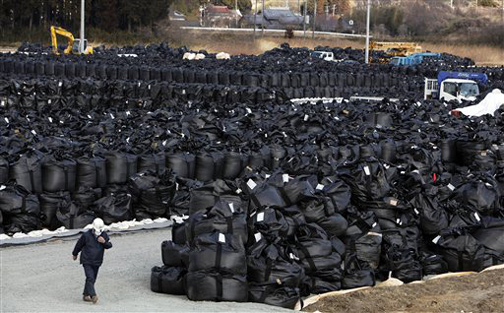
The government’s new radioactive waste storage facility in Fukushima Prefecture kicked into full gear on Saturday after completing a roughly four-month trial run.
While the facility near the crippled Fukushima No. 1 nuclear complex is designed to store soil and other tainted waste collected during decontamination work for up to 30 years, it remains only half complete six years after the triple core meltdown struck in March 2011.
An estimated 22 million cu. meters of contaminated waste exists in Fukushima, but the facility does not yet have enough capacity to store it all, and residents fear it will sit there permanently in the absence of a final disposal site.
The government has been able to buy only 40 percent of the land so far but eventually plans to secure 1,600 hectares for the facility, which is expected to generate ¥1.6 trillion ($14.1 billion) in construction and related costs.
The storage facility is urgently needed to consolidate the 13 million cu. meters of radioactive waste scattered around the prefecture. The prolonged disposal work, among other concerns, is said to be keeping residents away from their hometowns even when the evacuation orders are lifted.
Also on Saturday, the government began full operation of a facility where waste intended for incineration, such as trees and plants, is separated from the rest.
Contaminated soil is sorted into different categories depending on cesium level before storage.
Operator set to request 20 years extra for Tokai nuclear plant http://www.asahi.com/ajw/articles/AJ201710270036.html, THE ASAHI SHIMBUN, October 27, 2017 Japan Atomic Power Co. is preparing to apply for a 20-year extension to operate the aged Tokai No. 2 nuclear plant beyond its 40-year life span, sources said.
Such an extension would be the first among Japan’s aged boiling-water reactors, which include those at the crippled Fukushima No. 1 nuclear power plant.
Tokai No. 2 nuclear plant’s reactor, which went into service in 1978, is in a heavily populated area not far from Tokyo.
The company deems the 20-year extension of the plant in Tokai, Ibaraki Prefecture, as imperative to securing a stable revenue stream, the sources said.
However, the plan is expected to bring a host of challenges to the operator.
One is how to secure funds so as to cover the costs to improve safety at the old facility required under the more stringent nuclear regulations set after the 2011 Fukushima disaster.
Another is to ease concerns of local governments of the area where nearly 1 million residents could be affected in the event of a serious accident.
The move toward the extension comes as the Nuclear Regulation Authority is set to rule that the plant has met standards set in the new regulations necessary for a restart, the sources said.
The Tokai No. 2 plant, about 120 kilometers from the heart of the capital, houses one unit capable of generating 1.1 gigawatts.
If Japan Atomic Power proceeds with its plan to apply for the extension, it needs to submit the application to the NRA by Nov. 28.
The Tokai No. 2 plant narrowly escaped a catastrophe like the one at the Fukushima No. 1 nuclear plant when it was struck by the magnitude-9.0 Great East Japan Earthquake and tsunami on March 11, 2011.
It took Japan Atomic Power three and a half days to shut the reactor down when the disaster knocked out power. One of the three emergency generators installed there became dysfunctional after they were submerged by tsunami.
Some experts said it could have become impossible to keep cooling the reactor if the tsunami had been 70 centimeters higher.
Japan Atomic Power is keen to extend the operation of the Tokai No. 2 nuclear plant as the facility is the only venue that will feasibly bring it revenue. It has no option but to apply for the extended operation,” said an official familiar with the management of the company.
Apart from the Tokai No. 2 nuclear plant, Japan Atomic Power owns three other reactors: one at the Tokai nuclear plant, also in Tokai, and two at the Tsuruga nuclear plant in Tsuruga, Fukui Prefecture.
The one at the Tokai nuclear plant and one unit at the Tsuruga nuclear plant are on their way to being decommissioned.
Prospects for whether the company can win approval for a restart of the remaining reactor at the Tsuruga nuclear plant are bleak, as it has been reported that the facility was likely built on an active seismic fault.
If the company pulled the plug on the Tokai No. 2 nuclear plant, it would mean that it would be left with no revenue sources.
That expected management crisis could likely affect the bottom line of utilities such Tokyo Electric Power Co., the operator of the Fukushima No. 1 nuclear plant, which has a stake in Japan Atomic Power.
The Tokai No. 2 nuclear plant supplies power to TEPCO and Tohoku Electric Power Co., and although extending its operation would keep those revenue sources open, it would also come with a huge price tag.
The company said Oct. 26 that the estimated costs of the safeguarding measures for a restart of the plant will balloon to about 180 billion yen ($1.58 billion), more than double the 78 billion yen projected initially.
The total sum is expected to further increase if Japan Atomic Power chooses to operate the plant beyond the 40-year limit, according to the sources.
The plant’s extended operation could prove to be a big headache for local governments nearby.
Municipalities within a 30-kilometer radius are required to draw up evacuation plans to prepare for a contingency in the post-Fukushima crisis years.
Hammering out workable plans for close to 1 million residents in the area is expected to be difficult, the sources said.
Even the Ministry of Economy, Trade and Industry, which oversees the nuclear industry, is cautious about the extension.
“The consequences would be too enormous if an accident did occur,” said a ministry official.
(This story was written by Tsuneo Sasai and Yusuke Ogawa.)
Kobe Steel sent products with tampered data to nuclear companies, Cars, trains, planes … and nuclear facilities. REUTERS, Oct 27th 2017 TOKYO— Kobe Steel supplied parts with false specifications for nuclear equipment owned by Japan Nuclear Fuel Ltd, JNFL said on Friday, adding that the products were not used.
The parts were destined for use in centrifuges to enrich uranium, a JNFL spokesman said by phone. Citing security reasons, he declined to provide further details.
Kobe Steel has not told JNFL whether there are any safety issues with the parts, the spokesman said.
A Kobe Steel spokesman confirmed the firm fabricated data about specialized coatings used on the parts and had not identified any safety issues.
JNFL is the second company in the nuclear power industry to receive components affected by the steelmaker’s data tampering.
Tokyo Electric Power Co said this month it had taken delivery of pipes from Kobe Steel that were not checked properly.
Japan’s atomic regulator has asked nuclear operators to check whether they are using Kobe Steel products at nuclear plants, it said on Wednesday, adding it had received no reports that Kobe Steel’s data tampering scandal had affected safety.
No deadline has been given for nuclear operators to report back to the Nuclear Regulation Authority, a spokesman said by phone on Friday.
The unfolding data tampering scandal has spread from Kobe Steel’s copper and aluminum business to most areas of the company and sent companies at the end of complex supply chains across the world scrambling to check whether the safety or performance of their products has been compromised.
While no safety issues have been identified, Japan’s third-largest steelmaker is likely to face claims for replacement parts and other costs.
Kawasaki Heavy Industries Ltd would ask Kobe Steel to cover any costs for replacement of parts or other expenses related to the data tampering, President Yoshinori Kanehana told reporters on Friday at an earnings briefing…….
Kobe Steel said on Thursday 88 out of 525 affected customers had yet to confirm its products were safe in the light of widespread tampering of specifications, but that it had not received any requests for recalls.
Take atmospheric nuclear test threat ‘literally’, North Korea diplomat says Washington SMH, 26 Oct 17 The North Korean foreign minister’s warning of a possible atmospheric nuclear test over the Pacific Ocean should be taken literally, a senior North Korean official has told CNN.
“The foreign minister is very well aware of the intentions of our supreme leader, so I think you should take his words literally,” Ri Yong-pil, a senior diplomat in North Korea’s Foreign Ministry, told CNN in an interview aired on Wednesday.
North Korean Foreign Minister Ri Yong-ho said last month Pyongyang may consider conducting “the most powerful detonation” of a hydrogen bomb over the Pacific Ocean amid rising tensions with the US.
CIA chief Mike Pompeo said last week that North Korea could be only months away from gaining the ability to hit the US with nuclear weapons.
Experts say an atmospheric test would be a way of demonstrating that capability. All of North Korea’s previous nuclear tests have been conducted underground.
Trump next week will make a visit to Asia during which he will highlight his campaign to pressure North Korea to give up its nuclear and missile programs……
Hiroshima Survivor Setsuko Thurlow Recalls U.S. Bombing
‘We learned how to step over the dead bodies’: Setsuko Thurlow, 85, was 13 when she survived the attack. She has spent her life since campaigning against nuclear weapons Setsuko Thurlow will be in Oslo, Norway, on Dec. 10 to jointly accept the 2017 Nobel Peace Prize on behalf of this year’s laureate, the International Campaign to Abolish Nuclear Weapons (ICAN).
The 85-year-old Toronto resident is a Hibakusha — a survivor of the atomic attacks on Japan in 1945. Her hometown of Hiroshima was destroyed by the Americans on August 6, 1945.
Thurlow’s sister, burned and bloated from the blast, lived for four days afterwards. When she spoke, what she expressed was a mother’s guilt: Her child had been badly burned. How could she have let it happen?
“It’s not easy to carry these memories,” Thurlow says. “We learned how to step over the dead bodies.” She recalls feeling numb. She couldn’t cry. All she could do was watch, as Japanese soldiers tossed the lifeless bodies of her sister, Ayako, and her four-year-old nephew, Eiji, into a shallow grave, dousing them with gasoline, throwing in a match. Thurlow was 13.
She has spent much of her life since campaigning against nuclear weapons.
Her weapon is her words — and her resolve to keep telling the story. Thurlow sat down with the National Post at her home in Toronto.
Greenpeace 25th Oct 2017, Japan’s nuclear regulator must take urgent action to launch a
comprehensive investigation into the supply and widespread use of
potentially flawed Kobe Steel products in the Japanese nuclear industry,
Greenpeace and five other NGOs demanded today.
The groups submittedanalysis of Kobe Steel’s supply chain to the nuclear industry together
with a demand letter to The Nuclear Regulation Authority (NRA) commissioner
Toyoshi Fuketa on 24 October. http://www.greenpeace.org/japan/ja/news/press/2017/pr201710251/
India-US nuke deal signed without ground work: Ex-US Senator PTI|Oct 26, 2017, WASHINGTON: The landmark India-US civil nuclear deal was “dead at the very beginning” as it was signed without ground work, a former top Republican Senator has alleged, describing the agreement as more of an “arms deal” for American defence manufacturing companies.
Former Senator Larry Pressler, who has served as chairman of the US Senate’s Arms Control Subcommittee, told a Washington audience that the deal was much-praised “but there is no chance of it being implemented as the liability issues have not been addressed and it has not been worked through.”
He said that the India-US civil nuclear deal “was dead at the very beginning.
Pressler said that there was “no groundwork done” in India or the US on the civil nuclear deal.
The India-US nuclear cooperation agreement was signed in October 2008, ending India’s isolation by the West in the nuclear and space arena. The deal has given a significant boost to India’s nuclear energy production.
Pressler was speaking at an event organised by The Hudson Institute, a top American think-tank, to discuss his latest book ‘Neighbours in Arms: An American Senator s Quest for Disarmament in a Nuclear Subcontinent’.
“…There was nothing to it really. If you look into it, it is more of an arms sale agreement,” he alleged.
Pressler claimed the then US president Barack Obama’s visit to New Delhi was “largely an arms sale trip”.
The move will restart work on the two reactors that was frozen after President Moon Jae-in came to power in May on a ticket calling for scaling back nuclear power. It comes after results of a survey unveiled last week found a majority of South Koreans actually backed the projects.
The world’s fifth-biggest nuclear energy user currently runs 24 nuclear reactors, generating a third of the country’s total electricity needs.
“Construction work (for the two new nuclear reactors) will begin immediately after midnight,” Paik Un-gyu, Minister of Trade, Industry and Energy, told a news briefing in the capital.
But in a bid to press on with Moon’s commitment to boost use of natural gas and renewable sources in the nation’s energy mix, the ministry said Seoul will also cancel all plans to construct a further six nuclear reactors. The number of nuclear reactors operating in South Korea will be cut to a net 14 by 2038 it said.
The ministry said it will use alternative fuels such as solar and wind power to replace the six nuclear reactors with a projected combined capacity of 8.8 gigawatts (GW).
Additionally, the Asia’s fourth-largest economy will not allow extending the lifespan of 14 aging nuclear power stations, totaling 12.5 GW of capacity, the statement said.
The energy ministry said it will reflect changes in the country’s long-term energy mix plan, which is expected to be finalised in November.
Reporting by Jane Chung; Additional reporting by Christine Kim; Editing by Kenneth Maxwell