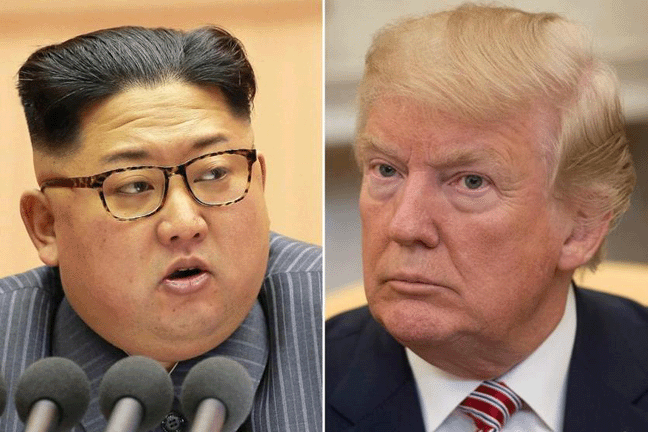
Trump accepts invitation to meet with North Korean leader Kim Jong Un Boston Globe, By Anna FifieldTHE WASHINGTON POST
TOKYO – President Donald Trump has agreed to meet with North Korean leader Kim Jong Un for talks, an extraordinary development following months of heightened nuclear tension during which the two leaders exchanged frequent military threats and insults.
Kim has also committed to stopping nuclear and missile testing, even during joint military drills in South Korea next month, Chung Eui-yong, the South Korean national security adviser, told reporters at the White House on Thursday night after briefing the president on his four-hour dinner meeting with Kim in Pyongyang on Monday.
After a year in which North Korea fired intercontinental ballistic missiles capable of reaching all of the United States and tested what is widely thought to have been a hydrogen bomb, such a moratorium would be welcomed by the United States and the world.
Trump and Kim have spent the past year making belligerent statements about each other, with Trump mocking Kim as ‘‘Little Rocket Man’’ and pledging to ‘‘totally destroy’’ North Korea and Kim calling the American president a ‘‘dotard’’ and a ‘‘lunatic’’ and threatening to send nuclear bombs to Washington, D.C.
But Kim has ‘‘expressed his eagerness to meet President Trump as soon as possible,’’ Chung told reporters.
‘President Trump said he would meet Kim
Jong Un by May,’’ Chung said, but he did not provide any information on where the meeting would be. In Seoul, the presidential Blue House clarified that the meeting would occur by the end of May.
Greenpeace 8th March 2018, The Japanese government has announced that it had accepted all four
recommendations made at the United Nations Human Rights Council (UNHRC) on
the rights of evacuees from the Fukushima Daiichi nuclear accident.
The decision is a victory for the human rights of tens of thousands of
evacuees, and civil society that have been working at the UNHRC and
demanding that Japan accept and comply with UN principles.
The decision means that the Japanese government must immediately change its unacceptable
policies, said Greenpeace.
The announcement by the Ministry of Foreign Affairs was made in a formal submission to the UNHRC. Japan is to give its
formal decision on 16 March at the UNHRC Universal Periodic Review session in Geneva to recommendations made by Austria, Portugal and Mexico on the need to respect the rights of Fukushima, particularly women and children,
and from Germany, which called on Japan to protect citizens from harmful
radiation by dramatically reducing permitted radiation exposure.
At an event held in Tokyo today, where two evacuee mothers, a leading lawyer
representing Fukushima citizens, Human Rights Now, and Greenpeace,
explained the crisis facing many survivors and the multiple violations of
their rights by the government of Shinzo Abe and the implications of its
decision to accept all the four UNHRC recommendations. http://www.greenpeace.org/japan/ja/news/press/2018/pr20180308/
N-power project junked due to Fukushima disaster Gujarat CM. Energy World
The project was proposed to be set up at Mithivirdi village in Bhavnagar district, said Energy Minister Saurabh Patel. March 09, 2018, Gandhinagar: Gujarat Chief Minister Vijay Rupani today told the Assembly the proposal to set up a nuclear power plant in Bhavnagar district has been scrapped owing to a movement by panic-stricken locals following the 2011 Fukushima nuclear accident in Japan.
The project was proposed to be set up at Mithivirdi village in Bhavnagar district, said Energy Minister Saurabh Patel.
He was speaking during a debate on the issue during Question Hour of the Assembly which is having its budget session.
Taking part in the debate, Rupani said though the state government had signed an MoU with Nuclear Power Corporation of India (NPCIL) in 2007, the project was eventually scrapped by the PSU after villagers raised apprehensions about their safety in the wake of radioactive “leak” from the Fukushima nuclear plant following a tsunami.
Rupani was replying to a question by Imran Khedawala (Congress) about the status of the proposed 6,000 MW nuclear power plant, for which the state had signed agreements with NPCIL in 2007 during the Vibrant Gujarat Summit.
“This project has been scrapped permanently by NPCIL. During the UPA rule, then Prime Minister Manmohan Singh had signed a nuclear deal with the USA. After that, a total of six nuclear plants were planned across the country and this plant in Bhavnagar was one of them,” he said.
Wang Yi says the moment has arrived to test whether all sides are sincere in wanting to resolve tensions over Pyongyang’s nuclear weapons programme
China called for direct dialogue between North Korea and the United States to defuse tensions on the Korean peninsula and warned there was still the potential for chaos amid the stand-off over Pyongyang’s nuclear weapons programme.
The warning by Chinese Foreign Minister Wang Yi on Thursday came despite the announcement that North and South Korea’s leaders are to meet at a summit, raising hopes that the nuclear crisis might be defused. …….
The South China Morning Post reported that North Korean leader Kim Jong-un may propose sending his sister, Kim Yo-jong, to the US as part of efforts to launch direct talks between Washington and Pyongyang.
This may be one of a number of possible messages South Korean envoy Chung Eui-yong will deliver to US National Security Adviser H.R. McMaster in Washington this week, a South Korean diplomatic source told the Post, speaking on condition of anonymity.
Chung is travelling to Washington with South Korea’s national intelligence service chief Suh Hoon, who, according to multiple South Korean diplomatic sources, will meet his US counterpart Mike Pompeo.
……. The fact that North Korea did not conduct nuclear and missile tests during the Winter Olympics, while South Korea and the United States have suspended their military drills, proved that China’s approach to handle the nuclear crisis was effective, Wang said.
Kim Jong-un’s sister could be sent to US to launch talks on ending nuclear crisis, South Korean envoy Chung Eui-yong is to deliver an ‘unconventional’ and ‘very unusual’ message to US National Security Adviser H.R. McMaster this week, the Post has learned SCMP, Robert Delaney, US correspondent, 08 March, 2018 North Korean leader Kim Jong-un may propose sending his sister, Kim Yo-jong, to the US as part of efforts to launch direct talks between Washington and Pyongyang, according to a South Korean diplomatic source.
That may be one of a number of possible messages South Korean envoy Chung Eui-yong will deliver to US National Security Adviser H.R. McMaster in Washington this week, the source told the South China Morning Post, speaking on the condition of anonymity.
……… Kim Yo-jong, the North Korean leader’s younger sister, spearheaded a charm offensive from Pyongyang when she attended the start of the Winter Olympic Games in Pyeongchang, South Korea last month, and invited South Korea’s President Moon Jae-in to visit Pyongyang.
Kim Yo-jong was the first member of the North’s ruling dynasty to visit South Korea.
The younger Kim’s presence in Pyeongchang laid the groundwork for visits by two South Korean government delegations to Pyongyang after the Games ended.
What has followed represents a reversal from the militaristic threats Kim Jong-un and US President Donald Trump lobbed at each other – Kim via North Korea’s state media and Trump via Twitter – throughout the second half of last year………
The message Chung and Suh are bringing from Pyongyang is likely to include a freeze or moratorium on the country’s nuclear weapons development programme in exchange for a downgraded or scaled-back version of joint US-South Korea military exercises, Korea Society senior director Stephen Noerper said in an interview.
“It’s a different tack for North Korea to go through South Korea,” Noerper said. “There could be an attempt to try to drive a wedge between the US and South Korea by saying ‘look, here’s all we’re offering and the Americans just aren’t listening’.
https://mainichi.jp/english/articles/20180307/p2a/00m/0na/017000c(Mainichi Japan) Sixteen pieces of data relating to the underground disposal of highly radioactive waste generated by nuclear reactors, which scandal-hit Kobe Steel Ltd. and a subsidiary analyzed at the request of the Japan Atomic Energy Agency (JAEA), were falsified, forged or flawed in other ways, the nuclear research organization said.
The government-affiliated JAEA, which commissioned Kobe Steel and its subsidiary Kobelco Research Institute Inc. to analyze data on the impact of burying highly radioactive waste deep underground, has demanded that the steelmaker redo the work.
Kobe Steel expressed regret over the matter. “We’ll do our best to prevent a recurrence,” said a company official.
According to the JAEA, the data in question includes that on the corrosion of metal used for cladding tubes and containers for spent nuclear fuel. Between fiscal 2012 and 2016, the Nuclear Regulation Authority and the Ministry of Economy, Trade and Industry (METI) commissioned the JAEA to conduct the analyses, and the agency farmed out the work to the steelmaker and its subsidiary.
JAEA officials said most of the data was not accompanied by records of experiments conducted in the analyses, or had intentionally been altered.
According to METI’s Agency for Natural Resources and Energy and other sources, the report detailing the results of the analyses will be partially corrected following the discovery of the data falsification.
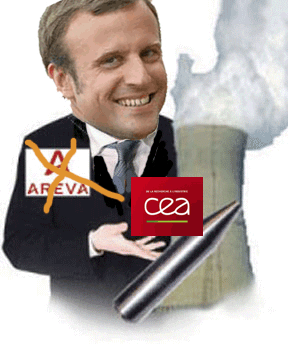
Counterview 6th March 2018, French president Emmanuel Macron should not be imposing the “untested,
expensive and technically troubled” French EPR reactor on India, say two
international groups, India-based DiaNuke and US-based Beyond Nuclear,
campaigning against nuclear power in India and across the world.
The French-supported Jaitapur Nuclear Power Project of the Nuclear Power
Corporation of India has been proposed at Madban village of Ratnagiri
district in Maharashtra.
The two well-known non-profit organizations’ statement comes amidst plans to hold a massive protest, with the
participation of 5,000 people of the villages surrounding the Jaitapur
site, on the eve of Macron’s visit on March 11. The Jaitapur EPR project
would be the biggest nuclear power plant site in the world if built,
producing 9,900 MW of electricity. https://www.counterview.net/2018/03/anti-nuclear-protest-to-greet-french.html
JUST when the world thought they had him pegged, Kim Jong Un has stunned with an apparent about face on nuclear weapons. News.com.au Victoria Craw@Victoria_Craw 7 Mar 18NORTH Korea has vowed not to use nuclear weapons against South Korea and could impose a ban on further nuclear and missile tests during talks with the US, South Korean media reports.
The stunning about face followed the first meeting between North Korean leader Kim Jong Un and South Korean officials since 2011.
It led to claims Kim Jong Un would not use conventional weapons against South Korea and had no reason to possesses nuclear weapons if it has a security guarantee.
The leaders also agreed to establish a “hotline” between the countries to reduce military tensions and will meet for another summit in late April at the border village of Panmunjom.
President Trump weighed in on the news on Twitter, saying “the US is ready to go hard in either direction”.
“The North side clearly affirmed its commitment to the denuclearisation of the Korean Peninsula and said it would have no reason to possess nuclear weapons should the safety of its regime be guaranteed and military threats against North Korea removed,” he said.
Seoul sends envoy to North Korea in hope of opening nuclear talks, Telegraph UK , Nicola Smith, taipei 4 MARCH 2018
South Korea is to send its national security chief to Pyongyang on Monday to discuss how to resume dialogue between the US and North Korea over its nuclear and weapons programme.
President Moon Jae-in announced on Sunday that Chung Eui-yong, head of the National Security Office, and his intelligence chief Suh Hoon, would lead a ten member delegation on a two day trip to the North.
The envoys will deliver a letter from Mr Moon to North Korean leader, Kim Jong-un, although it is still uncertain if they will meet with him personally. It would be the first time for Kim to meet with a South Korean official since he came to power in 2011.
The delegation is expected to hold talks that would pave the way for a possible summit meeting between the leaders of South and North Korea after Kim Jong-un last month invited Mr Moon to visit Pyongyang.
The envoys are “expected to hold talks with North Korea’s high level officials to discuss ways to establish peace on the Korean Peninsula and develop the South-North Korea relationship,” presidential chief press secretary Yoon Young-chan said.
Fukushima makes anime to counter harmful rumors https://www3.nhk.or.jp/nhkworld/en/news/20180228_28/Japan’s Fukushima Prefecture has produced animated films stressing the safety of its agricultural and fishery products to dispel overseas rumors about radioactive contamination from the 2011 nuclear accident.
The prefecture has been trying to expand the international markets for its farm produce and seafood. The main challenge is to refute the negative rumors that have persisted since the nuclear accident.
The 5 “anime” films, each lasting about 4 minutes, are aimed at promoting the safety and quality of local peaches, rice, beef and other items.
In the films, high school girls play the roles of the food items and work hard together to improve their taste.
The prefectural government also plans to make available English, Chinese, Spanish and French versions, which will be shown for the first time at an event in Hong Kong in March.
These versions will also be posted on the Internet.
A prefectural official says the films represent the aspirations of food producers in Fukushima and will convey the safety of their products on an affable note, mainly to younger generations abroad.
Japan’s Mitsubishi acquires 5% stake in French nuclear power firm Orano for $306m, Deal Street Asia, Mars Woo February 28, 2018 Tokyo-headquartered Mitsubishi Heavy Industries (MHI) has completed its acquisition of a 5 per cent interest in Orano, a French multinational group specialising in nuclear power and renewable energy, for €250 million ($306 million).
In a statement on Wednesday, MHI said the completion of the investment, which was agreed upon in March 2017, would enhance technological and business cooperation between the two companies and strengthen global value chain for nuclear energy…….
Orano primarily focuses on the fuel cycle business, including uranium mining, enrichment, and conversion and processing of spent fuel. MHI had in 1991, partnered with Areva, now an Orano subsidiary, to form a joint venture in the fuel cycle business for the manufacture and sale of a full range of reprocessing equipment. The company said it aims to play an important role in forging stronger links between the Japanese and French nuclear energy industries, as confirmed by the two countries’ governments in October 2015.
The company said it aims to play an important role in forging stronger links between the Japanese and French nuclear energy industries, as confirmed by the two countries’ governments in October 2015. “By strengthening the relationship between manufacturers in Japan and France, every effort will be made to expand and improve structurally as a comprehensive manufacturer capable of supporting the global nuclear power generation business in all aspects; from production of nuclear fuel to plant design, construction and maintenance, and reprocessing of spent fuel,” MHI said in a statement. https://www.dealstreetasia.com/stories/japans-mitsubishi-acquires-5-stake-french-nuclear-power-firm-orano-306m-93291/
Defense News, By: Mike Yeo , 2 Mar 18 MELBOURNE, Australia— One of China’s largest shipbuilders has revealed plans to speed up the development of China’s first nuclear-powered aircraft carrier, as part of China’s ambition to transform its navy into a blue-water force by the middle of the next decade.
In a since-amended news release outlining the company’s future strategic direction in all of its business areas, the state-owned China Shipbuilding Industry Corporation, or CSIC, said the shipbuilding group will redouble efforts to achieve technological breakthroughs in nuclear-powered aircraft carriers, new nuclear-powered submarines, quieter conventionally powered submarines, underwater artificial intelligence-based combat systems and integrated networked communications systems………https://www.defensenews.com/naval/2018/03/01/china-to-develop-its-first-nuclear-powered-aircraft-carrier/
Bags of radioactive waste during radioactive decontamination process after the daiichi nuclear power plant irradiation, Fukushima prefecture, Iitate, Japan
Uranium and other radioactive materials, such as caesium and technetium, have been found in tiny particles released from the damaged Fukushima Daiichi nuclear reactors.
This could mean the environmental impact from the fallout may last much longer than previously expected according to a new study by a team of international researchers, including scientists from The University of Manchester.
The team says that, for the first time, the fallout of Fukushima Daiichi nuclear reactor fuel debris into the surrounding environment has been “explicitly revealed” by the study.
The scientists have been looking at extremely small pieces of debris, known as micro-particles, which were released into the environment during the initial disaster in 2011. The researchers discovered uranium from nuclear fuel embedded in or associated with caesium-rich micro particles that were emitted from the plant’s reactors during the meltdowns. The particles found measure just five micrometres or less; approximately 20 times smaller than the width of a human hair. The size of the particles means humans could inhale them.
The reactor debris fragments were found inside the nuclear exclusion zone, in paddy soils and at an abandoned aquaculture centre, located several kilometres from the nuclear plant.
It was previously thought that only volatile, gaseous radionuclides such as caesium and iodine were released from the damaged reactors. Now it is becoming clear that small, solid particles were also emitted, and that some of these particles contain very long-lived radionuclides; for example, uranium has a half-life of billions of years.
Dr Gareth Law, Senior Lecturer in Analytical Radiochemistry at the University of Manchester and an author on the paper, says: “Our research strongly suggests there is a need for further detailed investigation on Fukushima fuel debris, inside, and potentially outside the nuclear exclusion zone. Whilst it is extremely difficult to get samples from such an inhospitable environment, further work will enhance our understanding of the long-term behaviour of the fuel debris nano-particles and their impact.”
The Tokyo Electric Power Company (TEPCO) is currently responsible for the clean-up and decommissioning process at the Fukushima Daiichi site and in the surrounding exclusion zone. Dr Satoshi Utsunomiya, Associate Professor at Kyushu University (Japan) led the study.
He added: “Having better knowledge of the released microparticles is also vitally important as it provides much needed data on the status of the melted nuclear fuels in the damaged reactors. This will provide extremely useful information for TEPCO’s decommissioning strategy.”
At present, chemical data on the fuel debris located within the damaged nuclear reactors is impossible to get due to the high levels of radiation. The microparticles found by the international team of researchers will provide vital clues on the decommissioning challenges that lie ahead.
Tokyo Electric on Friday said it had spotted what is almost certainly fuel debris in reactor 2 at the Fukushima No. 1 plant that shows its fuel assembly likely dropped through the pressure vessel.
While Tokyo Electric Power Company Holdings Inc. got a peek at lava-like objects that looked like melted fuel in reactor 3 last year, this is the first time it has located similar debris in reactor 2.
Tepco inserted a 13-meter pipe-shaped device with two cameras on its tip into a 12-cm utility hole in the primary containment vessel to capture images of the area directly beneath the pressure vessel, which holds the core.
One camera spotted a handle for the fuel rod assembly lying at the bottom of the PCV, surrounded by sediment.
This means “there must have been a hole big enough to let the fuel rod assembly fall out of the reactor, so we are almost certain that the sediment around it is fuel debris,” Tepco spokesman Takahiro Kimoto explained at a news conference at the utility’s headquarters in Chiyoda Ward.
Kimoto also said the image shows pebble-like objects that look similar to the fuel debris witnessed at the Three Mile Island facility in Pennsylvania after its partial core meltdown in 1979.
The fuel melted after the mega-quake and tsunami of March 11, 2011, knocked out all power to the Fukushima No. 1 plant, crippling its vital cooling systems.
As a result, some of reactor 2’s fuel rods apparently melted and penetrated the bottom of the 20-cm-thick pressure vessel before dropping to the bottom of the PCV.
Locating the fuel debris is crucial to decommissioning the crippled plant, which is expected to take more than three decades. Tepco plans to decide on a plan for removing the fuel in fiscal 2019.
This is the first internal probe of reactor 2’s primary containment vessel since February last year, when it inserted a rod about 10 meters long to capture images of the interior.
At that time, Tepco found some black sediment stuck to the steel grating beneath the pressure vessel but could not tell what it was.
Last July, the utility sent a robot inside reactor 3’s PCV, where it found what was believed to be melted fuel debris.
India, Russia, Bangladesh sign tripartite pact for civil nuclear cooperation, By Dipanjan Roy Chaudhury, ET Bureau| Mar 01, 2018, NEW DELHI: In a landmark development India for the first time signed a tripartite agreement on Thursday with foreing partners — Russia & Bangladesh — for civil nuclear cooperation.
Nuclear Power Cooperation of India Limited (NPCIL) will play a key role in building a nuclear power plant on foreign soil with the proposed supply of equipment and material for the power station being built by Russia in Bangladesh. India is also extending support for capacity building and has been training Bangladeshi nuclear scientists for the project.
The agreement was signed in Moscow on Thursday by Deputy Director General of Rosatom (Russia’s Alex civil nuclear body) Nikolay Spassky, Ambassador of Bangladesh in Russia S.M. Saiful Hoque and Indian Ambassador to Russia Pankaj Saran.
Rosatom is constructing nuclear power plant in Bangladesh on a turnkey contract basis. The scope of work includes design, production and supply of equipment, construction, installation, pre-commissioning and commissioning, according to Rosatom officials.
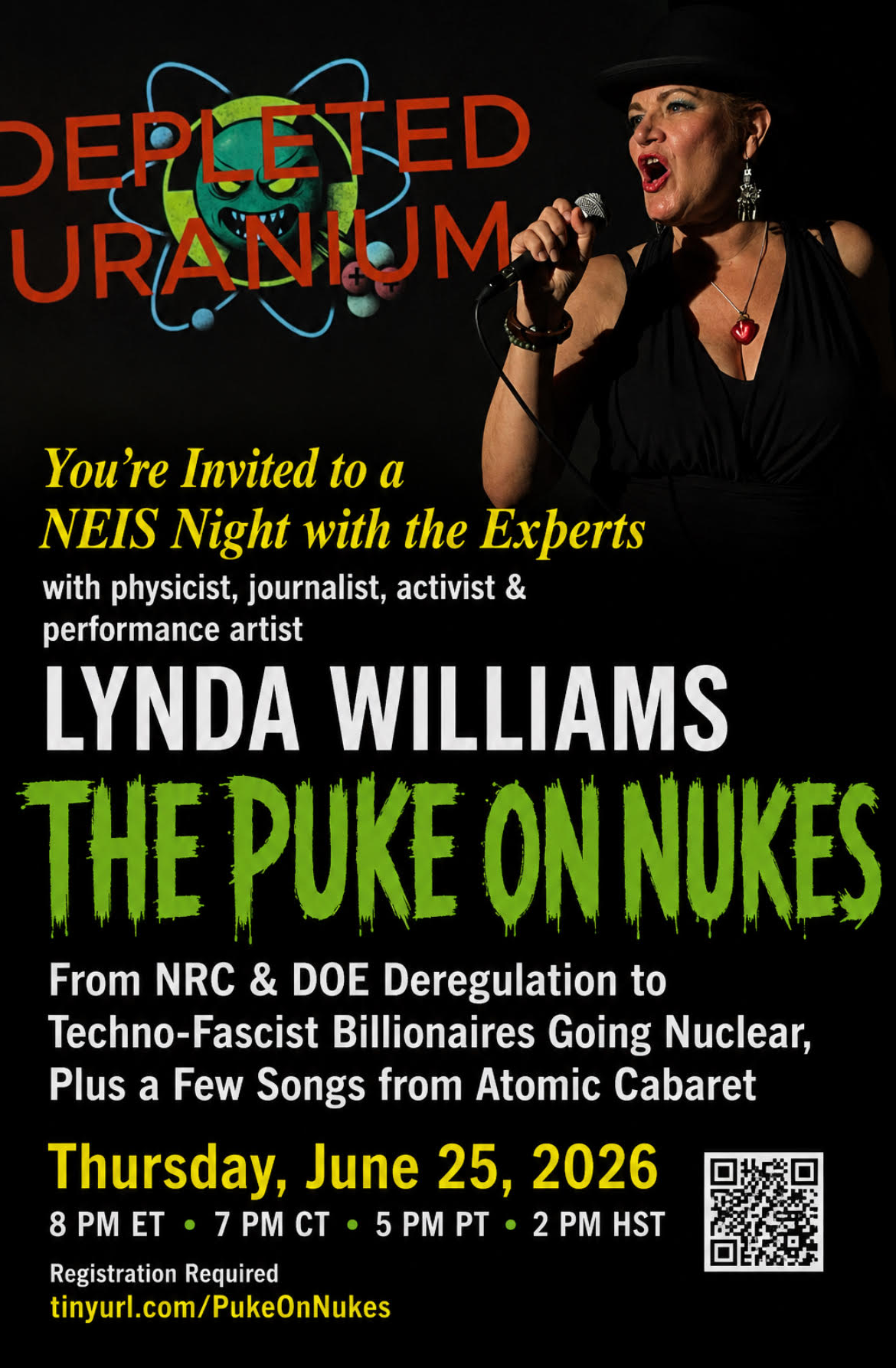
7pm Central Time (8pm ET, 6pm MT, 5pm PT) UTC – 5 From NRC & DOE Deregulation to Techno-Fascist Billionaires Going Nuclear, Plus a Few Songs from Atomic Cabaret REGISTER










 nuclear-news