Ecological risks of China’s floating nuclear power plants in South China Sea
China plans to power some of its claimed islets with nuclear energy, the U.S. Department of Defense recently told Congress in an annual report on Chinese military activities. Beijing had indicated last year it was planning to install “floating nuclear power stations” that would start operating before 2020, the report says.
That development would bulk up China’s maritime claim after about a decade of land reclamation in parts of the 3.5 million-square-kilometer sea and the sending of military units to some of the artificial islands, analysts say. Rival maritime claimants Brunei, Malaysia, the Philippines, Taiwan and Vietnam lack similar means to electrify their holdings.
“You are literally facilitating increase of physical control of the South China Sea,” said Collin Koh, maritime security research fellow at Nanyang Technological University in Singapore.
“I think the more immediate concerns of anyone, be they claimants, be they non-claimants, is a huge ecological risk, and taking into account that Chinese nuclear energy technology may not necessarily be one of the best in the world,” he said………
Ecological risks
China is unlikely to do an environmental impact study on any nuclear-power barges before installing them, Koh said. A “runaway reactor” could lead to a “major ecological disaster,” he said. The U.S. Defense Department report notes that the sea is prone to typhoons, during which most vessels seek shelter.
Pirates and terrorists at sea could also disrupt a nuclear power barge, said Andrew Yang, secretary-general of the Chinese Council of Advanced Policy Studies think tank.
“It certainly requires a different kind of infrastructure building, because it’s a floating nuclear power plant, never been doing it before, and the maritime conditions (are) putting a lot of potential risks or uncertainty in terms of maintaining such an installation,” Yang said. https://www.voanews.com/a/china-s-floating-nuclear-power-plants-risks-south-china-sea/4551979.html
 |
ReplyForward
|
U.S.-North Korea Nuclear Talks are going nowhere
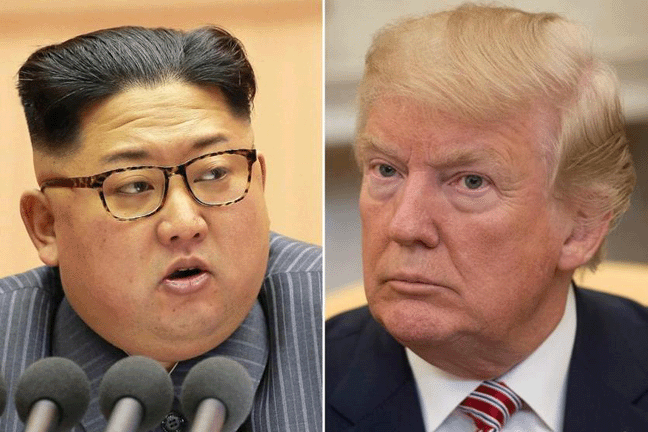 Why the U.S.-North Korea Nuclear Talks Have Stalled, Bloomberg, By David Tweed, August 29, 2018 Just a few months after Donald Trump’s historic handshake with Kim Jong Un in June, nuclear talks between the U.S. and North Korea are going nowhere.
Last week the U.S. president publicly acknowledged for the first time that discussions weren’t going according to plan, canceling a trip to Pyongyang by Secretary of State Michael Pompeo. North Korean state media then accused the U.S. of “double-dealing attitudes” and returning to “gunboat diplomacy.”
The problem is, neither side can agree on what the Singapore Declaration signed by both leaders actually means. Pompeo asserts that Kim accepted the “final, fully verified denuclearization of North Korea.” North Korean Foreign Minister Ri Yong Ho says all four provisions must be implemented simultaneously, not denuclearization first.
……… The failure to formally resolve the 1950-53 Korean War lies at the heart of the dispute, with each side using the continued threat of attack to justify its own military activities. Thus, the agreement between Trump and Kim — like earlier deals by their predecessors — included a pledge to “build a lasting and stable peace regime on the Korean Peninsula.”
Signing a peace treaty without a disarmament deal carries risks for the U.S. because it could legitimize Kim’s control over half of the peninsula and undermine the rationale for stationing 28,000 or so American troops in South Korea. Although Trump suspended some military drills with South Korea, he has so far refused to accept a symbolic peace declaration. That’s prompted the North Koreans to accuse the U.S. of backtracking on its commitments.
Denuclearization
Despite Trump’s post-summit claim that North Korea was “no longer a nuclear threat,” his agreement with Kim provided no timetable for giving up his nuclear weapons. Even the phrase “complete denuclearization” — a term preferred by North Korea’s that could be read to include nuclear-capable U.S. bombers and submarines — was left open to negotiation.
While Kim has followed through on pledges to refrain from weapons tests and dismantle testing facilities, those were moves he committed to before meeting with Trump. Pompeo has conceded before the U.S. Senate that Kim’s regime continues producing fissile material and has provided no inventory of its nuclear program and facilities. North Korea has warned that the U.S.’s focus on “denuclearization first” risks derailing talks.……… https://www.bloomberg.com/news/articles/2018-08-29/why-u-s-north-korea-nuclear-talks-have-stalled-state-of-play
Release of tritium-tainted water into sea is opposed by Fukushima fisheries group
 Fukushima fisheries group opposes release of tritium-tainted water into sea https://www.japantimes.co.jp/news/2018/08/30/national/fukushima-fisheries-group-opposes-release-tritium-tainted-water-sea/#.W4hrkSQzbGg
JIJI TOMIOKA, FUKUSHIMA PREF. – The head of a fisheries industry group in Fukushima Prefecture expressed opposition on Thursday to the idea of releasing water containing radioactive tritium from a crippled nuclear plant in the prefecture into the ocean.
The tritium-tainted water is from Tokyo Electric Power Company Holdings Inc.’s Fukushima No. 1 nuclear power plant, which was damaged heavily in the powerful earthquake and tsunami in March 2011.
“At a time when harmful rumors are still circulating in Japan and some countries continue to restrict imports (of Fukushima goods), releasing the tainted water into the sea will inevitably deliver a fatal blow to the Fukushima fishery industry,” Tetsu Nozaki, who leads the Fukushima Prefectural Federation of Fisheries Cooperative Associations, said.
His remarks came during a public hearing held by a subcommittee of the Agency for Natural Resources and Energy in the Fukushima town of Tomioka.
The hearing was for the canvassing of opinions on how to deal with the tritium-tainted water. Releasing it into the sea has been proposed as one option. Similar hearings will be held in the city of Koriyama, Fukushima, and Tokyo on Friday.
Using special equipment, Tepco is lowering the radiation levels in contaminated water at the plant, but the device cannot remove tritium. While the processed water is kept in tanks within the premises of the nuclear power station, the amount of tainted water continues to increase as the plant’s damaged reactors need to be cooled continuously. Tepco is about to run out of suitable sites to construct new storage tanks, according to the government.
Discussions on ways to deal with the tritium-contaminated water are underway at the subcommittee of the government agency.
In a June 2016 report, an expert panel of the agency said that releasing the polluted water into the sea after it is diluted with fresh water would be relatively cheap and time-efficient.
Japan’s municipalities in growing rejection to hosting nuclear waste dumps
 Assemblies make moves to reject playing host to nuclear waste http://www.asahi.com/ajw/articles/AJ201808280029.html By CHIAKI OGIHARA/ Staff WriterAugust 28, 2018 More local assemblies are taking measures to send a strong message to the central government not to bother asking them to host storage facilities for nuclear waste.The moves, in the form of ordinances, were accelerated after the Ministry of Economy, Trade and Industry in July 2017 released its Nationwide Map of Scientific Features for Geological Disposal that classified areas around Japan into four colors denoting their suitability as storage sites for nuclear waste.
Electric power companies are looking for land plots to construct an interim storage facility for spent nuclear fuel. The central government is planning a final storage facility where high-level radioactive waste would be mixed with glass and vitrified before being buried more than 300 meters underground.
Twenty-two municipal assemblies now have ordinances that limit the entry of highly radioactive waste into their communities.
About half of the ordinances were adopted by 2005, followed by an extended period when concerns decreased about being chosen as a site for nuclear waste storage facilities.
But the release of the geological disposal map prompted five municipal assemblies to quickly adopt ordinances limiting the introduction of nuclear waste to their communities.
Dark green areas on the map show places deemed appropriate for hosting the final storage facility. They are all within 20 kilometers from the coast, have favorable geological features and are considered adequate for the transportation of waste.
About 900 municipalities fall into the dark green areas.
Light green areas on the map have favorable geological features but face problems in transporting the waste.
Orange areas are considered inappropriate from a geological standpoint, while silver areas are also deemed inappropriate because they have reserves of natural resources that could be mined in the future.
Between autumn 2017 and spring 2018, the village of Yamato and the towns of Higashi-Kushira and Kimotsuki–all in dark green areas in Kagoshima Prefecture–adopted ordinances to reject the acceptance of nuclear waste.
Two towns in Hokkaido passed similar ordinances. Biei, located in a light green area, took the action in April, while Urakawa, which lies mostly in a dark green area, adopted the ordinance in June.
Kagoshima Prefecture has the most municipalities–11–with such ordinances. In 2000 and 2001, six municipalities adopted the ordinances amid rising concerns that an interim spent fuel storage facility would be brought in. Between 2005 and 2015, four other municipalities followed suit.
The town of Yaku was among the first group, but its ordinance became invalid after it merged with Kami-Yaku to form the new town of Yakushima.
The Yakushima town assembly is now planning to submit an ordinance in its September session to reiterate its opposition to serving as a site for nuclear waste storage.
However, the law for nuclear waste storage would take legal precedence over any municipal ordinance, meaning that the local governments could still be asked to accept the nuclear waste.
The Nuclear Waste Management Organization of Japan (NUMO) is in charge of the final nuclear waste storage project, and it has held explanatory meetings around Japan about the geological disposal map.
At those meetings, NUMO officials have stressed that it would not force a locality to accept nuclear waste if the prefectural governor or municipal mayor was opposed.
Still, Kohei Katsuyama, chairman of the Yamato village assembly in Kagoshima Prefecture, said the ordinance serves as a strong sign of the municipality’s stance of rejecting any idea of serving as host of a nuclear waste storage facility.
South Korea’s nuclear corporation in desperate effort to save Moorside nuclear plant project
 Kepco in last-ditch attempt to save Moorside nuclear plant project https://www.ft.com/content/50389e18-a6df-11e8-926a-7342fe5e173fSouth Korean utility group looks at potential lenders to finance construction Sylvia Pfeifer in London, Song Jung-a in Seoul and Leo Lewis in Tokyo, 28 Aug 18
Korea Electric Power Corp is meeting lenders to finance the construction of a new nuclear power plant in west Cumbria, as it makes a last-ditch attempt to save the project. Kepco said it was “exchanging opinion with potential lenders” but noted that the Korean government, which owns a majority stake in the company, had said it was “too early” to enter financing negotiations. The South Korean group was named last December as the preferred bidder for Toshiba’s NuGen unit, which was to build the plant at Moorside. But the deal ran into problems after the UK announced in June that it was considering how the funding for new nuclear power plants should be structured. One model under review is for private investors to secure a return on a nuclear plant’s so-called regulated asset base (RAB). The following month, Toshiba said it was exploring alternative options for the business and had terminated Kepco’s preferred bidder status.
Toshiba has set a deadline to secure a deal by the end of September, according to people close to the negotiations. The company declined to comment. The persistent delays have prompted NuGen to review its operations. It started a 30-day consultation period at the start of August raising the prospect of about 100 job losses. Toshiba is believed to have spent hundreds of millions of pounds on developing the site so far. It was forced to pay close to $139m to buy a 40 per cent stake held by France’s Engie last year. The failure of the Moorside plant would deal a blow to the UK government’s plans to encourage the construction of new reactors to replace its ageing fleet.
A government spokesperson in Seoul confirmed the company had launched a joint study to ascertain whether the RAB model was “workable”. The Korean government is understood to remain keen to progress with the investment because it would give it a foothold in one of the few western nations backing the construction of new reactors. But it has said the investment must pass a “national audit” test before it can proceed.
Kepco wants to deploy two of its APR-1400 reactors at Moorside to generate a combined electricity of about 3GW — close to 7 per cent of Britain’s electricity needs. Kepco said it was “too early” to say whether it would be able to meet the criteria for the audit. A spokesperson for the Department for Business, Energy and Industrial Strategy said the government had “repeatedly engaged with Kepco and the government of the Republic of Korea both in Korea and the UK in support of ongoing Moorside negotiations”. “Ultimately, this remains a commercial matter between Toshiba and Kepco,” he added.
Nuclear fuel soon to be removed from Japan’s failed Monju fast breeder reactor
Nuclear fuel removal to start at Monju reactor NHK, 28 Aug 18 The operator of Japan’s Monju prototype fast-breeder reactor plans to soon start removing its nuclear fuel from a storage container as part of the plant’s decommissioning.
The Japan Atomic Energy Agency plans to scrap the reactor in Tsuruga City in Fukui Prefecture, central Japan, over 30 years.
Work to move the fuel to a detached storage pool was to start in late July. But it was postponed due to equipment trouble including fogging up of monitoring camera lenses during trials.
The work is now to start on Thursday……..https://www3.nhk.or.jp/nhkworld/en/news/20180828_33/
How India & Pakistan Deal With The Bomb -“Brokering Peace in Nuclear Environments “
Diplomacy In The Nuclear Age, Kashmir Observer, HAIDER NIZAMANI • Aug 28, 2018, How India & Pakistan Deal With The Bomb
India and Pakistan ‘gatecrashed’ the nuclear club in May 1998. Children who were born right after the nuclear tests, carried out by the two countries in that year, are now able to vote — a generation, particularly in Pakistan, that has grown up on a steady diet of nuclear nationalism that portrays weapons of mass destruction as guarantors of national security and sources of collective pride. In times when the country can showcase little by way of achievements, we always console ourselves by saying that we have nuclear weapons.
Nuclear weapons and their delivery systems are made by experts trained in science and engineering but there is also another ‘nuclear expert’ whose bread and butter is linked to writing about these. There was only a small group of such experts two decades ago but nuclear tests by India and Pakistan have opened up many new spots for them. They are camped mainly in think tanks in New Delhi, Islamabad and Washington DC.
An overwhelming majority of them use the lens of political realism that sees states as key actors who pursue their national interests in competition with each other. Moeed Yusuf also belongs to this tribe of nuclear experts. He defines the crises explored in his book as “exercises in coercion through adversaries seek to enhance their relative bargaining strength vis-à-vis their opponents”………..
limitations of Yusuf’s book Brokering Peace in Nuclear Environments are, in fact, the limitation of realist theory that focuses on state actors and their actions and does not delve into the social, economic, political and strategic factors that cause those actions and determine their direction and outcome. Additionally, many Indian and Pakistan security experts consciously or unwittingly end up echoing official versions as the true versions of history. In many parts, Brokering Peace in Nuclear Environments also follows the same path which makes its analysisa bit lopsided and its prescriptions a little too Pakistan-centric.
Its strength, however, is the large number of interviews that Yusuf has conducted with policymakers, especially from the United States and Pakistan, who played key roles during the three crises mentioned above. For this reason alone, if for nothing else, his book should be seen as a good addition to the academic literature available on war and peace between India and Pakistan. https://kashmirobserver.net/2018/feature/diplomacy-nuclear-age-35464
Japanese students submit nuclear abolition petition to UN
Students submit nuclear abolition petition to UN https://www3.nhk.or.jp/nhkworld/en/news/20180829_06/ A group of Japanese high school students has visited the United Nations European headquarters in Geneva to submit a petition calling for the abolition of nuclear weapons.
The 20 “peace messengers” met Anja Kaspersen, the director of the UN Office for Disarmament Affairs, on Tuesday. Some of the students are from the atomic-bombed cities of Hiroshima and Nagasaki. The students showed Kaspersen photos taken immediately after the 1945 bombings. They told her the bombs not only killed many people but also forced survivors to live with burns and aftereffects.
They submitted about 100,000 signatures they had collected over the past year and urged the UN to do more to create a world with no nuclear weapons.
Kaspersen said the students’ campaign is not just about hope, but it is also helping young people in many countries to promote generosity and understanding.
The UN adopted the Treaty on the Prohibition of Nuclear Weapons last year, but nations possessing nuclear weapons and Japan have not joined it. Riko Shitakubo from Hiroshima said she renewed her resolve to keep trying to change the situation surrounding nuclear weapons.
Water leak in Japan’s unfinished Rokkasho nuclear reprocessing plant
|
Unfinished nuclear fuel plant had water leak NHK, 28 Aug 18The operator of a nuclear fuel reprocessing plant under construction in northern Japan says it found a water leak earlier this month at one of its facilities.
Japan Nuclear Fuel says an employee spotted the leak in the pipes of a storage pool at the plant in Rokkasho Village, Aomori Prefecture. The operator found that the pipes were corroded in 20 places and one of them had a hole. They are located outdoors and used for inspections. The operator believes that rainwater seeped through gaps in insulation materials wrapped around the pipes………https://www3.nhk.or.jp/nhkworld/en/news/20180829_02/ |
|
China reaffirms commitment to no first use of nuclear weapons
China stands by its commitment not using nuclear weapons, Pakistan Observer , August 28, 2018 BEIJING : China on Tuesday reiterated that it will not use nuclear weapons first and foremost at any time and under any circumstances.
Japan – Nuclear waste briefings in coastal areas
Nuclear waste briefings in coastal areas https://www3.nhk.or.jp/nhkworld/en/news/20180827_27/ Japanese energy agency officials say they will continue to hold public briefing sessions on the disposal of highly radioactive nuclear waste.
The government last year released a map showing which parts of the country may be scientifically suited to hosting an underground disposal site.
The Agency for Natural Resources and Energy has so far invited residents to 55 briefing sessions. Most have taken place in prefectural capitals.
On Monday, the agency held a meeting in Tokyo to explain the sessions to regional officials.
Agency officials said participants tend to question whether highly contaminated nuclear waste can safely be stored in earthquake-prone Japan. They also express concerns over how local people’s opinions may be reflected.
The agency plans to hold further briefings, mainly in coastal areas that are considered to be relatively suitable for underground waste storage.
The districts cover about 900 municipalities.
The officials say they will decide on where to hold the briefing sessions after discussions with the municipalities.
Japan revises guidelines for earthquake probabilities
New earthquake probability scale https://www3.nhk.or.jp/nhkworld/en/news/20180828_18/ Japanese government officials have revised the chances for earthquakes linked to marine trenches in order to avoid misleading the public. The government’s task force for earthquake research released its assessment of quakes that may hit Japan, along with their probabilities of occurring within 30 years.
Currently, the chances of quakes linked to marine trenches are given in percentages.
But experts fear that such descriptions could cause misunderstandings. People might feel safe living in an area with a small quake possibility figure, such as 0.1 percent or less.
The task force said it has introduced a new 4-rank scale to describe quake probabilities.
The highest rank of 3 means having the biggest chance of a large-scale quake within 30 years– a chance of 26 percent or more. Rank 2 is for areas with the chance of a quake between 3 and 26 percent. The rank of 1 suggests quake probabilities of less than 3 percent. Another rank of X suggests the chances of a quake cannot be calculated due to a lack of data, but an imminent quake cannot be ruled out.
Under the new classification system, possible mega quakes, including along the Nankai Trough off the Pacific coast from central through western Japan, are ranked 3.
Taiwan to hold referendum on lifting Fukushima food ban in November


Former worker’s book: TEPCO unfit to operate nuclear plants

Fukui disaster drill for simultaneous atomic accidents ends

1 This Month
26 September – International Day for the Total Elimination of Nuclear Weapons





PLEASE OPPOSE HR 8255 AND S.3639 – bills would accelerate satellite deployment, with no environmental review or safeguards – https://ncstd5li.quorum.us/campaign/169331/
To see nuclear-related stories in greater depth and intensity – go to https://nuclearinformation.wordpress.com
-
Archives
- September 2026 (305)
- August 2026 (330)
- July 2026 (355)
- June 2026 (287)
- May 2026 (306)
- April 2026 (356)
- March 2026 (251)
- February 2026 (267)
- January 2026 (308)
- December 2025 (358)
- November 2025 (359)
- October 2025 (375)
-
Categories
- 1
- 1 NUCLEAR ISSUES
- business and costs
- climate change
- culture and arts
- ENERGY
- environment
- health
- history
- indigenous issues
- Legal
- marketing of nuclear
- media
- opposition to nuclear
- PERSONAL STORIES
- politics
- politics international
- Religion and ethics
- safety
- secrets,lies and civil liberties
- spinbuster
- technology
- Uranium
- wastes
- weapons and war
- Women
- 2 WORLD
- ACTION
- AFRICA
- Atrocities
- AUSTRALIA
- Christina's notes
- Christina's themes
- culture and arts
- Events
- Fuk 2022
- Fuk 2023
- Fukushima 2017
- Fukushima 2018
- fukushima 2019
- Fukushima 2020
- Fukushima 2021
- general
- global warming
- Humour (God we need it)
- Nuclear
- RARE EARTHS
- Reference
- resources – print
- Resources -audiovicual
- Weekly Newsletter
- World
- World Nuclear
- YouTube
-
RSS
Entries RSS
Comments RSS

