Accusations of scientific misconduct concern city in Japan

 Fukushima at 8: Accusations of scientific misconduct concern city in Japan http://www.beyondnuclear.org/radiation-health-whats-new/2019/3/7/fukushima-at-8-accusations-of-scientific-misconduct-concern.html Eight years after the Fukushima nuclear reactors exploded on Japan’s Northern coast, spewing radioactive particles into the air, across the land, and into the Pacific Ocean, the country continues to struggle with decontamination and relocation efforts. Determining the health impacts resulting from the nuclear disaster has been particularly fraught. For Date City, about 60 km from the ruined Fukushima reactors, and still blanketed by radioactive contamination from the ongoing catastrophe, the struggle for protection of health continues amid accusations of scientific misconduct and betrayal.
After the nuclear catastrophe began, Date City residents received glass badges that measured radioactivity. About four and a half years of measurements collected from these glass badges were used by Ryugo Hayano, Professor emeritus from the University of Tokyo and Makoto Miyazaki from Fukushima Medical University (FMU) to initially publish two studies in the Journal of Radiological Protection (JRP). Radiation policy makers in Japan often reference the second of these two studies, indicating they trust the data and conclusions it offers. However, earlier this year, Shin-ichi Kurokawa (Professor Emeritus of The High Energy Accelerator Research Organization) and Akemi Shima (resident of Date City) contended that this research and the studies using it, are compromised by serious ethical violations and scientific misconduct.
Date City officials requested the studies subsequent to their adoption of a 5 mSv annual radiation exposure limit, which represents a huge increase of radiation exposure to residents. Date City has also limited decontamination efforts in certain areas, and the former mayor Shoji Nishida, requested that the International Atomic Energy Agency proclaim 5 mSv per year safe, instead of the current 1mSv. More detailed information is coming to light as a new mayor of Date City has been elected.
Kurokawa first raised concerns about the second study in a peer-reviewed August 2018 letter sent to JRP. The JRP, a U.K. journal, has yet to publish Kurokawa’s critique, so he published it on a Cornell University website in December 2018. Kurokawa also published a timeline and further critique of Hayano’s response to the letter in Harbor Business Online in February 2019, original article in Japanese. This research has also been reported on Retraction Watch, a website that tracks published troubled papers, although there are more serious concerns than those RW highlights.
Hayano has admitted (English translation here) to a miscalculation that underestimated doses to Date City residents by three times. Hayano also admits to destruction of the data on which the studies were based, claiming this “deletion” was in accordance with research protocol of the study. But Kurokawa disputes that, pointing out that data destruction is a violation of Japan’s ethical guidelines on handling human data – guidelines that instruct researchers to keep the data as long as possible. This destruction of data, and failure to publish a promised third study, appear to conceal evidence that found very high internal doses of radioactivity in some residents of Date City.
The Date City glass badge experiment
The research used glass badge data from approximately 59,000 Date City residents. These badges, paid for and distributed by Date City, supposedly measured the external radioactivity that each individual was exposed to beginning about August 2011, approximately 5 months after the nuclear catastrophe began, until the summer of 2015. The mayor’s office of Date City provided both the glass badge data and data on internal exposures for individual residents.
According to research protocols agreed to with FMU, Miyazaki and Hayano planned to publish three studies based on these data. The first, comparing individual external doses to survey results of airborne radiation from the Government of Japan, was published in 2016. The second, a prediction of lifetime dose and an evaluation of the effect of decontamination on doses to individuals, was published in 2017. The third study, examining the relationship between external doses and internal doses, will not be published. Instead it has been replaced by a study on a different topic.
Where things went wrong
Bad glass badge data
Perhaps the experiment was doomed from the start as the Miyazaki-Hayano studies admit some residents of Date City may not have worn the glass badges on their bodies or actually lived at the address registered for the badge. Such improper badge use would immediately compromise any conclusions reached concerning individual doses, but the researchers used the data anyway.
Mishandling and destruction of data
In addition to questionable glass badge measurements, Kurokawa contends the Miyazaki-Hayano research suffers from mishandling and destruction of data that violates ethical guidelines:
- Residents (research subjects) of Date City were not informed of the content of the research prior to the research commencing, and were not given opportunity to refuse use of their data. Miyazaki, being a municipal advisor on radiation to Date City as well as a study author, should have known how to handle this properly, yet he did not.
- Miyazaki and Hayano failed to note that some residents had not consented to use of their data, a fact obvious in the data supplied to them by Date City. They further failed to obtain consent from those residents prior to use of their data.
- Hayano presented data before the research protocol was submitted to, and approved by, an FMU Ethics review committee.
- Residents were not told of the papers once they were published, nor were they told that the Mayor’s office of Date City had requested the papers be published. This presented a conflict of interest since the Date City Mayor’s office had an agenda (see slides 21 & 26) of encouraging residents to increase “resilience” while living in a contaminated environment. For residents, this means consuming contaminated food and restricting decontamination efforts per Date City’s new 5 mSv annual exposure limit. A few months after Date Mayor Shoji Nishida announced this “resiliency” policy, Miyazaki was hired as radiation advisor to the city.
- Miyazaki and Hayano violated research protocol by replacing the third studyoriginally agreed to, with a study that said nothing about internal versus external doses.
- At the conclusion of the research, all of the data were destroyed. According to records obtained by an information request filed by Shima, Kurokawa’s co-author of the Kagaku article, Hayano created an integrated database at the request of Date City, but did not share this database with the city. Therefore, when the database was destroyed, Miyazaki and Hayano knew that Date City could not replicate it or the data it contained.
- Kurokawa points out that research conducted in Japan must follow the ethical guidelinesbased on the Declaration of Helsinki for proper protocols in handling medical and health research involving human subjects, such as valuing welfare of the research subjects over that of scientific results. FMU approved the Miyazaki-Hayano research papers under these protocols – protocols this research seriously violated by not allowing people to control use of their own data and by destroying the data after publication so that neither researchers nor the research subjects, can access it or replicate the studies.
Underestimation of dose
In addition to the mishandling of data, Kurokawa has discovered discrepancies in the values of cumulative doses in paper 2, which appear to underestimate actual doses. Hayano has, by his own admission, underestimated individual doses by three times. Professor Hayano says that he will issue a correction (corrigendum) for this dose underestimation, but has failed to completely answer the additional serious discrepancies, and the ethical violations of mishandling and destruction of data Kurokawa notes.
Why the “phantom” third study matters
The missing third study was supposed to investigate correlation between external and internal individual doses – a correlation Miyazaki and Hayano had already hypothesizedwould not exist. However, upon reviewing other data in Date City reports, the opposite was found: “[there was very] clear correlation between the external and internal doses…some cases with very high levels of internal exposure measurements.” Kurokawa offers his own hypothesis as to why Miyazaki and Hayano never published a paper on this third research question:
The true reason for not publishing Paper 3 could be the discovery of a clear correlation between the external and internal doses with some residents showing internal exposure measurements of several thousand Bq even since 2015. Not publishing inconvenient results despite receiving the internal exposure dose data from Date City would have to be considered a violation of the Ethical Guidelines. (emphasis added)
This correlation also reveals that Date City’s “resiliency” plan is not protecting its residents. Miyazaki and Hayano’s unwillingness to address internal dose evidence in the Date City data also calls into question Hayano’s other research on internal doses issues such as monitoring of food and whole body scans of children, the last publication of which appears to be in 2015.
Mistaken assumptions based on faulty studies
Japan’s Radiation Council (JRC) on setting standards for protecting people from radiation often references this ethically and scientifically compromised research in discussions, particularly the second paper, which was the focus of Kurokawa’s critical letter. Hayano’s work is often mentioned by other scientists and press as indication that doses from Fukushima radiation are low, that decontamination efforts paid for by Date City funds, might not have been necessary, and that living in an environment contaminated by “low” levels of man-made radiation is acceptable.
Where was the peer-review?
For its part JRP has now determined at this time that a correction for the dose underestimation is all that is needed, while an investigation into the consent issue is conducted. JRP claims to adhere to the Declaration of Helsinki for proper protocols in handling medical and health research involving human subjects. However, data misuse and destruction should require retraction of the papers, not correction.
Kurokawa contends that underestimating 70-year lifetime doses by three times is a severe enough miscalculation that a mere correction will not suffice, implying the conclusions of the papers are now in jeopardy. Hayano is claiming, falsely, that JRPwants a rewrite of the paper. Even if JRP did want a rewrite, it is unclear how Hayano intends to accomplish this since the Date City data on which the original papers were based have been destroyed. Kurokawa states:
There is no way to rewrite a paper when the research has already completed and all the data have been destroyed. Even if Date City were to re-supply the data to FMU, it would be considered new research and a new research proposal would have to be submitted to the Ethics Review Committee at FMU. A resulting paper would no longer be a revised version, but an entirely different paper based on new research. A scientist should never conceal such information, let alone pretend as if what was requested by JRP was a rewritten paper when it was a corrigendum that was actually requested. (emphasis in original English translation)
To date, neither Miyazaki nor Hayano have responded in the customary fashion, which would be to answer Kurokawa’s original letter criticizing their published research point-by-point. Kurokawa has published an analysis of Miyazaki-Hayano paper 1 in the March issue of Kagaku in Japanese, and will be publishing detailed analysis of paper 2 in April 2019.
Thanks to Yuri Hiranuma for input and review of this article and for the translations used to write it. See Yuri’s blog.
8 Years On: Tainted Soil Use Plan Draws Backlash from Fukushima Residents

https://www.nippon.com/en/news/yjj2019030601012/8-years-on-tainted-soil-use-plan-draws-backlash-from-fukushima-residents.html Mar 8, 2019 Minamisoma, Fukushima Pref., March 8 (Jiji Press)–A plan to use soil from decontamination work in areas tainted with radioactive substances from the March 2011 nuclear disaster in Fukushima Prefecture is facing a strong backlash from local residents.
Under an envisaged feasibility study program, the Environment Ministry aims to use the soil for public works projects and examine its safety.
The ministry apparently hopes to reduce the amount of tainted soil to be transferred to a planned final disposal facility.
But Fukushima residents continue to have strong safety concerns about radiation eight years after the triple meltdown accident at Tokyo Electric Power Company Holdings Inc.’s <9501> Fukushima No. 1 nuclear power plant, damaged in the March 2011 earthquake and tsunami
UK, Japan scientists study radioactive Fukushima particles

This sounds like a good idea. But – can we really be confident about science done by Atomic Energy Agencies , whose brief is to further develop atomic energy?
OXFORD, England (Reuters) 8 Mar 19, – Eight years after the Fukushima nuclear meltdown in Japan, radioactive particles collected from the site are undergoing new forensic investigation in Britain in an effort to understand the exact sequence of events…….
The Japan Atomic Energy Agency (JAEA) is currently collaborating with British researchers to learn more about the state of the radioactive particles created by the meltdown.
Dr Yukihiko Satou from the JAEA oversaw the transportation of particles collected from within the restricted zone, very close to the disaster site, to Britain.
“The particles were fundamentally extracted from those attached to soil, dust and debris,” Satou told Reuters.
Encased in protective tape, the samples were brought to the Diamond Light Source, Britain’s national synchrotron, or cyclic particle accelerator, near Oxford.
Here electrons are accelerated to near light speeds until they emit light 10 billion times brighter than the sun, then directed into laboratories in ‘beamlines’ which allow scientists to study minute specimens in extreme detail.
…… Understanding the current state of these particles and how they behave in the environment could ultimately determine if and when the area could be declared safe for people to return…… Writing by Matthew Stock,; Editing by Gareth Jones https://www.reuters.com/article/us-japan-disaster-radiation/uk-japan-scientists-study-radioactive-fukushima-particles-idUSKCN1QP1GF
People of Kashmir – stuck in a dangerous, potentially nuclear, conflict
In Kashmir, we’re stuck in the middle of a potentially nuclear conflict but the world looks away, ABC News, By Umar Lateef Misgar 9 Mar 19, When Adil Dar rammed a car stuffed with explosives into a paramilitary convoy in Indian-administered Kashmir last month, I didn’t make much of the news.
I was travelling across northern India at the time. Having been born and brought up amid a conflict that has defined the life of every young Kashmiri for the past three decades it just seemed more of the same: military cordons, gunfights, curfews, blown-up houses, maiming and the death of our friends and acquaintances.
But the magnitude of this attack by Dar, a 22-year-old Kashmiri, crept up on me through numbers and images. It was the worst attack against Indian forces since the armed insurgency erupted in Kashmir in the late 1980s.
At least 40 Indian paramilitary personnel had been killed, setting off a chain of events that almost brought South Asia to the brink of an all-out nuclear war.
I felt heartbroken by the loss of life that had occurred.
The Indian media instantly began to whip up a frenzy against the Kashmiris, doubling down on efforts to demonise an entire people.
The Indian population’s anger was focused against Kashmiri civilians, students and migrant businessmen, who were attacked by mobs. As many as 2000 of them were forced to flee from different Indian cities…….
I have lived in India as a student and travelled across the country throughout my life, but I have never felt as threatened as during this recent visit.
Constantly dehumanised in the Indian media as well as politics, Kashmiris have been undermined and permanently relegated as dispensable other in the Indian consciousness. Even the India’s parliamentary opposition, led by the Indian National Congress party that finds its roots in the anti-colonial struggles of the subcontinent, didn’t even dare to speak a word against this wave of anti-Kashmiri hate-crimes………
Amid rising tensions, both the countries mobilised their armed forces, leading to the worst tension in 20 years. Diplomats succeeded in persuading the two nuclear-armed nations to back-off. For now.
It is local Kashmiris whose lives were disrupted by this military posturing and brinkmanship. Civilians across the de-facto border that divides Indian and Pakistani-administered Kashmir, suffered the stress of warplanes hovering above and the impending threat of war………
Deadliest decade
The confrontation between India and Pakistan has slowly de-escalated but people continue to be killed, and while last year was the deadliest in a decade the coming year looks catastrophically bleak.
In the past week 15 people including eight Kashmiri civilians died in shelling and gunfights on the border.
As world attention shifts elsewhere the plight of Kashmiri people remains constant. Our land, our air and our bodies will remain the sites of violent confrontation and electoral bargaining.
Will anyone bat an eye before the next nuclear showdown? https://www.abc.net.au/news/2019-03-09/kashmir-is-stuck-in-the-middle-of-nuclear-tension/10878950
Nuclear threat still hangs over India and Pakistan
|
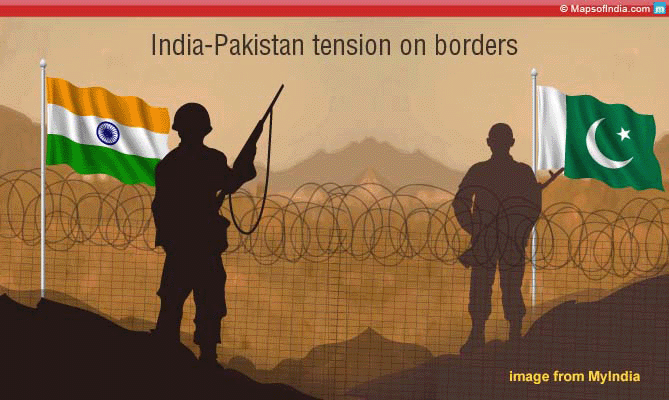
Crisis may be easing, but nuclear threat still hangs over India and Pakistan, Analysis by Brad Lendon, CNN, March 4, 2019 Hong Kong Tensions on the border between India and Pakistan last week pushed the two nuclear-powered South Asian adversaries closer to conflict than at any point in the past two decades.
|
|
|
South Korean President Moon Jae-in praised North Korea’s offer to dismantle a key nuclear production complex

 Moon Lauds North Korea’s Nuclear Offer, Splitting With Trump, Bloomberg, By Youkyung Lee, March 4, 2019,
- He says a ‘partial’ sanctions lift was discussed in Hanoi
- Moon says Trump, Kim should meet soon to reach agreement
South Korean President Moon Jae-in praised North Korea’s offer to dismantle a key nuclear production complex as an “irreversible” step to undercut its weapons program, breaking with the Trump administration.
In a meeting to discuss the summit last week in Hanoi between Donald Trump and Kim Jong Un, Moon on Monday lauded North Korea’s offer to dismantle the Yongbyon nuclear complex. He also called for pushing ahead with inter-Korean projects currently hindered by sanctions and said the two sides discussed the “partial” lifting of sanctions — backing North Korea’s version of events…….
Moon has endeavored to serve as a bridge between Trump and Kim, and has staked political capital on bringing peace to the divided peninsula. ….
Nightmarishly high radiation levels -robots the only chance to deal with Fukushima reactors’ molten fuel
For Fukushima’s nuclear disaster, robots may be the only hope, The 2011 meltdown in Japan is still too hot for humans to handle. Send in the machines. CNet BY ROGER CHENG, MARCH 4, 2019 ………. I’m inside the cavernous top of the Unit 3 reactor in the Fukushima Daiichi Nuclear Power Plant. Yes, that Fukushima Daiichi, site of the world’s worst nuclear disaster.
Unit 3 was one of three reactors crippled on March 11, 2011, after a 9.0 earthquake struck 80 miles off the coast of Japan. (Units 4, 5 and 6 at Daiichi weren’t operating at the time.) The temblor shook so violently it shifted the Earth’s axis by nearly 4 inches and moved the coast of Japan by 8 feet. Eleven reactors at four nuclear power plants throughout the region were operating at the time. All shut down automatically. All reported no significant damage.
An hour later, the tsunami reached shore.
Two 50-foot-high waves barreled straight at Fukushima Daiichi, washing over coastal seawalls and disabling the diesel generators powering the plant’s seawater cooling systems. Temperatures inside the reactors skyrocketed to as high as 5,000 degrees Fahrenheit.
Fuel rods became molten puddles of uranium that chewed through the floors below, leaving a radioactive cocktail of fuel rods, concrete, steel and melted debris. Molten fuel ultimately sank into the three reactors’ primary containment vessels, designed to catch and secure contaminated material.
Next Monday marks the eighth anniversary of the earthquake. Since then, Japanese energy giant Tokyo Electric Power Company, or Tepco, has cleared enough of the rubble on the top floor of the Unit 3 building to allow for my 10-minute visit.
I gaze up at the massive barrel vault ceiling, trying to get a handle on the sheer scale of everything. Radiation levels are too high for me to linger. My quickening pace and breath are betrayed by rapid flapping noises coming from the purple filters on both sides of my respirator mask.
At the far end of the room, there’s an enormous orange platform known as a fuel-handling machine. It has four giant metal legs that taper down, giving the structure a sort of animalistic look. Thin steel cables suspend a chrome robot in the center of the frame. The robot, largely obscured by a pink plastic wrapper, is equipped with so-called manipulators that can cut rubble and grab fuel rods. The robot will eventually pull radioactive wreckage out of a 39-foot-deep pool in the center of the room.
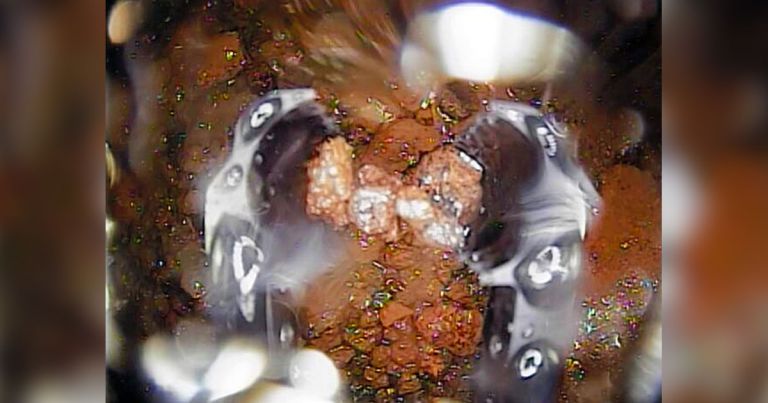
It’s just one of the many robots Tepco is using to clean up the power plant. It’s why I came to Japan this past November — to see how robots are working in one of the most extreme situations imaginable.
The Japanese government estimates it will cost $75.7 billion and take 40 years to fully decommission and tear down the facility. The Japan Atomic Energy Agency even built a research center nearby to mock up conditions inside the power plant, allowing experts from around the country to try out new robot designs for clearing away the wreckage.
The hope is that the research facility — along with a drone-testing field an hour away — can clean up Daiichi and revitalize Fukushima Prefecture, once known for everything from seafood to sake. The effort will take so long that Tepco and government organizations are grooming the next generation of robotics experts to finish the job. …….
Two years ago, Tepco erected a dome over the Unit 3 reactor and fuel pool so that engineers could bring in heavy equipment and now, us.
Roughly 60 feet below me, radiation is being emitted at 1 sievert per hour. A single dose at that level is enough to cause radiation sickness such as nausea, vomiting and hemorrhaging. One dose of 5 sieverts an hour would kill about half of those exposed to it within a month, while exposure to 10 sieverts in an hour would be fatal within weeks.
Unit 3 is the least contaminated of the three destroyed reactors.
 Radiation in Unit 1 has been measured at 4.1 to 9.7 sieverts per hour. And two years ago, a reading taken at the deepest level of Unit 2 was an “unimaginable” 530 sieverts, according to The Guardian. Readings elsewhere in Unit 2 are typically closer to 70 sieverts an hour, still making it the hottest of Daiichi’s hotspots.
The reactors’ hostile environments brought most of the early robots to their figurative knees: High gamma radiation levels scrambled the electrons within the semiconductors serving as the robots’ brains — ruling out machines that are too sophisticated. Autonomous robots would either shut down or get snared by misshapen obstacles in unexpected places.
The robots also had to be nimble enough to avoid disturbing the volatile melted fuel rods, essentially playing the world’s deadliest game of “Operation.” At least initially, they weren’t. “Fukushima was a humbling moment,” says Rian Whitton, an analyst at ABI Research. “It showed the limits of robot technologies.”………….. https://www.cnet.com/news/for-fukushimas-nuclear-disaster-robots-may-be-the-only-hope/
North Korea’s major nuclear reactor has been shut down for months
Key North Korean nuclear reactor has been shut down for months: IAEA, Channel News Asia, 4 Mar 19, VIENNA: The nuclear reactor that is believed to have supplied much of the plutonium for North Korea’s nuclear weapons appears to have been shut down for the past three months, the UN atomic watchdog said on Monday (Mar 4), without suggesting why.The 5-megawatt reactor is part of North Korea’s Yongbyon nuclear complex, the possible dismantling of which was a central issue in talks between US President Donald Trump and North Korean leader Kim Jong Un in Vietnam last week.
The Vienna-based International Atomic Energy Agency has not had access to North Korea since Pyongyang expelled its inspectors in 2009, and it now monitors the country’s nuclear activities mainly through satellite imagery.
Some independent analysts, who are also using satellite imagery, believe the ageing reactor is having technical problems.
“The agency has not observed any indications of the operation of the 5MW(e) reactor since early December 2018,” IAEA Director-General Yukiya Amano said in a closed-door speech to his agency’s Board of Governors, which is meeting this week.
At the radiochemical laboratory that separates plutonium from the reactor’s spent fuel, there were no indications of such reprocessing activities, Amano added.
But a facility widely believed to be used for uranium enrichment, a process that can also produce weapons-grade material for nuclear bombs, appeared to be running, he said. And building work continued on an experimental light-water reactor.
The IAEA has repeatedly said it is ready to play a verification role in North Korea once a political agreement is reached on the country’s nuclear activities.
The United States says it wants a full “denuclearisation” of North Korea, but the Trump-Kim summit’s abrupt ending without agreement left the future of their talks uncertain ………. https://www.channelnewsasia.com/news/asia/key-north-korean-nuclear-reactor-has-been-shut-down-for-months–iaea-11310906
Russia to lease nuclear-powered attack submarine to India for a cool $3 billion
|
India, Russia To Sign $3 Billion Nuclear Sub Deal This Week
India and Russia are set to sign a $3 billion lease agreement for a nuclear-powered attack sub on March 7, according to local media reports. The Diplomat, By Franz-Stefan Gady, March 05, 2019 India and Russia are expected to conclude an intergovernmental agreement for a 10-year lease of a Russian nuclear-powered attack submarine (SSN) this week. The deal, estimated to be worth around $3 billion, will likely be inked on March 7, according to sources cited by The Economic Times. Neither the Indian nor Russian defense ministries, however, have officially confirmed that a signing ceremony will be held in the coming days. |
|
Punjab Chief Minister Amarinder Singh warns on Pakistan’s readiness to use nuclear weapons
|
Pakistan will not hesitate to go nuclear in war with India: Amarinder Singh, “Whether it was one killed or 100, the message has gone out loud and clear that India will not let the killing of its soldiers and citizens go unpunished,” Singh said. Economic Times , 4 Mar 19, AMRITSAR: Punjab Chief Minister Amarinder Singh on Monday warned that Pakistan would not hesitate to use its nuclear arsenal if it felt it was losing out against India in a conventional war. Pointing out that both India and Pakistan were nuclear powers, he said it was not in either country’s interest to use the weapons of mass destruction but Islamabad could indulge in such a misadventure, if faced with defeat in other battles. ….. https://economictimes.indiatimes.com/news/politics-and-nation/pakistan-will-not-hesitate-to-go-nuclear-in-war-with-india-amarinder-singh/ |
|
|
North Korea’s frighteningly strong non-nuclear artillery
|
Forget About Nuclear Weapons: North Korea’s Artillery Could Kill Thousands And impact millions within 24 hours. National Interest
North Korea on Nov. 16, 2018 claimed it tested a new “ultramodern” weapon, ending a voluntary freeze on major weapons testing that began in April 2018. State-run Korean Central News Agency said Kim visited the Academy of Defense Science, a center of weapons-development in North Korea, and “supervised a newly-developed ultramodern tactical weapon test.” Pak Jong Chon, who apparently is head of the Korean People’s Army Artillery Command, reportedly attended the test alongside North Korean leader Kim Jong Un, hinting that the weapon in the test was a non-nuclear artillery system, perhaps firing rockets. ……. Much of Pyongyang’s artillery is in range of the Seoul Greater Metropolitan Area, which begins just 25 miles south of the DMZ. Some 10 million people live in the Greater Seoul Metropolitan Area and another 15 million reside just outside of the metropolitan area. South Korea has prepared underground shelters for Seoul’s entire population. “Though the expanding range of North Korea’s ballistic missiles is concerning, a serious, credible threat to 25 million [Republic of Korea] citizens and approximately 150,000 U.S. citizens living in the [Greater Seoul Metropolitan Area] is also posed from its long-range artillery.” U.S. Army general Vincent Brooks, head of U.S. Forces Korea, told a U.S. Senate committee in March 2018. …….. https://nationalinterest.org/blog/buzz/forget-about-nuclear-weapons-north-korea%E2%80%99s-artillery-could-kill-thousands-46077 |
|
USA and South Korea cancel big war games – in a conciliatory gesture to North Korea
 US, S. Korea officially call off annual military exercises amid nuclear talks with N. Korea, By KIM GAMEL | STARS AND STRIPES March 2, 2019
SEOUL, South Korea — The United States and South Korea canceled key war games in favor of low-profile drills, the allies said Sunday, in a major concession to North Korea days after its nuclear summit with President Donald Trump collapsed without agreement.
The springtime exercises known as Key Resolve and Foal Eagle, along with their autumn counterpart Ulchi Freedom Guardian, have long been the lynchpin of the alliance between Seoul and Washington.
The drills, which include computer simulations and live-fire bombing runs, also have been a touchstone for tensions as the North considers them a rehearsal for an invasion.
The decision to cancel Key Resolve and Foal Eagle had been widely expected after Trump reiterated his own antipathy for the drills, which he has called “very expensive” and “provocative.”
Rebranding exercises
A rebranded “combined command post exercise” will be held from Monday to March 12, according to a separate statement issued Sunday by the top U.S. and South Korean commanders on the divided peninsula.
Commanders and other military officials insisted they can maintain a strong defensive posture with scaled-back training…… https://www.stripes.com/news/pacific/us-s-korea-officially-call-off-annual-military-exercises-amid-nuclear-talks-with-n-korea-1.571119
Japan’s nuclear watchdog concerned at possibility of volcano near nuclear station
Little is known of processes that lead to giant eruptions of calderas, or ground depressions formed by volcanic activity, due to a lack of observation data. Such eruptions are extremely rare and occurs every 10,000 years in Japan.
The Aira Caldera, in Kagoshima Bay, was the site of a giant eruption around 30,000 years ago.
The Nuclear Regulation Authority has so far relied on land-based seismic and other sensors to indirectly monitor magma activity and other changes beneath the seabed.
Starting in the new fiscal year from April, the NRA will set up seismic sensors and water-pressure gauges on the seafloor for additional monitoring……..
Huge calderas exist within a 160-km radius of other nuclear plants in Japan, including Kyushu Electric’s Genkai plant in Saga Prefecture, Shikoku Electric Power Co.’s Ikata plant in Ehime Prefecture and Hokkaido Electric Power Co.’s Tomari plant. The NRA intends to conduct studies in those areas, too………http://www.asahi.com/ajw/articles/AJ201903030001.html
Along the 2020 Olympics torch route in Japan – higher radiation levels
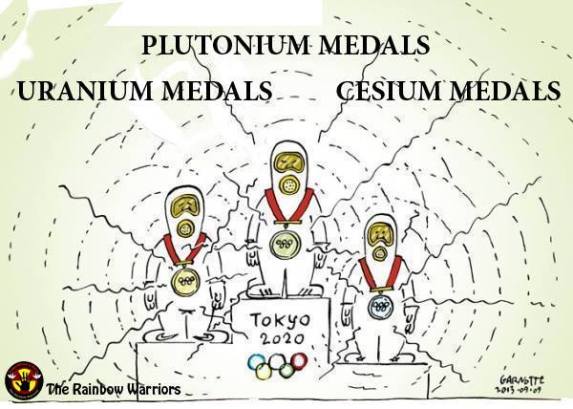
Atomic Balm Part 1: Prime Minister Abe Uses The Tokyo Olympics As Snake Oil Cure For The Fukushima Daiichi Nuclear Meltdowns March 01, 2019, Fairewinds Energy Education, By Arnie Gundersen “……….To determine whether or not Olympic athletes might be affected by fallout emanating from the disaster site, Dr. Marco Kaltofen and I were sponsored by Fairewinds Energy Education to look at Olympic venues during the fall of 2017.We took simple dirt and dust samples along the Olympic torch route as well as inside Fukushima’s Olympic stadium and as far away as Tokyo. When the Olympic torch route and Olympic stadium samples were tested, we found samples of dirt in Fukushima’s Olympic Baseball Stadium that were highly radioactive, registering 6,000 Bq/kg of Cesium, which is 3,000 times more radioactive than dirt in the US. We also found that simple parking lot radiation levels were 50-times higher there than here in the US.
Thirty of the dirt and fine dust samples that I took on my last two trips to Japan in February and March 2016 and September 2017 were analyzed at WPI (Worchester Polytechnic Institute. The WPI laboratory analysis are detailed in the report entitled: Measuring Radioactivity in Soil and Dust Samples from Japan, T. Pham, S. Franca and S. Nguyen, Worchester Polytechnic Institute, which found that:
With the upcoming XXXII Olympiad in 2020 hosted by Japan, it is necessary to look into the radioactivity of Olympic venues as well as tourist attractions in the host cities… Since thousands of athletes and millions of visitors are travelling to Japan for the Olympics, there has been widespread concern from the international community about radiation exposure. Therefore, it is important to investigate the extent of radioactive fallout from the Fukushima Dai-ichi incident.
The measured results showed a much higher activity of Cesium-137 in the proposed torch route compared to other areas. Overall, the further away from the Fukushima Dai-ichi Nuclear Power Plant, the lower the radioactivity. The activity of Cesium-137 in Tokyo, the furthest site from the plant, was the lowest when compared to the other sites. Therefore, the activity of Cesium-137 in Tokyo sample was used as the baseline to qualitatively estimate the human exposure to radiation.
At the Azuma Sports Park, the soil and dust samples yielded a range of 78.1 Bq/kg to 6176.0 Bq/kg. This particular Olympic venue is around 90 km from the Nuclear Power Plant. The other sites that are closer to the Nuclear Power Plant like the tourist route, proposed torch route, and non-Olympic samples have higher amounts due to the close proximity to ground zero of the disaster.
… the proposed torch route samples had the highest mean radioactivity due to their close proximity to the plant. Based on the measurement, we estimated qualitatively that the radiation exposure of people living near the Azuma Sports Park area was 20.7 times higher than that of people living in Tokyo. The main tourist and proposed torch routes had radiation exposure of 24.6 and 60.6 times higher, respectively, than in Tokyo…. Olympic officials should consider using the results of this project to decide whether the radioactivity level at the proposed torch route and the Olympic venues are within acceptable level…… https://www.fairewinds.org/demystify/atomic-balm-part-1-prime-minister-abe-uses-the-tokyo-olympics-as-snake-oil-cure-for-the-fukushima-daiichi-nuclear-meltdowns
Imran Khan to consult nuclear chiefs after India’s first air strike on Pakistan in decades
 ABC News 28 Feb 19 Pakistan’s Prime Minister Imran Khan will stage an emergency parliamentary session and meet with the body in control of Islamabad’s nuclear arsenal in response to India’s first air strikes on Pakistan since 1971.
Key points:
- Indian fighter jets struck an area 50 kilometres into Pakistan on Tuesday
- India said the strike was in response to a terrorist attack that killed 44 Indian police
- Pakistan said its own warplanes had scattered Indian jets, forcing them to drop their payload over uninhabited areas
The two nuclear-armed neighbours have fought three wars since partition in 1947, and the majority of them have been over Kashmir — a territory both India and Pakistan claim in full…….https://www.abc.net.au/news/2019-02-27/imran-khan-stages-meetings-response-to-indian-air-strikes/10853290
1 This Month
26 September – International Day for the Total Elimination of Nuclear Weapons





PLEASE OPPOSE HR 8255 AND S.3639 – bills would accelerate satellite deployment, with no environmental review or safeguards – https://ncstd5li.quorum.us/campaign/169331/
To see nuclear-related stories in greater depth and intensity – go to https://nuclearinformation.wordpress.com
-
Archives
- September 2026 (305)
- August 2026 (330)
- July 2026 (355)
- June 2026 (287)
- May 2026 (306)
- April 2026 (356)
- March 2026 (251)
- February 2026 (267)
- January 2026 (308)
- December 2025 (358)
- November 2025 (359)
- October 2025 (375)
-
Categories
- 1
- 1 NUCLEAR ISSUES
- business and costs
- climate change
- culture and arts
- ENERGY
- environment
- health
- history
- indigenous issues
- Legal
- marketing of nuclear
- media
- opposition to nuclear
- PERSONAL STORIES
- politics
- politics international
- Religion and ethics
- safety
- secrets,lies and civil liberties
- spinbuster
- technology
- Uranium
- wastes
- weapons and war
- Women
- 2 WORLD
- ACTION
- AFRICA
- Atrocities
- AUSTRALIA
- Christina's notes
- Christina's themes
- culture and arts
- Events
- Fuk 2022
- Fuk 2023
- Fukushima 2017
- Fukushima 2018
- fukushima 2019
- Fukushima 2020
- Fukushima 2021
- general
- global warming
- Humour (God we need it)
- Nuclear
- RARE EARTHS
- Reference
- resources – print
- Resources -audiovicual
- Weekly Newsletter
- World
- World Nuclear
- YouTube
-
RSS
Entries RSS
Comments RSS

