China, Russia back Iran as Trump presses Tehran for nuclear talks

By Ryan Woo, Xiuhao Chen and Laurie Chen, March 14, 2025,
- Summary
- China, Russia, Iran say talks should be based on mutual respect
- They say ‘unlawful’ unilateral sanctions should be lifted
- China, Russia urge respect for Iran’s right to peaceful uses of nuclear energy
BEIJING, March 14 (Reuters) – China and Russia stood by Iran on Friday after the United States demanded nuclear talks with Tehran, with senior Chinese and Russian diplomats saying dialogue should only resume based on “mutual respect” and all sanctions ought to be lifted.
In a joint statement issued after talks with Iran in Beijing, China and Russia also said they welcomed Iran’s reiteration that its nuclear programme was exclusively for peaceful purposes, and that Tehran’s right to peaceful uses of nuclear energy should be “fully” respected………………………………………………… https://www.reuters.com/world/asia-pacific/china-iran-russia-kick-off-talks-beijing-over-irans-nuclear-issues-2025-03-14/
Alarmed by Trump, South Korea mulls Japan-style nuclear option
Prominent voices seek capacity to reprocess spent nuclear fuel or enrich uranium and be able potentially to make bombs.
ASIA TIMES, by Daniel SneiderMarch 15, 2025
……………………………………………………………………………………………………………………………………………… The most striking evidence of South Korean alarm over the treatment of allies is the widening discussion of the need to have an independent nuclear arms capability. Conservatives have long advocated that option, but the debate has now moved into progressive circles where prominent voices are calling for South Korea to develop nuclear latency – the capacity to reprocess spent nuclear fuel or enrich uranium to be able to potentially possess fissile material for making bombs.
The Japanese model?
For now, South Korea hopes it can follow the path set by Japanese Prime Minister Shigeru Ishiba and offer Trump concessions ranging from trade, supply chain investment, and cooperation on shipbuilding to promoting South Korea’s role as an asset in a confrontation against China.
At the moment, South Korea does not have an effective government, pending the imminent decision of the Constitutional Court on the impeachment of South Korean President Yoon Suk Yeol. But whatever follows, the South Korean president will have to deal with Trump.
Assemblyman Wi believes the best they can hope for is a smooth and non-confrontational meeting modeled on that of Ishiba, which yielded a joint statement that reaffirmed the US-Japan alliance along the lines of previous statements with the Joe Biden administration.
………………………………………………………………………………….. I think President Trump thinks North Korea is unfinished business left over from the first Trump administration. We have to prepare for the worst.”
Nuclear latency
“The worst” includes the withdrawal of United States Forces Korea (USFK) from South Korea and a withholding of the US nuclear umbrella.
Regardless of how important the U.S.-ROK alliance is now, “there may come a time when it is difficult to rely on the US for our security,” former Minister of Foreign Affairs Yoon Young-kwan wrote in an op-ed published this month. “In preparation for that time, we should strengthen our national defense capabilities, including potential nuclear capabilities, and prepare to handle the deterrence of North Korea with our own strength.”
Progressives are more reticent to endorse nuclear weapons outright, but some have thrown their weight behind nuclear latency – a conscious imitation of the model pursued by Japan to have a full fuel cycle capability. South Korea could, theoretically, reprocess the spent fuel from its power reactors to extract bomb-grade plutonium or, alternatively, have the capacity to enrich uranium, potentially up to bomb-grade levels.
South Korea has long sought to revise the so-called 123 agreement for nuclear cooperation with the United States, which has restricted its ability to have a full fuel cycle. The agreement was only recently reaffirmed, in January at the close of the Biden administration.
In an important column published on March 4 in the progressive newspaper Kyunghyang Shinmun, former Minister of Unification Lee Jong-seok, another close advisor to presidential aspirant Lee Jae-myung, argued that nuclear latency can be achieved within the framework of the Nuclear Non-Proliferation Treaty and with the consent of the United States.
“China, Russia and North Korea, our neighboring countries, are nuclear weapon states, and Japan has already demonstrated its potential,” Lee wrote. “In this situation, it is rather unnatural that South Korea, a nuclear power, cannot reprocess or enrich uranium due to the restrictions of the Korea-US Nuclear Energy Agreement.”
Others in Seoul advocate defecting from the 123 agreement if the United States reduces USFK forces on the peninsula, says Kim Joon-hyung, a Rebuilding Korea Party lawmaker and former senior diplomat.
Kim is a critic of the U.S. alliance but is personally opposed to nuclear latency. “I don’t agree with nuclear proliferation,” he said. “Even if we have nuclear weapons, I don’t think we have security. Small conflicts may become more common. The Korean Peninsula is too small – high tech conventional weapons are enough. Japan will go nuclear and relations with China and Russia will worsen.”
Others are concerned about the isolation that South Korea could experience if it goes down this road. Cho Hyun, a former senior diplomat and progressive foreign policy advisor, helped negotiate the 123 agreement during the Bill Clinton administration. “The right wing thinks we should have our own nuclear development,” Cho told me in Seoul. “We don’t think it is realistic. Some progressives want to request the US for full fuel cycle like Japan. I am against this.”
As the nuclear latency argument rapidly gains support among progressive circles, revising the 123 agreement may become a bargaining chip for South Korea in negotiations with the Trump administration.
At least some inside the administration, though likely not Trump-appointed officials, have become aware of this, prompting media reports that the U.S. Department of Energy is considering labeling South Korea a “sensitive country,” a designation for countries who might be considering going nuclear.
For South Korea, this may only be the start of many shocks to come.
Daniel C. Sneider is a non-resident distinguished fellow at the Korea Economic Institute of America and a lecturer in East Asian studies at Stanford University. https://asiatimes.com/2025/03/alarmed-by-trump-south-korea-mulls-japan-style-nuclear-latency/#
Chinese nuclear weapons, 2025
Bulletin, By Hans M. Kristensen, Matt Korda, Eliana Johns, Mackenzie Knight | March 12, 2025
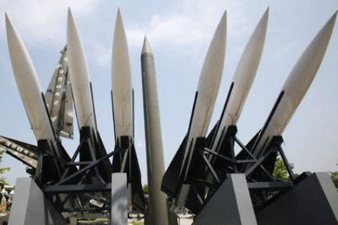
The modernization of China’s nuclear arsenal has both accelerated and expanded in recent years. In this issue of the Nuclear Notebook, we estimate that China now possesses approximately 600 nuclear warheads, with more in production to arm future delivery systems. China is believed to have the fastest-growing nuclear arsenal among the nine nuclear-armed states; it is the only Party to the Treaty on the Non-Proliferation of Nuclear Weapons that is significantly increasing its nuclear arsenal. The Nuclear Notebook is researched and written by the staff of the Federation of American Scientists’ Nuclear Information Project: director Hans M. Kristensen, associate director Matt Korda, and senior research associates Eliana Johns and Mackenzie Knight.
………………………………………………………………………………………………………………………………………………………………………… more https://thebulletin.org/premium/2025-03/chinese-nuclear-weapons-2025/
Movements across the world call for an end to all US military exercises on the Korean peninsula
The call to cancel the military exercises takes on increased urgency given the military accident last week when South Korean jets bombed their own citizens in the region bordering North Korea during the preparation of yet another joint military exercise with the US.
March 12, 2025 by Abdul Rahman, people’s dispatch
Pressure continues to grow against the ongoing Freedom Shield 25, a joint military exercise between the US and South Korea.
The International People’s Assembly (IPA) and International League of Peoples Struggle (ILPS) joined Nodutdol, an anti-imperialist Korean diaspora group, in launching a joint statement calling for the Freedom Shield military exercises to be cancelled, claiming it is drumming up threats of war on the Korean peninsula. The anti-imperialist and anti-war platforms bring together hundreds of people’s movements and organizations across the world.
“Freedom Shield 25 has dire implications for regional and global peace and stability. As part of Washington’s New Cold War against China, the NATO bloc and its Asian and Oceanian partners are escalating in East Asia, using the Korean peninsula as a staging ground. Freedom Shield poses a most immediate threat to the stability of the region, but its effects also extend far beyond,” the statement reads……………………………………………………………………………………………………………………………………. more https://peoplesdispatch.org/2025/03/12/movements-across-the-world-call-for-an-end-to-all-us-military-exercises-on-the-korean-peninsula/
Governor urges contaminated soil be disposed of outside Fukushima by 2045

Soil from radiation decontamination work after the 2011 nuclear reactor
meltdowns in Fukushima Prefecture should be disposed of outside the
prefecture by the deadline set by law, Fukushima Gov. Masao Uchibori said
in a recent interview. A law stipulates that all such soil must be disposed
of outside Fukushima by March 2045.
“The final disposal must be completed
within 20 years, no matter whether the soil is reused (within Fukushima) or
not,” the governor said. However, Shiro Izawa, the mayor of Futaba — one
of the towns hosting Tokyo Electric Power Company Holdings’ crippled
Fukushima No. 1 plant — said lasts month that soil from radiation
decontamination work should be reused in Fukushima. The mayor said this was
his personal opinion. Uchibori pointed out the heavy burden placed on
Futaba and the neighboring town of Okuma for accepting interim storage
facilities for soil from decontamination work.
Japan Times 11th March 2025. https://www.japantimes.co.jp/news/2025/03/11/japan/fukushima-gov-soil-disposal/
‘Nervous and rushed’: Massive Fukushima plant cleanup work involves high radiation and stress
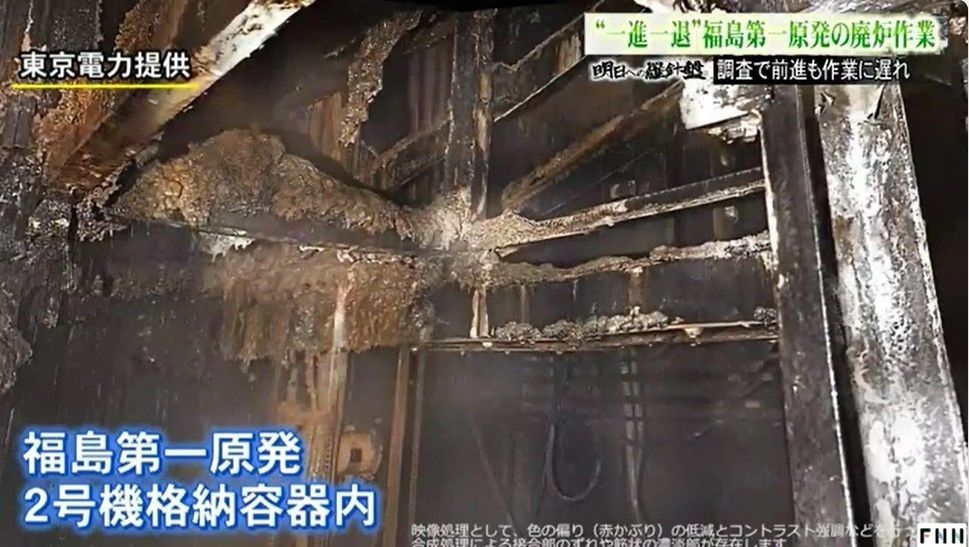
Experts say the hard work and huge challenges of decommissioning the plant are just beginning. There are estimations that the work could take more than a century. The government and TEPCO have an initial completion target of 2051, but the retrieval of melted fuel debris is already three years behind, and many big issues remain undecided.
By ASSOCIATED PRESS, 12 March 2025
OKUMA, Japan (AP) – The Fukushima Daiichi nuclear power plant’s radiation levels have significantly dropped since the cataclysmic meltdown in Japan 14 years ago. Workers walk around in many areas wearing only surgical masks and regular clothes.
It’s a different story for those who enter the reactor buildings, including the three damaged in the 2011 earthquake and tsunami. They must use maximum protection – full facemasks with filters, multi-layered gloves and socks, shoe covers, hooded hazmat coveralls and a waterproof jacket, and a helmet.
As workers remove melted fuel debris from the reactors in a monumental nuclear cleanup effort that could take more than a century, they are facing both huge amounts of psychological stress and dangerous levels of radiation.
The Associated Press, which recently visited the plant for a tour and interviews, takes a closer look.
A remote-controlled extendable robot with a tong had several mishaps including equipment failures before returning in November with a tiny piece of melted fuel from inside the damaged No. 2 reactor.
That first successful test run is a crucial step in what will be a daunting, decades-long decommissioning that must deal with at least 880 tons of melted nuclear fuel that has mixed with broken parts of internal structures and other debris inside the three ruined reactors…………………………………………………
Radiation levels are still dangerously high inside the No. 2 reactor building, where the melted fuel debris is behind a thick concrete containment wall. Earlier decontamination work reduced those radiation levels to a fraction of what they used to be.
In late August, small groups took turns doing their work helping the robot in 15- to 30-minute shifts to minimize radiation exposure. They have a remotely controlled robot, but it has to be manually pushed in and out.
“Working under high levels of radiation (during a short) time limit made us feel nervous and rushed,” said Yasunobu Yokokawa, a team leader for the mission. “It was a difficult assignment.”
Full-face masks reduced visibility and made breathing difficult, an extra waterproof jacket made it sweaty and hard to move, and triple-layered gloves made their fingers clumsy, Yokokawa said.
To eliminate unnecessary exposure, they taped around gloves and socks and carried a personal dosimeter to measure radiation. Workers also rehearsed the tasks they’d perform to minimize exposure…………………………………………………..
a growing number of workers are concerned about safety and radiation at the plant, said Ono, the decommissioning chief, citing an annual survey of about 5,5,00 workers……
Yokokawa and a plant colleague, Hiroshi Ide, helped in the 2011 emergency and are team leaders today. They say they want to make the job safer as workers face high radiation in parts of the plant.
On the top floor of the No. 2 reactor, workers are setting up equipment to remove spent fuel units from the cooling pool. That’s set to begin within two to three years.
At the No. 1 reactor, workers are putting up a giant roof to contain radioactive dust from decontamination work on the top floor ahead of the removal of spent fuel.
To minimize exposure and increase efficiency, workers use a remote-controlled crane to attach pre-assembled parts, according to TEPCO. The No. 1 reactor and its surroundings are among the most contaminated parts of the plant.
Workers are also removing treated radioactive wastewater. They recently started dismantling the emptied water tanks to make room to build facilities needed for the research and storage of melted fuel debris.
After a series of small missions by robots to gather samples, experts will determine a larger-scale method for removing melted fuel, first at the No. 3 reactor.
Experts say the hard work and huge challenges of decommissioning the plant are just beginning. There are estimations that the work could take more than a century. The government and TEPCO have an initial completion target of 2051, but the retrieval of melted fuel debris is already three years behind, and many big issues remain undecided.
Ide, whose home in Namie town, northwest of the plant, is in a no-go zone because of nuclear contamination, still has to put on a hazmat suit, even for brief visits home…….
https://www.dailymail.co.uk/wires/ap/article-14484347/Nervous-rushed-Massive-Fukushima-plant-cleanup-exposes-workers-high-radiation-stress.html
Life as a “displaced person”

Evacuated or not, we all need to protect ourselves from the radioactive contamination resulting from the Fukushima nuclear accident. “Evacuation” is a rightful act of a human being to avoid exposure to radiation so as to enjoy good health. In Japan, however, evacuees are subjected to discrimination and bullying, labeled as “rumor spreaders” since our very existence points out the dangers of radiation. Under this severe social pressure, we can barely express our rightful thought.
https://beyondnuclearinternational.org/2025/03/09/life-as-a-displaced-person/
Fleeing the Fukushima disaster left many families fatherless, including my own, writes Akiko Morimatsu
I am Akiko Morimatsu. I left Fukushima to avoid radiation exposure caused by the Fukushima nuclear catastrophe, and I have been living as an internally displaced person.
Fourteen years have passed since the Great East Japan Earthquake of March 11, 2011 and the subsequent accident at TEPCO’s Fukushima Daiichi Nuclear Power Plant. The accident is far from over and the crippled power plant continues to contaminate the oceans, air, and land connected to the rest of the world. The situation is anything but “under control”, and I am outraged that none of the leaders of the Japanese State have acknowledged this fact.
Even after 14 years, many people continue to remain displaced. The number of evacuees registered with the government (Reconstruction Agency) is still approximately 29,000 people in all 47 prefectures of Japan, and they are in desperate need of government protection and relief.
However, the exact number of evacuees has never been counted by the Japanese government.
In fact, many more people than registered in official statistics have been compelled to flee their homes and are still in distress with no relief in sight, as they are not officially recognized as evacuees.
I have two children. At the time of the disaster, they were a 5-month-old baby and a 3-year-old toddler. For the past 14 years, my husband (the children’s father) lived in Koriyama City, Fukushima Prefecture, and I was living with my children in Osaka City, far apart one from the other.
Thus, people living in contaminated areas outside of the mandatory evacuation zones, made their not-easy-to-take decision to escape from the radiation source with only mothers and their children, who are more vulnerable to radiation. And this, without official aide or support. Even now, there are many people displaced living by their own means, and among them, a large number of households without fathers.
Evacuated or not, we all need to protect ourselves from the radioactive contamination resulting from the Fukushima nuclear accident. “Evacuation” is a rightful act of a human being to avoid exposure to radiation so as to enjoy good health. In Japan, however, evacuees are subjected to discrimination and bullying, labeled as “rumor spreaders” since our very existence points out the dangers of radiation. Under this severe social pressure, we can barely express our rightful thought.
I would also like to strongly emphasize that this issue is not only a problem for the people of Fukushima. I would like to share with everyone in the world the following question: when threatened with nuclear damage, will you stand on the side of those who impose radiation exposure, or will you stand on the side of those who protect people’s lives and health from radiation exposure?
If nuclear power is promoted as a national policy, fleeing will not be easily allowed, and the government can claim, as in Japan, that coexistence with radiation is possible, in order to preserve nuclear power. It is nothing but deception.
The year 2025 will mark 80 years since the end of World War II. Last year, Nihon Hidankyô, the Japan Confederation of A- and H-Bomb Sufferers Organizations, was awarded the Nobel Peace Prize, and hibakusha gave a speech to the world audience, drawing attention to the issue of radiation exposure.
We believe that now is the time to connect with people around the world concerned about nuclear damage. Avoiding radiation exposure to protect lives should be a universally recognized principle. As a victim of the Fukushima nuclear disaster, I, too, have renewed my determination to continue to raise my voice and strive for the establishment of this universal right. Let us continue fighting together.
Following the Great Earthquake and nuclear disaster in Fukushima, Akiko Morimatsu moved from Fukushima to Osaka with her two children aged 5 months and 3 years, leaving her husband who decided to continue working in Fukushima. She is the co-chair of the national coordination of the plaintiffs’ groups of the lawsuits filed by victims of the Fukushima nuclear accident, and the representative of the plaintiffs’ group in the Osaka metropolitan area. She lectures in Japan and abroad to defend the rights of nuclear accident victims. In 2018, she gave a speech at the United Nations Human Rights Council in Geneva. Translation from the Japanese by Kurumi Sugita, Nos Voisins Lontains 3.11.
14 years since Fukushima nuclear disaster: Greenpeace statement
Greenpeace International, 11 March 2025
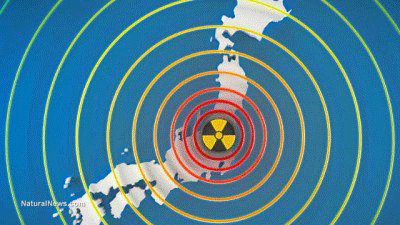
Tokyo, Japan – 14 years have passed since the Great East Japan Earthquake and the Fukushima Daiichi nuclear disaster devastated the northeast region of Japan. Greenpeace Japan extends heartfelt condolences to the victims and their families who are still suffering the aftermath of this devastating catastrophe……………………………
The risks of nuclear power plants increase with the length of time they have been in operation, as does their vulnerability to natural disasters such as earthquakes. The Fukushima Daiichi nuclear accident occurred at a nuclear power plant that had been in operation for more than 30 years, and radiation levels remain so high that even 14 years after the accident, it is still impossible for humans to directly inspect the damaged reactors. Therefore, the change of policy to promote nuclear power is unacceptable.[1]
There is no prospect for the disposal of spent nuclear fuel while the existing storage facilities are already close to full capacity, and many local authorities have yet to put in place an effective method for the safe evacuation of residents living near nuclear power stations in the event of an unforeseen emergency.
In addition, the Japanese Government and the Tokyo Electric Power Company (TEPCO), pushing aside the concerns of fishermen, residents and others, have decided to start deliberately discharging contaminated water containing radioactive substances from the accident at the Fukushima Daiichi Nuclear Power Plant into the environment. This discharge is expected to continue for about 30 years until 2051.
14 years ago, the then Government considered the possibility of evacuating 50 million people in the Tokyo metropolitan area. In fact, water treatment plants in Tokyo even introduced temporary restrictions on the amount of water that infants should drink. Due to the direction of the wind, much of the released radioactive material was carried out to sea, but a different wind direction would have resulted in a completely different outcome. The Prime Minister secretly drafted a statement at that time which stated that the worst case scenario had occurred. Have we, who experienced the accident, stayed true to the feelings we had in our hearts at the time?
The Great Hanshin-Awaji Earthquake 30 years ago, the Great East Japan Earthquake 14 years ago, the Noto Peninsula Earthquake a year ago and other earthquakes and floods across the country have occurred in rapid succession. We can only prepare for these natural disasters as best we can, but nuclear disasters are different. Nuclear disasters are caused by our choice and use of nuclear power as a means of generating electricity in Japan. Fortunately, there are many possibilities in Japan to pursue comfortable energy savings, as the electricity supply can be replaced by renewable energies that use neither nuclear power nor fossil fuels.
Therefore, Greenpeace Japan, whose vision is to preserve the bounty of the earth for our children 100 years from now, believes that the only reasonable course to take is to stop nuclear power generation in order to prevent nuclear disasters from happening again. The government should clearly state its policy to phase out the use of nuclear power and fossil fuels, in order to ensure a stable energy supply and decarbonise the country. They should make great strides in energy conservation in a way that promotes health, comfort and efficiency, and the use of renewable energy in a way that is in harmony with local communities and nature, thereby aiming to make Japan an energy-saving and renewable energy powerhouse. We will do our utmost this year to work towards this goal.” https://www.greenpeace.org/international/press-release/73383/14-years-since-fukushima-nuclear-disaster-greenpeace-statement/
“Difficult-to-Return” zones

Some have returned to areas contaminated by the Fukushima disaster but they should never be considered safe, writes Ruiko Muto
https://beyondnuclearinternational.org/2025/03/09/difficult-to-return-zones/ 9 Mar 25
Last summer, I had the opportunity to visit parts of the Difficult-to-Return zones in Fukushima. A hospital, where more than 50 patients died during evacuation efforts in the 2011 nuclear disaster, was now overgrown with dense trees and grasses. In a care home for older people, I saw disarrayed beds and scattered items, such as diapers, medicines and documents, all left untouched since the residents had to evacuate suddenly for safety. The meal plan for 11th March 2011 was still written on the whiteboard.
At a nearby primary school, I found dictionaries placed on each small wooden desk. Pupils’ bags, shoes, brush washers, and even fallen bicycles as well as helmets were still there – everything was left behind. No sounds were to be heard except for the hum of cicadas. There is no doubt that people lived here until just 13 years ago, but now, there is no one. These places remain abandoned even today.
Only a very small number of people have returned to the areas where evacuation orders were lifted. Empty houses need to be demolished one by one. Grand gates and storehouses, seemingly with centuries of history, are being torn down. New homes have been built nearby for disaster-affected families, with some residents with children moving in from outside Fukushima. A resident told me that the current indoor radiation level was as high as 0.3μSv/h, five to ten times higher than the levels before 2011. Part of the Difficult-to-Return zone begins just behind the fences surrounding these homes. Such living conditions should never be called safe.
Meanwhile, the Japanese government has removed its pledge to reduce reliance on nuclear energy from its Seventh Strategic Energy Plan, signalling their intention to revive the industry. To someone like me, who is acutely aware of the ongoing sufferings from the Fukushima nuclear disaster and the reality that local residents cannot safely stay or evacuate if a similar disaster were triggered by an earthquake in areas like the Noto Peninsula, the epicentre of a major earthquake in 2024, Japan’s continued reliance on nuclear energy seems inconceivably absurd.
In 2022, Japan’s Supreme Court ruled that the government was not liable for the 2011 disaster, dismissing the claims of many evacuees and victims seeking fair compensation and accountability. Since then, it has been revealed by a journalist that there was a collusion between the judge and the executives of Tokyo Electric Power Company (TEPCO). The state of the judicial system in Japan is deeply concerning. Similar rulings in other Fukushima nuclear disaster related cases followed in lower courts, leaving those suffering in an incredibly difficult position.
The extraction of 0.7 gramme of nuclear debris from the damaged Fukushima Daiichi nuclear plant has been recently reported, but the modest “success” was achieved only after repeated failed attempts. Harsh working conditions with high levels of radiation exposure and mismanagement by TEPCO — such as failing to send a company staff member to properly inspect a telescopic device — became evident during the process. No review of the plant’s decommissioning roadmap has been carried out to account for the radioactive decay period, even though no one believes the decommissioning process will be completed by 2051, as originally planned.
Having released contaminated underground water from the plant into the ocean despite strong opposition, Japan is now distributing contaminated soil to wider areas, touting it as a “recycled” material for rebuilding works. In doing so, the Japanese government continues to propagate nuclear safety myths, particularly among younger people, while asserting that they alone have the authority to determine which evidence is scientific and which is not.
Along the quiet Fukushima coastline, almost empty of people, lavish corporate facilities and state-of-the art laboratories have been built with generous subsidiaries under the guise of reconstruction efforts.
A nuclear disaster not only devastates your life and home, but it also deprives you of basic human rights. Confronted with this harsh reality even 14 years after the disaster, I cannot help but feel a sense of despair about the future of Fukushima.
With winter nearly gone and spring just around the corner, I long to be filled with good intentions and to see the world with discerning eyes. Encouraged by the knowledge that many friends around the world are tirelessly working to end nuclear energy production, I will continue to contribute as much as possible to this important cause.
Update: Last week the Japanese Supreme Court upheld the acquittals made by a lower court of two of the three TEPCO ex-executives charged. The charges against ex-chairman Katsumata Tsunehisa were dropped following his death in October last year. Lawyers from the criminal trial support group and Ruiko Muto, the plaintiff’s representative, held a press conference. The following are excerpts from Ms. Muto’s statement, translated from the original Japanese:
“Although the defendants were all acquitted by the District Court and the High Court, we put our hope in the dignity of judges and in the justice of the Supreme Court.
“The fact that this decision was made today just before March 11 shows the heartlessness with which the victims of the nuclear accident were truly treated. I wonder how many victims are disappointed and angry.
“The Fukushima nuclear accident is still ongoing. How much damage has been caused by this accident, how many lives have been ruined, how much negative legacy has been inflicted on future generations! Failure to hold accountable the management of the companies responsible for the accident could lead to another nuclear accident. It is very regrettable and disappointing that the court did not understand all this. We cannot challenge this decision in court, but we are not convinced of its validity. I believe that the responsibility for this accident will be challenged in many ways in the future, and we are determined to continue working towards that goal.”
Ruiko Muto is a Fukushima native and a longtime opponent of nuclear power who has spent more than 30 years in the anti-nuclear movement. Ms. Muto is also co-representative of the Nuclear Accident Victims Group Liaison Committee and the Chair of the Complainants for the Criminal Prosecution of the Fukushima Nuclear Disaster. Translation from the Japanese by Japanese Against Nuclear (UK).
Fukushima victims angered, saddened by TEPCO acquittals.
THE ASAHI SHIMBUN, March 7, 2025, by Susumu Okamoto, Noriyoshi Otsuki, Yuto Yoneda and Takashi Endo. https://www.asahi.com/ajw/articles/15659097?fbclid=IwY2xjawI5r7VleHRuA2FlbQIxMQABHWN3s0dp9P01VgNx6-uHR7J7t09vvNY9N_2gIceMP_VQvQV1fbE1ExO8Qw_aem_q068mi2UQmCXSqQO2wrDJQ
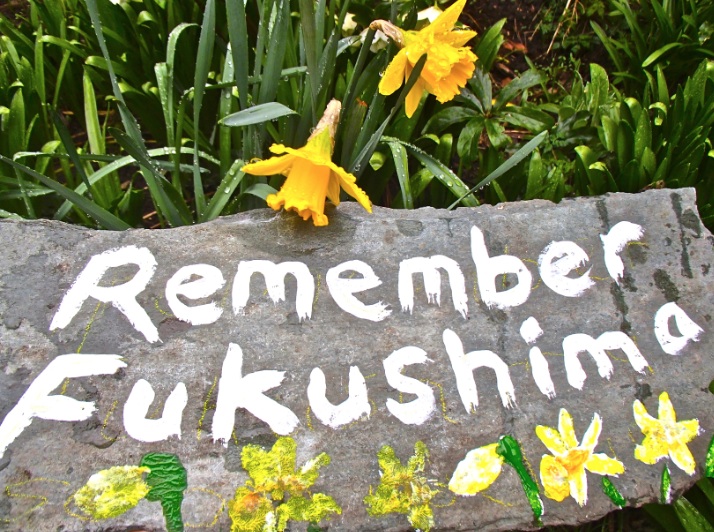
Victims of the Fukushima nuclear disaster expressed outrage and sadness after the Supreme Court upheld the acquittals of two former executives of Tokyo Electric Power Co., operator of the stricken nuclear plant.
But for Yoshinobu Ishii, the March 5 decision came as no surprise.
“I expected this because the rulings of the first and second trials were ‘not guilty,’” said Ishii, 80, from Kawauchi, Fukushima Prefecture.
Ishii’s mother, Ei, died at the age of 91 after being forced to flee from the nuclear accident in March 2011.
“My mother is not coming back, even if I blame someone (for her death),” said Ishii, resigned.
The two former vice presidents at TEPCO were charged with professional negligence resulting in death and injury concerning the company’s preparations for a tsunami that could hit its Fukushima No. 1 nuclear power plant.
However, the top court agreed with earlier rulings that said a tsunami of that scale could not have been foreseen and absolved them of criminal responsibility.
Ishii said he was concerned the ruling could further promote Japan’s return to using nuclear power generation for its energy needs.
EVACUATION PLAN ‘USELESS’
On the morning of March 11, 2011, Ishii’s wife, Aiko, 75, visited Ei at an affiliated facility near Futaba Hospital in Okuma, near the nuclear plant.
Ei, who had hurt her back, ate the grated apple and pickled radish that Aiko had brought, and then said her last words to her daughter-in-law: “Be careful on your way home. Come again tomorrow.”
The Great East Japan Earthquake struck that afternoon, unleashing a tsunami that caused the triple meltdown at the nuclear plant.
In the ensuing chaos, patients left behind in hospitals and related facilities were forced to take buses and other means on a harsh evacuation route exceeding 200 kilometers.
A week after the tsunami, the Ishii couple found Ei’s body wrapped in a white cloth in a high school gymnasium. Her death certificate read: “Cause of death: hypothermia” and “Date of death: around March 14.”
The former TEPCO executives were cleared of negligence charges concerning the deaths of 44 people, including hospital patients like Ei who died in evacuation.
Immediately after the nuclear accident, there was a growing movement to move away from nuclear power generation.
Now, however, nuclear reactors are increasingly being restarted around the nation.
“Japan is a country where many earthquakes occur, so ‘100 percent safety’ is impossible,” Ishii said. “That’s why the nuclear accident happened and why the evacuation plan was useless.”
FEELING HELPLESS
A group of victims in Fukushima Prefecture initiated the criminal procedures against the former TEPCO executives.
The group’s leader, Ruiko Muto, 71, ran a coffee shop in Tamura, Fukushima Prefecture, about 40 kilometers west of the Fukushima No. 1 nuclear power plant.
She had no choice but to close the shop after the accident.
“I wanted to make it clear through a criminal trial who should take responsibility to prevent a repeat of the same mistakes,” she said.
She had sat in the galleries of court rooms since the first hearing of the trial at the Tokyo District Court in 2017.
When she learned on March 6 that the Supreme Court had effectively finalized the not guilty verdicts, she felt frustrated and shed tears.
She fears the acquittals will intensify a sense of helplessness among those affected in Fukushima Prefecture.
“Victims of damage caused by the nuclear accident tend not to speak out,” Muto said.
FOCUS NOW ON CIVIL CASE
Yuichi Kaido, a lawyer representing plaintiffs in both the criminal case and a civil lawsuit against former TEPCO managers, criticized the Supreme Court’s decision at a news conference on March 6.
“Its logic was too rough,” Kaido said.
But he said some good came out of the trial and appeals process, which took more than seven years to complete.
Many TEPCO employees and other related parties testified as witnesses.
“The testimonies at the trial have become invaluable evidence when discussing the nuclear accident,” Kaido said.
In the civil lawsuit, the Tokyo District Court ordered the former TEPCO managers to pay more than 13 trillion yen ($88 billion) in damages over the nuclear accident.
The defendants appealed the ruling, and the Tokyo High Court is expected to hand down its ruling in June.
“It is important to ensure the district court’s ruling is upheld,” Kaido said.
DISAPPOINTMENT
In the criminal case, prosecutors initially decided not to charge the former TEPCO executives.
But a citizens inquest panel twice ruled that they should be prosecuted, and mandatory indictments were applied.
(A third former TEPCO executive was charged, but his trial was terminated after his death in October last year.)
The four designated lawyers who acted as prosecutors in the trial held a news conference after the top court’s decision.
“The Supreme Court did not respond to our arguments,” Shozaburo Ishida said. “I wish they had made a more rigorous decision.”
9-year lawsuit fails to stop Ikata nuclear plant operations

By KAI NEMOTO/ Staff Writer, March 5, 2025, https://www.asahi.com/ajw/articles/15655918
HIROSHIMA—The district court here rejected a request on March 5 by plaintiffs to stop operations at the Ikata nuclear power plant in Ehime Prefecture on the main island of Shikoku.
The Hiroshima District Court ended a nine-year lawsuit brought by 337 plaintiffs, including some who survived the Aug. 6, 1945, atomic bombing of Hiroshima, by rejecting the injunction request.
Although Hiroshima is located about 100 kilometers north of the Ikata plant, operated by Shikoku Electric Power Co., the plaintiffs argued that a serious accident would send radioactive materials spewing into the air and waters of the Seto Inland Sea that lies between Hiroshima and Ehime prefectures.
The main points of contention in the lawsuit filed in March 2016 were the safety of the Ikata plant against earthquakes and volcanic eruptions in Kyushu.
During the course of the trial, atomic bomb survivors testified about what they went through after Hiroshima was leveled 80 years ago.
The Ikata nuclear plant began operations in 1977, but only the No. 3 reactor is currently operating. The other two reactors are in the process of being decommissioned.
Similar lawsuits to stop operations have been filed in other district courts in the region, but in March 2024 the Oita District Court rejected the request by plaintiffs, who appealed to the Fukuoka High Court.
Debris extracted from Fukushima nuclear plant revealed to media
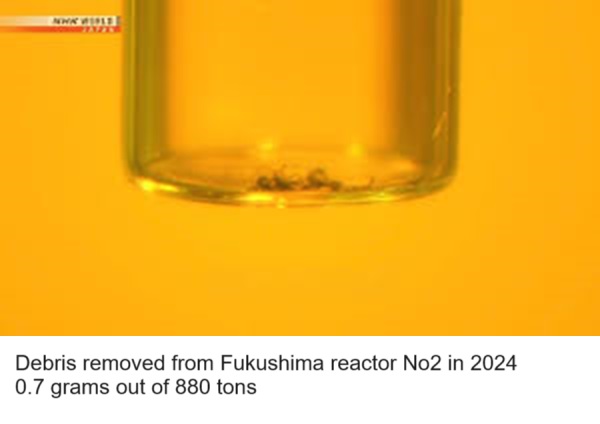
Friday, Feb. 21, https://www3.nhk.or.jp/nhkworld/en/news/20250221_08/?fbclid=IwY2xjawInSAlleHRuA2FlbQIxMQABHSRSw2PSosgQ6p28ndBqzler46N1Sr9mAHZH_X5SQL5hfjsJ5Tr3M48JTg_aem_xXho8cY6EkFQUvxp6aOcZQNuclear fuel debris that was extracted from the damaged Fukushima Daiichi nuclear power plant last year has been revealed to reporters for the first time.
The debris taken from the plant’s No.2 reactor consists of molten fuel mixed with surrounding structural components. The operator, Tokyo Electric Power Company, successfully retrieved 0.7 grams of the material in its first test extraction operation through November last year.
The debris was first transferred to a research facility of the Japan Atomic Energy Agency in Oarai Town, Ibaraki Prefecture, for the initial analysis, including surface observation.
The researchers then split the debris into smaller pieces to be examined at five research facilities, including a large one in Hyogo Prefecture.
Reporters were given the opportunity to observe the samples, which were placed in two separate transparent containers at a facility in Ibaraki Prefecture. One container held a particle about 2 millimeters in size that appeared silver, while the other had multiple dark fragments.
So far, the researchers have detected uranium, which is contained in nuclear fuel, on the surface of the debris, as well as metals such as iron, which are believed to have come from the reactor’s structure.
The researchers plan to examine the characteristics of the debris, including its hardness and adhesiveness. They will also expose the samples to lasers to determine whether the uranium inside is prone to triggering a nuclear fission reaction.
The agency says it will use these analyses to evaluate potential methods for full-scale extraction of the debris, and to determine the risk of a renewed criticality event, in which a self-sustaining chain reaction could occur.
The agency plans to release the findings of the major analyses in the middle of this year.
Ogino Hideki, the chief engineer at the agency’s Collaborative Laboratories for Advanced Decommissioning Science, spoke to the reporters.
He said it is difficult to fully grasp the overall characteristics of the debris based on the ongoing analyses alone. But he expressed his commitment to contributing to the decommissioning efforts through analyzing the samples using the technology that he and his fellow researchers have developed.
It is estimated that there is a total of around 880 tons of fuel debris in the No. 1, 2 and 3 reactors.
5.0-magnitude quake strikes off Japan’s Fukushima: JMA
TOKYO, Feb. 21 (Xinhua) https://english.news.cn/20250221/1a62306993674102b4bf547c66308416/c.html?fbclid=IwY2xjawInSGJleHRuA2FlbQIxMQABHaLmlIJlO8LIDD4_tC9mDYzpZnPQTSalQEzW0hj-j5vNUxWQ8hVw_Wrelw_aem_JSAQL14AGKbnrwbZ10cXPA
— An earthquake with a preliminary magnitude of 5.0 struck off the northeastern Japanese prefecture of Fukushima on Friday, the country’s weather agency said.
The temblor occurred at around 10:01 p.m. local time at a depth of 50 km, measuring 4 on the Japanese seismic intensity scale of 7, according to the Japan Meteorological Agency (JMA).
The epicenter was located at a latitude of 37.5 degrees north and a longitude of 141.5 degrees east.
There was no tsunami warning, the JMA added
Japan to pick final disposal sites for Fukushima soil around 2030

The Environment Ministry plans to decide around 2030 or later where to finally dispose of soil removed from the ground during decontamination work after the March 2011 disaster at Tokyo Electric Power Company Holdings’ Fukushima No.1 nuclear power plant, it was learned Wednesday.
The plan was included in a draft timetable for the final disposal of such soil outside Fukushima Prefecture by March 2045, presented by the ministry at a meeting of a related expert panel on the day. The ministry will consider a process for selecting final disposal sites from fiscal 2025.
As of the end of December, about 14 million cubic meters of such soil had been transported to an interim storage facility straddling the Fukushima towns of Okuma and Futaba.
Three-quarters of the soil had radiation concentrations of 8,000 becquerels per kilogram or less and will be reused in public works, while the rest will be subject to final disposal.
Final disposal sites are estimated to require up to 50 hectares if the volume of the soil is not reduced, or 2 to 3 hectares if the volume is reduced. Meanwhile, radiation levels would be higher in the reduced soil.
The government is slated to draw up a basic plan as early as this spring for reusing some of the soil and finally disposing of the rest.
TEPCO takes on challenge of making space for Fukushima nuclear debris
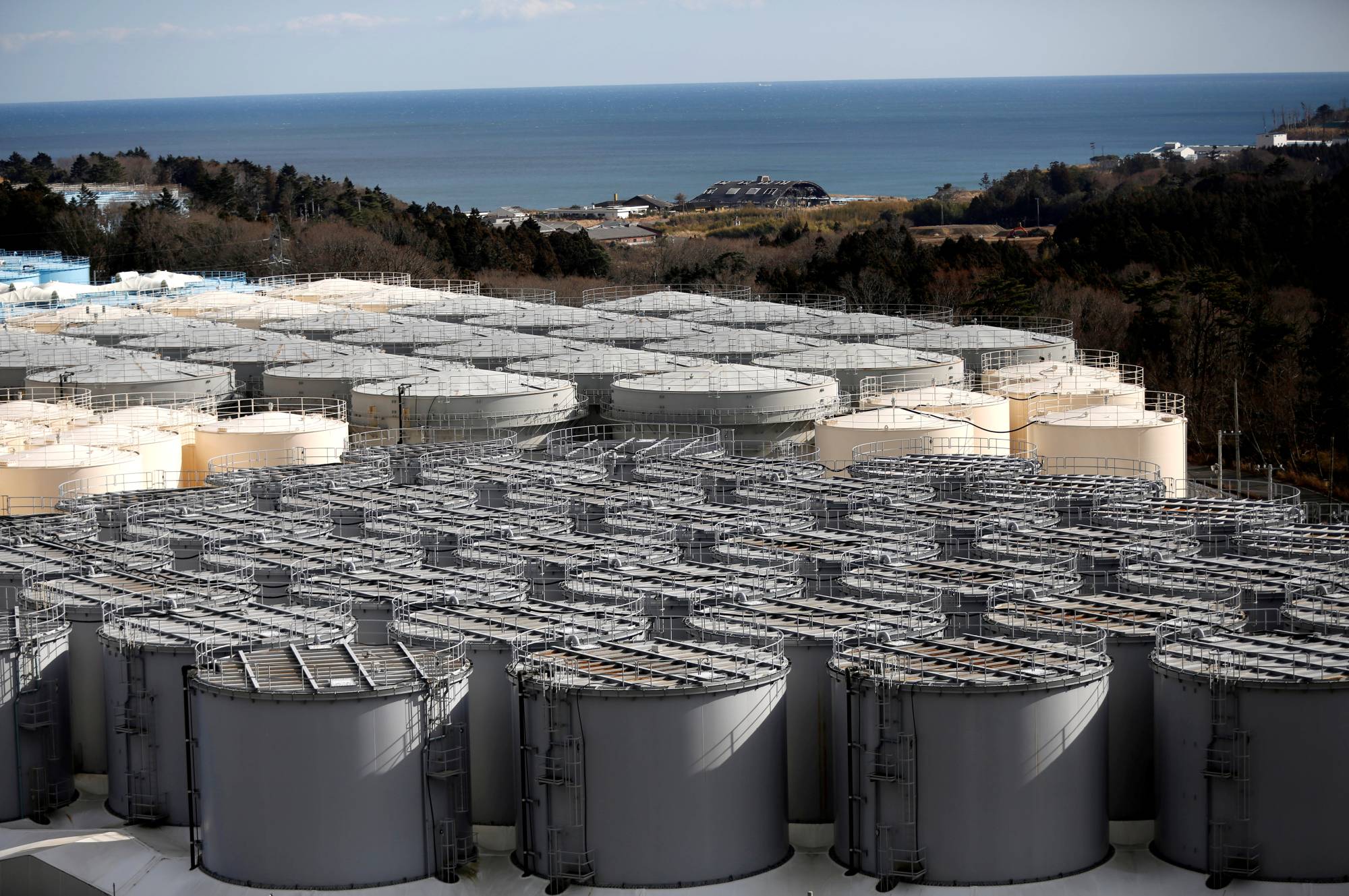
Fukushima Daiichi Nuclear Power Plant (Japan) (AFP) – Workers at Japan’s crippled Fukushima nuclear plant have started dismantling water storage tanks to free up space for tonnes of nuclear debris, 14 years after the facility was hit by a devastating tsunami.…………………….
France24 15th Feb 2025, https://www.france24.com/en/live-news/20250215-tepco-takes-on-challenge-of-making-space-for-fukushima-nuclear-debris
1 This Month
5 March -Online – Reversing nuclearization:
From nuclear weapons in Belarus and NATO host countries to a European-Nuclear-Weapon Free Zone
11am-12:30pm Eastern Time USA / 5pm-6:30pm CET

of the week – Advocating for a
nuclear free beach – https://www.samuellawrencefoundation.org/
The Samuel Lawrence Foundation advocates for a Nuclear Waste Free Beach at San Onofre, join us and take action!

10 March A LIVE WEBINAR THE REAL EFFECTS OF NUCLEAR POWER
What the Industry Isn’t Telling Us
1:00 PM Mountain, 2 pm Central, 3 pm Eastern. Live on the Keepers of the Water Facebook page

18 March Webinar @ 1 PM EST: An Assessment of SMR Projects: The Case of Canada
register for the zoom:
https://us02web.zoom.us/webinar/register/WN_o8BIIOUvQ2ONJR1nta65DQ#/registration

of the week – STOP SMALL MODULAR REACTORS IN CANADA
To see nuclear-related stories in greater depth and intensity – go to https://nuclearinformation.wordpress.com
-
Archives
- March 2026 (51)
- February 2026 (268)
- January 2026 (308)
- December 2025 (358)
- November 2025 (359)
- October 2025 (376)
- September 2025 (258)
- August 2025 (319)
- July 2025 (230)
- June 2025 (348)
- May 2025 (261)
- April 2025 (305)
-
Categories
- 1
- 1 NUCLEAR ISSUES
- business and costs
- climate change
- culture and arts
- ENERGY
- environment
- health
- history
- indigenous issues
- Legal
- marketing of nuclear
- media
- opposition to nuclear
- PERSONAL STORIES
- politics
- politics international
- Religion and ethics
- safety
- secrets,lies and civil liberties
- spinbuster
- technology
- Uranium
- wastes
- weapons and war
- Women
- 2 WORLD
- ACTION
- AFRICA
- Atrocities
- AUSTRALIA
- Christina's notes
- Christina's themes
- culture and arts
- Events
- Fuk 2022
- Fuk 2023
- Fukushima 2017
- Fukushima 2018
- fukushima 2019
- Fukushima 2020
- Fukushima 2021
- general
- global warming
- Humour (God we need it)
- Nuclear
- RARE EARTHS
- Reference
- resources – print
- Resources -audiovicual
- Weekly Newsletter
- World
- World Nuclear
- YouTube
-
RSS
Entries RSS
Comments RSS
 nuclear-news