Japan’s trouble-plagued nuclear fuel reprocessing plant Rokkasho should be shut down

Rokkasho plant should be shut down in energy policy shift, Asahi Shimbun, July 31, 2020 “…….. The Nuclear Regulation Authority on July 29 approved an outline of safety measures for the trouble-plagued nuclear fuel reprocessing plant Japan Nuclear Fuel Ltd. is building in Rokkasho, Aomori Prefecture…..
The Nuclear Regulation Authority on July 29 approved an outline of safety measures for the trouble-plagued nuclear fuel reprocessing plant Japan Nuclear Fuel Ltd. is building in Rokkasho, Aomori Prefecture
It is also nearly impossible to find a site for building a new nuclear plant. As aged reactors will be decommissioned one after another in the coming years, the importance of nuclear power generation for Japan’s energy supply will steadily diminish.
Over the long term, Japan needs to phase out nuclear power generation to remove public anxiety about a large-scale accident.
Nuclear fuel recycling can have no great significance in this new era when Japan has to start shifting away from atomic energy. Many industrial nations have long given up nuclear reprocessing as economically unviable.
Another big problem with reprocessing the spent fuel is that it produces plutonium, a material that can also be used to make nuclear weapons.
Japan has a stockpile of some 46 tons of plutonium, stored both at home and abroad, an amount enough to make 6,000 atomic bombs. It is fueling fears and drawing criticism internationally.
Japan Nuclear Fuel’s plant in Rokkasho is designed to have the capacity of reprocessing 800 tons of spent nuclear fuel annually to recover 7 tons of plutonium.
But the plan to develop a fast neutron reactor that can “consume” plutonium by transforming it into other forms of nuclear waste, the key technology for plutonium consumption, has gone awry with the decision to decommission Japan’s “Monju” prototype sodium-cooled fast-breeder reactor.
There are clearly also limitations to the plan to burn so-called MOX (mixed oxide) fuel, which is usually plutonium blended with natural uranium, in existing nuclear reactors.
The government has promised the international community to reduce the nation’s surplus plutonium. That means the reprocessing operation at the Rokkasho plant will have to be restricted so that the amount of plutonium recovered will not exceed consumption.
It simply does not make sense to spend as much as 14 trillion yen ($134.33 billion) on building the plant to recover a small amount of plutonium.
Given that this huge cost will be passed onto consumers through higher electricity bills, it is impossible to win broad public support for the project.
If the government decides to pull the plug on the fuel recycling program, it will have to face tough policy challenges it has long avoided tackling, such as how to dispose of spent fuel. But the nation cannot make the inevitable leap into the new age of energy if it continues spending huge amounts on nuclear power generation, which is beset by so many problems.
There is a growing global trend toward renewable energy sources such as solar and wind power. This is the time for the government to make a radical shift in its energy policy. http://www.asahi.com/ajw/articles/13594167
India’s nuclear power industry – unsafe and shrouded in secrecy
 The alarming safety record of India’s nuclear power plants https://tribune.com.pk/article/97109/the-alarming-safety-record-of-indias-nuclear-power-plants In 2016, an emergency was declared when the nuclear plant at Kakrapar was shut down after a major water leak, Syed Zain Jaffery, July 28, 2020
The Indian nuclear power industry is still veiled in confidentiality and opacity while refusing to reveal its safety details. Prominent environmental watchdogs have already voiced apprehensions about safety standards adopted by the nuclear establishment, where technical negligence or poor maintenance is commonplace, and regulatory bodies in India habitually sweep major nuclear accidents under the carpet. The production of nuclear energy is regulated in secrecy by a government body known as the Nuclear Power Corporation of India (NPCIL).
It is no mystery as to why India is reluctant to establish a completely autonomous and politically neutral nuclear oversight authority to discretely operate from the industry it oversees. The nuclear disaster in Fukushima demonstrated the significance of independent nuclear oversight. India’s persistent refusal to create an independent regulatory body shows a lack of confidence in maintaining standards which are internationally recognised.
The former chairman and managing director of Nuclear Power Corporation, S.K. Jain, was of the view that,
This entire episode shows the lack of awareness in India regarding upholding proper safety procedures through a timely tackling of any evolving threats.
Alarmingly, Indian nuclear engineers failed to investigate the exact reason for the leakage. The central government unpublicised the incident and did not even allow ordinary citizens to use geiger-counters to measure radiation. Shockingly, New Delhi has prohibited the use of geiger-counters, which is a global norm, under the vague excuse of national security. An on-site emergency at Kakrapar nuclear power plant and the circumstance that led to the major leakage raises many questions regarding Indian nuclear expertise.
Syed Zain Jaffery The author holds a Masters degree from NUST, Islamabad and writes about current affairs and politics.
Local approval still needed, as Japan’s nuclear regulators OK fuel reprocessing plant, despite safety concerns
The regulators said on Wednesday that they had received about 760 opinions, and that many of them were about safety. The risk of radioactive materials leaking out was among the concerns.
The regulators concluded that the operator had measures in place to deal with the concerns, and said the firm’s application had been approved.
Japan Nuclear Fuel Limited wants to complete construction by September 2021, and launch operations in 2022. But the construction work, which began 27 years ago, has been delayed by problems. That has caused the cost to balloon to more than 130 billion dollars.
Plans to use the reprocessed plutonium are not moving forward as initially outlined.
The government and energy firm also still need to obtain local approval. https://www3.nhk.or.jp/nhkworld/en/news/20200729_20/
Thorium nuclear plan with USA firm – a dubious deal for Indonesia
 Thorcon, Defense Ministry to cooperate on thorium nuclear reactor, Norman Harsono, The Jakarta Post Thorcon, Defense Ministry to cooperate on thorium nuclear reactor, Norman Harsono, The Jakarta PostJakarta / Tue, July 28, 2020 United States-based nuclear company Thorcon International Pte Ltd and Indonesia’s Defense Ministry signed a deal on Jul. 22 to study developing a thorium molten salt reactor (TMSR) for either power generation or marine vehicle propulsion.Thorcon said it would provide technical support to the ministry’s research and development (R&D) body to develop “a small-scale TMSR reactor under 50 megawatts (MW)”, the company wrote in a statement on Friday, Jul. 24,
“[This will] strengthen national security in the outermost, frontier and least developed regions,” reads the company’s statement……… “We hope Thorcon may be more open toward providing technical support for the Defense Ministry’s R&D body in making the designs and technical preparations for when we enter the construction phase,” the ministry’s statement reads. At 50 MW, the Defense Ministry’s “small-scale” reactor would become the biggest nuclear reactor in Indonesia. The country’s current largest reactor – a non-commercial facility – is the 30 MW GA Siwabessy reactor in Serpong, Banten. …… Thorium nuclear technology is also unready for commercial application, National Nuclear Energy Agency (Batan) director Dandang Purwadi told The Jakarta Post earlier this year. “We have to wait around 10 years for the technology to mature, then it takes 10 years to build the facility”, he said, commenting on Thorcon’s planned commercial plant. Energy experts speaking at a discussion on Jul. 1 pointed out that nuclear plants were losing popularity and were much more costly than renewables, despite improvements in nuclear plant safety, following headline grabbing meltdowns. … “Usage of nuclear power plants is entering a sunset phase,” said Herman Ibrahim, country chairman of the Paris-based International Council on Large Electric Systems (CIGRE). https://www.thejakartapost.com/news/2020/07/28/thorcon-defense-ministry-to-cooperate-on-thorium-nuclear-reactor.html |
|
Kim Jong Un says that North Korea’s nuclear weapons guarantee its freedom from attack, and war
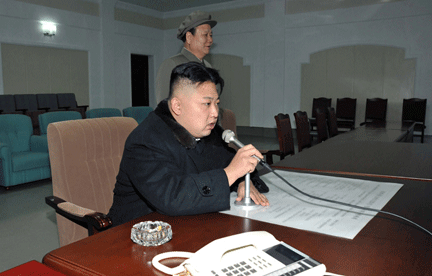 North Korea’s Kim Says No More War Thanks to Nuclear Weapons, VOA, By Reuters July 27, 2020 SEOUL, SOUTH KOREA – North Korean leader Kim Jong Un has said there will be no more war as the country’s nuclear weapons guarantee its safety and future despite unabated outside pressure and military threats, state media said Tuesday.
Kim made the remarks as he celebrated the 67th anniversary of the end of the 1950-53 Korean War, which fell on July 27, with a reception for veterans, the official KCNA news agency said.
The country developed nuclear weapons to win “absolute strength” to stave off another armed conflict, Kim said in a speech carried by KCNA, emphasizing the defensive nature of the programs. ………
The speech came amid stalled talks aimed at dismantling Pyongyang’s nuclear and missile programs in exchange for sanctions relief from Washington. ……https://www.voanews.com/east-asia-pacific/north-koreas-kim-says-no-more-war-thanks-nuclear-weapon
Global heating means more rain for Asian monsoon regions
 Wetter than wet: Global warming means more rain for Asian monsoon regions EurekAlert, Large-scale simulation reveals how Asian monsoons will transform with climate change TOKYO METROPOLITAN UNIVERSITY 26 Jul 20, Tokyo, Japan – Researchers from Tokyo Metropolitan University studied how the weather will change with global warming in Asian monsoon regions using a high-resolution climate simulation. The region is home to a large population, and the monsoons are a major driver of global water cycles. They explicitly simulated cloud formation and dissipation, and found significantly increased precipitation over the monsoon “trough,” with tropical disturbances such as typhoons and concentrated water vapor playing key roles.
As the world braces itself for the impact of global warming, it is now more vital than ever to have an accurate, detailed picture of how exactly the climate will change. This applies strongly to the Asian monsoon regions, where vast amounts of annual precipitation make it an important part of global energy and water cycles. As home to a large proportion of the world population, detailed, local predictions for the scale and nature of monsoons and tropical disturbances such as typhoons/cyclones have the potential to inform disaster mitigation strategies and key policymaking. ………. https://www.eurekalert.org/pub_releases/2020-07/tmu-wtw072220.php
Robot to use brush to retrieve melted fuel at Fukushima plant
Robot to use brush to retrieve melted fuel at Fukushima plant, Asahi Shimbun, By KEITARO FUKUCHI/ Staff Writer, July 27, 2020 FUKUSHIMA--A robotic arm under development in Britain will use a brush and vacuum vessel on its end to collect melted fuel in a step toward retrieving debris at the crippled Fukushima No. 1 nuclear power plant.
Details of the device, which will start collecting debris inside the No. 2 reactor on a trial basis next year, were announced on July 2.
The government and plant operator Tokyo Electric Power Co. plan to retrieve melted fuel at the No. 2 reactor ahead of two other reactors because radiation levels are relatively low……..
Training is expected to reduce the time required for workers to put debris into the transfer vessel near the fuel.
Other measures to lessen workers’ doses will be taken, such as introducing panels to block radiation. http://www.asahi.com/ajw/articles/13529394
EDF denies that China has increasingly big role in UK’s Hinkley Point nuclear project
 EDF Denies Rising Chinese Influence at U.K. Nuclear Site, Bloomberg, By Corinne Gretler, July 26, 2020,
- Chinese partner’s role bigger than disclosed, Telegraph said
- EDF said allegations are ‘untrue,’ CGN’s role not increasing
Electricite de France SA denied a media report that China General Nuclear Power Corp.’s role at a U.K. nuclear site is increasing, underlining the growing tensions about China’s involvement in critical infrastructure.
The company understated the number of Chinese personnel on site and leaned heavily on CGN’s expertise in planning and construction, the Sunday Telegraph reported, citing company documents and unidentified sources. The newspaper also said Chinese engineers proposed a way to lift a concrete dome onto the reactor at Hinkley Point C that would’ve involved dangling the heavy structure above workers, before it was deemed too dangerous…………
EDF owns about two-thirds of the Hinkley Point program while CGN holds the rest. The project was approved in 2016. The Tories have demanded a review of the plant, the Telegraph said, citing former Conservative leader Sir Iain Duncan Smith saying ministers were misled when they approved China’s role as just a financial partner in the project. https://www.bloomberg.com/news/articles/2020-07-26/dalio-warns-of-u-s-china-capital-war-that-would-hit-dollar
China’s government-run nuclear institutions are experiencing a brain drain.
 Mass resignations at state-run nuclear institute alarms China https://www.wionews.com/world/mass-resignations-at-state-run-nuclear-institute-alarms-china-315515 Mass resignations at state-run nuclear institute alarms China https://www.wionews.com/world/mass-resignations-at-state-run-nuclear-institute-alarms-china-315515
WION Beijing, China Jul 23, 2020, Edited By: Palki Sharma
STORY HIGHLIGHTSReportedly, ‘China’s best minds’ had access to extremely sensitive information and their sudden resignation has raised many conspiracies and theories regarding the exodus. A crisis has erupted in a major Chinese research institute in the form of mass resignation of 90 nuclear scientists. The Communist Party has launched an investigation after calling it ”brain drain”. However, the incident has become a major concern because of the massive number that have tendered their resignation. ”China’s best minds” reportedly had access to extremely sensitive information and their sudden resignation has raised many conspiracy theories regarding the exodus. The scientists of the Institute of Nuclear Energy Safety Technology(INEST) in China’s eastern city of Hefei are now in the headlines. This institute is part of the Hefei institutes of physical science that’s under the state-run Chinese Academy of Sciences – China’s top research body. INEST specialises in advanced nuclear energy and safety technology which participates in more than 200 national and international projects. It has about 600 members and 80 per cent of the researchers have PhD degrees. Last year, INEST was in the news for developing a virtual nuclear power planet, something that can be used for safety assessment. However, the tables have turned and some serious systemic issues have come to light due to this year’s incident. In June, INEST employees clashed with the staff of their parent institute. Reports say they fought over who gets to control access to their facilities. As per a theory, the institute was unable to get big projects due to lack of funding and the researchers were poached by private companies. China’s Vice Premier Liu He has announced that a team will be sent to investigate the mass resignations. The seriousness of event can also be assessed by the fact that 90 out of the 500 members have left. Last year, the figure had dropped to 200, it is now believed that only 100 researchers work there. The fact is that scientific research in China is largely in the hands of state-run universities and research institutes. While outwardly the premise of research and innovation is the freedom to explore, it is controlled by Beijing and managed by the Communist Party of China. The jobs at state-run institutes promised stability, better benefits but young researchers are now more than willing to give up these jobs and move to the private sector for more money and more freedom. The state run institutions are the like brain trust of China and now they are witnessing a brain drain. |
|
South Asia floods displace millions and kill 550
|
Humanitarian crisis warning as South Asia floods displace millions and kill 550, The Canary 23 Jul 20, More than 9.6 million people across South Asia have been affected by severe floods, with hundreds of thousands struggling to get food and medicine, officials and aid organisations said.About 550 people have died in India, Bangladesh and Nepal, while millions have been displaced from their homes since the flooding began last month, said the International Federation of Red Cross and Red Crescent Societies (IFRC). The organisation warned of a humanitarian crisis, saying that close to one third of Bangladesh has already been flooded, with more flooding expected in the coming weeks. It said 2.8 million people have been affected, and that more than one million are isolated In India, more than 6.8 million people have been affected by the flooding, mainly in the northern states of Assam, West Bengal, Bihar and Meghalaya bordering Bangladesh, the IFRC said, citing official figures. In India’s north-eastern state of Assam alone, some 2.5 million people were affected and at least 113 have died, authorities said. MS Manivannan, head of Assam’s Disaster Management Authority, said many rivers were still flowing above the danger level……. Jagan Chapagain, secretary general of the IFRC, said South Asia could face a humanitarian crisis. “People in Bangladesh, India and Nepal are sandwiched in a triple disaster of flooding, the coronavirus and an associated socioeconomic crisis of loss of livelihoods and jobs,” he said. “Flooding of farmlands and destruction of crops can push millions of people, already badly impacted by Covid-19, further into poverty.” https://www.thecanary.co/discovery/news-discovery/2020/07/22/humanitarian-crisis-warning-as-south-asia-floods-displace-millions-and-kill-550/?fbclid=IwAR3qePVk0IamgIn4kqDOarIgD-NX7iNROR87_3Ui0OO_vdSNG9_iuNKUx6M |
|
Virtual tours planned at Hiroshima Peace Memorial Museum and the Nagasaki Atomic Bomb Museum
Virtual tours planned at atomic bomb museums, https://www3.nhk.or.jp/nhkworld/en/news/20200721_43/?fbclid=IwAR2KZ-D8gWm-K1Yl8WVBDpUyobELxvI6Hm-DiWxtZYPBmyS8mo9BOneLd2E 21 Jul 20, Two Japanese museums dedicated to documenting the 1945 atomic bombings of Hiroshima and Nagasaki plan to offer virtual tours online in cooperation with an international NGO devoted to the elimination of nuclear weapons.They are planning the events as the number of international visitors to these museums has dropped sharply due to the coronavirus pandemic.
Kawasaki Akira, a member from the International Campaign to Abolish Nuclear Weapons, or ICAN, unveiled the plan online on Monday.
The exhibits at the Hiroshima Peace Memorial Museum and the Nagasaki Atomic Bomb Museum will be shown live on Instagram. Volunteers and researchers from universities will explain the displays in English.
The Hiroshima museum will hold the virtual tour on Wednesday for about 30 minutes after closing time, between 6:30 p.m. and 7p.m. Japan time.
The Nagasaki museum will hold it on Friday for about 30 minutes before opening time, between 8:00 a.m. and 8:30 a.m. Japan time.
Kawasaki said his group and the museums want to do everything possible online as various activities have been canceled due to the coronavirus pandemic.
He said he wants to offer young people abroad an opportunity to find out about the damage and aftereffects of the atomic bombings of the two cities.
Why the nuclear whistleblower exposing AQ Khan was ignored
The CIA’s failure to stop him in 1975 “was the first monumental error”, Robert Einhorn, who worked on nonproliferation in the Clinton and Obama administrations, told Frantz and Collins. The Americans asked the Dutch “to inform them fully but not take any action”, Lubbers recalled, laughing. He said he “found it a bit strange”, but also thought, “‘OK, it’s American business.’ We didn’t feel . . . safeguarding the world against nuclear proliferation as a Dutch responsibility.” The business of the Netherlands was business. The CIA would watch Khan for decades.
Arms Control Today interviews Hiroshima Mayor Kazumi Matsui
 Freeing the World of Nuclear Weapons: Arms Control Today interviews Hiroshima Mayor Kazumi Matsui https://www.armscontrol.org/act/2020-07/features/freeing-world-nuclear-weapons-arms-control-today-interviews-hiroshima-mayor July/August 2020As the site of the first atomic bomb attack, Hiroshima has served as a vital center for education about nuclear weapons and their effects. The people of the city, along with those of Nagasaki, have been steadfast in their advocacy for abolishing nuclear weapons. The survivors of the U.S. atomic bombings on Japan, the hibakusha, have worked to communicate their experience to global citizens and leaders. Kazumi Matsui, Hiroshima’s mayor since 2011, has played a major role in that effort. He serves as president of Mayors for Peace, an assembly of thousands of cities worldwide devoted to protecting cities from the scourge of war and mass destruction. Freeing the World of Nuclear Weapons: Arms Control Today interviews Hiroshima Mayor Kazumi Matsui https://www.armscontrol.org/act/2020-07/features/freeing-world-nuclear-weapons-arms-control-today-interviews-hiroshima-mayor July/August 2020As the site of the first atomic bomb attack, Hiroshima has served as a vital center for education about nuclear weapons and their effects. The people of the city, along with those of Nagasaki, have been steadfast in their advocacy for abolishing nuclear weapons. The survivors of the U.S. atomic bombings on Japan, the hibakusha, have worked to communicate their experience to global citizens and leaders. Kazumi Matsui, Hiroshima’s mayor since 2011, has played a major role in that effort. He serves as president of Mayors for Peace, an assembly of thousands of cities worldwide devoted to protecting cities from the scourge of war and mass destruction.
In response to the coronavirus pandemic, Hiroshima is planning to scale back large gatherings and instead hold virtual events marking 75 years since the August 6, 1945, bombing. Matsui spoke with Arms Control Today on June 23. Arms Control Today: Seventy-five years after the first nuclear test explosion and the atomic bombings that destroyed your city and Nagasaki, what message do you, as the president of Mayors for Peace, and the people of Hiroshima, including the hibakusha, have for others around the world about living under the dark shadow of nuclear weapons? Mayor Kazumi Matsui: In August 1945, two single atomic bombs dropped on the cities of Hiroshima and Nagasaki instantly reduced them to rubble, taking more than 210,000 precious lives. With almost 75 years since the bombings, the hibakusha, those who barely survived, still suffer from the harmful aftereffects of radiation. While their minds and bodies are in pain, they, together with other members of the public, continue to make their appeal that “no one else should suffer as we have.” However, today, the nuclear-armed states possess about 13,000 nuclear warheads. The destructive power of every one of them is far above the atomic bombs dropped on Hiroshima and Nagasaki. These weapons could be used by accident or for terrorism. The current situation is far from what the citizens of Hiroshima, including the hibakusha, have been seeking for so long. This is because the nuclear-armed states and their allies consider nuclear deterrence as essential for their security assurance, prioritizing the pursuit of only their own misguided national interest. However, this poses a grave threat to the survival of us all, the whole of humanity. The current global coronavirus pandemic is a transboundary crisis that touches us all. We are experiencing firsthand that we can confront and defeat common threats through solidarity and cooperation. Based on what we have learned from this experience, we must build a robust global coalition of citizens everywhere to address and solve global security challenges, especially nuclear weapons. We must not take action based on self-centered nationalism. I sincerely hope that everyone in the world will share in the hibakusha’s message and join us in realizing a peaceful world free of nuclear weapons. ACT: There are now fewer and fewer hibakusha and fewer people who have witnessed the devastation of the atomic bombings. What can be done over the next 75 years to remind current and future generations of the experiences and the messages of the survivors of the Hiroshima and Nagasaki bombings and the health impacts of the use of nuclear weapons? Are we at risk of forgetting? Matsui: The average age of the hibakusha has exceeded 82. With their unshakable conviction that “no one else should suffer as we have,” they have conveyed their experiences and their desire for peace to younger generations. However, if we leave this important task of passing down to the future generations to the hibakusha alone, then unfortunately, sooner or later, there will no longer be anyone able to do so. In order to ensure that the hibakusha’s messages will be faithfully inherited and shared with future generations, the City of Hiroshima conducts various initiatives. The Hiroshima Peace Memorial Museum exhibits belongings and photos of victims along with the words of their bereaved family members. Each item conveys to visitors the memories, sentiments, and the pain and sorrow of the victims and the bereaved. In addition, displays on the harm caused by the radiation tell the world of the inhumane nature of nuclear weapons. We encourage all world leaders and their fellow citizens to visit this museum to see the long-term catastrophic effects of the atomic bombings for themselves. We also have a project to train A-bomb Legacy Successors, volunteers who pass down hibakusha experiences and their desire for peace on their behalf. Today, 131 successors are engaged in such activities. We also make videos of hibakusha testimonies and collect memoirs in collaboration with the government. We are translating these into many languages so that all can understand their tragic experiences. We intend to continue our efforts to enrich and expand these and make them available physically and online to share the messages of the hibakusha with the younger generation, who are the future of our society. ACT: You and others have noted that “vital nuclear arms control agreements are being abandoned, budgets for development and production of new nuclear weapons are growing, and the potential for nuclear weapons use is too dangerous to tolerate. We are badly off course in efforts to honor the plea of the hibakusha and end the nuclear threat.” On an international level, how can and should the world get back on track toward nuclear disarmament? Matsui: We see unilateralism is rising in the international community, and exclusivity and confrontational approaches have increased tensions between nations. Now, the international situation surrounding nuclear weapons is very unstable and uncertain. But why is that? Fundamentally, policymakers should tackle issues, even if they are rooted in local contexts, from a global perspective. However, they are more likely to jump to a short-term compromise, which results in the current international situation. In order to break the status quo of dependence on nuclear deterrence and get back on track toward nuclear disarmament, it is essential to mobilize civil society’s shared values and create a supportive environment to give world leaders the courage to shift their policies. Those shared values and desires of civil society aim at securing every citizen’s safety and welfare. As a nonpartisan organization made up of the very heads of local governments responsible for realizing that goal, Mayors for Peace implements a number of relevant initiatives. Specifically, by utilizing its network of more than 7,900 member cities in 164 countries and regions, Mayors for Peace conveys the realities of the atomic bombings and works to increase the number of people who share in the hibakusha’s message. In this way, we can build a consensus among global civil society that the elimination of nuclear weapons is key to the peaceful future we need. This consensus will serve as the foundation for a collaborative international environment in which policymakers around the world can take decisive steps forward toward the total elimination of nuclear weapons. I sincerely hope that all states, including the nuclear-armed ones, will engage in good-faith dialogue led by world leaders who wholeheartedly accept the earnest wish of the hibakusha, that is, the realization of nuclear weapons abolition as soon as possible. Through this, they will surely share wisdom and come up with an approach to make substantial progress in nuclear disarmament and nonproliferation. ACT: What more can be done at the local level, especially by the younger generations, wherever they may live, to support global efforts for nuclear nonproliferation and disarmament? Matsui: As I understand it, what civil society is sincerely seeking is to secure the public’s safety and welfare. But when it comes to big global challenges to the peaceful existence of humanity as a whole, such as the abolition of nuclear weapons, we should not limit our solutions to the framework of nation-states. Solutions should also be based on that sincere desire of civil society at the grass-roots level across the world. I believe that we should spread awareness of this throughout civil society. My hope for younger generations, the future of our society, is that they will start thinking about the preciousness of their daily lives, which are supported by rules based on mutual trust. Hopefully, they will then understand that this is exactly what peace is and think what they can do to preserve it and take action. In civil society, which is based on democracy, if every person develops such concepts of peace and takes action accordingly, it follows that policymakers will be elected who can realize our common wish. It is also not a dream for them to become policymakers themselves. If more people come to envisage a future different from the past and work to realize it, they will become the drive to change the world. Mayors for Peace puts emphasis on peace education aimed at raising awareness among younger generations as part of its intensified efforts. Through our various programs, we nurture young leaders who engage in peace activities proactively. ACT: What more can Japan’s national leadership do to move us closer to the peace and security of a world without nuclear weapons? Matsui: As the only country to have experienced the devastation caused by nuclear attacks, Japan has a responsibility to share the hibakusha’s sincere desire to abolish nuclear weapons with the world and take the lead on various initiatives to make that a reality. Japan has a role in international society as a “bridge” between the nuclear-armed states and the states-parties of the Treaty on the Prohibition of Nuclear Weapons to foster and promote dialogue and cooperation. To realize abolition as soon as possible, Japan can and should do even more to fulfil this role. I hope this will happen from the bottom of my heart. |
|
Plutonium particles from Fukushima a bigger problem than previously thought
 Plutonium Particles Scattered 200km From Fukushima Nuclear Disaster Site, Scientists Say https://theswaddle.com/plutonium-particles-scattered-200km-from-fukushima-nuclear-disaster-site-scientists-say/, By Aditi Murti, Jul 22, 2020 Plutonium fragments may have spread more than 200km via caesium microparticle compounds released during the 2011 Fukushima Daiichi nuclear power plant disaster in Japan. These findings are according to research done on the region’s soil samples, published in Science of The Total Environment, by an international group of scientists.
1 This Month
Chernobyl: The Lost Tapes – A good documentary on Chernobyl on SBS available On Demand for the next 3 weeks– https://www.sbs.com.au/ondemand/tv-program/chernobyl-the-lost-tapes/2352741955560

of the week–London Campaign for Nuclear Disarmament

Tell the Ukrainian Government to Drop Prosecution of Peace Activist Yurii Sheliazhenko
To see nuclear-related stories in greater depth and intensity – go to https://nuclearinformation.wordpress.com
-
Archives
- April 2026 (152)
- March 2026 (251)
- February 2026 (268)
- January 2026 (308)
- December 2025 (358)
- November 2025 (359)
- October 2025 (376)
- September 2025 (257)
- August 2025 (319)
- July 2025 (230)
- June 2025 (348)
- May 2025 (261)
-
Categories
- 1
- 1 NUCLEAR ISSUES
- business and costs
- climate change
- culture and arts
- ENERGY
- environment
- health
- history
- indigenous issues
- Legal
- marketing of nuclear
- media
- opposition to nuclear
- PERSONAL STORIES
- politics
- politics international
- Religion and ethics
- safety
- secrets,lies and civil liberties
- spinbuster
- technology
- Uranium
- wastes
- weapons and war
- Women
- 2 WORLD
- ACTION
- AFRICA
- Atrocities
- AUSTRALIA
- Christina's notes
- Christina's themes
- culture and arts
- Events
- Fuk 2022
- Fuk 2023
- Fukushima 2017
- Fukushima 2018
- fukushima 2019
- Fukushima 2020
- Fukushima 2021
- general
- global warming
- Humour (God we need it)
- Nuclear
- RARE EARTHS
- Reference
- resources – print
- Resources -audiovicual
- Weekly Newsletter
- World
- World Nuclear
- YouTube
-
RSS
Entries RSS
Comments RSS
 nuclear-news