- Satellite photos show North Korea leader’s train near compound
-
Kim’s two-week absence fuels speculation about his health Speculation about Kim Jong Un’s health intensified over the weekend after tantalizing — yet unverified — reports about a visit by a Chinese medical team and movements of the North Korean leader’s armored train.
China sent a team including doctors and senior diplomats to advise its neighbor and longtime ally, Reuters reported on Saturday, citing three people familiar with the matter. Meanwhile, a train resembling one long used by North Korean rulers was parked last week near a coastal leadership compound in Wonsan, according to an analysis of satellite imagery released Sunday by the website 38 North. A prominent South Korea adviser also rejected the notion that Kim was ailing or dead…….
Any leadership change in North Korea could increase the threat of instability on China’s border and raise questions about control of the country’s expanding nuclear arsenal. Kim has also been central to U.S. President Donald Trump’s so far unsuccessful efforts to get him to reduce his weapons stockpile. …..
North Korea’s nuclear activity still a ‘serious concern’: UN watchdog
North Korea’s nuclear activity still a ‘serious concern’: UN watchdog https://nypost.com/2020/09/02/north-koreas-nuclear-activity-still-a-serious-concern-un/-By Ben Feuerherd, September 2, 2020
Nuclear activities in North Korea remain a cause for “serious concern,” and the rogue totalitarian state continues to enrich uranium, which could be used in an atomic weapon, the UN’s watchdog said in a recent report.
The activities by the country are in “clear violation of relevant UN Security Council resolutions,” the International Atomic Energy Agency wrote in the report that was released Tuesday.
The report also notes that what was once the heart of the country’s nuclear program, the Yongbyon site, has likely been shut down since 2018 — and that no plutonium has been produced there in the past year.
Nuclear activities in North Korea remain a cause for “serious concern,” and the rogue totalitarian state continues to enrich uranium, which could be used in an atomic weapon, the UN’s watchdog said in a recent report.
The activities by the country are in “clear violation of relevant UN Security Council resolutions,” the International Atomic Energy Agency wrote in the report that was released Tuesday.
The report also notes that what was once the heart of the country’s nuclear program, the Yongbyon site, has likely been shut down since 2018 — and that no plutonium has been produced there in the past year.
Still, the information it’s able to get about the program is “declining” because the agency’s been locked out of the hermit nation.
“Knowledge of the DPRK’s nuclear program is limited and, as further nuclear activities take place in the country, this knowledge is declining,” the report states.
Vulnerability of nuclear reactors to extreme weather events. Flooding all too close to North Korea’s main nuclear reactor
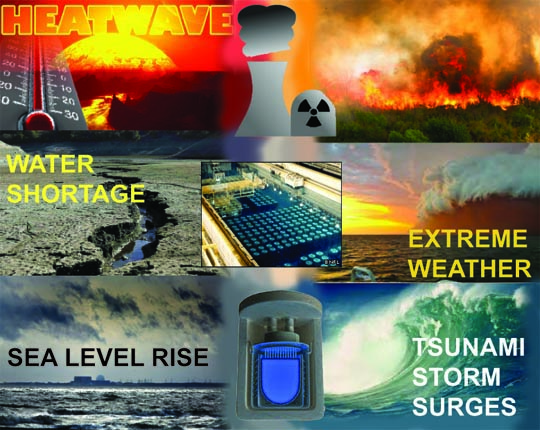 North Korea floods kill 22, approach nuclear reactor — but Kim doesn’t want help, WP, By Simon Denyer August 14, 2020 , TOKYO — Flooding caused by weeks of unusually heavy monsoon rains has killed at least 22 people in North Korea, with four others missing, and even approached the country’s main nuclear reactor, but leader Kim Jong Un says he is too worried about coronavirus to accept outside help.
The International Federation of the Red Cross said the floods have left at least 22 people dead and four missing, citing the Democratic People’s Republic of Korea Red Cross and the country’s State Committee for Emergency and Disaster Management.
The floodwaters approached the Yongbyon nuclear complex last week, reaching the bases of two pump houses designed to cool the country’s main nuclear reactor, according to the 38 North website, citing satellite imagery.
The floodwaters have receded somewhat and pose “no imminent danger,” as the main reactor apparently has not been operating for some time and a nearby experimental light water reactor has yet to come online, said Jenny Town, deputy director of 38 North, part of the Stimson Center.
“In the long run, though, it exposes a vulnerability of the reactors to extreme weather events such as floods,” she wrote in an email, noting that North Korea has been working on building an embankment and dam along the Kuryong River to offer better protection.
“But this year, the river level is usually high,” Town added. “If this were to happen when a reactor was running, it could cause problems in the cooling systems that would necessitate the reactors to be shut down.” ………. https://www.washingtonpost.com/world/north-korea-floods-kill-22-approach-nuclear-reactor–but-kim-doesnt-want-help/2020/08/13/f53992a8-ddda-11ea-b4f1-25b762cdbbf4_story.html
Flooding might have damaged Bort Korea’s nuclear reactor site
|
North Korea nuclear reactor site threatened by recent flooding, U.S. think-tank says https://www.reuters.com/article/us-northkorea-nuclear-floods/north-korea-nuclear-reactor-site-threatened-by-recent-flooding-u-s-think-tank-says-idUSKCN25908S, Josh Smith 12 Aug 20SEOUL (Reuters) – Satellite imagery suggests recent flooding in North Korea may have damaged pump houses connected to the country’s main nuclear facility, a U.S.-based think-tank said on Thursday.
Analysts at 38 North, a website that monitors North Korea, said commercial satellite imagery from August 6-11 showed how vulnerable the Yongbyon Nuclear Scientific Research Center’s nuclear reactor cooling systems are to extreme weather events. The Korean peninsula has been hammered by one of the longest rainy spells in recent history, with floods and landslides causing damage and deaths in both North and South Korea. Located on the bank of the Kuryong River about 100 km (60 miles) north of North Korea’s capital, Pyongyang, Yongbyon is home to nuclear reactors, fuel re-processing plants and uranium enrichment facilities that are thought to be used in the country’s nuclear weapons programme. The five-megawatt reactor – believed to be used to produce weapons-grade plutonium – does not appear to have been operating for some time, and an Experimental Light Water Reactor (ELWR) has not yet come online, but such flooding in the future would likely force a shutdown, the 38 North report said. “Damage to the pumps and piping within the pump houses presents the biggest vulnerability to the reactors,” the report said. “If the reactors were operating, for instance, the inability to cool them would require them to be shut down.” While there was further flooding downstream, it did not appear to reach the Yongbyon facility’s Uranium Enrichment Plant and by August 11 the waters appear to have somewhat receded, 38 North said. South Korea’s Ministry of Defence declined to comment on the report, but said it is always monitoring developments related to North Korea’s nuclear and missile programmes and maintaining close cooperation with the U.S. government. At a summit with U.S. President Donald Trump in Vietnam in 2019, North Korean leader Kim Jong Un offered to dismantle here Yongbyon in exchange for relief from a range of international sanctions imposed over North Korea’s nuclear weapons and ballistic missile programmes. At the time Trump said he rejected that deal because Yongbyon is only one part of the North’s nuclear programme, and was not enough of a concession to warrant loosening so many sanctions. Reporting by Josh Smith. Additional reporting by Hyonhee Shin.; Editing by Lincoln Feast. |
|
Kim Jong Un says that North Korea’s nuclear weapons guarantee its freedom from attack, and war
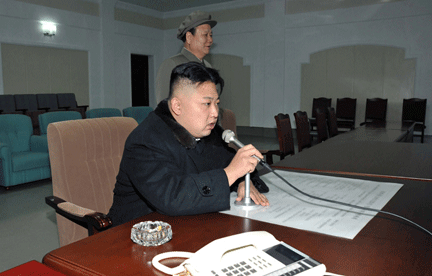 North Korea’s Kim Says No More War Thanks to Nuclear Weapons, VOA, By Reuters July 27, 2020 SEOUL, SOUTH KOREA – North Korean leader Kim Jong Un has said there will be no more war as the country’s nuclear weapons guarantee its safety and future despite unabated outside pressure and military threats, state media said Tuesday.
Kim made the remarks as he celebrated the 67th anniversary of the end of the 1950-53 Korean War, which fell on July 27, with a reception for veterans, the official KCNA news agency said.
The country developed nuclear weapons to win “absolute strength” to stave off another armed conflict, Kim said in a speech carried by KCNA, emphasizing the defensive nature of the programs. ………
The speech came amid stalled talks aimed at dismantling Pyongyang’s nuclear and missile programs in exchange for sanctions relief from Washington. ……https://www.voanews.com/east-asia-pacific/north-koreas-kim-says-no-more-war-thanks-nuclear-weapon
North Korea continues policy -no denuclearization talks until the US withdraws its “hostile policy.
North Korea Proceeds Down a Nuclear Path, BY: 38 NORTH, JULY 20, 2020
Reports about the unusual “closed-door meeting” of the Workers’ Party of Korea Central Military Commission (CMC)[1] on July 18 suggested that North Korea remains committed to its strategic weapons development and production plan, including its nuclear weapons. This meeting builds on recent statements by North Korean officials implying that Pyongyang will proceed with its strategic weapons plans and that the moratorium on nuclear weapons and long-range ballistic missile testing is off the table. ……
North Korea may have omitted “nuclear” to dial down the tone of recent messaging, but it does not necessarily translate into actual policy implications …….
In the Context of Recent Statements
This nuanced treatment of nuclear weapons in CMC meeting coverage is consistent with recent statements by North Korean officials, which indicated denuclearization is off the table for now and North Korea will proceed with its weapons development to cope with US “long-term threats.”…….
While Kim Yo Jong’s July 10 press statement seemed more conciliatory in tone than the previous Foreign Ministry statements, the bottom line was consistent with North Korea’s position since the Stockholm talks in October 2019: there will be no denuclearization talks until the US withdraws its “hostile policy.”[9] Kim added that North Korea must plan for “long-term threats” from the US and “strengthen and steadily increase our practical capabilities,” which implied going ahead with North Korea’s weapons development and production plan. https://www.38north.org/2020/07/cmc072020/
North Korea to ‘counter nuclear with nuclear’ against US
|
North Korea to ‘counter nuclear with nuclear’ against US https://www.9news.com.au/world/north-korea-to-counter-nuclear-with-nuclear-against-us/f1da3676-8adb-4056-9245-363b039406e9
By Inga Neilsen, Jun 26, 2020 North Korea has claimed it is prepared to use nuclear weapons in response to “hostile policy” by the US, according to an official government report.
The Democratic People’s Republic of Korea (DPRK) issued a report by the Ministry of Foreign Affairs Institute for Disarmament and Peace, which said the country had no choice but to counter “nuclear with nuclear.”
“In order to eliminate the nuclear threats from the US, the DPRK government made all possible efforts either through dialogue or in resort to the international law, but all ended in vain,” the report read.
“The option left was only one, and that was to counter nuclear with nuclear.”
The report, released on state run media on the 70th anniversary of the start of the Korean War, said the socialist state will continue to bolster its power to “to contain the persistent nuclear threats from the US.”
The Trump administration and Kim Jong Un’s regime embarked on a series of talks in an attempt to stop North Korea’s nuclear ambitions, but did not reach a binding agreement.
North Korea responses by firing short-range missile tests which blew up an inter-Korean liaison office, cutting communication lines with South Korea.
The option left was only one, and that was to counter nuclear with nuclear.”
South Korean President Moon Jae-in, speaking at a ceremony to honour veterans of the Korean War, urged North Korea to seek peace.
“We will continuously search for routes that are mutually beneficial for both Koreas through peace,” he said.
“Before speaking of unification, I hope that we can become friendly neighbours first.”
|
|
Kim Jong Un’s cyberwar preparations
 Kim Jong Un has quietly built a 7,000-man cyber army that gives North Korea an edge nuclear weapons don’t, Business Insider, ELLEN IOANES, JUN 17, 2020,
- North Korea has a cyber army of about 7,000, trained to find secrets, disrupt critical infrastructure, and steal money to circumvent sanctions.
- These cyberattacks are often difficult to pin on North Korea because they originate in countries like China and Russia, and a counterattack is almost impossible because of North Korea’s rudimentary internet.
- North Korea’s likely next targets are critical US infrastructure like power plants, dams, and electrical grids.
North Korea’s state-sponsored hack of Sony Pictures in 2014 over the movie “The Interview” was highly embarrassing for Sony. But it was just the tip of the iceberg, according to Daniel Russel, vice president for international security and diplomacy at the Asia Society Policy Institute. …………
The WannaCry virus, on the one hand, was ransomware; you could argue that it’s aimed at getting money, but it caused a huge disruption of hospitals in the UK and, potentially, in something like 100-plus other countries where they had disseminated the ransomware. This was software that brought the operation of critical facilities to a standstill.
This is not hacking; this is cyber warfare.
Cyber weapons kind of level the playing field for North Korea in a way that nukes can’t. Not only do the United States, China, Russia, have vastly more nuclear weapons than North Korea, but a nuclear weapon is an all-or-nothing proposition.
Cyber warfare has a very different risk-return calculation. it’s a low-cost, asymmetric, relatively speaking, low-risk weapon system. And the US is the most vulnerable country on planet Earth to disruptive cyberattacks………
Because North Korea depends so heavily on China, not just for cyber, but in the case of cyber, for access to servers, its pipelines, and so on, it would be critical for the United States to develop some degree of cooperation with China to limit North Korea’s offensive cyber threat.
Obviously, there’s much more on the diplomatic side that we would have to do to present North Korea with an international unified front that would make it difficult for it to find these cyber platforms to use against us………… https://www.businessinsider.com.au/north-korea-kim-jong-un-cyber-army-cyberattacks-nuclear-weapons-2020-6?r=US&IR=T
U.S. – China talks may cover North Korea nuclear issue
 North Korea nuclear issue may be on the agenda at US-China SCMP, 17 June 20
Stephen Biegun, the US special representative for North Korea, will join the talks in Hawaii on Wednesday.
US special envoy for North Korea Stephen Biegun will be part of the American delegation at
, suggesting the stalemate in nuclear disarmament negotiations with Pyongyang could be on the agenda.
But Chinese observers said it was unlikely that Beijing and Washington – at odds on a range of issues – would act together to break the deadlock. Tensions are mounting on the Korean peninsula after
and threatened military action against the South……….
The Hawaii meeting comes as relations between the world’s two largest economies are at their lowest point in decades and facing off on many fronts – from trade and technology to Hong Kong and the South China Sea. US officials, including President Donald Trump and Pompeo, have blamed Beijing for the coronavirus pandemic, while Beijing has accused Washington of trying to pass the buck to hide its own failings in dealing with Covid-19 in the US.
t also comes as tensions on the Korean peninsula are again escalating after Pyongyang demolished a four-storey liaison office set up near the border with South Korea in 2018 after the first summit between North Korean leader Kim Jong-un and South Korean President Moon Jae-in. A major setback for the detente in the region, observers said the move reflected Pyongyang’s growing frustration over its stalled nuclear talks with Washington.
But Chinese analysts said the North Korea issue was unlikely to be a priority for Beijing or Washington as the two powers engaged in long-term and all-out strategic competition…….
Kim Jong Un unlikely to use nuclear weapons – an alternative leader of N Korea might be worse
Kim Jong-un: Terrifying reason behind North Korean leader’s nuclear obsession exposed, Express UK By JOSH SAUNDERS, Jun 5, 2020
KIM JONG-UN is considered one of North Korea’s most feared leaders because he has successfully produced a stockpile of nuclear missiles – but one expert claims the hermit state head would not use them and instead there is a more chilling reason behind his obsession with world-ending weapons……….
although having the world-ending weapons at his disposal, North Korea expert Chris Mikul told Express.co.uk that he believes Kim Jong-un has no intention of firing them. He suspects there may lie an even more sinister motive for pursuing a nuclear stockpile. …….
Mr Mikul told Express.co.uk: “He essentially became westernised, so you can see why there is a big difference between him and the other leaders of North Korea.
“To me there are a lot of signs that he is a more benevolent character and the reason is because he is different at heart… that said, he is still a brutal dictator.”……
“while no one likes to see the continued success of a brutal dictator” things could be a lot worse if he had died – as was believed in April and May.
Mr Mikul told Express.co.uk: “We know he has got nuclear weapons now, which makes him the most successful Kim because he has managed to attain a goal they were trying to achieve since the Sixties. “The reason they want nuclear weapons is because they know that it’s an insurance policy that will keep the regime in power forever – and he’s done it.
“But in my opinion, he won’t pull the trigger because it would end up in the destruction of North Korea, so maybe it’s good for him to stay there now.”……
Despite the threat perceived by the US Department of the Defence, Mr Mikul believes the weapons may be more symbolic and a way to secure their regime.
If Kim Jong-un was to die, he fears there would more risk from the hermit state due to “no clear successor” being named.
He believes – if it happened – that there could be a “fight at the top” among the inner circle, which in turn could collapse the regime.
Mr Mikul told Express.co.uk: “What could happen is that you would get hundreds of thousands of North Koreans fleeing the country, causing chaos in China, South Korea and Russia. “So it’s probably better to have Kim Jong-un as leader, even though it is horrible to say – the economy is better under him than it has ever been or as good as it has ever been under the Kims.”
Chris Mikul’s book ‘My Favourite Dictators’ was published by Headpress in 2019, it is available here. https://www.express.co.uk/news/world/1291963/kim-jong-un-news-north-korea-nuclear-missiles-attack-south-korea-world-dead-alive-spt
South Korea’s government dismissed rumours about North Korean leader Kim Jong Un being gravely ill
 North Korean leader Kim Jong-un health rumours dismissed by South Korean intelligence, ABC News, 27 Apr 20, South Korea’s Government has dismissed rumours that North Korean leader Kim Jong-un is in a fragile condition, as speculation about his health intensifies amid the North’s silence on his whereabouts.
Unification Minister Kim Yeon-chul told a closed-door forum in Seoul that South Korea had “enough intelligence to confidently say that there are no unusual developments” in rival North Korea that would back up speculation about Mr Kim’s health, his ministry said.
The minister did not reveal what specific intelligence led to that conclusion, but stressed that it was reached after a thorough analysis.
His comments are a reiteration of earlier South Korean statements that Mr Kim appeared to be handling state affairs normally and that no unusual activities had been detected in North Korea.
Those comments, however, failed to dispel the rumours about Mr Kim, partly because past outside intelligence reports on developments in North Korea have sometimes turned out to be wrong. …..
As the absolute leader of a country with a nuclear weapons program, Mr Kim’s health is a matter of intense interest both regionally and globally.
If something were to happen to him, it could lead to instability in North Korea. Mr Kim hasn’t publicly anointed a successor, and that has prompted questions about who would take control of North Korea if he is gravely ill or dies…..
serious unrest could occur if a power struggle erupts between those supporting the Kim dynasty and those who want non-Kim rule…….. https://www.abc.net.au/news/2020-04-28/kim-jong-un-health-rumours-south-korea-intelligence/12191504
North Korea: Expert reveals ‘power struggle’ for ‘control of nuclear weapons and military’
NORTH KOREA’s lack of a formal succession plan for Kim Jong-un could spark a “power struggle” in the region as speculation continues to grow surrounding the supreme leader’s health, according to foreign policy expert Bruce Klingner. Express UK, By SVAR NANAN-SEN, Apr 27, 2020
Bruce Klingner, a senior researcher for Northeast Asia at The Heritage Foundation told Fox News that there could be a power struggle in North Korea regarding who succeeds Kim Jong-un. The Supreme Leader of North Korea has not been seen for over two weeks and his absence has led to speculation over his health and the future of his country.
Mr Klinger said: “As was the case when his father passed away, there is no formal succession plan in the North Korea constitution.
“We don’t know if they have anything planned behind the scenes. So right now, we are all speculating who the next leader might be.
“We are speculating that his sister may be the next leader. In the last couple of years, she has gained power, she has gained authority, we have seen her coming out of the shadows in the last couple of years…….. https://www.express.co.uk/news/world/1274376/North-Korea-Kim-Jong-Un-death-health-successor-nuclear-weapons-military-latest-news
Kim Jong Un Mystery Grows on Reports of Train, Medical Team
Kim Jong Un Mystery Grows on Reports of Train, Medical Team, Bloomberg By Kanga Kong and Ros Krasny, Where is North Korea’s Kim Jong Un?
Kim Jong-un’s death may lead to brutal power struggle and unknown finger on nuke button, https://www.express.co.uk/news/world/1273890/Kim-Jong-un-dead-North-Korea-nuclear-weapon-news-latest-death-USKIM JONG-UN’S death could spark a power struggle in nuclear-armed North Korea and even an attack on its neighbour in the South, according to an expert on conflict in the Korean peninsula.By GERRARD KAONGAKim Jong-un’s death could result in multiple worst-case scenarios according to Korean expert and senior research fellow Bruce Klingner of think tank The Heritage Foundation. Chinese and Japanese media outlets have claimed the North Korean dictator has died following complications from heart surgery earlier this month. The North Korean state is yet to confirm whether the nation’s leader has died.
While on Fox News Mr Klingner said if the reports of Kim Jong-un’s death were correct the resulting power vacuum would be a cause for international concern.
Mr Klingner warned the death of the leader could result in power struggles, military faction infighting, and even the nation lashing out at its neighbour in the South.
He insisted this was particularly concerning as he said North Korea was a nation with nuclear weapon capabilities.
Mr Klingner said: “There is always a concern when you have a nuclear weapon state if you don’t know who the next leader is.
“It could be a smooth transition or it could be a power struggle where everyone is trying to grab the ring of power. “Then it is a question of who has control over nuclear weapons and the military.”
Mr Klingner also outlined the worst possible scenarios that could occur if Kim Jong-un is confirmed, by North Korea, to be dead.
He continued: “There are a lot of worst-case scenarios.
“Things like a regime collapse and a struggle for power or unknown actions from military factions warring against each other. “There is a concern that there could be an explosion in the sense of North Korea lashing out against its neighbours.
“Or even an implosion with the regime collapse and instability.”
Mr Klingner closed by insisting nations remain concerned similarly to the last death of a North Korean leader.He said: “We were equally concerned during the two previous successions of the father and the grandfather when they passed away.
“The system worked and there was a maintaining of stability so it is more likely the regime will maintain itself.”
There have been conflicting reports regarding the death of North Korean leader Kim Jong-un.
Earliest reports of his death came from the vice director of HKSTV Hong Kong Satellite Television Shijan Xingzou who claimed a very solid source told her the North Korean leader had died.
Japanese weekly magazine Shukan Gendai argued the dictator had not yet died but is currently in a vegetative state and will not recover.
North Korea already has its nuclear arsenal. even if Kim should die.
|
Even if Kim Jong Un dies, he has given North Korea the nuclear arsenal it needed to deter the U.S.
While North Korea is still among the world’s most impoverished nations, living standards are rising for the ruling elite in Pyongyang. Kim has shown he can endure crushing economic sanctions,National Post, Bloomberg News, Jihye Lee and Jon Herskovitz, April 23, 2020 Whatever the state of Kim Jong Un’s health, he has already put North Korea in its strongest position to resist U.S. pressure in decades. Eight years after Kim filled the power vacuum left by the death of his reclusive father, Kim Jong Il, North Korea is more secure and less isolated. The 36-year-old supreme leader has achieved two key marks of legitimacy long sought by his predecessors: a nuclear arsenal that can credibly deter an American attack and a personal relationship with the U.S. president, including three face-to-face meetings with Donald Trump. While North Korea is still among the world’s most impoverished nations, living standards are rising for the ruling elite in Pyongyang. Kim has shown he can endure crushing economic sanctions, illustrated by a United Nations report published Tuesday accusing the regime of widespread evasion. Moreover, the Kim dynasty holds a renewed pledge of strategic support from its ultimate guarantor, China. “The country has pole-vaulted in their nuclear-destruction potential and missile-delivery capabilities compared to capabilities under grandfather or father Kim,” said Soo Kim, a Rand Corp. policy analyst who specializes in Korean peninsula issues. “The specter of a North Korean nuclear attack breeds enough unease in the international community to lean more towards accommodation than confrontation.”…….. North Korea has given up little since Kim’s unprecedented handshake with Trump almost two years ago in Singapore. Besides halting launches of missiles that can reach the U.S. mainland and demolishing some testing facilities, Kim has signed only a vaguely worded pledge to “work toward complete denuclearization of the Korean Peninsula.” …… https://nationalpost.com/news/world/despite-kim-jong-un-health-north-korea-has-little-to-worry-about-u-s-sanctions |
|
|
North Korean leader Kim Jong-Un’s health speculation raises question over nuclear weapons future
|
North Korean leader Kim Jong-Un’s health speculation raises question over nuclear weapons future, 9 news, By CNN, Apr 22, 2020 Confusing and sometimes conflicting reports have emerged about the health of North Korean leader Kim Jong Un.
Those were followed by intense speculation on his whereabouts, his medical condition and the future of the world’s only hereditary communist state.
Initial rumblings began after North Korea’s most important holiday came and went on April 15 without an appearance by Kim, which was unusual.
Then Daily NK, an online publication based in South Korea that focuses on the north, reported that Kim had received a cardiovascular system procedure on April 12 and was being treated in a villa in Hyangsan County.
The reports have also sparked speculation over the security and question of what happens to North Korea’s nuclear weapons in the event of some sort of leadership transition, which is likely of concern in Washington, Seoul and Beijing……..
North Korea’s nuclear weapons are another closely guarded secret inside the country.
Little is known about how many Pyongyang has, how reliable they are, if its missiles and submarines could successfully fire them or even how Kim oversees their command and control apparatus…….
Though North Korea is still technically at war with the South and the United States, many of Pyongyang’s nuclear weapons may be sitting disassembled and “there are probably very few ready systems,” Narang said.
But Narang said he wouldn’t be terribly concerned about the security of North Korea’s nuclear weapons in the event Kim died of natural causes……. https://www.9news.com.au/world/north-korea-kim-jong-un-health-status-confusion-nuclear-weapons-future-usa-south-korea-world-news/6c8663e8-9416-4635-ab90-9036d3e63246
|
|
1 This Month
23-25 October – on Zoom – World BEYOND War’s annual global conferenc


Shut down the radiation-damaged Heysham nuclear reactors now
To see nuclear-related stories in greater depth and intensity – go to https://nuclearinformation.wordpress.com

Say No to NASA’s Reckless Nuclear Reactor on the Moon
Say No to NASA’s Reckless Nuclear Reactor on the Moon

-
Archives
- October 2026 (247)
- September 2026 (339)
- August 2026 (330)
- July 2026 (355)
- June 2026 (287)
- May 2026 (306)
- April 2026 (356)
- March 2026 (251)
- February 2026 (267)
- January 2026 (308)
- December 2025 (358)
- November 2025 (359)
-
Categories
- 1
- 1 NUCLEAR ISSUES
- business and costs
- climate change
- culture and arts
- ENERGY
- environment
- health
- history
- indigenous issues
- Legal
- marketing of nuclear
- media
- opposition to nuclear
- PERSONAL STORIES
- politics
- politics international
- Religion and ethics
- safety
- secrets,lies and civil liberties
- spinbuster
- technology
- Uranium
- wastes
- weapons and war
- Women
- 2 WORLD
- ACTION
- AFRICA
- Atrocities
- AUSTRALIA
- Christina's notes
- Christina's themes
- culture and arts
- Events
- Fuk 2022
- Fuk 2023
- Fukushima 2017
- Fukushima 2018
- fukushima 2019
- Fukushima 2020
- Fukushima 2021
- general
- global warming
- Humour (God we need it)
- Nuclear
- RARE EARTHS
- Reference
- resources – print
- Resources -audiovicual
- Weekly Newsletter
- World
- World Nuclear
- YouTube
-
RSS
Entries RSS
Comments RSS

