- Satellite photos show North Korea leader’s train near compound
-
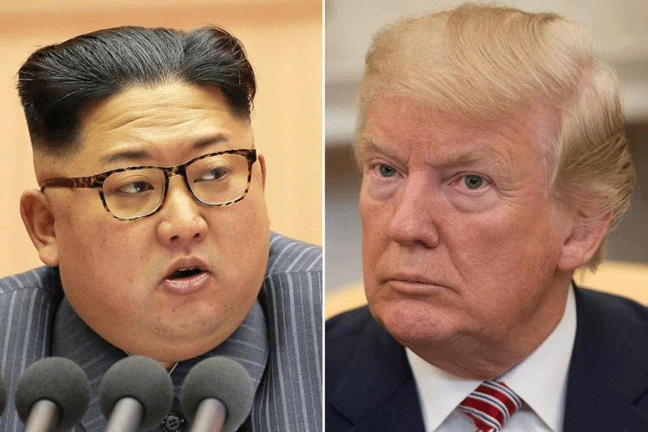
Kim’s two-week absence fuels speculation about his health Speculation about Kim Jong Un’s health intensified over the weekend after tantalizing — yet unverified — reports about a visit by a Chinese medical team and movements of the North Korean leader’s armored train.
China sent a team including doctors and senior diplomats to advise its neighbor and longtime ally, Reuters reported on Saturday, citing three people familiar with the matter. Meanwhile, a train resembling one long used by North Korean rulers was parked last week near a coastal leadership compound in Wonsan, according to an analysis of satellite imagery released Sunday by the website 38 North. A prominent South Korea adviser also rejected the notion that Kim was ailing or dead…….
Any leadership change in North Korea could increase the threat of instability on China’s border and raise questions about control of the country’s expanding nuclear arsenal. Kim has also been central to U.S. President Donald Trump’s so far unsuccessful efforts to get him to reduce his weapons stockpile. …..
North Korea: Expert reveals ‘power struggle’ for ‘control of nuclear weapons and military’
NORTH KOREA’s lack of a formal succession plan for Kim Jong-un could spark a “power struggle” in the region as speculation continues to grow surrounding the supreme leader’s health, according to foreign policy expert Bruce Klingner. Express UK, By SVAR NANAN-SEN, Apr 27, 2020
Bruce Klingner, a senior researcher for Northeast Asia at The Heritage Foundation told Fox News that there could be a power struggle in North Korea regarding who succeeds Kim Jong-un. The Supreme Leader of North Korea has not been seen for over two weeks and his absence has led to speculation over his health and the future of his country.
Mr Klinger said: “As was the case when his father passed away, there is no formal succession plan in the North Korea constitution.
“We don’t know if they have anything planned behind the scenes. So right now, we are all speculating who the next leader might be.
“We are speculating that his sister may be the next leader. In the last couple of years, she has gained power, she has gained authority, we have seen her coming out of the shadows in the last couple of years…….. https://www.express.co.uk/news/world/1274376/North-Korea-Kim-Jong-Un-death-health-successor-nuclear-weapons-military-latest-news
Kim Jong Un Mystery Grows on Reports of Train, Medical Team
 Kim Jong Un Mystery Grows on Reports of Train, Medical Team, Bloomberg By Kanga Kong and Ros Krasny,
 Where is North Korea’s Kim Jong Un?
Kim Jong-un’s death may lead to brutal power struggle and unknown finger on nuke button, https://www.express.co.uk/news/world/1273890/Kim-Jong-un-dead-North-Korea-nuclear-weapon-news-latest-death-USKIM JONG-UN’S death could spark a power struggle in nuclear-armed North Korea and even an attack on its neighbour in the South, according to an expert on conflict in the Korean peninsula.By GERRARD KAONGAKim Jong-un’s death could result in multiple worst-case scenarios according to Korean expert and senior research fellow Bruce Klingner of think tank The Heritage Foundation. Chinese and Japanese media outlets have claimed the North Korean dictator has died following complications from heart surgery earlier this month. The North Korean state is yet to confirm whether the nation’s leader has died.
While on Fox News Mr Klingner said if the reports of Kim Jong-un’s death were correct the resulting power vacuum would be a cause for international concern.
Mr Klingner warned the death of the leader could result in power struggles, military faction infighting, and even the nation lashing out at its neighbour in the South.
He insisted this was particularly concerning as he said North Korea was a nation with nuclear weapon capabilities.
Mr Klingner said: “There is always a concern when you have a nuclear weapon state if you don’t know who the next leader is.
“It could be a smooth transition or it could be a power struggle where everyone is trying to grab the ring of power. “Then it is a question of who has control over nuclear weapons and the military.”
Mr Klingner also outlined the worst possible scenarios that could occur if Kim Jong-un is confirmed, by North Korea, to be dead.
He continued: “There are a lot of worst-case scenarios.
“Things like a regime collapse and a struggle for power or unknown actions from military factions warring against each other. “There is a concern that there could be an explosion in the sense of North Korea lashing out against its neighbours.
“Or even an implosion with the regime collapse and instability.”
Mr Klingner closed by insisting nations remain concerned similarly to the last death of a North Korean leader.He said: “We were equally concerned during the two previous successions of the father and the grandfather when they passed away.
“The system worked and there was a maintaining of stability so it is more likely the regime will maintain itself.”
There have been conflicting reports regarding the death of North Korean leader Kim Jong-un.
Earliest reports of his death came from the vice director of HKSTV Hong Kong Satellite Television Shijan Xingzou who claimed a very solid source told her the North Korean leader had died.
Japanese weekly magazine Shukan Gendai argued the dictator had not yet died but is currently in a vegetative state and will not recover.
North Korea already has its nuclear arsenal. even if Kim should die.
|
Even if Kim Jong Un dies, he has given North Korea the nuclear arsenal it needed to deter the U.S.
While North Korea is still among the world’s most impoverished nations, living standards are rising for the ruling elite in Pyongyang. Kim has shown he can endure crushing economic sanctions,National Post, Bloomberg News, Jihye Lee and Jon Herskovitz, April 23, 2020 Whatever the state of Kim Jong Un’s health, he has already put North Korea in its strongest position to resist U.S. pressure in decades. Eight years after Kim filled the power vacuum left by the death of his reclusive father, Kim Jong Il, North Korea is more secure and less isolated. The 36-year-old supreme leader has achieved two key marks of legitimacy long sought by his predecessors: a nuclear arsenal that can credibly deter an American attack and a personal relationship with the U.S. president, including three face-to-face meetings with Donald Trump. While North Korea is still among the world’s most impoverished nations, living standards are rising for the ruling elite in Pyongyang. Kim has shown he can endure crushing economic sanctions, illustrated by a United Nations report published Tuesday accusing the regime of widespread evasion. Moreover, the Kim dynasty holds a renewed pledge of strategic support from its ultimate guarantor, China. “The country has pole-vaulted in their nuclear-destruction potential and missile-delivery capabilities compared to capabilities under grandfather or father Kim,” said Soo Kim, a Rand Corp. policy analyst who specializes in Korean peninsula issues. “The specter of a North Korean nuclear attack breeds enough unease in the international community to lean more towards accommodation than confrontation.”…….. North Korea has given up little since Kim’s unprecedented handshake with Trump almost two years ago in Singapore. Besides halting launches of missiles that can reach the U.S. mainland and demolishing some testing facilities, Kim has signed only a vaguely worded pledge to “work toward complete denuclearization of the Korean Peninsula.” …… https://nationalpost.com/news/world/despite-kim-jong-un-health-north-korea-has-little-to-worry-about-u-s-sanctions |
|
|
North Korean leader Kim Jong-Un’s health speculation raises question over nuclear weapons future
|
North Korean leader Kim Jong-Un’s health speculation raises question over nuclear weapons future, 9 news, By CNN, Apr 22, 2020 Confusing and sometimes conflicting reports have emerged about the health of North Korean leader Kim Jong Un.
Those were followed by intense speculation on his whereabouts, his medical condition and the future of the world’s only hereditary communist state.
Initial rumblings began after North Korea’s most important holiday came and went on April 15 without an appearance by Kim, which was unusual.
Then Daily NK, an online publication based in South Korea that focuses on the north, reported that Kim had received a cardiovascular system procedure on April 12 and was being treated in a villa in Hyangsan County.
The reports have also sparked speculation over the security and question of what happens to North Korea’s nuclear weapons in the event of some sort of leadership transition, which is likely of concern in Washington, Seoul and Beijing……..
North Korea’s nuclear weapons are another closely guarded secret inside the country.
Little is known about how many Pyongyang has, how reliable they are, if its missiles and submarines could successfully fire them or even how Kim oversees their command and control apparatus…….
Though North Korea is still technically at war with the South and the United States, many of Pyongyang’s nuclear weapons may be sitting disassembled and “there are probably very few ready systems,” Narang said.
But Narang said he wouldn’t be terribly concerned about the security of North Korea’s nuclear weapons in the event Kim died of natural causes……. https://www.9news.com.au/world/north-korea-kim-jong-un-health-status-confusion-nuclear-weapons-future-usa-south-korea-world-news/6c8663e8-9416-4635-ab90-9036d3e63246
|
|
A win-win for USA and North Korea? Helping to fight coronavirus
|
Why Helping North Korea Fight Coronavirus Could Lessen the Chance of a Nuclear War https://nationalinterest.org/blog/korea-watch/why-helping-north-korea-fight-coronavirus-could-lessen-chance-nuclear-war-143697
A necessary win-win for Washington and Pyongyang?
by Cynthia Lazaroff Follow @CynthiaLazaroff on Twitter 13 Apr 20, Amidst the existential nightmare unfolding with the coronavirus, comes the news that North Korea has ramped up its missile testing and lost all interest in a dialogue with the United States. At a March meeting with G-7 Foreign Ministers, Secretary of State Pompeo called on all nations to maintain diplomatic and economic pressure on North Korea over its nuclear and ballistic missile programs. Pompeo’s ill-timed call to uphold sanctions even during the global pandemic escalated tensions and triggered Pyongyang’s chilling response: North Korea has become “more zealous for our important planned projects aimed to repay the U.S. with actual horror and unrest for the sufferings it has inflicted upon our people.”
While some may call this mere bluster, Pyongyang’s warning serves as a grim reminder that the existential nuclear threat is not going on lockdown during this pandemic. It is a clear and present danger like COVID-19, invisible but very much alive. And like the virus, it has been ignored for perilously too long. Former U.S. Secretary of Defense William J. Perry has sounded the alarm: “Today, the danger of some sort of a nuclear catastrophe is greater than it was during the Cold War and most people are blissfully unaware of this danger.”
We are now awake to the COVID-19 catastrophe, the enormity of the pain and suffering, the staggering human and economic costs. Worst case projections estimate that COVID-19 deaths could be in the millions globally, with variable forecasts over the past month for America. Estimates show Americans could lose anywhere from 60,000 to 2.2 million or more of their loved ones to the virus because Washington ignored repeated warnings and failed to act before it was too late. This is the price of sleepwalking in the face of this existential threat, which is horrific, but these numbers nonetheless pale in comparison to the estimated tens of millions in North and South Korea, Japan, Guam, Hawaii and beyond who could die in the mass carnage if nuclear weapons were to be launched by Kim or Trump in a moment of anger, accident, miscalculation or mistake.
Existential threats by nature do not discriminate. Like nuclear weapons, COVID-19 attacks human beings indiscriminately, oblivious to race, religion, gender, ideology or country of origin. Like radioactive fallout, the virus does not recognize borders, and like nuclear war, it spares no one—whether rich, poor, Korean, American, sanctioned or unsanctioned.
If Washington doesn’t take emergency measures to stop the spread of COVID-19 in the human population as a whole, America fails to do so at its own peril. Outbreaks in other countries increase the risk of outbreaks around the world. This is why it makes no sense to uphold sanctions that in any way hinder a country’s capacity to combat the virus. U.N. High Commissioner for Human Rights Michelle Bachelet has called for humanitarian exemptions to sanctions because “in a context of global pandemic, impeding medical efforts in one country heightens the risk for all of us.” In other words, what America does to the people of North Korea, Iran, Venezuela, Russia, Cuba and other sanctioned countries, America does to itself.
If Washington doesn’t take emergency measures to stop the spread of COVID-19 in the human population as a whole, America fails to do so at its own peril. Outbreaks in other countries increase the risk of outbreaks around the world. This is why it makes no sense to uphold sanctions that in any way hinder a country’s capacity to combat the virus. U.N. High Commissioner for Human Rights Michelle Bachelet has called for humanitarian exemptions to sanctions because “in a context of global pandemic, impeding medical efforts in one country heightens the risk for all of us.” In other words, what America does to the people of North Korea, Iran, Venezuela, Russia, Cuba and other sanctioned countries, America does to itself.
Guterres calls on Americans further to unite now in solidarity to protect the most vulnerable and susceptible to COVID-19 everywhere—those ravaged by war, women, children, the elderly, homeless and displaced populations, along with those living in the poorest countries with weak health care infrastructures like North Korea. During this global existential crisis, Bachelet and Guterres are inviting Americans to rise to the better angels of our nature, transcend our differences and get our priorities straight: to stop wasting precious time and resources on conflict and war and mobilize as a “human family” to give it everything we’ve got to save lives.
If the United States applies Bachelet and Guterres’ recommendations to North Korea, Washington can make progress on the existential threat of COVID-19 and the existential threat of a nuclear exchange with Pyongyang. America and North Korea can work together to halt the spread of COVID-19, thereby create goodwill and de-escalate tensions. Washington can and should take further steps to reduce tensions and the risk of a nuclear missile launch due to anger, accident, miscalculation or mistake.
Here are five steps the United States should take right now:
Americans wake up every morning to soaring death tolls, the tragic cost of waiting too long to act to contain COVID-19. It is already late—for the United States, for North Korea, for the world. Millions of lives are at stake. The time to act on these existential threats is now. Cynthia Lazaroff is an expert on U.S.-Russia relations, a documentary film producer, and environmental activist. She has been engaged in Track II and 1.5 dialogue for the past forty years and has directed several films on the Soviet Union and nuclear proliferation. You can follow her on Twitter @CynthiaLazaroff. |
|
What effect will pandemic have on tensions with North Korea?
Breakthrough or Crisis? How Will Coronavirus Impact Tensions with North Korea?
Is a breakthrough possible?: “As it continues to call on Pyongyang to resume negotiations, Washington could consider gathering support for an interim agreement from Seoul, Tokyo, Beijing, and Moscow. If successful, perhaps North Korea will feel pressured to return to dialogue or risk being blamed for breaking the diplomatic process. If a deal cannot be reached before November, the elements of such an interim agreement could be the starting point of discussions with the US administration after the elections.” National Interest, by Duyeon Kim, 22 Mar 20 The novel coronavirus pandemic has accelerated geopolitical tensions first in Northeast Asia, with the original outbreak in China, and now around the world as the United States, Europe and many others battle their own epidemics and global markets spiral downward. Leaders among the big powers—particularly the US, China, and Russia—already trying to exploit this global crisis to gain advantage and exert power instead of coming together to fight a common threat. This climate adds another layer of uncertainty over the Korean Peninsula where an authoritarian leader is trying to exert his power at a time when every world leader is preoccupied with the viral disease that is simultaneously testing their leadership and competence.
The pandemic in the context of intensified US-China competition — have complicated an already challenging diplomatic and security situation on the Korean Peninsula this year. Prospects for diplomacy on North Korea’s nuclear weapons program are now even poorer as key capitals will be in coronavirus crisis management mode for the next several months, as they should, and consumed with geopolitics and geo-economics. Dealing with traditional long-standing security issues regarding the Korean Peninsula, including nuclear diplomacy, will be put on hold at least until key stakeholders–the US, South Korea, China, and Japan–are able to manage the current pandemic with more ease.
The virus has worsened existing geopolitical rifts among Northeast Asian countries, which will also overshadow or interrupt attention to the North Korean nuclear issue. The virus is also exacerbating domestic political battles in South Korea, the US, and Japan that will further consume leaders’ attention. These strains will make policy coordination and consultation even more difficult among key countries, let alone face-to-face meetings because of viral infection and transmission concerns.
This environment, if mismanaged, is ripe for a potential security crisis. While China, South Korea, Japan, and the US scramble to contain the disease, North Korea has reminded the world that it will continue to pursue its strategic plans for 2020–despite even a deadly outbreak that has put its own population’s health at risk. On March 2, 8, and 21, Pyongyang fired several rounds of projectiles that US officials say appeared to be short-range ballistic missiles and conducted what North Korea called artillery strike drills using a multiple-rocket launch system. It is not yet clear whether these were tests of any components of a “new strategic weapon” that Pyongyang warned last December it would unveil this year.
The tests nevertheless suggest North Korea had both military and political objectives. It is commonly believed that Pyongyang’s primary driver for its testing schedule is its calculation of what timing will achieve the greatest political impact vis-à-vis the US, but often times, it chooses dates based simply on when it is technologically ready to try out its capability. The latter may have been the case for the recent tests……..https://nationalinterest.org/blog/korea-watch/breakthrough-or-crisis-how-will-coronavirus-impact-tensions-north-korea-135937
North Korea’s nuclear tests have made Hamgyong Province area unstable

Latest North Korea quake shows legacy of instability at nuclear test site: South Korea, https://www.channelnewsasia.com/news/asia/north-korea-earthquake-nuclear-test-12364348 29 Jan 2020 SEOUL: A small natural earthquake detected in North Korea on Wednesday (Jan 29) was likely a result of seismic instability lingering in the area since North Korea conducted its sixth and largest nuclear test in 2017, the South Korean government said.A magnitude-2.5 earthquake was detected at 9.33am (0033 GMT) in Hamgyong Province, the location of North Korea’s shuttered Punggye-ri Nuclear Test Site, according to South Korea’s Meteorological Administration.
“It was a natural earthquake, presumably caused by the sixth nuclear test,” the administration said in a statement on its website. “The area is about 3km southeast of the sixth nuclear test site.”
Punggye-ri is the only known site in North Korea used to test nuclear weapons. At least six tests were conducted there between October 2006 and September 2017.
In early 2018, North Korea said it would close the site, saying its nuclear force was complete.
The entrances to tunnels at the site were blown up in front of a small group of foreign media invited to view the demolition, but North Korea rejected calls for international experts to inspect the closure.
Frustrated at what it sees as a lack of reciprocal concessions by the United States in denuclearisation talks, North Korea now says it is no longer bound by its self-imposed moratorium on test firing nuclear weapons and long-range ballistic missiles, though it has not conducted new tests.
The 2017 nuclear test, which North Korea said was a thermonuclear weapon, appeared to be several times larger than previous blasts, according to monitoring organisations at the time.
In the weeks after the sixth explosion, experts pointed to a series of tremors and landslides near the nuclear test base as a sign the large blast had destabilised the region.
Wednesday’s quake is the latest confirmation that the nuclear explosion had permanently changed the geology of the area, said Woo Nam-chul, an earthquake analyst at KMA.
“The terrain of the area was solid enough to have no natural earthquakes before the sixth nuclear test in September 2017.”
North Korea abandoning talks with “hostile” USA
|
North Korea walks away from nuclear talks with United States, blaming ‘brutal and inhumane’ sanctions,ABC News, 22 Jan 2020, North Korea has walked away from nuclear talks with the United States, saying a 2019 year-end deadline for the talks had been ignored so it no longer felt bound by commitments, which included a halt to its nuclear testing and the firing of inter-continental ballistic missiles.
Key points:
North Korean leader Kim Jong-un had earlier set a December 31 deadline for denuclearisation talks with the US and White House national security adviser Robert O’Brien said at the time the US had opened channels of communication. Mr O’Brien said he hoped Kim would follow through on denuclearisation commitments he made at summits with US President Donald Trump. However, that now would appear to be off the table with North Korea announcing at the United Nations-backed Conference on Disarmament that it was no longer interested in talks. “We found no reason to be unilaterally bound any longer by the commitment that the other party fails to honour,” Ju Yong Chol said while in Geneva. Speaking as the envoy from the People’s Democratic Republic of Korea (DPRK), he accused the US of applying “the most brutal and inhuman sanctions”.
“If the United States tries to enforce unilateral demands and persists in imposing sanctions, North Korea may be compelled to seek a new path.”……https://www.abc.net.au/news/2020-01-22/north-korea-ends-nuclear-talks-with-us/11887832 |
|
North Korea said it was ‘deceived’ by the US in 18 months of nuclear talks
North Korea said it was ‘deceived’ by the US in 18 months of nuclear talks, Business Insider, ELLEN CRANLEY, JAN 12, 2020
- North Korea said it has been “deceived” by the United States in the last 18 months of broken down denuclearization talks.
- In a statement published Saturday, a top adviser wrote that despite the positive, personal relationship between President Donald Trump and North Korean leader Kim Jong Un, it was moving on from the “wasted time” spent in negotiations.
- Once-historic nuclear negotiations between the countries have broken down in the last year and a half as North Korea has increasingly rejected Washington’s hand in Pyongyang policy………. https://www.businessinsider.com.au/north-korea-says-deceived-by-the-united-states-2020-1?r=US&IR=T
North Korea’s nuclear capabilities already expanding rapidly
|
North Korean nuclear threat is here, The Hill
BY ERIC BREWER, OPINION CONTRIBUTOR — 01/09/20 Kim Jong Un has done a good job keeping the United States guessing about his next nuclear provocation. North Korea had threatened that it would pursue a more hardline “new path” by the end of last year unless the United States dropped its “hostile” policies toward the country. This was followed by promises of a “Christmas gift” in December, which was widely speculated to be the test of a more advanced long range missile system. Kim most recently announced that North Korea would no longer be bound by its own limits on long range missile and nuclear testing, and stated that “the world will witness a new strategic weapon” system soon……..
The days when North Korea was thought of having a handful of nuclear weapons that may not be deliverable with a missile are over. The bigger issue is how the United States and its allies need to adapt to rapidly expanding North Korean nuclear capabilities.
While Trump is right that North Korea has not tested a long range missile since his first summit with Kim back in 2018, North Korea has been busily advancing other elements of its nuclear deterrent. Kim has continued to churn out more nuclear warheads and missiles during this interim period. According to one estimate in 2018, he had as many as 60 warheads, and his stockpile has likely grown since. The pace of North Korean missile testing also kept up with some of the most aggressive years on record.
This included solid rocket missiles, which can be launched faster than their liquid counterparts thus reducing warning time, and missiles that could pose challenges to regional missile defenses, making American allies and regional bases more vulnerable. North Korea has also made progress in developing its own submarine launched ballistic missile. All these advances, made during a period when the relationship between Pyongyang and Washington was supposedly never better, show that Kim is not interested in disarming. Rather, he seeks a robust nuclear arsenal.
This has all occurred in the past year and a half. North Korea conducted what it claimed was its second test of a thermonuclear weapon in 2017, upping the lethality of its force. That same year North Korea also carried out three intercontinental ballistic missile tests, demonstrating that the entire United States is already likely within range of a North Korean attack. While the precise reliability of its reentry vehicle remains unclear, as in the odds that the warhead would survive the intense conditions of flight, any American president will operate under the assumption that North Korea could strike the homeland during a crisis. This is no small victory for Kim………..
There is little the United States can do to stop Kim from going down this pathway of renewed provocations if that is his intention. A subpar deal that provides substantial sanctions relief, but without verifiable limits on his ability to grow the program, is worse than no deal at all. Conversely, raising pressure will not prevent North Korea from building weapons. The task to prioritize now is analyzing how Kim might leverage his increasingly sophisticated capabilities to challenge and undermine deterrence in East Asia, and then begin working with American allies to repair those gaps. Eric Brewer is deputy director of the Project on Nuclear Issues with the Center for Strategic and International Studies. He previously served as director for counterproliferation on the National Security Council staff. https://thehill.com/opinion/international/477514-north-korean-nuclear-threat-is-here
|
|
Kim Jong Un May Be Leaving The Door Open To Nuclear Talks
Why North Korea’s Kim Jong Un May Be Leaving The Door Open To Nuclear Talks, January 1, 2020, ANTHONY KUHN
After keeping the world waiting and watching, first for a “Christmas present” to the U.S., and then for a New Year’s shift to a harder line on nuclear negotiations, North Korean leader Kim Jong Un delivered neither.
Some analysts believe a key reason behind his calculations may be President Trump’s prospects for surviving an impeachment process and possibly winning a second term in the White House.
“Donald Trump happens to be the first sitting U.S. president to view North Korea as a source of political victory, for domestic purposes,” says Go Myong-hyun, a research fellow and expert on North Korea at the Asan Institute for Policy Studies, a Seoul-based think tank.
Pyongyang has said it has no intention of handing President Trump any victories on denuclearization, but officials see Trump’s eagerness to tout achievements to his domestic audience as a source of leverage.
In remarks carried by state media, Kim on Tuesday had plenty of tough words for the U.S. as he addressed a plenum of the ruling Workers Party Central Committee. He acknowledged the countries’ current stalemate on nuclear talks, but insisted he would not passively wait for things to improve……
Kim said Pyongyang had unilaterally halted nuclear and intercontinental ballistic missile tests in order to build confidence with the U.S. And he appeared to leave the door open for concessions and further talks. ……
Prolonged stalemate likely
For now, analysts see a prolonged stalemate over North Korea’s nukes as all but inevitable……North Korea’s only remaining tool is nuclear brinksmanship — essentially bluffing opponents into thinking Pyongyang might actually use atomic weapons, even though it is plainly evident that the cost of doing so is prohibitive for both sides.
Fuhrmann’s theory has implications for policy: a nuclear-armed North Korea is not the apocalyptic event some fear, “even if we might prefer a situation where they were not to have nuclear weapons.”
He advises that a complete and verifiable nuclear disarmament is “somewhat unrealistic.” Better, he says, for the U.S. to “look for a deal that allows us to place meaningful limits on North Korean capabilities.” https://www.npr.org/2020/01/01/792843551/north-korea-drops-testing-moratorium-but-leaves-door-open-to-u-s-nuclear-talks

North Korea preparing for nuclear negotiations with USA
|
The ruling Workers’ Party meeting is a focus of keen attention as some observers predict North Korea might use the conference to announce it would abandon faltering diplomacy with the U.S. and lift its moratorium on major weapons test. The Korean Central News Agency reported that leader Kim Jong Un presided over a plenary meeting of the party’s Central Committee convened in Pyongyang on Saturday. It called the gathering the “first-day session,” suggesting it would continue for at least another day. The meeting is intended to “overcome the manifold and harsh trials and difficulties and further accelerate the development of the revolution with transparent anti-imperialist independent stand and firm will,” KCNA said. The meeting will also discuss “important matters” in the party and national defence, KCNA said……. Diplomacy breakdown would be blow to TrumpAfter his second summit with U.S. President Donald Trump in February in Vietnam failed, Kim gave the U.S. until the end of this year to offer new initiatives to salvage the nuclear negotiations. North Korea has recently warned that its resumption of tests of long-range missiles and nuclear devices depends on U.S. action. Restarting nuclear and ICBM tests would be a blow to Trump, who has boasted that North Korea’s moratorium was a major foreign policy win. But that would also likely completely derail diplomacy with the U.S. and further dim the prospect for North Korea to get badly needed sanctions relief to rebuild its troubled economy, some experts said. North Korea is pushing to win major sanctions relief in return for limited denuclearization steps, but the U.S. maintains sanctions will stay in place until North Korea takes significant steps toward ridding itself of nuclear weapons and technology.https://www.cbc.ca/news/world/north-korea-meeting-political-conference-nuclear-1.5410028 |
|
Kim Jong Un refers to North Korea being ‘prepared’ for war, hinting at nuclear capabilities
|
Kim Jong Un stresses nuclear capabilities during meeting https://www.dailynk.com/english/kim-jong-un-stresses-nuclear-capabilities-during-meeting/The Third Expanded Meeting of the Central Military Commission was held on Sunday, according to Rodong Shinmun, By Lee Sang Yong, 2019.12.27 North Korean leader Kim Jong Un recently presided over an expanded meeting of the Central Military Commission of the Workers’ Party of Korea (WPK). At the meeting, Kim made references to readying North Korea’s nuclear capabilities for war, Daily NK has learned.
Although Kim did not explicitly say so, his remarks on “launchers,” the reorganization of the military, as well as his emphasis on self-reliant defense capabilities, can all be seen as a roundabout reference to the country’s nuclear capabilities. NO EXPLICIT MENTION OF NUCLEAR CAPABILITIES AT MEETING At the meeting, Kim stressed that rockets (missiles) and artillery capabilities should be strengthened, according to a high-ranking North Korean source speaking to Daily NK on Monday. These are the “decisions on organizational matters” alluded to in the North Korean media, which were also presumably the main issues of the meeting. “They say that Kim Jong Un issued a direct order calling for the reinforcement of military divisions where relevant to rocket and artillery capabilities,” a source in North Korea told Daily NK. “This essentially translates to an order to improve every aspect related to the strengthening of rocket and artillery capabilities, and can be seen as very relevant to ensuring nuclear weapons are battle-ready.” ”There was no explicit mention of nuclear weapons, but those present understood the order to mean that Kim Jong Un should be able to launch whatever he makes up his mind to launch, should he decide to do so,” continued the source. “Thus, whether it’s rockets or weapons of mass destruction, we must be prepared for every possibility.” In this context, “rocket” is a catch-all term that refers to both short-range and long-range missiles. Since Kim Jong Un came into power, North Korea has invested in the operational capabilities of various missiles, such that a dedicated branch was formed, called the Strategic Rocket Forces (currently Strategic Forces Command). The Strategic Forces Command reportedly consists of three divisions: the Scud missile division, the Rodong missile division, and the Musudan missile division. The announcement that there is to be a new division in addition to these three can be read as a move to create a separate division for strategic weapons, including intercontinental ballistic missiles (ICBM) like the Hwasong-15. A MOVE TOWARD MORE CONFRONTATION WITH SOUTH KOREA? North Korea also recently conducted a series of tests at the Sohae Satellite Launch Site in Dongchang-ri, Cholsan County in North Pyongan Province. The tests involved a new solid-fuel engine for its ICBMs as well as a stability test. This has led to speculation over whether this is an indicator of North Korea’s determination to construct a system with the ability to stealthily launch both short- and long-range missiles at any hour of the day. “It’s been made clear that North Korean rockets must be shown as a force to be contended with,” said a source. “Apparently there was considerable emphasis on the sanctions against North Korea, and the fact that the military must take the lead in developing a self-reliant defense system.” “The order to strengthen artillery capabilities seems to indicate that they’re more interested in a confrontation with South Korea, rather than dialogue,” continued the source. “Given the emphasis on being prepared for every possibility in a fight, it seems they will continue to conduct tests with the aim of improving the relevant technologies.” On Sunday, the Korean Central News Agency (KCNA) reported that North Korean leader Kim Jong Un had presided over the Third Expanded Meeting of the Seventh WPK Central Military Commission and discussed issues pertaining to the strengthening of “self-reliant defense capabilities.” This meeting is presumed to have taken place on Saturday, given that top military officials assembled in Pyongyang on Friday morning. *Translated by Violet Kim Please direct any comments or questions about this article to dailynkenglish@uni-media.net. |
|
USA rejects North Korea’s ‘hostile’ deadline over nuclear talks
|
Top US diplomat rejects North Korea’s ‘hostile’ deadline over nuclear talks and says Washington will not bow to Pyongyang’s ominous threat of a ‘Christmas Gift’ provocation,
By ROSS IBBETSON FOR MAILONLINE and AFP 17 Dec 19, A senior US diplomat has today slammed North Korea for making ‘hostile demands’ over nuclear talks and warned Kim Jong-un against his planned ‘Christmas Gift’ provocation. US special representative Stephen Biegun told reporters in Seoul that Washington would not bow to Pyongyang’s increasingly strident demands for concessions by 2020. ‘Let me be absolutely clear: The United States does not have a deadline. We are fully aware of the strong potential for North Korea to conduct a major provocation in the days ahead,’ Biegun said. ‘To say the least, such an action will be most unhelpful in achieving lasting peace on the Korean Peninsula.’….. Pyongyang has said that if Washington fails to make it an acceptable offer, it will adopt a so far unspecified ‘new way’. It has carried out a series of static tests at its Sohae rocket facility this month, after a number of weapons launches in recent weeks, some of them described as ballistic missiles by Japan and others – which Pyongyang is banned from testing under UN sanctions……Pyongyang has said that if Washington fails to make it an acceptable offer, it will adopt a so far unspecified ‘new way’. It has carried out a series of static tests at its Sohae rocket facility this month, after a number of weapons launches in recent weeks, some of them described as ballistic missiles by Japan and others – which Pyongyang is banned from testing under UN sanctions…https://www.dailymail.co.uk/news/article-7797205/Top-diplomat-rejects-North-Koreas-deadline-says-Washington-not-bow-threats.html |
|
|
1 This Month

of the week – Shut Down Drone Warfare!


Tell the Ukrainian Government to Drop Prosecution of Peace Activist Yurii Sheliazhenko

Petition to revoke the licensing of the Near Surface Nuclear Disposal Facility (NSDF) at Chalk River. https://www.ourcommons.ca/petitions/en/Petition/Details?Petition=e-7247
To see nuclear-related stories in greater depth and intensity – go to https://nuclearinformation.wordpress.com
-
Archives
- March 2026 (244)
- February 2026 (268)
- January 2026 (308)
- December 2025 (358)
- November 2025 (359)
- October 2025 (376)
- September 2025 (257)
- August 2025 (319)
- July 2025 (230)
- June 2025 (348)
- May 2025 (261)
- April 2025 (305)
-
Categories
- 1
- 1 NUCLEAR ISSUES
- business and costs
- climate change
- culture and arts
- ENERGY
- environment
- health
- history
- indigenous issues
- Legal
- marketing of nuclear
- media
- opposition to nuclear
- PERSONAL STORIES
- politics
- politics international
- Religion and ethics
- safety
- secrets,lies and civil liberties
- spinbuster
- technology
- Uranium
- wastes
- weapons and war
- Women
- 2 WORLD
- ACTION
- AFRICA
- Atrocities
- AUSTRALIA
- Christina's notes
- Christina's themes
- culture and arts
- Events
- Fuk 2022
- Fuk 2023
- Fukushima 2017
- Fukushima 2018
- fukushima 2019
- Fukushima 2020
- Fukushima 2021
- general
- global warming
- Humour (God we need it)
- Nuclear
- RARE EARTHS
- Reference
- resources – print
- Resources -audiovicual
- Weekly Newsletter
- World
- World Nuclear
- YouTube
-
RSS
Entries RSS
Comments RSS
 nuclear-news