North Korea’s grandiose plans for ‘nuclear backpack’ squad, and giant submarine
 North Korea trains its elite soldiers to use ‘nuclear backpacks’ as individual bombs as it emerges Kim Jong Un wants to build a 3,000 tonne submarine
- North Korea training ‘outstanding’ troops to join ‘nuclear backpack’ squad
- They would be ordered to infiltrate South and set off bombs in event of war
- Pyongyang has tested a submarine-launched missile for the first time
- Kim Jong Un also wants to built a giant 3,000 tonne submarine
By JULIAN ROBINSON FOR MAILONLINE , 1 September 2016 |
North Korea is training its elite soldiers to smuggle ‘nuclear backpacks’ across the border with the South before detonating their individual bombs. Troops from the People’s Army will be trained to enter enemy territory and, in the event of war, unleash their own nuclear bomb. Sources within the secretive country say ‘outstanding’ military personnel have been selected to join the battalion.
It comes as it emerged Kim Jong Un is planning to build a giant 3,000 tonne submarine made from old Russian submarine parts. Defector Kim Heung-kwang claimed the dictator has ordered the huge vessel to be completed by October, 2017. The huge submarine will be capable of carrying four ballistic missiles which can be launched from the vessel.
Meanwhile, there are also plans to create a unit of soldiers capable of carrying their own nuclear weapons. It has yet to be clarified whether Pyongyang intends the unit to be a suicide squad similar to Japanese Kamikaze pilots who attacked warships in the Second World War.
According to Radio Free Asia, formation of the units has been taking place since March and is stationed in the North Hamgyong province. It added that dummy bombs used for training purposes weigh between 22lbs and 62 lbs and rather than generating huge explosions, the back pack bombs would be designed to spray radioactive material over a large area.
News of the unit emerged as it was revealed that North Korea has made considerable progress this year on weapons technology, including testing a submarine-launched missile for the first time.
However, it’s still not clear if the isolated nation has developed a nuclear warhead. It also does not yet have a fleet of submarines that can launch the newly developed missile……….http://www.dailymail.co.uk/news/article-3768447/North-Korea-trains-elite-soldiers-smuggle-nuclear-backpacks-border-South-unleash-individual-bombs.html
Nortyh Korea’s submarine – launched missile
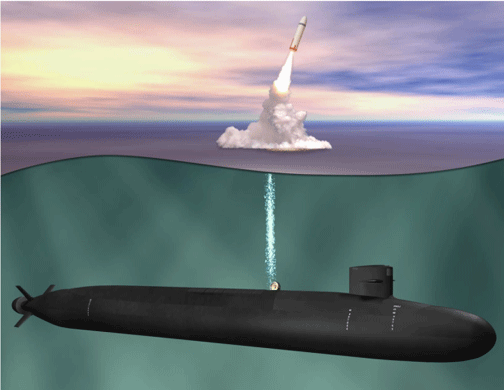 North Korea puts ‘another piece in puzzle’ towards nuclear
  capability, CNBC, David Reid | @cnbcdavy
26 Aug 16 North Korea’s latest missile test has security analysts admitting that the military-led country is closer than ever to possessing a nuclear missile system capable of attacking another country.
Pyongyang’s official KCNA news agency reported that regime leader Kim Jong Un supervised the test and described it as “the greatest success and victory”.
Research Analyst in Proliferation and Nuclear Policy at RUSI, Emil Dall, said to CNBC that Wednesday’s launch appears to be North Korea’s most successful missile test.
“It demonstrates Pyongyang’s continued determination to develop a fully-workable nuclear weapon capability, and this is another piece in that puzzle.
Dall said Thursday it was also probable the rogue state now has a nuclear bomb that can fit on the missile.
“Whether North Korea has been able to construct a nuclear warhead small enough to fit on to an intermediate-range missile is uncertain, but should be assumed at this point,” he said via email…….http://www.cnbc.com/2016/08/26/north-korea-will-soon-be-able-to-launch-nuclear-weapons.html
North Korea’s ‘Military First’ celebration enhanced by nuclear missile test
N. Korea missile test adds to ‘Military First’ celebration, Jakarta Post. ERIC TALMADGE, Associated Press PYONGYANG, North Korea (AP) | Associated Press | Pyongyang, North Korea , August 26 2016 North Korea marked its “Military First” holiday on Thursday with mass dancing, outdoor concerts and boasts of a successful — and potentially game-changing — submarine-launched ballistic missile test it hopes will serve as a warning to Washington and Seoul to stop holding joint military exercises Pyongyang sees as a dress rehearsal for invasion.
Television news broadcasts and the front pages of morning newspapers Thursday showed images of the launch, conducted in the early hours the day before. The test, which brought immediate condemnation from the United States and North Korea’s neighbors, sent a “Pukguksong” missile soaring from a submerged position off the North’s port city of Sinpo. It flew an estimated 500 kilometers (310 miles) toward the seas around Japan, the longest distance North Korea has yet achieved in a submarine launch.
Kim was shown smiling and hugging officials after watching the test from an observation deck. He was quoted by state media as calling it the “success of all successes.”……..
“This shows that our national defense strength has reached a new level,” said Choe Kum Chol, a 42-year-old factory worker. “We are a nuclear power and everything is ready, so we have nothing to fear.”
The test came as the US and South Korea are conducting their annual, 12-day Ulchi Freedom Guardian exercises south of the Demilitarized Zone.
Though North Korea has protested such exercises for decades, prompting regular spikes in tensions on the divided peninsula, it has been particularly alarmed by reports that the maneuvers have recently started to include training for an invasion of the North and precision strikes, or “beheading operations,” against its top leaders.
North Korea’s missile and nuclear weapons development programs have brought heavy international sanctions down on its head, but it says they are justified because of the threat posed by the US and South Korea.
“They are not military exercises, but war preparations to invade our country,” said Kim Kyong Ik, a 44-year-old Pyongyang resident. “Our country is getting more prosperous and they don’t like that, so they are stepping up their moves to stifle us.”
He said South Korea should “wake up and kick the Americans out.”………http://www.thejakartapost.com/news/2016/08/26/nkorea-missile-test-adds-to-military-first-celebration.html
Japan protests, as North Korea fires submarine-launched ballistic missile into Sea of Japan
North Korea fires submarine-launched ballistic missile into Sea of Japan, officials say, ABC News 24 Aug 16, North Korea has fired a submarine-launched ballistic missile off its east coast, South Korea’s military said, the latest in a string of missile launches by the isolated country in defiance of UN Security Council resolutions.
Key points:
- The missile reached Japan’s air defence identification zone
- Japan President Shinzo Abe slams ‘unforgiveable act’
- China, Japan and South Korea’s Foreign Ministers were due to meet in Tokyo today
The missile was fired at around 5:30am (local time) from near the coastal city of Sinpo, where satellite imagery shows a submarine base to be located, and flew about 500 kilometres before splashing into the Sea of Japan, US and South Korean officials said.
The projectile reached Japan’s air defence identification zone (ADIZ), an area of control designated by countries to help maintain air security, according to Japanese and South Korean authorities
“This is the first time a missile from North Korea was launched from a submarine into our country’s air-defence identification zone,” Japanese Prime Minister Shinzo Abe told reporters, adding that Japan had lodged a stern protest………http://www.abc.net.au/news/2016-08-24/north-korea-test-fires-submarine-launched-ballistic-missile/7779612
North Korea’s nuclear threats to USA and South Korea
North Korea threatens to turn Washington and Seoul into a ‘heap of ash’ AUGUST 24, 2016 Gavin Fernando news.com.au@GavinDFernando NORTH Korea has issued a fresh warning to Seoul and Washington, threatening a huge nuclear attack if provoked.
The North’s military warned it will turn the cities into “a heap of ash through a Korean-style pre-emptive nuclear strike” if they show any signs of aggression towards their territory, a spokesman for North Korea’s military was quoted as saying by the country’s state media.
This comes as South Korea and the US begin their annual military drills, which South Korea has described as defensive in nature. The allied countries have repeatedly stated they have no intention of invading or taking aggressive action against North Korea capital Pyongyang.
South Korea President Park Geun-Hye responded to the threats saying: “The North Korean regime has been continuously suppressing its people by its reign of terror while ignoring the livelihood of its people.”
She also said the South would “prepare” for any potential attacks by North Korea, adding that the communist country’s nuclear and missile threats are “direct and realistic”.
Relations between the countries are tenser than usual now, following the defection of a senior North Korean diplomat and a US plan to place a hi-tech missile defence system in South Korea.
Earlier this month, it was reported South Korea intends to arm itself with nuclear weapons.The state will develop a nuclear self-defence strategy in defiance of a treaty that has been in place for almost 50 years. “It will become a domino effect and even South Korea will become concerned and develop nuclear weapons, and maybe Japan as well,” a senior official in the Seoul government told Fairfax.
Meanwhile, over the weekend, Australia surprised the world by being the only country to attempt to block an international ban on nuclear weapons.
The Australian government tried — and ultimately failed — to block a United Nations report for a complete international ban on nuclear weapons……http://www.news.com.au/world/asia/north-korea-threatens-to-turn-washington-and-seoul-into-a-heap-of-ash/news-story/f1851e5cde3ef6cf88697b57a8a1f11f
We can’t solve the problem of a nuclear-armed North Korea without talking to them
 To Address Nuclear Threat, We Must Talk To North Korea http://www.huffingtonpost.com/lee-h-hamilton/to-address-nuclear-threat_b_11572840.html Isolated and secretive, North Korea presents the United States with a unique challenge we cannot ignore. The North Korean nuclear arsenal is becoming steadily more alarming, and it is past time for the United States to get serious about the threat.
The Obama administration has pursued a policy of “strategic patience,” which includes applying international sanctions and waiting for North Korea to move away from its nuclear program or for the government to collapse. It hasn’t been enough.
The good news is that the region has been relatively stable. But our policy has not changed North Korea’s behavior. Economic sanctions imposed in response to nuclear tests and missile launches are hurting, but they have not threatened the regime’s survival.
Meanwhile, North Korea’s nuclear arsenal continues to grow in defiance of United Nations resolutions; and so does its capacity to threaten its neighbors and even the U.S. It is time to revise our strategy.
For North Korea, its nuclear program is essential to its identity as a nation. It has an estimated 10 to 20 nuclear devices and is developing a new nuclear weapon every six weeks or so. It has both short- and long-range missiles and is constantly trying to improve their effectiveness. It hopes to be able to target the U.S. mainland. An underground nuclear test and unsuccessful satellite launch early this year suggest it is seriously pursuing that goal.
North Korea is the weakest power in Northeast Asia, but it has played its limited hand fairly well. With no real allies, it may well be the most isolated nation on Earth. Life for most of its citizens is unrelentingly harsh. Poverty is widespread, and the country’s per-capita GDP is among the lowest outside of Africa, according to the CIA.
Little is known about its young ruler, 32-year-old Kim Jong Un. He is mysterious, unpredictable and dangerous. He has consolidated power, purging many government officials and promoting others. He obviously wants to keep control and has continued to maintain a rigidly nationalistic and repressive state.
China has more influence with North Korea than any other country, in part because up to 90 percent of North Korea’s international trade is with China. In the U.S., we are continually urging China to get tougher with North Korea.
But while China is no fan of North Korea’s nuclear program, it does not see the country as an imminent threat. China benefits from its neighbor’s stability, fearing a collapse there would create chaos and violence on the Korean peninsula and send refugees surging across the border into China.
For the United States, North Korea’s nuclear program should be cause for alarm but not panic. We can’t do much to influence such an isolated country, but we should not ignore the options we do have. We urgently need to pursue a political process aimed at freezing North Korea’s nuclear weapons program.
And like it or not, we can’t solve the problem of a nuclear-armed North Korea without talking to them. Talking with North Korea will not be popular, but it has become necessary.
Previous multi-party talks addressing North Korea’s nuclear program fell apart in the face of North Korean intransigence. Since then, the U.S. has said we will return to the negotiating table only if North Korea moves away from its nuclear weapons program, a precondition that has ensured no talks.
To continue that stance would be a mistake. We should be prepared to resume talks without preconditions. It may be that the Obama administration is moving away from such preconditions. But we have not yet sat down to talk.
None of this is to suggest that talks with North Korea would be easy or would yield prompt results. We should continue using sanctions and attempting to hold government leaders responsible for their decisions. But along with pressure, we need to add a strong political and diplomatic component to our efforts.
At the same time, the U.S. and its partners must be prepared in the event North Korea collapses. The immediate challenge for the international community would be to seize or destroy North Korea’s nuclear arsenal to prevent it from falling into the wrong hands.
In all of these efforts, we need to work closely with other Asian nations – especially China. We must find a way to persuade North Korea that the path to security and stability lies in moving away from isolation and secrecy, not in pursuing nuclear strength.
Lee H. Hamilton is a Distinguished Scholar, Indiana University School of Global and International Studies; Professor of Practice, IU School of Public and Environmental Affairs; and Senior Advisor, IU Center on Representative Government. He served as U.S. Representative from Indiana’s 9th Congressional District from 1965-1999.
North Korea claims that it is ready for a nuclear strike on USA
North Korea says it is preparing for nuclear strike against United States http://www.bignewsnetwork.com/news/246711889/north-korea-says-it-is-preparing-for-nuclear-strike-against-united-states Big News Network.comSunday 14th August, 2016 SEOUL, South Korea – North Korea says it is preparing for a preemptive nuclear strike against the United States.The country says it has switched the status of its military from defense mode to attack mode.
The deployment by the United States of three B-52 stealth bombers to Andersen Air Force Base at Guam earlier this week has unnerved the North Korean regime which said Saturday the deployment was preparation for a planned nuclear strike on North Korea.
The government said if it it sees any sign an invasion underway it will launch a nuclear strike against the U.S.
The Yonhap news agency based in Seoul in South Korea confirmed the Nortth Korean government statement which it picked up from the Korean Central News Agency (KCNA), the North Korean official news agency.
“The U.S. attempt to invade the DPRK (Democratic Peoples Republic of Korea) is getting evermore reckless,” KCNA said in a signed commentary.
The U.S. Air Force says it deployed the 3 B-52 to Guam on Tuesday, largely because of the recent rhetoric coming out of North Korea. Pyongyang however believes the United States is preparing for a pre-emptive nuclear strike. “The U.S. evermore undisguised reinforcement of the nuclear force goes to clearly prove that it is trying to make a preemptive nuclear strike at the DPRK a fait accompli,” said the commentary.
Warning that it could strike first, North Korea said: “The right to make a preemptive nuclear strike is not the monopoly of the U.S.” “The DPRK revolutionary armed forces switched from their existing mode of military counter-action to the mode of a preemptive strike to cope with the enemy’s ridiculous military hysteria to undermine its sovereignty and right to existence,” the KCNA statement said. “All their operational groups are fully ready to deal a merciless and annihilating blow to the enemy if they make even the slightest provocation,” it added.
Saturday’s developments coincide with an acceleration of conscription in North Korea. The government has introduced a new recruitment regulation which requires all men aged up to their mid-30s, who have dodged military service in the past, to now join up. University students, factory workers, and men with families have been exempted in the past. They are now getting call-up notices to report for physical examinations. Source: Big News Network
Pyongyang accused Washington of preparing nuclear attack
North Korea accuses US of planning nuclear strike, 9 News, 8 Aug 16 North Korea has accused Washington of planning a pre-emptive nuclear strike, after the US announced it would deploy its B-1 bomber in the Pacific for the first time in a decade.
The strategic aircraft were to be deployed on Saturday on the US island of Guam, the US military said last month, describing the operation as a routine rotation with the B-52 bomber.
Tensions have been running high since North Korea carried out its fourth nuclear test in January, followed by a barrage of missile launches that this month reached Japanese waters directly for the first time.
On July 29, the US Air Force said it would upgrade its hardware on Guam, a US territory in the western Pacific, by sending the B-1 for the first time since April 2006.
“The B-1 will provide US Pacific Command and its regional allies and partners with a credible, strategic power projection platform,” it said in a statement…….. http://www.9news.com.au/world/2016/08/07/11/43/north-korea-accuses-us-of-planning-nuclear-strike#MmhgdfqtXxMPWwiv.99
Britain’s history of supplying nuclear weapons technology to North Korea
What Theresa May forgot: North Korea used British technology to build its nuclear bombs.Ecologist, David Lowry 26th July 2016
When Theresa May proclaims in Parliament that we need the £200 billion Trident nuclear missile system to see off the North Korean nuclear threat, writes David Lowry, just bear this in mind. It is a threat that the UK, global nuclear proliferator in chief, created in the first place, providing both the reactor technology and vital centrifuge materials to make North Korea’s nuclear dream come true.
- ” … today the threats from countries such as Russia and North Korea remain very real.”
- “North Korea has stated a clear intent to develop and deploy a nuclear weapon, and it continues to work towards that goal, in flagrant violation of a series of United Nations Security Council resolutions.”
- “North Korea is the only country in the world to have tested nuclear weapons this century, carrying out its fourth test this year, as well as a space launch that used ballistic missile technology. It also claims to be attempting to develop a submarine-launch capability and to have withdrawn from the nuclear non-proliferation treaty.”
- “Based on the advice I have received, we believe that North Korea could already have enough fissile material to produce more than a dozen nuclear weapons. It also has a long-range ballistic missile, which it claims can reach America, and which is potentially intended for nuclear delivery.”
It reminded me of the similarly ill-informed former Prime Minister Tony Blair, in his speeches to MPs trying to win them over with dodgy ‘advice’ from British intelligence, to go to war by invading Iraq in 2003.
MPs have short memories, despite the Chicot Report on the Iraq invasion disaster not yet two weeks old, and 472 motley MP fools backed May and Trident replacement. As with the Iraq invasion, MPs will in future have to admit their regrets at being fooled. And again, they ignord the thousands of demonstrators outside, calling for Trident to be abandoned.
Britain’s nuclear proliferation ‘secret’
But May was right in one way. North Korea has developed nuclear weapons. But what she did not say was they did it with copied British bomb-making technology.
There is significant evidence that the British Magnox nuclear plant design – which was primarily built as a military plutonium production factory – provided the blueprint for the North Korean military plutonium programme based in Yongbyon. Here is what Douglas (now Lord) Hogg, then a Conservative minister, admitted in a written parliamentary reply in 1994 to Labour MP Llew Smith:
“We do not know whether North Korea has drawn on plans of British reactors in the production of its own reactors. North Korea possesses a graphite moderated reactor which, while much smaller, has generic similarities to the reactors operated by British Nuclear Fuels plc. However, design information of these British reactors is not classified and has appeared in technical journals.”
The uranium enrichment programmes of both North Korea and Iran also have a UK connection. The blueprints of this type of plant were stolen by Pakistani scientist, A Q Khan, from the URENCO enrichment plant in The Netherlands in the early 1970s.
(see David Albright, Peddling Peril, 2010 pp 15-28, Free Press, New York)
This plant was – and remains – one-third owned by the UK government. The Pakistan government subsequently sold the technology to Iran, who later exchanged it for North Korean Nodong missiles……….
Lessons of history
This sorry tale has several important lessons for us today. First – and this must never be forgotten – the UK’s early ‘atoms for peace’ nuclear power programme was specifically designed and intended to produce plutonium for nuclear bombs. And it was not just nuclear waste from Calder Hall that went for plutonium extraction at Windscale, but from other sites that were meant to be purely civilian such as Hinkley Point.
The UK is therefore guilty of ‘breaking the rules’ that are meant to separate civil and military nuclear activities, and its complaints of other states doing the same all carry the unmistakeable whiff of ripest humbug.
Second, for all its public position of seeking to restrain nuclear proliferation, the UK is actually one of the world’s most egregious nuclear proliferators: providing arch-nuclear enemy North Korea with both the Magnox technology it has used to produce plutonium for atom bombs; and the high strength aluminium it has used for its uranium centrifuges.
So when Theresa May stands up in Parliament and proclaims that we need the Trident nuclear missile system to see off the North Korean nuclear threat, remember: it is a threat that the UK created in the first place, providing both the nuclear reactor technology and the centrifuge materials to make it happen.
And when the UK cites the nuclear threat from North Korea as a reason to spend an estimated £200 billion on the next generation of Trident, we can be sure that North Korea and other countries aspiring to their own nuclear weapons are applying precisely the same logic to the British nuclear threat.
And that considering the UK’s history of aggressive regime-changing interventions in Iraq and Libya, the hundreds of (up to 225) nuclear warheads in its possession, and its ability to target them accurately anywhere in the world, North Korea’s fears are probably a great deal better founded than Mrs May’s. http://www.theecologist.org/News/news_analysis/2987935/what_theresa_may_forgot_north_korea_used_british_technology_to_build_its_nuclear_bombs.html
North Korea seek ‘nuclear nation’ status at ASEAN forum
NK to seek ‘nuclear nation’ status at ARF Pyongyang’s top diplomat attends ASEAN forum, Korea Times, By Rachel Lee Ri Yong-ho, 23 July 16
North Korean Foreign Minister Ri Yong-ho is expected to call on the international community to accept his country as a nuclear state at the ASEAN Regional Forum (ARF) in Laos, officials here said Sunday……..
The North has stepped up its nuclear weapons program this year. It fired a Hwasong-10 intermediate range ballistic missile on June 22, after carrying out its fourth nuclear test on Jan. 4 and a series of ballistic missile tests afterwards.
This year’s ARF, the region’s largest security gathering, attracted diplomats from 27 countries, including all members of the six-party talks aimed at Pyongyang’s denuclearization as well as the 10 ASEAN-member states……..
“The ARF will discuss some of the very complex issues surrounding terrorism, the South China Sea and North Korea’s nuclear and missile threats after its fourth nuclear test early this year,” Yun said, expressing his will to have the majority of participating countries strictly follow the U.N. Security Council’s latest sanctions on Pyongyang.
On the sidelines of the forum, Yun will hold talks with Vietnam, Myanmar and Laos _ all of which have been friendly with Pyongyang _ as part of his efforts to attract participation in sanctioning the North. High on the agenda will also be the deployment of the Terminal High-Altitude Area Defense battery on the Korean Peninsula. …..http://www.koreatimes.co.kr/www/news/nation/2016/07/120_210172.html
North Korea’s nuclear weapons not able to reach Britain
North Korea admits ‘our nuclear weapons aren’t a threat to the UK’, Mirror UK, , 22 JUL 2016, [good pictures and video] The rogue state claimed that Theresa May’s comments on the nuclear threat that Kim Jong-un poses were “absolutely astonishing”. North Korea has admitted that its nuclear weapons CAN’T reach the United Kingdom. Pyongyang said that claims made by Theresa May on the threat it poses were “absolutely astonishing”.
A statement from the North Korean foreign ministry said: “It is illogical that the DPRK’s nuclear weapons pose a threat to the UK.
“It is a pity that the UK makes an excuse for the building of [nuclear submarines] by finding fault with the DPRK, thousands [of] kilometres away from it.”
Prime Minister May was making the case for renewing Britain’s Trident missile defence system when she pointed out that the UK must be prepared to act should it come under attack. May added: “We must continually convince any potential aggressors that the benefits of an attack on Britain are far outweighed by their consequences and we cannot afford to relax our guard or rule out further shifts which would put our country in grave danger.”
However North Korea responded: “The DPRK does not regard the UK’s nuclear weapons as a threat to it.
“Therefore, the UK has no need to regard the DPRK’s nukes as a threat to it.”………http://www.mirror.co.uk/news/uk-news/north-korea-admits-our-nuclear-8469712
North Korea Accuses US Of Creating Nuclear War Threat Near Korean Peninsula
BY VISHAKHA SONAWANE @VISHAKHANS ON 07/05/16 International Business Times, North Korea Tuesday criticized the United States for its joint military drills with South Korea held between June 13 and 20. Pyongyang’s official Korean Central News Agency (KCNA), in a commentary, held Washington responsible for nuclear war threat on the Korean Peninsula.
The U.S. sent two B-52 Stratofortress, which can be equipped with long-range nuclear air-to-ground missiles, to fly over the skies near South Korea during the exercises with the Japanese Air Self-Defense Force. KCNA said that Japanese planes that took part in the exercises targeting North Korea……http://www.ibtimes.com/north-korea-accuses-us-creating-nuclear-war-threat-near-korean-peninsula-2389291
USA nuclear bombers fly near South Korea
U.S. sends 2 nuclear bombers to fly in skies near S. Korea last month http://english.yonhapnews.co.kr/national/2016/07/03/33/0301000000AEN20160703004100315F.html SEOUL, July 3 (Yonhap) — The United States sent two B-52 nuclear bombers to fly in skies near South Korea last month, military officials said Sunday, a move seen as a display of force against North Korea.
The U.S. strategic bombers from Andersen Air Force Base in Guam conducted flights in skies near the Korean Peninsula and Japan between June 13 and 20, the officials said.
The move was part of the U.S. Air Force’s efforts to check its military capacity in the Asia-Pacific region, they added.
In January the U.S. flew its strategic bunker-busting B-52 bomber across the skies of South Korea in response to North Korea’s fourth nuclear test.
The B-52 Stratofortress, armed with long-range nuclear air-to-ground missiles, conducted a low-level flight over the U.S. Osan Base, some 55 kilometers south of the capital Seoul.
The June flight of the B-52 bombers appeared to be detected by North Korea.
Pyongyang insisted that a formation of B-52s was busy conducting a “nuclear bomb-dropping drill” on June 17.
On June 23, North Korea claimed the successful launch of what it called a Hwasong-10 intermediate range ballistic missile, known as the Musudan missile to other countries, saying that it has the capacity to strike U.S. forces in the Pacific region.
North Korea: United Nations human rights report on N.K. this week
U.S. State Department to release human rights report on N.K. this week WASHINGTON, July 5 (Yonhap) –– The U.S. State Department is expected to submit a report on North Korea’s human rights abuses to Congress this week, and the document is likely to name North Korean leader Kim Jong-un responsible for the situation, a diplomatic source said Tuesday.
Under the North Korea Sanctions and Policy Enhancement Act enacted in February, the State Department is required to submit a specific report on Pyongyang’s human rights abuses within 120 days of enactment. That deadline passed on June 17.
The department is expected to submit the report this week as it is unable to delay any longer, and the report is expected to mention the North’s leader, the source said on condition of anonymity.
The report can be used as a basis for what would be the first-ever U.S. sanctions on the North over the country’s human rights record. News reports have said that the U.S. is expected to blacklist about 10 North Korean officials. Should Kim be included in the report, he is also expected to be blacklisted……..The U.S. has led the U.N. Security Council to adopt the toughest sanctions ever on Pyongyang while enacting its own unilateral sanctions on the communist nation in the wake of the North’s fourth nuclear test in January and a long-range rocket launch the following month.
Last month, the Treasury Department also designated the North as a “primary money laundering concern,” a powerful sanction designed to cut off the provocative regime from the international banking system for defiantly pursuing nuclear and missile development. http://english.yonhapnews.co.kr/news/2016/07/06/52/0200000000AEN20160706000400315F.html
North Korea reopening plutonium facility?
Pyongyang vowed in 2013 to restart all nuclear facilities, including the main reactor at its Yongbyon site that had been shut down and has been at the heart of its weapons program.
It said in September that Yongbyon was operating and that it was working to improve the “quality and quantity” of its nuclear weapons. It has since carried out what is widely believed to have been a nuclear test.
The International Atomic Energy Agency (IAEA), which has no access to NorthKorea and mainly monitors its activities by satellite, said last year it had seen signs of a resumption of activity at Yongbyon, including at the main reactor…….
Little is known about the quantities of weapons-grade uranium or plutonium that North Koreapossesses, or its ability to produce either, though plutonium from spent fuel at Yongbyon is widely believed to have been used in its nuclear bombs.
North Korea has come under tightening international pressure over its nuclear weapons program, including tougher U.N. sanctions adopted in March backed by its lone major ally China, following its most recent nuclear test in January…….http://www.huffingtonpost.com.au/2016/06/07/north-korea-appears-to-reopen-plutonium-plant-nuclear-watchdog/
1 This Month



26 September – International Day for the Total Elimination of Nuclear Weapons


PLEASE OPPOSE HR 8255 AND S.3639 – bills would accelerate satellite deployment, with no environmental review or safeguards – https://ncstd5li.quorum.us/campaign/169331/
To see nuclear-related stories in greater depth and intensity – go to https://nuclearinformation.wordpress.com
-
Archives
- September 2026 (219)
- August 2026 (330)
- July 2026 (355)
- June 2026 (287)
- May 2026 (306)
- April 2026 (356)
- March 2026 (251)
- February 2026 (267)
- January 2026 (308)
- December 2025 (358)
- November 2025 (359)
- October 2025 (375)
-
Categories
- 1
- 1 NUCLEAR ISSUES
- business and costs
- climate change
- culture and arts
- ENERGY
- environment
- health
- history
- indigenous issues
- Legal
- marketing of nuclear
- media
- opposition to nuclear
- PERSONAL STORIES
- politics
- politics international
- Religion and ethics
- safety
- secrets,lies and civil liberties
- spinbuster
- technology
- Uranium
- wastes
- weapons and war
- Women
- 2 WORLD
- ACTION
- AFRICA
- Atrocities
- AUSTRALIA
- Christina's notes
- Christina's themes
- culture and arts
- Events
- Fuk 2022
- Fuk 2023
- Fukushima 2017
- Fukushima 2018
- fukushima 2019
- Fukushima 2020
- Fukushima 2021
- general
- global warming
- Humour (God we need it)
- Nuclear
- RARE EARTHS
- Reference
- resources – print
- Resources -audiovicual
- Weekly Newsletter
- World
- World Nuclear
- YouTube
-
RSS
Entries RSS
Comments RSS
 nuclear-news