
 North Korea throws down gauntlet to Trump with second ICBM test, US, South Korean and Japanese monitors detect an unusual late-night missile test carried out by North Korea. SBS World News, 29 July 17 North Korea on Friday carried out what appeared to be its second test this month of an intercontinental ballistic missile, doubling down on its threat to develop a nuclear strike capability against the US mainland in the face of severe warnings from President Donald Trump.
South Korean, US and Japanese monitors all detected the unusual late-night test, with Japanese Prime Minister Shinzo Abe saying the missile may have landed within Japan’s maritime exclusive economic zone.
“We assess that this missile was an intercontinental ballistic missile,” Pentagon spokesman Navy Captain Jeff Davis said, adding that the projectile travelled about 1,000 kilometers (620 miles) before splashing down in the Sea of Japan.
However, the Russian military said the launch appeared to be a “medium-range” ballistic missile.
The launch came a day after North Korea celebrated what it calls “Victory Day” – the anniversary of the end of the 1950-53 Korean War. Pyongyang regularly times its missile tests to coincide with symbolic dates.
Condemnation was swift with Japan’s top government spokesman, calling Friday’s test another clear violation of UN resolutions.
“Our country will never tolerate it and made a severe protest to North Korea, condemning it in the strongest words,” Suga said.
In Seoul and Tokyo, the governments convened meetings of their national security councils.
South Korean President Moon Jae-In said Seoul would respond with a “strong military show of force,” including joint South Korea-US missile tests, according to a statement from the presidential Blue House.
Further sanctions
US military and South Korean intelligence officials had in recent days warned that North Korea appeared to be prepping another missile test — likely of an ICBM.
The ICBM test on July 4 had triggered global alarm, with experts saying the missile had a theoretical range to reach Alaska.
North Korean leader Kim Jong-Un, who personally oversaw that launch on America’s Independence Day, described it as a gift to the “American bastards.”
It sent tensions soaring in the region, pitting Washington, Tokyo and Seoul against China, Pyongyang’s last remaining major ally.
The United States instigated a push at the United Nations for tougher measures against Pyongyang, with US President Donald Trump saying he was considering a “pretty severe” response.
Joel Wit, a senior fellow at the US-Korea Institute at Johns Hopkins University and an expert on the North’s nuclear weapons programme, said Friday’s launch confirmed time was running out for Washington to find a way out of a pressing security crisis.
“Another North Korean test of what appears to be a missile that can reach the United States further emphasises the need for the Trump administration to focus like a laser on this increasingly dangerous situation,” Wit said on the institute’s 38 North website.
Friday’s launch came just hours after the US Senate passed bipartisan sanctions on Pyongyang, and Japan slapped its own sanctions on two Chinese firms, including a bank accused of laundering North Korean cash…….
There remain doubts whether the North can miniaturise a nuclear weapon to fit a missile nose cone, or if it has mastered the technology needed for the projectile to survive re-entry into the Earth’s atmosphere…..
Reacting to Friday’s launch, United Nations spokesman Farhad Haq said it was “frustrating” that the UN secretary general’s calls for all sides to de-escalate tensions on the Korean peninsula had gone unheeded……
Meanwhile, the US military is preparing to conduct another test of a missile-intercept system in Alaska, perhaps as soon as Saturday. http://www.sbs.com.au/news/article/2017/07/29/north-korea-throws-down-gauntlet-trump-second-icbm-test
July 29, 2017
Posted by Christina Macpherson |
North Korea, weapons and war |
Leave a comment
The exact details of the launch are still coming out, and it remains unclear if the missile was capable of reaching the continental United States. However, the launch itself is not a shock. Advancements in North Korea’s weapons program have become a fact of life. The debate about when Pyongyang would theoretically be able to hit the U.S. mainland with a nuclear-tipped ballistic missile has shifted from “if” to “when.”…..
First, North Korea has nuclear weapons — perhaps as many as 30, according to a former U.N. weapons inspector — and it’s not going to willingly give them up. Kim Jong Un knows what happened to leaders such as Libya’s Moammar Gaddafi and Iraq’s Saddam Hussein after they gave up their own weapons programs. The ship for denuclearization has almost certainly sailed.
Meanwhile, North Korea may soon be able to put a nuclear weapon on a missile that could hit the United States. Pyongyang keeps testing missiles, dramatically improving its weapons technology in the process.
Then there’s the catch: Any attempt to use force to destroy North Korea’s weapons systems probably would be catastrophic….. In the event of a military strike on North Korea’s nuclear sites, Seoul could ……it is unclear what the Trump administration’s plan for North Korea is — even whether a military strike is off the table…..
Then there is the president himself, a man who seems to prize his own unpredictability and rashness. …..If Trump is resigned to a North Korea with nuclear weapons, it may not be a bad thing…..
In the past, Trump has suggested he might be open to talks with Kim or other inventive options. Although there’s no guarantee these efforts will work, they seem to be less risky than military actions. ….https://www.washingtonpost.com/news/worldviews/wp/2017/07/28/the-inevitability-of-north-koreas-nuclear-weapons/?utm_term=.db9780d66790
July 29, 2017
Posted by Christina Macpherson |
North Korea, politics international |
Leave a comment
Why it’s time to fear North Korea, The Australian July 26, 2017, CAMERON STEWART North Korea will be able to reliably launch a nuclear-armed long range missile at Australia and the United States as early as next year, according to a stunning new assessment by the Pentagon.
The prediction brings forward by around two years previous US intelligence assessments of the progress of North Korea’s nuclear and missile programs.
It follows an analysis of recent missile tests by the hermit kingdom which found that scientists in Pyongyang have advanced their technology on the country’s missile testing program faster and more efficiently that was predicted by the west.
Senior US officials have told the Washington Post that the Pentagon’s Defense Intelligence Agency has concluded that North Korea’s leader Kim Jong-un will be able to make a ‘reliable, nuclear-capable Intercontinental Ballistic Missile’ sometime in 2018.
In July 4, Mr Kim launched his country’s first missile with the range to strike the US state of Alaska and northern Australia.
The US intelligence assessment shows that the US now believes North Korea is closer than previously thought to having the know-how to miniaturise its nuclear weapons to arm its new ICBM……http://www.theaustralian.com.au/news/world/north-korea-able-to-launch-nuclear-strike-on-australia-as-early-as-2018/news-story/6602ff2c8575b1cd5d7c8dcb93577096
July 26, 2017
Posted by Christina Macpherson |
North Korea, weapons and war |
Leave a comment
Accept that North Korea has nuclear weapons
The precondition, though, should be no preconditions. As unpalatable as it sounds, it’s time humankind accepted that Pyongyang has nuclear weapons, that it won’t give them up, and to work from there.
World Leaders Must Accept The Reality Of A Nuclear North Korea And Work From There, https://www.forbes.com/sites/insideasia/2017/07/20/world-leaders-must-accept-the-reality-of-a-nuclear-north-korea-and-work-from-there/#491264ed3c2b, Inside Asia , CONTRIBUTOR, William Pesek Mr. Pesek is a Tokyo-based journalist and the author of “Japanization: What the World Can Learn from Japan’s Lost Decades.”
Some national leaders surround themselves with “yes-men,” toadies who agree with anything they do. Wiser leaders choose advisors who speak up when needed. And then there’s South Korea’s Moon Jae-in, who wants to be his own “no-man.”
In recent speeches aimed at calming tensions with North Korea, Moon laid out a “four no’s” doctrine: No hostile steps toward Pyongyang, no military dramas, no regime-change ulterior motives and no forced “artificial” reunification. With all these assurances, Moon is trying to get Kim Jong-un to say “yes” to fresh dialogue and cooperation on the peninsula.
But there’s also a fifth “no” Moon needs to keep in mind — the near-certain answer to whether his gambit, however well-intentioned, will succeed.
Kim’s survival depends on his military Consider, first, what Kim is up to with at least 11 missile tests this year: building deterrence abroad and energizing his base at home. The recent attempted test of an intercontinental ballistic missile was aimed, symbolically at least, at a Donald Trump White House pushing a more confrontational line on Pyongyang. It also targeted the trigger-happy generals peering over his shoulder. Kim needs to looks as strong and antagonistic as his father and granddad, if not more.
The influence of these Cold War relics is arguably greater than that of Trump, Moon or China’s Xi Jinping, traditionally North Korea’s main benefactor. Kim can take out foes, kill his uncle and order, allegedly, the assassination of his half-brother.
But his survival, and that of the dynasty, depends on preserving the loyalty of his generals and admirals. Trump has an “America first” policy. Kim’s manta is “military first,” and the volume is rising. Continue reading →
July 22, 2017
Posted by Christina Macpherson |
North Korea, politics international |
Leave a comment
 North Korea Wants to Deter a U.S. Attack. That’s Why It Has Nukes. Truth Dig Jul 17, 2017 By Col. Ann Wright / Consortiumnews Despite the rhetoric from the Trump administration about military confrontation with North Korea, the common theme of many U.S. experts on North Korea is that the U.S. presidential administration must conduct a dialogue with North Korea—and quickly. Military confrontation is not an option, according to the experts.
And most importantly, the new president of South Korea, Moon Jae-in, was elected in May 2017 on a pledge to engage in talks with North Korea and pursue diplomacy to finally officially end the Korean conflict. Nearly 80 percent of South Koreans support a resumption of long-suspended inter-Korean dialogue, according to a survey by a presidential advisory panel showed in late June.
On June 28, 2017, six former high-level experienced U.S. government officials from both Republican and Democratic administrations over the past 30 years sent a letter to President Trump stating that “Kim Jong Un is not irrational and highly values preserving his regime. … Talking is not a reward or a concession to Pyongyang and should not be construed as signaling acceptance of a nuclear-armed North Korea. It is a necessary step to establishing communication to avoid a nuclear catastrophe. The key danger today is not that North Korea would launch a surprise nuclear attack. Instead the primary danger is a miscalculation or mistake that could lead to war.”
The experts:
–William J. Perry, 19th U.S. Secretary of Defense under the Clinton administration,
–George P. Shultz, 60th Secretary of State under the Reagan administration and now Distinguished Fellow, Hoover institution, Stanford University,
–Former Gov. Bill Richardson, U.S. Secretary of Energy and U.S. Ambassador to the United Nations under the Clinton administration,
–Robert L. Gallucci, former negotiator in the Clinton administration and now with Georgetown University,
–Sigfrid S. Hecker, nuclear weapons expert and the last U.S. official to visit the North Korea nuclear facilities and now with the Center for International Security and Cooperation, Stanford University,
— Retired U.S. Sen. Richard G. Lugar, R-Indiana, now President of the Lugar Center,
They wrote: “There are no good military options, and a North Korean response to a U.S. attack would devastate South Korea and Japan. Tightening sanctions can be useful in increasing pressure on North Korea, but sanctions alone will not solve the problem. Pyongyang has shown that it can make progress on missile and nuclear technology despite its isolation. Without a diplomatic effort to stop its progress, there is little doubt that it will develop a long-range missile capable of carrying a nuclear warhead to the United States.”
The experts ended their letter to President Trump calling for quick action: “Today, there is a window of opportunity to stop these programs, and it may be the last chance before North Korea acquires long-range capability. Time is not on our side. We urge you to put diplomacy at the top of the list of options on the table.”…….http://www.truthdig.com/report/item/the_united_states_double_standard_with_north_korea_20170717
July 21, 2017
Posted by Christina Macpherson |
North Korea, weapons and war |
Leave a comment

 N Korean missile crisis needs new kind of thinking, Today Online, By KAUSHIK BASU, JULY 13, 2017 “…….
The North’s latest ICBM test has transformed the theatre of diplomacy and war in Asia, and possibly the world, as it implies a level of nuclear risk witnessed only once before, with the Soviet Union in 1962. Indeed, we are now witnessing a slow-motion repeat of the Cuban missile crisis.
The question is whether today’s leaders will show the same level of strategic thinking that enabled US President John F Kennedy to defuse the threat in Cuba……..
The North Korea crisis requires similar strategic thinking. Whether North Korea’s opponents have developed bigger weapons is no longer the issue.
North Korea’s nuclear capabilities are sufficiently developed that threats of military action, or even an attack, will not bring about the desired outcome — namely, that North Korea gives up its nuclear weapons……..
On the diplomatic front, it has often been suggested that China should use its considerable leverage to push North Korea to abandon its nuclear weapons voluntarily. But it is not clear that China has the ability — or even the will — to do so.
China fears that if the North’s abandonment of its nuclear weapons led to eventual Korean reunification, US soldiers — of which there are now 28,500 in South Korea — would arrive at its doorstep.
As for North Korea, its leaders know that giving up their nuclear weapons, without safeguards, would be tantamount to suicide. They have in mind the fate of countries like Iraq, Libya and Ukraine. So, as in 1962, there is a need for a strategic solution…….
The North Korea crisis is not a classic “hawk-dove game” — or a game of chicken, which Bertrand Russell famously used to analyse nuclear strategy — in which the side that makes an uncompromising commitment to aggression wins.
The players in the North Korean nuclear game must pursue gradual de-escalation, characterised by mutual concessions. The US may not like the idea of rolling back some of its military presence in such a pivotal region, but it should not forget what Kennedy knew: There is no victor in a nuclear war. PROJECT SYNDICATE http://www.todayonline.com/commentary/n-korean-missile-crisis-needs-new-kind-thinking
ABOUT THE AUTHOR: Kaushik Basu, a former chief economist of the World Bank, is Professor of Economics at Cornell University.
July 15, 2017
Posted by Christina Macpherson |
North Korea, politics international |
1 Comment
 North Korea may have more nuclear bomb material than thought: U.S. think tank, David Brunnstrom and Matt Spetalnick WASHINGTON (Reuters) JULY 14, 2017 – Thermal images of North Korea’s main nuclear site show Pyongyang may have reprocessed more plutonium than previously thought that can be used to enlarge its nuclear weapons stockpile, a U.S. think tank said on Friday.
The analysis by 38 North, a Washington-based North Korean monitoring project, was based on satellite images of the radiochemical laboratory at the Yongbyon nuclear plant from September until the end of June, amid rising international concerns over North Korea’s nuclear and missile programs.
The think tank said images of the uranium enrichment facility at Yongbyon could also indicate operation of centrifuges that could be used to increase North Korea’s stock of enriched uranium, its other source of bomb fuel.
There were signs too of at least short-term activity at North Korea’s Experimental Light Water Reactor that could be cause for concern, 38 North said.
The images of the radiochemical laboratory showed there had been at least two reprocessing cycles not previously known aimed at producing “an undetermined amount of plutonium that can further increase North Korea’s nuclear weapons stockpile,” something that would worry U.S. officials who see Pyongyang as one of the world’s top security threats.
It was unclear if the thermal activity detected at the uranium plant was the result of centrifuge operations or maintenance………
Experts at 38 North estimated in April that North Korea could have as many as 20 nuclear bombs and could produce one more more each month. https://www.reuters.com/article/us-northkorea-nuclear-exclusive-idUSKBN19Z1EN
July 15, 2017
Posted by Christina Macpherson |
North Korea, weapons and war |
Leave a comment
Why we will all learn to live with a North Korean ICBM, Channel News Asia, 13 Jul 17 Despite all the talk that North Korea’s ICBM test launch may provoke military action, Robert E Kelly argues that regional countries have no choice but to live with the situation.
“………….SOUTH KOREA’S VETO AGAINST MILITARY FORCE
this ICBM test launch will not lead to a strike, despite all the talk about how it is a game-changer.
The most important reason is not strategic but political. Any kinetic action by the US against North Korea would risk substantial retaliation, likely targeted at US allies South Korea and Japan.
Yes, Alaska may be within Pyongyang’s missile range. But North Korea could strike with far greater force and flexibility in the region. Its many missile tests into the Sea of Japan over the last year are almost certainly intended to signal to Japan that it too is in the firing line. But of course, it is South Korea that is most vulnerable.
Any US strike against the North would require, both politically and morally, the assent of the Japanese and especially the South Korean government. Politically, a strike without their assent would almost certainly terminate the alliances at once, since South Korean and Japanese populations and cities would likely face devastating retaliation after a US strike. If they did not have the right to consent to the risk of that strike, why would they stay in alliance with the US?.
Morally, it would be astonishingly callous for a democracy like the US to gamble millions of lives without even soliciting Japanese and South Korean assent.
So even Donald Trump, for all his bluster, is not going to attack North Korea without South Korean and Japanese approval…….
If kinetic options are not on the table, what other choices are there as the “impossible state” progresses toward a nuclear missile that can strike the lower 48 states of the US?
One word, adaptation. The US and the west learned to live with the nuclear missiles of unfriendly regimes in the past. ……… http://www.channelnewsasia.com/news/asiapacific/commentary-why-we-will-all-learn-to-live-with-a-north-korean-9025510
July 15, 2017
Posted by Christina Macpherson |
North Korea, weapons and war |
Leave a comment
 Tipping point for nuclear war’ – North Korea lashes out after US practice bombing run, Telegraph UK, Our Foreign Staff 9 JULY 2017 North Korea on Sunday lashed out at a live-fire drill the US and South Korea staged in a show of force against Pyongyang, accusing Washington of pushing the peninsula to the “tipping point” of nuclear war.
The allies held the rare live-fire drill as tensions grew over the peninsula following the North’s first intercontinental ballistic missile (ICBM) test held last week. The test sparked global alarm as it suggested North Korea now possessed an ICBM capable of reaching Alaska, a major milestone for the reclusive, nuclear-armed state.Saturday’s drill, designed to “sternly respond” to potential missile launches by the North, saw two US bombers destroy “enemy” missile batteries and South Korean jets mount precision strikes against underground command posts.
The North’s state-run Rodong newspaper accused Washington and Seoul of ratcheting up tensions with the drill, in an editorial titled “Don’t play with fire on a powder keg.”
“The US, with its dangerous military provocation, is pushing the risk of a nuclear war on the peninsula to a tipping point,” it said, describing the peninsula as the “world’s biggest tinderbox.”During Saturday’s drill, long-range B-1B Lancer bombers reportedly flew close to the heavily-fortified border between two Koreas and dropped 2,000-pound (900 kilogram) bombs.
Pyongyang described the joint drill as a “dangerous military gambit of warmongers who are trying to ignite the fuse of a nuclear war on the peninsula.”
“A small misjudgment or error can immediately lead to the beginning of a nuclear war, which will inevitably lead to another world war,” it said…… http://www.telegraph.co.uk/news/2017/07/09/north-korea-us-practice-bombing-run-could-tipping-point-nuclear/
July 10, 2017
Posted by Christina Macpherson |
North Korea, politics international, USA, weapons and war |
1 Comment
N.K. might have miniaturized nuke warheads for ICBMs: ex-IAEA official http://english.yonhapnews.co.kr/northkorea/2017/07/06/41/0401000000AEN20170706005700315F.html, 2017/07/06 11:07 SEOUL, — A former senior international nuclear watchdog official has raised the possibility of North Korea having nuclear warheads small enough to fit on intercontinental ballistic missiles, a U.S. broadcaster reported Thursday.
It is possible for the North to have held considerably elaborate and miniaturized nuclear warheads with less than 500 kilograms given its technology and manpower, Olli Heinonen, former deputy director-general for safeguards at the International Atomic Energy Agency, told Radio Free Asia. He said that more than a decade has passed since the North conducted its first nuclear test in 2006.
The North has pressed ahead with its nuclear program as a major task, into which it has put talented manpower and huge resources, Heinonen pointed out, while recalling that it has produced plutonium since the 1980s, even before the nuclear test.
However, the North’s ICBM deployment is likely to be possible one or two years from now, he said.
The North’s sixth nuclear test, if carried out, will have an importance more in political purposes than in improving technology, he said.
It may be the last chance to make nuclear negotiations with the North by mobilizing both incentives and restrictions, he added.
July 7, 2017
Posted by Christina Macpherson |
North Korea, weapons and war |
Leave a comment
 For Trump, Threats but Few Options in Confronting North Korea, NYT, By DAVID E. SANGER, JULY 4, 2017 When then-President-elect Trump said on Twitter in early January that a North Korean test of an intercontinental ballistic missile capable of reaching the United States “won’t happen!” there were two things that he still did not fully appreciate: how close Kim Jong-un, the North’s leader, was to reaching that goal, and how limited any president’s options were to stop him.
July 5, 2017
Posted by Christina Macpherson |
North Korea, politics international, USA, weapons and war |
Leave a comment
U.S. Confirms North Korea Fired Intercontinental Ballistic Missile, NYT 点击查看本文中文版 By CHOE SANG-HUNJULY 4, 2017 SEOUL, South Korea — The Trump administration on Tuesday confirmed North Korea’s claim that it had launched an intercontinental ballistic missile, and it told Pyongyang that the United States would use “the full range of capabilities at our disposal against the growing threat.”
July 5, 2017
Posted by Christina Macpherson |
North Korea, weapons and war |
Leave a comment
The United States on Tuesday requested an emergency meeting of the UN Security Council after North Korea declared that it had successfully tested its first intercontinental ballistic missile, the US mission said. The meeting is expected to take place on Wednesday.
US Ambassador Nikki Haley on Tuesday spoke by phone with China’s Ambassador Liu Jieyi, who holds the council presidency this month, to convey the US request for an urgent meeting.
North Korea’s announcement Tuesday came after the launch of a ballistic missile in the morning. It flew about 39 minutes and reached an altitude of 2,802 kilometres, before landing in waters within Japan’s exclusive economic zone, according to the announcement.
North Korea’s claims the missile reached that altitude could not be verified. However Japan’s Defence Ministry said it reached an altitude that “greatly exceeded” 2,500 kilometres.
A test-launch of an intercontinental ballistic missile, if confirmed, would be considered a game-changer by countries looking to check North Korea’s push for a nuclear-armed missile that can reach anywhere in the United States.
The test still may be the North’s most successful yet; a weapon analyst says missile could be powerful enough to reach Alaska. The “landmark” test of a Hwasong-14 missile was overseen by leader Kim Jong-un, an emotional female announcer said. It flew 933 kilometres, she added. The North was “a strong nuclear power state” and had “a very powerful ICBM that can strike any place in the world” she said.
There are still doubts whether the North can miniaturise a nuclear weapon sufficiently to fit it onto a missile nose cone, or whether it has mastered the technology needed for it to survive the difficult re-entry into the Earth’s atmosphere.
In his New Year’s address, Kim said his country had reached the final stage of preparing to test-launch the long-range missile.
Officials from South Korea, Japan and the United States said the missile landed in Japan’s Exclusive Economic Zone (EEZ) after being launched near an airfield in Panghyon, about 100 km northwest of the North’s capital, Pyongyang.
Japan said on Monday the United States, South Korea and Japan will have a trilateral summit on North Korea at the G20. China’s leader Xi Jinping will also be at the July 7-8 meeting in Hamburg, Germany.
Trump, responding to the latest launch, wrote on Twitter: “North Korea has just launched another missile. Does this guy have anything better to do with his life?” an apparent reference to North Korean leader Kim Jong-un. “Hard to believe South Korea and Japan will put up with this much longer. Perhaps China will put a heavy move on North Korea and end this nonsense once and for all!”, Trump said in a series of tweets.
North Korea has conducted nuclear and missile tests to show defiance in the face of international pressure and to raise the stakes when Pyongyang sees regional powers getting ready for talks or sanctions, analysts say.
White House officials said Trump was briefed on the latest launch, which took place hours before Independence Day celebrations in the United States. North Korea has previously fired missiles around this holiday.
Pyongyang has conducted missile-related activities at an unprecedented pace since the start of last year, but analysts had thought it was years away from having a nuclear-tipped ICBM. capable of hitting the United States.
North Korea is also trying to develop intermediate-range missiles capable of hitting US bases in the Pacific. The last North Korean launches before Tuesday were of land-to-sea cruise missiles on June 8.
David Wright, co-director of the Global Security Programme at the US-based Union of Concerned Scientists, said the assessments of the flight time and distance suggest the missile might have been launched on a “very highly lofted” trajectory of more than 2,800 km.
The same missile could reach a maximum range of roughly 6,700 km on a standard trajectory, Wright said in a blog post.“That range would not be enough to reach the lower 48 states or the large islands of Hawaii, but would allow it to reach all of Alaska,” he said.
South Korea’s President Moon said on Monday in a meeting with former US president Barack Obama that North Korea now faces its “last opportunity” to engage in talks with the outside world.
North Korea has conducted four missile tests since Moon took office in May, vowing to use dialogue as well as pressure to bring Pyongyang’s nuclear and missile programmes under control.
Earlier this week, North Korea was a key topic in phone calls between Trump and the leaders of China and Japan. Leaders of both Asian countries reaffirmed their commitment to a denuclearised Korean Peninsula. Trump has recently suggested he was running out of patience with China’s modest steps to pressure North Korea.
July 5, 2017
Posted by Christina Macpherson |
China, North Korea, politics international |
Leave a comment
 Russia, China offer plan to ease N.Korea tension, abc news, 4 July 17 Russia and China have proposed that North Korea declare a moratorium on nuclear and missile tests while the United States and South Korea refrain from large-scale military exercises.
The call was issued in a joint statement by the Russian and Chinese foreign ministries on Tuesday following talks between Russian President Vladimir Putin and Chinese President Xi Jinping.
The statement came after North Korea tested a missile that flew higher and longer than previous ones, sparking concerns around the world.
Moscow and Beijing suggested that if North Korea halts nuclear and missile tests while the U.S. and South Korea freeze military maneuvers, the parties could sit down for talks that should lead to obligations not to use force and to refrain from aggression………..
North Korea says its latest missile test reached a height of 2,802 kilometers (1,740 miles) and flew 933 kilometers (580 miles) for 39 minutes before falling into the sea.
The country’s Academy of Defense Science said Tuesday in a statement that it was a successful test of an intercontinental ballistic missiles called Hwasong-14.
The statement was distributed by North Korea’s KCNA news service.
The reported trajectory was similar to that announced earlier by U.S., South Korean and Japanese officials, though the U.S. judged it to be an intermediate-range missile.
Either way, it would be a longer and higher flight than similar tests previously reported.
The U.S military says it tracked a North Korean missile for 37 minutes before it landed in the Sea of Japan.
The Hawaii-based U.S. Pacific Command said in a statement Tuesday that an intermediate-range ballistic missile was launched from near an airfield in North Korea.
NORAD, or the North American Aerospace Defense Command, said the missile did not pose a threat to North America.
South Korean and Japanese officials reported the North Korean missile launch earlier Tuesday. It is part of a string of recent tests as the North works to build a nuclear-tipped missile that could reach the United States………http://abcnews.go.com/International/wireStory/latest-north-korea-height-distance-missile-48430348
———
July 5, 2017
Posted by Christina Macpherson |
China, North Korea, politics international, Russia, weapons and war |
Leave a comment
 Australia now within range of new North Korean missile, as calculations show it could fly far enough to hit Darwin
- The ‘landmark’ test of a Hwasong-14 missile was overseen by leader Kim Jong-Un
- It was fired from a site in the North Phyongan province into the Sea of Japan
- It is believed to have reached an altitude of 2802 km and flew 933 km
- The North has long sought to build nuclear missiles capable of reaching the US
- Weapons analysts say the missile has the capability to travel up to 6,700km
- Darwin is only 5,750km from Pyongyang, putting Australia into the firing line
By Hannah Moore For Daily Mail Australia and Kelly Mclaughlin For Mailonline, 4 July 2017 North Korea on Tuesday said it had successfully tested an intercontinental ballistic missile (ICBM), claiming the rocket had flown 933 kilometres for 39 minutes.
Experts say the missile could reach a maximum range of 6,700km on a standard trajectory, meaning it would be able to hit Darwin, which is 5,750km from Pyongyang.
David Wright, of the Union of Concerned Scientists, wrote on the organisation’s allthingsnuclear blog that the available figures implied the missile ‘could reach a maximum range of roughly 6,700 km on a standard trajectory’.
‘That range would not be enough to reach the lower 48 states or the large islands of Hawaii, but would allow it to reach all of Alaska.’ …………http://www.dailymail.co.uk/news/article-4664328/Australia-range-new-North-Korean-missile.html#ixzz4ltt8SE9M
July 5, 2017
Posted by Christina Macpherson |
AUSTRALIA, North Korea, weapons and war |
Leave a comment


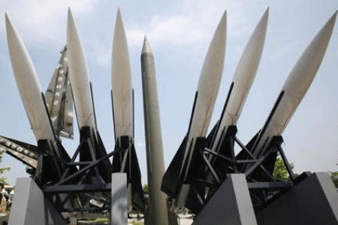










China has called for calm and restraint after North Korea claimed to have test-launched its first intercontinental ballistic missile that is capable of hitting anywhere in the world.