How the nuclear-armed nations brought the North Korea crisis on themselves https://www.theguardian.com/world/2017/sep/05/nuclear-armed-nations-brought-the-north-korea-crisis-on-themselves
Failure to honour terms of the 1970 nuclear non-proliferation treaty has helped create ground for Kim Jong-un’s recklessness, Guardian, Simon Tisdall, 5 Sept 17, North Korea’s defiant pursuit of nuclear weapons capabilities, dramatised by last weekend’s powerful underground test and a recent long-range ballistic missile launch over Japan, has been almost universally condemned as posing a grave, unilateral threat to international peace and security.
The growing North Korean menace also reflects the chronic failure of multilateral counter-proliferation efforts and, in particular, the longstanding refusal of acknowledged nuclear-armed states such as the US and Britain to honour a legal commitment to reduce and eventually eliminate their arsenals.
In other words, the past and present leaders of the US, Russia, China, France and the UK, whose governments signed but have not fulfilled the terms of the 1970 nuclear non-proliferation treaty (NPT), have to some degree brought the North Korea crisis on themselves. Kim Jong-un’s recklessness and bad faith is a product of their own.
The NPT, signed by 191 countries, is probably the most successful arms control treaty ever. When conceived in 1968, at the height of the cold war, the mass proliferation of nuclear weapons was considered a real possibility. Since its inception and prior to North Korea, only India, Pakistan and Israel are known to have joined the nuclear “club” in almost half a century.
To work fully, the NPT relies on keeping a crucial bargain: non-nuclear-armed states agree never to acquire the weapons, while nuclear-armed states agree to share the benefits of peaceful nuclear technology and pursue nuclear disarmament with the ultimate aim of eliminating them. This, in effect, was the guarantee offered to vulnerable, insecure outlier states such as North Korea. The guarantee was a dud, however, and the bargain has never been truly honoured.
Rather than reducing their nuclear arsenals, the US, Russia and China have modernised and expanded them. Britain has eliminated some of its capability, but it is nevertheless renewing and updating Trident. France clings fiercely to its “force de frappe”. Altogether, the main nuclear-weapon states have an estimated 22,000 nuclear bombs. A report by the non-governmental British-American Security Information Council in May said nuclear security was getting worse.
“The need for nuclear disarmament through multilateral diplomacy is greater now than it has been at any stage since the end of the cold war. Trust and confidence in the existing nuclear non-proliferation regime is fraying, tensions are high, goals are misaligned and dialogue is irregular,” the report said.
“Internationally, relationships between the nuclear-weapon states have deteriorated, in particular between the US and Russia, and to some extent, China … All nuclear-armed states are modernising their nuclear forces, at a worldwide cost of $1tn per decade … Attention tends to be focused on specific cases of proliferation concern, such as North Korea and Iran, at the expense of the bigger picture.”
Multilateral forums for advancing nuclear disarmament are in crisis. The next NPT review conference is not due until 2020. Like its 2015 predecessor, it is not expected to achieve much. The UN-backed conference on disarmament, which helped produce conventions banning biological and chemical weapons and initiated the 1996 comprehensive test ban treaty, is politically polarised and struggling to agree key measures such as a fissile material cut-off treaty.
Meanwhile, as South Korea and Japan consider acquiring nuclear weapons, Donald Trump appears irrationally determined to scrap one of the few recent arms control successes – the landmark 2015 nuclear deal with Iran.
 There has been one big breakthrough this year, the under-reported adoption by 122 countries at the UN in July of a new treaty on the prohibition of nuclear weapons, which envisages an outright ban on the use of all nukes. It has, however, been potentially fatally undermined by a boycott by the nuclear powers. The US, Britain and France declared, cynically as critics saw it, that they preferred to stick with the never-ending NPT route to disarmament. “This initiative clearly disregards the realities of the international security environment,” they said in a joint statement.
The ineffectiveness of current arms control and counter-proliferation efforts has helped to create an environment in which North Korea, allegedly using smuggled, Russian-designed ballistic missile engines, is rapidly advancing its nuclear ambitions with apparent impunity, at great risk to international stability.
Multilateral arms control failures also mean the Korean “solution” Trump talks about with increasing frequency – the use of preventive military action, notwithstanding its illegality under international law – could, if applied, spell the end of deterrence and the beginning of an unchecked global nuclear arms race.
September 6, 2017
Posted by Christina Macpherson |
2 WORLD, North Korea, politics international |
Leave a comment
 North Korea nuclear crisis: Putin warns of planetary catastrophe As Kim Jong-un reportedly prepares further missile launch, Russian president says further sanctions would be ‘useless’, Guardian, Justin McCurry in Tokyo and Tom Phillips in Beijing, 6 Sept 17, The Russian president, Vladimir Putin, has warned that the escalating North Korean crisis could cause a “planetary catastrophe” and huge loss of life, and described US proposals for further sanctions on Pyongyang as “useless”.
“Ramping up military hysteria in such conditions is senseless; it’s a dead end,” he told reporters in China. “It could lead to a global, planetary catastrophe and a huge loss of human life. There is no other way to solve the North Korean nuclear issue, save that of peaceful dialogue.”
On Sunday, North Korea carried out its sixth and by far its most powerful nuclear test to date. The underground blast triggered a magnitude-6.3 earthquake and was more powerful than the bombs dropped by the US on Hiroshima and Nagasaki during the second world war.
Putin was attending the Brics summit, bringing together the leaders of Brazil, Russia, India, China and South Africa. Speaking on Tuesday, the final day of the summit in Xiamen, China, he said Russia condemned North Korea’s provocations but said further sanctions would be useless and ineffective, describing the measures as a “road to nowhere”.
Foreign interventions in Iraq and Libya had convinced the North Korean leader, Kim Jong-un, that he needed nuclear weapons to survive, Putin said.
“We all remember what happened with Iraq and Saddam Hussein. His children were killed, I think his grandson was shot, the whole country was destroyed and Saddam Hussein was hanged … We all know how this happened and people in North Korea remember well what happened in Iraq.
“They will eat grass but will not stop their [nuclear] programme as long as they do not feel safe.” …….https://www.theguardian.com/world/2017/sep/05/south-korea-minister-redeploying-us-nuclear-weapons-tensions-with-north
September 6, 2017
Posted by Christina Macpherson |
North Korea, politics international, Russia |
1 Comment

 Kim Jong-un’s North Korea nuclear test mountain may collapse, let out ‘many bad things’, SMH SEPTEMBER 6 2017 Beijing: North Korea has conducted all of its underground nuclear tests beneath one mountain, Chinese scientists believe, prompting one to express concern the mountain may collapse, causing an environmental disaster.
“We call it taking the roof off,” the China Institute of Atomic Energy’s Wang Naiyan told the South China Morning Post.
geophysicists from the University of Science and Technology of China have examined seismograph records and say Sunday’s underground nuclear test by North Korea was the fifth nuclear bomb to be exploded at the same mountain at Punggye-ri.
Professor Wen Lianxing from the university’s Key Laboratory of Earthquake and Earth Physics said nuclear explosions were previously staged at the mountain in September 2016, January 2016, February 2013 and May 2009.
The researchers used satellite images and seismic data from 112 Chinese seismic bureaus in their study, which gave the positions of the tests accurate to within 100 metres, according to a statement published on the university’s website……http://www.smh.com.au/world/kim-jonguns-north-korea-nuclear-test-mountain-may-collapse-let-out-many-bad-things-20170905-gyb8dp.html
September 6, 2017
Posted by Christina Macpherson |
North Korea, safety, weapons and war |
Leave a comment
Pyongyang issue new threats against the US http://www.skynews.com.au/news/politics/international/2017/09/06/pyongyang-issue-new-threats-against-the-us.html, 6 September 2017 Amid international uproar over North Korea’s latest and biggest nuclear weapons test, one of its top diplomats says it’s ready to send ‘more gift packages’ to the United States.
Han Tae Song, ambassador of the Democratic People’s Republic of Korea (DPRK) to the UN in Geneva, on Tuesday addressed the UN-sponsored Conference on Disarmament two days after his country detonated its sixth nuclear test explosion.
‘I am proud of saying that just two days ago on the 3rd of September, DPRK successfully carried out a hydrogen bomb test for intercontinental ballistic rocket under its plan for building a strategic nuclear force,’ Han told the Geneva forum.
‘The recent self-defence measures by my country, DPRK, are a ‘gift package’ addressed to none other than the US,’ Han said. ‘The US will receive more ‘gift packages’ from my country as long as its relies on reckless provocations and futile attempts to put pressure on the DPRK,’ he added without elaborating.
Military measures being taken by North Korea were ‘an exercise of restraint and justified self-defence right’ to counter ‘the ever-growing and decade-long US nuclear threat and hostile policy aimed at isolating my country’.
US disarmament ambassador Robert Wood said North Korea had defied the international community once again with its test.
‘It can no longer be business as usual with this regime.’
The White House said on Monday President Donald Trump had agreed ‘in principle’ to scrap a warhead weight limit on South Korea’s missiles in the wake of the North’s latest test.
The United States accused North Korea’s trading partners of aiding its nuclear ambitions and said Pyongyang was ‘begging for war’. Russia’s UN Ambassador Vassily Nebenzia said on Tuesday that a US aim for the United Nations Security Council to vote on Monday on new sanctions on North Korea over its latest nuclear test is ‘a little premature’.
German Chancellor Angela Merkel and Japanese Prime Minister spoke by telephone on Tuesday and agreed that sanctions against Pyongyang should be stepped up.
‘She agreed with Prime Minister Abe that North Korea’s latest nuclear test threatened the security of the entire world and that this massive violation of the UN Security Council’s resolution must result in a resolute reaction from the international community as well as tougher sanctions,’ spokesman Steffen Seibert said.
September 6, 2017
Posted by Christina Macpherson |
North Korea, politics international |
Leave a comment
North Korea’s Nuclear Arsenal Threatens China’s Path to Power, NYT, By JANE PERLEZ, SEPT. 5, 2017 “………China has made little secret of its long-term goal to replace the United States as the major power in Asia and assume what it considers its rightful position at the center of the fastest-growing, most dynamic region in the world.
September 6, 2017
Posted by Christina Macpherson |
China, North Korea, politics international |
Leave a comment
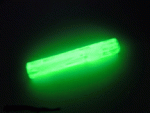 Robin des Bois 30th Aug 2017, Within a few days, unless an accident occurs, the Pacific Egret will enter the North Korean missile influence area. The Pacific Egret carries 8 tons of MOX, a nuclear fuel made in France containing 8 to 10% of plutonium mixed with enriched uranium.
This civil bomb left the French port of Cherbourg on July 5, 2017. After having sailed down the Atlantic Ocean, passed off South Africa, crossed the Indian Ocean and the Pacific Ocean, the MOX is expected to be unloaded in the small private port of the Japanese nuclear power plant in Takahama, facing North Korea.
Once again, the French government, Areva and the Nuclear Safety Authority have taken the irresponsible risk of permitting and undertaking a nuclear expedition bound for an unsteady zone in all political, geological and climatic respects. http://www.robindesbois.org/en/moxquitue-n2/
September 6, 2017
Posted by Christina Macpherson |
France, North Korea, safety |
Leave a comment
North Korea: What can actually be done to deal with a nuclear Pyongyang? http://www.abc.net.au/news/2017-09-03/north-korea-is-it-time-to-accept-it-will-remain-a-nuclear-threat/8868138, ANALYSIS By chief foreign correspondent Philip Williams, From the first tweak of the seismograph it was clear this was no ordinary tremor — it signalled the most powerful bomb of all.
The North Korean TV newsreader announced with a flourish this was the state’s first hydrogen bomb.If that now means Pyongyang has the weapon and the delivery system that could wipe out a Los Angeles, a San Francisco or a Sydney in a flash, then the world is now a different place.
Nuclear weapons are supposed to be a deterrent — make yourself so dangerous no-one will ever dare challenge you — and it is a fact that barring some Scuds aimed at Israel during the 1991 Gulf War and some border skirmishes between China and Vietnam and India and Pakistan, no nuclear-armed state has ever faced a serious attack by another country.
Clearly the thinking for three generations of Kim is that the regime is made safe if everyone fears you. And the clear impression you are crazy helps too — no-one wants to aggravate a disturbed mind.
But what to do? US President Donald Trump has described the test as hostile and dangerous and said Pyongyang “only understands one thing”.
Appeasement was not working, he said, and the rogue nation has become a “great threat and embarrassment” to China. He later tweeted the US was considering “stopping trade with any country doing business with North Korea”.
That would include both China and Russia. While both signed on to the latest UN sanctions, cutting trade altogether would be a far more serious step.
Beijing would have to cut off oil supplies and Moscow send back the North Korean labourers who “volunteer” to work in Siberian forestry camps in what have been described as slave-like conditions.
The whole region and beyond is in a fix. China especially is feeling the squeeze from the United States, and even Australia has argued Beijing has not applied full muscle against North Korea to mend its errant ways.
But the Chinese Government has agreed to the latest sanctions and deeply resents the assertion it could stop Kim Jong-un if it really wanted to. There is nothing for the Chinese to gain from a nuclear war on the Korean Peninsula.
Not only would there be the risk of nuclear contamination, what really worries Beijing is the thought of millions of refugees pouring over the border seeking shelter from a nuclear storm. Not to mention the terrible human and economic cost of shattered neighbours.
The constant refrain from Mr Trump and Malcolm Turnbull for China to do more and do it now could soon become counterproductive. Beijing’s influence on North Korea’s leadership is often overstated.
Its troublesome neighbour has repeatedly embarrassed China by testing bombs or missiles at an inopportune moment. This latest test happened at the opening of a major BRICS (Brazil, Russia, India, China and South Africa) conference held in China and hosted by President Xi Jinping.
Not only was his thunder stolen, he and guest Vladimir Putin were forced to issue a joint statement condemning the test but urging a negotiated solution. Mr Trump underlined that via a tweet, saying: “North Korea is a rogue nation which has become a great threat and embarrassment to China, which is trying to help but with little success.”
For his part, the US leader has wedged himself with rhetoric — it was only a couple of days ago he said the time for talking was over. But what does that leave?
The US military will have its plans ready, just in case. And Mr Trump is the only person with power to order what would be the destruction of North Korea. Is he really contemplating the death of millions, the ruin of cites on both sides of the 38th parallel?
Only if North Korea crosses his red lines. Do they exist in the seas off Guam, Hawaii, or the West coast of the mainland itself?
Surely Mr Kim and his predecessors have not come all this way to self-destruct. After all, these bombs and missiles are supposed to protect, not trigger an end game conflict. No party to this conundrum wants this to happen.
But the scene is set, the main players less than predictable and the talk tough. North Korea will never willingly trade away its newfound military clout, it is seen as vital for survival, but successive US presidents have made it clear they will never live with a nuclear armed and able North Korea.
It is a country that revels in regular threats to wipe out entire US cities. It is no longer trash talk that can be ignored and no-one, it seems, has a plausible answer.
One commentator suggested arming both South Korea and Japan with nuclear weapons to act as a foil to the North. That would mean five countries in the region with the ability to erase entire cities from the planet.
Our once relatively safe and increasingly prosperous neighbourhood is taking a serious turn for the worse. Only two people on the planet can change all that, and neither is showing signs there is a safe way out.
Asked by a reporter if the US would attack North Korea, Mr Trump said: “We’ll see.”
September 4, 2017
Posted by Christina Macpherson |
North Korea, politics international, weapons and war |
Leave a comment
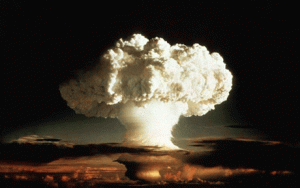 North Korea says it successfully tested hydrogen bomb, marking sixth nuclear test since 2006, ABC News, 3 Sept 17, North Korea has said it successfully tested a hydrogen bomb designed to be mounted on its newly developed intercontinental ballistic missile (ICBM), producing a greater yield than any of its previous nuclear tests.
Key points:
- Previous recent tremors in North Korea have been caused by nuclear tests
- Tremor came hours after state media said Kim Jong-un inspected new hydrogen bomb
- Witnesses on the Chinese side of the border said tremor lasted roughly 10 seconds
The hydrogen bomb test ordered by leader Kim Jong-un was a “perfect success” and was a “meaningful” step in completing the country’s nuclear weapons programme, according to state television.
The announcement came hours after a large quake that appeared to be man-made was detected near the North’s known nuclear test site, indicating that the reclusive country had conducted its sixth nuclear test since 2006.
The tremor struck within a kilometre of the site of a magnitude-5.3 “nuclear explosion” from September last year, according to the United States Geological Survey (USGS).
South Korea said this most recent test appeared to be several times stronger than its previous test, estimating the nuclear blast yield was between 50 to 60 kilotons — or five to six times stronger than the North Korea’s fifth test a year ago…….http://www.abc.net.au/news/2017-09-03/north-korea-says-it-successfully-tested-hydrogen-bomb/8867568
September 4, 2017
Posted by Christina Macpherson |
North Korea, weapons and war |
Leave a comment
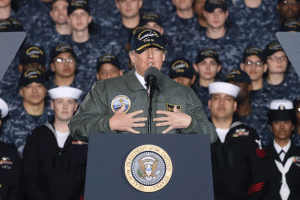 All options on the table after missile: Trump Sky News , 30 August 2017 US president Donald Trump has said ‘all options are on the table’ after North Korea launched a ballistic missile over Japan.
Mr Trump spoke as China said tensions on the Korean peninsula were now at ‘tipping point’.
North Korea fired a midrange ballistic missile that flew over Japan on Tuesday, a test considered one of the most provocative ever from the reclusive state.
It came as US and South Korean forces conduct annual military exercises on the peninsula. Chinese foreign ministry spokeswoman Hua Chunying reiterated Beijing’s call for peace talks, saying ‘pressure and sanctions’ against North Korea ‘cannot fundamentally solve the issue’, and said the country needed to exercise restraint.
‘The UN Security Council has put through several resolutions and sanctions have all along been put in place but everyone can see whether they’ve had actual results,’ she added.
‘On the one hand, sanctions have continued to be put in place via resolutions and on the other hand North Korea’s nuclear and missile launch process is still continuing.’……http://www.skynews.com.au/news/top-stories/2017/08/30/all-options-on-the-table-after-missile–trump.html
August 30, 2017
Posted by Christina Macpherson |
North Korea, politics international, USA |
Leave a comment
Can the world live with a nuclear North Korea?, BBC, Jonathan MarcusDiplomatic correspondent, 30 August 2017, This is, by any standards, the most provocative of North Korea’s recent missile tests.
August 30, 2017
Posted by Christina Macpherson |
North Korea, politics international |
Leave a comment
 NORTH KOREA KEEPS SAYING IT MIGHT GIVE UP ITS NUCLEAR WEAPONS — BUT MOST NEWS OUTLETS WON’T TELL YOU THAT, The Intercept Jon Schwarz, August 26 2017 “…….here’s what you don’t know, unless you’re an obsessive North Korea-watcher:
Also starting on July 4, North Korea has been saying over and over again that it might put its nuclear weapons and missiles on the negotiating table if the United States would end its own threatening posture.
This fact has been completely obscured by U.S. and other western media. For the most part, newspapers and television have simply ignored North Korea’s position. When they haven’t ignored it, they’ve usually mispresented it as its opposite – i.e., claiming that North Korea is saying that it will never surrender its nuclear weapons under any circumstances. And on the rare occasions when North Korea’s statements are mentioned accurately, they’re never given the prominence they deserve.
North Korea’s proclamations have been closely tracked by Robert Carlin, currently a visiting scholar at Stanford University’s Center for International Security and Cooperation and formerly head of the Northeast Asia Division in the State Department’s intelligence arm. Carlin has visited North Korea over 30 times.
Via email, Carlin described how it is difficult but critical to accurately decode North Korean communications. “Observers dismiss as unimportant what the North Koreans say,” Carlin writes, and “therefore don’t read it carefully, except of course if it is colorful, fiery language that makes for lovely headlines. Some of what the North says is simply propaganda and can be read with one eye closed. Other things are written and edited very carefully, and need to be read very carefully. And then, having been read, they need to be compared with past statements, and put in context.”
With that in mind, here’s Kim Jong-un’s statement on July 4:
[T]he DPRK would neither put its nukes and ballistic rockets on the table of negotiations in any case nor flinch even an inch from the road of bolstering the nuclear force chosen by itself unless the U.S. hostile policy and nuclear threat to the DPRK are definitely terminated. [emphasis added]
That formulation again appeared in an August 7 government statement after the United Nations Security Council passed new sanctions on North Korea. The same day, North Korean Foreign Minister Ri Yong Ho also said it during a speech at the Association of Southeast Asian Nations regional forum in the Philippines.
And on August 22 at the UN Conference on Disarmament in Switzerland, North Korean diplomat Ju Yong Chol made exactly the same point, stating, “As long as the U.S. hostile policy and nuclear threat remains unchallenged, the DPRK will never place its self-defensive nuclear deterrence on the negotiating table.”
In the past North Korea has pledged to renounce its nuclear weapons program. During the so-called Six-Party Talks in 2005, all the nations involved, including North Korea, affirmed that the North Korea was “committed to abandoning all nuclear weapons and existing nuclear programs.” Meanwhile, the United States and North Korea agreed to “respect each other’s sovereignty, exist peacefully together, and take steps to normalize their relations.”
Then the situation soured. Carlin writes that more recently “the routine formula in lower level media commentaries was that the nuclear deterrent was ‘not a mere bargaining chip to put on the table for negotiations with the United States.’”
So all of this seems quite clear and straightforward. North Korea is again telling the world that it is willing to consider renouncing its nuclear weapons program. Obviously Kim’s regime may not be telling the truth, especially given the fact that it has violated prior agreements. But the United States has flagrantly violated those agreements as well. The only way to find out whether there’s a path to North Korean disarmament is to honestly engage with them about it.
There are huge roadblocks to that happening, and one of the biggest is the failure of western media simply to inform their audience of the basics of what’s happening.
Since July 4, the New York Times and Washington Post have published hundreds of articles about North Korea. Both papers have informed their readers that Kim has called Americans “bastards.” But they’ve each only published one story quoting Kim’s key caveat, that North Korea will consider giving up its nukes if “the U.S. hostile policy and nuclear threat to the DPRK are definitely terminated.” And in both cases the Post and Times simply reprinted an AP story — in which Kim’s words appear in the 23rd paragraph – rather than running pieces of their own………
Coverage in other publications has tended to be, if anything, shoddier, with television coverage worst of all. The BBC World Service soberly explained on August 15 that “North Korea says its nuclear program can never be on the negotiating table and that’s where the stand-off is.” Other outlets have generally maintained a discreet silence about North Korea’s position.
Taken in total, the media’s performance on North Korea so far is an extremely ominous development. We know because of the Iraq War that newspapers and TV can provide a key assist in launching catastrophic U.S. wars. As things stand now, it’s by no means impossible that they will do it again. https://theintercept.com/2017/08/25/north-korea-keeps-saying-it-might-give-up-its-nuclear-weapons-but-most-news-outlets-wont-tell-you-that/
August 28, 2017
Posted by Christina Macpherson |
North Korea, politics international, weapons and war |
Leave a comment
North Korea vows to ‘sharpen its nuclear sword’ in WORLD WAR 3 threat to USA, Express UK 27 Aug 17 NORTH Korea has sparked fears of all-out war with the USA after threatening to “sharpen its nuclear sword” as tensions continue to escalate., By JOEY MILLAR, Aug 27, 2017 North Korea has issued yet another sabre-rattling statement to its Western enemies, warning the US it would show “no mercy” in any conflict.
August 28, 2017
Posted by Christina Macpherson |
North Korea, politics international, weapons and war |
Leave a comment
Russian nuclear bombers fly near North Korea in rare show of force, http://www.reuters.com/article/us-russia-southkorea-bombers-idUSKCN1B40MP, Andrew Osborn, 25 Aug 17, Moscow, Reuters, Russian nuclear-capable strategic bombers have flown a rare mission around the Korean Peninsula at the same time as the United States and South Korea conduct joint military exercises that have infuriated Pyongyang.
Russia, which has said it is strongly against any unilateral U.S. military action on the peninsula, said Tupolev-95MS bombers, code named “Bears” by NATO, had flown over the Pacific Ocean, the Sea of Japan, the Yellow Sea and the East China Sea, prompting Japan and Seoul to scramble jets to escort them.
The flight, which also included planes with advanced intelligence gathering capabilities, was over international waters and was announced by the Russian Defence Ministry on the same day as Moscow complained about the U.S.-South Korean war games.
“The US and South Korea holding yet more large-scale military and naval exercises does not help reduce tensions on the Korean Peninsula,” Maria Zakharova, a spokeswoman for the foreign ministry, told a news briefing in Moscow.
“We urge all sides to exercise maximum caution. Given the arms build-up in the region, any rash move or even an unintended incident could spark a military conflict.”
August 25, 2017
Posted by Christina Macpherson |
North Korea, Russia, South Korea, weapons and war |
Leave a comment
North Korea also has the collective memory of the horror wrought by the US in the three year conflict on a country then with a population of just 9.6 million souls. US General Curtis Lemay in the aftermath stated: “After destroying North Korea’s seventy eight cities and thousands of her villages, and killing countless numbers of her civilians … Over a period of three years or so we killed off – what – twenty percent of the population.”

 North Korea, An Aggressor? A Reality Check http://www.globalresearch.ca/north-korea-an-aggressor-a-reality-check/5605534, By Felicity Arbuthnot, Global Research, August 24, 2017
“ … war in our time is always indiscriminate, a war against innocents, a war against children.”(Howard Zinn, 1922-2010.)
“All war represents a failure of diplomacy.” (Tony Benn, MP. 1925-2014.)
“No country too poor, too small, too far away, not to be threat, a threat to the American way of life.” (William Blum, “Rogue State.”)
The mention of one tiny country appears to strike at the rationality and sanity of those who should know far better. On Sunday, 6th August, for example, The Guardian headed an editorial: “The Guardian view on sanctions: an essential tool.” Clearly the average of five thousands souls a month, the majority children, dying of “embargo related causes” in Iraq, year after grinding year – genocide in the name of the UN – for over a decade has long been forgotten by the broadsheet of the left.
This time of course, the target is North Korea upon whom the United Nations Security Council has voted unanimously to freeze, strangulate and deny essentials, normality, humanity. Diplomacy as ever, not even a consideration. The Guardian, however, incredibly, declared the decimating sanctions: “A rare triumph of diplomacy …” (Guardian 6th August 2017.)
As US Secretary of State, Rex Tillerson, the US’ top “diplomat” and his North Korean counterpart Ri Yong-ho headed for the annual Ministerial meeting of the Association of Southeast Asian Nations (ASEAN) in Manila on 5th August, a State Department spokesperson said of Tillerson:
“The Secretary has no plans to meet the North Korean Foreign Minister in Manila, and I don’t expect to see that happen”
Pathetic. In April, approaching his hundredth day in office, Trump said of North Korea:
“We’d love to solve things diplomatically but it’s very difficult.”
No it is not. Talk, walk in the other’s psychological shoes. Then, there they were at the same venue but the Trump Administration clearly does not alone live in a land of missed opportunities, but of opportunities deliberately buried in landfill miles deep. This in spite of his having said in the same statement:
“There is a chance that we could end up having a major, major conflict with North Korea. Absolutely.”
A bit of perspective: 27th July 2017 marked sixty four years since the armistice agreement that ended the devastating three year Korean war, however there has never been a peace treaty, thus technically the Korean war has never ended. Given that and American’s penchant for wiping out countries with small populations which pose them no threat (think most recently, Afghanistan, Iraq, Libya) no wonder North Korea wishes to look as if it has some heavy protective gear behind the front door, so to speak.
Tiny North Korea has a population of just 25.37 million and landmass of 120,540 km² (square kilometres.) The US has a population of 323.1 million and a landmass of 9.834 MILLION km² (square kilometres.) Further, since 1945, the US is believed to have produced some 70,000 nuclear weapons – though now down to a “mere” near 7,000 – but North Korea is a threat?
America has fifteen military bases in South Korea – down from a staggering fifty four – bristling with every kind of weapons of mass destruction. Two bases are right on the North Korean border and another nearly as close. See full details of each, with map at (1.)
North Korea also has the collective memory of the horror wrought by the US in the three year conflict on a country then with a population of just 9.6 million souls. US General Curtis Lemay in the aftermath stated: “After destroying North Korea’s seventy eight cities and thousands of her villages, and killing countless numbers of her civilians … Over a period of three years or so we killed off – what – twenty percent of the population.”
“It is now believed that the population north of the imposed 38th Parallel lost nearly a third its population of 8 – 9 million people during the 37-month long ‘hot’ war, 1950 – 1953, perhaps an unprecedented percentage of mortality suffered by one nation due to the belligerence of another.” (2)
In context:
“During The Second World War the United Kingdom lost 0.94% of its population, France lost 1.35%, China lost 1.89% and the US lost 0.32%. During the Korean war, North Korea lost close to 30 % of its population.” (Emphasis added.)
“We went over there and fought the war and eventually burned down every town in North Korea anyway, some way or another …”, boasted Lemay.
Gen. Douglas MacArthur said during a Congressional hearing in 1951 that he had never seen such devastation.
“I shrink with horror that I cannot express in words … at this continuous slaughter of men in Korea,” MacArthur said. “I have seen, I guess, as much blood and disaster as any living man, and it just curdled my stomach, the last time I was there.” (CNN, 28th July 2017.)
Horrified as he was, he did not mention the incinerated women, children, infants in the same breath.
Moreover, as Robert M. Neer wrote in “Napalm, an American Biography”:
‘“Practically every U.S. fighter plane that has flown into Korean air carried at least two napalm bombs,” Chemical Officer Townsend wrote in January 1951. About 21,000 gallons of napalm hit Korea every day in 1950. As combat intensified after China’s intervention, that number more than tripled (…) a total of 32,357 tons of napalm fell on Korea, about double that dropped on Japan in 1945. Not only did the allies drop more bombs on Korea than in the Pacific theater during World War II – 635,000 tons, versus 503,000 tons – more of what fell was napalm …’
In the North Korean capitol, Pyongyang, just two buildings were reported as still standing.
In the unending history of US warmongering, North Korea is surely the smallest population they had ever attacked until their assault on tiny Grenada in October 1983, population then just 91,000 (compulsory silly name: “Operation Urgent Fury.)
North Korea has been taunted by the US since it lay in ruins after the armistice sixty five years ago, yet as ever, the US Administration paints the vast, self appointed “leader of the free world” as the victim.
As Fort-Russ pointed out succinctly (7th August 2017):
“The Korean Peninsula is in a state of crisis not only due to constant US threats towards North Korea, but also due to various provocative actions, such as Washington conducting joint military exercises with Seoul amid tensions, and which Pyongyang considered a threat to its national security.”
This month “massive land, sea and air exercises” involving “tens of thousands of troops” from the US and South Korea began on 21st of August and continue until 31st.
‘In the past, the practices are believed to have included “decapitation strikes” – trial operations for an attempt to kill Kim Jong-un and his top Generals …’, according to the Guardian (11th August 2017.)
The obligatory stupid name chosen for this dangerous, belligerent, money burning, sabre rattling nonsense is Ulchi-Freedom Guardian. It is an annual occurrence since first initiated back in 1976.
US B-1B bombers flying from Guam recently carried out exercises in South Korea and “practiced attack capabilities by releasing inert weapons at the Pilsung Range.” In a further provocative (and illegal) move, US bombers were again reported to overfly North Korea, another of many such bullying, threatening actions, reportedly eleven just since May this year.
Yet in spite of all, North Korea is the “aggressor.”
“The nuclear warheads of United States of America are stored in some twenty one locations, which include thirteen U.S. states and five European countries … some are on board U.S. submarines. There are some “zombie” nuclear warheads as well, and they are kept in reserve, and as many as 3,000 of these are still awaiting their dismantlement. (The US) also extends its “nuclear umbrella” to such other countries as South Korea, Japan, and Australia.” (worldatlas.com)
Russian Foreign Minister Sergey Lavrov who also attended the ASEAN meeting in Manila, did of course, do what proper diplomats do and talked with his North Korean counterpart Ri Yong-ho. Minister Lavrov’s opinion was summed up by a Fort Russ News observer as:
“The Korean Peninsula is in a state of crisis not only due to constant US threats towards North Korea, but also due to various provocative actions, such as Washington conducting joint military exercises with Seoul amid tensions, and which Pyongyang considered a threat to its national security.”
The “provocative actions” also include the threatening over-flights by US ‘planes flying from Guam. However when North Korea said if this continued they would consider firing missiles in to the ocean near Guam – not as was reported by some hystericals as threatening to bomb Guam – Agent Orange who occasionally pops in to the White House between golf rounds and eating chocolate cake whilst muddling up which country he has dropped fifty nine Tomahawk Cruise missiles on, responded that tiny North Korea will again be: “… met with fire and fury and frankly power, the likes of which the world has never seen before.”
It was barely noticed that North Korea qualified the threat of a shot across the bows by stating pretty reasonably:
(The US) “should immediately stop its reckless military provocation against the State of the DPRK so that the latter would not be forced to make an unavoidable military choice.” (3)
As Cheryl Rofer (see 3) continued, instead of endless threats, US diplomacy could have many routes:
“We could have sent a message to North Korea via the recent Canadian visit to free one of their citizens. We could send a message through the Swedish embassy to North Korea, which often represents US interests. We could arrange some diplomatic action on which China might take the lead. There are many possibilities, any of which might show North Korea that we are willing to back off from practices that scare them if they will consider backing off on some of their actions. That would not include their nuclear program explicitly at this time, but it would leave the way open for later.”
There are in fact, twenty four diplomatic missions in all, in North Korea through which the US could request to communicate – or Trump could even behave like a grown up and pick up the telephone.
Siegfried Hecker is the last known American official to inspect North Korea’s nuclear facilities. He says that treating Kim Jong-un as though he is on the verge of attacking the U.S. is both inaccurate and dangerous.
“Some like to depict Kim as being crazy – a madman – and that makes the public believe that the guy is undeterrable. He’s not crazy and he’s not suicidal. And he’s not even unpredictable. The real threat is we’re going to stumble into a nuclear war on the Korean Peninsula.” (5)
Trump made his crass “fire and fury” threat on the eve of the sixty second commemoration of the US nuclear attack on Nagasaki, the nauseating irony seemingly un-noticed by him.
Will some adults pitch up on Capitol Hill before it is too late?
Notes
- https://militarybases.com/ south-korea/
- http://www.globalresearch.ca/ know-the-facts-north-korea- lost-close-to-30-of-its- population-as-a-result-of-us- bombings-in-the-1950s/22131
- https://nucleardiner. wordpress.com/2017/08/11/ north-korea-reaches-out/
- https://www.commondreams.org/ news/2017/08/08/sane-voices- urge-diplomacy-after-lunatic- trump-threatens-fire-and-fury
August 25, 2017
Posted by Christina Macpherson |
North Korea, politics international, Reference, weapons and war |
Leave a comment
 U.S. Pacific Command chief says diplomacy — not military action — key to North Korea crisis, Japan Times 22 Aug 17 , REUTERS, AP OSAN, SOUTH KOREA – The head of the U.S. military’s Pacific Command said on Tuesday it was more important to use diplomacy to counter North Korea’s missile threat rather than consider what actions by the reclusive North might trigger a pre-emptive strike.
Adm. Harry Harris was in South Korea to observe annual joint military drills with the South Korean military, which the North called a step toward nuclear conflict masterminded by the U.S. and South Korean “war maniacs.”
“So we hope and we work for diplomatic solutions to the challenge presented by Kim Jong Un,” Harris told reporters at a U.S. air base in South Korea about an hour from the capital, Seoul, referring to the North Korean leader.
He said diplomacy was “the most important starting point” in response to the North’s threat, when asked what actions by North Korea might trigger a pre-emptive U.S. strike against Pyongyang……
The United States and South Korean began long-planned joint military exercises on Monday called the Ulchi Freedom Guardian (UFG), which the allies have said were purely defensive and did not aim to increase tension on the Korean Peninsula.
The drills end on Aug. 31 and involve tens of thousands of troops as well as computer simulations designed to prepare for war with a nuclear-capable North Korea.
A North Korean military spokesman repeated the threat of “merciless retaliation” against the United States for readying a preemptive strike and a war of aggression, using the drills as an excuse to mount such an attack.
“The U.S. will be wholly held accountable for the catastrophic consequences to be entailed by such reckless aggressive war maneuvers, as it chose a military confrontation,” the unnamed spokesman said in comments carried by the North’s official KCNA news agency.
The North claims the drills are an invasion rehearsal, senior U.S. military commanders on Tuesday dismissed calls to pause or downsize exercises they called crucial to countering a clear threat from Pyongyang…….https://www.japantimes.co.jp/news/2017/08/22/asia-pacific/u-s-pacific-command-chief-says-diplomacy-not-military-action-key-north-korea-crisis/#.WZykbPgjHGg
August 23, 2017
Posted by Christina Macpherson |
North Korea, politics international, USA |
Leave a comment







 nuclear-news