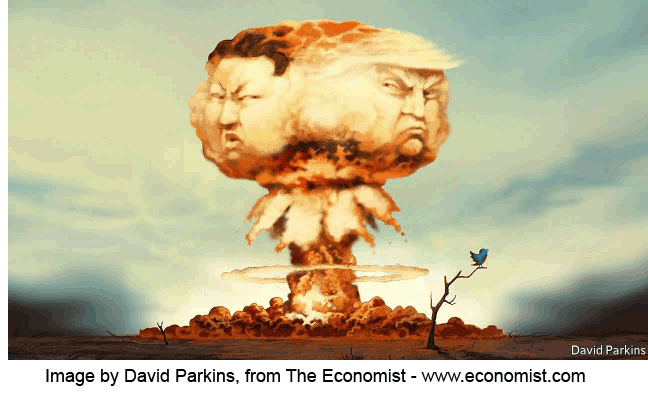
How We Got to North Korea’s Pacific Nuclear Test Threat and What Comes Next It would be the first above-ground detonation in decades and would send tensions into uncharted territory. The Drive BY JOSEPH TREVITHICK, SEPTEMBER 22, 2017 In ever escalating war of words between the United States and Kim Jong-un’s totalitarian regime in North Korea has reached an entirely new level since President Donald Trump threatened to “totally destroy” the Hermit Kingdom in a speech to the United Nations General Assembly. It seems all but guaranteed that the rhetoric will lead to new North Korean provocations, but what’s unprecedented and potentially game-changing is that they could potentially include a full demonstration of a nuclear-armed ballistic missile, or at least an above-ground nuclear weapon test, either which in turn would similarly demand some form of American response.
This latest escalation in tensions between the U.S. government and North Korean officials began on Sept. 19, 2017, when Trump addressed the United Nations General Assembly for the first time with fiery remarks, lashing out at not only North Korea, but also Iran, Cuba, Venezuela, and other critics of American foreign policy more broadly. He vowed to put the United States interests first in all matters and encouraged the other assembled leaders to do the same. But he reserved some of the most incendiary comments for Kim, who he has now nicknamed “Rocket Man,” and his regime.
“The United States has great strength and patience, but if it is forced to defend itself or its allies, we will have no choice but to totally destroy North Korea,” he declared. “Rocket Man is on a suicide mission for himself and for his regime. The United States is ready, willing and able, but hopefully this will not be necessary.”
This particular statement drew “audible gasps” from some of the world leaders in attendance, according to The Associated Press. The North Korean delegation had already walked out in protest before Trump even began speaking……..
The string of threats, especially Nikki Haley’s comments, suggest the United states and its allies could easily handle the increasingly worrisome situation with military force if it runs out of other options. This of course is entirely untrue and major conflict with North Korea would be devastating for all the involved parties.
Not surprisingly, this has not prompted a change in the behavior of the North Korean regime or Premier Kim. As we at The War Zone have noted for months, these statements feed into the country’s existing paranoid and propaganda that the United States and its allies are actively looking to destroy it and forcefully eliminate its government.
It has only appeared to give North Korea more of a reason to continue to develop advanced ballistic missiles and nuclear weapons to achieve some relative parity with the United States in order, if nothing else, to preserve the regime’s very existence. Kim said as much himself in a televised rebuttal on Sept. 21, 2017……
Trump continued the cycle on Sept. 22, 2017, as part of a series of Tweets on various topics. “Kim Jong Un of North Korea, who is obviously a madman who doesn’t mind starving or killing his people, will be tested like never before!” he posted on the social media site.
If his remarks in front of the United Nations seemed likely to generate a North Korean response, the Tweet sounded closer to a direct challenge. Given Kim’s immediate response to Trump’s threat of total destruction, it seems he will have little room but to make a provocative move in response to this new “test.”
After Kim’s own televised address, North Korean Foreign Minister Ri Yong Ho had already said the North Korean response could include detonating a hydrogen bomb in or over the Pacific Ocean. Earlier in September 2017, North Korea tested what experts believe to be a working thermonuclear device…….
In the future, North Korea may simply need to conduct nuclear weapons tests outside of its own borders since the Punggye-ri underground test site may simply not be able to survive the strain of more powerful thermonuclear designs. The nuclear test earlier in September 2017 appeared to cause the tunnel containing the device to collapse, highlighting the limits of underground testing.
Even if the atmospheric test went as intended, it could be difficult to be entirely sure there would be no inadvertent casualties and the resulting fallout could easily fall on civilian mariners or populated areas……..
despite Nikki Haley’s and H.R. McMaster’s insistence that there are available military options to respond to these growing provocations, as well as Trump’s vague threats, any direct action would be fraught with its own dangers. One of the most likely courses of action, shooting down the missile, carries significant risks as the impact of the interceptor could trigger the device or the radioactive debris could fall over populated areas.
Perhaps more importantly to the viability of America’s still largely unproven ballistic missile defense shield, if the intercepting weapon misses or otherwise fails to achieve the desired effect, it would expose a serious vulnerability to not just North Korea, but the rest of the world…..
In particular, systems that engage the missile as it comes falling back down to earth, such as the Terminal High Altitude Air Defense (THAAD) system, have a very narrow window to achieve a “kill.” Furthermore, this means that personnel manning the interceptors would likely be in the direct path the incoming weapon, and if it was fully armed, a nuclear test.
There is very little room for failure in any of these scenarios. Even if the shoot down were to go smoothly, it is possible that it could trigger a larger and immensely destructive conflict on the Korean Peninsula or throughout East Asia. The War Zone’s Tyler Rogoway has highlighted these various issues previously in a deep dive into the United States’ available options in responding to North Korea’s continued provocations……..
All of these options still come with their own risks, though, and there’s still no indication that they would convince Kim to change course. If the North Korean regime’s primary goal is its own survival, it is perfectly rational for them to continue to demonstrate their resolve to respond in kind to American threats.
And despite his comments, Trump’s first step, on Sept. 21, 2017, was to sign a new executive order penalizing any individual or business doing business with North Korea. This follows a trend of steady sanctions against actors and firms outside of North Korea that the United States accuses of enabling the reclusive country’s government.
Trump and other members of his administration repeatedly question Kim’s mental stability, but as we at The War Zone have noted before, he clearly has a coherent plan. We’re still not sure that U.S. government has developed a thought-out strategy to dissuade him from his chosen path.
North Korea ‘threatens Pacific nuclear test’ Sky News, , 22 September 2017 North Korean Foreign Minister Ri Yong Ho says he believes the North could consider a hydrogen bomb test on the Pacific Ocean of an unprecedented scale, South Korea’s Yonhap news agency reports.
Mr Ri was speaking to reporters in New York when he was asked what North Korean leader Kim Jong-un had meant when he threatened in an earlier statement the ‘highest level of hard-line countermeasure in history’ against the United States.
North Korea could consider a hydrogen bomb test, Mr Ri said, although he did not know his leader’s exact thoughts, Yonhap reported.
In an earlier statement Mr Kim said Mr Trump was ‘mentally deranged’ and his comments were ‘the most ferocious declaration of a war in history,’ Mr Kim said the US president’s UN speech on Tuesday confirmed Pyongyang’s nuclear program has been ‘the correct path’.
‘His remarks … have convinced me, rather than frightening or stopping me, that the path I chose is correct and that it is the one I have to follow to the last,’ Mr Kim said in the statement carried by the North’s official KCNA news agency, promising to make Trump ‘pay dearly for his speech’.
Mr Trump had warned the North Korean leader in his UN address on Tuesday that the United States, if threatened, would ‘totally destroy’ the country of 26 million people and mocked Kim as a ‘rocket man’ on a suicide mission………
He offered more vitriol for Mr Trump, saying he was ‘unfit to hold the prerogative of supreme command of a country, and he is surely a rogue and a gangster fond of playing with fire, rather than a politician.’
North Korea: Trump and Kim call each other mad, BBC, 22 September 2017
Kim Jong-un has said remarks by “deranged” US President Donald Trump have convinced him he is right to develop weapons for North Korea.
In an unprecedented personal statement, Mr Kim said Mr Trump would “pay dearly” for a UN speech where he threatened to “totally destroy” the North if the US was forced to defend itself.
Mr Trump responded that the “madman… will be tested like never before”.
The two countries have engaged in ever more heated rhetoric in recent months.
Mr Kim ended his statement by saying he would “surely and definitely tame the mentally deranged US dotard with fire”.
China responded to the war of words, warning that the situation was “complicated and sensitive”.
“All relevant parties should exercise restraint instead of provoking each other,” said Foreign Minister spokesman Lu Kang.
Russia also urged restraint, with Foreign Minister Sergei Lavrov describing the rhetoric between the two leaders as a “kindergarten fight between children”……http://www.bbc.com/news/world-asia-41356836
Tighter sanctions on North Korea could have a harsh humanitarian impactThe Conversation Donald Trump has announced even more sanctions on North Korea, this time targeting anyone who does business there. His move comes hot on the heels of UN Security Council Resolution 2375, passed in response to North Korea’s sixth nuclear test, which marks a new stage in the world’s attempts to squeeze the Pyongyang government.
The resolution takes what was already a tough sanctions regime focused on nuclear and military-related trade and tries to exert broader pressure on the country’s economy, embargoing North Korean textile exports, capping the dispatch of additional North Korean workers overseas, and limiting exports of refined petroleum and crude oil to North Korea.
The US mission to the UN claimed that these measures amount to the “strongest sanctions ever”. But the measures contained within sit at odds with a claim made in the resolution’s article 26, namely that the measures “are not intended to have adverse humanitarian consequences for the civilian population of the DPRK”………
Hit hard
Restricting North Korean energy imports, for one, cannot but have an impact on the North Korean people themselves. A recent report by the Nautilius Institute argues that the military is likely to have access to considerable stockpiles of oil, even as ordinary North Korean citizens do not.
Similarly, the textile sector is a significant provider of jobs: the most recent North Korean census in 2008 showed that nearly 400,000 workers were employed in the textile manufacturing sector – and that was before the rapid growth of Chinese outsourcing to the North……….
Tipping the balance
Because North Korea is the world’s lowest-spending nuclear state, the level of economic stress needed to halt funding to the country’s nuclear weapons programme probably cannot be applied without severe human costs. There is also no guarantee that even extreme levels of hardship brought about by effective sanctions will produce a popular North Korean revolution. During the mass starvation of the 1990s, for example, there were no recorded incidents of significant civil unrest and the regime seemed resilient……..
Tipping the balance
Because North Korea is the world’s lowest-spending nuclear state, the level of economic stress needed to halt funding to the country’s nuclear weapons programme probably cannot be applied without severe human costs. There is also no guarantee that even extreme levels of hardship brought about by effective sanctions will produce a popular North Korean revolution. During the mass starvation of the 1990s, for example, there were no recorded incidents of significant civil unrest and the regime seemed resilient…….
To be sure, not all sanctions are ill-advised. But as the scope of multilateral sanctions is extended to target everyday North Koreans’ livelihoods, it’s crucial to ask whether this approach is likely to succeed. Given just how resilient the North Korean regime has so far been in the face of intense international pressure, the chances seem slim. https://theconversation.com/tighter-sanctions-on-north-korea-could-have-a-harsh-humanitarian-impact-84299
“The world will never accept a nuclear-armed North Korea,” U.S. Ambassador Nikki Haley told the U.N., after the sanctions passed the Security Council on Monday. She added: “If the North Korean regime does not halt its nuclear program, we will act to stop it ourselves.”
But some analysts believe that this approach to the North Korean nuclear crises is dangerously deluded.
A decade or so ago, it still may have been possible to use sanctions or the threat of military force to compel North Korea to give up its nuclear programs, argues Zhao Chu, an independent, Shanghai-based analyst, former soldier and former editor of World Outlook, a foreign affairs magazine.
But Zhao warns that the situation has now fundamentally changed, and that trying to fly through a window of opportunity that has already closed is a very bad idea. Pyongyang can hardly be expected to give up the nuclear ace in the hole that it worked so long to acquire.
Then again, perhaps the window of opportunity for military action was never open, argues Lyle Goldstein, an associate professor in the Strategic Research Department at the U.S. Naval War College in Newport, Rhode Island. This is because the South Korean capital, “Seoul was always so vulnerable” to North Korean conventional artillery attacks, which could cause mass casualties.
Analysts say North Korea looked at the fate of other authoritarian regimes, particularly Libya under Moammar Gadhafi and Iraq under Saddam Hussein, and concluded that their lack of nuclear weapons left them vulnerable to being toppled by the U.S. and its allies.
Pyongyang now believes — correctly or not — that, by acquiring the ability to carry out a nuclear strike against the U.S., it has taken a crucial step toward assuring its own survival.
“You could credit the Kim regime with taking regime change off the table,” says the U.S. Naval War College’s Goldstein.
Another way of looking at it is that North Korea has now gained a valuable bargaining chip. And while it is unlikely to give it away for nothing, it may be willing to trade it for some sort of security guarantee, or some form of payment, whether in food or energy.
A grimmer possibility, of course, is that it might just sell it to raise much-needed cash.
Here, Goldstein sees an opportunity to strike a bargain with North Korea to resolve the crisis. He says that years of using all sticks and no carrots have not yielded the required results, and it’s time for some creative thinking.
Goldstein rejects the idea that the only way to improve North Korea is through regime change. “There are plenty of obnoxious regimes around the world,” he says, “and more than a few are allies of the United States.”…..
“I think we should take a pragmatic attitude and tolerate a nuclear North Korea,” Zhao concludes. “Why did the U.S. and China tolerate India and Pakistan going nuclear? Because they had no better options.”
All that’s left to do, Zhao says, is to try to prevent North Korea from proliferating nuclear technology, help it to avoid nuclear accidents, and set up unofficial dialogues to get scholars, if not officials, discussing possible solutions.
US must stop North Korea threats, says China, as Kim Jong-un aims for military ‘equilibrium’
Chinese ambassador says America needs to do ‘much more’ to achieve cooperation as Kim Jong-un speaks of goal of equalling US military might, Guardian, Tom Phillips , 16 Sept The United States must stop threatening North Korea’s leader if a peaceful solution to the nuclear crisis is to be found, China’s ambassador to Washington has said, as Kim Jong-un reiterated his country’s aim to reach military “equilibrium” with the US.
Cui Tiankai told reporters in Washington: “They [the US] should refrain from issuing more threats. They should do more to find effective ways to resume dialogue and negotiation.”
“Honestly, I think the United States should be doing … much more than now, so that there’s real effective international cooperation on this issue.”
North Korea’s state news agency, KCNA on Saturday quoted Kim as saying: “Our final goal is to establish the equilibrium of real force with the US and make the US rulers dare not talk about military option.”
US national security advisor HR McMaster said: “We have been kicking the can down the road and we’re out of road. For those who have been commenting about the lack of a military option – there is a military option. Now, it’s not what we prefer to do, so what we have to do is call on all nations to do everything we can to address this global problem, short of war.”
The Chinese ambassador was speaking after Pyongyang fired a missile over Japan for the second time in two weeks a move the UN security council said it “strongly condemned”.
North Korea secretly building nuclear submarine: report Washington Times, By Guy Taylor – The Washington Times – Sunday, September 17, 2017 North Korea is clandestinely building a nuclear-powered submarine, according to a Japanese newspaper report highlighting the potential new threat from Pyongyang, whose increased naval activities during recent months already had U.S. military and intelligence officials on edge.
The report by Japan’s Sekai Nippo — citing an “informed” but unnamed “source familiar with the North Korean situation” — said the size of the nuclear-powered submarine under construction is unclear, but that the Kim Jong Un regime in Pyongyang hopes to have it deployed within three years.
The claim could not be independently verified by The Washington Times and U.S. intelligence sources could not immediately be reached for comment. If true, however, the claim could indicate a dramatic naval evolution by North Korea, which analysts say presently has a fleet of between 50 and 60 diesel-electric submarines that are louder and easier to detect than nuclear-powered vessels…….http://www.washingtontimes.com/news/2017/sep/17/report-north-korea-secretly-building-nuclear-subma/
US warns of military option if North Korea nuclear and missile tests continue
UN ambassador and national security adviser float possibility if new sanctions fail: ‘We have been kicking the can down the road and we’re out of road’, Guardian, Julian Borger , Justin McCurry and Tom Phillips , 16 Sept 17, The US has warned it could revert to military options if new sanctions fail to curb North Korean missile and nuclear tests, after Pyongyang fired a missile over Japan for the second time in two weeks.
The US ambassador to the UN, Nikki Haley, and the national security advisor, HR McMaster, told reporters that the latest set of UN sanctions – imposed earlier this week after North Korea’s sixth nuclear test – would need time to take effect, but they suggested that after that, the US would consider military action……..
In a unanimous statement late on Friday, the UN Security Council said it “strongly condemned” the missile launch, but did not threaten further sanctions on Pyongyang.
The missile flew further than any missile tested by the regime, triggering emergency sirens and text alerts minutes before it passed over the northern Japanese island of Hokkaido on Friday morning.
Flight data shows the missile travelled higher and further than the one involved in the 29 August flyover of Japan, suggesting the regime is continuing to make advances in its missile and nuclear weapons programmes.
A new UN security council session was called on Friday to address North Korean defiance, but Haley said there was little more that UN measures could do to change Pyongyang’s behaviour…….
when he was asked about a possible US military response, Mattis said: “I don’t want to talk about that yet.”…..
Many strategic analysts argue there is no feasible military option for curtailing North Korean nuclear and missile development, as any pre-emptive attack would be likely to trigger a devastating barrage on Seoul, without any guarantee that all Pyongyang’s missiles and nuclear weapons would be put out of action……..
The Chinese foreign ministry spokeswoman Hua Chunying said Beijing objected to North Korea’s latest launch but believed diplomacy was the only way to solve the “complicated, sensitive and grim” problem.
“The top priority is now to prevent any provocative acts,” Hua told reporters.
But Hua rejected the theory – advanced, among others, by Trump and Theresa May, the British prime minister – that Beijing held the key to thwarting Kim Jong-un’s nuclear and missile ambitious.
“China is not the focus. China is not the driving force behind the escalating situation. And China is not the key to resolving the issue,” Hua said.
Hua said China had already made “great sacrifices” and “paid a high price” in its bid to help rein in Pyongyang: “China’s willingness and its efforts to fulfill its relevant international responsibilities cannot be questioned.”
In an online editorial, the Communist party-controlled Global Times newspaper said it was the US and South Korea, not China, that needed “to guide North Korea into a new strategic direction” through dialogue.
North Korea Threatens Nuclear Weapon Action On Japan, U.S. For Supporting UN Sanctions”Japan is no longer needed to exist near us.” HuffPost 14/09/2017 A North Korean state agency threatened on Thursday to use nuclear weapons to “sink” Japan and reduce the United States to “ashes and darkness” for supporting a U.N. Security Council resolution and sanctions over its latest nuclear test.
Pyongyang’s Korea Asia-Pacific Peace Committee, which handles the North’s external ties and propaganda, also called for the breakup of the Security Council, which it called “a tool of evil” made up of “money-bribed” countries that move at the order of the United States.
“The four islands of the archipelago should be sunken into the sea by the nuclear bomb of Juche. Japan is no longer needed to exist near us,” the committee said in a statement carried by the North’s official KCNA news agency.
Juche is the North’s ruling ideology that mixes Marxism and an extreme form of go-it-alone nationalism preached by state founder Kim Il Sung, the grandfather of the current leader, Kim Jong Un.
Regional tension has risen markedly since the reclusive North conducted its sixth, and by far its most powerful, nuclear test on Sept. 3.
The 15-member Security Council voted unanimously on a U.S.-drafted resolution and a new round of sanctions on Monday in response, banning North Korea’s textile exports that are the second largest only to coal and mineral, and capping fuel supplies.
The North reacted to the latest action by the Security Council, which had the backing of veto-holding China and Russia, by reiterating threats to destroy the United States, Japan and South Korea.
Seismologists stumped by mystery shock after North Korean nuclear test, Nature
A second jolt felt minutes after this month’s detonation continues to confound researchers.David Cyranoski, Eight-and-a-half minutes after North Korea set off a nuclear bomb on 3 September, a second burst of energy shook the mountain where the test had just occurred. More than a week later, researchers are still puzzling over what caused that extra release of seismic energy — and what it says about North Korea’s nuclear-testing site, or the risks of a larger radiation leak. Monitoring stations in South Korea have already picked up minute levels of radiation from the test.
A number of theories have emerged to explain the second event, ranging from a tunnel collapse or a landslide to a splintering of the rock inside Mount Mantap, the testing site. But seismologists can’t agree and say that they may not get enough evidence to pin down the cause.
“This is an interesting mystery at this point,” says Göran Ekström, a seismologist at Columbia University in New York City. The nature of the first seismic signal is clearer because it matches the profile of a bomb blast. The US Geological Survey (USGS) determined the magnitude of the seismic event associated with the nuclear explosion at 6.3, whereas the Comprehensive Nuclear-Test-Ban Treaty Organization (CTBTO) in Vienna calculated it at 6.1 on the basis of a separate analysis. The explosion was many times the size of past North Korean tests and was the largest seismic signal from a nuclear test ever detected by the international network of seismic monitoring stations used by the CTBTO.
The second event came 8.5 minutes later and registered as magnitude-4.1, reported the USGS. The agency suggested that it was associated with the test and may have been a “structural collapse”. The possibility that the smaller shock was caused by a tunnel collapse inside the testing site has dominated discussion in the media. But Paul Earle, a seismologist at the USGS, told Nature that was just one possibility that was raised in the immediate aftermath of the explosion. The USGS, he said, was “basing that on previous nuclear tests of comparable size that had a collapse”.
Possible signs of a collapse are visible on satellite images taken of the testing site, according to an analysis released on 12 September by 38 North, a partnership of the US-Korea Institute and the Johns Hopkins School of Advanced International Studies in Washington, DC.
But the seismic signal doesn’t match what would be expected from a collapse, says Lianxing Wen, a geophysicist at the State University of New York at Stony Brook. A collapse would produce mostly vertical movement of rock, but his own unpublished work suggests that the seismic clues point to a large horizontal movement as well, something he says would be more consistent with a landslide.
China Worried Over Nuclear Radiation After North Korea Tests, Epoch Times, By NTD Television| September 10 2017 The Chinese regime is on high alert for radiation seeping into China from North Korea’s latest nuclear test.
The test took place less than 50 miles from China’s border. The magnitude-6.3 earthquake could be felt by locals and Chinese hundreds of miles away as the nuclear test went off. A smaller tremor followed. It could be from a structural collapse after the first earthquake. The worry is that radiation was emitted into the atmosphere due to underground shifting, The Wall Street Journal reported.
The Chinese regime said that testing centers haven’t detected radiation yet. Soil, air, and water will continue to be tested. Seismologist Steven Gibbons told WSJ that it may take days or weeks to detect radiation. An environmental issue could become a political issue if the regime thinks that it is being perceived as weak on North Korea.
Chinese officials are reported to have told South Korea’s former President Park Geun-hye that North Korea’s nuclear testing in 2013 contaminated the Yalu River, which runs across the border between China and North Korea. Chinese officials neither confirm nor deny the comment, but since 2013 China has added several radiation-monitoring stations……..http://www.theepochtimes.com/n3/2294407-china-worried-over-nuclear-radiation-after-north-korea-tests/
How Kim Jong-un would escape in caves if a nuclear war occurs A NORTH Korea expert has revealed how Kim Jong-un could flee, warning he could be harder to find than Osama bin Laden.news.com.au 8 Set 17 Sam Webb, Grant Rollings and Martin Phillips, The Sun NORTH Korean dictator Kim Jong-un will escape to a vast complex of underground tunnels if a nuclear war breaks out — with a huge supply of his favourite cheese.
And a military expert says that if the brutal leader of the Stalinist regime does go underground he will be harder to take out than 9/11 terror mastermind Osama bin Laden………
North Korea nuclear test site experiencing landslides: researchers, https://www.brisbanetimes.com.au/world/north-korea-nuclear-test-site-experiencing-landslides-researchers-20170907-gycjvb.html,By William Broad, New York: Analysts peering at satellite images of North Korea after the latest nuclear test on Sunday, report they have spotted many landslides and wide disturbances at the country’s test site, in the North’s mountainous wilds. Tunnels for the nuclear blasts are deep inside Mount Mantap, a mile-high peak.
“These disturbances are more numerous and widespread than what we have seen from any of the five tests North Korea previously conducted,” three experts wrote in an analysis for 38 North, a website run by the US-Korea Institute of the Johns Hopkins University School of Advanced International Studies.
Early readings from global networks that monitor shock waves suggest that the nuclear blast on Sunday had a destructive power equal to 120,000 tons of high explosives. If correct, that is roughly six times more powerful than the North’s test of September 2016, and eight times larger than the bomb dropped on Hiroshima in 1945.
The new satellite images of the Punggye-ri nuclear test site were taken Monday, the day after the nuclear detonation. Planet, a company in San Francisco that owns swarms of tiny satellites, reconnoitered the secretive nuclear test site.
The three analysts, Frank Pabian, Joseph Bermudez jnr and Jack Liu, said the wide disturbances appeared to include numerous landslides throughout the rugged site “and beyond”.
They added that they could find no evidence of a surface crater that would have formed if the cavern carved out within the mountain by the blast’s violence and high temperatures had suddenly collapsed.
Sunday’s underground test resulted in two earthquakes, with other analysts suggesting the second could have been a tunnel collapse.
t comes as a nuclear scientist said the mountain could collapse due to the impact of five underground nuclear tests at the same Punggye-ri site, on the southern side of Mount Mantap. China Institute of Atomic Energy’s Wang Naiyan said it could cause an environmental disaster as “many bad things” could leak out.
Kim’s Nukes Aren’t a Bargaining Chip. They’re an Insurance Policy Climb into the North Korean dictator’s mind, and you can see that his aim isn’t to destroy Los Angeles but to save his regime. Bloomberg Michael Schuman, 7 Sept 17,
North Korea looks pretty scary at the moment, firing off missile after missile, threatening to target Guam, and, on Sept. 3, testing what the regime claims was its first hydrogen bomb. And the country’s dictator, Kim Jong Un—so ruthless he may have had members of his own family murdered—might be just crazy enough to push the button to initiate a catastrophic war.
Or maybe not. Look deeper, and you’ll find a North Korea that isn’t as much of an immediate danger to the U.S. as the headlines and rhetoric suggest. That’s because Pyongyang isn’t very likely to use its nukes and missiles against the U.S.—or anyone else.
Don’t get me wrong: North Korea still presents a huge security risk to East Asia and the world. Kim’s neighbors include three of the world’s 11 largest economies and two of America’s closest allies, Japan and South Korea. No U.S. president would want to see Pyongyang lob a missile into Tokyo or Seoul, let alone Hawaii.
But climb into the mind of Kim—as terrifying as that may sound—and we can conclude that his aim isn’t to destroy Los Angeles but to save his own skin. This is a regime that was never expected to still be around in 2017. When the Berlin Wall came down and the Soviet Union unraveled more than a quarter century ago, North Korea was supposed to vanish with them. The regime has since outlasted economic and political isolation, stiff international sanctions, and famines so severe that they may have claimed hundreds of thousands of lives. But through it all, the Pyongyang government has persisted. That speaks to the cunning of the Kim family, which has lorded over the country since its founding by the current Kim’s granddaddy in 1948. They’re survivors.
And that’s what Kim is striving to do today: survive. He’s not out to conquer the world or even expand his influence in his own neighborhood. Kim and the Pyongyang elite must recognize that the odds are against them and their backs are to the wall. …….
Here’s where the nukes come into play. Pyongyang believes they’re the best, and possibly only, deterrent against evaporation, absorption, or annihilation. That’s why the regime has never been truly willing to trade its nuclear program for other benefits—something Washington has tried to do since the 1990s. The nukes aren’t a bargaining chip. They’re an insurance policy.
Yet the very same weakness that drives Kim’s mania for nuclear weapons is why he can never use them, at least not as an aggressor. As President Trump has already warned, any such attack would be met by “fire and fury.” That comment was irresponsible, but the point is true nevertheless. Kim likely isn’t delusional enough to think his country could survive an all-out war with the U.S. and its allies. Proactively launching a nuclear-topped ballistic missile against the U.S. would mean his own destruction. That’s why it won’t happen. The U.S. Defense Department in its 2015 report said that even though the country remains a continuing threat, “North Korea is unlikely to attack on a scale that would risk regime survival.”
If we see Pyongyang’s motivations in this light, the policy course the Trump administration is taking is all wrong. Threats of fire and fury will only make Kim more paranoid and more certain that he needs nukes to defend himself or deter an aggressive Washington—……
At this stage, with Kim already in possession of nukes and maybe the ability to deliver them, the only viable option for Washington is to accept this reality and deal with Pyongyang as it does with any of the world’s other nuclear powers. This may sound terribly distasteful, and the course presents its own risks—mainly, that North Korea’s neighbors, especially Japan and South Korea, will feel the need for nuclear weapons of their own, leading to a regionwide, potentially destabilizing arms race. Washington would also have to work hard to ensure Pyongyang doesn’t spread its know-how to other rogue states or terrorist organizations that might be less wary of using it—such as Islamic State.
Failure to honour terms of the 1970 nuclear non-proliferation treaty has helped create ground for Kim Jong-un’s recklessness, Guardian, Simon Tisdall, 5 Sept 17, North Korea’s defiant pursuit of nuclear weapons capabilities, dramatised by last weekend’s powerful underground test and a recent long-range ballistic missile launch over Japan, has been almost universally condemned as posing a grave, unilateral threat to international peace and security.
The growing North Korean menace also reflects the chronic failure of multilateral counter-proliferation efforts and, in particular, the longstanding refusal of acknowledged nuclear-armed states such as the US and Britain to honour a legal commitment to reduce and eventually eliminate their arsenals.
In other words, the past and present leaders of the US, Russia, China, France and the UK, whose governments signed but have not fulfilled the terms of the 1970 nuclear non-proliferation treaty (NPT), have to some degree brought the North Korea crisis on themselves. Kim Jong-un’s recklessness and bad faith is a product of their own.
The NPT, signed by 191 countries, is probably the most successful arms control treaty ever. When conceived in 1968, at the height of the cold war, the mass proliferation of nuclear weapons was considered a real possibility. Since its inception and prior to North Korea, only India, Pakistan and Israel are known to have joined the nuclear “club” in almost half a century.
To work fully, the NPT relies on keeping a crucial bargain: non-nuclear-armed states agree never to acquire the weapons, while nuclear-armed states agree to share the benefits of peaceful nuclear technology and pursue nuclear disarmament with the ultimate aim of eliminating them. This, in effect, was the guarantee offered to vulnerable, insecure outlier states such as North Korea. The guarantee was a dud, however, and the bargain has never been truly honoured.
Rather than reducing their nuclear arsenals, the US, Russia and China have modernised and expanded them. Britain has eliminated some of its capability, but it is nevertheless renewing and updating Trident. France clings fiercely to its “force de frappe”. Altogether, the main nuclear-weapon states have an estimated 22,000 nuclear bombs. A report by the non-governmental British-American Security Information Council in May said nuclear security was getting worse.
“The need for nuclear disarmament through multilateral diplomacy is greater now than it has been at any stage since the end of the cold war. Trust and confidence in the existing nuclear non-proliferation regime is fraying, tensions are high, goals are misaligned and dialogue is irregular,” the report said.
“Internationally, relationships between the nuclear-weapon states have deteriorated, in particular between the US and Russia, and to some extent, China … All nuclear-armed states are modernising their nuclear forces, at a worldwide cost of $1tn per decade … Attention tends to be focused on specific cases of proliferation concern, such as North Korea and Iran, at the expense of the bigger picture.”
Multilateral forums for advancing nuclear disarmament are in crisis. The next NPT review conference is not due until 2020. Like its 2015 predecessor, it is not expected to achieve much. The UN-backed conference on disarmament, which helped produce conventions banning biological and chemical weapons and initiated the 1996 comprehensive test ban treaty, is politically polarised and struggling to agree key measures such as a fissile material cut-off treaty.
There has been one big breakthrough this year, the under-reported adoption by 122 countries at the UN in July of a new treaty on the prohibition of nuclear weapons, which envisages an outright ban on the use of all nukes. It has, however, been potentially fatally undermined by a boycott by the nuclear powers. The US, Britain and France declared, cynically as critics saw it, that they preferred to stick with the never-ending NPT route to disarmament. “This initiative clearly disregards the realities of the international security environment,” they said in a joint statement.
The ineffectiveness of current arms control and counter-proliferation efforts has helped to create an environment in which North Korea, allegedly using smuggled, Russian-designed ballistic missile engines, is rapidly advancing its nuclear ambitions with apparent impunity, at great risk to international stability.
Multilateral arms control failures also mean the Korean “solution” Trump talks about with increasing frequency – the use of preventive military action, notwithstanding its illegality under international law – could, if applied, spell the end of deterrence and the beginning of an unchecked global nuclear arms race.






 nuclear-news