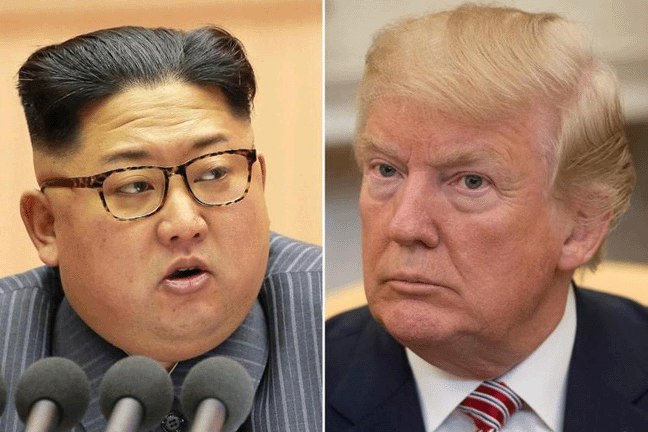
Trump’s nuclear summit with Kim ‘will have preconditions’ SMH, 12 Mar 18 Washington: US President Donald Trump’s condition for meeting North Korean leader Kim Jong-un is that there be no nuclear or missile testing, Treasury Secretary Steve Mnuchin said on Sunday.”There shouldn’t be confusion,” Mnuchin told NBC’s Meet the Press when asked about White House press secretary Sarah Sanders’ statement on Friday that there would be no meeting without concrete and verifiable actions by North Korea.
The President has made it clear that the conditions are that there’s no nuclear testing and there’s no missiles and those will be a condition through the meeting.”
North Korean leader Kim Jong Un provides guidance on a nuclear weapons program in this undated photo released by North Korea’s Korean Central News Agency (KCNA) in Pyongyang September 3, 2017. KCNA via REUTERS
North Korea’s Nuclear Ambitions And Abilities, NPR’s Renee Montagne talks with Siegfried Hecker, a former director of the Los Alamos National Laboratory, about North Korea’s nuclear program. National Public Radio. 11 Mar 18
………. HECKER: Well, first of all, I think it’s not very likely to happen, [the meeting between Trump and Kim] . What’s significant in the current situation is they’ve actually said that they would be willing to give up nuclear weapons, you know, if their security is assured, and they’re not threatened. However, to think that’s going to happen in the short term is just not realistic because to build a nuclear weapons program, it’s an enormous number of facilities. It’s a large number of people. It took, well, more or less 50 years but particularly the last 25 years to get to where they are today. They’re not going to turn that over overnight.
…….. MONTAGNE: Well, short of full denuclearization, what other steps could North Korea take to prove, you know, its sincerity in this?
HECKER: So there are very important steps. And one can lay those out. In other words, I look at the things that are highest risk. And those are the things you want them to stop first. So two that were highest on my list – they have, for the time being, said they would do a moratorium. And that’s no more missile tests and no more nuclear tests – because to increase the sophistication of your bombs, you have to do more nuclear tests. The next one would be not to make any more bomb-grade material, which means stop the operation of the reactors. All three of those are verifiable. The problem is on the bomb-grade material, you can also go the uranium route. Those are the centrifuge halls. We know where one of them is. We don’t know where the other one or two are. And that will be extremely difficult to verify. And that’s going to take a long time and a real detailed process with them to get there.
MONTAGNE: From what you know of North Korea from your time on the ground, are they motivated to use these weapons? Is this something to really be afraid of?
HECKER: What I worry about when it comes to the weapons is – one is capability. Second is motivation. And capability – for many years, I was able to say, look. You know, they have the bomb, but they don’t have much. They don’t have a nuclear arsenal. Then comes the motivation part. And would they be motivated to go ahead and attack the United States, Japan or South Korea basically out of the blue? I say absolutely not. They want those weapons to make sure to protect them. Perhaps they want the weapons so that they actually have sort of sufficient maneuvering room, you know, on the Korean Peninsula. What I’ve worried about is not so much that they’re motivated to attack us but rather that we’re going to stumble into a nuclear war.
Donald Trump’s historic bet on Kim Jong Un summit shatters decades of orthodoxy Straits Times 9 Mar 18 WASHINGTON (BLOOMBERG) –US President Donald Trump took the biggest gamble of his presidency on Thursday (March 8), breaking decades of US diplomatic orthodoxy by accepting an invitation to meet with North Korean leader Kim Jong Un.
The bet is that Mr Trump’s campaign to apply maximum economic pressure on Mr Kim’s regime has forced him to consider what was previously unthinkable: surrendering the illicit nuclear weapons programme begun by his father.
If the president is right, the US would avert what appeared at times last year (2017) to be a steady march towards a second Korean War………
Regardless of how it turns out, the stunning decision by Mr Trump hands Mr Kim a prize long sought by the regime’s ruling dynasty: the legitimacy conferred by a historic meeting with the sitting president.
So much could go wrong.
…….Senator Brian Schatz, a Hawaii Democrat, applauded Mr Trump’s diplomatic effort.
“Expectations should be low and history demonstrates that scepticism and careful diplomatic work are necessary, but it is better to be talking about peace than recklessly ramping up for a war,” he said on Twitter.
DENUCLEARISATION ‘UNLIKELY’
Mr Adam Mount, a senior fellow at the Federation of American Scientists, said that while the talks would extend the period of relative warmth that began during the Olympics, denuclearisation remained “extremely unlikely”.
Nuclear weapons are fundamental to the Kim family’s grip on power at home.
“Kim Jong Un has rational incentives to keep his nuclear arsenal,” Mr Mount said in a phone interview.
He also cautioned that the meeting was “a massive coup” for a regime that “wants to be seen as a regular nuclear power”.
It could lend Mr Kim insights into how the US and South Korea coordinate, and the regime could test Mr Trump by asking for exorbitant terms in exchange for denuclearisation.
Trump accepts invitation to meet with North Korean leader Kim Jong Un Boston Globe, By Anna FifieldTHE WASHINGTON POST
TOKYO – President Donald Trump has agreed to meet with North Korean leader Kim Jong Un for talks, an extraordinary development following months of heightened nuclear tension during which the two leaders exchanged frequent military threats and insults.
Kim has also committed to stopping nuclear and missile testing, even during joint military drills in South Korea next month, Chung Eui-yong, the South Korean national security adviser, told reporters at the White House on Thursday night after briefing the president on his four-hour dinner meeting with Kim in Pyongyang on Monday.
After a year in which North Korea fired intercontinental ballistic missiles capable of reaching all of the United States and tested what is widely thought to have been a hydrogen bomb, such a moratorium would be welcomed by the United States and the world.
Trump and Kim have spent the past year making belligerent statements about each other, with Trump mocking Kim as ‘‘Little Rocket Man’’ and pledging to ‘‘totally destroy’’ North Korea and Kim calling the American president a ‘‘dotard’’ and a ‘‘lunatic’’ and threatening to send nuclear bombs to Washington, D.C.
But Kim has ‘‘expressed his eagerness to meet President Trump as soon as possible,’’ Chung told reporters.
‘President Trump said he would meet Kim
Jong Un by May,’’ Chung said, but he did not provide any information on where the meeting would be. In Seoul, the presidential Blue House clarified that the meeting would occur by the end of May.
Wang Yi says the moment has arrived to test whether all sides are sincere in wanting to resolve tensions over Pyongyang’s nuclear weapons programme
China called for direct dialogue between North Korea and the United States to defuse tensions on the Korean peninsula and warned there was still the potential for chaos amid the stand-off over Pyongyang’s nuclear weapons programme.
The warning by Chinese Foreign Minister Wang Yi on Thursday came despite the announcement that North and South Korea’s leaders are to meet at a summit, raising hopes that the nuclear crisis might be defused. …….
The South China Morning Post reported that North Korean leader Kim Jong-un may propose sending his sister, Kim Yo-jong, to the US as part of efforts to launch direct talks between Washington and Pyongyang.
This may be one of a number of possible messages South Korean envoy Chung Eui-yong will deliver to US National Security Adviser H.R. McMaster in Washington this week, a South Korean diplomatic source told the Post, speaking on condition of anonymity.
Chung is travelling to Washington with South Korea’s national intelligence service chief Suh Hoon, who, according to multiple South Korean diplomatic sources, will meet his US counterpart Mike Pompeo.
……. The fact that North Korea did not conduct nuclear and missile tests during the Winter Olympics, while South Korea and the United States have suspended their military drills, proved that China’s approach to handle the nuclear crisis was effective, Wang said.
Kim Jong-un’s sister could be sent to US to launch talks on ending nuclear crisis, South Korean envoy Chung Eui-yong is to deliver an ‘unconventional’ and ‘very unusual’ message to US National Security Adviser H.R. McMaster this week, the Post has learned SCMP, Robert Delaney, US correspondent, 08 March, 2018 North Korean leader Kim Jong-un may propose sending his sister, Kim Yo-jong, to the US as part of efforts to launch direct talks between Washington and Pyongyang, according to a South Korean diplomatic source.
That may be one of a number of possible messages South Korean envoy Chung Eui-yong will deliver to US National Security Adviser H.R. McMaster in Washington this week, the source told the South China Morning Post, speaking on the condition of anonymity.
……… Kim Yo-jong, the North Korean leader’s younger sister, spearheaded a charm offensive from Pyongyang when she attended the start of the Winter Olympic Games in Pyeongchang, South Korea last month, and invited South Korea’s President Moon Jae-in to visit Pyongyang.
Kim Yo-jong was the first member of the North’s ruling dynasty to visit South Korea.
The younger Kim’s presence in Pyeongchang laid the groundwork for visits by two South Korean government delegations to Pyongyang after the Games ended.
What has followed represents a reversal from the militaristic threats Kim Jong-un and US President Donald Trump lobbed at each other – Kim via North Korea’s state media and Trump via Twitter – throughout the second half of last year………
The message Chung and Suh are bringing from Pyongyang is likely to include a freeze or moratorium on the country’s nuclear weapons development programme in exchange for a downgraded or scaled-back version of joint US-South Korea military exercises, Korea Society senior director Stephen Noerper said in an interview.
“It’s a different tack for North Korea to go through South Korea,” Noerper said. “There could be an attempt to try to drive a wedge between the US and South Korea by saying ‘look, here’s all we’re offering and the Americans just aren’t listening’.
JUST when the world thought they had him pegged, Kim Jong Un has stunned with an apparent about face on nuclear weapons. News.com.au Victoria Craw@Victoria_Craw 7 Mar 18NORTH Korea has vowed not to use nuclear weapons against South Korea and could impose a ban on further nuclear and missile tests during talks with the US, South Korean media reports.
The stunning about face followed the first meeting between North Korean leader Kim Jong Un and South Korean officials since 2011.
It led to claims Kim Jong Un would not use conventional weapons against South Korea and had no reason to possesses nuclear weapons if it has a security guarantee.
The leaders also agreed to establish a “hotline” between the countries to reduce military tensions and will meet for another summit in late April at the border village of Panmunjom.
President Trump weighed in on the news on Twitter, saying “the US is ready to go hard in either direction”.
“The North side clearly affirmed its commitment to the denuclearisation of the Korean Peninsula and said it would have no reason to possess nuclear weapons should the safety of its regime be guaranteed and military threats against North Korea removed,” he said.
North Korea says it’s deploying nuclear missiles https://www3.nhk.or.jp/nhkworld/en/news/20180223_18/ North Korea’s ruling party newspaper says the country’s military is pushing forward with its deployment of nuclear warheads and ballistic missiles.
The Rodong Sinmun made the comment in an editorial on Friday.
The article says the country possesses intercontinental ballistic missiles, submarine-launched ballistic missiles, and hydrogen bombs. It insists that it has made all preparations for a possible nuclear attack on the United States.
The editorial also says that wishing for the denuclearization of North Korea is more foolish than waiting for the ocean to dry up.
North Korea has been fostering a reconciliatory mood with South Korea during the ongoing PyeongChang Winter Olympics.
But the North staged a military parade on February 8th, the eve of the Games’ opening ceremony, displaying the new ICBM-class missile known as the Hwasong-15.
US imposes largest package of sanctions against North Korea, SMH, 24 Feb 18 US President Donald Trump says the United States will impose the “largest-ever” package of sanctions on North Korea, intensifying pressure on the reclusive country to give up its nuclear and missile programmes.
In addressing the Trump administration’s biggest national security challenge, the US Treasury sanctioned one person, 27 companies and 28 ships, according to a statement posted on the US Treasury Department’s website.
The Treasury’s Office of Foreign Assets Control announced the measures, which are designed to disrupt North Korean shipping and trading companies and vessels and to further isolate Pyongyang.
The ships are located, registered or flagged in North Korea, China, Singapore, Taiwan, Hong Kong, Marshall Islands, Tanzania, Panama and Comoros.
A North Korean cyberspy group known as “Reaper” is rapidly expanding its operations and scope of capability posing a global threat to overseas networks, according to a new report from the California cybersecurity firm FireEye Inc.
The group is also identified by FireEye as APT37 and has been active since at least 2012, focusing primarily on the public and private sectors in South Korea. In 2017, the group began attacks on Japan, Vietnam, and the Middle East, according to the report.
FireEye said it had “high confidence” the activities carried out by APT37 are on behalf of the North Korean government and include use of wiper malware and zero-day vulnerabilities, where hackers exploit vulnerabilities in computer software on the same day those vulnerabilities become known, preventing developers from the opportunity to fix problems before they occur.
“Our concern is that this could be used for a disruptive attack rather than a classic espionage mission, which we already know that the North Koreans are regularly carrying out,” FireEye Director of Intelligence Analysis John Hultquist said to the Washington Post.
APT37 joins North Korean leader Kim Jong Un’s growing list of hacking units that have been accused of being behind massive cyberattacks in the past, including the group “Lazarus’” hack on Sony Pictures in 2014.
. U.S. officials also blamed the Kim regime for the WannaCry virus last year.
“Ignored, these threats enjoy the benefit of surprise, allowing them to extract significant losses on their victims, many of whom have never previously heard of the actor,” FireEye said in an emailed statement to Bloomberg.
North Korea seeks easing tensions, but vows to advance nuclear power Nikkei Asian Review, 16 Feb 18, BEIJING (Kyodo) — North Korea called on South Korea on Friday to abandon its joint military drills with the United States to improve inter-Korean ties further, while reiterating its eagerness to advance its nuclear capacity to make the country a military power.
Uriminzokkiri, North Korea’s propaganda website, said U.S.-South Korea joint exercises, which have been postponed while the Winter Olympics and Paralympics are under way in the South, “should be ended forever.”
“To mend relations between the north and the south and to make a breakthrough toward the unification, military tensions should be reduced as a matter of first priority,” it said in its editorial published on the 76th anniversary of former leader Kim Jong Il’s birth.
Pyongyang has been steadfastly opposed to the annual joint military drills, describing them as preparations for invasion.
The official newspaper of North Korea’s ruling Workers’ Party, meanwhile, said in an editorial Friday that Pyongyang has become a nuclear power thanks to earnest efforts by Kim Jong Il, father of the current leader Kim Jong Un.
“We have to boost our prestige as the world’s strongest nuclear nation,” the Rodong Sinmun, North Korea’s most influential newspaper, said, indicating Pyongyang is still intending to develop nuclear weapons despite a thaw with the South.
Relations between the two Koreas are apparently improving after North Korea decided to join the Pyeongchang Winter Olympics, which began late last week. Through high-level delegates including his sister, Kim Jong Un has invited South Korean President Moon Jae In to visit Pyongyang for a summit.
Washington and Seoul have agreed to suspend their joint military drills until the March 18 end of the Paralympics, to which North Korea has pledged to send its athletes.
The West risks missing a chance at peace if it continues to treat North Korea’s change of heart with cynicism Could it be that Trump’s bombast over the airwaves cut through in Pyongyang in a way that conventional diplomacy had failed to do? The Independent UK, Mary Dejevsky@IndyVoices 16 Feb 18
“”…………The mixed messages about the North Korean skaters, however, highlighted – or so it seemed to me – something else: a reluctance on the part of the foreign policy establishment, including the media, to look good news in the face, especially when it has not been expected.
How long ago was it –in fact, a bare six weeks – that Kim Jong-un and the US President were trading very public, very macho, insults, culminating in Donald Trump’s memorable boast that his nuclear button was “much bigger and more powerful” than Kim’s and, what is more, “my button works”.
Even the most hardened pessimist would have to admit that between then and now there has been something of a mood swing. Less than three weeks after the “big button” exchange, North Korea suddenly acted on overtures in Kim’s New Year address to broach talks with the South, and even participated in the Olympics. The IOC delayed its deadline for entries, permitted North Korea’s participation, and the next thing we knew was that North and South were concocting a joint ice hockey team, the North’s nonagenarian de facto head of state was on his way to Seoul, and Kim announced that his sister – his sister – would be going to the opening ceremony, too.
Far from hailing these developments as the possible start of a North-South thaw, however, the Western response seemed – to me, at least, – both fearful and curmudgeonly. Kim Jong-un was suspected of the basest of motives. Might he not be deviously stringing the South along, it was asked, just waiting to demand all sorts of impossible concessions at the last moment that would cast the Seoul government as the villain if it refused?
And was Kim not also staging a vast military parade in Pyongyang on the eve of the official Olympic opening? Well, of course, he was. No self-respecting national leader, least of all an autocrat in the mould of Kim, can be seen to be weak in front of his own people. Shows of strength have a habit of going hand in hand with diplomatic U-turns.
As the North Korean nuclear threat vanished from the headlines, however, it was only to be replaced with another menace from the North. Kim’s very presentable little sister, Kim Yo-jong, was accused of stealing the limelight, diluting the world’s attention that should have been Seoul’s, and presenting an image of the North that was scandalously at odds with the cruel and earth-scorched reality. Don’t allow yourself to be fooled, was the message.
That she was received in Seoul at the highest level and filmed handing over an invitation to President Moon Jae-in to visit Pyongyang was also somehow seen as out of order, another trick to gain diplomatic advantage. Surely it would all turn sour even before the Olympic glow over the South had faded. The North Korean threat was still there.
Far from hailing these developments as the possible start of a North-South thaw, however, the Western response seemed – to me, at least, – both fearful and curmudgeonly. Kim Jong-un was suspected of the basest of motives. Might he not be deviously stringing the South along, it was asked, just waiting to demand all sorts of impossible concessions at the last moment that would cast the Seoul government as the villain if it refused?
And was Kim not also staging a vast military parade in Pyongyang on the eve of the official Olympic opening? Well, of course, he was. No self-respecting national leader, least of all an autocrat in the mould of Kim, can be seen to be weak in front of his own people. Shows of strength have a habit of going hand in hand with diplomatic U-turns.
As the North Korean nuclear threat vanished from the headlines, however, it was only to be replaced with another menace from the North. Kim’s very presentable little sister, Kim Yo-jong, was accused of stealing the limelight, diluting the world’s attention that should have been Seoul’s, and presenting an image of the North that was scandalously at odds with the cruel and earth-scorched reality. Don’t allow yourself to be fooled, was the message.
That she was received in Seoul at the highest level and filmed handing over an invitation to President Moon Jae-in to visit Pyongyang was also somehow seen as out of order, another trick to gain diplomatic advantage. Surely it would all turn sour even before the Olympic glow over the South had faded. The North Korean threat was still there.
Nor should the use by potentates – and not just potentates – of close relatives as personal representatives and trusted go-betweens – be discounted as a ploy. Rather than being designed to detract from the South’s Olympic show, Kim Jong-yo’s trip to Seoul might rather be seen as evidence of her brother’s serious intent and esteem.
And what might have changed the equation? How about the US Secretary of State’s low-key offer of direct talks without preconditions that he made in December? Repeated in Seoul by Vice-President Mike Pence this week (once he had done cold-shouldering the North Koreans for the benefit of the US audience back home), this is what first broke the deadlock. There have been concessions on all sides.
So while the doomwatchers see the Olympic thaw as, at best, a deceptive interlude before the nuclear stand-off inevitably resumes, I would argue, for more optimism. A basis has been laid for detente; there is a real chance now to step back from the brink. The risk now is less that the North is insincere, than that suspicion and cynicism everywhere cause this chance to be missed. http://www.independent.co.uk/voices/north-korea-war-nuclear-us-uk-europe-world-peace-conflict-a8212656.html
The North is increasingly close to developing a nuclear-tipped ICBM that can hit the continental US. Washington knows it cannot destroy all the country’s capabilities – so hawks are now arguing for a “bloody nose” strategy to warn Kim Jong-un off threatening the US (though he must know any attack would be suicidal). Seoul, just 35 miles from the border, would bear the brunt of any retaliation. A conflict could kill tens of thousands and potentially draw in other regional powers, including China.
“There’s a real concern that for the first time there is a US administration that could take unilateral action against North Korea without consulting the South,” says Professor Hazel Smith of the centre of Korean studies at Soas Univeristy of London. “People are pushing, virtually preparing, for a so-called ‘surgical strike’ – even though the majority of US and South Korean military planners argue that it would be risky to the point of likely catastrophe for the South, and US troops there.
“The Olympic initiative was never going to solve the nuclear question overnight, but I think it has stopped the mad escalation of the conflict that was going on.”
The task of Kim Yo-jong and the bevy of cheerleaders has been to normalise the image of a country that looks utterly abnormal to outsiders. ………
Kim has cemented his position, in part through tighter control. He purged and executed his uncle Jang Song-thaek; and he is believed to have ordered the killing of his self-exiled brother, Kim Jong-nam, a year ago. There have been repeated crackdowns on smuggled – especially South Korean – media.
On the other hand he has promised his people a return to prosperity, and though this has mostly been signalled by totemic projects such as a ski resort, there have been some broader economic shifts, such as an increase in marketisation, apparently producing modest improvements in the economy. And, in dispatching the Olympic delegation, and then inviting the South Korean president Moon Jae-in to visit him, he has shown he can reduce tensions as well as increase them.
Sending his sister was doubly inspired. A family member is a more intimate representative than a high-ranking official. And for a patriarchal culture, Kim Yo-jong and the cheerleaders are – by virtue of gender – not only charming and unthreatening but somehow morally elevated, detached from worldly, manly concerns of power (never mind that, in reality, Kim is at the heart of her brother’s regime). ……..
Is the North’s participation in Pyeongchang a first step to denuclearisation and eventual reunification? No. Events in Iraq and Libya hardened the regime’s beliefs that hanging on to WMDs is a matter of survival. The thaw may not even be a precursor to substantive reengagement with the South, or broader talks, let alone a breakthrough (although the North might freeze its programme if offered a cast-iron US security guarantee, it is hard to see that happening under Trump). But if the softening of the North’s image and approach make it harder for US hawks to strike, then Seoul – and the rest of us – should be grateful for those synchronised chants and armwaves. https://www.theguardian.com/world/2018/feb/14/what-north-koreas-week-at-the-winter-olympics-tells-us-about-the-nuclear-threat
Kim Jong-un’s rocket men: North Korea’s ‘key men’ behind nuclear weapons arsenal,Express UK MEET the Megaton Twins – the two scientists Kim Jong-un can thank for his terrifying nuclear arsenal, according to experts. Michael Madden, who works with the 38 North watchdog, said Hong Sung-mu and Ri Hong-sop were crucial to the weapons programme’s success. Feb 13, 2018
With their help, North Korea went from detonating suspected duds in 2006 to its current nukes, which are up to 18 times more powerful than the Hiroshima bomb.
And with the regime’s latest missile – the Hwasong-15 – theoretically able to reach Washington DC, their weapons are more threatening than ever.
Mr Madden said there were a number of people who’d contributed to North Korea’s nuclear weapons over the years.








 nuclear-news