Uranium Neo-colonialism in Mongolia: Crime but No Punishment
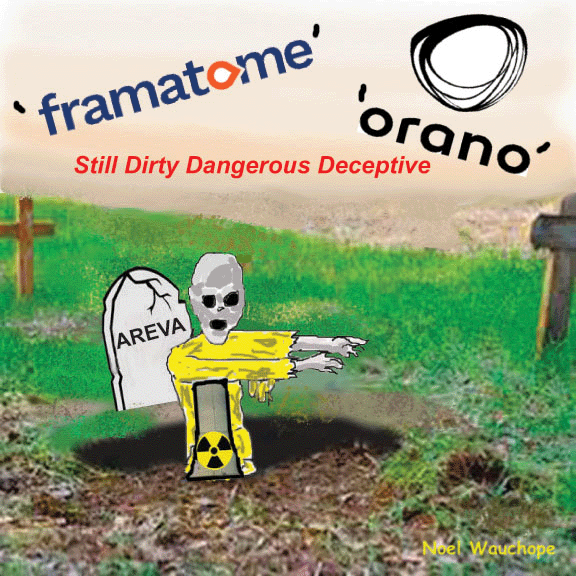
The unexplained illnesses and deaths of animals, a desert veterinary clinic run by a uranium mining corporation, and its attempts to ignore the troubling facts are perplexing.
Orano has set a stark precedent, demonstrating that even lenient mining laws are no real constraint. According to activists, the company simply ignored the required environmental impact assessment for some of its ISL mining projects in Dornogobi Aimag. Coincidentally, Orano was also bribing officials to secure mining licenses during this same period.
Environmentalists square off against a French mining company.
By Tatyana Ivanova | February 12, 2026, https://fpif.org/uranium-neo-colonialism-in-mongolia-crime-but-no-punishment/
On a warm April 1st day last year, Budee Khekhee, head of local non-profit The Power of Unity for the Sake of Our Homeland, led a team into the Gobi Desert to investigate reports of a mysterious illness causing the death of wild and domestic animals, which he obtained from the local herders. A former resident who’d assisted his father’s veterinary work, Budee knew the terrain and knew authorities had ignored previous alarms.
In Zamyn Ud, they spotted numerous white-tailed gazelles lying on the ground, unable to get up, and twitching their legs convulsively. The activists livestreamed their discovery. “My heart was overwhelmed with despair,” Budee later testified. “I realized I couldn’t just abandon them here to die.”
Suspecting that the epidemic was caused by French uranium company Orano’s in-situ leach operations, he loaded four gazelles aboard a truck and drove to the corporation’s clinic gate, broadcasting on Facebook. Orano had built and was operating a veterinary clinic in the mining area. Budee didn’t trust them a lot, but he hoped that the staff would assist in rescuing the animals. Those hopes were dashed when, after two hours of standing outside the locked clinic doors, no one appeared, and the animals died. Left with little choice, the activists dissected the gazelles’ bodies and took tissue samples for independent analysis. They livestreamed their actions to Facebook.
For many Mongolian herders, resource neocolonialism is not an abstract concept. They have resulted in tangible losses, illness, and deaths. Descendants of the Mongol Empire now face uranium mining invaders. After the Soviets departed—leaving behind a legacy of toxic mining—the “clean” French uranium industry arrived, reproducing similar patterns of corruption while poisoning the land. At the same time, these colonialists have participated in the persecution of environmental activists.
Should they be held accountable before domestic and international communities?
The Revenge
In official reports, human rights defenders often refer to the persecution of activists as “unjust” or “disproportional punishment.” However, what happened in the case of the Mongolian herders was closer to pure revenge. Unidentified individuals made police reports accusing Khekhee of illegal hunting. He was subjected to repeated questioning for several months after the criminal investigation began.
The local prosecutor’s office then reclassified the matter as an administrative offense. The state’s Environmental Protection Office determined that Khekhee illegally pursued and killed four gazelles. They penalized him $1,200, a substantial sum for an average Mongolian. His July appeal was denied in full in September, but the court of first instance postponed the sentence for three months, thereby conceding that the case lacked merit.
Neither the investigation nor the court determined why Budee Khekhee allegedly needed to kill the gazelles. However, a local journalist discovered the “motive,” writing in August 2025 that it was done “to mislead the public about the consequences of uranium mining by the joint Mongolian-French enterprise ‘Badrakh Energy’ LLC.”
Prosecution for Independent Dosimetry
The unexplained illnesses and deaths of animals, a desert veterinary clinic run by a uranium mining corporation, and its attempts to ignore the troubling facts are perplexing. Especially when combined with the absurd accusation of poaching directed at an environmental activist whose action was widely livestreamed. When connected to other similar events, a pattern emerges.
In mid-August 2025, the same non-profit invited Russian nuclear physicist Andrey Ozharovskiy to conduct dosimetry measurements. Their focus on radioactive pollution was encouraged by groundwater assessments, which had revealed high uranium and arsenic levels in the area. Ozharovskiy, who had extensive experience in identifying radioactive sources, agreed to come. He entered Mongolia legally with his dosimetry and spectrometry equipment for “business purposes.”
On August 15–17, activists drove him along dirt roads in the Gobi Desert to Orano’s pilot ISL uranium extraction wells, where locals reported trucks carrying pregnant solution or liquid waste. It didn’t take the Russian expert long to discover three dried-up puddles emitting gamma radiation 20-50 times above background levels. Spectrometry identified uranium decay products—radium-226, bismuth-214, and lead-214, which, according to Ozharovskiy, was consistent with mining spills rather than natural radiation. The activists published their finding on social media, and this is how the Mongolian authorities learned about the expedition.
The group later traveled across Mongolia along similar dirt roads to Maradai. On August 19, while measuring radiation near abandoned Soviet mining sites, the group was detained by a border officer and some people in plain clothes. According to the activists, the authorities used drones to spot them in the desert. After spending a day or two in several offices, Ozharovskiy was transferred to the Main Intelligence Directorate in Ulaanbaatar. There, after being questioned, he was told that he was suspected of espionage and immigration violations.
Although the authorities released Ozharovskiy, they took his passport so that he couldn’t leave the country. A few days later he was taken again, forced to admit administrative violations, including using unregistered dosimetry devices, and to pay a fine. Then they brought him to the border with Russia and expelled him without his belongings but with a 10-year entry ban. The local activists, meanwhile, have spoken of intimidation, police reporting requirements, smartphone searches, and non-disclosure agreements.
In the same days the Mongolian Nuclear Regulatory Commission issued a formal statement, where accused Ozharovskiy of spreading false information about radiation background. Some media labeled the activists foreign agents undermining Franco-Mongolian projects in Russia’s interest.
A System That Favors Abuse and Distrust
Mongolian law prohibits radiation measurements using devices that haven’t been registered with the country’s Nuclear Regulatory Commission. After his first detention, Ozharovskiy donated some of his measuring devices to the non-profit. Activists brought them to the NRC but were denied certification with no clear explanation. The only reason provided, though invalid, was that the devices belonged to a Russian citizen.
The activists explained why they hadn’t registered the devices beforehand: they didn’t want authorities to know about their survey in advance. “If they knew about the devices, they wouldn’t let us measure anyway,” one activist said. “We don’t trust them,” Khekhee added.
This distrust is entirely justified given the broader context documented by prominent human rights organizations. Mongolia has earned a reputation for cracking down on critics and human rights defenders, particularly those challenging the mining industry. Amnesty International’s 2024 report documents that criticism of authorities and mining corporations has become effectively criminalized. According to the report Our Land, these corporations commit massive environmental violations, causing significant environmental pollution and deterioration of public health, and undermining traditional Mongolian livelihoods. To attract investors, Mongolian mining lobbyists even managed to pass corporate-friendly legislation. According to Our Land, in 2006 and again in 2013–2015 they weakened environmental safeguards, reducing water protection zones and allowing mining on private and even protected lands.
Another Face of the French Republic
Continue readingRussian engineer-physicist Ozharovsky spoke about deportation from Mongolia.
Andrey Ozharovsky was detained in Mongolia while exploring the Gobi Desert. He was trying to find out if there was radiation contamination where the French were mining uranium. Metro asked the Russian nuclear scientist what happened to him.
Metro Moscow 27th Aug 2025, https://www.gazetametro.ru/articles/rossijskij-inzhener-fizik-ozharovskij-rasskazal-chto-proizoshlo-s-nim-v-mongolii-27-08-2025
The media reported on the detention of the Russian activist on August 19. As Ozharovsky himself said, in Mongolia he was deprived of his freedom, passport and the opportunity to talk to his relatives. At the same time, Mongolian security forces behaved correctly with him.
Why Russian Researcher Deported from Mongolia
“I came to help local activists figure out whether there is radioactive contamination in the part of the Gobi Desert where the French company Orano mines uranium using the underground solution method,” Ozharovsky told Metro.
According to him, Mongolian activists invited him to participate in the research of the area because the scientist’s equipment had previously detected similar contamination in Russia. During three days of research in Mongolia, Ozharovsky found deviations – the consequences of uranium mining by the French.
“Apparently, those who mine uranium in the Gobi did not like this. And perhaps the French nuclear scientists are behind my deportation,” the scientist concluded.
Suddenly a jeep with three security officers and a female employee of the migration service arrives. After that they take my passport for inspection and give it back only a week later.— deported nuclear physicist Andrei Ozharovsky
Ozharovsky believes that the circumstances of his arrest were extremely strange.
“We finished taking measurements in the desert, then moved to a new location, the Maradai mine. That’s where the immigration service detained me. Before that, we had only met one shepherd the previous day,” he explained.
According to the researcher, he was first taken under guard for interrogation to the provincial capital, the city of Choibalsan. And only after that was he sent to Ulaanbaatar.
“Russian spy” and “Rosatom saboteur”
As Ozharovsky says, shortly before his arrest, an active campaign against him began in the local media. The scientist emphasizes that in their materials, Mongolian journalists called him a spy and intelligence officer who was in Mongolia “in the interests of Rosatom.”
— After completing the measurements in Gobi, we traveled for more than a day to a new location. And during this time, as if on command, several articles were published in which journalists called on the Mongolian authorities to take decisive action, because “a Russian spy is driving around the country’s uranium mines,” the nuclear physicist explains.
At the same time, after his arrest, representatives of Mongolian intelligence stated that they had no claims against Ozharovsky. And his case was forwarded to the police.
However, the nuclear physicist emphasizes that Mongolia is now allegedly trying to hide a major environmental problem that he and local activists managed to discover.
“I found three areas in Mongolia where the usual Gobi dose rate of 0.1 microsievert per hour was exceeded by 20-50 times. In problem areas, the pollution level reached 5 microsievert per hour,” he said.
Microsieverta unit of measurement that can be used to determine how much radiation a person has received
According to the researcher, such indicators can already have serious consequences for humans. And the nomads living in the region can make specific assumptions about what caused the increase in cancer cases.
“One nomad we spoke to had a father who died of cancer. And his young wife was diagnosed with breast cancer,” the scientist said.
Deportation and its consequences
The nuclear physicist fully admits that he could have violated Mongolian law. But he emphasizes that this happened due to ignorance of its subtleties.
— In Mongolia, it is prohibited to measure the radiation environment with devices that have not been accredited in the country. That is, even if you have proof of the functionality of the equipment in other countries, you must bring your device to the authorities, pay money for the inspection, and only then receive the right to conduct research, he explained.
In addition, the country has very specific restrictions for Russians. And Ozharovsky could have accidentally violated one of them.
— According to Mongolian law, Russians can stay in the country without a visa only if they are tourists. After the dosimeter was turned on, according to the law enforcement officers who deported me, I ceased to be one, — the nuclear scientist added.
According to the researcher, he plans to contact lawyers to assess the legality of the punishment. He also emphasized that he does not plan to abandon his research in Mongolia, but will now conduct it in other ways.
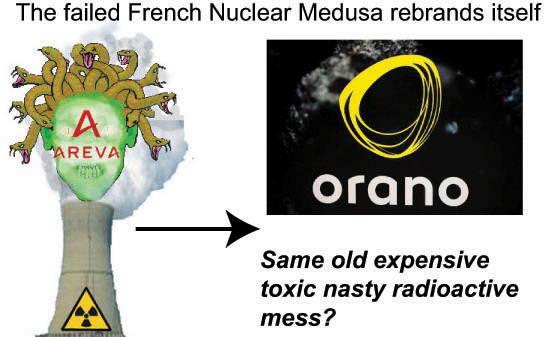
AREVA – ORANO? -Framatome? – corruption in the air yet again for France’s nuclear corporation?
Orano’s activities in Mongolia under judicial investigation for suspicion of corruption https://www.lemonde.fr/energies/article/2018/12/19/les-activites-d-orano-en-mongolie-visees-par-une-enquete-judiciaire-pour-des-soupcons-de-corruption_5399983_1653054.html 19th Dec 2018 These suspicions of “bribery of a foreign public official” involve one of the service providers of Orano, the consulting firm Eurotradia International.
The French nuclear group Orano, [or is it Framatome?] formerly Areva, is in  the sights of the national prosecutor’s office that investigates suspicions of corruption in Mongolia, it was learned, Wednesday, December 19,from sources close to the case. These suspicions of “bribery of a foreign public official” involve one of the service providers of Orano, the consulting firm Eurotradia International.
Anti-corruption campaign in Mongolia
In October 2013, under the chairmanship of Luc Oursel, Areva entered into a strategic partnership to exploit two uranium deposits in the Gobi Desert (southeast) with Mongolian Mon-Atom and Japan’s Mitsubishi. The agreement came after more than ten years of exploration of the French group in Mongolia, but it remained uncertain until the last moment. The project had sparked strong environmental opposition in this huge country of three million inhabitants, whose subsoil is rich in ores (uranium, copper, gold, coal).
The case is part of an anti-corruption campaign in Mongolia where, in another case, two former prime ministers were jailed in April for controversial deals with the mining giant, Anglo-Australian Rio Tinto.
In addition, the French nuclear group has already been targeted since 2015 by a preliminary survey of the PNF. This case, dubbed “uraniumgate”, is about the controversial sale in the fall of 2011, a large amount of Nigerian uranium for $ 320 million. https://www.lemonde.fr/energies/article/2018/12/19/les-activites-d-orano-en-mongolie-visees-par-une-enquete-judiciaire-pour-des-soupcons-de-corruption_5399983_1653054.html
Nuclear waste deals that fell flat, between Toshiba, USA and Mongolia
 The elephant in the room for Toshiba is nuclear http://www.japantimes.co.jp/news/2016/01/16/national/media-national/elephant-room-toshiba-nuclear/
BY PHILIP BRASOR THE JAPAN TIMES, JAN 16, 2016
Japanese press outlets often cover scoops from competing outlets, but it’s rare to build on a competitor’s story with original reporting, especially when the scoop is a few years old. In December, the weekly magazine Aera, which is affiliated with the Asahi Shimbun, ran an article about a secret meeting that took place between representatives of Japan, Mongolia and the United States almost five years ago. This meeting was first reported by Haruyuki Aikawa in the May 9, 2011, issue of the Mainichi Shimbun.
What interested Aera reporter Atsushi Yamada about the article was Aikawa’s assertion that Toshiba Corp. was on hand for the negotiations. In 2006, Toshiba had bought a majority share in the American company Westinghouse, a manufacturer, like Toshiba, that started out in the home electronics field and eventually expanded into nuclear power plant construction. Japan said it would buy uranium mined in the central Asian country and in return Mongolia would tap Japan’s nuclear energy expertise in building power plants and, more significantly, nuclear fuel reprocessing facilities that would incorporate the acceptance of high-level nuclear waste from Japan and other countries.
Though the Mainichi story received little attention in Japan or the U.S., it was translated and disseminated in Mongolia, thus leading, only three months after the 2011 nuclear meltdown in Fukushima, to citizen protests against the deal, which opponents said would turn their country into a “toilet” for the world’s nuclear waste. Later, the Mongolian government said it might be difficult for it to accept this waste.
Yamada read subsequent emails between Toshiba’s president at the time, Norio Sasaki, and an official of the U.S. Dept. of Energy, which said that negotiations with Mongolia should continue and that any further arrangements be made in a confidential manner. Toshiba’s public relations department confirmed the existence of the emails to Yamada but denied that Toshiba had asked the Mongolian government to receive outside nuclear waste. The negotiations, it said, had more to do with “building on the system of nuclear nonproliferation.”
Aikawa told Yamada that while ostensibly the negotiations were between the three governments, the plans for the deal were drawn up by the U.S. and Toshiba with the aim of selling nuclear power plants to emerging economies under a scheme called Comprehensive Fuel Service. According to this scheme, vendors assure potential customers that they will handle any future nuclear waste produced by power plants the customers buy, which is why Mongolia’s acceptance of such waste is so important. Due to local resistance, neither the U.S. nor Japan has anywhere to dump spent fuel, even their own.
The reason Yamada became so interested in this topic years after the fact is that in the meantime, Toshiba has been caught up in financial scandals that have brought the company to its knees, and he wanted to explore the connection between Toshiba’s nuclear energy business and its fiscal woes.
The connection itself is not a secret. Toshiba spent almost ¥600 billion to buy its share of Westinghouse, which at the time of the purchase was only worth about ¥250 billion. The extra “goodwill” money (norendai) was in anticipation of future revenues that would accrue as Toshiba expanded its nuclear energy business both in Japan and throughout the world with Westinghouse as its “trump card.” But then Fukushima happened, putting a serious damper on demand for plant construction.
The revenues Toshiba envisioned didn’t materialize, and the norendai became a huge liability it tried to hide through bookkeeping. Sasaki, his predecessor and his successor are all now being sued by Toshiba’s management for ordering improper accounting practices after Nikkei Business reported that Toshiba was violating Tokyo Stock Exchange regulations regarding the disclosure of a subsidiary’s losses.
However, at the end of December, the Financial Services Agency, in its investigation of the accounting scandal, did not find Toshiba to be at fault, but rather punished the auditing firm of Ernst & Young ShinNihon for “failure to detect” Toshiba’s improper accounting practices. In a follow-up article in the Jan. 11 issue of Aera, the reporter wondered if this arrangement didn’t smack of “conspiracy,” and an FSA representative told the magazine that the agency “suspected” as much but “could not find any evidence.” For the next three months, ShinNihon is suspended from signing any new business contracts and must pay a “surcharge” of ¥2.1 billion. Though that may sound severe, industry people told Aera that usually in such cases penalized companies are suspended from conducting business altogether.
So why didn’t the FSA accuse Toshiba of accounting fraud, especially given that it’s not uncommon for auditors to revise their findings so as not to inconvenience powerful clients? As Yamada points out, the agency didn’t even mention Westinghouse in its findings.
Perhaps the government still needs Toshiba, since Prime Minister Shinzo Abe has pegged Japanese growth at least partly to the export of nuclear technology. In November, the Asahi Shimbun interviewed the CEO of Westinghouse, who said his company had plans to build dozens of new reactors all over the world, “including Japan.” Abe is selling nuclear technology to Vietnam, Turkey and other countries, and in October he finalized a trade deal with Mongolia.
Ryoko Imaoka, an associate professor at Osaka University and longtime expert on Mongolia, has explained that the U.S., desperate to find a friendly country to accept nuclear waste, was pushing Japan to make a deal with Mongolia. Japan publicly downplays the nuclear part of the trade agreement and Japanese media have obliged, though Mitsubishi Corp. is already developing three new mines there. She says the country’s currently dormant uranium pits remain extremely radioactive and it’s not clear where any nuclear waste would be buried, but in any event there are Mongolians who are ready to sue to shut the whole thing down.

Mongolia plans to become a renewable energy hub
Mongolia eyes renewable energy as climate warms SMH June 5, 2013 Mongolia, which is banking on a mining-led investment boom to develop its economy, is aiming to turn itself into a regional renewable energy hub as it tries to fight off the pressures of global warming, the country’s president said.
“We have some ideas of how Mongolia can be Asia’s super grid for wind power and solar power, and other renewable energies. If we use all the wind power (potential) in the country, we can enhance the energy supply of China and all over Asia.”
Mongolia was chosen to host the U.N.’s World Environment Day on June 5, and at a news conference to mark the occasion, officials said the country also planned to better regulate a mining sector that is polluting an already fragile environment……..
Achim Steiner, head of the U.N. Environment Programme told Reuters during a visit this week that Mongolia had seen average temperatures rise 2.1 degrees Celsius (3.8 F) in the past 60 to 70 years – about three times faster than the global average.
Its high altitude and sparse vegetation in many regions made the nation vulnerable…..
Mongolia could meet all its energy need through renewable sources
Mongolia to Increase Renewable Energy Development, Xinhua Says http://www.bloomberg.com/news/2012-11-12/mongolia-to-increase-renewable-energy-development-xinhua-says.html By Ehren Goossens – Nov 12, Mongolia plans to increase the amount of energy produced from renewable sources, the country’s President Tsakhia Elbegdorj said Monday, according to China ’s official Xinhua News Agency.
The country expects to produce 20 percent to 25 percent of its electricity from wind, solar and other renewable resources by 2020, Elbegdorj said at the Northeast Asia Renewable Energy Resources Cooperation Forum. He didn’t say how much renewable energy is produced now.
Mongolia has the potential to meet its entire domestic energy demand with renewable power, Elbegdorj said.
Wind power may transform Mongolia’s energy supply
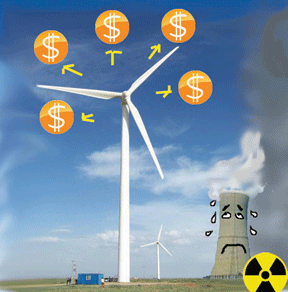 The group has six wind-power plant projects that are due to bring 1,000 megawatts online in the country by 2020. In the U.S., that would be enough to power about 800,000 homes. In Mongolia’s economy, it would stretch much further.
Mongolia’s Renewables Belittle World’s Nuclear Supply, Bloomberg, By Yuriy Humber Jan 5, 2012 Untapped mineral riches are fueling Mongolia’s ambition to compete with Australia and Brazil in Asia. The nation’s resource-based economy grew 21 percent last quarter alone.
This largesse obscures a potential aboveground treasure also awaiting investors.
The world’s most sparsely populated nation has the potential to generate 2.6 million megawatts of wind, solar, geothermal and hydropower, based on data collected by the U.S. National Renewable Energy Laboratory and the Mongolian National Renewable Energy Center.
That’s a fantastic figure. It’s seven times the capacity of all the world’s operable nuclear reactors combined, according to world nuclear association data. In contrast, Mongolia’s current power capacity is less than that of one large coal plant, just 878 megawatts.
That’s what Newcom Group’s acting Chief Executive Office Byambasaikhan Bayanjargal recently told investors in Hong Kong. Of that, close to 40 percent of the potential is in wind, and Bayanjargal is eager to harness it….. Continue reading
1 This Month

of the week – Shut Down Drone Warfare!


Tell the Ukrainian Government to Drop Prosecution of Peace Activist Yurii Sheliazhenko

Petition to revoke the licensing of the Near Surface Nuclear Disposal Facility (NSDF) at Chalk River. https://www.ourcommons.ca/petitions/en/Petition/Details?Petition=e-7247
To see nuclear-related stories in greater depth and intensity – go to https://nuclearinformation.wordpress.com
-
Archives
- March 2026 (230)
- February 2026 (268)
- January 2026 (308)
- December 2025 (358)
- November 2025 (359)
- October 2025 (376)
- September 2025 (257)
- August 2025 (319)
- July 2025 (230)
- June 2025 (348)
- May 2025 (261)
- April 2025 (305)
-
Categories
- 1
- 1 NUCLEAR ISSUES
- business and costs
- climate change
- culture and arts
- ENERGY
- environment
- health
- history
- indigenous issues
- Legal
- marketing of nuclear
- media
- opposition to nuclear
- PERSONAL STORIES
- politics
- politics international
- Religion and ethics
- safety
- secrets,lies and civil liberties
- spinbuster
- technology
- Uranium
- wastes
- weapons and war
- Women
- 2 WORLD
- ACTION
- AFRICA
- Atrocities
- AUSTRALIA
- Christina's notes
- Christina's themes
- culture and arts
- Events
- Fuk 2022
- Fuk 2023
- Fukushima 2017
- Fukushima 2018
- fukushima 2019
- Fukushima 2020
- Fukushima 2021
- general
- global warming
- Humour (God we need it)
- Nuclear
- RARE EARTHS
- Reference
- resources – print
- Resources -audiovicual
- Weekly Newsletter
- World
- World Nuclear
- YouTube
-
RSS
Entries RSS
Comments RSS
 nuclear-news