Thyroid cancer at ages 0 and 2 at the time of the nuclear accident-Health survey in Fukushima Prefecture January 2021
Thyroid cancer at ages 0 and 2 at the time of the nuclear accident-Health survey in Fukushima  Prefecture Posted by: ourplanet Posted on: Thu, 01/14/2021 –00:46 http://ourplanet-tv.org/?q=node/2537 (Japanese only)
(Translated from Google) The “Prefectural Health Survey” Review Committee was held in Fukushima City on the 15th to discuss the health survey of Fukushima citizens following the accident at the Fukushima Daiichi Nuclear Power Plant. For the first time, it was discovered that two infants, a 0-year-old girl and a 2-year-old girl at the time of the accident, were diagnosed with thyroid cancer.
Material https://www.pref.fukushima.lg.jp/site/portal/kenkocyosa-kentoiinkai-40.html

This time, the result of the fourth round of thyroid examination until June last year was newly announced. The number of children diagnosed with suspected thyroid cancer by fine needle cytology increased by 6 from the previous time to 27, and the number of children who underwent thyroidectomy increased by 3 from the previous time to 16 children. Up to now, 252 patients have been diagnosed with thyroid cancer or suspected thyroid cancer from prior examination, of which 203 have undergone thyroid surgery. 202 people, excluding one, were confirmed to have thyroid cancer.
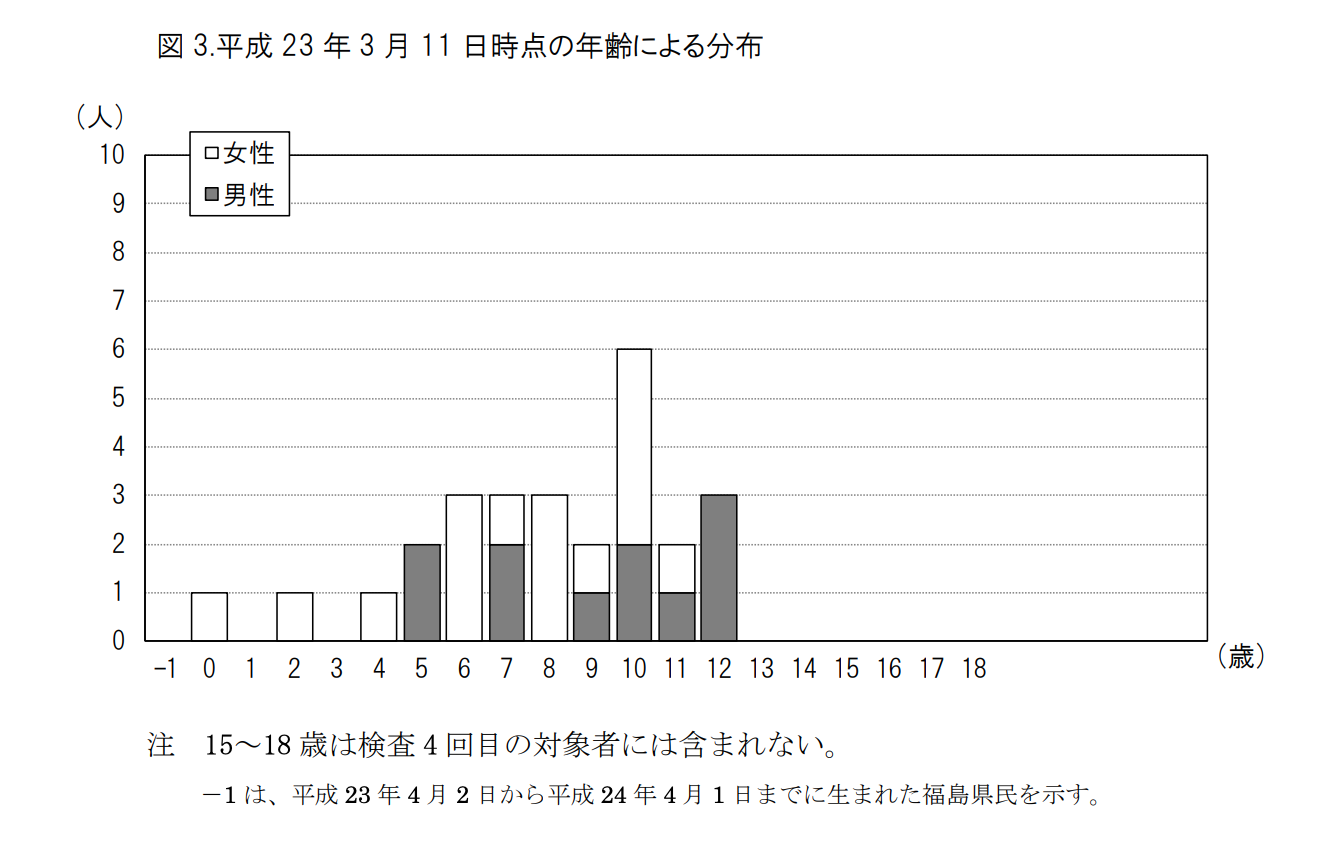
In the fourth round of examination, it was found for the first time that a girl who was 0 years old and a girl who was 2 years old at the time of the accident were diagnosed with thyroid cancer. Since the age of the examination is not the actual age but the grade, the ages at the time of the examination are 9 years old (3rd grade of elementary school) and 11 years old (5th grade of elementary school), respectively. According to the previous test results of 27 patients, 5 patients had “A1 judgement” without nodules or tumors, and 16 people had “A2 judgement” with nodules of 5 mm or less or cysts of 2 cm or less, 5 mm or more. 5 people had a “B-judgement” with nodules or cysts of 2 cm or more, and 1 had not been examined. He had the smallest tumor size of 6.1 mm and the largest tumor was 29.4 mm.
What stands out in the results of the fourth round of examination is the high dose of radiation for people diagnosed with thyroid cancer. Of the 27 patients diagnosed as suspected of being malignant by fine needle cytology, 11 patients (40.7%) who submitted the basic survey questionnaire had an exposure dose of less than 1 mSv in 2 patients (18.1%) 4 months after the accident. The number of children exposed to 2mSv or more was the highest, with 4 (36.3%) from 1mSv to 2mSv and 5 (45.5%) from 2mSv to 5mSv. In particular, the two boys who were five years old at the time of the accident were both over 2mSv.
According to the results of the basic survey of all Fukushima residents, 62.2% are less than 1mSv, 31.6% are from 1mSv to 2mSv, and 5.5% are from 2mSv to 3mSv. Very different.

To review the mass examination at school At this review committee, a major shift was made to reviewing simultaneous examinations at schools. The test, which has found more than 200 people with thyroid cancer, raises the theory of “overdiagnosis” among experts who deny the effects of radiation exposure, saying that they are finding thyroid cancer that they do not have to find. There is a growing opinion that the mass examination at school should be reviewed.
Based on these opinions, the review committee decided to conduct an interview survey at schools in the prefecture on August 31st last time. This time, there was a report on the results of a survey conducted by the prefecture at 26 elementary and junior high schools and high schools in the prefecture.
At many schools, thyroid examinations were performed during class hours, criticized by Shoichiro Tsugane, a member of the National Cancer Center, saying, “You can’t take this without a strong will.” “The benefits of the test are not except that you can be reassured when you get negative. The discovery of thyroid cancer has little benefit in avoiding death or poor quality of life, especially when you are diagnosed with thyroid cancer. “I think it will be a huge disadvantage for those who do,” he said. “Thyroid examination in a group of asymptomatic healthy people is not desirable. I asked him to stop the mass examination at school. ..
In addition, Professor Toshiya Inaba of Hiroshima University also cut out at the school examination that “they are left behind” and said, “Parents are not worried. The school rents the venue. The prefectural medical college has an inspection. I understand each position well, but in the end, it is the people who are left unattended. ” He emphasized that the prefectures and medical colleges that are the subjects of the survey should explain more to children and students the significance of the test and the fact that it can be rejected.

In response, Professor Satoshi Tomita of Fukushima University argued head-on. He criticized that “many Fukushima residents have anxiety about their health” and that members of the Prefectural Health Investigation Committee, especially members outside Fukushima Prefecture, are calling for the cancellation or reduction of examinations. He said that thyroid examination is a way to relieve the anxiety of Fukushima residents, “the anxiety of Fukushima residents, especially those with children, is left behind.” “It is dangerous to go in the direction of reduction easily.” “Thinking” was pointed out.
Ikuko Abe, chairman of the Fukushima Clinical Psychologists Association, who also lives in Fukushima Prefecture and has a close relationship with schools, agrees with this, saying, “I agree with Professor Tomita’s opinion.” “Given the anxiety about radiation that Fukushima residents have, thyroid examinations are very reassuring,” she said. “Reducing or eliminating the examinations still takes the opposite position. I want you to do it. “
What caught my eye in the discussion was the presence of Katsushi Tahara, director of the Ministry of the Environment’s Health and Welfare Department. The members of the review committee from the Ministry of the Environment have not said much, but have played a role in important aspects of policy change. This time too, Mr. Tahara considers the fact that the school is cooperating with the implementation of the examination, such as encouraging households whose delivery to Fukushima Medical University is delayed to submit again when the deadline has passed. About 30% of the children undergoing medical examinations at school were asked intensively about this point, such as confirming that the school side took over the collection of consent forms.
To conduct hearings with the person to be inspected Following a survey of the school, the prefecture proposed to have a place to hear directly from the children and students who had been inspected. Questions were raised about the representativeness of the interviewees, and there was an opinion requesting a quantitative survey such as a questionnaire, but the prefecture’s proposal was approved because the survey took too long.
Regarding this “interview survey,” there was a harsh debate over the neutrality of the content, such as the opinion that a pilot study was unavoidable and that the voices of patients diagnosed with thyroid cancer should also be heard. With the strong push back of the constellation chairman, it was decided that the selection of the target audience and the holding method would be left to the chairperson and the prefecture. The results will be reported at the next meeting.
In response to the further shift to reviewing mass screening at school in this “interview,” Chiba parent and child of the “thyroid cancer support group Hydrangea Association” that supports families with thyroid cancer said, “Accident Among the 0-year-old and 2-year-old children at that time, a child with thyroid cancer appeared and my chest hurts. Thyroid cancer also has recurrence and metastasis, and early detection and early treatment are beneficial for the child. Given that the cancer was found in a school test, there can be no argument to eliminate the school test. ” The group has made offers to the prefecture three times in the past and opposes the reduction of inspections.
In March 2011 Japan’s government considered evacuating the then Emperor Akihito further away from Fukushima
|
Emperor’s evacuation to Kyoto weighed after Fukushima nuclear disaster , Japan Times, 3 Jan 2021 The government led by the now-defunct Democratic Party of Japan unofficially proposed that then-Emperor Akihito evacuate to Kyoto or somewhere further west immediately after the eruption of the March 2011 Fukushima nuclear crisis, a former administration official has said.However, the Imperial Household Agency flatly dismissed the idea, saying there was “no way” the emperor would do so at a time when people were not evacuating Tokyo, leading to the government of Prime Minister Naoto Kan to give up the proposal.
Several former senior officials at the Prime Minister’s Office separately said the administration at the time also briefly considered evacuating Prince Hisahito, the son of Crown Prince Akishino and Crown Princess Kiko, from Tokyo to Kyoto…….. https://www.japantimes.co.jp/news/2021/01/02/national/emperor-fukushima-nuclear/ |
|
Fukushima nuclear clean-up hugely affected by discovery of lethal radiation levels

|
Lethal Levels of Radiation Found in Damaged Fukushima Reactor Will Have ‘Huge Impact’ on Shutdown, Regulators Warn https://www.commondreams.org/news/2020/12/30/lethal-levels-radiation-found-damaged-fukushima-reactor-will-have-huge-impact The radiation levels reported around shield plugs at two reactors are high enough to kill a worker exposed for even an hour. Brett Wilkins, staff writer
In what Japanese regulators on Wednesday called an “extremely serious” development, lethal levels of radiation have been recorded inside the damaged reactor building at the Fukushima No. 1 nuclear power plant, threatening the shutdown and decommissioning of the site of the second-worst peacetime nuclear disaster in history.”This will have a huge impact on the whole process of decommissioning work.” —Toyoshi Fuketa, Nuclear Regulation Authority According to The Asahi Shimbun, Japan’s Nuclear Regulation Authority (NRA) reported that massive amounts of radioactive materials have been found around shield plugs of the containment vessels in the No. 2 and No. 3 reactors. NRA officials estimated radiation levels at 10 sieverts per hour—enough to kill a worker who spends just one hour there. Decommission of the reactor requires workers to remove the shield plugs, which block radiation from the reactor core during normal plant operation. This discovery has forced officials to reconsider their shutdown plans. NRA chair Toyoshi Fuketa said that removing the highly irradiated shield plugs made safe retrieval of nuclear fuel debris—an already dangerously daunting task—all the more difficult.. “It appears that nuclear debris lies at an elevated place,” Fuketa said at a news conference earlier this month. “This will have a huge impact on the whole process of decommissioning work.” The latest alarming find is the result of an investigation that resumed in September after a five-year pause in which the NRA took new measurements of radiation levels around the shield plugs at the No. 2 and No. 3 reactors. Tokyo Electric Power Co., the operator of the plant, announced December 24 that nuclear fuel debris removal would be postponed until 2022 or later due to the coronavirus pandemic. As Common Dreams reported in October, Greenpeace and other environmental and anti-nuclear advocates expressed shock and outrage after the Japanese government announced a plan to release stored water from the ill-fated plant into the Pacific Ocean. Greenpeace subsequently released a report claiming that radioactive carbon-14 released into the ocean “has the potential to damage human DNA.” The Fukushima Daiichi disaster—the result of a 2011 earthquake and tsunami that killed more than 15,000 people in northeastern Japan—was the worst nuclear incident since the 1986 Chernobyl meltdown in the former Soviet Union, and the worst in Japan since the United States waged a nuclear war against the country in 1945 that killed hundreds of thousands of people. |
Delay in removal of melted nuclear fuel from Fukushima No 1 Power plant, because of the pandemic
|
Pandemic delays melted nuclear fuel removal at Fukushima http://www.asahi.com/ajw/articles/14059716, By YU KOTSUBO/ Staff Writer, December 25, 2020 The government and operator of the Fukushima No. 1 nuclear power plant announced they had abandoned plans to start removing melted nuclear fuel and other contaminated debris from the stricken facility within 2021, citing delayed development in Britain of a robotic arm crucial for the purpose.They explained that the novel coronavirus pandemic was chiefly to blame for the delay.
The government and Tokyo Electric Power Co. had planned to start the hazardous task in 2021 but said Dec. 24 that is no longer feasible. In December 2011, nine months after the triple meltdown triggered by the March earthquake and tsunami disaster, the two parties set a goal of starting to retrieve the melted fuel “within 10 years” so reactor decommissioning could start. Since then, they have had to downsize the scale of debris that can be realistically be retrieved, mainly because the technology does not exist to accomplish such dangerous work. The No. 2 reactor, along with the No. 1 and No. 3 reactors, went into meltdown after tsunami generated by the 2011 Great East Japan Earthquake knocked out cooling systems at the plant. Debris retrieval constitutes the biggest obstacles to deciding how reactor decommissioning will progress in the years ahead. The debris is emitting extremely high levels of radiation, making it difficult to access the site even with robots. Little is known about the state of the debris or its composition. The government and TEPCO revised the timetable last December with the aim of retrieving a few grams of debris on an experimental basis in 2021 from the No. 2 reactor. The No. 2 reactor was chosen because the state of the containment housing is better understood than for the other reactors. Japan approached Britain to develop a special robotic arm because it has more experience in this field. But the work has experienced significant delays because of the COVID-19 pandemic. Trial tests for the robotic arm are planned to be held in Japan next spring or later with retrieval work postponed to 2022 or later. However, many questions remain about the reactor decommissioning of the Fukushima No. 1 nuclear power plant as a whole due to a number of factors such as wrecked equipment at the site. For example, initial projections to complete the removal of used nuclear fuel from a fuel pool were delayed for 10 years. However, the government and TEPCO are sticking to their schedule to complete reactor decommissioning between 2041 and 2051. With regard to debris retrieval, this is to be done on a “step-by-step” basis. The two parties on Dec. 24 also announced they will postpone the start of probing the interior of the No.1 reactor’s containment vessel from the second half of fiscal 2020 to fiscal 2021. They have been working to secure a route that will allow robotic equipment to explore the interior but experienced huge hurdles because their current method caused radioactive substances to spread. The accumulated debris in the three reactors is estimated to total about 880 tons. Tentative plans call for increasing the amount of debris to be retrieved gradually after a few grams are collected with a metallic brush attached to the top of the robotic arm and analyzed. |
|
Fukushima nuclear debris removal to be delayed due to pandemic
|
Fukushima nuclear debris removal to be delayed due to pandemic, https://www.japantimes.co.jp/news/2020/12/23/national/fukushima-nuclear-debris-delay/ The operator of the Fukushima No. 1 nuclear power plant, which suffered core meltdowns in 2011, has decided to delay the removal of nuclear debris by about one year from 2021 due to the coronavirus pandemic, sources said Wednesday.The process of removing the melted fuel, the most difficult part of cleaning up the facility, was to begin at the No. 2 reactor in 2021, but the virus spread has stalled tests in the U.K. of a robot arm that is to be used for the removal, the sources said.
Of the Nos. 1 to 3 reactors that experienced meltdowns following a massive earthquake and tsunami, the removal procedure was to start at the No. 2 unit because the operator, Tokyo Electric Power Company Holdings Inc., had the best grasp of its internal condition, they said. Tepco had planned to insert a robot arm into the unit’s containment vessel, from which it would initially extract around 1 gram of the debris at a time, then gradually expand the amount as it works toward removing several kilograms a day. The company was originally scheduled to verify in August the viability of the robot arm in the U.K. and transfer the equipment to Japan in February 2021 so that workers could start training with it. However, the spread of COVID-19 in the U.K. has caused delays, as precautionary measures were taken to limit the number of workers at factories, according to the sources. Tepco is considering doing part of the testing in Japan. The removal process is expected to take several years for the No. 2 unit, which according to one estimate contains 237 tons of debris. Together, the three units are estimated to house around 880 tons of debris. The government and Tepco have said they expect the plant’s decommissioning to be completed between 2041 and 2051. |
|
Fukushima nuclear reactor no.1 – debris prevented from falling into fuel storage pool

Tokyo Electric Power Company on Thursday released footage showing precautions it had taken to keep a broken crane from falling into the pool.
The crane, weighing 161 tons, has been hanging over the pool since a hydrogen explosion hit the building in March 2011. The pool is still holding nuclear fuel.
The video shows a platform being moved on rails to a spot directly under the broken part of the crane. A bag on the platform is then filled with mortar and fixed to the crane to hold it in place.
The entire process was done remotely due to high levels of radiation in the reactor building.
TEPCO plans to install a cover over the whole building before starting the removal of fuel from the pool as early as fiscal 2027.
Survey finds that most Fukushima evacuees do not intend to return
65% of Fukushima evacuees have no intention of returning home: survey https://english.kyodonews.net/news/2020/11/675982b84707-65-of-fukushima-evacuees-have-no-intention-of-returning-home-survey.html
KYODO NEWS Osaka, Sixty-five percent of the people who evacuated from Fukushima Prefecture after the March 2011 nuclear disaster have no intention of returning, according to a recent survey conducted by a Japanese university.
While the survey, conducted by a research facility at Kwansei Gakuin University, only received responses from 522 of 4,876 people to whom questionnaires were sent, it provided a rare insight into how former residents see the reconstruction of their former home.
The government of the northeastern prefecture has not carried out such surveys in recent years. There were over 36,900 evacuees within and outside the prefecture as of October, according to the prefectural government.
Among the 522 respondents who resided in the prefecture at the time of the nuclear meltdowns at the Fukushima Daiichi power plant triggered by the massive quake and ensuing tsunamis, 341 people said they do not intend to return.
According to the survey conducted between July and September, 138 people said they plan to go back and 43 people did not answer or offer a valid response.
In response to a multiple-choice question asking why they have not returned to their homes, 46.1 percent said they still fear contamination of the environment, followed by 44.8 percent who said they have settled down in places they currently live.
Destructive potential of over a million tons of radioactive water into the Pacific
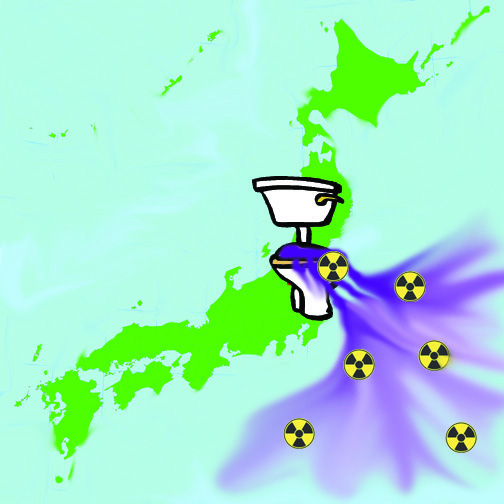 Almost Unnoticed Nuclear Pandemic Is Spreading in Japan, https://indepthnews.net/index.php/the-world/asia-pacific/3967-almost-unnoticed-nuclear-pandemic-is-spreading-in-japanBy Manlio Dinucci, MONTREAL (IDN) 4 Nov 20, – It was not Covid-19, therefore the news went almost unnoticed: Japan will release over a million tons of radioactive water from the Fukushima nuclear power plant into the sea. The catastrophic incident in Fukushima was triggered by the Tsunami that struck the north-eastern coast of Japan on March 11, 2011, submerging the power plant and causing the core of three nuclear reactors to melt.
The power plant was built on the coast just 4 meters above sea level with five-meter-high breakwater dams, in a tsunami-prone area with waves 10-15 meters high. Furthermore, there had been serious failures by the private company TEPCO (the Tokyo Electric Power Company) managing the plant, in the control of the nuclear plant: the safety devices did not come into operation at the time of the Tsunami.
Water has been pumped through the reactors for years to cool the molten fuel. The water became radioactive and was stored inside the plant in over a thousand large tanks, accumulating 1.23 million tons of radioactive water. TEPCO is building other tanks, but they will also be full by mid-2022.
TEPCO must continue pumping water into the melted reactors and has decided to discharge, in agreement with the government, the water accumulated so far into the sea after filtering it to make it less radioactive (however, to what extent it is not known) with a process which will last 30 years. There is also radioactive sludge accumulated in the decontamination filters of the plant, stored in thousands of containers, and huge quantities of soil and other radioactive materials.
As TEPCO admitted, the melting in reactor 3 is particularly serious because the reactor was loaded with Mox, a much more unstable and radioactive mix of uranium oxides and plutonium.
The Mox for this reactor and other Japanese ones was produced in France, using nuclear waste sent from Japan. Greenpeace has denounced the danger deriving from the transport of this plutonium fuel for ten thousand kilometres.
Greenpeace also denounced that Mox favours the proliferation of nuclear weapons, since plutonium can be extracted more easily and, in the cycle of uranium exploitation, there is no clear dividing line between civilian and military use of fissile material.
Up to now, around 240 tons of plutonium for direct military use and 2,400 tons for civil use (nuclear weapons can however be produced with them), were accumulated in the world (according to 2015 estimates), plus about 1,400 tons of highly enriched uranium for military use. A few hundred kilograms of plutonium would be enough to cause lung cancer to 7.7 billion inhabitants of the planet, and plutonium remains lethal for a period corresponding to almost ten-thousand human generations.
A destructive potential has thus accumulated, for the first time in history, capable of making the human species disappear from the face of Earth. The nuclear bombings of Hiroshima and Nagasaki; the more than 2,000 experimental nuclear explosions in the atmosphere, at sea and underground; the manufacture of nuclear warheads with a power equivalent to over one million Hiroshima bombs; the numerous accidents involving nuclear weapons and those involving civilian and military nuclear plants, all this has caused radioactive contamination that has affected hundreds of millions of people.
A portion of approximately 10 million annual cancer deaths worldwide – documented by WHO – is attributable to the long-term effects of radiation. In ten months, again according to the World Health Organization data, Covid-19 caused about 1.2 million deaths worldwide.
This danger should not be underestimated, but it does not justify the fact that mass media, especially television, did not inform that over one million tons of radioactive water will be discharged into the sea from the Fukushima nuclear power plant, with the result that it will further increase cancer deaths upon entering in the food chain.
Nuclear disaster: Fukushima schools frozen in time
Nuclear disaster: Fukushima schools frozen in time https://www3.nhk.or.jp/nhkworld/en/news/backstories/1365/
|
Sakurayama Kyoko, NHK World Correspondent 16 Nov 20, At an elementary school in Futaba Town, Fukushima Prefecture, children’s bags and notebooks still lie scattered where they were left after the meltdown at the Fukushima Daiichi nuclear power plant in 2011. The evacuation order for part of the town was lifted in March this year, but no one has returned to live there.
Nishizaki Ryusuke, 21 and a former student at the Futaba Minami Elementary School, visited it last month for the first time since the accident. It is located just three kilometers from the nuclear plant. The sight of everything frozen in time brought back vivid memories. Ties severedNishizaki, then a fifth-grader, was in his homeroom when the earthquake that precipitated the crisis struck. He fled with only the clothes he was wearing. Since that day, he has been living as an evacuee, moving with his family from one place to another within Fukushima Prefecture and in neighboring Niigata. His ties with his home and neighbors have been severed. “ I had no doubt that I would spend my life in the town,” says Nishizaki. “But the earthquake and the nuclear accident changed everything all of a sudden.” Ties severedNishizaki, then a fifth-grader, was in his homeroom when the earthquake that precipitated the crisis struck. He fled with only the clothes he was wearing. Since that day, he has been living as an evacuee, moving with his family from one place to another within Fukushima Prefecture and in neighboring Niigata. His ties with his home and neighbors have been severed. “ I had no doubt that I would spend my life in the town,” says Nishizaki. “But the earthquake and the nuclear accident changed everything all of a sudden.” The town projected that renovating them would cost 900 million yen, or about 8.6 million dollars, per school. In addition, it would require an estimated 10 million yen, or about 95,000 dollars, a year in maintenance costs. Yoshida Katsunori, an official at Namie’s education board, says: “It’s extremely important to pursue the ideal of preserving school buildings. But, financially speaking, it might not be realistic.” Fukaya Naohiro, a Visiting Associate Professor at the Fukushima Future Center For Regional Revitalization, says all efforts should be made to preserve buildings that can serve as reminders of the accident and help us prepare for future disasters. “When it came to preserving the Atomic Bomb Dome in Hiroshima, it wasn’t just local residents, but people across Japan, who took part in the debate,” says Fukaya. “Each and every one of us should think about what to do with the Fukushima buildings.” Concrete remindersNishizaki says that there are some things that people can understand only when they visit the site and see it for themselves: “We want people to know that children who had been at the schools at the time of the accident couldn’t go back for nine and a half years.” At the time of writing, just one building in Fukushima Prefecture has been listed to be preserved as a memorial for future generations. |
|
The accumulating radioactive water is another Fukushima disaster crisis
|
Japan faces another Fukushima disaster crisis https://www.eco-business.com/news/japan-faces-another-fukushima-disaster-crisis/ – 6 Nov 20, A plan to dump a million tonnes of radioactive water from the Fukushima disaster off Japan is alarming local people. Paul Brown, Climate News Network. The Japanese government has an unsolvable problem: what to do with more than a million tonnes of water contaminated with radioactive tritium, in store since the Fukushima disaster and growing at more than 150 tonnes a day.
The water, contained in a thousand giant tanks, has been steadily accumulating since the nuclear accident in 2011. It has been used to cool the three reactors that suffered a meltdown as a result of the tsunami that hit the coast. Tritium is a radioactive element produced as a by-product by nuclear reactors under normal operation, and is present everywhere in the fabric of the reactor buildings, so water used for cooling them is bound to be contaminated by it. To avoid another potentially catastrophic meltdown in the remaining fuel the cooling has to continue indefinitely, so the problem continues to worsen. The government has been told that Japan will run out of storage tanks by 2022. Announcement delayedAs often happens when governments are faced with difficult problems, the unpalatable decision to release the contaminated water into the sea has not been formally announced, but the intention of the government to take this course has been leaked and so widely reported. Immediately both local and worldwide adverse reaction has resulted. There are the direct effects on the local fishermen who fear that no one will want to buy their catch, but over a wider area the health effects are the main concern. As ever with the nuclear industry, there are two widely different views on tritium. The Health Physics Society says it is a mildly radioactive element that is present everywhere, and doubts that people will be affected by it. But the Nuclear Information and Resource Service believes tritium is far more dangerous and increases the likelihood of cancers, birth defects and genetic disorders. The issue is further complicated because the Fukushima wastewater contains a number of other radionuclides, not in such high quantities, but sufficient to cause damage. Ian Fairlie, an independent consultant on radioactivity in the environment, is extremely concerned about Japan’s plans and the health of the local people. In a detailed assessment of the situation he says other highly dangerous radioactive substances, including caesium-137 and strontium-90, are also in the water stored at Fukushima. They are in lower quantities than the tritium, he says, but still unacceptably high – up to 100 times above the legally permitted limit. All these radionuclides decay over time − some take thousands of years − but tritium decays faster, the danger from it halving every 12.3 years. In a briefing for the Nuclear Free Local Authorities (NFLA), a UK based organisation, another independent analyst, Tim Deere-Jones, discusses research that shows that tritium binds with organic material in plants and animals. This is potentially highly damaging to human health because it travels up the food chain in the marine environment, specifically accumulating in fish. This means fish-eating communities on the Japanese coast could ingest much larger quantities of tritium than some physicists think likely. Relying on dilutionTim Deere-Jones is also concerned that the tritium will be blown inshore on the prevailing wind in sea spray and will bio-accumulate in food plants, making it risky to eat crops as far as ten miles inland. Because of the potential dangers of releasing the water the NFLA has asked the Japanese government to reconsider its decision. The government has not yet responded though, because officially it is still considering what to do. However, it is likely to argue that pumping the contaminated water into the sea is acceptable because it will be diluted millions of times, and anyway seawater does already contain minute quantities of tritium. Dr Fairlie is among many who think this is too dangerous, but he admits there are no easy solutions. He says: “Barring a miraculous technical discovery which is unlikely, I think TEPCO/Japanese Gov’t [TEPCO is the Tokyo Electric Power Company, owner of the Fukushima Daiichi plant] will have to buy more land and keep on building more holding tanks to allow for tritium decay to take place. Ten half-lives for tritium is 123 years: that’s how long these tanks will have to last – at least. “This will allow time not only for tritium to decay, but also for politicians to reflect on the wisdom of their support for nuclear power.” |
|
Compensation claims recognised – workers made ill by working at Fukushima’s wrecked nuclear plant
 Compensation claims related to Fukushima nuclear plant work total 269, https://japantoday.com/category/national/compensation-claims-related-to-fukushima-plant-work-total-269
The workers’ compensation claims that have been recognized by labor authorities include six cases of workers who developed cancer or leukemia due to radiation exposure, and four others who suffered from overwork-related illnesses, according to the Ministry of Health, Labor and Welfare officials.
Decommissioning of the Fukushima plant is still under way nearly 10 years after the massive earthquake and tsunami that devastated northeastern Japan triggered meltdowns at the Fukushima Daiichi nuclear plant. To this day, about 4,000 people still work on site every day, with many at risk of radiation exposure.
The compensation claims that have been approved refer to the period since the March 2011 nuclear accident through Oct 1 this year.
According to the plant operator, Tokyo Electric Power Company Holdings Inc, three people died between fiscal 2011 and 2019.
One worker, who wished to remain anonymous, told Kyodo News the pressure of working at a nuclear power plant as opposed to a normal working site is “incomparable.”
“I have to deal with so much anxiety and stress as I could never know what may happen inside a nuclear power plant,” said the man from Iwaki, Fukushima Prefecture.
According to the worker, he wears two protective layers of clothing and tapes them together so there is no space between them, and also puts on a raincoat.
“I sweat a lot even in winter and I drink a lot of water,” he said, adding that several of his colleagues suffered from heat stroke or heat exhaustion while working at the plant.
TEPCO said a total of 98 people suffered from heat-related illnesses between fiscal 2011 and 2019, having had to wear masks and protective gear made of less permeable materials under the sweltering summer heat.
At the site of the Fukushima Daiichi plant, 313 accidents have occurred in the same period of time, including several fatal cases between 2014 and 2015 in which workers fell into a tank, TEPCO said.
Acknowledging that many accidents had occurred, a TEPCO official said, “We will continue to work with our contractors to prevent such incidents from happening.”
Japanese Prime Minister Yoshihide Suga soon to decide on disposal of Fukushima’s nuclear waste water
Reuters 21st Oct 2020, Japanese Prime Minister Yoshihide Suga said on Wednesday that he is aiming
to make a speedy decision on the disposal of contaminated water at the
tsunami-crippled Fukushima nuclear plant.
Japan’s government is appealing the landmark ruling about its responsibility for Fukushima nuclear accident
Landmark Court Ruling In Japan Holds Government Accountable For 2011 Nuclear Meltdown https://www.npr.org/2020/10/15/924150284/landmark-court-ruling-in-japan-holds-government-accountable-for-2011-nuclear-mel
 Heard on All Things Considered, ANTHONY KUHN, 15 Oct 20, Japan’s government is appealing a landmark court ruling that holds it responsible for failing to prevent the worst nuclear accident in the country’s history and orders it to pay damages to victims. Heard on All Things Considered, ANTHONY KUHN, 15 Oct 20, Japan’s government is appealing a landmark court ruling that holds it responsible for failing to prevent the worst nuclear accident in the country’s history and orders it to pay damages to victims.AILSA CHANG, HOST: The Japanese government and a nuclear power plant operator have appealed a landmark court ruling. The ruling holds them responsible for the country’s worst ever nuclear accident. The 2011 Fukushima meltdown was triggered by a huge earthquake and tsunami. But as NPR’s Anthony Kuhn reports from Seoul, plaintiffs are concerned that justice is being delayed once again. (CHEERING) ANTHONY KUHN, BYLINE: Cheering broke out outside the high court in the city of Sendai, about 60 miles north of the crippled Fukushima nuclear plant last month. To many people’s surprise, the court’s ruling held the central government and the Tokyo Electric Power Company – or TEPCO, which runs the plant – equally responsible for the accident. Plaintiffs argued that scientists had warned the government in 2002 that a major tsunami could hit the area. The court said in its scathing verdict that the government failed to take action. TAKASHI NAKAJIMA: (Speaking Japanese).KUHN: “The government, despite its position as regulator, just let TEPCO do as it pleased and let it put off safety measures. It was gross negligence, and it was an attitude unbefitting a regulatory agency.” That was Takashi Nakajima paraphrasing the court’s verdict. He’s a leader among the nearly 3,600 plaintiffs in the case. The Sendai court ordered the government and TEPCO to pay them $9.6 million in compensation, double what a lower court had ruled three years ago. Many people in Nakajima’s community near Fukushima fled their homes. He says he filed the lawsuit basically just to say, give me back my former life. NAKAJIMA: (Speaking Japanese). KUHN: “Imagine how you would feel,” he says, “if suddenly you get into a situation where you can never go back to your hometown because there’s a risk of radiation.” Nakajima runs a supermarket, but he says that fears about radiation in waters near Fukushima make it impossible to sell the local fish in which he used to take such pride. NAKAJIMA: (Speaking Japanese). KUHN: “The fishermen eat them because they’ve been eating them for a long time,” he says, “and they’re tasty. But their sons and daughters-in-law tell them that their grandchildren should not eat them. This is a situation which divides many families.” Judges in the Sendai verdict appear to have been especially sympathetic to such hardships. Eri Osaka, a law professor at Toyo University in Tokyo, explains. ERI OSAKA: (Through translator) The Sendai High Court judges actually visited the area at issue in the trial before the decision was made. It’s very unusual that judges truly understand what hardships the victims are experiencing. KUHN: Some plaintiffs in similar lawsuits have not been as fortunate as Nakajima and have lost. Professor Masafumi Yokemoto, a professor of environmental policy at Osaka City University, says the Sendai verdict could change that. MASAFUMI YOKEMOTO: (Speaking Japanese). KUHN: “This is the first time a decision recognizing the government’s full responsibility has been made at the high court level,” he says, “although it was partly recognized by a lower court. It’s very significant, and it’ll clearly influence future decisions.” That’s why many observers were not surprised when the government and TEPCO appealed the verdict on Tuesday. Plaintiff Takashi Nakajima hopes that the Sendai court ruling will eventually pave the way for the shutdown of all dangerous nuclear power plants in Japan. But whether or not the ruling stands will now be up to Japan’s Supreme Court to decide. Anthony Kuhn, NPR News, Seoul. |
|
Japan’s government planning to dump into the sea, the radioactive water from Fukushima No. 1 nuclear reactor
Fukushima No. 1 nuclear plant wastewater looks headed for ocean, THE ASAHI SHIMBUN, October 16, 2020 The government is moving toward the controversial disposal method for contaminated water at the crippled Fukushima No. 1 nuclear power plant of dumping it into the ocean.
Fishermen have fiercely opposed this disposal method at the plant, which experienced a triple meltdown in March 2011 following a magnitude-9.0 earthquake and tsunami, over fears of resulting negative publicity hurting their industry.
The central government is likely to hold a meeting of relevant Cabinet ministers before the end of October to make a formal decision on the dumping, sources said.
Before being dumped into the ocean, the stored water would be processed a second time and diluted with seawater to lower levels of radioactive materials below legally established standards.
It is expected to take about two years to prepare for the dumping process.
Water contaminated with radioactive materials continues to be produced at the Fukushima No. 1 plant at a daily rate of about 140 tons. Water used to cool melted spent nuclear fuel mixes in with groundwater that leaks into the reactor building.
Tokyo Electric Power Co., the operator of the plant, treats the contaminated water using equipment called advanced liquid processing systems, or ALPS, before storing the water in tanks on the plant grounds.
But about 1.2 million tons of processed water is being stored in tanks and TEPCO has estimated that tank capacity will be reached by the summer of 2022 even under the current plan to build more tanks.
Because about two years is needed to construct the necessary equipment to dispose of the contaminated water and to pass screening by the Nuclear Regulation Authority, a decision on disposal of the water was expected by this summer.
A subcommittee of experts set up by the economy ministry compiled a proposal in February that said the two realistic alternatives were to dump the water into the ocean or release it into the atmosphere. The panel added that dumping the water into the ocean was the method that could be implemented with certainty.
Since April, the government has conducted seven hearings involving local government officials, farming and fisheries organizations and business groups on the issue……… http://www.asahi.com/ajw/articles/13831640
Fukushima’s citizen radiation testers still on the job.
Fukushima Has Turned These Grandparents Into Avid Radiation Testers, NPR, Kat Lonsdorf (@lilkat_bigworld) September 11, 2020 Takenori Kobayashi lugs a garbage bag full of soil across a parking lot to an unmarked office. His wife, Tomoko, holds the door to a tiny work space with lab equipment and computers set up. On the edge of Fukushima’s former nuclear exclusion zone, this is the place the couple likes to call their “grandma and grandpa lab.”
A handful of other residents help run the lab, and throughout the years, experts from nearby universities have come to teach them all about the different equipment and radiation science.
“All the grandparents here are radiation professionals now,” Takenori, 71, says with a smile……..
1 This Month


31st January – Challenging the War Machine – a DECLASSIFIED UK SUMMIT


Website of the Week
Now until to February 10, 2026 Radioactive waste storage in France: the debate is finally open! How to participate?
-
Archives
- January 2026 (220)
- December 2025 (358)
- November 2025 (359)
- October 2025 (377)
- September 2025 (258)
- August 2025 (319)
- July 2025 (230)
- June 2025 (348)
- May 2025 (261)
- April 2025 (305)
- March 2025 (319)
- February 2025 (234)
-
Categories
- 1
- 1 NUCLEAR ISSUES
- business and costs
- climate change
- culture and arts
- ENERGY
- environment
- health
- history
- indigenous issues
- Legal
- marketing of nuclear
- media
- opposition to nuclear
- PERSONAL STORIES
- politics
- politics international
- Religion and ethics
- safety
- secrets,lies and civil liberties
- spinbuster
- technology
- Uranium
- wastes
- weapons and war
- Women
- 2 WORLD
- ACTION
- AFRICA
- Atrocities
- AUSTRALIA
- Christina's notes
- Christina's themes
- culture and arts
- Events
- Fuk 2022
- Fuk 2023
- Fukushima 2017
- Fukushima 2018
- fukushima 2019
- Fukushima 2020
- Fukushima 2021
- general
- global warming
- Humour (God we need it)
- Nuclear
- RARE EARTHS
- Reference
- resources – print
- Resources -audiovicual
- Weekly Newsletter
- World
- World Nuclear
- YouTube
-
RSS
Entries RSS
Comments RSS
 nuclear-news