Greenpeace says that TEPCO ignored risks to South Korea when assessing radiological impact of releasing Fukushima nuclear water waste.
The international environmental organization called TEPCO’s radiological
impact assessment “highly selective” in its use of IAEA guidelines. The
international environmental group Greenpeace sent an opinion to the Tokyo
Electric Power Company (TEPCO) on Thursday stating that the company’s
radiological impact assessment of contaminated water from the Fukushima
Nuclear Power Plant made convenient use of International Atomic Energy
Agency (IAEA) guidelines without considering the potential damages to
residents of neighboring countries such as South Korea.
The opinion from Greenpeace was based on its review of the draft version of a contaminated
water radiological impact assessment report released by TEPCO last month.
Hankyoreh 18th Dec 2021
http://english.hani.co.kr/arti/english_edition/e_international/1023823.html
Tepco to repair Fukushima nuclear station’s partially melted protective ice wall.

Ice Wall to Halt Groundwater Flow at Japan’s Fukushima Nuclear Plant to Be Repaired https://thewire.in/world/ice-wall-to-halt-groundwater-flow-at-japans-fukushima-nuclear-plant-to-be-repaired
Tokyo Electric Power Co (Tepco) will launch remedial works at the stricken plant after ice wall tests indicated partial melting. Tokyo: Tokyo Electric Power Co (Tepco) will launch remedial works at the stricken Fukushima Daiichi nuclear plant to strengthen an ice wall intended to halt the flow of groundwater after testing indicated partial melting.
The work could begin as early as the start of December, according to a presentation from the plant operator dated Thursday, part of a costly and troubled effort to secure the site following the 2011 earthquake and tsunami.
The ice wall is intended to limit the seepage of groundwater into the plant, which has created large amounts of toxic water being stored by Tepco in tanks.
Japan plans to release more than 1 million tonnes of water into the sea after treating it. The water contains the radioactive isotope tritium, which cannot be removed.
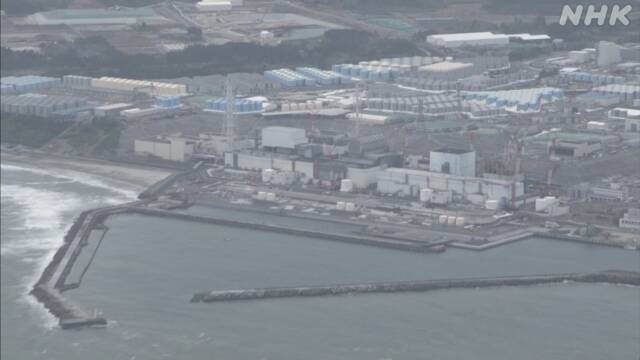
Temperature rises over 10 degrees Celsius in some parts of the “frozen earth wall” to reduce contaminated water at Fukushima Daiichi Nuclear Power Plant
October 28, 2021
As a countermeasure to reduce the amount of contaminated water from the Fukushima Daiichi Nuclear Power Plant, it was found that the temperature of the ground in some parts of the “frozen soil wall”, which freezes the ground around the buildings to prevent the inflow of underground water, has been rising above 0 degrees Celsius since the middle of last month, reaching a maximum of 10 degrees Celsius. The Tokyo Electric Power Company (TEPCO) is investigating the cause of the problem, saying that it does not affect the function of the wall to prevent the inflow of underground water.
The “frozen earth wall” is one of the measures to reduce the amount of contaminated water. Pipes are embedded around the buildings of the Fukushima Daiichi Nuclear Power Plant, and liquid at 30 degrees below zero is poured into the pipes and frozen, forming an “ice wall” that prevents groundwater from flowing into the buildings.
The Tokyo Electric Power Company (TEPCO) has installed thermometers in the “frozen earth wall” to measure the underground temperature, and in some areas located on the mountain side of the No. 4 reactor at the Fukushima Daiichi Nuclear Power Plant, the temperature, which is usually below freezing, has been rising and has been above zero since the middle of last month.
The temperature in the area where the increase was confirmed was between 1 meter and 4 meters deep, and the temperature exceeded 10 degrees Celsius on some days.
The freezing wall is about 10 meters thick, and TEPCO has stated that there is no significant difference in the water level between the inside and outside of the wall, so there is no impact on its ability to control the inflow of groundwater.
It is possible that water leaked from cracks in the drainage channel that intersects the frozen soil wall and seeped into the frozen area, causing the temperature to rise.
Prime Minister Fumio Kishida confirms release of Fukushima wastewater to start in 2023
Release of Fukushima wastewater to proceed: Kishida, The Guardian, TOKYO, 18 Oct 21,
New Japanese Prime Minister Fumio Kishida has said that there can be no delay to plans to release contaminated water from the wrecked Fukushima Dai-ichi nuclear power plant into the sea, despite opposition from fishers and neighboring countries.
Kishida, who made his first trip to the plant on Sunday since becoming prime minister last month, said every effort would be made to reassure local people that disposing of the water in the Pacific Ocean was safe……
Researchers have used snakes fitted with tracking devices and dosimeters to measure radiation levels in the area around the Fukushima Dai-ichi Nuclear Power Plant, which suffered triple meltdowns in March 2011……
More than 1 million tonnes of water are being stored in 1,000 tanks at the site, and TEPCO has said that space would run out late next year.
The government and TEPCO in April said that work to release the heavily diluted water would begin in the spring of 2023 and take decades to complete.
The move is opposed by nearby fishing communities, which say it would undo years of hard work rebuilding their industry’s reputation since the plant was struck by a huge tsunami in March 2011, soon after Japan’s northeast coast was rocked by a magnitude 9 earthquake.
The decision ended years of debate over what to do with the water, with other options including evaporation or the construction of more storage tanks at other sites. More than 1 million tonnes of water are being stored in 1,000 tanks at the site, and TEPCO has said that space would run out late next year.
The government and TEPCO in April said that work to release the heavily diluted water would begin in the spring of 2023 and take decades to complete.
The move is opposed by nearby fishing communities, which say it would undo years of hard work rebuilding their industry’s reputation since the plant was struck by a huge tsunami in March 2011, soon after Japan’s northeast coast was rocked by a magnitude 9 earthquake.
The decision ended years of debate over what to do with the water, with other options including evaporation or the construction of more storage tanks at other sites.More than 1 million tonnes of water are being stored in 1,000 tanks at the site, and TEPCO has said that space would run out late next year.
Japan has requested help from the International Atomic Energy Agency to ensure that the discharge meets global safety standards, including treating the wastewater so its radioactivity levels are below legal limits. https://www.taipeitimes.com/News/front/archives/2021/10/19/2003766372
New radiation scrubber begins cleaning water at Fukushima plant
New radiation scrubber begins cleaning water at Fukushima plant, Japan Times 19 Sep 21The operator of the crippled Fukushima No. 1 nuclear plant on Thursday powered up an additional water treatment facility to scrub contamination from the massive quantities of radioactive water stored there.
The new, mobile facility filters radioactive strontium from water used to cool three reactors that partially melted down in March 2011, said operator Tokyo Electric Power Co., and can handle 300 tons of water a day……
The procedure will reduce radioactive strontium in the water to about one-thousandth of its current level, the utility said.
However, removing strontium will not in itself render the water safe. It then needs to be treated by another system at the plant which filters out around 60 kinds of radioactive materials.
But there is an important reason why the strontium takes precedence. Removing that isotope before the others will make the water far less of a hazard in the event of a major leak into the ocean.
Meanwhile, an estimated 400 tons of groundwater continues to seep into the reactor basements every day, forcing the utility to find ways to store it. Tepco already has 400,000 tons of toxic water stored at the site, which will all need to be treated one day. https://www.japantimes.co.jp/news/2014/10/03/national/new-radiation-scrubber-begins-cleaning-water-at-fukushima-plant/
Tepco technicians ignored Fukushima filters leaking radioactive water.
Technicians at Japan’s wrecked Fukushima nuclear power plant have acknowledged neglecting to investigate the cause of faulty exhaust filters key to preventing radioactive pollution, after being forced to replace them twice. Representatives of the Tokyo Electric Power Company made the revelations Monday during a regular review of the Fukushima Daiichi plant at a meeting with Japanese regulatory authorities.
The plant suffered triple meltdowns following a massive earthquake and tsunami in 2011. “At the core of this problem is TEPCO´s attitude,” said a Nuclear RegulationAuthority commissioner, Nobuhiko Ban, at the meeting. TEPCO has been
repeatedly criticized for coverups and delayed disclosures of problems atthe plant. In February, it said two seismometers at one reactor remained broken since last year and failed to collect data during a powerful quake.
Company officials have said that 24 out of 25 filters attached to water treatment equipment had been found damaged last month, after an alarm went off as workers were moving sludge from the unit to a container, temporarilysuspending the water treatment. The operation partially resumed last weekafter filter replacement. The filters are designed to prevent particles from escaping into the air from a contaminated water treatment system – called Advanced Liquid Processing System, or ALPS – that removes selected radioactive isotopes in the water to below legally releasable limits.
Daily Mail 14th Sept 2021
IAEA Seeks Japan Transparency in Release of Fukushima Water
IAEA Seeks Japan Transparency in Release of Fukushima Water, By Mari Yamaguchi | September 8, 2021 TOKYO (AP) — Experts from the International Atomic Energy Agency asked Japan on Tuesday for full and detailed information about a plan to release treated but still radioactive water from the wrecked Fukushima nuclear plant into the ocean.
The three-member team, which is assisting Japan with the planned release, met Tuesday with government officials to discuss technical details before traveling to the Fukushima Daiichi plant for an on-site examination Wednesday. They will meet with Japanese experts through Friday…….. https://www.claimsjournal.com/news/international/2021
IAEA team in Japan to help prepare Fukushima water release.
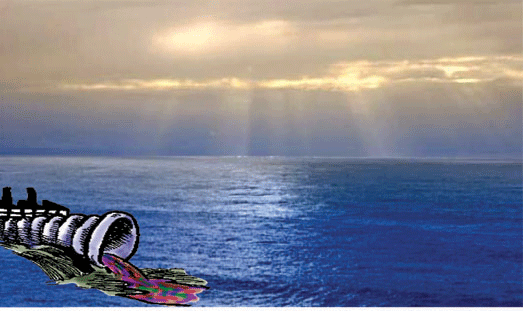
IAEA team in Japan to help prepare Fukushima water release
An International Atomic Energy Agency mission has arrived in Japan to help prepare for a decades-long release into the ocean of treated but still radioactive water from the wrecked Fukushima nuclear plantBy MARI YAMAGUCHI Associated Press7 September 2021 TOKYO — An International Atomic Energy Agency mission arrived in Japan on Monday to help prepare for a decades-long release into the ocean of treated but still radioactive water from the wrecked Fukushima nuclear plant, officials said.
The three-member team will meet with officials in Tokyo and travel to the Fukushima Daiichi plant to discuss technical details with experts until Friday, IAEA and Japanese officials said.
The team, headed by Lydie Evrard, head of the IAEA’s Department of Nuclear Safety and Security, is gathering information to prepare a review of the discharge plans.
The Japanese government and the plant’s operator, Tokyo Electric Power Company Holdings, announced plans in April to start releasing the water in the spring of 2023 so hundreds of storage tanks at the plant can be removed to make room for other facilities needed for its decommissioning.
The idea has been fiercely opposed by fishermen, residents and Japan’s neighbors, including China and South Korea.
The utility plans to send the water through an undersea tunnel and discharge it from a location about 1 kilometer (0.6 mile) away from the coastal power plant after further treating and diluting it with large amounts of seawater…….. https://abcnews.go.com/Technology/wireStory/iaea-team-japan-prepare-fukushima-water-release-79857833
UN urges Japan to investigate damaged Fukushima nuclear reactors for clean-up
UN urges Japan to investigate damaged Fukushima nuclear reactors for clean-up, New York Post,
By Isabel Vincent 28 Aug 21. A team of United Nations experts is urging Japan to investigate nuclear reactors damaged a decade ago by a massive earthquake and tsunami.
Scientists working for the International Atomic Energy Agency reviewing the progress of the Fukushima plant’s clean-up say that Japan has been slow to examine the melted fuel inside the reactors.
And they’re worried that the country will be unable to meet a 2051 target to clean up the mess, according to a report.
“We need to gather more information on the fuel debris and more experience on the retrieval of the fuel debris to know if the plan can be completed as expected in the next 30 years,” said Christophe Xerri, head of IAEA, at a press conference after he and a colleague submitted a report on their recent findings to the Japanese government Friday……….https://nypost.com/2021/08/28/un-urges-japan-to-investigate-damaged-fukushima-nuclear-reactors/
International Atomic Energy Agency doubts the ability of Japan to clean up Fukushima nuclear wreck by intended date 2051

UN team: Unclear if Fukushima cleanup can finish by 2051, MARI YAMAGUCHI, THE PRESS DEMOCRAT, ASSOCIATED PRESS, August 27, 2021,
TOKYO — Too little is known about melted fuel inside damaged reactors at the wrecked Fukushima nuclear power plant, even a decade after the disaster, to be able to tell if its decommissioning can be finished by 2051 as planned, a U.N. nuclear agency official said Friday.
“Honestly speaking, I don’t know, and I don’t know if anybody knows,” said Christophe Xerri, head of an International Atomic Energy Agency team reviewing progress in the plant’s cleanup.
“We need to gather more information on the fuel debris and more experience on the retrieval of the fuel debris to know if the plan can be completed as expected in the next 30 years,” he told reporters.
The cleanup plan depends on how the melted fuel needs to be handled for long-term storage and management, he said.
The IAEA team’s review, the fifth since the disaster, was mostly conducted online due to the coronavirus pandemic. Only Xerri and another team member visited the plant this week before compiling and submitting a report to Japan’s government on Friday.
In the report, the team noted progress in a number of areas since its last review in 2018, including the removal of spent fuel from a storage pool at one of the damaged reactors, as well as a decision to start discharging massive amounts of treated but still radioactive water stored at the plant into the ocean in 2023………. https://www.pressdemocrat.com/article/news/un-team-unclear-if-fukushima-cleanup-can-finish-by-2051/?ref=recent
Japan’s murky management of Fukushima nuclear wastewater

Japan’s murky management of Fukushima nuclear wastewater https://www.eastasiaforum.org/2021/06/25/japans-murky-management-of-fukushima-nuclear-wastewater/
Author: Cheol Hee Park, SNU
On 13 April 2021, the Japanese government announced plans to dispose of the wastewater stored at the Fukushima Daiichi nuclear plant into the Pacific Ocean over a period of 30 years.
The plant has about 1000 wastewater tanks that can hold up to 1.37 million tons of contaminated water. Currently, 1.25 million tons are being stored, which accounts for about 90 per cent of the total storage capacity. The tanks are expected to fill up by the autumn of 2022, which prompted the Japanese government to adopt the least expensive option — disposing the wastewater into the sea, starting from 2023.
The United States and the International Atomic Energy Agency (IAEA) remain sympathetic to the Japanese decision, saying that it meets the international standard. On the other hand, China and South Korea have voiced concerns about the decision. They are distrustful of and dissatisfied with the sudden decision made by the Japanese government. The difference is starkly highlighted in how the wastewater is being referred to by different countries. Japan and the United States call it ‘treated water’ while China and South Korea define it as ‘contaminated water’.
The Japanese government explained that it will fully treat and dilute the wastewater until the contamination level is reduced to at least one-hundredth of its original concentration. Officials say that tritium will be reduced to one-fortieth of the Japanese government’s normal standard. Deputy Prime Minister Taro Aso even claimed that the treated water will be drinkable.
he Japanese government also made it clear that before the accident in 2011 the Fukushima nuclear plant disposed of 2.2 trillion becquerels of tritium into the sea each year, which caused no problems. They added that because tritium is a weak radioactive isotope, most of the material will exit the human body, meaning its negative impact will be small.
Despite the Japanese government’s efforts to convince people outside of the country, the most vocal opposition has come from within Japan. The Japan Fishermen’s Association argued that they will not accept the Japanese government’s decision. They explain that the decision went against the government’s promise in 2015 that the release would not happen without their consent. Fishermen from Fukushima and Ibaraki are particularly sensitive about the potential consumer backlash over the radioactive wastewater release, which will directly impact their livelihoods. About 70 per cent of fishermen oppose the government’s decision. It remains unclear whether the Japanese government will be able to persuade them.
Concerns from neighbouring countries are another hurdle to overcome. There is little sign that the Japanese government fully consulted adjacent countries before it announced the decision. Because of the lack of prior consultation and reliable notice, the Japanese government’s decision should be regarded as a unilateral move. South Korea and China should not approach this issue to drag down Japan’s efforts to resolve the problem. At the same time, it is Japan’s responsibility to be attentive to neighbouring countries’ legitimate concerns.
Securing transparency in the process of implementing the plan is another challenge. Despite the Japanese government’s explanation, it remains uncertain whether various nuclides other than tritium can be reliably removed using the Advanced Liquid Processing System (ALPS). Passing on the correct and reliable information to concerned parties in and outside the country is necessary. Japan should incorporate third-party specialists to provide objective and reliable information about the process.
Finally, verifying the safety of the water with international standards would give comfort to and garner trust from concerned parties, including Japanese fishermen. The IAEA could mobilise experts or build a verification team on behalf of Japan and its neighbouring countries so that all concerned regional countries can be persuaded about the safety of the water.
The Japanese government should better fulfil its responsibilities, justify the necessity of its decision, remain transparent about its implementation of the plan and be resilient in verifying the safety of the water it disposes of.
Cheol Hee Park is Professor at the Graduate School of International Studies and Director of the Institute of International Affairs, Seoul National University.
TEPCO begins process to scrap Fukushima No. 2 nuclear plant,
TEPCO begins process to scrap Fukushima No. 2 nuclear plant, http://www.asahi.com/ajw/articles/14379413
THE ASAHI SHIMBUN, June 23, 2021 Tokyo Electric Power Co. Holdings Inc. began decommissioning the Fukushima No. 2 nuclear power plant in Fukushima Prefecture on June 23, aiming to complete the work in fiscal 2064.
In 2018, TEPCO decided to scrap all four reactors at the plant, located south of the No. 1 nuclear plant that was devastated by the 2011 Great East Japan Earthquake and tsunami. Operations at the No. 2 plant have been suspended since it was inundated by the tsunami.
The company estimates the total cost of scrapping the No. 2 plant, including reprocessing spent nuclear fuel, at 410 billion yen ($3.70 billion).
TEPCO divided the process of decommissioning the plant in four stages, each taking about a decade. In the first stage, the company will focus mainly on decontamination work.
TEPCO has already begun work to scrap all six reactors at the crippled No. 1 plant. The company needs considerable manpower to simultaneously carry out the decommissioning work at both plants.
It is also facing many challenges, such as where some 10,000 spent nuclear fuel assemblies should be transferred to.
The Nuclear Regulation Authority, the government’s nuclear watchdog, approved TEPCO’s decommissioning plan for the No. 2 plant on April 28. The company also obtained prior consent to the plan from Fukushima Prefecture as well as Tomioka and Naraha towns, which co-host the plant, on June 16.
Fukushima Governor Masao Uchibori is urging TEPCO to move the spent fuel out of the prefecture and to cultivate a corporate culture that prioritizes safety and to work with local companies when carrying out the decommissioning work.
TEPCO started the work by inspecting the interior of the reactor buildings and checking the procedure for decommissioning. It will bring in necessary equipment and materials to the plant from July 1 and begin decontamination work on a full scale from mid-July.
(This article was written by Tetsuya Kasai and Satoshi Shinden.)
Fukushima waste water dumped in Pacific Ocean – a critical environmental issue threatening marine pollution

Is Japan’s Nuclear Wastewater Dumping Reckless? THE ASEAN POST, Anna Malindog-Uy6 June 2021
it is important to speak about one of the most critical environmental issues that might cause marine pollution in the Pacific Ocean and beyond soon.
It can be recalled that a few months back, Japan alarmingly announced that it will release around 1.25 million tons of contaminated water or wastewater from the destroyed Fukushima nuclear power plant into the sea. These 1.25 million tons of wastewater can fill up around 500 Olympic-sized swimming pools.
What’s pretty disquieting is the fact that, thus far, there has never been any precedent in the world or actual practice of discharging such a huge volume of wastewater into the sea. Even the International Atomic Energy Agency (IAEA), though not opposed to Japan’s decision, has no relevant experience in this regard.
Accordingly, it will be hard to assess the long-term effects of such dumping of radioactive waste into the sea. Likewise, according to some reports, no independent testing of the water will be allowed as previously promised. ………
Perplexing
But one perplexing thing about all this is the fact that the United States (US) seems to be in agreement with this decision. In a tweet, US Secretary of State, Antony Blinken said “We thank Japan for its transparent efforts in its decision to dispose of the treated water.” This is a bit idiosyncratic and out of the ordinary given that the US continues to ban the import of farm and seafood products from the Fukushima region just like some other countries, precisely because of fears that these marine and agricultural products are contaminated with radioactive materials.,……….
Protests
Nevertheless, countries in East Asia like South Korea, China, and even Taiwan are protesting against Japan’s unilateral decision to dump radioactive waste into the Pacific Ocean. This is because it will be hazardous to marine ecosystems and resources, and will affect the fishing industries of these countries. ……….
Roque, an expert on international law said that “I can only repeat the principles of International Environmental Law that I hope all countries will comply with. The first principle is we are one ecosystem. The second principle is that we are interconnected and the third principle is that the polluter must pay.”……….
it’s not only neighbouring countries that have expressed their opposition and resistance to the plan of dumping wastewater into the sea. Even the Japanese people themselves are opposed to it.
For instance, the local fisherfolks of Fukushima have publicly announced their opposition to the plan saying, “…the said plan will undo the years of work rebuilding their industry’s reputation since the plant was destroyed and ruined by the huge tsunami in March 2011.”
In a Yahoo Japan survey, 41.5 percent of the 31,035 respondents disagreed with the government’s plan.
Conclusion
The unilateral plan of the Japanese government to dump wastewater in the Pacific Ocean needs to be reconsidered and studied further. Japan should at least show the necessary courtesy to consult and discuss its decision with its immediate neighbours like South Korea, China, Taiwan, and even beyond East Asia given the seriousness of the matter.
It should be noted that the bodies of water in Asia are very much connected and pollutants originating from the Fukushima water will no doubt reach other nearby areas, affecting local marine and the coastal environments and people’s health. Thus, as a responsible member of the community of nations, Japan should think twice before proceeding with its plan and prudently consult with countries that will directly be affected by such a decision.
However, Japan being a privileged country may not heed the call of its neighbours probably because it has the backing of the US. But if something goes wrong with the said plan, developing countries like the Philippines will surely be adversely affected and left on their own to suffer the negative consequences. ……
It is also quite shocking that the international media and even the mainstream media in the Philippines is downplaying this issue which is of great importance.
Another baffling issue is why has the IAEA sanctioned Japan’s decision when not much study has been done yet on the effects of dumping such a huge volume of radioactive wastewater into the sea. ……..https://theaseanpost.com/article/japans-nuclear-wastewater-dumping-reckless
Japanese government and TEPCO planning release of radioactive water, via a pipeline to the Pacific Ocean
Japan Times 12th May 2021, Japan and Tepco studying release of Fukushima water 1 kilometer from coast.
Tokyo Electric Power Company Holdings Inc. and the government are
considering a plan to release treated radioactive water from the crippled
Fukushima No. 1 nuclear power plant into the sea about 1 kilometer from the
coast, informed sources said Tuesday.
The plan calls for a pipeline to be set up at the bottom of the ocean, according to the sources. Tepco, the
government and the Nuclear Regulation Authority are expected to kick off
full-fledged talks next month to decide whether to release the water
directly from the coast near the power plant or offshore through a
pipeline, the sources said. As tritium cannot be removed with existing
technology, the levels of the radioactive substance will be diluted to
about 1/40 of the state-set standard before the release of the treated
water into the ocean.
https://www.japantimes.co.jp/news/2021/05/12/national/release-fukushima-water-study/
Even with water release to the Pacific, Fukushima nuclear plant needs more storage tanks
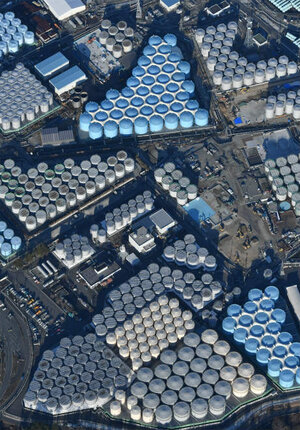
Even with water release, nuclear plant needs more storage tanks, Asahi Shimbun, By KEITARO FUKUCHI/ Staff Writer, May 1, 2021 The plan to release treated radioactive water from the crippled Fukushima No. 1 nuclear plant into the sea will likely not resolve the chronic problem of contaminated water accumulating there, Asahi Shimbun calculations show.
The maximum rate of water discharge allowed under the government’s basic plan would be less than the inflow of rainwater and groundwater at the nuclear power plant, meaning that additional water storage tanks would inevitably be needed at the site.
The government on April 13 approved the basic plan to release more than 1 million tons of treated water into the sea. The government and plant operator Tokyo Electric Power Co. hope to start discharging the water two years from now. Existing storage tanks at the site are expected to reach full capacity around the same time.
The Asahi Shimbun studied this plan based on documents and materials published by the government and TEPCO……… http://www.asahi.com/ajw/articles/14332645
1 This Month

Website of the Week
Now until to February 10, 2026 Radioactive waste storage in France: the debate is finally open! How to participate?
-
Archives
- January 2026 (148)
- December 2025 (358)
- November 2025 (359)
- October 2025 (377)
- September 2025 (258)
- August 2025 (319)
- July 2025 (230)
- June 2025 (348)
- May 2025 (261)
- April 2025 (305)
- March 2025 (319)
- February 2025 (234)
-
Categories
- 1
- 1 NUCLEAR ISSUES
- business and costs
- climate change
- culture and arts
- ENERGY
- environment
- health
- history
- indigenous issues
- Legal
- marketing of nuclear
- media
- opposition to nuclear
- PERSONAL STORIES
- politics
- politics international
- Religion and ethics
- safety
- secrets,lies and civil liberties
- spinbuster
- technology
- Uranium
- wastes
- weapons and war
- Women
- 2 WORLD
- ACTION
- AFRICA
- Atrocities
- AUSTRALIA
- Christina's notes
- Christina's themes
- culture and arts
- Events
- Fuk 2022
- Fuk 2023
- Fukushima 2017
- Fukushima 2018
- fukushima 2019
- Fukushima 2020
- Fukushima 2021
- general
- global warming
- Humour (God we need it)
- Nuclear
- RARE EARTHS
- Reference
- resources – print
- Resources -audiovicual
- Weekly Newsletter
- World
- World Nuclear
- YouTube
-
RSS
Entries RSS
Comments RSS
 nuclear-news