nuclear-news

The News That Matters about the Nuclear Industry Fukushima Chernobyl Mayak Three Mile Island Atomic Testing Radiation Isotope

  • Home
  • 1 This Month
  • ACTION !
  • Disclaimer
  • Links
  • PAGES on NUCLEAR ISSUES

Enormous costs of shutting down Japan’s nuclear facilities
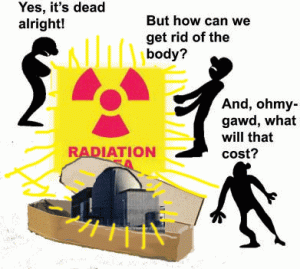
Costs for scrapping 79 nuclear facilities estimated at 1.9 tril. yen https://mainichi.jp/english/articles/20181227/p2g/00m/0na/001000c

December 27, 2018 (Mainichi Japan) TOKYO (Kyodo) — The state-backed Japan Atomic Energy Agency said Wednesday it would need to spend about 1.9 trillion yen ($17.1 billion) to close 79 facilities over 70 years, in its first such estimate.

The total costs could increase further, as the agency said the estimated figure, which would be shouldered by taxpayers, excludes expenses for maintenance and replacing aging equipment.

The JAEA plans to close more than half of the 79 facilities over the next 10 years due in part to the increased costs to operate them under stricter safety rules introduced after the 2011 Fukushima nuclear crisis. The agency, which has led nuclear energy research in Japan with its predecessors since the 1950s, owns a total of 89 facilities.

Of the estimated costs, the expense for closing the nation’s first spent-fuel reprocessing plant in the village of Tokai, Ibaraki Prefecture, northeast of Tokyo, accounts for the largest chunk of 770 billion yen. It will cost 150 billion yen to decommission the trouble-plagued Monju prototype fast-breeder nuclear reactor.

As for nuclear waste, the agency said about 100 kiloliters of high-level radioactive waste and up to 114,000 kl of low-level radioactive waste were estimated to have been produced but it has yet to decide on disposal locations.

The Japanese government aims to restart nuclear power plants after a nationwide halt following the nuclear crisis, despite persistent concern over the safety of atomic power generation.

December 27, 2018 Posted by Christina Macpherson | decommission reactor, Japan, politics | Leave a comment

Top court orders TEPCO to pay compensation for voluntary evacuation from Fukushima

December 18, 2018 (Mainichi Japan) TOKYO — The Supreme Court on Dec. 13 upheld the lower court ruling ordering Tokyo Electric Power Co. (TEPCO) to pay about 16 million yen in compensation to a man in his 40s and his family that voluntarily evacuated Fukushima Prefecture to western Japan after the 2011 nuclear disaster.

The top court’s First Petty Bench confirmed an Osaka High Court ruling handed down in October 2017 that recognized the man had developed depression due to the disaster and became unable to work. It marked the first time that a ruling awarding compensation to voluntary evacuees from the Fukushima Daiichi Nuclear Power Station disaster has been finalized by the top court, according to a legal team for victims of the nuclear crisis.  ….. https://mainichi.jp/english/articles/20181218/p2a/00m/0na/021000c

December 24, 2018 Posted by Christina Macpherson | Japan, legal | Leave a comment

Sun setting on Japan’s nuclear export sector

nuclear-960x576.jpg
December 16, 2018
Post-Fukushima cost overruns may kill a giant power project in Turkey, and there are few other deals to replace it
Japan’s nuclear export industry could be dealt a fatal blow if Mitsubishi Heavy Industries pulls out of a massive project to build four large power plants on Turkey’s Black Sea coast, as reports have suggested.
The Sinop plant project in Turkey was seen as Japan’s best chance for an industry – battered and bruised after the 2011 tsunami and triple meltdown at Fukushima – to put together a workable export strategy that did not break the bank of potential international customers.
Aside from Sinop, the Japanese industry has only one viable export project still upcoming: Hitachi’s bid to build two reactors on the island of Anglesey in Britain. And even that deal is looking shaky.
Mitsubishi Heavy Industries (MHI) has not pulled the plug yet on its stake in the four-reactor project on Turkey’s Black Sea coast, but a slew of domestic media reports and talk in Tokyo, suggests that, in the face of seemingly ever-rising construction costs to meet new safety standards that have been put in place since the 2011 Fukushima disaster, the company will bail.
Fukushima legacy
When the deal was signed with Ankara in 2013, the ownership profile was: 65% awarded to a consortium made up of MHI, Itochu, France’s Areva, and GDF Suez. The other 35% was covered by Turkey’s electric power utility, Elektrik Uretim.
However, in April, Itochu pulled out of the consortium, citing cost overruns. That left the consortium with 51%, and the remaining 49% owned by the Turkish utility.
Without Mitsubishi the viability of the project is in question, sources say, unless Turkey can find a new partner or is willing to take on the project without its largest foreign partner. The Russians, who are building a nuclear complex on Turkey’s southern Mediterranean coast, might be interested.
According to Kyodo, a thorough cost evaluation was to be completed by the end of this year. Itochu waited for the report to be released before bailing out of the deal. MHI is apparently waiting for the study to be completed before deciding its next move.
When the deal with Mitsubishi was signed in 2013, the estimated cost was $18 billion for four 1,100-megawatt nuclear power plants. But overall costs have soared, passing $42 billion in April – when Itochu withdrew, and is now put at about $44 billion.
Cost increases are nothing new in the nuclear power industry, but have been exacerbated in recent years by expensive adjustments phased in to meet more stringent safety concerns following the earthquake and tsunami that destroyed four units of the Fukushima Daiichi plant. The Sinop cost rises, however, also encompass other problems encountered in construction.
Fukushima, one of the most serious nuclear accidents in history, turned most of Japan against nuclear power. Before March 11, 2011, Japan had 54 nuclear plants. All were shut down after the accident and some are slowly returning to service having passed scrutiny by the regulator. Five are expected to restart within the next five years, and eight will likely be decommissioned. But prospects for the remaining plants are unclear.
Aware that no new nuclear plant may ever be built at home amid the anti-atomic public mood, Japan’s nuclear vendors have turned to overseas exports as the Fukushima accident does not appear to have destroyed the Japanese industry brand in other countries.
Endgame for nuclear exports?
If Mitsubishi does pull out of the huge project in Turkey it will be a blow to Prime Minister Shinzo Abe, who sees international exports of nuclear technology as an important way to boost the economy. On his many trips abroad, he often acts as a salesman for nuclear exports. For example, it was a topic of discussion with Turkish President Recep Erdogan on the sidelines of the G-20 meeting in Argentina.
Details of the conversation were not revealed, but it would be a good bet that they discussed the Sinop project with the threat of Mitsubishi hanging over them, and that Abe sought ways to keep the project viable.
Meanwhile, it is not just MHI that may have doubts about the sector. Japan’s nuclear export industry has suffered plenty of setbacks in the seven years since Fukushima. Questions about the future of the sector hang over all three main players in the sector.
Toshiba, one of Japan’s big-three nuclear constructors, recently pulled out of the nuclear power business overseas after incurring huge losses in the United States.
Toshiba has also suffered something of an administrative meltdown in its quest to win construction contracts in the US. In February it finally unloaded it money-losing American subsidiary, Westinghouse, for $1 billion less than it paid to acquire the company 10 years ago.
If the export program is to remain viable, it may be in Wales, where the British government is seeking to build a two-reactor nuclear power plant on the island of Anglesey. Among those bidding for the project is Japan’s third nuclear constructor, Hitachi, through a subsidiary called Horizon Nuclear.
In the nuclear world, there are constructors – like MHI, Toshiba and Hitachi – and operators, who run the plant after it is completed, and they are not always the same. Japan learned from Korea’s successful bid to build six nuclear plants in the United Arab Emirates that offering to build and also run them – a one-stop service – is key to making sales.
Hitachi is teaming up with the Japan Atomic Power Company, which operates two plants in Japan (although both are currently shut down pending the review by regulators). The plan is to present the British with a package deal.
Now, there are worries that Hitachi might pull out of the British project. Chairman Hiroaka Nakanishi was quoted in the Times of London saying his company was “facing an extreme situation,” and that a final decision on whether to stay with the project or leave it will be made next year.
If Mitsubishi does, as is widely expected, pull out of the huge project in Turkey, the only egg left in Japan’s overseas nuclear export basket will be Wales.
http://www.atimes.com/article/sun-setting-on-japans-nuclear-export-sector/

December 20, 2018 Posted by dunrenard | Japan | Hitachi, Mitsubishi, Nuclear Exports, Toshiba | Leave a comment

Japan’s Move to amend nuclear damage law will push the burden of risk on citizens: CNIC

safe_image.php
December 8, 2018
An important statement by Tokyo-based Citizens’ Nuclear Information Center(CNIC).
 
On November 2, a bill for the partial amendment of the Compensation for Nuclear Damage Act (hereafter, CND) was submitted to the Diet.
In the first place, this CND amendment is based on supplementary regulations demanding “a drastic review including an amendment of CND at the earliest possible date” and “necessary measures from the viewpoint of minimizing the burden on the people of the nation” when the Nuclear Damage Compensation Facilitation Corporation Act was deliberated in the Diet in 2011. Further, both houses of the Diet limited “at the earliest possible date” to “around a year” and determined, by supplementary decisions attached to that act, that “deliberations to clarify the nature of liability in Article 3 of CND and the nature of the government’s liability including the nature of compensatory payments in Article 7 of CND” should also be carried out. In 2015, however, a specialist committee on the nuclear compensation system was set up within the Atomic Energy Commission, and even after serious deliberations had begun progress was extremely slow. It was not until October 30, 2018 that a final draft was approved.
The main points of the draft amendment are: 1) Nuclear power plant (NPP) operators are mandated to prepare and publish a new damage compensation implementation policy, 2) Creation of a system for the government to lend funds to the operator for early compensation (provisional payments) to affected persons before the start of the main compensation payments, 3) In the case that alternative dispute resolution (ADR) by the Nuclear Damage Dispute Reconciliation Committee is terminated, it will be deemed that an appeal has been submitted at the time of the request for settlement mediation if the appeal is brought before the court within one month after the notification of termination of ADR, and 4) The compensatory fund is to be left unchanged at 120 billion yen.
It is surprising that 1) is not already being carried out by NPP operators. At the time of the TEPCO Fukushima Daiichi nuclear accident the government had already devised measures similar to 2) for provisional compensation in the Act on Emergency Measures for Damage due to Nuclear Accidents. 3) can be said to be rational since there has been a series of cases in which the nuclear business side has rejected settlement proposals. On the other hand, the content of 4) is strikingly problematic since it does nothing to adjust the astoundingly miserly current compensatory fund of 120 billion yen in the face of the estimated 22 trillion yen in damages for the TEPCO Fukushima Daiichi nuclear accident.
Originally, CND began as an exemption of makers from liability due to nuclear accidents in order to encourage the construction of nuclear power plants. The discussions in the latest series of reviews have progressed with no mention of this point, but in fact we believe the specialist committee should have taken one step further and questioned the liability of nuclear reactor makers.
Looking back on the deliberations for the Nuclear Damage Compensation Facilitation Corporation Act, where the argument began, it can be seen that there was a shared understanding that the compensatory fund of 120 billion yen was inadequate. Even in the specialist committee, there was general agreement among the committee members on the point that the amount of the compensatory fund should be raised. At the same time, the executive director of the Japan Atomic Energy Insurance Pool (JAEIP), committee member Tetsuro Kihara, stated at the fifth committee meeting, “A five or ten trillion level is simply impossible…. but the idea of lifting the current 120 billion yen to a level of 150 or 200 billion yen is a different question.” While making this statement, which appears to suggest that there is a margin for raising the level of the compensatory fund, he made an about-face at the 17th meeting by denying that there was any margin for raising the amount of the fund by stating, “The conclusion is that, as far as the insurance industry is concerned, it would be extremely difficult to raise the fund above 120 billion yen.” The nuclear business operators themselves also opposed a raise.
However, it is quite clear, firstly, that it is impossible for JAEIP to hold a mammoth sum of 22 trillion yen in insurance money. If so, while considering raising the amount of the compensatory fund, and to minimize the burden on the people of the nation, rather than maintain the compensation scheme with the premise of allowing the nuclear business operators to continue to exist, based on the Act on the Nuclear Damage Compensation and Decommissioning Facilitation Corporation, it should have been necessary to devise a new compensation scheme based on the 22 trillion yen in damages arising from the TEPCO Fukushima Daiichi nuclear accident that did not necessarily insist on the continued existence of the nuclear business operator. With the specialist committee unable to get a grasp on this problem, we are left with the unavoidable question of what on earth the committee, and the Atomic Energy Commission which led it, had been doing for three years, after which they simply threw the ball back at the Ministry of Education, Culture, Sports, Science and Technology (MEXT).
In the meantime, on October 25, just before the conclusion was reached, MEXT, under whose jurisdiction CND lies, stated at a Liberal Democratic Party (LDP) Education, Culture, Sports, Science and Technology section meeting that it had accepted the CND amendment. This constitutes an extremely grave problem from the viewpoint of procedure. Why should MEXT be going to an LDP section meeting to give explanations without having received the conclusion of the specialist committee? It is impossible for both MEXT and the specialist committee to avoid censure for their disrespect for deliberations.
CND is directly linked with the problem of the interests of citizens regarding how nuclear energy risks are distributed under the unlimited liability of nuclear business operators. If NPPs are to be operated on just a very small burden, the risk of “cheap NPPs” is essentially borne by the citizens. The bill for the amendment utterly fails to resolve this problem and would allow NPPs to be operated with the citizenry, as ever, bearing the huge risk involved. Implementing deregulation of the power industry while accepting that it is fine to push this enormous risk onto the citizens greatly alleviates the burden on nuclear business operators and will lead to a serious deterioration in the competitive environment.
The U.S. Price–Anderson Nuclear Industries Indemnity Act concentrates liability for damage due to a nuclear accident on the operator regardless of whether the fault lies with the operator or not, and also established a system whereby a ceiling of 1.5 trillion yen is guaranteed through a mutual assistance system between operators. At the same time, the act also states (42 U.S. Code § 2210 (i) (2) (B)) that in the event of an amount exceeding this, funds from industrial circles and others will be considered. In the case of the U.S., the amount of damages in the Three Mile Island nuclear accident did not exceed the amount of the compensatory fund. In Japan, however, damages arising from the TEPCO Fukushima Daiichi nuclear accident, even by government estimates, will total roughly 22 trillion yen (including the cost of decommissioning). As provision against further accidents, the mutual assistance among the operators, based on the current Act on the Nuclear Damage Compensation and Decommissioning Facilitation Corporation, will be totally inadequate.
The current legal amendment began from a demand to consider the law from the viewpoint of minimizing the burden on the people of the nation. If so, while it is natural to maintain the unlimited liability, and based on the premise of the damage arising from the TEPCO Fukushima Daiichi nuclear accident, a mutual assistance system should be set up to include not only the operators but all those in nuclear power industry circles who have profited from the nuclear energy business thus far in sharing the burden. This is the duty that should be borne by the operators and nuclear power industry circles who have expanded a business that has the potential to cause the horrendous damage we have seen from just one accident. If they cannot do this because they believe the risk is too high, the only option is for the operators to withdraw from the nuclear power business.
 http://www.dianuke.org/japans-move-to-amend-nuclear-damage-law-will-push-the-burden-of-risk-on-citizens-cnic/?fbclid=IwAR3hy-xr5E8-KBPpbZpSA7yW9vx3oCVemiLS-FDlGI9s4mh3bG8E0jJiF1g

December 20, 2018 Posted by dunrenard | Japan | CND, Compensation for Nuclear Damage Act | Leave a comment

Japan’s nuclear export industry about to get the fatal blow
Sun setting on Japan’s nuclear export sector http://www.atimes.com/article/sun-setting-on-japans-nuclear-export-sector/
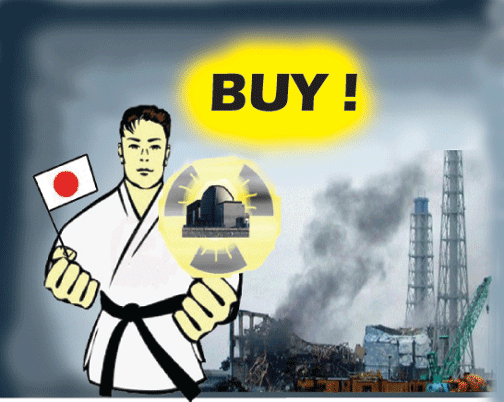
Post-Fukushima cost overruns may kill a giant power project in Turkey, and there are few other deals to replace it

By TODD CROWELL DECEMBER 16, 2018    Japan’s nuclear export industry could be dealt a fatal blow if Mitsubishi Heavy Industries pulls out of a massive project to build four large power plants on Turkey’s Black Sea coast, as reports have suggested.

The Sinop plant project in Turkey was seen as Japan’s best chance for an industry – battered and bruised after the 2011 tsunami and triple meltdown at Fukushima – to put together a workable export strategy that did not break the bank of potential international customers.

Aside from Sinop, the Japanese industry has only one viable export project still upcoming: Hitachi’s bid to build two reactors on the island of Anglesey in Britain. And even that deal is looking shaky.

Mitsubishi Heavy Industries (MHI) has not pulled the plug yet on its stake in the four-reactor project on Turkey’s Black Sea coast, but a slew of domestic media reports and talk in Tokyo, suggests that, in the face of seemingly ever-rising construction costs to meet new safety standards that have been put in place since the 2011 Fukushima disaster, the company will bail.

Fukushima legacy

When the deal was signed with Ankara in 2013, the ownership profile was: 65% awarded to a consortium made up of MHI, Itochu, France’s Areva, and GDF Suez. The other 35% was covered by Turkey’s electric power utility, Elektrik Uretim.

However, in April, Itochu pulled out of the consortium, citing cost overruns. That left the consortium with 51%, and the remaining 49% owned by the Turkish utility.

Without Mitsubishi the viability of the project is in question, sources say, unless Turkey can find a new partner or is willing to take on the project without its largest foreign partner. The Russians, who are building a nuclear complex on Turkey’s southern Mediterranean coast, might be interested.

According to Kyodo, a thorough cost evaluation was to be completed by the end of this year. Itochu waited for the report to be released before bailing out of the deal. MHI is apparently waiting for the study to be completed before deciding its next move.

When the deal with Mitsubishi was signed in 2013, the estimated cost was $18 billion for four 1,100-megawatt nuclear power plants. But overall costs have soared, passing $42 billion in April – when Itochu withdrew, and is now put at about $44 billion.

Cost increases are nothing new in the nuclear power industry, but have been exacerbated in recent years by expensive adjustments phased in to meet more stringent safety concerns following the earthquake and tsunami that destroyed four units of the Fukushima Daiichi plant. The Sinop cost rises, however, also encompass other problems encountered in construction.

Fukushima, one of the most serious nuclear accidents in history, turned most of Japan against nuclear power. Before March 11, 2011, Japan had 54 nuclear plants. All were shut down after the accident and some are slowly returning to service having passed scrutiny by the regulator. Five are expected to restart within the next five years, and eight will likely be decommissioned. But prospects for the remaining plants are unclear.

Aware that no new nuclear plant may ever be built at home amid the anti-atomic public mood, Japan’s nuclear vendors have turned to overseas exports as the Fukushima accident does not appear to have destroyed the Japanese industry brand in other countries.

Endgame for nuclear exports?

If Mitsubishi does pull out of the huge project in Turkey it will be a blow to Prime Minister Shinzo Abe, who sees international exports of nuclear technology as an important way to boost the economy. On his many trips abroad, he often acts as a salesman for nuclear exports. For example, it was a topic of discussion with Turkish President Recep Erdogan on the sidelines of the G-20 meeting in Argentina.

Details of the conversation were not revealed, but it would be a good bet that they discussed the Sinop project with the threat of Mitsubishi hanging over them, and that Abe sought ways to keep the project viable.

Meanwhile, it is not just MHI that may have doubts about the sector. Japan’s nuclear export industry has suffered plenty of setbacks in the seven years since Fukushima. Questions about the future of the sector hang over all three main players in the sector.

Toshiba, one of Japan’s big-three nuclear constructors, recently pulled out of the nuclear power business overseas after incurring huge losses in the United States.

Toshiba has also suffered something of an administrative meltdown in its quest to win construction contracts in the US. In February it finally unloaded it money-losing American subsidiary, Westinghouse, for $1 billion less than it paid to acquire the company 10 years ago.

If the export program is to remain viable, it may be in Wales, where the British government is seeking to build a two-reactor nuclear power plant on the island of Anglesey. Among those bidding for the project is Japan’s third nuclear constructor, Hitachi, through a subsidiary called Horizon Nuclear.

In the nuclear world, there are constructors – like MHI, Toshiba and Hitachi – and operators, who run the plant after it is completed, and they are not always the same. Japan learned from Korea’s successful bid to build six nuclear plants in the United Arab Emirates that offering to build and also run them – a one-stop service – is key to making sales.

Hitachi is teaming up with the Japan Atomic Power Company, which operates two plants in Japan (although both are currently shut down pending the review by regulators). The plan is to present the British with a package deal.

Now, there are worries that Hitachi might pull out of the British project. Chairman Hiroaka Nakanishi was quoted in the Times of London saying his company was “facing an extreme situation,” and that a final decision on whether to stay with the project or leave it will be made next year.

If Mitsubishi does, as is widely expected, pull out of the huge project in Turkey, the only egg left in Japan’s overseas nuclear export basket will be Wales.

December 18, 2018 Posted by Christina Macpherson | business and costs, Japan, politics | Leave a comment

Hitachi having trouble financing new nuclear reactors in Wales – may pull the plug on Wylfa project

Hitachi may freeze British nuclear project due to swelling costs, https://www.japantimes.co.jp/news/2018/12/16/business/corporate-business/hitachi-may-freeze-british-nuclear-project-due-swelling-costs/#.XBawLdIzbGg

KYODO 17 Dec 18, Hitachi Ltd. is considering freezing its plan to build nuclear reactors in Wales after facing difficulties in finding investors to finance the project’s ballooning costs, sources close to the matter said Sunday.

If the Japanese conglomerate freezes the ¥3 trillion Wylfa Newydd plant construction, all of the overseas nuclear projects promoted by the government of Prime Minister Shinzo Abe as part of his growth strategy would have faltered.

Mitsubishi Heavy Industries Ltd. is mulling withdrawing from a nuclear project in Turkey amid swelling safety-related costs following the 2011 Fukushima nuclear accident, while Toshiba Corp. has decided to exit from the nuclear plant business outside Japan after incurring huge losses in the United States.

Hitachi has said it wants to lower its stake in Horizon Nuclear Power Ltd., a wholly owned unit it acquired in 2012 from two German electric utilities to take over the nuclear project, to below 50 percent to limit the impact on the Hitachi group of the construction of two advanced boiling water reactors on the Isle of Anglesey in Wales.

Hitachi is likely to have told the British and Japanese governments of its plan to freeze the project, the sources said. The issue will likely be discussed at the planned meeting between Abe and British Prime Minister Theresa May in January, they said.

The company has been contacting prospective investors in the project, including Japanese utilities, but little progress has been made amid concerns that costs will further swell, they said.

Hitachi also remains at odds with the British government over the purchase price of electricity to be generated by the plant, a key factor in determining the project’s profitability for the company and potential investors.

Given the current turmoil in British politics over May’s proposed deal with the European Union on the United Kingdom’s departure from the bloc, price-setting talks are at a “deadlock,” a senior Hitachi official said.

December 18, 2018 Posted by Christina Macpherson | business and costs, Japan, UK | 1 Comment

Comprehensive and Progressive Agreement for Trans-Pacific Partnership (CFTPP) held over Taiwan , because of its referendum rejecting food from Fukushima

FOOD IMPORTS FROM FUKUSHIMA-AFFECTED AREAS BECOME WEDGE ISSUE WITH JAPAN https://newbloommag.net/2018/12/17/fukushima-food-cftpp/18DECEMBER 2018  by Brian Hioe

I T IS UNSURPRISING that Taiwan will not be admitted to the Comprehensive and Progressive Agreement for Trans-Pacific Partnership (CFTPP) because of the referendum vote against food imports from Fukushima-affected areas held in late November concurrent with nine-in-one elections. Namely, the issue of food imports is one upon which Taiwan has long been pushed around by larger, more powerful countries, who dangle the threat of being denied admittance to international free trade agreements if Taiwan does not allow food imports.

The Abe administration has in the past made allowing food imports from Fukushima-affected areas a condition for stronger diplomatic relations with Japan. This would be part of a more general effort by the Abe administration to promote the prefecture of Fukushima as safe, with concerns that lingering radiation may still cause harmful effects in the region after the 2011 Fukushima disaster. The Abe administration has thus attempted to promote food exports from the area, as well as to encourage tourism to the area.

Concerns over whether food from Fukushima is safe are valid, seeing as this is an issue of contention in Japan itself. Abe’s Liberal Democratic Party (LDP) is deeply wedded to the Japanese nuclear industry, with an unusual willingness to push for nuclear energy in spite of outbreaks of large-scale public protest. Concerns have also been longstanding that the LDP has been unwilling to provide accurate nuclear assessments for the Fukushima area, or sought to mislead through official statistics.

After the results of the referendum in late November, in which 7,791,856 voted against allowing food imports from Fukushima, the Japanese government initially expressed understanding regarding the results of the referendum, suggesting that not allowing food imports from Fukushima would not be an obstacle for Japan-Taiwan relations going forward. However, this appears to have not entirely been the truth.

Indeed, as the KMT was a powerful force behind the push for the referendum, it is likely that the KMT sought to use the issue of food imports from Fukushima-affected areas as a means to not only to attack the DPP with the accusation that it was endangering public safety but also sabotage closer relations between Japan and Taiwan. Apart from that the KMT’s Chinese nationalism has a strong anti-Japanese element, the KMT is pro-unification and so opposes closer ties between Japan and Taiwan, seeing as Japan could be a powerful regional ally that interceded on behalf of Taiwan against Chinese incursion.

The CFTPP is a regional free trade agreement that is the form that the Trans-Pacific Partnership (TPP) took on after America withdrew from the trade agreement under Donald Trump. Despite the fact that the TPP was orchestrated under American auspices as a means to counter growing Chinese influence in the Asia-Pacific region, the Trump administration favored protectionism instead of free trade, seeing free trade as overextending American resources rather than expanding its economic reach.

Japan subsequently became the dominant power among former TPP signatories, continuing to push for the agreement because it was still beneficial to Asia-Pacific nations to economically integrate as a regional bloc against the threat of China.

This would not be the first time that food imports have been used as a condition of Taiwan’s admittance to or denial from the TPP framework. America previously made allowing American beef imports into Taiwan to be a condition of Taiwan’s possibly entering into the TPP, seeing as there were in concerns in Taiwan that the use of the hormone ractopamine—banned in most of the world’s countries but not in America—was unsafe. This, too, was a valid concern regarding food safety, but the KMT was interested in the issue because it hoped to use this as a wedge issue to sabotage relations between Taiwan and the US.

Now that Japan is the primary driving force behind the CFTPP, as the renewed version of the TPP, food imports from Fukushima-affected areas have taken priority as the issue which would determine Taiwan’s admittance or non-admittance to the CFTPP. As free trade agreements are more generally a way for large, powerful countries to coerce smaller, weaker countries into relations of economic subordination, this would be nothing surprising.

More generally, free trade agreements have also long been held over the heads of Taiwanese voters in order to influence how they vote, as observed in the examples of the Economic Cooperation Framework Agreement or the Cross-Strait Services Trade Agreement under the Ma administration. But in light of the issue of food imports from Fukushima-affected areas being a contested issue in Taiwan, it remains to be seen whether the CFTPP will become a significant wedge issue in Taiwanese politics going forward.

December 18, 2018 Posted by Christina Macpherson | Japan, politics international, Taiwan | Leave a comment

High Iodine distribution, low intake among children after Fukushima nuclear accident

 https://www.healio.com/endocrinology/thyroid/news/in-the-journals/%7B33ecf315-c68e-474b-aeda-81c5271d2371%7D/high-iodine-distribution-low-intake-among-children-after-fukushima-nuclear-accident    Despite a high distribution rate of stable iodine after the 2011 Fukushima nuclear accident in Japan, only 63.5% of parents reported children took the tablets, with many citing safety concerns in questionnaires, according to findings published in The Journal of Clinical Endocrinology & Metabolism.

The intake of stable iodine after a nuclear emergency is a key strategy for preventing childhood thyroid cancer, along with evacuation and other measures, Yoshitaka Nishikawa, MD, a physician and medical researcher in the department of internal medicine at Hirata Central Hospital in Fukushima, Japan, and colleagues wrote in the study background. The timing of iodine administration is optimally between 24 hours before and up to 2 hours after the expected onset of exposure, they noted; however, iodine is still reasonably effective when taken up to 8 hours later. To date, there is limited information about the acceptability and feasibility of implementation of iodine distribution in actual cases, they wrote.

“To prepare for future nuclear emergencies, investigations of the operational issues in an actual case are needed,” the researchers wrote.

In a retrospective, observational study, Nishikawa and colleagues analyzed data from 961 children from Miharu, a town in Fukushima prefecture, who underwent biennial thyroid screenings at Hirata Central Hospital between August and November 2017 (median age at time of accident, 5 years). In addition to the Fukushima Health Management Survey, Miharu has continued thyroid screenings for all primary and secondary school students.

In Miharu, health care professionals distributed stable iodine to 3,134 households (94.9% distribution rate) after explosions at the Fukushima nuclear plant caused by the 2011 earthquake in eastern Japan, along with instructions provided by the local government. Screening and questionnaire records included age of participants at the time of the nuclear accident, sex, region of residence before the accident, whether the participant was evacuated, whether the child and parents took stable iodine orally after the accident and dietary habits, including iodine intake. Researchers used logistic regression models to identify factors associated with stable iodine intake.

Within the cohort, 610 children (63.5%) had taken stable iodine, according to questionnaire data.

Researchers found that children were more likely to take stable iodine provided after the accident if their parents took stable iodine (OR = 61; 95% CI, 37.9-102.9). Compared with preschool and school-aged children, infants (aged 2 years or younger) were less likely to take stable iodine (OR = 0.21; 95% CI, 0.11-0.36).

In assessing questionnaire data from parents who reported children did not take stable iodine (n = 351), concern about safety was the most frequent reason provided (n = 164; 46.2%), followed by evacuation to other areas, no national or prefectural instruction and iodine not being delivered.

“Qualitative analysis revealed that concern about safety was the major reason for avoiding intake,” the researchers wrote. “Other issues related to distribution methods, information about the effects and adverse events and instruction about intake. In future nuclear disasters, it would be important to explain to both children and parents the effects and adverse effects of iodine intake and to provide detailed instructions about the intake of iodine by infants.” – by Regina Schaffer

Disclosures: The authors report no relevant financial disclosures.

December 18, 2018 Posted by Christina Macpherson | children, Japan, Reference | Leave a comment

UK’s “nuclear revival”?Japanese company Hitachi may walk away from Wylfa project
Times 11th Dec 2018 , Doubts over Britain’s planned nuclear revival increased yesterday amid
fears that the Japanese company developing a new plant on Anglesey may be
preparing to scrap the project. Shares in Hitachi rose by as much as 2.9
per cent at one point after Japanese media reported that it was considering
abandoning work on the proposed Wylfa plant because of rising costs.
Hitachi’s board is understood to be holding a quarterly board meeting today
at which the fate of Horizon, the subsidiary developing the £15
billion-plus project, will be discussed.
The company has been in talks with
the British government over financial support for Wylfa and is understood
to want a deal by the middle of next year or else could walk away. TV
Asahi, the Japanese broadcaster, reported that a decision was likely to be
taken by the end of the business year in March.
https://www.thetimes.co.uk/article/b6c04dec-fcbc-11e8-9a88-fa81ced0c139

December 13, 2018 Posted by Christina Macpherson | Japan, politics, UK | Leave a comment

50% in nuclear industry: Energy plan for 2030 is ‘unrealistic’

gjkll.jpg
Tohoku Electric Power Co. has decided to decommission the No. 1 reactor at the Onagawa nuclear power plant in Miyagi Prefecture. 
December 5, 2018
Half of companies in the nuclear industry doubt the government’s goal of having nuclear power account for 20 to 22 percent of Japan’s energy supply by fiscal 2030, according to a survey.
The reasons for their skepticism relate mainly to difficulties restarting or building reactors under stricter safety measures taken after the Fukushima nuclear disaster in 2011.
The survey was conducted in June and July by the Japan Atomic Industrial Forum, whose members include electric power companies that operate nuclear plants.
The forum contacted 365 companies in the nuclear industry, such as equipment manufacturers, and received responses from 254, or 70 percent.
According to the results, 50 percent of the companies said the government’s nuclear energy goal for fiscal 2030 is “unachievable,” compared with only 10 percent that said it is “achievable.” Forty percent said the attainability is “unknown.”
An estimated 30 reactors must be operating to reach the target, but the resumption of reactor operations has been slow since all of them were shut down after the triple meltdown at the Fukushima No. 1 nuclear power plant.
“Only nine reactors were restarted in the more than seven years after the accident in Fukushima,” Akio Takahashi, president of the forum and former senior official at Tokyo Electric Power Co., said at a news conference. “I guess respondents think it’s difficult (to achieve the goal) given the current pace (of the restarts).”
Tougher nuclear safety standards were set after the Fukushima disaster, forcing utilities to spend more on upgrading their reactors or keeping aging units operational.
Asked why they thought the government’s nuclear goal was unrealistic, 48 percent of the companies said, “There are no plans in sight to build or replace nuclear reactors.”
Thirty-three percent cited the delays in restarting idle reactors, while 16 percent said, “No progress can be seen in regaining trust from the public.”
http://www.asahi.com/ajw/articles/AJ201812050032.html?fbclid=IwAR0QEU_LXlh3lxKAq1p81-2txXz5T-QMeYxu-bubPwr4pg_g38ZzRNbTXos

December 7, 2018 Posted by dunrenard | Japan | decommissioning, nuclear plants | Leave a comment

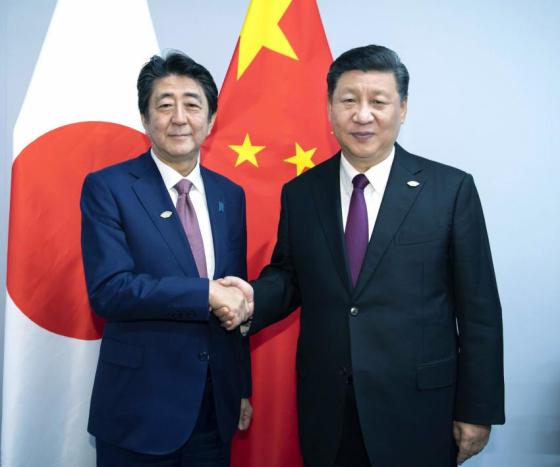
Abe asks Xi to lift Japan food import ban following nuclear disaster
_w850
Chinese President Xi Jinping, right, poses with Japanese Prime Minister Shinzo Abe during a meeting on the sidelines of the G20 summit in Buenos Aires, Argentina, on Friday.
December 2, 2018
BUENOS AIRES – Prime Minister Shinzo Abe has asked Chinese President Xi Jinping to lift his country’s ban on Japanese food imports introduced following the 2011 Fukushima nuclear accident, a senior government official said Saturday.
Abe’s request came after Japan’s farm ministry said Thursday that Beijing has allowed rice produced in Niigata Prefecture, more than 200 kilometers away from the crippled Fukushima Daiichi nuclear power plant, to be shipped to China.
During their meeting Friday on the sidelines of the Group of 20 summit in Buenos Aires, Abe, welcoming Beijing’s latest decision, urged Xi to abolish the rest of the import restrictions based on scientific grounds as soon as possible, according to the Japanese official.
Xi responded to Abe by saying that China will take appropriate action in keeping with scientific assessments, the official added.
Aside from Niigata rice, China maintains its ban on all other Japanese foods and feedstuff initially subject to the import restrictions, which include products from 10 of the country’s 47 prefectures, the Japanese Ministry of Agriculture, Forestry and Fisheries said.
Other countries, including South Korea and Singapore, restrict food imports against a backdrop of radiation concerns, while Taiwan has decided to keep its ban on food imports from five Japanese prefectures intact as a result of a referendum on Saturday.
The accident at the Fukushima Daiichi nuclear power complex was triggered by the devastating March 2011 earthquake-tsunami disaster that hit northeastern Japan.
As for the situation in the East China Sea, Abe called on Xi to improve the unstable situation in the contested waters, emphasizing the importance of restarting talks about a 2008 bilateral accord on joint gas development there.
The Japanese and Chinese leaders also reaffirmed that U.N. sanctions — aimed at preventing North Korea from developing nuclear weapons and ballistic missiles — should be fully implemented until Pyongyang achieves denuclearization as promised.
With trade tensions between the United States and China intensifying, Abe told Xi that China should take concrete measures to stem its alleged unfair business practices such as stealing intellectual property and technology from other nations.
The Japanese prime minister expressed hope that Xi will have a “valuable discussion” with U.S. President Donald Trump at their planned meeting on the fringes of the G-20 summit.
In October, Abe arrived in Beijing for the first official visit to China by a Japanese political leader in nearly seven years. Until late last year, Sino-Japanese relations had been at their worst level in decades over a territorial row in the East China Sea.
During his stay in Beijing, Abe held talks with Xi and Chinese Premier Li Keqiang, in which they agreed to accelerate new economic cooperation between Japan and China by changing the dynamics of bilateral relations “from competition to collaboration.”
https://japantoday.com/category/politics/abe-asks-xi-to-lift-japan-food-import-ban-following-nuclear-disaster?

December 7, 2018 Posted by dunrenard | Japan | China, Japan Food Import Ban | Leave a comment

In rural towns like Shikoku’s Ikata, the Japanese nuclear industry is making a quiet comeback

n-nuclear-a-20181201-870x580
A port with orange farms dotting the mountains in the background in Ikata, Ehime Prefecture, which relies on the nuclear power industry for revenue
November 30, 2018
IKATA, EHIME PREF. – On a side street near a darkened Ikata shopping arcade full of abandoned storefronts, the Sushi Ko restaurant is unusually busy on a weekday.
Balancing a tray full of drinks, Sachiyo Ozaki said most of her restaurant’s customers were there because of an industry shunned elsewhere: nuclear power.
 
“He drives a minivan to take workers to the plant,” she said, gesturing toward a man sitting at the counter. Pointing to another man sipping a beer, she added, “And he works in construction, so they’ve been busy too.”
“We’re all for nuclear power, and you can print that,” Ozaki said.
In the mostly residential neighborhood around her restaurant, hotel rooms and local inns were also packed with workers preparing to reopen Shikoku Electric Power’s Ikata nuclear plant, nestled on the Shikoku coast at the base of the verdant Sadamisaki Peninsula.
Nearly eight years after an earthquake and tsunami triggered nuclear meltdowns at Tokyo Electric Power Company Holdings Inc.’s Fukushima No. 1 plant, the battered industry is making a quiet and somewhat unexpected return.
Ikata is a poster child for that recovery. In September, a court reversed a decision that had idled Shikoku Electric’s sole nuclear reactor for about a year, paving the way for the operator to reopen the facility in late October.
Regional utilities like Shikoku Electric have aggressively fought a string of lawsuits since 2011, hiring veteran lawyers to beef up their legal teams. At the same time, they wooed towns where nuclear plants are based, visiting with residents door to door while the government kept up a stream of generous subsidies for local projects.
Thanks in large part to this strategy, Japan is on track to have nine reactors running in the near future.
That is a far cry from the 54 running before 2011 — all of which were idled after the Fukushima disaster — but more than analysts and experts expected, considering it seemed at the time like the end of the road for the country’s nuclear industry.
A Reuters analysis calculates that as few as six more reactors are likely to restart within the next five years, eight will mostly likely be mothballed and that the prospects for two dozen others is uncertain.
Despite that cloudy outlook, nuclear power recently overtook renewables like wind and solar in the country’s energy mix for the first time since Fukushima.
Japan embraced nuclear power after World War II, spurred by the promise of clean energy and independence from foreign suppliers.
But the botched Fukushima disaster response sowed public distrust in the industry and the government.
Given that skepticism, some see a recent run of court victories by utilities as the resurgence of an alliance of industry, government and host communities that for decades promoted the construction of nuclear facilities.
“If our losing streak continues, we could see 20 to 25 reactors come back online,” says Hiroyuki Kawai, a prominent anti-nuclear lawyer who represented citizens in a suit against Shikoku Electric.
Since 2011, hundreds of citizens represented by volunteer lawyers like Kawai have filed nearly 50 lawsuits against the central government and utilities in 25 district and appellate courts.
In Ikata, Shikoku Electric spent months gaining approval for a restart from the tougher post-Fukushima regulator, rebooting one of its plant’s three reactors in 2016. But in December 2017, an appellate court issued a temporary injunction keeping the reactor, already idled for routine maintenance, shut down for nine more months.
In response, the company pulled more staff into its legal department and drafted its head of nuclear power to supervise the team. The utility also recruited outside lawyers who had handled cases for other operators.
“There are only a handful of lawyers knowledgeable about nuclear litigation, so they’re popular and sought after,” said Kenji Sagawa, the deputy general manager of the company’s Tokyo office.
Yoshiaki Yamanouchi, 76, began his career in nuclear litigation in 1973 when he represented Shikoku Electric in a landmark suit brought by Ikata residents seeking to stop the plant from opening.
He still represents the utility and works with other companies, advising younger lawyers fighting similar cases, which he calls “superficial,” in far-flung district courts.
“Utilities, in particular Shikoku, have gotten much smarter about fighting for the plants they know they can reopen and mothballing others that would cost too much time and money,” Yamanouchi said. The utility is decommissioning two of the three reactors at Ikata.
Shikoku Electric would not disclose how much it has spent fighting legal challenges, but said it was a fraction of the cost of idling a plant.
Every month a nuclear reactor sits inoperative, the utility spends ¥3.5 billion for additional fuel at its conventional power plants. Shikoku has also spent ¥190 billion on safety upgrades to meet stricter rules set by the Nuclear Regulation Authority.
Activists have seen some victories. Kansai Electric Power Co. has had its reactors slapped with temporary injunction orders multiple times over the years. All of these decisions were later overturned by higher courts.
“Before Fukushima, these utilities won by default — now, they have to work harder,” said Yuichi Kaido, a lawyer who has spent three decades dueling Yamanouchi in court.
Shikoku Electric still faces several lawsuits and injunction requests. A Hiroshima court rejected a request from residents to extend the suspension of the Ikata reactor on Oct. 26, a day before the operator restarted it.
The quiet revival of the industry is most tangible in rural areas like Ikata. Rural regions are home to the bulk of the country’s nuclear plants.
Ikata is best known for its mikan mandarin oranges harvested on terrace farms on the sides of steep hills overlooking the Seto Inland Sea and Uwa Sea.
The town, with 9,500 residents, relies on nuclear power for a third of its annual revenue. Since 1974, Ikata has received more than ¥101.7 billion in such payments.
These funds literally built the town; Ikata’s roads, schools, hospitals, fire stations and even five traditional taiko drums for festivals were all paid for with subsidies.
“My biggest struggle now is finding one or two more pillars for this town other than nuclear power,” said Ikata Mayor Kiyohiko Takakado.
The town and utility’s mutual dependence stretch back decades.
Former Mayor Kiyokichi Nakamoto was a city councilman in Ikata when he successfully wooed the utility to his hometown. On the walls of the dim parlour of his home are framed commendations from two prime ministers, thanking him for his contributions to the national energy policy.
“We were a poor village with only farming and fishing,” the 90-year-old said. Had the town failed to attract the plant, Ikata would have gone broke, he said.
In the wake of the Fukushima disaster, Shikoku Electric campaigned to reassure residents of their plant’s safety. Employees wearing the company’s blue uniforms went from house to house to explain how their plant was different from Fukushima No. 1 — and therefore safe.
“If something like Fukushima happened here, our reputation would be destroyed in an instant,” said orange farmer Shigeto Suka, 54, as he checked still-green mikan on tree branches.
He and other farmers in Yawatahama, a neighboring town 15 km from the plant, worry that even a hint of contamination would devastate their brand.
After the 2011 disaster, Fukushima’s farmers and fishermen were unable to sell their produce because of fears over contaminated food. Dozens of countries still have restrictions on Fukushima produce.
For others in the area, the Ikata plant feels like an inextricable part of life.
Hiroshi Omori, 43, spent most days over the summer at Shikoku Electric’s visitors’ house overlooking the Ikata plant. His three young children take free art classes there while Omori and other parents wait in air-conditioned rooms sipping water and tea.
But Ikata is projected to shrink to 5,000 residents over the next 20 years, and Takakado recently said he found it hard to imagine an industry that could replace nuclear power.
This year he joined dozens of other mayors nationwide to voice their support for the industry and ask the government to clarify its position on building new plants or replacing old ones.
“I’m just trying to prevent the town from losing even more people,” he said.
 
https://www.japantimes.co.jp/news/2018/11/30/national/rural-towns-like-shikokus-ikata-japanese-nuclear-industry-making-quiet-comeback/?fbclid=IwAR31ElZ5l8nJQmw7-evwoYuS-qitN_RG7sziQkmyoYZYJe3BckbwqGB5Zww#.XAE3R_ZFzIU

December 7, 2018 Posted by dunrenard | Japan | Ehime Pref., Ikata NPP | Leave a comment

China lifts ban on Niigata rice in place since nuclear disaster

vgjkl.jpg
November 29, 2018
China on Nov. 28 lifted its import ban on rice produced in Niigata Prefecture but maintained restrictions imposed since the 2011 Fukushima nuclear disaster on other food from 10 prefectures.
During their summit in October, Japanese Prime Minister Shinzo Abe urged Chinese President Xi Jinping to lift the import restrictions on Japanese agricultural and other products.
China apparently examined the distances and wind directions from the crippled Fukushima No. 1 nuclear plant and decided to remove the ban on Niigata rice.
Japanese private companies have long hoped to resume rice exports to China, which accounts for about 30 percent of the world market for the staple food.
The Japanese government plans to ask the Chinese government to further ease restrictions on other food products.
The Abe administration has been promoting overseas sales of Japanese food products. It has set a goal of 1 trillion yen ($8.8 billion) as the annual export amount of agricultural, forestry and fishery products, as well as processed food.
But after the triple meltdown at the Fukushima No. 1 nuclear plant, 54 countries and regions imposed restrictions on food imports from Japan.
Although the restrictions have been gradually eased, eight countries and regions–China, the United States, South Korea, Singapore, the Philippines, Taiwan, Hong Kong and Macau–still ban imports of certain products from certain areas of Japan, according to the agricultural ministry.
http://www.asahi.com/ajw/articles/AJ201811290055.html

December 7, 2018 Posted by dunrenard | Japan | China, Import ban lifting, Niigata Prefecture, Rice | Leave a comment

Nuclear plants must take threat of volcanic ash more seriously

fdgfhjhkjl.jpg
The Takahama nuclear power plant in Takahama, Fukui Prefecture 
 
November 27, 2018
The Nuclear Regulation Authority will reassess the safety risks posed by possible natural disasters to certain nuclear power plants that have been declared to be fit for operation under the new safety standards.
The nuclear watchdog’s unusual decision has been prompted by recent discoveries of new facts concerning possible effects of volcanic eruptions on the Mihama, Oi and Takahama nuclear power plants operated in Fukui Prefecture by Kansai Electric Power Co.
It is a totally reasonable decision based on the principle of putting the top priority on safety in regulating nuclear plants.
Initially, Kansai Electric asserted that volcanic ash posed no threat to the safety of the three nuclear plants. Its claim was based on its own estimate of the amount of volcanic ash that would fall on the plants.
Using research findings and geological surveys as well as simulations of eruptions of Mount Daisen, a volcanic mountain in Tottori Prefecture located about 200 kilometers from the plants, the Osaka-based utility estimated that the nuclear compounds could be coated with up to 10 centimeters of ash from a major volcanic eruption.
The NRA accepted the company’s assessments of volcanic hazards for these plants and allowed the No. 3 and No. 4 reactors at both the Oi and Takahama plants to come back online.
After the NRA’s safety screenings, however, a 30-cm ash layer from an eruption of Mount Daisen that occurred 80,000 years ago was discovered in Kyoto, 190 km from the mountain.
Kansai Electric argued that the thickness of ash from the mountain cannot be estimated accurately because ash from other sources was mixed in.
But the NRA confirmed that the layer of volcanic ash from the mountain is 25 cm thick through its own on-site inspection and other research, concluding that the eruption was greater in scale than the utility’s estimate of a maximum possible incident.
These developments have led to the regulator’s unusual decision to reassess the risks posed by volcanic ash fall to the safety of the plants.
A massive fall of volcanic ash could cause a malfunction of the emergency power generation system at a nuclear power plant and cut off the power supply, which is crucial for preventing a severe nuclear accident during a natural disaster.
The new findings have made it inevitable to re-evaluate the estimate of maximum possible volcanic ash fall for each nuclear plant and consider the necessity of additional safety measures.
One important component of the new tighter nuclear safety standards introduced after the 2011 Fukushima nuclear disaster is the so-called “back-fit” system, which applies the latest safety requirements to existing reactors.
The NRA acted on this new rule when it decided to reassess the threats posed by volcanic eruptions to the safety of the nuclear plants by incorporating the implications of the newly discovered facts.
The body should adopt the same stance toward safety risks posed by other natural disasters such as earthquakes and tsunami.
But the NRA has also decided not to order the utility to suspend the operations of the four reactors, at least for now, because there is a certain safety margin in the measures to deal with volcanic ash fall taken at the three nuclear plants in Fukui Prefecture.
But it should not hesitate to order the shutdowns of these reactors if more new facts are discovered with risk implications for them.
Bodies of scientific knowledge concerning earthquakes, tsunami and volcanic eruptions change constantly due to new findings from research and surveys.
Kansai Electric Power’s response to the new discovery deserves to be criticized as an attempt to escape from an inconvenient new fact.
Electric utilities operating nuclear plants need to make constant efforts to gather the latest information and face new facts concerning the safety of their nuclear plants in a humble and honest manner.
The back-fit system was introduced to ensure the safety of nuclear plants in this nation as a policy response to the lessons learned from the catastrophic accident at the Fukushima No. 1 nuclear power plant. This should never be forgotten.
http://www.asahi.com/ajw/articles/AJ201811270019.html?fbclid=IwAR3fdzLLFvsLu2RHSZk3IUgeGXV2WmieeIX1tj0k3854X6R_xo7e_hPvn4U

December 6, 2018 Posted by dunrenard | Japan | nuclear plants, Volcanic ash | Leave a comment

Nuclear companies think that Japan’s nuclear power plans are unrealistic

50% in nuclear industry: Energy plan for 2030 is ‘unrealistic’ http://www.asahi.com/ajw/articles/AJ201812050032.html, By NORIYOSHI OHTSUKI/ Senior Staff Writer, December 5, 2018 Half of companies in the nuclear industry doubt the government’s goal of having nuclear power account for 20 to 22 percent of Japan’s energy supply by fiscal 2030, according to a survey.The reasons for their skepticism relate mainly to difficulties restarting or building reactors under stricter safety measures taken after the Fukushima nuclear disaster in 2011.

The survey was conducted in June and July by the Japan Atomic Industrial Forum, whose members include electric power companies that operate nuclear plants.

The forum contacted 365 companies in the nuclear industry, such as equipment manufacturers, and received responses from 254, or 70 percent.

According to the results, 50 percent of the companies said the government’s nuclear energy goal for fiscal 2030 is “unachievable,” compared with only 10 percent that said it is “achievable.” Forty percent said the attainability is “unknown.”

An estimated 30 reactors must be operating to reach the target, but the resumption of reactor operations has been slow since all of them were shut down after the triple meltdown at the Fukushima No. 1 nuclear power plant.

“Only nine reactors were restarted in the more than seven years after the accident in Fukushima,” Akio Takahashi, president of the forum and former senior official at Tokyo Electric Power Co., said at a news conference. “I guess respondents think it’s difficult (to achieve the goal) given the current pace (of the restarts).”

Tougher nuclear safety standards were set after the Fukushima disaster, forcing utilities to spend more on upgrading their reactors or keeping aging units operational.

Asked why they thought the government’s nuclear goal was unrealistic, 48 percent of the companies said, “There are no plans in sight to build or replace nuclear reactors.”

Thirty-three percent cited the delays in restarting idle reactors, while 16 percent said, “No progress can be seen in regaining trust from the public.”

December 6, 2018 Posted by Christina Macpherson | business and costs, Japan, politics | Leave a comment

« Previous Entries     Next Entries »

1 This Month

Chernobyl: The Lost Tapes – A good documentary on Chernobyl on SBS available On Demand for the next 3 weeks– https://www.sbs.com.au/ondemand/tv-program/chernobyl-the-lost-tapes/2352741955560

of the week–London Campaign for Nuclear Disarmament

Tell the Ukrainian Government to Drop Prosecution of Peace Activist Yurii Sheliazhenko

​https://actionnetwork.org/petitions/tell-the-ukrainian-government-to-drop-prosecution-of-peace-activist-yurii-sheliazhenko/?clear_id=true&link_id=4&can_id=f0940af377595273328101dea28c2309&source=email-yurii-has-been-abducted&email_referrer=email_3153752&email_subject=yurii-has-been-abducted&&

​To see nuclear-related stories in greater depth and intensity – go to https://nuclearinformation.wordpress.com

  • Categories

    • 1
      • Arclight's Vision
    • 1 NUCLEAR ISSUES
      • business and costs
        • employment
        • marketing
      • climate change
      • culture and arts
      • ENERGY
        • renewable
          • decentralised
          • energy storage
      • environment
        • oceans
        • water
      • health
        • children
        • psychology – mental health
        • radiation
        • social effects
        • women
      • history
      • indigenous issues
      • Legal
        • deaths by radiation
        • legal
      • marketing of nuclear
      • media
        • investigative journalism
        • Wikileaks
      • opposition to nuclear
      • PERSONAL STORIES
      • politics
        • psychology and culture
          • Trump – personality
        • public opinion
        • USA election 2024
        • USA elections 2016
      • politics international
      • Religion and ethics
      • safety
        • incidents
      • secrets,lies and civil liberties
        • civil liberties
      • spinbuster
        • Education
      • technology
        • reprocessing
        • Small Modular Nuclear Reactors
        • space travel
      • Uranium
      • wastes
        • – plutonium
        • decommission reactor
      • weapons and war
        • Atrocities
        • depleted uranium
      • Women
    • 2 WORLD
      • ANTARCTICA
      • ARCTIC
      • ASIA
        • Burma
        • China
        • India
        • Indonesia
        • Japan
          • – Fukushima 2011
          • Fukushima 2012
          • Fukushima 2013
          • Fukushima 2014
          • Fukushima 2015
          • Fukushima 2016
          • Fukushima continuing
        • Malaysia
        • Mongolia
        • North Korea
        • Pakistan
        • South Korea
        • Taiwan
        • Turkey
        • Vietnam
      • EUROPE
        • Belarus
        • Bulgaria
        • Denmark
        • Finland
        • France
        • Germany
        • Greece
        • Ireland
        • Italy
        • Kazakhstan
        • Kyrgyzstan
        • Russia
        • Spain
        • Sweden
        • Switzerland
        • UK
        • Ukraine
      • MIDDLE EAST
        • Afghanistan
        • Egypt
        • Gaza
        • Iran
        • Iraq
        • Israel
        • Jordan
        • Libya
        • Saudi Arabia
        • Syria
        • Turkey
        • United Arab Emirates
      • NORTH AMERICA
        • Canada
        • USA
          • election USA 2020
      • OCEANIA
        • New Zealand
        • Philippines
      • SOUTH AMERICA
        • Brazil
    • ACTION
    • AFRICA
      • Kenya
      • Malawi
      • Mali
      • Namibia
      • Niger
      • Nigeria
      • Somalia
      • South Africa
    • Atrocities
    • AUSTRALIA
    • Christina's notes
    • Christina's themes
    • culture and arts
    • Events
    • Fuk 2022
    • Fuk 2023
    • Fukushima 2017
    • Fukushima 2018
    • fukushima 2019
    • Fukushima 2020
    • Fukushima 2021
    • general
    • global warming
    • Humour (God we need it)
    • Nuclear
    • RARE EARTHS
      • thorium
    • Reference
      • Reference archives
    • resources – print
    • Resources -audiovicual
    • Weekly Newsletter
    • World
    • World Nuclear
    • YouTube
  • Pages

    • 1 This Month
    • ACTION !
    • Disclaimer
    • Links
    • PAGES on NUCLEAR ISSUES
      • audio-visual news
      • Anti Nuclear, Clean Energy Movement
        • Anti Nuclear movement – a success story
          • – 2013 – the struggle for a nuclear-free, liveable world
          • – 2013: the battle to expose nuclear lies about ionising radiation
            • Speakers at Fukushima Symposium March 2013
            • Symposium 2013 Ian Fairlie
      • Civil Liberties
        • – Civil liberties – China and USA
      • Climate change
      • Climate Change
      • Economics
        • – Employment
        • – Marketing nuclear power
        • – Marketing Nuclear Power Internationally
        • nuclear ‘renaissance’?
        • Nuclear energy – the sick man of the corporate world
      • Energy
        • – Solar energy
      • Environment
        • – Nuclear Power and the Tragedy of the Commons
        • – Water
      • Health
        • Birth Defects in the Chernobyl Radiation Affected Region.
      • History
        • Nuclear History – the forgotten disasters
      • Indigenous issues
      • Ionising radiation
        • – Ionising radiation – medical
        • Fukushima FACT SHEET
      • Media
        • Nuclear Power and Media 2012
      • Nuclear Power and the Consumer Society – theme for December 2012
      • Peace and nuclear disarmament
        • Peace on a Nuclear Free Earth
      • Politics
        • – Politics USA
      • Public opinion
      • Religion and ethics
        • -Ethics of nuclear power
      • Resources – print
      • Safety
      • Secrets and lies
        • – NUCLEAR LIES – theme for January 2012
        • – Nuclear Secrets and Lies
      • Spinbuster
        • 2013 nuclear spin – all about FEAR -theme for June
        • Spinbuster 1
      • Technology
        • TECHNOLOGY Challenges
      • Wastes
        • NUCLEAR WASTES – theme for October 2012
        • – Plutonium
      • Weapons and war
      • Women
  • Archives

    • April 2026 (152)
    • March 2026 (251)
    • February 2026 (268)
    • January 2026 (308)
    • December 2025 (358)
    • November 2025 (359)
    • October 2025 (376)
    • September 2025 (257)
    • August 2025 (319)
    • July 2025 (230)
    • June 2025 (348)
    • May 2025 (261)
  • Categories

    • 1
      • Arclight's Vision
    • 1 NUCLEAR ISSUES
      • business and costs
        • employment
        • marketing
      • climate change
      • culture and arts
      • ENERGY
        • renewable
          • decentralised
          • energy storage
      • environment
        • oceans
        • water
      • health
        • children
        • psychology – mental health
        • radiation
        • social effects
        • women
      • history
      • indigenous issues
      • Legal
        • deaths by radiation
        • legal
      • marketing of nuclear
      • media
        • investigative journalism
        • Wikileaks
      • opposition to nuclear
      • PERSONAL STORIES
      • politics
        • psychology and culture
          • Trump – personality
        • public opinion
        • USA election 2024
        • USA elections 2016
      • politics international
      • Religion and ethics
      • safety
        • incidents
      • secrets,lies and civil liberties
        • civil liberties
      • spinbuster
        • Education
      • technology
        • reprocessing
        • Small Modular Nuclear Reactors
        • space travel
      • Uranium
      • wastes
        • – plutonium
        • decommission reactor
      • weapons and war
        • Atrocities
        • depleted uranium
      • Women
    • 2 WORLD
      • ANTARCTICA
      • ARCTIC
      • ASIA
        • Burma
        • China
        • India
        • Indonesia
        • Japan
          • – Fukushima 2011
          • Fukushima 2012
          • Fukushima 2013
          • Fukushima 2014
          • Fukushima 2015
          • Fukushima 2016
          • Fukushima continuing
        • Malaysia
        • Mongolia
        • North Korea
        • Pakistan
        • South Korea
        • Taiwan
        • Turkey
        • Vietnam
      • EUROPE
        • Belarus
        • Bulgaria
        • Denmark
        • Finland
        • France
        • Germany
        • Greece
        • Ireland
        • Italy
        • Kazakhstan
        • Kyrgyzstan
        • Russia
        • Spain
        • Sweden
        • Switzerland
        • UK
        • Ukraine
      • MIDDLE EAST
        • Afghanistan
        • Egypt
        • Gaza
        • Iran
        • Iraq
        • Israel
        • Jordan
        • Libya
        • Saudi Arabia
        • Syria
        • Turkey
        • United Arab Emirates
      • NORTH AMERICA
        • Canada
        • USA
          • election USA 2020
      • OCEANIA
        • New Zealand
        • Philippines
      • SOUTH AMERICA
        • Brazil
    • ACTION
    • AFRICA
      • Kenya
      • Malawi
      • Mali
      • Namibia
      • Niger
      • Nigeria
      • Somalia
      • South Africa
    • Atrocities
    • AUSTRALIA
    • Christina's notes
    • Christina's themes
    • culture and arts
    • Events
    • Fuk 2022
    • Fuk 2023
    • Fukushima 2017
    • Fukushima 2018
    • fukushima 2019
    • Fukushima 2020
    • Fukushima 2021
    • general
    • global warming
    • Humour (God we need it)
    • Nuclear
    • RARE EARTHS
      • thorium
    • Reference
      • Reference archives
    • resources – print
    • Resources -audiovicual
    • Weekly Newsletter
    • World
    • World Nuclear
    • YouTube
  • RSS

    Entries RSS
    Comments RSS

Site info

nuclear-news
Create a free website or blog at WordPress.com.
Privacy & Cookies: This site uses cookies. By continuing to use this website, you agree to their use.
To find out more, including how to control cookies, see here: Cookie Policy
  • Subscribe Subscribed
    • nuclear-news
    • Join 2,078 other subscribers
    • Already have a WordPress.com account? Log in now.
    • nuclear-news
    • Subscribe Subscribed
    • Sign up
    • Log in
    • Report this content
    • View site in Reader
    • Manage subscriptions
    • Collapse this bar
 

Loading Comments...