 Koizumi says Japan must say ‘no’ to nuclear energy, THE ASAHI SHIMBUN, January 17, 2019, When he was prime minister, Junichiro Koizumi championed the use of atomic power to generate electricity.
Then the 2011 earthquake and tsunami disaster struck, triggering a crisis at the Fukushima No. 1 nuclear power plant in Fukushima Prefecture.
Koizumi, in office from 2001 to 2006, and widely regarded as one of Japan’s most popular postwar leaders, started reading up on the nuclear issue, and had a change of heart. Koizumi, 76, published his first book by his own hand titled “Genpatsu Zero Yareba Dekiru” (We can abolish all nuclear plants if we try) in December. It is available from Ohta Publishing Co.
In it, he lambasts consumers for lacking a sense of crisis and simply believing a serious accident like the Fukushima disaster will never happen again in Japan during their lifetime.
In a recent interview with The Asahi Shimbun, Koizumi said it was “a lie” to claim that nuclear power is “safe, low-cost and clean,” although that is precisely what he espoused when he held the reins of power.
Excerpts from the interview follow.
…….. Q: Is it really possible to replace all the nuclear reactors with other sorts of power plants?
A: No reactors were operated for two years after the Fukushima disaster. But no power shortages were reported during the period. That means Japan can do without nuclear plants. It is a fact……. http://www.asahi.com/ajw/articles/AJ201901170010.html
January 17, 2019
Posted by Christina Macpherson |
Japan, politics |
Leave a comment
Japan News 14th Jan 2019 The total cost for scrapping the nation’s nuclear power facilities —
excluding Fukushima No. 1 nuclear power plants and other facilities under construction — is estimated to be about ¥6.72 trillion, according to a tally by The Yomiuri Shimbun.
The assessment only includes dismantlements of nuclear power facilities for which the cost can currently be estimated. Among these estimates, the cost for closing a spent nuclear fuel reprocessing plant now being built by Japan Nuclear Fuel Ltd. (JNFL) in Rokkasho, Aomori Prefecture, accounts for the largest amount at ¥1.6 trillion.
The cost for decommissioning 53 commercial nuclear reactors is estimated to total about ¥3.58 trillion, for an average at ¥57.7 billion per reactor. Of the 53 reactors, 19 reactors are scheduled or are likely to be scrapped.
http://the-japan-news.com/news/article/0005476533
January 15, 2019
Posted by Christina Macpherson |
decommission reactor, Japan |
Leave a comment
 Students tasked to develop dishes with Fukushima produce to promote prefecture’s recovery, Japan Times, 13 Jan 19
A group of elementary, junior high and high school students in the city of Fukushima are taking part in an initiative to develop original recipes using local agricultural products as part of a broader project to highlight the city’s recovery from the 2011 Great East Japan Earthquake.
The first phase of the campaign, known as the Fukko Project, whereby the students create new dishes, started Dec. 16. It is designed to help the children learn about local agriculture so they will be able to implement their own action plans to assist Fukushima’s recovery……https://www.japantimes.co.jp/news/2019/01/13/national/students-tasked-develop-dishes-fukushima-produce-promote-prefectures-recovery/#.XDudF9IzbGg
January 14, 2019
Posted by Christina Macpherson |
Japan, spinbuster |
Leave a comment
 Russia’s Rosatom wins two bids for accident management at Fukushima NPP http://tass.com/world/1039631, January 12, 2019, MOSCOW, Russia’s state nuclear corporation Rosatom has been engaged in the nuclear control plan at Japan’s stricken Fukushima nuclear power plant and has already won two bids in that project, Rosatom CEO Alexei Likhachev said in a televised interview with Rossiya’24 news channel on Saturday.
“We have been engaged by Japan to implement the nuclear accident management plan at the Fukushima NPP. We have won two tenders and are getting ahead,” he said.
In September 2017, Rosatom’s First Deputy CEO Kirill Komarov said that Rosatom offered help to Japanese counterparts in handling the crippled Fukushima NPP.
The nuclear disaster at the Fukushima-1 power plant in March 2011 was triggered by an earthquake-induced tsunami that knocked out vital reactor cooling systems. This resulted in three nuclear meltdowns, hydrogen explosions and a massive release of radioactive waste, which contaminated the surrounding area. Clean-up operations continue at the power plant and adjacent territories. According to the current action plan, full decommissioning of the station may take place only around 2040.
January 14, 2019
Posted by Christina Macpherson |
Fukushima continuing, Russia, safety |
Leave a comment
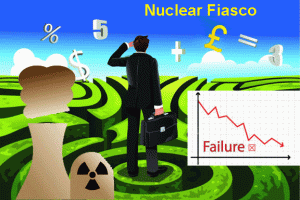 Japan’s nuclear rethink could derail UK energy plans, https://unearthed.greenpeace.org/2019/01/09/japan-uk-nuclear-plans-go-awry/, Doug Parr, 11 Jan 19, Reports in the Japanese press claim Hitachi is set to suspend all work on Wylfa, its nuclear power project in Wales.
Japan’s prime minister Shinzo Abe is in London this week, and it seems likely in his meeting with Theresa May that the Japanese-backed nuclear power plant in Wales will come up.
The Wylfa project, to be built by Hitachi and its subsidiary Horizon, is one of a clutch of planned nuclear power stations which the UK government has heavily prioritised for security of power supply, and meeting the country’s climate obligations.
Late last year another of the 6 major projects, the proposed Moorside plant in Cumbria, was effectively abandoned after Toshiba pulled out. And another has come under fire as questions are raised about security issues flowing from the Chinese builders.
These developments effectively illustrate that UK nuclear power policy is heavily dependent on overseas developers. What is less understood is that there are significant shifts underway in Japan which strongly suggest Hitachi’s projects may too be at risk.
‘Nuclear export superpower’ The most advanced of Horizon’s nuclear plans is a large power station to be built at Wylfa on Anglesey, North Wales.
In fact, with the collapse of Moorside, the Wylfa plant is the only nuclear project that could realistically be built before 2030, in addition to the plant already under construction at Hinkley Point in Somerset.
Japan, however, is reconsidering its nuclear export strategy. Because it keeps going wrong.
Until recently it had 3 companies interested in building nuclear power stations abroad: Toshiba, Mitsubishi and Hitachi.
These companies have experience building nuclear stations at home but since the Fukushima disaster in 2011, they have had to look elsewhere. Seeking to help these giants of Japanese industry to maintain their businesses, Prime Minister Abe reportedly wanted to turn Japan into a “nuclear export superpower”.
Misfires Toshiba pulled out of Moorside last year because it had run up huge losses in building 2 nuclear plants in USA. One, the Summer project in South Carolina, was abandoned altogether despite it being nearly half-built. Toshiba has pulled out not just of Moorside, but of building new nuclear power stations altogether.
Meanwhile, another of Japan’s nuclear groups, Mitsubishi Heavy Industries (MHI), has also been struggling to get its international project off-the-ground. It had one nuclear power station in the offing, at Sinop in Turkey, following an agreement years ago between the two countries’ prime ministers. However it seems clear that MHI is preparing to leave the project amid its “ballooning costs”. This is the only nuclear power station project MHI had an interest in.
The last of the companies involved in Japan’s nuclear export push is Hitachi. It has one active overseas nuclear project in UK at Wylfa, North Wales, and one more speculatively planned at Oldbury in Gloucestershire.
Hitachi, however, are reportedly be thinking of scrapping the project as its costs and risks become unmanageable. Hitachi could be looking at Toshiba’s near-bankruptcy and thinking ‘let’s not go there’. According to their chairman the project was in “an extremely severe situation” as it struggled to attract investors, even though UK government may have promised as much as two thirds of the build cost.
Despite this already generous largesse (on behalf of UK taxpayers, not offered to any other energy projects) Hitachi are intending to come back to UK government and ask for more. It looks like no assessment of the risks by a private funder come back looking good, and the only way nuclear plants can be built is with government stepping into very risky projects that require taxpayers to shoulder the risk.
The aversion from private investors may not only be because of the rising costs, but also that the operating performance of the proposed reactor is pretty poor (albeit partly due to earthquakes). Notably Hitachi continues to be happy to spend many billions of pounds on power grid investments, but not its own nuclear reactor, which it wants UK taxpayers to fund.
Second thoughts Unsurprisingly this tale is making many in Japan have second thoughts.
Major Japanese newspapers have opposed their own taxpayers lending supportto the Wylfa project, even though a home-grown company would be getting the benefits. And during the Xmas break, Japan’s third largest newspaper called for the nuclear export strategy to be abandoned. Another paper attacks the ‘bottomless swamp’ of nuclear funding in UK and remarks upon how few countries seem to be following the UK-style nuclear-focused policy.
Reportedly Japanese government has asked its development banks to fund the ‘nuclear export strategy’, and Wylfa in particular, but they don’t want to. It is quite difficult to see how Hitachi can manage the risks of this project without some home support, and support in Japan is ebbing away.
Few other countries will be stepping into the UK’s nuclear hole. The South Korean company KEPCO – that once might have taken over the Moorside project – is also finding exporting nuclear power tough to export, as ‘shoddy’ construction in a nuclear plant in United Arab Emirates, with attendant delays and extra costs, is showing.
For the UK, which has made a heavy bet on new nuclear to cover for retiring plants and make up a significant share of its decarbonisation targets, news from the other side of the world makes that bet look a dodgy one.
January 12, 2019
Posted by Christina Macpherson |
business and costs, Japan, politics, UK |
Leave a comment
Unearthed 9th Jan 2019 Doug Parr: Japan’s prime minister Shinzo Abe is in London this week, and it seems likely in his meeting with Theresa May that the Japanese-backed
nuclear power plant in Wales will come up. The Wylfa project, to be built
by Hitachi and its subsidiary Horizon, is one of a clutch of planned
nuclear power stations which the UK government has heavily prioritised for
security of power supply, and meeting the country’s climate obligations.
Late last year another of the 6 major projects, the proposed Moorside plant
in Cumbria, was effectively abandoned after Toshiba pulled out. And another
has come under fire as questions are raised about security issues flowing
from the Chinese builders.
These developments effectively illustrate that
UK nuclear power policy is heavily dependent on overseas developers.
What is less understood is that there are significant shifts underway in Japan
which strongly suggest Hitachi’s projects may too be at risk. The most
advanced of Horizon’s nuclear plans is a large power station to be built
at Wylfa on Anglesey, North Wales. In fact, with the collapse of Moorside,
the Wylfa plant is the only nuclear project that could realistically be
built before 2030, in addition to the plant already under construction at
Hinkley Point in Somerset.
Japan, however, is reconsidering its nuclear
export strategy. Because it keeps going wrong. Until recently it had 3
companies interested in building nuclear power stations abroad: Toshiba,
Mitsubishi and Hitachi. These companies have experience building nuclear
stations at home but since the Fukushima disaster in 2011, they have had to
look elsewhere.
Seeking to help these giants of Japanese industry to
maintain their businesses, Prime Minister Abe reportedly wanted to turn
Japan into a “nuclear export superpower”. Hitachi, however, are
reportedly be thinking of scrapping the project as its costs and risks
become unmanageable. Hitachi could be looking at Toshiba’s
near-bankruptcy and thinking ‘let’s not go there’. According to their
chairman the project was in “an extremely severe situation” as it
struggled to attract investors, even though UK government may have promised
as much as two thirds of the build cost.
Despite this already generouslargesse (on behalf of UK taxpayers, not offered to any other energy projects) Hitachi are intending to come back to UK government and ask for
more. It looks like no assessment of the risks by a private funder come
back looking good, and the only way nuclear plants can be built is with
government stepping into very risky projects that require taxpayers to
shoulder the risk.
The aversion from private investors may not only be
because of the rising costs, but also that the operating performance of the
proposed reactor is pretty poor (albeit partly due to earthquakes).
Notably Hitachi continues to be happy to spend many billions of pounds on power
grid investments, but not its own nuclear reactor, which it wants UK
taxpayers to fund. Major Japanese newspapers have opposed their own
taxpayers lending support to the Wylfa project, even though a home-grown
company would be getting the benefits.
And during the Xmas break, Japan’s
third largest newspaper called for the nuclear export strategy to be
abandoned. Another paper attacks the ‘bottomless swamp’ of nuclear
funding in UK and remarks upon how few countries seem to be following the
UK-style nuclear-focused policy. Reportedly Japanese government has asked
its development banks to fund the ‘nuclear export strategy’, and Wylfa
in particular, but they don’t want to. It is quite difficult to see how
Hitachi can manage the risks of this project without some home support, and
support in Japan is ebbing away.
https://unearthed.greenpeace.org/2019/01/09/japan-uk-nuclear-plans-go-awry/
January 12, 2019
Posted by Christina Macpherson |
Japan, politics international, UK |
Leave a comment
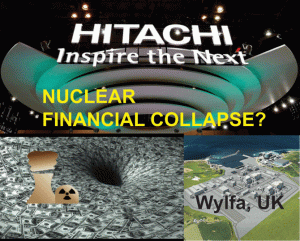 Nikkei Asian Review 11th Jan 2019
 , Hitachi to suspend all work on UK nuclear plant. Funding deadlock looks set to sink Japan’s last overseas nuclear project. Hitachi plans to put a U.K.
nuclear power project on hold as negotiations with the British government over funding hit an impasse, all but closing the book on Tokyo’s vision for nuclear infrastructure exports.
The Japanese industrial conglomerate’s
board is expected to officially decide next week to suspend all work on the
plant, including design and preparations for construction. Hitachi will
freeze the roughly 300 billion yen ($2.77 billion) in assets held by its
British nuclear business and write down their value, likely booking a loss
of 200 billion yen to 300 billion yen for the fiscal year ending in March.
The move would bring to a halt Japan’s last active overseas nuclear project
after the news last month that a Japanese-led consortium including
Mitsubishi Heavy Industries was scrapping a project in Turkey. With the
aversion to nuclear power that took hold after the March 2011 Fukushima
Daiichi disaster showing little sign of abating, prospects look grim for a
sector that the Japanese government had positioned as a pillar of its
infrastructure export drive. Hitachi had taken on the planned construction
of two reactors on the Welsh island of Anglesey after acquiring U.K.-based
Horizon Nuclear Power in 2012. The company is leaving the door open to a
return. The project is “not being abandoned,” a source close to Hitachi
told Nikkei, suggesting the company would keep an eye on the situation and
resume the project if possible.
January 12, 2019
Posted by Christina Macpherson |
business and costs, Japan, UK |
Leave a comment
The Tokai No. 2 nuclear power plant in Tokai, Ibaraki Prefecture, which is operated by the Japan Atomic Power Co.
Although telling six municipalities they have the right to prior consent before restarting the Tokai No. 2 nuclear power plant, operator Japan Atomic Power Co. (JAPC) is apparently reneging on that promise.
JAPC reached a draft agreement with the local governments to obtain their consent before restarting the Tokai No. 2 plant reactor in Ibaraki Prefecture, according to documents from Naka in the prefecture.
The documents, obtained by The Asahi Shimbun through an information disclosure request, detail the six years of negotiations between JAPC and the six local governments and a new safety agreement reached in March 2018.
The six are Tokai village, which hosts the plant, and the five surrounding cities of Hitachi, Hitachinaka, Naka, Hitachiota and Mito.
However, when asked by The Asahi Shimbun if the agreement contained a clause that JAPC would obtain prior consent from the six municipal governments on the restart, the company replied “No.” The six municipalities said the right to prior consent had been agreed upon.
JAPC has apparently changed its stance.
The new safety agreement, concluded on March 29, 2018, stipulates that when JAPC seeks to restart the Tokai No. 2 nuclear plant or extend its operation, it will effectively obtain prior approval from Tokai village and five surrounding municipalities.
The apparent break from tradition to give surrounding local municipalities the right of prior consent drew widespread attention as the “Ibaraki method.”
The concept of working out an agreement started in February 2012 when the heads of the six municipalities met to discuss nuclear power and local vitalization.
Tatsuya Murakami, then Tokai village chief, talked about the wide-ranging effects from the March 2011 accident at the Fukushima No. 1 nuclear power plant.
He said that the issue of whether to allow a restart of the Tokai No. 2 nuclear plant couldn’t be decided by Tokai village alone and that it was necessary for surrounding municipalities to have the same right.
However, JAPC rejected the proposal, saying that it needed to maintain a consistent approach with another nuclear plant it operates.
The negotiations continued, and in March 2017 the circumstances changed. In a meeting held that month, JAPC President Mamoru Muramatsu proposed a new safety agreement to the six municipalities.
As for their prior consent, he said, “We’ve determined that we can’t restart the nuclear plant until we obtain consent from the municipalities.”
The municipalities asked Muramatsu if that effectively meant they had the right to “prior consent.”
The JAPC president replied, “That’s correct.”
On Nov. 22, 2017, JAPC presented a new safety agreement, which included “effective prior consent,” in a meeting of the heads of the municipalities.
The municipalities again asked whether they had the right to prior consent. A JAPC official replied, “Yes.”
On Nov. 24, 2017, JAPC applied to the Nuclear Regulation Authority (NRA) for a 20-year extension of the operation of the nuclear plant. The deadline for the application was Nov. 28, 2017.
On Nov. 7, 2018, immediately after the NRA approved the 20-year extension, however, JAPC Vice President Nobutaka Wachi said, “The word ‘veto power’ can’t be found anywhere in the new agreement.”
The remark caused a backlash from the six municipalities, and Wachi apologized for his remark. However, relations between JAPC and the municipalities have deteriorated.
In the fall of 2018, The Asahi Shimbun conducted a survey of JAPC and the six municipalities. It asked them, “Is there anything in writing that states that JAPC must obtain prior consent from the six municipal governments in the new agreement?”
In response, JAPC said, “No.” A JAPC official explained, “The new agreement is a plan to effectively obtain prior consent from the six municipalities (by continuing to talk thoroughly with them until they grant their consent).”
The Asahi Shimbun told JAPC that official documents have a description that can be interpreted as granting the municipalities the right to prior consent.
The JAPC official said, “We will refrain from making a comment about the content of discussions from closed meetings.”
January 9, 2019
Posted by dunrenard |
Japan | Reactor Restart, Tokai NPP |
Leave a comment
 Resona bans lending to those developing, making or possessing nuclear weapons https://mainichi.jp/english/articles/20190107/p2a/00m/0bu/024000c, January 7, 2019 (Mainichi Japan) TOKYO — Resona Holdings Inc., a major financial group in Japan, has announced a policy of not extending loans to borrowers that are involved in the development, production or possession of nuclear weapons.
The statement, the first of its kind by a major Japanese banking institution, came amid similar moves by an increasing number of European banks and institutional investors following the adoption at the United Nations of the Treaty on the Prohibition of Nuclear Weapons in 2017.
Whether other Japanese corporations will follow Resona’s action is a focus of attention for the future. There were other lenders banning loans for the production of nuclear weapons, but the Resona policy prohibits any loans to such companies even when such transactions are for non-nuclear related purposes.
The new posture was incorporated in a document titled “Efforts toward socially responsible investment and loans,” which was announced in November last year. According to the paper, Resona refuses to lend to those that are associated with the development, production or possession of weapons of mass destruction, such as nuclear, chemical and biological weapons, or inhuman weaponry including antipersonnel mines and cluster munitions.
Entities that can be subject to relevant restrictions or sanctions, or even those with the potential to be hit with such punitive measures, will be rejected as borrowers, the document says.
An official with Resona, which has never lent to companies making nuclear weapons, explained that the banking group decided to introduce the policy “because we thought it important for providers of funds to make such efforts toward a sustainable society.”
According to the Dutch nongovernmental organization PAX, 63 financial institutions had similar lending policies as of October 2017, an increase of nine from the previous year.
A Mainichi Shimbun poll of four Japanese mega banks — Mitsubishi UFJ Financial Group, Sumitomo Mitsui Financial Group, Mizuho Financial Group and Sumitomo Mitsui Trust Holdings — as well as four major life insurance companies — Nippon, Dai-ichi, Meiji Yasuda and Sumitomo — found that all of the eight companies and groups have policies to refrain from lending and investment over inhuman weapons. Yet the entities did not specify the production of nuclear weapons as a condition to disengage from borrowers.
Officials at Sumitomo Mitsui and Mizuho replied that their companies ban loans to be used in the production of nuclear weapons, while a Mitsubishi UFJ official explained that the company is “making careful judgment in each transaction.”
(Japanese original by Satoko Takeshita, Business News Department)
January 8, 2019
Posted by Christina Macpherson |
business and costs, Japan |
Leave a comment
Japanese gov’t plan to export nuclear power technology floundering
A planned nuclear plant construction site is seen in Sinop, northern Turkey, in this 2012 file photo.
TOKYO — The Japanese government’s strategy to export nuclear power technology has run aground amid rising safety costs and deteriorating prospects for project profitability. While the government has aimed to maintain the country’s nuclear technology and expert resources through construction of atomic reactors abroad amid stalled nuclear plant development at home, its projects with Turkey and Britain have both hit snags.
“The Turkish government is in the midst of evaluating the project. I believe it will respond to us in some way or other,” said Shunichi Miyanaga, president of Mitsubishi Heavy Industries Ltd., in mid-December about a plan to build a nuclear power plant in Sinop, northern Turkey. Miyanaga’s comment suggested that the fate of the project had been left up to the Turkish government.
At the end of July last year, Mitsubishi Heavy told the Turkish government that the cost of the project would total somewhere around 5 trillion yen, more than doubling from the original estimate of roughly 2.1 trillion yen. As the plan envisages recovering the costs through profits from power generation at the nuclear facility, it would not become profitable unless Turkey purchases the generated electricity at a higher price than originally expected. If Turkey does not comply with the increased burden, Japan would withdraw from the plan.
The nuclear plant project was pitched by Prime Minister Shinzo Abe to then Turkish Prime Minister Recep Tayyip Erdogan in 2013. At the time, Abe vowed at a press conference in Ankara, “We will share our experiences and lessons from the (2011) disaster at the nuclear plant (run by the Tokyo Electric Power Co. in Fukushima) with the rest of the world, and will strive to contribute to enhancing the safety of nuclear power generation.”
However, the catastrophe prompted the international community to turn a wary eye toward nuclear power, leaving the costs for safety measures at nuclear plants to swell. The steep fall in the Turkish lira over the past year by more than 30 percent also added to the project’s deteriorating profitability.
Under these circumstances, Tokyo plans to propose to Ankara that it would provide comprehensive energy cooperation in such spheres as coal-fired thermal power generation and liquefied natural gas, in place of the atomic plant project. Because the nuclear power project is based on an agreement struck by both leaders, such a proposal by Tokyo could face a backlash from Ankara, but Japan’s focus is already shifting to how to withdraw from the project without undermining bilateral diplomatic ties with Turkey.
Meanwhile, a nuclear plant construction project undertaken by Hitachi Ltd. on the Isle of Anglesey in central Britain has also run into rough waters, after the project’s costs soared to approximately 3 trillion yen, about 1.5 times the initial estimate.
In May last year, Hitachi Chairman Hiroaki Nakanishi held talks with British Prime Minister Theresa May, where the latter agreed to expand her government’s support for the project. However, British citizens have been wary of the scheme out of concern that it could lead to rising electricity bills should Japan’s request to raise the sale price of electricity be accepted.
As the May administration is suffering from sagging approval ratings amid turmoil over Britain’s exit from the European Union, it is becoming increasingly difficult for London to comply with an increased burden. At home, Japanese companies are also becoming more reluctant to invest in the project out of fears of poor profitability and accident risks. Given the circumstances, Tokyo is also likely to exit the project.
The Abe administration has made the export of nuclear power technology a pillar of its growth strategy, but to little avail thus far. While the government intends to pursue measures to counter China and Russia’s aggressive drive to export nuclear plants by stepping up financial support for partner countries and through other measures, such a strategy may end up bringing more harm than good.
“The empirical values of China and Russia, where nuclear power plants are still being built, are considerably high (compared with other countries including Japan),” said Tomoko Murakami of the Institute of Energy Economics, Japan. In China, where 100 nuclear reactors are planned to be operational by 2030, state-owned companies are securing a spate of orders for nuclear power projects mainly in emerging countries, with the financial backing from the Chinese government. Russia also is said to undertake the whole process from leasing nuclear fuel to other countries to reprocessing their spent fuel, with the possible aim of boosting its diplomatic and security influence as well.
Officials in the Japanese nuclear power industry are finding a ray of hope in the Czech Republic’s plan to build a nuclear power plant, which has also attracted attention from China, Russia, South Korea and a joint venture of Mitsubishi Heavy and France’s Framatome. However, financial issues are again casting a shadow over the plan.
Tadashi Narabayashi, a specially appointed professor at the Tokyo Institute of Technology, warns that at this rate, “Japan would lose its own atomic power industry, and would have to import Chinese-made nuclear plants 20 years from now. It’s a critical situation.”
Meanwhile, a senior official of an economy-related government body said, “It is difficult for Japanese manufacturers, which can’t even build nuclear plants in their own country, to win confidence (abroad),” suggesting that the government’s strategy to export nuclear power technology in itself is unreasonable.
Gov’t to give up plan to export nuclear power reactors to Turkey
In this Nov. 6, 2018 file photo, Japan’s Prime Minister Abe, right, shakes hands with Turkish Foreign Minister Mevlut Cavusoglu at the prime minister’s office in Tokyo.
TOKYO — Japan is expected to effectively withdraw its plans to build a nuclear power plant in Turkey by asking Ankara to inject a significantly larger amount of funds amid ballooning safety costs — a demand Turkey is likely to reject — according to people familiar with the decision.
The Japanese government decided to ask for the increased coverage by Turkey as a final condition for constructing the plant. Under the current proposal, the plant is to be built by ATMEA, a joint venture of Japan’s Mitsubishi Heavy Industries Ltd. (MHI) and French nuclear plant maker Framatome, near the Black Sea coastal town of Sinop in northern Turkey.
Besides the Turkish project, another plan to export nuclear power reactors to Britain by Hitachi Ltd. also faces difficulties. If both plans fail, a growth drive strategy of the administration of Prime Minister Shinzo Abe will collapse.
The Turkish project has its roots in a 2013 joint declaration for cooperation over the construction of nuclear power plants signed by Prime Minister Abe and then Turkish Prime Minister Recep Tayyip Erdogan. Under the original plan, four medium-sized ATMEA1 reactors would be built for the start of operation in 2023.
However, the total cost estimate conducted in July 2018 by MHI for the project more than doubled from the original projection of some 2.1 trillion yen to around 5 trillion yen. The price hike occurred amid rising safety costs following the 2011 triple core meltdowns that hit the Tokyo Electric Power Co.’s Fukushima Daiichi Nuclear Power Station, as well as the finding of an active fault near the Sinop site. In addition, the Turkish lira has gone down since the summer of 2018, eroding the project’s profitability further. Tokyo therefore decided to increase the sale price of electricity to be generated by the new nuclear power station in a bid to recover project costs.
It is expected to be difficult for Ankara to accept the new condition, because it would mean the Turkish people would have to shoulder a greater financial burden. Japan and Turkey will effectively discuss how to arrange Japan’s departure from the project. In a bid to sustain their bilateral relationship, the Japanese government and MHI plan to propose to Turkey provision of high efficiency coal-fired power production technologies and other offers.
Meanwhile, Hitachi, which also manufactures nuclear reactors, has acknowledged that it faces difficulties in completing a project to build two nuclear reactors in Britain. Chairman Hiroaki Nakanishi of the company told reporters in December that he informed the British government that the plan was “at a limit” due to a surge in project costs.
Both the Turkish and British projects have been pitched directly by Prime Minister Abe, but those once promising plans now appear to be falling apart.
January 7, 2019
Posted by dunrenard |
Japan | Japan, Nuclear Exports, Turkey |
Leave a comment
 Japanese gov’t plan to export nuclear power technology floundering, January 4, 2019 (Mainichi Japan) (Japanese original by Takayuki Hakamada and Ryo Yanagisawa, Business News Department) TOKYO — The Japanese government’s strategy to export nuclear power technology has run aground amid rising safety costs and deteriorating prospects for project profitability. While the government has aimed to maintain the country’s nuclear technology and expert resources through construction of atomic reactors abroad amid stalled nuclear plant development at home, its projects with Turkey and Britain have both hit snags.
“The Turkish government is in the midst of evaluating the project. I believe it will respond to us in some way or other,” said Shunichi Miyanaga, president of Mitsubishi Heavy Industries Ltd., in mid-December about a plan to build a nuclear power plant in Sinop, northern Turkey. Miyanaga’s comment suggested that the fate of the project had been left up to the Turkish government.
At the end of July last year, Mitsubishi Heavy told the Turkish government that the cost of the project would total somewhere around 5 trillion yen, more than doubling from the original estimate of roughly 2.1 trillion yen. As the plan envisages recovering the costs through profits from power generation at the nuclear facility, it would not become profitable unless Turkey purchases the generated electricity at a higher price than originally expected. If Turkey does not comply with the increased burden, Japan would withdraw from the plan.
The nuclear plant project was pitched by Prime Minister Shinzo Abe to then Turkish Prime Minister Recep Tayyip Erdogan in 2013. At the time, Abe vowed at a press conference in Ankara, “We will share our experiences and lessons from the (2011) disaster at the nuclear plant (run by the Tokyo Electric Power Co. in Fukushima) with the rest of the world, and will strive to contribute to enhancing the safety of nuclear power generation.”
However, the catastrophe prompted the international community to turn a wary eye toward nuclear power, leaving the costs for safety measures at nuclear plants to swell. The steep fall in the Turkish lira over the past year by more than 30 percent also added to the project’s deteriorating profitability.
Under these circumstances, Tokyo plans to propose to Ankara that it would provide comprehensive energy cooperation in such spheres as coal-fired thermal power generation and liquefied natural gas, in place of the atomic plant project. Because the nuclear power project is based on an agreement struck by both leaders, such a proposal by Tokyo could face a backlash from Ankara, but Japan’s focus is already shifting to how to withdraw from the project without undermining bilateral diplomatic ties with Turkey.
Meanwhile, a nuclear plant construction project undertaken by Hitachi Ltd. on the Isle of Anglesey in central Britain has also run into rough waters, after the project’s costs soared to approximately 3 trillion yen, about 1.5 times the initial estimate.
n May last year, Hitachi Chairman Hiroaki Nakanishi held talks with British Prime Minister Theresa May, where the latter agreed to expand her government’s support for the project. However, British citizens have been wary of the scheme out of concern that it could lead to rising electricity bills should Japan’s request to raise the sale price of electricity be accepted.
As the May administration is suffering from sagging approval ratings amid turmoil over Britain’s exit from the European Union, it is becoming increasingly difficult for London to comply with an increased burden. At home, Japanese companies are also becoming more reluctant to invest in the project out of fears of poor profitability and accident risks. Given the circumstances, Tokyo is also likely to exit the project.
The Abe administration has made the export of nuclear power technology a pillar of its growth strategy, but to little avail thus far. While the government intends to pursue measures to counter China and Russia’s aggressive drive to export nuclear plants by stepping up financial support for partner countries and through other measures, such a strategy may end up bringing more harm than good………..
a senior official of an economy-related government body said, “It is difficult for Japanese manufacturers, which can’t even build nuclear plants in their own country, to win confidence (abroad),” suggesting that the government’s strategy to export nuclear power technology in itself is unreasonable.
https://mainichi.jp/english/articles/20190104/p2a/00m/0bu/030000c
January 5, 2019
Posted by Christina Macpherson |
business and costs, Japan |
Leave a comment
 Gov’t to give up plan to export nuclear power reactors to Turkey, January 4, 2019 (Mainichi Japan) TOKYO — Japan is expected to effectively withdraw its plans to build a nuclear power plant in Turkey by asking Ankara to inject a significantly larger amount of funds amid ballooning safety costs — a demand Turkey is likely to reject — according to people familiar with the decision. Gov’t to give up plan to export nuclear power reactors to Turkey, January 4, 2019 (Mainichi Japan) TOKYO — Japan is expected to effectively withdraw its plans to build a nuclear power plant in Turkey by asking Ankara to inject a significantly larger amount of funds amid ballooning safety costs — a demand Turkey is likely to reject — according to people familiar with the decision.
The Japanese government decided to ask for the increased coverage by Turkey as a final condition for constructing the plant. Under the current proposal, the plant is to be built by ATMEA, a joint venture of Japan’s Mitsubishi Heavy Industries Ltd. (MHI) and French nuclear plant maker Framatome, near the Black Sea coastal town of Sinop in northern Turkey.
Besides the Turkish project, another plan to export nuclear power reactors to Britain by Hitachi Ltd. also faces difficulties. If both plans fail, a growth drive strategy of the administration of Prime Minister Shinzo Abe will collapse.
The Turkish project has its roots in a 2013 joint declaration for cooperation over the construction of nuclear power plants signed by Prime Minister Abe and then Turkish Prime Minister Recep Tayyip Erdogan. Under the original plan, four medium-sized ATMEA1 reactors would be built for the start of operation in 2023…….
Meanwhile, Hitachi, which also manufactures nuclear reactors, has acknowledged that it faces difficulties in completing a project to build two nuclear reactors in Britain. Chairman Hiroaki Nakanishi of the company told reporters in December that he informed the British government that the plan was “at a limit” due to a surge in project costs.
Both the Turkish and British projects have been pitched directly by Prime Minister Abe, but those once promising plans now appear to be falling apart.
(Japanese original by Ryo Yanagisawa and Takayuki Hakamada, Business News Department)
However, the total cost estimate conducted in July 2018 by MHI for the project more than doubled from the original projection of some 2.1 trillion yen to around 5 trillion yen. The price hike occurred amid rising safety costs following the 2011 triple core meltdowns that hit the Tokyo Electric Power Co.’s Fukushima Daiichi Nuclear Power Station, as well as the finding of an active fault near the Sinop site. https://mainichi.jp/english/articles/20190104/p2a/00m/0bu/011000c
|
|
|
January 5, 2019
Posted by Christina Macpherson |
business and costs, Japan |
Leave a comment
Taxpayers will be paying the costs for scrapping nuclear facilities.
TOKYO (Kyodo) — The state-backed Japan Atomic Energy Agency said Wednesday it would need to spend about 1.9 trillion yen ($17.1 billion) to close 79 facilities over 70 years, in its first such estimate.
The total costs could increase further, as the agency said the estimated figure, which would be shouldered by taxpayers, excludes expenses for maintenance and replacing aging equipment.
The JAEA plans to close more than half of the 79 facilities over the next 10 years due in part to the increased costs to operate them under stricter safety rules introduced after the 2011 Fukushima nuclear crisis. The agency, which has led nuclear energy research in Japan with its predecessors since the 1950s, owns a total of 89 facilities.
Of the estimated costs, the expense for closing the nation’s first spent-fuel reprocessing plant in the village of Tokai, Ibaraki Prefecture, northeast of Tokyo, accounts for the largest chunk of 770 billion yen. It will cost 150 billion yen to decommission the trouble-plagued Monju prototype fast-breeder nuclear reactor.
As for nuclear waste, the agency said about 100 kiloliters of high-level radioactive waste and up to 114,000 kl of low-level radioactive waste were estimated to have been produced but it has yet to decide on disposal locations.
The Japanese government aims to restart nuclear power plants after a nationwide halt following the nuclear crisis, despite persistent concern over the safety of atomic power generation.
January 2, 2019
Posted by dunrenard |
Japan | nuclear plants, Scrapping |
Leave a comment
Projects to export nuclear power plants, a pillar of the “growth strategy” promoted by the administration of Prime Minister Shinzo Abe, appear to be crumbling.
Factors behind the failures include ballooning construction costs due to strengthened safety standards after the triple core meltdowns at Tokyo Electric Power Co.’s (TEPCO) Fukushima Daiichi Nuclear Power Station in March 2011, and growing anti-nuclear sentiments around the world.
Nothing else can be said but that the export projects have effectively failed. The prime minister’s office and the Ministry of Economy, Trade and Industry must bear the responsibility of continuing to promote these exports despite a massive change in the attitude toward nuclear power plants.
“We are really stretched to our limit,” Hitachi Chairman Hiroaki Nakanishi recently said of the company’s nuclear power plant construction plan in Britain. The statement came at a regular press conference of the Japan Business Federation, or Keidanren, indicating that continuing the project is not feasible.
Hitachi coordinated closely with the Japanese government to advance the U.K. project. The company was to build two nuclear power reactors in midwestern Britain through a local subsidiary, and to start operating the facilities in the first half of the 2020s.
But, the total estimated cost of the project has skyrocketed from the initial figure of 2 trillion yen to 3 trillion yen due to growing safety measure costs. Hitachi, hoping to distribute financial risk, sought investments from major power utilities and other firms, but the negotiations hit a snag due to the lowered profitability of the project.
In a bid to secure profits at an early stage, Hitachi requested that the British government raise the price of the electricity to be generated by the plants, which was guaranteed to be purchased in advance. This arrangement also hit a wall as confusion spread in the British political sphere over the nation’s planned exit from the European Union. Hitachi, which has a stake in the local subsidiary, would lose some 300 billion yen if the project was cancelled.
Similar trouble has arisen in Turkey. A plan to export nuclear power plants, which began from a close relationship between Prime Minister Abe and Turkish President Recep Tayyip Erdogan, has also run aground.
Under the original plan, Mitsubishi Heavy Industries and other businesses were to build four midsized reactors in Turkey along the coast of the Black Sea at a total estimated cost of 2.1 trillion yen. The amount has more than doubled to 5 trillion yen, due in part to increased cost estimates for earthquake-proof measures. This development now requires the Japanese and Turkish governments to extend additional financial support for the project, but the two sides have apparently failed to reach an agreement.
The Abe administration has thrown its weight behind the export of nuclear power plants as a major element of its economic “growth strategy,” with the trade ministry choreographing the moves for the projects. The ministry regards nuclear power generation as one of the main sources of power generation, always protecting and promoting the nuclear power industry.
However, after the Fukushima nuclear disaster in 2011, building such plants within Japan has become difficult, and the ministry hoped to maintain the size of the nuclear power industry through exports and the transference of relevant technologies and human resources to the next generation. But this has ignored the fact that international trends have shifted since the disaster.
The construction cost for nuclear power plants has grown exponentially with the increased focus on safety measures, while renewable energy sources such as solar power have become cheaper with the rapid expansion of their use. As such, the relative price competitiveness for nuclear power reactors has declined; it can no longer be called an “inexpensive energy source.”
According to the International Energy Agency (IEA), global investments for new nuclear power plant construction in 2017 dropped to 30 percent of the previous year’s figure. Global policy is moving away from nuclear power plants and instead tipping toward renewable energy sources.
The failure to reflect this trend led to the huge losses incurred by Toshiba Corp., which bought Westinghouse Electric Co. with backing from the trade ministry to pursue its troubled nuclear power projects in the United States.
In 2012, a national referendum in Lithuania voted down a project to build a Hitachi nuclear power plant, and then in 2016, Vietnam scrubbed a similar construction plan. The same year, Japan signed a nuclear cooperation agreement with India, eyeing exports of nuclear power plants despite concerns about the proliferation of nuclear materials to the nuclear weapon state outside of the Nuclear Non-proliferation Treaty. Still, the export plan has yet to materialize. It is clear that the export of nuclear power plants has been backed into a corner for quite some time already.
It is Japan that caused one of the world’s worst nuclear accidents, and is now working on decommissioning the damaged reactors in a process that will take decades to complete. Many people in Japan hold deeply rooted feelings against the government’s placement of nuclear power plant exports as a pillar of the nation’s growth strategy.
In response, the government has simply justified the projects by saying they will contribute to developing countries with a growing power demand by offering a cheap source of power to support their economic growth. Rising construction costs, however, has rendered this explanation moot.
Japan still has many nuclear power plants to run, and the decommissioning of older plants will soon be in full-swing. The latest technology and skilled experts are vital for these projects to be completed successfully.
Continuing to focus on nuclear power export, however, will lead Japan nowhere. The government should take another look at global trends, and review the basis of its nuclear power policy to rid Japan of nuclear power as soon as possible.
December 27, 2018
Posted by dunrenard |
Japan | Exports, nuclear plants, renewable energy |
Leave a comment
This is an ongoingly highly toxic and dangerous situation made even more difficult by lies and cover-ups and nuclear industry which owns way too many politicians.
For the 8th time mayors from five cities in Chiba prefecture requested that the central government deal with high level radioactive waste in their cities: Matsudo, Kashiwa, Nagareyama, Abiko, Inzai.
Since 2011, the waste from the Fukushima disaster has been left in temporary storage locations.
The mayors began formally requesting the central government establish a long term storage facility for this waste in January. At the 8th meeting again requesting this assistance they left empty handed again.
Much of this waste consists of contaminated soil, plant matter and possibly dried sewage sludge or incinerator ash. It was not specified what waste streams would be stored in the requested facility. Much of the contaminated soil has been stored in empty lots, some of these near homes or schools, others in watershed areas.
Parts of Chiba received unexpected levels of contamination. Southerly winds at the time of some of the larger releases from the nuclear meltdowns caused contamination into parts of Chiba and Tokyo. Places hours away from a nuclear power plant can find themselves dealing with high radiation levels and contamination due to bad timing and a change of the wind.
December 27, 2018
Posted by dunrenard |
Japan | Chiba Prefecture, Radioactive waste |
Leave a comment
 Koizumi says Japan must say ‘no’ to nuclear energy, THE ASAHI SHIMBUN, January 17, 2019, When he was prime minister, Junichiro Koizumi championed the use of atomic power to generate electricity.
 Students tasked to develop dishes with Fukushima produce to promote prefecture’s recovery, Japan Times, 13 Jan 19
  Russia’s Rosatom wins two bids for accident management at Fukushima NPP http://tass.com/world/1039631, January 12, 2019, MOSCOW, Russia’s state nuclear corporation Rosatom has been engaged in the nuclear control plan at Japan’s stricken Fukushima nuclear power plant and has already won two bids in that project, Rosatom CEO Alexei Likhachev said in a televised interview with Rossiya’24 news channel on Saturday.
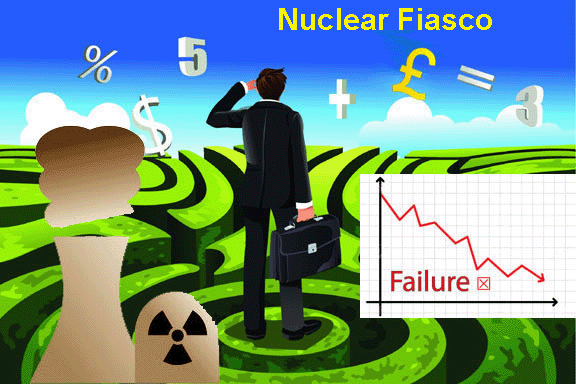 Japan’s nuclear rethink could derail UK energy plans, https://unearthed.greenpeace.org/2019/01/09/japan-uk-nuclear-plans-go-awry/, Doug Parr, 11 Jan 19, Reports in the Japanese press claim Hitachi is set to suspend all work on Wylfa, its nuclear power project in Wales.
 Nikkei Asian Review 11th Jan 2019 , Hitachi to suspend all work on UK nuclear plant. Funding deadlock looks set to sink Japan’s last overseas nuclear project. Hitachi plans to put a U.K.
 Resona bans lending to those developing, making or possessing nuclear weapons https://mainichi.jp/english/articles/20190107/p2a/00m/0bu/024000c, January 7, 2019 (Mainichi Japan) TOKYO — Resona Holdings Inc., a major financial group in Japan, has announced a policy of not extending loans to borrowers that are involved in the development, production or possession of nuclear weapons.

 Japanese gov’t plan to export nuclear power technology floundering, January 4, 2019 (Mainichi Japan) (Japanese original by Takayuki Hakamada and Ryo Yanagisawa, Business News Department) TOKYO — The Japanese government’s strategy to export nuclear power technology has run aground amid rising safety costs and deteriorating prospects for project profitability. While the government has aimed to maintain the country’s nuclear technology and expert resources through construction of atomic reactors abroad amid stalled nuclear plant development at home, its projects with Turkey and Britain have both hit snags.


 nuclear-news