China to Japan: If treated radioactive water from Fukushima is safe, ‘please drink it’
China to Japan: If treated radioactive water from Fukushima is safe, ‘please drink it’, WA Today, By Adam Taylor, April 15, 2021 —Washington: A spokesman for China’s Foreign Ministry challenged Japan’s deputy prime minister Wednesday to drink treated water, contaminated from contact with reactors, from the wrecked Fukushima nuclear power plant, after the Japanese official suggested the water released would be safe to drink.
Chinese Foreign Ministry spokesman Zhao Lijian, infamous for trolling Australia over the Afghanistan war crimes cases, said during a press briefing: “A Japanese official said, it’s okay if you drink this water. Then please drink it.”
The ocean is not Japan’s trash can,” Zhao also said.
The Chinese official also tweeted a similar message in English.
The Chinese Foreign Ministry’s remarks came after the Japanese government announced on Tuesday it had decided to release into the sea more than 1 million tons of water collected from Fukushima, which melted down during a 2011 nuclear disaster following a tsunami………….
China’s Zhao, known for his aggressive style of diplomacy, has responded at length to the issues surrounding Fukushima water this week, on Tuesday denying the suggestion that China had itself been in a comparable situation when it released treated radioactive water from power plants into the sea………..
Chinese records show that local power plants like Daya Bay in Shenzhen have also released large amounts of tritium into the sea. Zhao said that the water from the Fukushima was different from that released to the ocean by other nuclear plants.
“No comparison can be drawn between the two,” he said, without further explanation…..
While the United States has offered its support for Japan’s move on the Fukushima water, Zhao said on Wednesday that the Japanese side needed to reach an agreement with all stakeholder countries before it could proceed.
“China reserves the right to make further responses,” Zhao said.https://www.watoday.com.au/world/asia/china-to-japan-if-treated-radioactive-water-from-fukushima-is-safe-please-drink-it-20210415-p57jcj.html
Fukushima” is not over: Japanese NGOs raise concern over the ongoing nuclear disaster
Fukushima” is not over: Japanese NGOs raise concern over the ongoing nuclear disaster, Friends of the Earth Japan, Pacific Asia Resource Center (PARC), 14 Apr 21,
On the 10th anniversary of one of the worst nuclear accidents at Fukushima Daiichi Nuclear Power Station, and amid the controversial decision of the Japanese government to dump “treated” radioactive water into the ocean, Japanese NGOs Friends of the Earth Japan and Pacific Asia Resource Center (PARC) co-produced a documentary film Fukushima 10 Years Later: Voices from the continuing nuclear disaster. The film sheds light on the ongoing suffering of victims of the accident and poses critical questions about the Japanese government’s poor responses to the accident.
While then-Prime Minister Abe vainly declared to the world that “the situation in Fukushima is completely under control”, nuclear decays are continuing inside the molten fuel rods, and the exploded plants are still emitting radioactive particles to this day. In the meanwhile, evacuees are torn apart in limbo, with grim hopes of returning to their homeland, continued fear of radioactive fallout, and a dire socio-economic situation. Fisherfolk, who overcame the initial fear of ocean contamination, are forced to relive the experience each time TEPCO and the Japanese government repeatedly choose to release contaminated water into the ocean.
This happens all under the propaganda that Fukushima is pressing ahead with “Fukkou (Recovery)”.
This video aims to highlight the current situation of the victims of the man-made disaster, and challenge the government propaganda of Fukushima’s Recovery.
Fukushima 10 Years Later: Voices from the continuing nuclear disaster
Produced by Friends of the Earth Japan and Pacific Asia Resource Center
Supervised by HOSOKAWA Komei (Citizens’ Commission on Nuclear Energy)
Directed by MATSUMOTO Hikaru (Friends of the Earth Japan)
Running time: 43 min.
The English subtitled version of the film is now available on Vimeo on Demand and will cost USD 5.75 to rent and USD 47.50 to purchase.
https://vimeo.com/ondemand/fukushima10years
For further information on the film, please contact OKUMURA Yuto, Pacific Asia Resource Center.
E-mail: video@parc-jp.org
Yuto Okumura,Pacific Asia Resource Center (PARC)
Japan’s hugely costly nuclear reprocessing program.

Plutonium programs in East Asia and Idaho will challenge the Biden administration, Bulletin of the Atomic Scientists, By Frank N. von Hippel | April 12, 2021, ”………………Japan’s hugely costly reprocessing program. The United States has been trying to persuade Japan to abandon reprocessing ever since 1977. At the time, then prime minister Takeo Fukuda described plutonium breeder reactors as a matter of “life and death” for Japan’s energy future and steamrolled the Carter administration into accepting the startup of Japan’s pilot reprocessing plant. Today, Japan is the only non-nuclear-armed state that separates plutonium. Despite the absence of any economic or environmental justification, the policy grinds ahead due to a combination of bureaucratic commitments and the dependence of a rural region on the jobs and tax income associated with the hugely costly program. The dynamics are similar to those that have kept the three huge US nuclear-weapon laboratories flourishing despite the end of the Cold War.
For three decades, Japan has been building, fixing mistakes, and making safety upgrades on a large plutonium recycle complex in Rokkasho Village in the poor prefecture of Aomori on the northern tip of the main island, Honshu. The capital cost of the complex has climbed to $30 billion. Operation of the reprocessing plant is currently planned for 2023.
A facility for fabricating the recovered plutonium into mixed-oxide plutonium-uranium fuel for water-cooled power reactors is under construction on the same site (Figure 3 on original). The cost of operating the complex is projected to average about $3 billion per year. Over the 40-year design life of the plant, it is expected to process about 300 tons of plutonium—enough to make 40,000 Nagasaki bombs. What could possibly go wrong?
Japan’s Atomic Energy Commission reports that, because of the failures and delays of its plutonium useage programs, as of the end of 2019, Japan owned a stock of 45.5 tons of separated plutonium: 9.9 tons in Japan with the remainder in France and the United Kingdom where Japan sent thousands of tons of spent fuel during the 1990s to be reprocessed.
Both the Obama and Trump administrations pressed Tokyo to revise its reprocessing policy, especially after Japan’s decision to decommission its failed prototype breeder reactor in 2016.
Perhaps in response to this pressure, in 2018, Japan’s cabinet declared:
“The Japanese government remains committed to the policy of not possessing plutonium without specific purposes on the premise of peaceful use of plutonium and work[s] to reduce of the size of [its] plutonium stockpile.”
A step toward reductions that is being discussed would be for Japan to pay the United Kingdom to take title to and dispose of the 22 tons of Japanese plutonium stranded there after the UK mixed-oxide fuel fabrication plant was found to be inoperable. Japan’s separated plutonium in France is slowly being returned to Japan in mixed-oxide fuel for use in reactors licensed to use such fuel.
If, as currently planned, Japan operates the Rokkasho Reprocessing Plant at its design capacity of more than seven tons of plutonium separated per year, however, its rate of plutonium separation will greatly exceed Japan’s rate of plutonium use. Four of Japan’s currently operating reactors are licensed to use mixed-oxide fuel but loaded only 40 percent as much mixed-oxide fuel as planned in 2018-19 and none in 2020. Two more reactors that can use mixed-oxide are expected to receive permission to restart in the next few years. In 2010, Japan’s Federation of Electric Power Companies projected that the six reactors would use 2.6 tons of plutonium per year. If the much-delayed Ohma reactor, which is under construction and designed to be able to use a full core of mixed-oxide fuel, comes into operation in 2028 as currently planned, and all these reactors use as much mixed-oxide fuel as possible, Japan’s plutonium usage rate would still ramp up to only 4.3 tons per year in 2033. (At the end of 2020 the Federation of Electric Power Companies announced its hope to increase the number of mixed-oxide-using reactors to 12 by 2030 but did not list the five additional reactors, saying only, “we will release it as soon as it is ready.”)
As of June 2020, construction at Rokkasho on the mixed-oxide fuel fabrication facility that will process the plutonium separated by the Rokkasho Reprocessing Plant was only 12 percent complete. It was still just a hole in the ground containing some concrete work with its likely completion years behind the currently planned 2023 operation date of the reprocessing plant.
Thus, as happened in Russia and the United Kingdom, the Rokkasho Reprocessing Plant could operate indefinitely separating plutonium without the mixed-oxide plant operating. The reprocessing plant includes storage for “working stocks” containing up to 30 tons of unirradiated plutonium. If and when it begins operating, the mixed-oxide fuel fabrication plant will itself have additional working stocks of at least several tons of plutonium. Therefore, even if Japan transfers title to the plutonium it has stranded in the United Kingdom and manages to work down its stock in France, the growth of its stock in Japan could offset those reductions.
The Biden administration should urge Japan’s government to “bite the bullet” and begin the painful but necessary process of unwinding its costly and dangerous plutonium program. A first step would be to change Japan’s radioactive waste law to allow its nuclear utilities to use the planned national deep repository for direct disposal of their spent fuel.
In the meantime, most of Japan’s spent fuel will have to be stored on site in dry casks, as has become standard practice in the United States and most other countries with nuclear power reactors. Because of its safety advantages relative to storage in dense-packed pools, the communities that host Japan’s nuclear power plant are moving toward acceptance of dry-cask storage. During the 2011 Fukushima accident, the water in a dense-packed pool became dangerously low. Had the spent fuel been uncovered and caught on fire, the population requiring relocation could have been ten to hundreds of times larger ………….https://thebulletin.org/2021/04/plutonium-programs-in-east-asia-and-idaho-will-challenge-the-biden-administration/?utm_source=Newsletter&utm_medium=Email&utm_campaign=MondayNewsletter04122021&utm_content=NuclearRisk_EastAsia_04122021
Fukushima: Japan announces it will dump contaminated water into sea
Fukushima: Japan announces it will dump contaminated water into sea https://www.theguardian.com/environment/2021/apr/13/fukushima-japan-to-start-dumping-contaminated-water-pacific-ocean
More than 1m tonnes of contaminated water will be released from the destroyed nuclear station in two years’ time, Japan plans to release into the sea more than 1m tonnes of contaminated water from the destroyed Fukushima nuclear station, the government said on Tuesday, a decision that is likely to anger neighbours such as South Korea.
The move, more than a decade after the nuclear disaster, will deal another blow to the fishing industry in Fukushima, which has opposed such a step for years.
The work to release the water will begin in about two years, the government said, and the whole process is expected to take decades.
“On the premise of strict compliance with regulatory standards that have been established, we select oceanic release,” the government said in a statement after relevant ministers formalised the decision.
Around 1.25 million tonnes of water has accumulated at the site of the nuclear plant, which was crippled after going into meltdown following a tsunami in 2011.
It includes water used to cool the plant, as well as rain and groundwater that seeps in daily.
The water needs to be filtered again to remove harmful isotopes and will be diluted to meet international standards before any release.
The decision comes about three months ahead of the postponed Olympic Games to be hosted by Tokyo, with some events planned as close as 60km (35 miles) from the wrecked plant.
The disposal of contaminated water from the Fukushima Daiichi plant, run by Tokyo Electric Power, has proved a thorny problem for Japan as it pursues a decades-long decommissioning proj
China concerned about Japan dumping Fukushima nuclear waste water into the Pacific.
| China says concerned over Fukushima waste disposal https://www.aa.com.tr/en/asia-pacific/china-says-concerned-over-fukushima-waste-disposal/2206069 Beijing asks Japan to take ‘responsible attitude’ towards Fukushima nuclear plant’s radioactive water disposal Riyaz Ul Khaliq |12.04.2021 ANKARAChina on Monday expressed concern over the disposal of waste from Japan’s Fukushima nuclear power plant into the sea.“China has expressed grave concern to Japan through diplomatic channels, asking the country to take a responsible attitude towards Fukushima nuclear power plant’s radioactive water disposal,” the local newspaper People’s Daily reported, quoting the Chinese Foreign Ministry. Last week, Japan said it plans to dispose of radioactive wastewater from the Fukushima nuclear plant into the ocean.Prime Minister Yoshihide Suga’s government will move ahead with the idea despite opposition within and outside the country and may announce the decision as early as Tuesday. The wastewater, though treated, may still contain radioactive tritium.Japanese authorities want to dilute the waste to “acceptable global standards” and start dumping it into the ocean two years from now. Japan’s fishery industry and some provincial authorities have voiced concerns over the plan, which has also drawn criticism from China and South Korea.However, the Japanese government said it “will work to address their concerns and bring in the International Atomic Energy Agency (IAEA) and other partners.”“We will seek the cooperation of global organizations such as the IAEA and local governments to thoroughly check the plan’s safety and maintain transparency,” Kajiyama Hiroshi, Japan’s economy, trade, and industry minister, said last week. |
Japanese government and Tepco must pay monthly compensation to 3550 Fukushima residents displaced due to continued radioactivity.
International Bar Association 8th April 2021, In mid-February, the Tokyo High Court ruled that the Japanese government and nuclear plant operator Tokyo Electric Power Company (Tepco) should pay a total of JPY 278m (approximately $2.6m) in damages to a group of survivors of the 2011 Fukushima nuclear disaster.
The ruling came ahead of the ten-year anniversary of the major Tohoku earthquake, which killed and displaced thousands of people. The tsunami caused by the earthquake led to the meltdown of three nuclear reactors at the Fukushima Daiichi Nuclear Power Plant, operated by Tepco.
In September 2020, the Sendai High Court ordered the state and the plant operator to pay approximately $9.5m in
damages in total to 3,550 plaintiffs, finding both negligent for not taking measures to prevent the disaster. The plaintiffs had sought $265m in the form of monthly compensation of $470 each until radiation in the affected region subsided.
https://www.ibanet.org/Article/NewDetail.aspx?ArticleUid=1462911D-400D-422C-ABDA-99D4D5BF78A8
Japanese government continues Japan’s ”Nuclear Village” generous grants to keep ageing nuclear reactors going.

Lucrative grants offered to keep aging nuclear reactors running, http://www.asahi.com/ajw/articles/14326422
THE ASAHI SHIMBUN
April 7, 2021 The central government is offering billions of yen in new grants to Fukui Prefecture to allow a nuclear plant operator to run its aging reactors beyond their operational life span of 40 years.
Fukui is not the only prefecture in Japan that hosts old reactors, and the grants could create momentum toward the restarts of these units.
“As for an expansion of grants, up to 2.5 billion yen ($22.6 million) will be provided per nuclear plant to a prefecture preparing to respond to the extension of the 40-year life of reactors,” the Ministry of Economy, Trade and Industry said in a document presented to the Fukui prefectural government on April 6.
The ministry’s offer is expected to become a key point of discussions as Fukui Prefecture and the prefectural assembly begin to weigh whether they should approve of the restart of three reactors in question there.
Fukui Governor Tatsuji Sugimoto hailed the central government’s offer, calling it “a step forward.”
He had urged the prefectural assembly to discuss the restart issue in February, but the assembly put off the debate, citing a lack of measures to revitalize the local economy.
Osaka-based Kansai Electric Power Co. is pushing to reactivate the three reactors in Fukui Prefecture–the No. 1 and 2 reactors at the Takahama nuclear plant in Takahama and the No. 3 reactor at the Mihama nuclear plant in Mihama.
The Nuclear Regulation Authority has given its one-time permission to operate those reactors for 20 more years beyond their 40-year life spans.
If the local governments approve the restarts, Fukui Prefecture would receive a combined 5 billion yen under the new grant setup.
The town halls of Takahama and Mihama have already given the greenlight to the restarts. The remaining hurdle is whether the governor and the prefectural assembly will approve them.
The maximum 2.5 billion yen will be made available over a period of five years, according to the industry ministry’s Agency for Natural Resources and Energy.
The offer of the funds came in response to the Fukui prefectural government’s request for additional grants concerning the reactors as a measure to stimulate the local economy.
The prefectural government is expected to discuss how to distribute the grants with Takahama and Mihama.
Other prefectures hosting old reactors operated by companies seeking the 20-year extension will be eligible for the new grants.
The only other facility that has gained the NRA’s permission to operate beyond 40 years is the Tokai No. 2 nuclear plant in Ibaraki Prefecture.
Five other reactors in Japan have been in service for more than 35 years.
The decommissioning process has started for other aging reactors because their operators decided that upgrades and additional safeguard measures required to bring them back online would be too expensive.
(This article was written by Kenji Oda and Takayuki Sato.)
Japan’s Prime Minister getting ready to release Fukushima waste water into the Pacific ocean?
Reuters 6th April 2021, Japanese Prime Minister Yoshihide Suga will hold a ministerial meeting as early as next week to start discussions on the release of contaminated Fukushima Dai-ichi Nuclear Power Plant water into the ocean, broadcaster FNN said on Tuesday.
Suga is also expected to meet with the head of the national federation of fisheries cooperatives as early as Wednesday to discuss the potential release of the water. The water, which is treated but contains traces of tritium, was used to cool the reactors in the aftermath of the Fukushima Dai-ichi Power Plant’s nuclear disaster in 2011 and is now stored within the grounds of the power plant.
4,000 Fukushima waste bags contain unidentified radioactive materials

Mainichi 6th April 2021, Of the 85,000 containers holding radioactive waste placed in the radiation-controlled area of the Fukushima Daiichi nuclear power plant, the contents of about 4,000 have not been identified, operator Tokyo ElectricPower Company Holdings Inc. (TEPCO) announced on April 5. According to TEPCO, it began listing the contents of the containers after the meltdown in 2011, but about 4,000 of them remain unidentified. The company says it will formulate a survey plan and proceed to determine what they hold.
https://mainichi.jp/english/articles/20210406/p2a/00m/0na/002000c
Japan halts restart of nuclear plant over poor anti-terror measures
Japan halts restart of nuclear plant over poor anti-terror measures, DAILY SABAH,
BY ASSOCIATED PRESS, TOKYO ASIA PACIFIC APR 07, 2021 Japanese regulators last month fined a nuclear power plant operator over the organization’s inadequate anti-terrorism measures at a plant, and on Wednesday the operator announced that it would accept the penalty, further hurting its plans to restart operations at the facility for at least a year.
Tokyo Electric Power Co. (TEPCO), which was also the operator of the Fukushima nuclear plant that was destroyed in the 2011 disaster, made the announcement in response to a decision by the Nuclear Regulation Authority in late March to ban it from moving any nuclear materials at the No. 7 reactor at the Kashiwazaki-Kariwa nuclear power plant in Niigata prefecture.
The measure will suspend all ongoing steps to restart the plant. Regulators found malfunctioning anti-terrorism equipment and inadequate protection of nuclear materials at multiple locations at the plant from at least 2018………….
he punishment comes as TEPCO was making final preparations to restart the plant after regulators granted safety approvals for its No. 6 and No. 7 reactors in 2017.
Restarting the two reactors is considered crucial for TEPCO to reduce its financial burden in paying for damage caused by the Fukushima disaster. The penalty does not affect the wrecked Fukushima plant, which is being decommissioned.
On Wednesday, Prime Minister Yoshihide Suga said he will make a final decision “within days” on whether to allow the release into the sea of massive amounts of treated but still radioactive water stored at the plant. TEPCO is expected to run out of storage space for the water in the fall of 2022……..
TEPCO and government officials say radionuclides can be filtered to allowable safety levels, but some experts say the impact on marine life from long-term, low-dose exposure is still unknown…….https://www.dailysabah.com/world/asia-pacific/japan-halts-restart-of-nuclear-plant-over-poor-anti-terror-measures
Japan has the ability to become both coal-free and nuclear-free
Can Japan Be Both Carbon-Free and Nuclear-Free?
Japan can – and should – pursue an energy mix that is both carbon-neutral and avoids reliance on nuclear energy. The Diplomat, By Daisuke Akimoto 7 Apr 21, Japanese Prime Minister Suga Yoshihide, scheduled to have summit talks with U.S. President Joe Biden on April 16, has been pursuing a carbon-neutral society. On October 26, 2020, Suga delivered a policy speech to the Japanese parliament and declared that “by 2050 Japan will aim to reduce greenhouse gas emissions to net-zero.” Internationally, the Paris Agreement entered in to effect in 2016, and Japan as a signatory to the treaty is obliged to reduce greenhouse gas emissions to limit global warming.
Japan has been under international fire on climate issues, as it is the world’s fifth largest emitter of carbon dioxide. In an interview with Mainichi Shimbun on May 20, 2019, Swedish environment activist Greta Thunberg criticized the fact that Japan had relied on coal-fired energy for more than 30 percent of its total amount of electricity, and planned to build and export new coal-fired plants. For this reason, Suga’s pledge to pursue a carbon-zero society was welcomed by U.N. Secretary General Antonio Guterres.
According to a poll reported by Reuters on December 9, 2020 however, many Japanese companies were pessimistic about the feasibility of the government’s carbon-free goal. n its policy proposal of March 2021, the powerful Japan Business Federation (Keidanren) suggested that the government should rely on efficient coal-fired power generation and nuclear energy as well. Before the 2011 nuclear accident in the Fukushima Daiichi Nuclear Power Plant, Japan operated as many as 54 nuclear power plants, but currently, only nine nuclear power plants are in operation. Keidanren proposed that about 30 nuclear power plants should be brought back online by 2030.
Japan has been under international fire on climate issues, as it is the world’s fifth largest emitter of carbon dioxide. In an interview with Mainichi Shimbun on May 20, 2019, Swedish environment activist Greta Thunberg criticized the fact that Japan had relied on coal-fired energy for more than 30 percent of its total amount of electricity, and planned to build and export new coal-fired plants. For this reason, Suga’s pledge to pursue a carbon-zero society was welcomed by U.N. Secretary General Antonio Guterres.
According to a poll reported by Reuters on December 9, 2020 however, many Japanese companies were pessimistic about the feasibility of the government’s carbon-free goal. n its policy proposal of March 2021, the powerful Japan Business Federation (Keidanren) suggested that the government should rely on efficient coal-fired power generation and nuclear energy as well. Before the 2011 nuclear accident in the Fukushima Daiichi Nuclear Power Plant, Japan operated as many as 54 nuclear power plants, but currently, only nine nuclear power plants are in operation. Keidanren proposed that about 30 nuclear power plants should be brought back online by 2030.
Does Japan really need to continue its reliance on nuclear energy as a means of achieving a carbon-neutral society? In exploring answers to this energy conundrum, it is important to look to the changes in nuclear power’s share of electricity generation in Japan. In 2010, the 54 nuclear power plants generated nearly 25 percent of the total amount of electricity produced in Japan. Presently however, the nine nuclear reactors in operation produce a mere 6 percent of the total electricity generated in Japan, indicating that Japan has successfully managed to deal with its electricity shortage without too much dependence on nuclear power in the past 10 years.
Likewise, public opinion about Japan’s nuclear energy policy needs to be taken into consideration. According to a survey by the Japan Atomic Energy Relations Organization, 87 percent of respondents in 2010 agreed that nuclear power was necessary, but that the percentage plummeted to 24 percent in 2013, after the Fukushima nuclear disaster. In a 2019 survey, only 12 percent of respondents stated that nuclear power generation should be maintained or increased, whereas 60 percent replied that nuclear power should be phased out or abolished immediately. Clearly, a majority of the Japanese people do not support the reactivation of the existing nuclear power plants, much less construction of new ones.
From a different viewpoint, Japan’s reliance on nuclear energy has military implications. U.S. Senator Edward Markey has pointed out the possibility of nuclear proliferation in Northeast Asia, warning that Japan’s stockpile of plutonium amounted to 48 tons as of 2017, which was nearly equal to the U.S. military’s stores and sufficient to create more than 6,000 nuclear warheads. Some experts, such as Professor Arima Tetsuo at Waseda University, have argued that the possession of a vast amount of plutonium – more than necessary for commercial use – symbolizes Japan is keeping opening the option to possess nuclear weapons. Paradoxically however, Tomas Kaberger, chair of the Executive Board of the Renewable Energy Institute, contended that nuclear reactors and reprocessing plants could be targeted in the event of armed attack, increasing Japan’s military vulnerability.
lthough the Suga administration does not plan to build new nuclear reactors, the government would depend on nuclear energy to achieve the carbon-neutral goal. This is because most lawmakers of the ruling Liberal Democratic Party (LDP) insist on the necessity of nuclear energy, which is regarded as a rich source of political support. However, an increasing number of LDP politicians have been supportive of the gradual decommissioning of the nuclear power plants.
Akimoto Masatoshi, former parliamentary vice minister of land, infrastructure, transport and tourism, is the most conspicuous LDP legislator advocating for decommissioning nuclear reactors in Japan. Akimoto, a key ally of Suga, has argued that it is possible to create a carbon-free society without nuclear reactors. Likewise, Kono Taro who has prime ministerial ambitions and serves as minister for administrative reform and regulatory reform, has been convinced that it is desirable for Japan to reduce its reliance on fossil fuels and nuclear energy by facilitating the further introduction of renewable energy……….
Without doubt, the landscape of international politics has been transforming in response to the global climate change and energy transformation, which will eventually change Japanese politics. On March 11, five former prime ministers – Hosokawa Morihiro, Murayama Tomiichi, Koizumi Junichiro, Hatoyama Yukio, and Kan Naoto – expressed a joint declaration calling for the Suga government’s policy shift toward a nuclear-free Japan. Learning from the lessons of Fukushima, Suga and candidates for future Japanese prime minister who share nuclear-free ideals, such as Kono Taro and Environment Minister Koizumi Shinjiro, are expected to take bold actions to transform Japan’s energy policy toward a carbon-free and nuclear-free Japan. https://thediplomat.com/2021/04/can-japan-be-both-carbon-free-and-nuclear-free/
Crookedness, fraud, in 10 years of Fukushima nuclear clean-up

How the Cleanup of the Fukushima Nuclear Accident Got So Expensive, The Asia Pacific Journal Philip Brasor and Masako Tsubuku, April 2921,
Abstract: Drawing on Japanese press and TV reports, the authors explain the extraordinary costs of the decade long cleanup of the 3.11 earthquake, tsunami, and nuclear meltdown, with no end to the process in sight.
………………………. According to a documentary special that aired on public broadcaster NHK in February, ¥5.6 trillion has so far been spent on decontaminating the areas surrounding the Fukushima Daiichi nuclear power plant, but not all of this money has been spent directly on cleanup activities, the goal of which was to bring the affected area back to “normal” as soon as possible so that evacuees could return to their homes. But ten years later that hasn’t happened, or, at least, not to the degree originally envisioned. After 90% of the work was finished, an estimated 60% of the radiation had been reduced, and the cleanup had become a self-generating public works project with its own profit motives for contractors and sub-contractors.
The central problem was the way the work was allocated. Ideally, the trade or education ministry should have been in charge, since both have experience in the nuclear energy field; or the construction ministry, which has extensive experience in large public works projects. However, the government chose the environment ministry, which has never carried out any large-scale public works. The other ministries, apparently, were loath to take on a job involving “waste.”
Usually, when a government entity orders work to be done, they set up a bidding process. In this case, there were multiple distinct areas targeted for cleanup, as well as various stages in the cleanup process. Under such circumstances, general contractors try to get all the work in a given area in order to maximize profits, and ideally, they will have no competition for bids, which means they can essentially charge whatever they want. When NHK examined the bid documents for the areas targeted for cleanup and related work, they found that 68 percent of the work orders only had one bidder. These sorts of public works normally generate a profit margin of 5%, but in this case, it was about 10%. As one environment ministry official admitted to NHK, they had no real idea about the competitive situation and didn’t know how to oversee the work.
As a result, there was a lot of misuse of funds. NHK looked at one subcontractor headquartered in the city of Iwaki, Fukushima Prefecture, that was investigated by the tax authorities. The company’s president was described by others as being a big-hearted individual who had once worked at the nuclear power station himself and wanted to help his neighbors move back into the area. That’s why he started the company, with the intention of reconstructing the area. The company grew quickly. After only two years, its profits exceeded ¥10 billion, at which point, according to one employee, “the original motivation” for starting the company “disappeared.” The company was freely padding receipts and spending money to entertain contractors who controlled work orders so that they could get even more lucrative jobs.
The president started giving away new cars to valued employees. After six years, one of the contractors discovered that the Iwaki subcontractor had bribed several of its employees and dropped the subcontractor. Subsequently, the subcontractor started laying off people as profits decreased sharply, and they weren’t the only ones. Two employees of another large general contractor were arrested for fraud for having reported fake costs and pocketing the difference. As one subcontractor explained, it was easy to do. The manager of a particular job asks the subcontractor to forge receipts saying that twice as many people worked on the job or asks a company that supplies lodging for workers to inflate the room charge on the receipts. At least 15 employees of one general contractor were accused of fraud or failure to report income. The total amount of money swindled in these cases was about ¥4 billion.
One contractor told NHK that he knew the environment ministry was understaffed so he didn’t worry about getting audited. The ministry asked for more personnel and the government always refused, saying the cleanup was only a short-term project. As initially planned, it would be finished in three years and cost a little over ¥1 trillion, but after 10 years it’s still not finished and actual costs have soared past ¥3 trillion, not counting the money spent for processing waste and constructing storage facilities. The ministry planned to build only two incinerators for waste disposal, but the local governments said they would only allow waste collected within their borders to be burned, so the ministry ended up building 16 incinerators in Fukushima Prefecture alone. And while they were built to last 20 years, half of them have since been demolished in order to alleviate local anxieties, so in many areas the work was not completed, though the cost of waste incineration ended up being more 5 times the original estimate.
Public funds paid for all of this, but direct tax money was used mainly for mid-term storage of irradiated materials. Everything else related to the cleanup is supposed to be paid for by capital gains made from the government selling Tokyo Electric Power Co. (Tepco) stock. NHK says that the government bought ¥1 trillion worth of Tepco stock at ¥300 per share and estimates that in order to pay off the cleanup costs they would need to sell that stock at ¥1,500 per share. Unfortunately, the stock hasn’t gone up in price since the government bought it. As of February 20, it was about one-fourth what it needed to be, so they have simply put off sale of the shares. One expert NHK talked to, a scholar who has done extensive research into nuclear accidents, said that if the stock doesn’t go up in price, then the government will end up using tax money anyway to pay for the cleanup; either that, or Tepco is going to have to cover more of the cost, which means utility bills will go up again. So, the public—more specifically, future generations—pays for it either way.
This pay structure was built into the law quite recently. Originally, Tepco was legally responsible for cleaning up any situations caused by an accident at their facilities, and thus were expected to pay for the Fukushima disaster, but since the job was so huge the government borrowed money and paid for the operations on behalf of Tepco. In turn, all of Japan’s electric power companies were supposed to reimburse the government. But in March 2013, Tepco talked the government into changing the pay structure, convincing it to shoulder more of the burden by saying that making utilities pay for everything is unfair to their shareholders, since nuclear power is a “national policy.”
A letter that NHK uncovered from Tepco to the trade ministry said that Tepco would not be able to “revive” itself if the government didn’t take more responsibility for the cleanup. Nine months later, the Cabinet decided on the capital gains strategy. According to various officials interviewed by NHK, the government knew that the capital gains plan wouldn’t be able to cover the costs of the cleanup, even before it ballooned out of proportion, but that they had to come up with something quickly “on paper.” As one trade ministry official said, the plan puts the government in a double bind, since in order for the stock to go up appreciably, it has to guarantee not only Tepco’s survival, but its success as a private corporation in the short run. And that, presumably, means getting nuclear power plants back online as soon as possible, a task that has run up against a wall of public opposition in the wake of the Fukushima disaster. ………..https://apjjf.org/2021/7/Brasor.html
Niigata governor wants Japan’s Nuclear Regulator to reassess Tepco, following security lapses
| Governor asks nuclear regulator to reassess TEPCO, https://www3.nhk.or.jp/nhkworld/en/news/20210405_31/ 5 Apr 21, The prefectural governor of Niigata has asked Japan’s Nuclear Regulation Authority, NRA, to reassess the capability of a local nuclear power plant’s operator after a series of security lapses.Governor Hanazumi Hideyo requested on Monday that the regulator re-examine Tokyo Electric Power Company. His move followed the revelation that multiple sensors at the Kashiwazaki-Kariwa plant had been broken for months and alternative measures were insufficient, leaving the facility vulnerable to intruders. A TEPCO employee also improperly entered the plant’s central control room using another employee’s ID card. Four years ago, the NRA endorsed the operator’s safety measures and gave the green light to restart two of the plant’s reactors. In response to the governor’s request, NRA Secretary-General Ogino Toru said the authority will scrutinize the operator’s ability. The NRA has instructed TEPCO to compile a report on its probe into the security breaches by September. The authority plans to conduct additional inspections after the report is submitted to see whether the company is technically capable of running the plant. As a penalty for the security lapse, the NRA is expected to ban the utility from transferring nuclear fuel, which would make it impossible to restart the plant. |
Japan’s nuclear regulator bans Tepco from restarting Kashiwazaki-Kariwa plant due to safety flaws.
Japan Times 24th March 2021 ,Japan’s nuclear regulatory body decided Wednesday to effectively ban Tokyo
Electric Power Company Holdings Inc. (Tepco) from restarting a nuclear plant on the Sea of Japan coast after the complex was found to have serious safety flaws.
The Nuclear Regulation Authority decided at its meeting to ban Tepco from transporting nuclear fuel to the Kashiwazaki-Kariwa plant in Niigata Prefecture or loading it into the reactors. A final decision will be made after the operator is given an opportunity to provide an explanation. The punitive measure will be effective until Tepco’s response to the incident is “in a situation where self-sustained improvement is expected,” according to the regulator.
Infamous Fukushima town sign praising nuclear energy to become permanent museum display

全町避難が続く福島県双葉町で、原発推進看板の撤去工事を見守る標語考案者の大沼勇治さん=21日
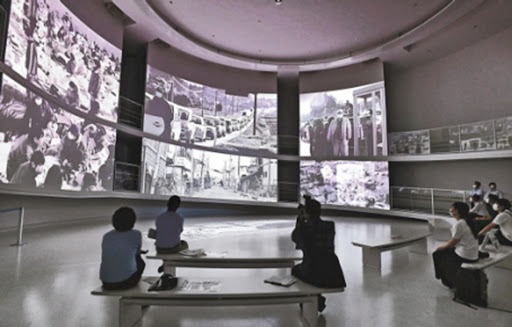 Infamous Fukushima town sign praising nuclear energy to become permanent museum display https://mainichi.jp/english/articles/20210320/p2a/00m/0na/006000c, March 20, 2021 (Mainichi Japan) FUKUSHIMA — A sign hailing nuclear energy and formerly located on the main street of Fukushima Prefecture town Futaba, which was rendered inaccessible following the nuclear meltdowns triggered by the March 2011 Great East Japan Earthquake, will go on display at the Great East Japan Earthquake and Nuclear Disaster Memorial Museum in the town from March 24. Infamous Fukushima town sign praising nuclear energy to become permanent museum display https://mainichi.jp/english/articles/20210320/p2a/00m/0na/006000c, March 20, 2021 (Mainichi Japan) FUKUSHIMA — A sign hailing nuclear energy and formerly located on the main street of Fukushima Prefecture town Futaba, which was rendered inaccessible following the nuclear meltdowns triggered by the March 2011 Great East Japan Earthquake, will go on display at the Great East Japan Earthquake and Nuclear Disaster Memorial Museum in the town from March 24.
The sign measures 2 meters by 16 meters, and reads “Nuclear Power: Energy for a Bright Future.” After the 2011 nuclear disaster at the Tokyo Electric Power Co. Fukushima Daiichi Nuclear Power Station, the sign became iconic nationally as a symbol of the northeastern Japan town that pushed for nuclear power and still remains entirely subject to evacuation orders. The sign was removed in March 2016 because its deterioration posed dangers, and photos of the sign were displayed at the museum. It is too large to be placed indoors, so authorities delayed its display when opening the museum in September 2020; in the meantime, discussions on how to exhibit it were held with the Fukushima Prefectural Government. Then, on March 19, the prefectural government announced the sign will go on permanent display at the museum’s outdoor terrace from March 24. Yuji Onuma, 45, who came up with the sign’s slogan when he was in elementary school, said, “I believe exhibiting the sign will symbolize a resolve to never have another nuclear accident, and to aim for a bright future this time around. It took a long time after its removal for display plans to be finalized, but I hope coming face to face with the real thing will give visitors a chance to think about the nuclear disaster.” (Japanese original by Ryusuke Takahashi, Fukushima Bureau) |
|
1 This Month

of the week – Shut Down Drone Warfare!


Tell the Ukrainian Government to Drop Prosecution of Peace Activist Yurii Sheliazhenko

Petition to revoke the licensing of the Near Surface Nuclear Disposal Facility (NSDF) at Chalk River. https://www.ourcommons.ca/petitions/en/Petition/Details?Petition=e-7247
To see nuclear-related stories in greater depth and intensity – go to https://nuclearinformation.wordpress.com
-
Archives
- April 2026 (114)
- March 2026 (251)
- February 2026 (268)
- January 2026 (308)
- December 2025 (358)
- November 2025 (359)
- October 2025 (376)
- September 2025 (257)
- August 2025 (319)
- July 2025 (230)
- June 2025 (348)
- May 2025 (261)
-
Categories
- 1
- 1 NUCLEAR ISSUES
- business and costs
- climate change
- culture and arts
- ENERGY
- environment
- health
- history
- indigenous issues
- Legal
- marketing of nuclear
- media
- opposition to nuclear
- PERSONAL STORIES
- politics
- politics international
- Religion and ethics
- safety
- secrets,lies and civil liberties
- spinbuster
- technology
- Uranium
- wastes
- weapons and war
- Women
- 2 WORLD
- ACTION
- AFRICA
- Atrocities
- AUSTRALIA
- Christina's notes
- Christina's themes
- culture and arts
- Events
- Fuk 2022
- Fuk 2023
- Fukushima 2017
- Fukushima 2018
- fukushima 2019
- Fukushima 2020
- Fukushima 2021
- general
- global warming
- Humour (God we need it)
- Nuclear
- RARE EARTHS
- Reference
- resources – print
- Resources -audiovicual
- Weekly Newsletter
- World
- World Nuclear
- YouTube
-
RSS
Entries RSS
Comments RSS
 nuclear-news