Japan needs a realistic debate instead of new push for fast nuclear reactors
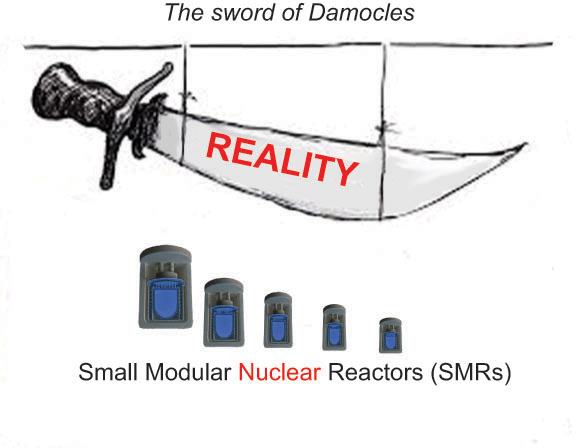
Realistic debate needed instead of new push for fast nuclear reactors https://www.asahi.com/ajw/articles/14534098
January 28, 2022 Japan has agreed to work with a U.S. company in technological cooperation to develop a sodium-cooled fast reactor.
People involved in the project stress that the new technology will contribute to the goal of a carbon-free society. But the government should not eschew reality-based debate on the future of existing nuclear power reactors.
The Japan Atomic Energy Agency, Mitsubishi Heavy Industries Ltd. and other Japanese entities will cooperate with TerraPower LLC’s project to build a fast reactor in the U.S. state of Wyoming.
Fast reactors are more resource efficient as they can burn types of nuclear fuel that cannot be used at conventional reactors.
TerraPower’s reactor will use liquid sodium as a cooling agent such as the Monju prototype fast-breeder reactor, which Japan decided to decommission after a series of accidents.
Japan can provide meaningful support to develop a new type of reactor and maintain related technology by offering what it has learned from its experiences including failures.
Japan has been promoting the concept of recycling separated plutonium back into fuel for nuclear power generation. Fast reactor technology to burn plutonium is at the core of this strategy.
But this program has suffered setbacks, including the decision to scrap Monju and a lack of progress in the government’s plan to burn so-called MOX (mixed oxide) fuel, which is usually plutonium blended with natural uranium, in conventional nuclear reactors.
The government also considered participating in France’s Advanced Sodium Technical Reactor for Industrial Demonstration (ASTRID) project to build a prototype sodium-cooled nuclear reactor.
But the idea was dropped after the French government decided to scale down the project.
The nuclear fuel recycling program, which has gone awry, should be abandoned. The participation in the TerraPower project should not allow the government to delay the decision on the program.
The technological cooperation with the United States has been touted as a way to “contribute to the achievement of carbon neutrality.”
However, it is unclear whether this will help Japan achieve its goal of net zero emissions of greenhouse gases by 2050.
TerraPower plans to start operating the new reactor in 2028. But this technology cannot be used immediately in Japan, which has been developing fast reactor technology for a different type of fuel.
The government’s road map for the development of fast reactor technology, determined in 2018, offers no clear time frame for practice use. It only said full-scale operation is expected “sometime in the late 21st century.”
The government has cited the development of next-generation reactor technology, such as small modular reactors and fast reactors, as an important factor for its clean energy and “zero carbon” policy efforts.
But it has failed to offer a clear vision for the future of existing nuclear reactors despite its massive reservoir of experience and expertise.
The government’s new Basic Energy Plan, unveiled last year, says nuclear power should account for 20 to 22 percent of the nation’s total electricity output in fiscal 2030. But the document did not refer to any specific measure to hit the target.
Neither Prime Minister Fumio Kishida nor members of his Cabinet have been eager to discuss this issue, apparently because of a reluctance to engage in debate on sticky issues concerning nuclear power.
Fast-breeder reactors, which can theoretically produce more fuel than they use, were once advertised as a source of “dream energy” for a resource-poor Japan.
Following the Monju debacle, the government started stressing that nuclear fuel recycling and fast reactor technology can help reduce high-level radioactive waste. Now, policymakers are singing the “carbon neutrality” theme.
The government should stop trying to obscure problems with its nuclear power policy by promoting a new technology without clear prospects for practical use under a new slogan.
Instead, it should launch a reality-based debate on existing nuclear reactors in line with its pledge to reduce the nation’s dependence on nuclear energy as much as possible.
Fukushima nuclear radiation has had strange effects on plants and trees
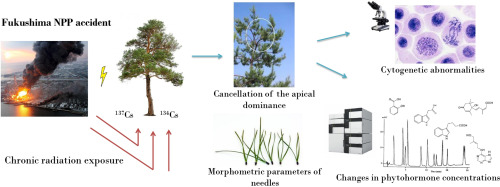
Fukushima Radiation Made Japanese Fir Trees Go Haywire After Nuclear Disaster Newsweek, BY ORLANDO JENKINSON ON 1/27/22 Plants in Fukushima are growing in abnormal ways because of the radiation left over from the 2011 nuclear accident, a study suggests.
In a study published on January 15 in the journal Plants, scientists described changes to the structure of plants and trees in areas close to where a partial meltdown occurred at Fukushima Dai-ichi Nuclear Power Plant (FNPP) after an earthquake caused a tsunami that overwhelmed the plant’s cooling systems.
………….. To come to their conclusion, researchers examined the whorls—the places on plants where foliage like leaves, petals or needles spread out from a central point.
Instead of branching out in the expected way, the whorls showed irregular growths and even elimination of some shoots in ways not seen on trees that avoided radiation.
What is more, the number of strange mutations like this corresponded with the amount of radiation the trees were hit with. Researchers said that the rate of mutations was “directly proportional to the dose of ionizing radiation to which the conifers had been exposed.”
The authors of the paper said that another abnormality they found was the “deletion” of shoots of Japanese fir and red pine trees. This happened most often after the spring of 2012, and peaked in 2013, though precisely why remains a mystery.
The paper consequently offered further evidence that ionizing radiation like that produced by nuclear accidents can alter the structure of conifer trees.
The authors noted that the abnormalities they uncovered were like those found on Scots Pine trees in the Chernobyl Exclusion Zone, the 18.6-mile radius surrounding the site of the Chernobyl nuclear disaster in the former Soviet Union in 1986. https://www.newsweek.com/fukushima-radiation-japanese-fir-trees-haywire-nuclear-disaster-1673577
Momentum building for nuclear ban treaty, with hopes that Japan will participate
Advocates of nuclear ban treaty try to build momentum for change, Koyama Shoko, NHK General Bureau for Europe Correspondent, Yoshida Mayu, 28 Jan 22 ”………………………….. The agreement entered into force on January 22, 2021, after securing 50 ratifications. That number has risen to 59 now, though it includes none of the countries that possess the weapons.
Delegates from states that are party to the treaty plan to hold a first meeting from March 22 to 24 in Vienna, although the schedule may change due to the COVID-19 pandemic. In addition, nine countries have notified the United Nations they will attend as observers. Some NATO members, including Germany and Norway, say they may attend too.
The chair hopes Japan will participate
The head of the Austrian Foreign Ministry’s disarmament department, Alexander Kmentt, will preside over the meeting, which he says will be “crucial in setting the future direction for the new treaty.”
Kmentt said support for victims of the weapons was one of the major items on the agenda, so he is hoping Japan will participate, as the only country to have experienced nuclear attacks.
“Whether or not to participate is for the Japanese government to decide,” he said. “But I hope that many states that have yet to ratify the TPNW will come to the meeting as observers.”
Hibakusha played a crucial role in the treaty
Elayne Whyte Gomez is a Costa Rican diplomat who was the chair of the negotiating conference for the prohibition treaty.
One of her first moves was to open the debate up to civil participation, allowing people not connected to governments or international organizations to attend the conference. She says the survivors of the Hiroshima and Nagasaki bombings, known as hibakusha, played a critical role in this process.
Let me put it this way, it’ll be very hard for me to envision that the treaty that prohibits nuclear weapons could have been achieved without the voices and the living testimonials of the survivors.”
International tensions heightening nuclear risk……….
Beatrice Fihn, Executive Director of the International Campaign to Abolish Nuclear Weapons (ICAN), an organization that played a major role in putting the prohibition treaty together, says the two agreements should not be considered mutually exclusive.
It’s just not true that the TPNW weakens the NPT,” she says, “and they are perfectly fine to coexist. The NPT is doing fine. The TPNW doesn’t harm the NPT. The only thing that harms their NPT is that the nuclear armed states refuse to implement the disarmament obligations, and that has nothing to do with the TPNW. Now that has to do with a nuclear armed state. So when the UK government increases their nuclear arsenal, there is a direct violation of the NPT. That’s harmful. When China increases its nuclear arsenals, it’s a direct violation of the NPT and it’s harming and undermining the NPT.”
Citizen activists have crucial role to play
ICAN has been urging nuclear-weapon states that have not ratified the prohibition treaty to attend the meeting in Vienna in March………..
Japanese youth play their part
In Japan, the hibakusha are inspiring some young people to get involved in the nuclear abolition movement…….. https://www3.nhk.or.jp/nhkworld/en/news/backstories/1879/
Can reactor fuel debris be safely removed from Fukushima Daiichi?
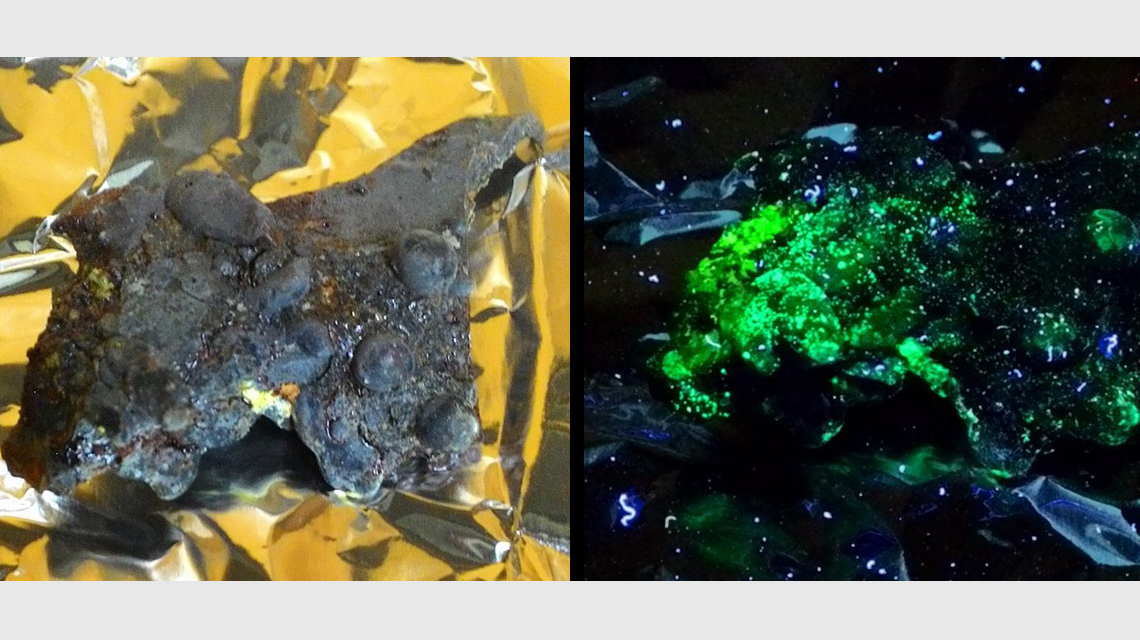
Can reactor fuel debris be safely removed from Fukushima Daiichi?, Science Daily, :January 25, 2022Source:University of Helsinki
Summary:Decommissioning and clean-up are ongoing at the Fukushima Daiichi Nuclear Power Plant (FDNPP); however, many difficult problems remain unaddressed. Chief amongst these problems is the retrieval and management of fuel debris.
Decommissioning and clean-up are ongoing at the Fukushima Daiichi Nuclear Power Plant (FDNPP); however, many difficult problems remain unaddressed. Chief amongst these problems is the retrieval and management of fuel debris. Fuel debris is the name given to the solidified mixture of melted nuclear fuel and other materials that now lie at the base of each of the damaged reactors (reactor Units 1 — 3). This material is highly radioactive and it has potential to generate enough neutrons to trigger successive nuclear fission reactions (uranium-235 breaks into two elements after capturing neutrons, emitting enormous amounts of energy, radiation, and more neutrons). Successive fission reactions would present a serious safety and material management risk.
One of the materials in nuclear reactors that can lower the number of neutrons interacting with uranium-235 is boron carbide (B4C). This was used as the control rod material in the FDNPP reactors, and it may now remain within the fuel debris. If so, it may limit fission events within the fuel debris.
Can the fuel debris be safely removed?
On March 11th 2011, the control rods were inserted into the FDNPP reactors to stop the fission reactions immediately after the earthquake, but the later tsunami destroyed the reactor cooling systems. Fuel temperatures soon became high enough (>2000 °C) to cause reactor meltdowns. Currently, the fuel debris material from each reactor is cooled and stable; however, careful assessment of these materials, including not only their inventories of radioactive elements but as well their boron content, a neutron absorber, is needed to ascertain if successive fission reactions and associated neutron flux could occur in the fuel debris during its removal. Many important questions remain: was boron from the control rods lost at high temperature during the meltdown? If so, does enough boron remain in the fuel debris to limit successive fission reactions within this material? These questions must be answered to support safe decommissioning.
Study shows direct evidence of volatilization of control rods during the accident.
Despite the importance of this topic, the state and stability of the FDNPP control rod material has remained unknown until now. However, work just published in the Journal of Hazardous Materials now provides vital evidence that indicates that most of the control rod boron remains in at least two of the damaged FDNPP reactors (Units 2 and/or 3).
The study was an international effort involving scientists from Japan, Finland, France, and the USA………………….. https://www.sciencedaily.com/releases/2022/01/220125093041.htm
Leakage of coolant water from ice wall around crippled Fukushima nuclear power station
| The operator of Japan’s crippled Fukushima nuclear power plant said this month that two storage tanks had leaked about four tonnes of coolant solution used to create an ice wall that prevented groundwater from seeping in. The operator, Tokyo Electric Power Co Holdings (9501.T) (Tepco), said the leak had no impact on the wall or the environment, however. But the incident highlights its struggle to clean up the plant nearly 11 years after a massive earthquake and tsunami set off meltdowns in the worst nuclear disaster since Chernobyl in 1986. Reuters 25th Jan 2022 https://www.reuters.com/world/asia-pacific/wall-ice-fukushimas-crippled-nuclear-plant-2022-01-25/ |
Call for Japan to join nuclear ban treaty on 1st anniversary
January 23, 2022
Supporters of a U.N. treaty banning nuclear weapons gathered Jan. 22 in Hiroshima and Nagasaki to mark the first anniversary of the pact going into force, stepping up their calls on Japan to sign it.
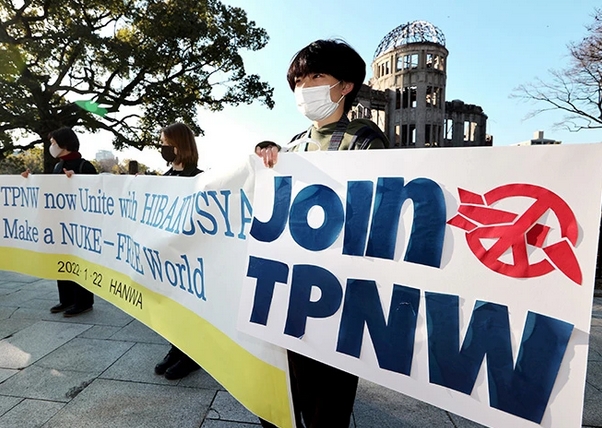
Standing in front of the symbolic Atomic Bomb Dome in Hiroshima, 10 or so members of a Hiroshima-based group calling for the abolition of nuclear weapons hoisted a banner that read the “whole world should join the Treaty on the Prohibition of Nuclear Weapons.”
“Unless Japan, the only country in the world to have been ravaged by atomic bombing, speaks out in the international community, it will be impossible to eliminate nuclear weapons,” said Shuichi Adachi, a lawyer representing the group.
Participation in the rally was kept to a minimum as a safety precaution against the COVID-19 pandemic.
Tomoyuki Mimaki, a representative of the association of A- and H-bomb sufferers in Hiroshima Prefecture, expressed disappointment with a joint statement released Jan. 21 by Tokyo and Washington on the issue of nuclear weapons.
“They treated the question with kid gloves,” he said dismissively, noting that although the statement encouraged the world’s political leaders and youth to visit Hiroshima and Nagasaki, it made no reference to the treaty.
Mimaki, 72, said he sent a letter to Prime Minister Fumio Kishida, who is from a constituency in Hiroshima, urging Japanese representatives to attend the first meeting of signatory countries of the treaty in Austria in March as observers.
Attendance on the part of Japan, he said, is indispensable as Kishida has pledged that Tokyo will work as an intermediary between the nuclear and nonnuclear powers.
In Nagasaki, about 150 nuclear-bomb survivors and their supporters gathered in the Peace Park to press the Japanese government to join and ratify the treaty.
“The government continues to ignore the treaty even though many countries have signed it,” said Shigemitsu Tanaka, president of the Nagasaki Atomic-bomb Survivors Council. “We want to get the public become familiar with the treaty so we can join forces in applying pressure on the government.”
Fifty-nine countries and territories have ratified the treaty.
But the nuclear powers as well as Japan, which is protected under the U.S. nuclear umbrella for its defense purposes, have refrained from doing so.
According to the Japan Council against Atomic and Hydrogen Bombs, 627 assemblies, or 35 percent, of the 1,788 local governments, including those at the prefectural level, had adopted a resolution as of Jan. 12 calling on the Japanese government to sign and ratify the treaty.
The figure included 90 or so local governments that adopted the resolution after the treaty went into force in 2021.
“The resolution adopted by local governments reflects public opinion and thus is more visible,” said Shiro Maekawa, an official of the council who tracks the trend among local governments on the issue. “The Japanese government should hear what the public says.”
Call for Japan to join nuclear ban treaty on first anniversary
Call for Japan to join nuclear ban treaty on 1st anniversary, https://www.asahi.com/ajw/articles/14528449
THE ASAHI SHIMBUN, January 23, 2022 Supporters of a U.N. treaty banning nuclear weapons gathered Jan. 22 in Hiroshima and Nagasaki to mark the first anniversary of the pact going into force, stepping up their calls on Japan to sign it.
Standing in front of the symbolic Atomic Bomb Dome in Hiroshima, 10 or so members of a Hiroshima-based group calling for the abolition of nuclear weapons hoisted a banner that read the “whole world should join the Treaty on the Prohibition of Nuclear Weapons.”
“Unless Japan, the only country in the world to have been ravaged by atomic bombing, speaks out in the international community, it will be impossible to eliminate nuclear weapons,” said Shuichi Adachi, a lawyer representing the group.
Participation in the rally was kept to a minimum as a safety precaution against the COVID-19 pandemic.
Tomoyuki Mimaki, a representative of the association of A- and H-bomb sufferers in Hiroshima Prefecture, expressed disappointment with a joint statement released Jan. 21 by Tokyo and Washington on the issue of nuclear weapons.
“They treated the question with kid gloves,” he said dismissively, noting that although the statement encouraged the world’s political leaders and youth to visit Hiroshima and Nagasaki, it made no reference to the treaty.
Mimaki, 72, said he sent a letter to Prime Minister Fumio Kishida, who is from a constituency in Hiroshima, urging Japanese representatives to attend the first meeting of signatory countries of the treaty in Austria in March as observers.
Attendance on the part of Japan, he said, is indispensable as Kishida has pledged that Tokyo will work as an intermediary between the nuclear and nonnuclear powers.
In Nagasaki, about 150 nuclear-bomb survivors and their supporters gathered in the Peace Park to press the Japanese government to join and ratify the treaty.
“The government continues to ignore the treaty even though many countries have signed it,” said Shigemitsu Tanaka, president of the Nagasaki Atomic-bomb Survivors Council. “We want to get the public become familiar with the treaty so we can join forces in applying pressure on the government.”
Fifty-nine countries and territories have ratified the treaty.
But the nuclear powers as well as Japan, which is protected under the U.S. nuclear umbrella for its defense purposes, have refrained from doing so.
According to the Japan Council against Atomic and Hydrogen Bombs, 627 assemblies, or 35 percent, of the 1,788 local governments, including those at the prefectural level, had adopted a resolution as of Jan. 12 calling on the Japanese government to sign and ratify the treaty.
The figure included 90 or so local governments that adopted the resolution after the treaty went into force in 2021.
“The resolution adopted by local governments reflects public opinion and thus is more visible,” said Shiro Maekawa, an official of the council who tracks the trend among local governments on the issue. “The Japanese government should hear what the public says.”
Scientists trace the path of radioactive cesium in the ecosystem of Fukushima

Scientists trace the path of radioactive cesium in the ecosystem of Fukushima https://phys.org/news/2022-01-scientists-path-radioactive-cesium-ecosystem.html
by National Institute for Environmental Studies In 2011, the nuclear accident at Fukushima, Japan, resulted in the deposit of radioactive cesium (radiocesium) into habitats in the vicinity. A decade after the accident, researchers from the National Institute of Environmental Studies, Japan, have collated the complicated dynamics of radiocesium within forest-stream ecosystems. Understanding radiocesium flow in the environment could help mitigate contamination and inform future containment strategies.
In the aftermath of the Fukushima nuclear accident, the Japanese government performed intensive decontamination in the human-occupied parts of the affected area by removing soil surface layers. But a major affected region consists of dense, uninhabited forests, where such decontamination strategies are not feasible. So, finding ways to avoid the spread of radioactive contaminants like radiocesium to areas of human activity that lie downstream to these contaminated forests is crucial.
The first step to this is to understand the dynamics of radiocesium flow through forest-stream ecosystems. In the decade since the accident, a vast body of research has been dedicated to doing just that. Scientists from the National Institute of Environmental Studies, Japan, sifted through the data and detangled the threads of individual radiocesium transport processes in forest-stream ecosystems. “We identified that radiocesium accumulates primarily in the organic soil layer in forests and in stagnant water in streams, thereby making them potent sources for contaminating organisms. Contamination management in these habitats is crucial to provisioning services in forest-stream ecosystems,” says Dr. Masaru Sakai, who led the study. The findings of this study was made available online on 6 July 2021 and published in volume 288 of the journal Environmental Pollution on 1st November 2021.
The research team reviewed a broad range of scientific research on radiocesium in forests and streams to identify regions of radiocesium accumulation and storage. After the accident, radiocesium was primarily deposited onto the forest canopy and forest floor. This radiocesium reaches the earth eventually—through rainfall and falling leaves—where it builds up in the upper layers of the soil. Biological activities, such as those of detritivores (insects and fungi that live off leaf debris etc.) ensure that radiocesium is circulated through the upper layers of the soil and subsequently incorporated into plants and fungi. This allows radiocesium to enter the food web, eventually making its way into higher organisms. Radiocesium is chemically similar to potassium, an essential mineral in living organisms, contributing to its uptake in plants and animals. “Fertilizing” contaminated areas with an excess of potassium provides an effective strategy to suppress the biological absorption of radiocesium.
Streams and water bodies in the surrounding area get their share of radiocesium from runoff and fallen leaves. Most radiocesium in streams is likely to be captured by the clay minerals on stream beds, but a small part dissolves in the water. Unfortunately, there is little information on the relationship between dissolved radiocesium and aquatic organisms, like fish, which could be important to the formulation of contamination management strategies. Radiocesium in streams also accumulates in headwater valleys,pools, and other areas of stagnant water. Constructions such as reservoir dams provide a way to effectively trap radiocesium but steady leaching from the reservoir sediments causes re-contamination downstream.
This complicated web of radiocesium transport is hard to trace, making the development of a one-stop solution to radiocesium contamination impossible. Dr. Sakai and team recommend interdisciplinary studies to accelerate a full understanding of radiocesium pathways in forest-stream ecosystems so that measures can be developed to reduce future contamination. “This review can serve as basal knowledge for exploring future contamination management strategies. The tangled radiocesium pathways documented here may also imply the difficulties of creating successful radiation contamination management strategies after unwished-for nuclear accidents,” explains Dr. Sakai.
Nuclear power is often touted as a solution to the energy crisis, but it is important to plan response measures to unpredictable contamination events. To address the essential need for clean energy in view of the climate crisis, contamination management in societies depending on nuclear power is integral. Fully understanding the behavior of radiocesium in ecosystems can not only lead to the successful management of existing contamination but can also ensure the swift containment of potential future accidents.
Horrors of Hiroshima, a reminder nuclear weapons remain global threat
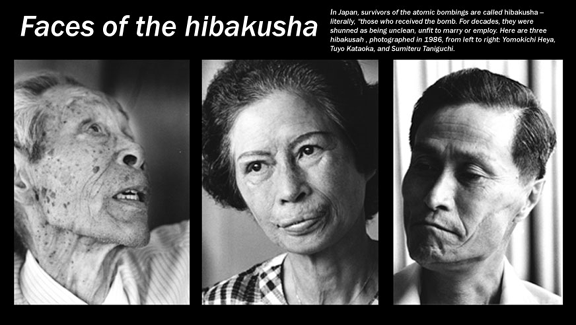
UN News, 15 January 2022, Peace and Security, Despite the annihilation of two major Japanese cities in 1945, atomic bombs have not been relegated to the pages of history books, but continue to be developed today – with increasingly more power to destroy than they had when unleashed on Hiroshima and Nagasaki back in 1945.
Those first nuclear weapons deployed by the United States, indiscriminately killed tens of thousands of non-combatants but also left indelible scars for the immediate survivors, that they, their children and grandchildren still carry today.
“The Red Cross hospital was full of dead bodies. The death of a human is a solemn and sad thing, but I didn’t have the time to think about it because I had to collect their bones and dispose of their bodies”, a then 25-year-old woman said in a recorded testimony, 1.5 km from Hiroshima’s ground zero.
“This was truly a living hell, I thought, and the cruel sights still stay in my mind”
To highlight the tireless work of the survivors, known in Japanese as the hibakusha, the UN’s Office for Disarmament Affairs, created an exhibition at UN Headquarters in New York which has just come to a close, entitled: Three Quarters of a Century After Hiroshima and Nagasaki: The Hibakusha—Brave Survivors Working for a Nuclear-Free World.
It vividly brings to life the devastation and havoc wreaked by those first atomic bombs (A-bombs), and their successor weapons, the more powerful hydrogen bombs (H-bombs) which began testing in the 1950s
Quest to save humanity
In the aftermath of the bombings in Japan, the hibakusha, conducted intense investigations with the aim of preventing history from repeating itself.
With an average age of 83 today, the dwindling band continue to share their stories and findings with supporters at home and abroad, “to sav[ing] humanity…through the lessons learned from our experiences, while at the same time saving ourselves”, they say, in the booklet No More Hibakusha -Message to the World, which accompanies the exhibit.
Recounting the day in Hiroshima that 11 members of her family slept together in an air raid shelter, a then 19-year-old woman spoke of how three small children died during the night, while calling for water.
“The next morning, we carried their bodies out of the shelter, but their faces were so swollen and black that we couldn’t tell them apart, so laid them out on the ground according to height and decided their identities according to their size”.
These brave survivors testify that peace cannot be achieved ever, through the use of nuclear weapons.
‘Absolute evil’
A group of elderly hibakusha, called Nihon Hidankyo, have dedicated their lives to achieving a non-proliferation treaty, which they hope will ultimately lead to a total ban on nuclear weapons.
“On an overcrowded train on the Hakushima line, I fainted for a while, holding in my arms my eldest daughter of one year and six months. I regained my senses at her cries and found no-one else was on the train”, a 34-year-old woman testifies in the booklet. She was located just two kilometres from the Hiroshima epicentre.
Fleeing to her relatives in Hesaka, at age 24 another woman remembers that “people, with the skin dangling down, were stumbling along. They fell down with a thud and died one after another”, adding, “still now I often have nightmares about this, and people say, ‘it’s neurosis’”.
One man who entered Hiroshima after the bomb recalled in the exhibition, “that dreadful scene – I cannot forget even after many decades”.
A woman who was 25 years-old at the time, said, “when I went outside, it was dark as night. Then it got brighter and brighter, and I could see burnt people crying and running about in utter confusion. It was hell…I found my neighbour trapped under a fallen concrete wall…Only half of his face was showing. He was burned alive”.Uniting for peace
The steadfast conviction of the Hidankyo remains: “Nuclear weapons are absolute evil that cannot coexist with humans. There is no choice but to abolish them”.
In August 1956, the survivors of the 1945 atomic bombs in Hiroshima on 6 August and Nagasaki three days later, formed the “Japan Confederation of A and H-Bomb Sufferers Organizations”.
Encouraged by the movement to ban the atomic bomb that was triggered by the Daigo Fukuryu Maru disaster – when 23 men in a Japanese tuna fishing boat were contaminated by nuclear fallout from a hydrogen bomb test at Bikini Atoll in 1954 – they have not wavered in their efforts to prevent others from becoming nuclear victims.
“We have reassured our will to save humanity from its crisis through the lessons learned from our experiences, while at the same time saving ourselves”, they declared at the formation meeting.
The spirit of the declaration, in which their own sufferings are linked to the task of preventing the hardship that they continue to carry, resonates still in the movement today…………………………………………….
The hibakusha became more and more vocal in the suffering that was inflicted upon them, hoping that it could help create a road map towards the abolition of nuclear weapons.
In oral testimonies, they shared their experiences both during and after the bombings and sent written messages to the NPT Review Conference in 2010 appealing to the world.
In July 2017, the Treaty on the Prohibition of Nuclear Weapons (TPNW), which complements the NPT, was adopted and came into force last year on 22 January……………………
the UN is committed to ensuring their testimonies live on, as a warning to each new generation.
The Hibakusha are a living reminder that nuclear weapons pose an existential threat and that the only guarantee against their use is their total elimination”, Mr. Guterres stated. “This goal continues to be the highest disarmament priority of the United Nations, as it has been since the first resolution adopted by the General Assembly in 1946”.
While the Tenth Review Conference of the NPT, which had been scheduled for January, has been postponed on account of the COVID-19 pandemic, he continued to urge world leaders to “draw on the spirit of the Hibakusha” by putting aside their differences and taking “bold steps towards achieving the collective goal of the elimination of nuclear weapons”. https://news.un.org/en/story/2022/01/1109602
Japan to join with NuScam, Bill Gates’ TerraPower, to develop plutonium fast reactors and small nuclear reactors
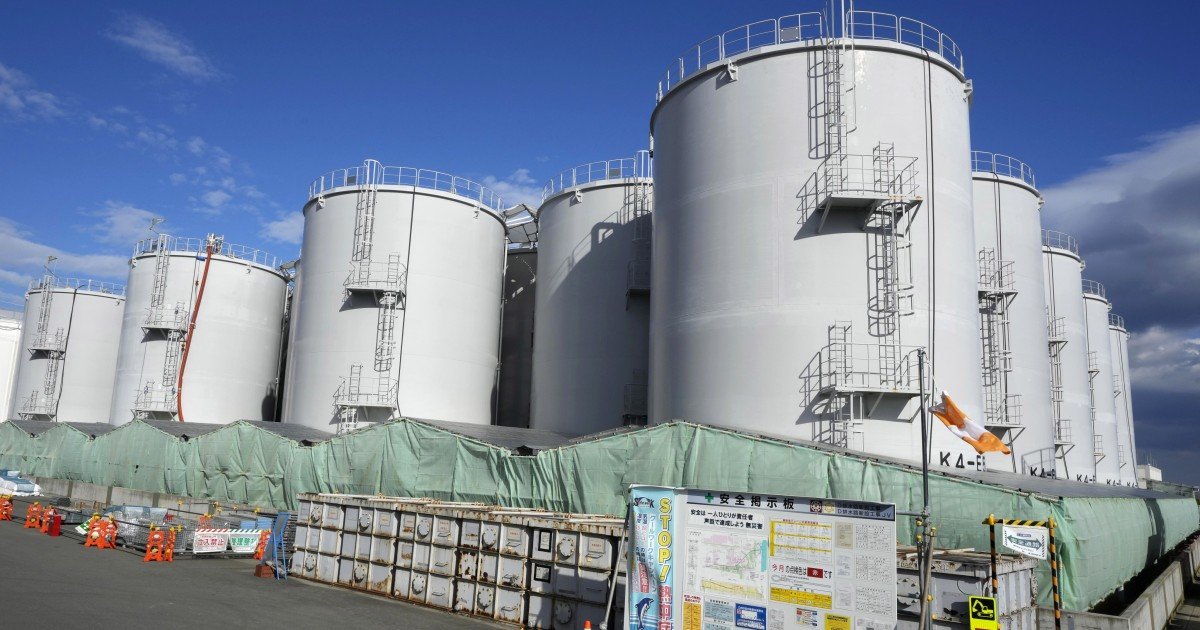
there is considerable skepticism of nuclear energy in Japan, and critics are concerned that the government is moving ahead with alliances with the United States to create new technologies while there are so many unanswered questions about safety
Next-Gen Nuclear Technology – US’ Ambitious Nuclear Power Pact With Tokyo Could Fuel Japanese Industry For Decades, BySakshi Tiwari, Eurasia Times, January 14, 2022 ”………………… (Japan) is set to give nuclear technology an all-new shot……………… Collaboration with scientists and companies in the United States will be a key component in the development of future nuclear energy technology
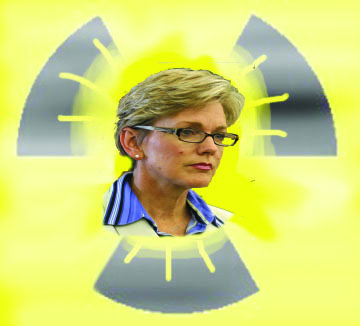
Japan’s Minister of Industry Koichi Hagiuda had a virtual meeting with US Energy Secretary Jennifer Granholm on January 6 during which they agreed to cooperate in the development of plutonium-burning fast reactors and advanced energy plants based on small modular reactors (SMRs).
Hagiuda told Granholm that Tokyo will encourage more local energy companies to join an international program to test fast reactors and small modular reactors, or SMRs, developed by US companies such as NuScale Power LLC and others.
The meeting, Hagiuda’s first since taking office last year, took place at a time when Japan is stepping up its efforts to develop advanced nuclear power technologies.
The Japanese government intends to promote domestic enterprises that participate in international tests incorporating such technology as part of its national energy plan. The United States and France are among the other international participants in the initiative…………………………..
in a noteworthy development that could now be seen as a premise for this new technology development, the Japanese government made it clear in its Sixth Strategic Energy Plan, released in October that it intends to move on from the events in northeast Japan………………..
In 2018, Japan and the United States had signed a memorandum of understanding to “advance the two countries’ worldwide leadership role” in civil nuclear energy.
“The Japan Atomic Energy Agency [JAEA] and Mitsubishi Heavy Industries are cooperating with US nuclear power start-up TerraPower simply because they have the required skills and knowledge on fast reactors,” says Tomoko Murakami, manager of the nuclear energy group at the Institute of Energy Economics Japan.
In the first stage of the alliance, Tokyo would spend 900 million yen ($7.8 million) on improving the AtheNa sodium experimental plant in Ibaraki prefecture for fast reactor development. The facility operated by Japan Atomic Energy Agency (JAEA) is already in operation, and an MoU on technological cooperation with TerraPower is expected to be inked by the end of January, SCMP reported.
In 2018, Japan and the United States had signed a memorandum of understanding to “advance the two countries’ worldwide leadership role” in civil nuclear energy.
“The Japan Atomic Energy Agency [JAEA] and Mitsubishi Heavy Industries are cooperating with US nuclear power start-up TerraPower simply because they have the required skills and knowledge on fast reactors,” says Tomoko Murakami, manager of the nuclear energy group at the Institute of Energy Economics Japan.
The system is meant to extract heat from a reactor core using liquid sodium to generate electricity. The facility will also be used in the cooperative development of a next-generation fast reactor with the United States, while work is also underway at another location, Joyo, to study the impact of neutrons on fuels and other equipment using sodium as a coolant……………………

With American experience in the technology and two of its companies deeply invested in it, Japan has a natural partner to cooperate with. Terrapower is a start-up, which is rigorously working on SMR technology and is partially funded by the American billionaire and philanthropist Bill Gates.
Another US giant working on this advanced next-generation technology is NuScale Power which has partnered with the US government on SMR development for third countries………….
Nonetheless, there is considerable skepticism of nuclear energy in Japan, and critics are concerned that the government is moving ahead with alliances with the United States to create new technologies while there are so many unanswered questions about safety, according to the SCMP.
“All the media coverage has become very positive about these new developments and the technology alliance with the US, but we must remember that at the moment fast reactor technology exists only on paper and there are no guarantees that it will be a success,” Hajime Matsukubo, secretary-general of the Tokyo-based Citizens’ Nuclear Information Centre (CNIC) was quoted as saying.
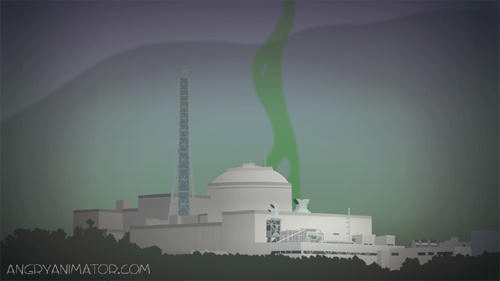
“Japan has already spent 1 trillion yen [US$8.7 billion] on fast reactor research and another 1 trillion yen on decommissioning the experimental Monju reactor, to say nothing of what is being spent on all the work at Fukushima and decommissioning all the other reactors around the country. So it’s ridiculous to spend even more on nuclear technology that so many people do not want and do not trust,” he added.
The billions spent on nuclear power, according to CNIC, would have been far better used in establishing a local renewable sector that could have tapped into geothermal, wind, wave, solar, and other sources — and would have been the envy of the world.
It also warns that due to Japan’s unstable geology, a replay of the Fukushima accident – or a situation far worse –always remains a possibility……
Severely damaged fuel at Fukushima No 1 reactor – survey to find this has been halted.

Survey at Fukushima No. 1 reactor container halted, https://www.japantimes.co.jp/news/2022/01/12/national/tepco-fukushima-survey-halted/ Tokyo Electric Power Company Holdings Inc. halted its investigation of the inside of the containment vessel of the No. 1 reactor at its stricken Fukushima No. 1 nuclear power plant on Wednesday.
The move came after an issue was found during preparation work for the display of data such as radiation levels from dosimeters inside underwater robots to be used in the survey. The preparations began at noon the same day and were halted around two hours later.
Tepco said that it will resume the survey once measures to resolve the issue are taken.
In the survey, which will continue until around August, Tepco aims to take pictures of melted nuclear fuel debris and other deposits using six types of underwater robots to record their locations and thickness in water that has accumulated at the bottom of the containment vessel.
It will also try to collect deposit samples and take pictures of the inside of the base that supports the reactor pressure vessel. The information obtained in the survey will be used for studies on ways to remove the debris.
The nuclear fuel at the No. 1 reactor’s core is believed to have melted and mostly fallen inside the containment vessel during the triple meltdown disaster at the plant, which was hit by a huge earthquake and tsunami on March 11, 2011.
In its survey of March 2017, Tepco failed to find nuclear fuel debris at the No. 1 reactor, leaving the reactor’s detailed situation unknown, in contrast to the No. 2 and No. 3 reactors, where melted fuel debris was successfully photographed.
Growing radioactive waste crisis at Fukushima nuclear power plant

The continuous accumulation of radioactive slurry and other nasty substances, coupled with the problem of finding a safe way to dispose of melted nuclear fuel debris at reactors No. 1, No. 2 and No. 3, has plant operator Tokyo Electric Power Co. frantically scratching around for ideas.
One problem is that storage containers for the tainted slurry degrade quickly, meaning that they constantly have to be replaced.
TEPCO slow to respond to growing crisis at Fukushima plant, THE ASAHI SHIMBUN, by Yu Fujinami and Tsuyoshi Kawamura, January 2, 2022, Radioactive waste generated from treating highly contaminated water used to cool crippled reactors at the Fukushima No. 1 nuclear power plant has thrown up yet new nightmarish challenges in decommissioning the facility, a project that is supposed to be completed in 30 years but which looks increasingly doubtful.
The continuous accumulation of radioactive slurry and other nasty substances, coupled with the problem of finding a safe way to dispose of melted nuclear fuel debris at reactors No. 1, No. 2 and No. 3, has plant operator Tokyo Electric Power Co. frantically scratching around for ideas.
One problem is that storage containers for the tainted slurry degrade quickly, meaning that they constantly have to be replaced. Despite the urgency of the situation, little has been done to resolve the matter.
Fuel debris, a solidified mixture of nuclear fuel and structures inside the reactors melted as a consequence of the triple meltdown triggered by the 2011 earthquake and tsunami disaster has to be constantly cooled with water, which mixes with groundwater and rainwater rainwater that seep into the reactor buildings, producing more new radioactive water.
The contaminated water that accumulates is processed via an Advanced Liquid Processing System to remove most of radioactive materials. The ALPS is housed in a 17-meter-tall building situated close to the center of the plant site.
Reporters from the Japan National Press Club were granted a rare opportunity in late November to visit the crippled facility to observe the process.
The building houses a large grayish drum-like container designed especially to store radioactive slurry. The interior of each vessel is lined with polyethylene, while its double-walled exterior is reinforced with stainless steel.
ALARMING DEVELOPMENTS The use of chemical agents to reduce radioactive substances from the contaminated water in the sedimentation process produces a muddy material resembling shampoo. Strontium readings of the generated slurry sometimes reach tens of millions of becquerels per cubic centimeter.
TEPCO started keeping slurry in special vessels in March 2013. As of November, it had 3,373 of the containers.
Because the integrity of the vessels deteriorates quickly due to exposure to radiation from slurry, TEPCO and the Nuclear Regulation Authority (NRA) predict that durability of the containers will reach the limit after exposure to an accumulated total of 5,000 kilograys of radiation–a level equivalent to 5 million sieverts.
Based on that grim forecast, TEPCO speculated the vessels will need replacement from July 2025.
But the NRA accused TEPCO of underestimating the impact of the radiation problem. It blasted the operator for measuring slurry density 20 centimeters above the base of the container when making its dose evaluation.
“As slurry forms deposits, the density level is always highest at the bottom,” a representative of the nuclear watchdog body pointed out.

The NRA carried out its own assessment in June 2021 and told TEPCO that 31 containers had already reached the end of their operating lives. Its findings also showed an additional 56 would need replacing within two years.The NRA told TEPCO to wake up and “understand how urgent the issue is since transferring slurry will take time.”………………..
With no drastic solutions in sight, a succession of containers will reach the end of their shelf lives shortly.
ANOTHER NIGHTMARE PROBLEM Radioactive slurry is not the only stumbling block for decommissioning.
In the immediate aftermath of the 2011 disaster, TEPCO stored contaminated water in the underground spaces below two buildings near the No. 4 reactor. In doing so, bags full of a mineral known as zeolite were placed in the temporary storage pools to absorb cesium so as to reduce the amount of radioactive substances.
Twenty-six tons of the stuff are still immersed in the dirty water on the floors under the buildings. Radiation readings of 4 sieverts per hour were detected on their surfaces in fiscal 2019, enough to kill half of all the people in the immediate vicinity within an hour.
TEPCO plans to introduce a remotely controlled underwater robot to recover the bags, starting no earlier than from fiscal 2023, However, it has not determined how long this will take or where to store the bags once they are retrieved.
In addition, radioactive rubble, soil and felled trees at the plant site totaled 480,000 cubic meters as of March 2021, leading TEPCO to set up a special incinerator. The total volume is expected to top 790,000 cubic meters in 10 years, but where to dispose of the incinerated waste remains unclear.
TEPCO is in a race against time. That’s the view of Satoshi Yanagihara, a specially appointed professor of nuclear engineering at the University of Fukui who has specialist knowledge on processes to abandon reactors.
“Now, only 30 years remain before the target date of the end of decommissioning set by the government and TEPCO,” said Yanagihara.As decommissioning work is due to shortly enter a crucial stage, such as recovering nuclear fuel debris on a trial basis from as early as 2022, Yanagihara noted the need for careful arrangements before forging ahead with important procedures.
“The government and TEPCO need to grasp an overall picture of the massive task ahead and discuss how to treat, keep and discard collected nuclear debris and the leftover radioactive waste with local residents and other relevant parties,” he said.https://www.asahi.com/ajw/articles/14503708
Protesters call for abolition of nuclear weapons
Protesters call for abolition of nuclear weapons, https://www3.nhk.or.jp/nhkworld/en/news/20220102_02/ Protesters in the Japanese city of Nagasaki took part in a sit-in on New Year’s Day and called for the abolition of nuclear weapons. A sit-in is held in the city every year on January 1. Nagasaki was hit by an atomic bomb during World War Two.
More than 60 people participated in the protest in the city’s Peace Park on Saturday.
The protesters observed a moment of silence at 11:02 a.m. The atomic bomb exploded in Nagasaki at that time on August 9, 1945. The participants held up pieces of paper with the word “peace” written on them in Japanese.
Atomic bomb survivor Tanaka Yasujiro said 2022 will be an important year. He said he wants non-nuclear countries to surround nuclear states, so that the number of nuclear warheads can be reduced.
The states, which signed the UN treaty that bans nuclear weapons, are scheduled to meet for the first time in March 2022.
The Review Conference of the Treaty on the Non-Proliferation of Nuclear Weapons may be held in August.
Parties to the NPT meet every five years to review the accord. A meeting was scheduled to take place in January. But the participants agreed to postpone it for the fourth time, due to the coronavirus pandemic. Various options are now being considered. A gathering in August is a possibility.
Japan’s plan for dumping nuclear waste-water into the sea
Japan’s government on Tuesday mapped out a plan for releasing contaminated
water from the crippled Fukushima nuclear plant into the sea, including
compensation standards for local industry and the compilation of a safety
assessment report. Japan said in April it would discharge more than 1
million tonnes of contaminated water in stages after treatment and
dilution, starting around spring 2023. The announcement provoked concerns
from local fishermen and objections from neighbouring China and South
Korea.
Reuters 28th Dec 2021
Kashiwazaki-Kariwa nuclear powerplant out of action for many months due to 74 instances of defective welding
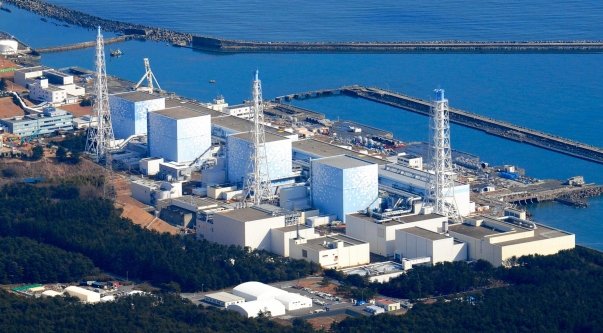
| Shoddy welding maintenance work at the Kashiwazaki-Kariwa nuclear power plant in Niigata Prefecture will push back moves to bring the facility back online by many months, perhaps longer, its operator Tokyo Electric Power Co. acknowledged. The No. 7 reactor has been plagued by problems to do with installing safeguards against terrorist attacks that required further work and a new round of inspections by the Nuclear Regulation Authority, the nation’s nuclear watchdog body. TEPCO announced Dec. 24 that it had uncovered 74 instances of defective welding that is essential to safe operations of the nuclear reactor. The utility said it had been tipped off anonymously on several occasions since March about shoddy welding work done by a subcontractor. In its latest announcement, TEPCO acknowledged the problem and said welding would have to be redone at 1,200 or so sections, a process that will likely take until next summer. Asahi Shimbun 25th Dec 2021 https://www.asahi.com/ajw/articles/14510525 |
1 This Month



26 September – International Day for the Total Elimination of Nuclear Weapons


PLEASE OPPOSE HR 8255 AND S.3639 – bills would accelerate satellite deployment, with no environmental review or safeguards – https://ncstd5li.quorum.us/campaign/169331/
To see nuclear-related stories in greater depth and intensity – go to https://nuclearinformation.wordpress.com
-
Archives
- September 2026 (234)
- August 2026 (330)
- July 2026 (355)
- June 2026 (287)
- May 2026 (306)
- April 2026 (356)
- March 2026 (251)
- February 2026 (267)
- January 2026 (308)
- December 2025 (358)
- November 2025 (359)
- October 2025 (375)
-
Categories
- 1
- 1 NUCLEAR ISSUES
- business and costs
- climate change
- culture and arts
- ENERGY
- environment
- health
- history
- indigenous issues
- Legal
- marketing of nuclear
- media
- opposition to nuclear
- PERSONAL STORIES
- politics
- politics international
- Religion and ethics
- safety
- secrets,lies and civil liberties
- spinbuster
- technology
- Uranium
- wastes
- weapons and war
- Women
- 2 WORLD
- ACTION
- AFRICA
- Atrocities
- AUSTRALIA
- Christina's notes
- Christina's themes
- culture and arts
- Events
- Fuk 2022
- Fuk 2023
- Fukushima 2017
- Fukushima 2018
- fukushima 2019
- Fukushima 2020
- Fukushima 2021
- general
- global warming
- Humour (God we need it)
- Nuclear
- RARE EARTHS
- Reference
- resources – print
- Resources -audiovicual
- Weekly Newsletter
- World
- World Nuclear
- YouTube
-
RSS
Entries RSS
Comments RSS
 nuclear-news