How the nuclear establishment distorts radiation surveys
One problem is that the survey only calculates mortality ratios, ignoring people who might have cancer but are still alive at the time of the survey. Such obvious methodological bias is frequent in this sort of surveys. In France and other countries, another bias is the tendency to ignore contract workers, though they receive the highest cumulative radioactive doses. Therefore, it is difficult to resist the conclusion that the very goal of these epidemiological surveys is to minimize the risks of nuclear radiation and encourage the nuclear industry’s business as usual.
Dying for TEPCO?Fukushima’s Nuclear Contract Workers, TheAsiaPacific Journal , Paul Jobin 28 April 11, “…..What is the objective of epidemiological surveys?An epidemiological survey published in March, just before the catastrophe, was based on a huge cohort of 212,000 persons recorded between 1990 and 1999, out of the total of 277,000 who had worked in nuclear plants. The survey found a significant mortality ratio for only one type of leukemia and judged that other forms of cancer among this population could not be attributed to their exposure to radiation at nuclear plants. Continue reading
Government and nuclear industry intertwined in Japan
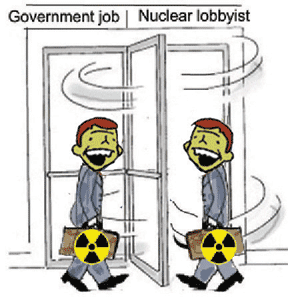 nuclear industry officials, bureaucrats, politicians and scientists — have prospered by rewarding one another with construction projects, lucrative positions, and political, financial and regulatory support. ……Japan would make the sale of nuclear reactors and technology the central component of a long-term export strategy to energy-hungry developing nations. A new company, the International Nuclear Energy Development of Japan, was created to do just that. Its shareholders were made up of the country’s nine main nuclear plant operators, three manufacturers of nuclear reactors and the government itself.
Safety Left Out in Japan’s ‘Nuclear  Power Village, Culture of Complicity Tied to Stricken Nuclear Plant, New York Times, By NORIMITSU ONISHI and KEN BELSON, April 26, 2011 “……..Revolving Door In Japan, the web of connections between the nuclear industry and government officials is now popularly referred to as the “nuclear power village.” The expression connotes the nontransparent, collusive interests that underlie the establishment’s push to increase nuclear power despite the discovery of active fault lines under plants, new projections about the size of tsunamis and a long history of cover-ups of safety problems. Continue reading
Fukushima will eventually be many times worse than Chernobyl
 Chernobyl is over. Fukushima hasn’t really begun. Chernobyl released a huge radioactive cloud when it blew up. Fukushima will exceed the Chernobyl release in a year no matter what else happens…..Fukushima will be many times worse than Chernobyl and will continue for, possibly, hundreds of years.
Fukushima Could Be Worse — And It Will Be, April 25,  2011, Hawaii News Daily, By Tom Burnett “.. F-Daiichi is releasing 154 teraBecquerels of radionuclide particulate matter a day. Almost all of the reports repeat the statement that Fukushima has (so-far) released only about 10% of the radiation Chernobyl released. No problem. Well, they say, “It COULD have been worse.” IT WILL BE! Continue reading
No room for complacency about Japan’s nuclear reactors
Every functional nuclear plant is being pushed to the limit and beyond in order to maintain a semblance of normality – but they are ALL in bad repair and are sitting ducks for the next mega-quake….or for ONE overworked plant manager to make a bad decision. Or simply overuse…………There also seem to be problems at :
Onagawa reactor #3
Fukushima Daini reactor #3
Tokai Reactor #3
Kashiwazaki reactor #3……the core is generating deadly radiation
Fukushima Could Be Worse — And It Will Be, April 25, 2011, Hawaii News Daily, By Tom Burnett “……..I have information from Yoichi ‘boots on the ground’ that smoke was emitting from Kashiwazaki last week after the MAG 7,1 EQ. which occurred off Honshu on 7 APR 2011. Continue reading
How a Fukushima safety whistleblower was blackballed
Despite a new law shielding whistle-blowers, the regulator, the Nuclear and Industrial Safety Agency, divulged Mr. Sugaoka’s identity to Tokyo Electric, effectively blackballing him from the industry
Safety Left Out in Japan’s ‘Nuclear Power Village, Culture of Complicity Tied to Stricken Nuclear Plant, New York Times, By NORIMITSU ONISHI and KEN BELSON, April 26, 2011, TOKYO — Given the fierce insularity of Japan’s nuclear industry, it was perhaps fitting that an outsider exposed the most serious safety cover-up in the history of Japanese nuclear power. It took place at Fukushima Daiichi, the plant that Japan has been struggling to get under control since last month’s earthquake and tsunami. Continue reading
Nuclear Safety Commission – hourly Fukushima Radiation forecasts
Nuclear Body To Issue Hourly Radiation Forecasts, TOKYO (Nikkei) April 26–The Nuclear Safety Commission said Monday that it will start issuing forecasts of how airborne radioactive material may be spreading out by the hour from the Fukushima Daiichi power plant.
Starting Tuesday, the commission’s Web site will show hour-by-hour data from SPEEDI, a system that analyzes and predicts dispersal of radioactive material in the event of a nuclear emergency.
Run by the government-affiliated Nuclear Safety Technology Center, the system has taken flak for publishing results just twice since the Fukushima crisis began, despite 11.3 billion yen in development and operating costs……..http://e.nikkei.com/e/fr/tnks/Nni20110426D25JFA23.htm
Japanese govt raises “acceptable”radiation standard for children
3.8 μSv/h is roughly 6 times the standard for “Radiation Controlled Areas” (0.6 μSv/h or more). The Labour Standards Act prohibits those under the age of 18 from working under these conditions. Forcing children to be exposed to such radiation doses is an exceedingly inhumane decision….”The cancer risk will visibly rise in the future. By setting these standards, the government will steer clear of any liability legally, however not morally.”
 Urgent Petition Against Imposing 20 milli-sievert Radiation Exposure Standard onto Children in Fukushima
http://blog.canpan.info/foejapan/daily/201104/24
On April 19th, the Ministry of Education, Culture, Sports, Science and Technology (MEXT) notified the Board of Education and related institutions in Fukushima Prefecture the level of 20 milli-sievert per year (mSv/y) as a Radiation Safety Standard for schools in Fukushima Prefecture. This is the standard to be used for school grounds and buildings. The Government has indicated that 20 mSv/y is equivalent to 3.8 micro-sievert per hour (μSv/h) measured outdoors. Continue reading
Fukushima debris too radioactive for workers to deal with
The legal limit on the amount of radiation a worker can be exposed to has been raised to 250 millisieverts for the crisis. It takes less than 17 minutes to hit that limit when working in an environment being exposed to 900 millisieverts per hour.
Hot debris hampers reactor repairs, Radiation map shows hazards lurking around every corner, Japan Times, Kyodo, 25 April 11, A contamination map revealing radiation levels at about 150 places in the Fukushima No. 1 power plant was released Saturday by troubled Tokyo Electric Power Co………One finding acquired from the map’s data as of Wednesday night is that a piece of concrete debris near the No. 3 reactor was emitting a nearly lethal 900 millisieverts per hour of radiation. Continue reading
Atmospheric radiation from Fukushima greater than they thought
.On April 17, plant operator Tokyo Electric Power Co. said in its plan for stabilization of the crippled reactors it would not start to get radiation leakage under control until the plan’s fourth month of implementation.
Atmospheric radiation leak underestimated, The Yomiuri Shimbun, 25 April 11, Data released by the government indicates radioactive material was leaking into the atmosphere from the Fukushima No. 1 nuclear power plant in early April in greater quantities than previously estimated. Continue reading
Deep underground wall to circle Fukushima nuclear plant?
 Japanese government considers underground wall to contain Fukushima radiation Miami Herald, 24 April 11, THE YOMIURI SHIMBUN TOKYO –– The Japanese government is considering building an underground barrier near the Fukushima No. 1 nuclear power plant to prevent radioactive material from spreading far from the plant via soil and groundwater, a senior government official said.
Sumio Mabuchi, a special adviser to the prime minister, revealed the plan Friday at the Japan National Press Club building in Tokyo. The plan is the first attempt to address the risk of contaminated water spreading far from the plant through soil.
According to Mabuchi, the barrier would extend so far underground that it would reach a layer that does not absorb water. The wall would entirely surround the land on which reactors No. 1, 2, 3 and 4 stand……. Read more: http://www.miamiherald.com/2011/04/23/2182117/japanese-government-considers.html#ixzz1KUAzGal2
Plutonium and Japan’s censorship of media
Now the Japanese government has moved to crack down on independent reportage and criticism of the government’s policies in the wake of the disaster by deciding what citizens may or may not talk about in public. A new project team has been created by the Ministry of Internal Affairs and Communication, the National Police Agency, and METI to combat “rumors” deemed harmful to Japanese security in the wake of the Fukushima disaster…..”The measures include erasing any information from internet sites that the authorities deem harmful to public order and morality…….
 Fukushima Residents Seek Answers Amid Mixed Signals From Media, TEPCO and Government. Report from the Radiation Exclusion Zone Asia Pacific Journal Makiko SEGAWA in Fukushima, 1
 8 April 11

“……There is one particularly telling example of the media shielding TEPCO by suppressing information. This concerns “plutonium”. According to Uesugi, after the reactor blew up on March 14, there was concern about the leakage of plutonium. However, astonishingly, until two weeks later when Uesugi asked, not a single media representative had raised the question of plutonium at TEPCO’s press conferences.
On March 26, in response to Uesugi’s query, TEPCO stated, “We do not measure the level of plutonium and do not even have a detector to scale it.” Ironically, the next day, Chief Cabinet Secretary Edano announced that “plutonium was detected”. Continue reading
Censorship of radioactive fallout reports
Comparison Of Censored And Uncensored Japan Fukushima Nuclear Radiation Fallout Forecast
 Active map Cover up of Japan Fukushima Nuclear Radiation Fallout Forecasts Exposed!
I previously reported on the steady concentrated stream of Nuclear radioactive fallout heading toward the US and Canada. In that post I pointed out that several censored radiation forecasts have been found but were never released to the public.
We now have for the first time a side by side comparison of two radiation fallout forecasts. On the left is the censored version released to the public downplaying the levels of radiation spreading around the world. On the right is the same uncensored forecast…. http://blog.alexanderhiggins.com/2011/04/19/comparison-censored-uncensored-japan-nuclear-radiation-fallout-forecast-18514/
520 tonnes of high level radioactive water into sea off Fukushima
 Japan’s nuclear leak into ocean at catastrophic levels
RT.com news 21 April, 2011 The Tokyo Electric Power Company says radioactive substances that leaked into the sea at the damaged Fukushima plant over six days in April exceed the annual allowable limit by 20,000 times.
The plant operator said it calculated the total amount of leaked water assuming that the leak began on April 1st. Some 520 tonnes of the high-level radioactive water have likely reached the sea during the period, reports Japan’s Broadcasting Corporation NHK.
The announcement comes as the government brought into effect the entry ban for the 20-kilometer evacuation area around the paralyzed nuclear complex. Police found more than 60 families still living within the contaminated area. …. http://rt.com/news/fukushima-plant-radioactive-leakage/
15 metre wall planned to protect Kashiwazaki Kariwa nuclear plant
Tepco to Build Wall for Nuclear Plant After Fukushima Disaster Bloomberg, By Tsuyoshi Inajima – Apr 21, 2011 Electric Power Co. will build a seawall to protect its biggest atomic power station from a tsunami like the one that knocked out its Fukushima Dai-Ichi plant, causing the worst nuclear crisis in 25 years.
Japan’s biggest power company, known as Tepco, plans to construct a wall to a height of 15 meters (50 feet) above sea level off the coast of its Kashiwazaki Kariwa plant northwest of Tokyo, spokeswoman Ai Tanaka said by phone. Three of seven reactors remain shut at the station after an earthquake in 2007 caused radiation leaks.
Tepco has been battling to contain radiation spewing from the Fukushima plant after a magnitude-9 quake on March 11 unleashed a tsunami that flooded the station, knocking out cooling systems. The company won’t get approval to start the remaining reactors at Kashiwazaki until it resolves the crisis at Fukushima, a local government official said on April 6.
Japan’s government last week raised the severity rating of the Fukushima crisis to the highest on an international scale, the same level as the Chernobyl disaster in 1986. The station, which has withstood hundreds of aftershocks, may release more contamination than Chernobyl before the crisis is contained, Tepco officials said. …..http://www.bloomberg.com/news/2011-04-22/tepco-to-build-wall-for-nuclear-plant-after-fukushima-disaster.html
Problematic evacuation of Japanese from nuclear zone
Japanese Revisit Nuclear Zone While They Can, New York Times, By ANDREW POLLACK April 21, 2011 “……In Futaba, a town next to the plant, several signs stretching across the empty streets extolled the virtues of atomic energy. “Nuclear power is energy for a brighter future,” read one. Another said, “The correct understanding of nuclear power leads to a better life.”
And at the gate of the Fukushima Daiichi plant itself, workers in white suits and masks turned away an unauthorized car while photographing its license plate. On a board behind the workers someone had written, “Don’t give up.” …… Continue reading
-
Archives
- October 2026 (112)
- September 2026 (339)
- August 2026 (330)
- July 2026 (355)
- June 2026 (287)
- May 2026 (306)
- April 2026 (356)
- March 2026 (251)
- February 2026 (267)
- January 2026 (308)
- December 2025 (358)
- November 2025 (359)
-
Categories
- 1
- 1 NUCLEAR ISSUES
- business and costs
- climate change
- culture and arts
- ENERGY
- environment
- health
- history
- indigenous issues
- Legal
- marketing of nuclear
- media
- opposition to nuclear
- PERSONAL STORIES
- politics
- politics international
- Religion and ethics
- safety
- secrets,lies and civil liberties
- spinbuster
- technology
- Uranium
- wastes
- weapons and war
- Women
- 2 WORLD
- ACTION
- AFRICA
- Atrocities
- AUSTRALIA
- Christina's notes
- Christina's themes
- culture and arts
- Events
- Fuk 2022
- Fuk 2023
- Fukushima 2017
- Fukushima 2018
- fukushima 2019
- Fukushima 2020
- Fukushima 2021
- general
- global warming
- Humour (God we need it)
- Nuclear
- RARE EARTHS
- Reference
- resources – print
- Resources -audiovicual
- Weekly Newsletter
- World
- World Nuclear
- YouTube
-
RSS
Entries RSS
Comments RSS

