Fukushima Plants Showing ‘Unusual Growing Patterns’
NewsWeek, BY ROBYN WHITE ON 8/31/22 , Japan’s Fukushima, the site of the world’s second-worst nuclear disaster, is showing “unusual growing patterns” among vegetation in the area because of the radiation contamination.
…………………… Tim Mousseau, a professor of biological sciences at the University of South Carolina and a radiation expert, told Newsweek that a “vast region near the power plant” is still “significantly contaminated” but that levels are much lower than they used to be. However, the effects of radiation continue to be seen in the plants in the area, he said.
“There have been a few studies of the plants showing effects of the radiation. For example, it has been shown that Japanese fir trees show unusual growth patterns similar to that observed for pine trees in Chernobyl,” Mousseau said. “Such effects are still open for study, as they are preserved in the growth form of the plant/tree as long as it is still living.”
He continued, “Many areas are still contaminated above levels that most would consider safe for people to live, although most of the region is now relatively safe for short visits.”
Carmel Mothersill, a radiobiologist and the Canada research chair in environmental radiobiology, said that remediation efforts have also affected the area’s vegetation.
………. Mousseau also said that the ongoing effects of the contamination and “other human disturbances” remain largely unknown, as “research in the region has dropped off dramatically in the past years because of COVID and Japan’s restrictions on visitors from outside the country.”
“Assuming Japan removes travel restrictions, more research will be conducted,” he said
While some areas are opening back up to the public, most of the Fukushima area remains evacuated, Mothersill said…….. https://www.newsweek.com/fukushima-plants-unusal-gorwing-patterns-1738525
Fukushima town lifts evacuation order, but few former residents want to come back
More than 80% of the municipality is designated as a “difficult-to-return” zone still experiencing high levels of radiation, the spokesman said. And a survey conducted last August found that 60.5% of residents had decided not to return — far exceeding the 11.3% who wanted to come back.
Fukushima town lifts evacuation order, allowing former residents to return 11 years after nuclear disaster, By Emiko Jozuka and Jessie Yeung, CNN, August 30,
Tokyo (CNN)More than a decade after Japan’s worst nuclear disaster, the town that hosts the disabled Fukushima Daiichi nuclear power plant finally lifted its evacuation order on Tuesday, allowing former residents to come home.
The town of Futaba, previously deemed off-limits, is the last of 11 districts to lift its evacuation order, a spokesman for the town’s municipal office told CNN.
On March 11, 2011, a 9.0-magnitude earthquake struck off Japan’s east coast, triggering a tsunami that caused a nuclear meltdown at the power plant and a major release of radioactive material. It was the world’s worst nuclear disaster since Chernobyl in 1986.
More than 300,000 people living near the nuclear plant were forced to evacuate temporarily; thousands more did so voluntarily. Once-bustling communities were turned into ghost towns.
In the years since, large-scale cleanup and decontamination operations have allowed some residents who once lived in the former exclusion zone to return.
…………………….Authorities began preparing for the town’s reopening this year; in January, they launched a program allowing former residents to return temporarily, but only 85 people from 52 households took part, the Futaba official said……………….It remains unclear, however, how many people will return — and how long the town will take to recover.
More than 80% of the municipality is designated as a “difficult-to-return” zone still experiencing high levels of radiation, the spokesman said. And a survey conducted last August found that 60.5% of residents had decided not to return — far exceeding the 11.3% who wanted to come back.
Futaba has no official timeline on when other areas of the town will be fully decontaminated.
But the spokesman expressed hope for the town’s future, saying Futaba aims to increase its population to 2,000 by 2030.
If other Japanese towns affected by the 2011 nuclear disaster are any indication, Futaba has a long road ahead. Even places that lifted evacuation orders several years ago have continued to face challenges.
For instance, Katsurao village, which lies about 40 kilometers (24 miles) from the plant, reopened to residents in 2016, but some households are still waiting for their sections of the village to be decontaminated.
Others may still have concerns about radiation. Despite the decontamination efforts, a 2020 survey by Kwansei Gakuin University found 65% of evacuees no longer wanted to return to Fukushima prefecture — 46% feared residual contamination and 45% had settled elsewhere.
CNN’s Kathleen Benoza contributed reporting. https://edition.cnn.com/2022/08/30/asia/futaba-fukushima-nuclear-evacuation-order-intl-hnk/index.html
The government is planning to “promote” nuclear power plants…but there are so many difficulties to overcome before this can be realized, and there are doubts about the assurance of safety and security

August 25, 2022
The government aims to make a major change in its nuclear energy policy, which has denied the construction of new nuclear power plants since the accident at TEPCO’s Fukushima Daiichi Nuclear Power Station on August 24. The government also plans to consider extending the operating periods of existing nuclear power plants again and to further promote their restart. The government is moving forward with the use of nuclear power plants because of the tight power supply and demand caused by the crisis in Ukraine. However, there are serious doubts about the safety and security of nuclear power plants, and it is not clear whether the public will understand this. (The government is now considering the use of nuclear power plants.)
The government is clearly stating that it is “considering” the construction of new and additional nuclear power plants…The government is promoting the extension of the operation period and the restart of a total of 17 reactors.
◆Next generation nuclear reactors” – Technology not yet established
We will discuss all options for a stable energy supply. We will discuss all options for a stable energy supply and will not rule out the construction of new reactors. Yuji Iida, director general of the Economic and Industrial Policy Bureau of the Ministry of Economy, Trade and Industry (METI), emphasized this before the Green Transformation (GX) Executive Conference, which was held on March 24 to discuss decarbonization policies.
The “Basic Energy Plan” approved by the Cabinet last October did not mention the construction of new nuclear power plants, and successive prime ministers have repeatedly stated that it was not envisioned at this time. Conscious of public sentiment in the aftermath of the nuclear accident, the government has avoided going into the issue.
The new plants to be considered this time are not existing nuclear power plants, but next-generation models, such as nuclear power plants with improved accident countermeasures and small reactors. Although the government emphasizes safety, many of these next-generation reactors are still in the process of being tested overseas, and it is difficult to say that they have been established as commercial power generation facilities.
One official at an electric power company commented, “We don’t have the capacity to build new reactors when we can’t even restart existing nuclear power plants. The first step is to operate the current nuclear power plants and restore their technological capabilities.
◆ Extension of operating period: Regulatory Commission not optimistic
In 2013, after the Fukushima accident, the law was amended to set the operating period of nuclear power plants at 40 years in principle, and to allow for a one-time extension of 20 years. The law was amended in 2013 after the Fukushima accident to allow for a one-time 20-year extension of the 40-year operating period. Four reactors were approved by the Nuclear Regulation Authority (NRA), of which Kansai Electric Power’s Mihama Unit 3 (Fukui Prefecture) has restarted.
If the units are operated for more than 60 years, which would mean a re-extension, the law may need to be revised again. At a press conference on March 24, Chairman Toyoshi Sarada of the Regulatory Commission said, “Detailed technical discussions are needed. In the U.S., operation for 80 years is permitted, but Mr. Sarada pointed out that “Japan has many earthquakes, and we should not be dragged down by foreign countries.
◆ Seven new reactors restarted → Inadequate anti-terrorism and evacuation plans hindering operations
The government has also set a target of restarting seven reactors at five nuclear power plants that have yet to be restarted, although they meet the new regulatory standards, sometime after next summer or winter.
In April of last year, the regulatory commission ordered a de facto ban on the operation of TEPCO’s Kashiwazaki Kariwa Nuclear Power Station in Niigata Prefecture because of a problem with a faulty intrusion detector that had been left unattended. The order was not lifted until the plant was found to be in an improved condition, and its inspections have continued.
Furthermore, Niigata Prefecture has made its own verification work a condition for whether or not it will agree to restart the plant, and the completion of the work is “not foreseeable” (Prefectural Nuclear Safety Division). In light of the inadequacies of the anti-terrorism measures, even a member of the Liberal Democratic Party’s prefectural assembly, which is pro-nuclear power generation, has voiced his desire not to have TEPCO operate the plant, and the sense of distrust is deep-rooted.
The Japan Atomic Power Company’s Tokai No. 2 Nuclear Power Plant in Ibaraki Prefecture has more than 900,000 people living within a 30-kilometer evacuation zone, the largest in the nation, and the plan has been extremely difficult to formulate. In addition to the prefectural government, only five of the 14 municipalities in the prefecture have been able to formulate a plan. In addition, the Mito District Court ordered an injunction against the operation of the plant last March, citing problems with the effectiveness of the evacuation plan.
There is almost no chance that both reactors will be able to operate within the government’s target of a little over a year.
https://www.tokyo-np.co.jp/article/197879
The legacy of Shinzo Abe: a Japan divided about nuclear weapons

August 24, 2022
On August 1, Prime Minister Fumio Kishida became the first Japanese leader to ever attend the Review Conference for the Treaty on the Non-Proliferation of Nuclear Weapons (NPT), which is taking place this month at UN headquarters in New York. Kishida, whose family hails from Hiroshima, is one of the very few voices within Japan’s ruling party, the Liberal Democratic Party (LDP), to consistently emphasize the humanitarian impacts of the use of nuclear weapons and Japan’s unwavering commitment to nuclear disarmament. This contrasts with his most-recognized predecessor, former Prime Minister Shinzo Abe, whose assassination on July 8, 2022, shocked the entire world.
Abe’s views about nuclear weapons. Shinzo Abe was known to hold views that underscored the effectiveness of nuclear deterrence and the usefulness of nuclear weapons. He even hinted at the possibility that Japan could one day acquire such weapons. During his eight years as prime minister, Abe made Japan’s ambivalent nuclear policy emphasize the importance of the US nuclear umbrella. In doing so, he shifted further away from the brief momentum in favor of nuclear disarmament created by former US President Barack Obama and Abe’s predecessors. From 2012 to 2020, Abe’s second term[1] was marked by heightened tensions and a rapidly deteriorating regional security environment—from China’s aggressive military buildup advancing claims in the East China Sea to North Korea’s increasing nuclear and missile capabilities. In February 2017, during a visit to US President Donald Trump in Washington, Abe successfully obtained reassurance about the unwavering “U.S. commitment to defend Japan through the full range of U.S. military capabilities, both nuclear and conventional.” One year later, in another remarkable sign of Abe’s focus on the role of nuclear weapons, his Foreign Minister Taro Kono issued swift and unequivocal praise of President Trump’s Nuclear Posture Review.
The increasingly tense regional security environment over the past 10 years may certainly have influenced the Abe government’s nuclear views. But Abe’s focus on nuclear weapons started before 2012. Shinzo Abe’s political rhetoric certainly caused several uproars among the Japanese public throughout his political career. But its analysis provides a useful glimpse into his and his party’s nuclear thinking. In one famous example, in May 2002, Shinzo Abe reportedly told students at Waseda University: “The possession of nuclear bombs is constitutional, so long as they are small.”[2] Then Japan’s deputy chief cabinet secretary, Abe was undeterred by the public outcry that followed his remarks and will maintain his views for the rest of his career.
Two decades later, as Russia was invading Ukraine, Shinzo Abe said on television that Japan needs to discuss the option of a NATO-style nuclear-sharing agreement with the United States. This was an apparent revision by Abe of the third principle of Japan’s Three Non-Nuclear Principles, which states Japan shall never permit the introduction of nuclear weapons into its territory. Japan’s Three Non-Nuclear Principles of not possessing, not producing, and not introducing nuclear weapons were established in 1967 by Prime Minister Eisaku Sato, Abe’s great-uncle. Although these principles were never made into law, they are still viewed as the cornerstone of Japan’s official nuclear policy to this day.
In his February 2022 television interview, Abe did try to stand by these principles, saying: “Japan is a party to the Nuclear Non-Proliferation Treaty (NPT) and has the Three Non-Nuclear Principles. As a country that has suffered atomic bombings, it is important to move toward the goal of nuclear abolition.” Still, his remarks about nuclear sharing were harshly criticized by the Hibakusha community—the survivors of the atomic bombings of Hiroshima and Nagasaki in August 1945.
A long political tradition of rhetorical ambivalence. Shinzo Abe’s positive view about the potential value of nuclear weapons for Japan was certainly not unique among Japanese politicians and has been shared by many within the LDP. Several of Abe’s government ministers spoke publicly in favor of the nuclear option or answered that “Japan should consider acquiring nuclear weapons if the international situation calls for it” in surveys by the Mainichi Shimbun, one of Japan’s major newspapers. These included Abe himself, former Deputy Prime Minister Taro Aso, and five former defense ministers. Shinzo Abe’s younger brother and current Defense Minister Nobuo Kishi gave the same response to the Mainichi survey in 2012, although in 2020 he ruled out the nuclear option and publicly supported the Three Non-Nuclear Principles.
Abe’s 2002 assertion about the legality of possessing nuclear weapons under the Japanese Constitution has been made several times by Japanese politicians since the 1950s. For instance, Prime Minister Nobusuke Kishi—Abe’s grandfather—stated in May 1957 during a session of the Diet (Japan’s parliament) that the postwar Constitution did not explicitly forbid Japan from possessing nuclear weapons if they were small. This caused several members of the Diet to interrogate Kishi at the time. Later, during a Diet session in April 1968, a socialist member asked State Minister Kaneshichi Masuda to clarify his position on Japan’s security arrangement with the United States, to which Masuda responded, I translate, “the Constitution, indeed, does not forbid Japan to possess tactical nuclear weapons if they’re solely for self-defense. … Just like the Constitution does not forbid the entry of another country’s nuclear weapons.” But Masuda immediately added that the Three Non-Nuclear Principles are here to cover that loophole.
In March 1973, Prime Minister Kakuei Tanaka also reaffirmed the Three Non-Nuclear Principles. But this time, he added that “while [Japan is] not able to have offensive nuclear weapons, we are not saying that we will have no nuclear weapons at all.” “[S]trategic nuclear weapons are offensive in character and tactical nuclear weapons are defensive,” Tanaka explained, and “defensive nuclear weapons are constitutional.” A similar argument was made by Prime Minister Takeo Fukuda in 1978 during a Diet debate: “[A]rticle 9 of the Constitution does not prohibit the possession of nuclear weapons by Japan. Japan can have them if their purpose is for a minimum level of defense. However, Japan also has the Three Non-Nuclear Principles.”
Shinzo Abe’s position of questioning the limits of Japan’s non-nuclear policy is therefore part of a long political tradition advancing the idea that nuclear weapons might be a possibility for Japan.
Getting rid of Japan’s non-nuclear policy? The long-standing reluctance by Japanese elites to publicly discuss nuclear weapons for Japan, called “the nuclear taboo,” derives from the strong public aversion to such weapons. This aversion was amplified after the Lucky Dragon no. 5 incident on March 1, 1954, when a Japanese fishing boat was contaminated by the nuclear fallout from the US nuclear test at Bikini Atoll. From that day, whenever a Japanese politician even mentioned nuclear weapons, the public reacted very strongly and stayed skeptical of any rhetoric that might suggest the non-nuclear principles and Japan’s status as a Hibakukoku—a country that suffered atomic bombings—not be upheld. Japanese officials and LDP members together have lamented that discussions over a nuclear Japan are still considered taboo. Former Defense Minister Shigeru Ishiba commented in 2017: “How can we take any responsibility if the Three Non-Nuclear Principles are actually four: not possessing, not producing, not introducing, and not even discussing nuclear weapons?” The gap between what the public expects Japanese politicians to say—and not say—and the LDP’s rhetoric about nuclear weapons truly reveals the ambivalence of the country’s official nuclear policy, which has been in place since the end of World War II.
In an ill-timed and bold rhetorical shift, however, Abe omitted the usual pledge to uphold the Three Non-Nuclear Principles in his Hiroshima speech on August 6, 2015. The omission, during the official ceremony commemorating the 70th anniversary of the atomic bombings, caused great anxiety among many and prompted angered responses from the Hibakusha community. Anti-nuclear activist and Hibakusha Tomoyuki Mimaki noted: “It seems like the government is disrespecting the Three Non-Nuclear Principles.” Another activist, Kazuo Okoshi, commented: “Some politicians advocate for nuclearization. This is proof that the Three Non-Nuclear Principles are weakening.” Probably in response to the public outcry following his omission, Abe did mention the Three Non-Nuclear Principles in his speech in Nagasaki three days later. In doing so, Abe was reassuring the Japanese that there would be no change to the official nuclear policy.
This long history of mixed messages and rhetorical mishaps by leaders of Japan’s ruling party can be read as the inevitable consequence of the country’s ambiguous nuclear policy, swinging between effective nuclear deterrence and global nuclear disarmament aspirations. But this posture can be also understood as creating a hedging strategy about nuclear weapons perceived as necessary by many within the LDP. Politicians of the ruling party may indeed have seen it as advantageous for Japan to flash the “nuclear card” from time to time while still referring to the Three Non-Nuclear Principles.
Talking to different audiences. The ambivalent nature of Japan’s nuclear policy may appear useful in catering to different audiences at home and abroad. The first and most obvious audience intended to receive signaling about the nuclear card consists of Japan’s regional adversaries, especially China. Statements about the constitutional right to possess nuclear weapons exemplify such rhetoric and are partly aimed at keeping Japan’s adversaries uncertain about their neighbor’s ultimate security intentions. As former Executive Director of the International Energy Agency Nobuo Tanaka wrote in 2018: “[G]iven recent geopolitical developments in Northeast Asia, eliminating Japan’s nuclear capability could be very unwise. If so, whether and how we should maintain Japan’s nuclear capability needs to include the national security perspective as part of a serious public discussion. Japan will never ever build nuclear weapons, and yet being suspected of doing so by some of its neighbors, is probably the strongest national security reason for Japan to continue to use nuclear power.”
The second audience is domestic. Japan is widely viewed as a nuclear threshold state, as it has significant latent capabilities due to its highly advanced nuclear fuel cycle technologies. That Japan refuses to develop nuclear weapons despite its latent nuclear status has been used by Japanese officials to reassure the public about the security of the archipelago, while keeping its moral stance vis-à-vis global peace. Possessing latent nuclear capabilities yet not going nuclear is indeed considered proof that Japan is an international role model and fits in the official narrative that Japan is a bridge-builder between nuclear and non-nuclear states. At the same time, because this rhetoric is ambiguous, it also provides Japanese leaders with another way to remind the public of the country’s potential to go nuclear, if it decides to.
The first recorded instance of such reassurance discourse dates from 1958. In his memoirs published in 1983, Prime Minister Nobusuke Kishi wrote after a visit to the new Tokai-mura nuclear facility “Japan does not have nuclear weapons, but by showing that we possess the technology to build them, we can increase our political leverage at the international level when it comes to disarmament issues and nuclear testing.”
A more explicit version of this argument features in a Diet debate in October 2006, when Akira Amari, minister of economy, trade, and industry under Shinzo Abe’s first premiership, stated, I translate: “Japan has the capabilities [to go nuclear], but doesn’t. The fact that Japan declares that it has no intention of doing so while maintaining those capabilities is what truly makes Japan’s policy convincing. If a country that doesn’t have the capabilities to go nuclear declares that it will not go nuclear, it is just lip service. However, Japan does have the technical capabilities, yet it asserts that it will not go nuclear: this is exactly what makes Japan a credible and persuasive advocate for the abolition of nuclear weapons around the world.” In other words, retaining nuclear latency adds credibility to disarmament matters.
The third audience is the United States, with which Abe has been particularly keen to engage. On some occasions, nuclear statements made by Japanese officials have alluded to a “nuclear option.” These were directed to the United States and meant to test its commitment to defend Japan. Commenting on North Korea’s nuclear test and ballistic missile launch of early 2016, Abe stated, in presence of US Pacific Commander Admiral Harry Harris, that “[t]he missile launch by North Korea was not only a direct threat to Japan but also a challenge to the United States.” Japanese political scientist Shogo Imoto commented at the time: “It is clearly an exaggeration to state that Mr. Abe is thinking of nuclear weapons for Japan. However, I interpret [his quote] as the following: ‘If the United States abandons Japan now and runs away from the North Korean threat, Japan will seriously consider a shift in its policy and nuclearize. Japan wants the United States to be fully aware of this as you tackle the North Korean issue.’”
These messages have appeared each time Japan felt its regional environment was becoming more challenging, as happened in December 1964 when Japan’s Prime Minister Eisaku Sato reportedly told US ambassador Edwin Reischauer that Japan could develop nuclear weapons. Sato’s remarks were made after China had conducted its first successful nuclear bomb test in October 1964.
The fourth and last audience is the most conservative part of the Japanese public. Using the slogan “Take Japan back” (Nippon wo torimodosu), Abe’s campaign for a second term appeared to go beyond the mainstream conservatism of LDP politicians and revealed the prime minister’s overtly nationalistic values and agenda. When Abe rose to power for the second time in 2012, many Japanese and international analysts warned about his revisionist and nationalist views and the regional instability they could cause. Some analysts even labeled Abe as “the most conservative leader in Japan’s postwar history.” Abe, however, quickly managed to eclipse his nationalist label by skillfully handling newly elected US President Donald Trump and even enjoyed a new reputation as a proactive diplomat seeking engagement and mediation. But in the nuclear rhetoric of Shinzo Abe, as of his closest allies, one could still find hints and allusions to nuclear weapons’ prestige and relevance to international politics.
Abe’s nuclear legacy. The deeply ambivalent messages that paved Abe’s political career point to the perception by LDP leaders that a nuclear stance needs to simultaneously address all four audiences—adversaries, allies, the Japanese public, as well as its most conservative fraction. But Shinzo Abe’s views on nuclear weapons do not only reflect the longstanding strategy of his party. His continued, strong emphasis on the need for nuclear deterrence also resulted in a sharper divide and a greater hostility between the government and largely anti-nuclear public opinion in Japan. Moreover, even though Abe’s views were not at odds with the LDP, his government’s reliance on nuclear deterrence uniquely contributed to consolidating Japan’s nuclear hedging posture even further. The delays and hesitation by Abe’s government in presenting a clear roadmap for the management of the country’s plutonium stockpile as well as its nuclear energy policy also exacerbated the distrust of the public, still embittered by how the government managed the aftermath of the 2011 Fukushima nuclear disaster.
Japan’s current prime minister, Fumio Kishida, is now highlighting Japan’s goal of nuclear disarmament and publicly rejected Abe’s idea of nuclear sharing. But the country’s nuclear hedging posture is so entrenched in the political thinking of the LDP’s leadership that it is highly unlikely Japan’s ambivalent nuclear policy will change in the foreseeable future.
Kishida’s speech on August 1 at the United Nations on the first day of the NPT Review Conference already drew harsh criticism from the Hibakusha community for failing to mention the Treaty on the Prohibition of Nuclear Weapons (TPNW, also called the “ban treaty”) and for not clarifying Japan’s future role in nuclear disarmament. Kishida’s efforts to re-center the country’s nuclear policy towards disarmament may be sincere, but it will have to overcome the wide gap between the public and the government that Abe’s focus on nuclear deterrence further exacerbated.
Through his security-oriented nuclear views, Shinzo Abe attempted to diminish the Japanese public’s long-standing allergy to and the country’s emotional wounds over nuclear weapons. However, his nuclear legacy has created an even wider divide in Japan—between those who think of nuclear policy exclusively in terms of disarmament and those who prefer emphasizing Japan’s deterrence needs. How Abe’s nuclear legacy will impact the future of nuclear policy in Japan—in one direction or another—is an open question.
Notes
[1] Shinzo Abe served four terms as prime minister of Japan, in 2006–2007, 2012–2014, 2014–2017, and 2017–2020. His last three contiguous terms from 2012 to 2020 are often referred to as his “second term.” Abe has been the longest-serving prime minister in Japan to date.
[2] What Shinzo Abe is reported to have said is not entirely clear. Some news outlets report that he said: “There is no problem with atomic bombs, constitutionally speaking. As long as they’re small.” (Wall Street Journal Japanese version) Others state he said: “The possession or use of nuclear weapons is not a problem constitutionally, as long as they’re small” (Sunday Mainichi magazine). As this was an oral remark at an event at Waseda University, it is difficult to know what Abe said exactly. In any case, his remarks were later criticized very harshly by the Japanese public.
Source; https://thebulletin.org/2022/08/the-legacy-of-shinzo-abe-a-japan-divided-about-nuclear-weapons/
Government policy change, considering new and additional nuclear power plants, restarting 7 additional reactors, and extending operating periods

August 24, 2022
On August 24, the government announced its policy to consider the construction of next-generation nuclear power plants to ensure a stable supply of electricity in the future. This is a shift in the basic policy of the previous energy policy, which did not envision the construction of new nuclear power plants or the rebuilding of existing ones. It will also consider extending the operating period of nuclear power plants, which had been set at a maximum of 60 years. It will also aim to restart an additional seven nuclear power plants that have already passed the new regulatory standards screening process from next year onward. The government is prepared to promote nuclear power plants in order to ensure a stable power supply while promoting decarbonization.
This was put forth at the “GX Action Council” held at the prime minister’s office to realize a decarbonized society. A conclusion will be reached by the end of the year. Prime Minister Fumio Kishida emphasized that “the government will take all possible measures in the forefront to restart nuclear power plants.
https://www.tokyo-np.co.jp/article_photo/list?article_id=197799&pid=755114&rct=national
Robot issue delays fuel removal from Fukushima nuclear plant
The operator of the wrecked Fukushima nuclear power plant says it is postponing the start of the removal of highly radioactive melted fuel from its damaged reactors because of delays in the development of a remote-controlled robotic arm
abc news, By, MARI YAMAGUCHI Associated Press, August 25, 2022, Tokyo Electric Power Company Holdings had originally planned to begin removing melted fuel from the Unit 2 reactor at the Fukushima Daiichi plant last year, 10 years after the disaster triggered by a massive earthquake and tsunami on March 11, 2011.
That plan was postponed until later this year, and now will be delayed further until about autumn next year because of additional work needed to improve the performance of the robotic arm, TEPCO said.
The giant arm, jointly developed by Veolia Nuclear Solutions of Britain and Japan‘s Mitsubishi Heavy Industries, has been transported to Japan and is being adjusted at a testing facility south of the Fukushima plant…………………… https://abcnews.go.com/Technology/wireStory/robot-issue-delays-fuel-removal-fukushima-nuclear-plant-88839281
Tepco delays removing Fukushima nuclear debris
TOKYO, Aug 24 (Reuters) – Tokyo Electric Power Company Holdings (Tepco) (9501.T) is considering abandoning a plan to start removing nuclear debris from a reactor in its wrecked Fukushima Daiichi nuclear power plant by the end of the year, Kyodo reported on Wednesday.
The plan will be postponed for about a year due to a delay in the development of a robot arm that will be used to remove the debris, the report said citing unnamed sources………………….. more https://www.reuters.com/business/environment/tepco-considering-delay-removing-fukushima-nuclear-debris-kyodo-2022-08-24/
The legacy of Shinzo Abe: a Japan divided about nuclear weapons

Bulletin of the Atomic Scientists, By Sayuri Romei | August 24, 2022, On August 1, Prime Minister Fumio Kishida became the first Japanese leader to ever attend the Review Conference for the Treaty on the Non-Proliferation of Nuclear Weapons (NPT), which is taking place this month at UN headquarters in New York. Kishida, whose family hails from Hiroshima, is one of the very few voices within Japan’s ruling party, the Liberal Democratic Party (LDP), to consistently emphasize the humanitarian impacts of the use of nuclear weapons and Japan’s unwavering commitment to nuclear disarmament. This contrasts with his most-recognized predecessor, former Prime Minister Shinzo Abe, whose assassination on July 8, 2022, shocked the entire world.
Abe’s views about nuclear weapons. Shinzo Abe was known to hold views that underscored the effectiveness of nuclear deterrence and the usefulness of nuclear weapons. He even hinted at the possibility that Japan could one day acquire such weapons. During his eight years as prime minister, Abe made Japan’s ambivalent nuclear policy emphasize the importance of the US nuclear umbrella. In doing so, he shifted further away from the brief momentum in favor of nuclear disarmament created by former US President Barack Obama and Abe’s predecessors. …………………..more https://thebulletin.org/2022/08/the-legacy-of-shinzo-abe-a-japan-divided-about-nuclear-weapons/
—
Report on “The Symposium Concerning Geological Disposal of High-level Radioactive Waste from Nuclear Power Plants” held in Kamoenai Village, Hokkaido
by Citizens’ Nuclear Information Center · Published August 4, 2022 · Updated August 4, 2022
By Takano Satoshi (CNIC)

In November 2020, literature surveys were launched in Suttsu Town and Kamoenai Village, both in Hokkaido, as part of the official procedures for determining whether the two municipalities were suitable for hosting an underground storage site for high-level radioactive waste from nuclear power plants. More than 18 months has passed since that time, during which the Nuclear Waste Management Organization of Japan (NUMO), which oversees the selection of the location of the dump site, strived to promote communications with the local residents by arranging “dialogue” events. Although NUMO publicly maintained that the dialogues were not intended to create a local consensus for accepting the storage facility, the reality was that NUMO took the leadership in the move to deepen popular understanding of the geological repository. Some of the local residents and the municipalities concerned were critical of the dialogue events, claiming that such occasions were organized simply for seeking compromises and winning the support of residents for the geological disposal project. [1]
To date, dialogue events have been held eight times in Kamoenai Village. In the events, some participants, such as the members of the events’ steering committee and local villagers, expressed a wish to hear different opinions, not only those of NUMO. In response, NUMO held a symposium concerning the geological disposal of high-level nuclear waste on May 29 in the Kamoenai Village Fishing Center, by inviting experts for and against the geological disposal project. [2] Professor Yoshida Hidekazu of Nagoya University Museum was invited as the expert supporting the geological disposal project, and CNIC Co-director Ban Hideyuki, as the expert against it. This writer accompanied Mr. Ban to Kamoenai to attend the event.
The symposium was comprised of two sessions, the first concerning policy aspects, and the second technical aspects. As for policy aspects, Mr. Ban pointed out the need to obtain the consent of the prefectural governor before the prefecture’s municipalities apply for the literature survey, in order to avoid confusion and turmoil within the local communities. He also said the government’s offer of subsidies in exchange for accepting the literature survey is not appropriate, since impoverished local governments may not be able to resist the temptation of the subsidies and apply for the literature survey simply to obtain the money. Mr. Ban went on to say that the offer of massive subsidies to small municipalities may create the negative effect of depressing their local industries. In addition, he pointed out the need to determine the types and the amount of high-level radioactive nuclear waste that would be stored in the repository.
Referring to the plan to set a limit on the total amount of nuclear waste to be stored at the disposal site and the determination of the types of waste, Prof. Yoshida said it would be rather difficult to formulate such a precise plan, but added that it would be ideal if it could be done. He went on to say that accumulation of a greater amount of highly radioactive waste would endanger the safety of geological disposal. Although nuclear power generation has the advantage of not emitting CO2, it is exposed to many risks, such as tsunami tidal waves, he added. For this reason, he recommended that Japan should develop other energy resources. There was no disagreement about this point between Mr. Ban and Prof. Yoshida. On the contrary, they agreed that they would make efforts to reduce the amount of nuclear waste and to prevent the restart of nuclear power plants.
With regard to the technological aspect of geological disposal, Prof. Yoshida introduced the geological phenomenon called “concretion.” This means a hard, compact mass of matter formed by the precipitation of mineral cement within the spaces between particles, which is found in sedimentary rock or soil. He then stated, if “concretion” is applied to the construction of the repository, it may be useful for making geological disposal safer.
According to Prof. Yoshida, the geological disposal site will be constructed several hundred meters below ground because the great depth of the ground prevents weathering originating from the ground surface, and serves as a buffer against seismic motion, volcanic activity, fault movements and other types of environmental phenomena on and below the ground surface. The buffer-function level is called the ‘cocoon degree,’ and a high ‘cocoon degree’ signifies an area suitable for creating a repository of nuclear waste.
He pointed out that NUMO must find a high cocoon-degree area based on the technological data collected in the literature survey, and then determine if it is appropriate to proceed to the next stage of overview survey of the area.
Prof. Yoshida also pointed out that the geological characteristic of the Kamoenai area is that it consists of hyaloclastite. Hyaloclastite is lava and volcanic ashes from undersea volcanic eruptions which have been crushed and cooled by seawater and accumulated in the location. The Kamoenai area and the Shakotan Peninsula were formed from hyaloclastite elevated from the seabed. Prof. Yoshida said the main point of the literature survey should be to discover how deep the underground accumulation of hyaloclastite is in the area.
Meanwhile, Mr. Ban said it is problematic that the standards by which construction of the nuclear waste repository would be deemed inappropriate are not clearly stated in the literature survey results. He went on to say that the geoscientific characteristics map gives only an extremely rough standard, and insisted that more exact and stricter standards should be formulated. For example, no volcanic eruptions are predicted on the east side of the “volcanic front” shown in the map, and for this reason he proposed that the repository site should be chosen within that area.
The comprehensive technological report contains a simulation which was conducted on the assumption that a rare frequency event had occurred. The simulation, using transuranic waste (TRU), revealed the possibility that an annual radiation exposure of 4 to 14 millisieverts per annum (mSv/y) might occur at ground level. The report said an annual exposure of less than 20 mSv/y is safe, but Mr. Ban asserted that such a high level of exposure is not safe. According to Mr. Ban, the maximum permissible level of exposure for ordinary people is 1 mSv/y and this level is set by considering the balance between the use of nuclear power and its effect on human health. The probability of the use of nuclear power by future generations is very slim, and setting the maximum permissible exposure level of 20 mSv/y for these future people is ethically impermissible, he added.
One thing that was impressive for this writer during this symposium was that when Kamoenai Village Mayor Takahashi Masayuki delivered the opening and closing speeches, nobody clapped. Generally speaking, when the head of a municipality greets the participants at the outset of a local event, they usually clap, albeit in a formal manner, but no one did so at this symposium. Mayor Takahashi has served as the mayor of the small village with a population of less than 800 people for a long time, and all the villagers know him.
I was unable to find out why the villagers did not clap, because I did not have a chance to ask them, but there is a possibility that his acceptance of the governments’ literature survey made the villagers angry and they are currently very dissatisfied with his behavior. The absence of applause made me feel that way.
As things stand now, I would like to watch the development of this literature survey issue in Kamoenai from a rather critical viewpoint from now on and try to understand the opinions and feelings of the villagers on this problem.
[1] Takano has outlined the problems with the dialogue that NUMO is conducting in a previous article at cnic.jp/english/?p=6053
[2] The symposium can be seen on YouTube at www.youtube.com/watch?v=LUFTrLwkMKw
Kishida, ‘PM from Hiroshima’, is Shifting Japan’s Long-Standing Pro-Nuclear Weapons Posture

He has begun a sincere effort to realign Japan’s position from one that supports the maintenance of the US “nuclear umbrella” to one that aims for gradual global nuclear weapons disarmament.
Marcus Donaldson The Wire, 17 Aug 22
Prime Minister Fumio Kishida has outlined what appears to be a sincere effort to realign Japan’s position on nuclear weapons – from one that supports the maintenance of the US “nuclear umbrella” to one that aims for gradual global nuclear weapons disarmament.
Previous administrations have been unwilling to challenge the nuclear weapons status quo. Indeed, Tokyo has been a quiet and consistent advocate for nuclear weapons among the non-nuclear powers (as counterintuitive as this may be for the only nation to have been subjected to nuclear weapons attacks).
At present, the United States, Russia, France, China, the United Kingdom, Israel, India, Pakistan, and North Korea are known to possess nuclear weapons arsenals.
In 2016, Japan voted against a UN resolution that would have compelled nations to negotiate the reduction and eventual elimination of nuclear weapons stockpiles. It also chose not to sign the Treaty on the Prohibition of Nuclear Weapons in 2017 – which did eventually pass – and snubbed subsequent invitations to ratify the accord or even to send observers to related diplomatic events.
Japan’s pro-nuclear weapons posture continued, relatively unchanged, into the early months of Kishida’s government. …………………………….
On August 1, Prime Minister Kishida travelled to New York to address the latest Review Conference for the Treaty on the Non-Proliferation of Nuclear Weapons (NPT), which are scheduled every five years, although this was held two years late due to the COVID-19 pandemic. This was the first time that a Japanese prime minister had ever spoken at one of these conferences, usually attended by working-level diplomats.
Kishida began by relating the issue to himself, noting that, “as a prime minister from Hiroshima, I believe that we must take every realistic measure towards a world without nuclear weapons, step by step, however difficult the path may be.”
This phrasing echoed the title of a book that Kishida published in 2020 – Kakuheiki no nai Sekai e (Toward a World without Nuclear Weapons).
In his speech, Kishida declared that “Japan is determined to firmly uphold the NPT as its guardian.” adding that he is working on a five-point “Hiroshima Action Plan” to reduce nuclear weapons risks.
As part of his initiative, Kishida clarified that “Japan supports the dialogue conducted between the United States and Russia for further reductions, and encourages the United States and China to engage in a bilateral dialogue on nuclear arms control and disarmament.” He also emphasised the importance of transparency between nuclear weapons powers, a greater commitment to the Comprehensive Nuclear-Test-Ban Treaty (CTBT), and a peaceful solution to conflicts such as that on the Korean Peninsula.
Kishida further announced that Tokyo would make a US$10 million contribution to the United Nations in order to set up a “Youth Leader Fund for a World without Nuclear Weapons,” again making use of the phrase which he seems to be promoting as his own political trademark.
“We must ensure that Nagasaki remains the last place to suffer an atomic bombing,” he declared.
Kishida’s address was well received by the Japanese public. Interestingly, some of the most outspoken praise came from the Japan Communist Party, which viewed the speech as a “landmark success.”
In late 2019, the Journal for Peace and Nuclear Disarmament conducted a poll which found that about 75% of the Japanese public supported joining the Treaty on the Prohibition of Nuclear Weapons, which the government has so far spurned.
In spite of the popularity of Kishida’s anti-nuclear weapons orientation among the general public, he faces the potential risk of alienating both rightwing forces within his own ruling party as well as some figures within the US government. Indeed, it was reported that Kishida’s own political advisers counselled him not to give the speech in New York and to keep a lower profile on nuclear weapons disarmament issues. https://thewire.in/world/fumio-kishida-japan-nuclear-weapons-stance
The shadows grow longer in Fukushima
By WANG XU in Tokyo | China Daily, 15 Aug 22,
As Tokyo tries to woo residents back, plans to dump toxic water pose more perils
For Setsuko Matsumoto, 71, there will be no return to her hometown in Fukushima prefecture-that is despite the determined efforts of the Japanese government to win her over to the idea that it is safe to do so. And that goes for the many like Matsumoto who cannot countenance how they can once again live in neighborhoods that were devastated by the earthquake and tsunami more than a decade ago.
Having run a hair salon for almost 30 years in Futaba, a town 4 kilometers from the crippled Fukushima Daiichi nuclear power plant, Matsumoto believes the place has no future. The government would have her believe otherwise. On Aug 30, it will lift the last of the restrictions imposed that have prevented former residents from living in the region permanently. It claims radiation levels arising from the nuclear accident in March 2011 are now low enough to be deemed safe.
“I don’t think that the town will be able to go on, even with the return of some elderly residents,” says Matsumoto.
Although 11 years have passed since the Fukushima plant’s cooling systems were severely damaged in the disaster, triggering the meltdown of three reactors and the release of large amounts of radiation, Matsumoto has her reasons for not moving back.
“Residing in Futaba is not an option for me,” she says. “The lack of shopping and medical care opportunities can’t be solved anytime soon and I don’t have a reason to relocate to a place with a worse living environment.”
Over the years, there have been sustained efforts-both from the top down and the bottom up-aimed at driving Fukushima’s reconstruction and revitalization. Seemingly limitless funds have been spent on that process, from the national government all the way down to township levels. These efforts are all bound up in the Japanese government’s economic and political ambitions to show the world that it has succeeded in managing the nuclear crisis.
Yet that strong desire to change Fukushima into something resembling its old form, or even something better, has encountered resistance from the likes of Matsumoto, who have lived with the effects of trauma for more than a decade.
As a result of the disaster, some 160,000 people like Matsumoto were evacuated from the Fukushima region. What the authorities had to contend with was a level-7 nuclear accident, the highest on the international scale of nuclear and radiological events. By the end of 2021, some 40,000 of them were still unable to return to their homes. But, with Futaba, the last of dozens of places ending their status as no-go zones, the government still faces a challenge in regaining the people’s trust.
In a survey conducted by Japan’s Reconstruction Agency and others, only 11.3 percent of respondents said they wanted to return to Futaba while more than 60 percent said they already decided not to return.
The town aims to attract 2,000 people back in the next five years but in a trial for overnight stays, beginning in January, has seen only 15 former residents have applied.
In a report in 2020, Miranda Schreurs, a professor and chair of environmental and climate policy at the Technical University of Munich, Germany, argues that the situation in Fukushima remains precarious because problems like the removal of radioactively contaminated waste, and issues such as incineration, still need to be addressed.
“It will still take many years to win back confidence and trust in the government’s messages that the region is safe,” Schreurs says in the report, adding that intergenerational equity is also an issue. The next generations will be left with the burden of completing the highly dangerous and complex decommissioning work at the Fukushima plant, she said.
The plans for Fukushima’s future also bump up against the government’s divisive decision to proceed with a plan to discharge the radioactive water from the plant into the Pacific Ocean. The water has been used to cool the highly radioactive, damaged reactor cores and would be sufficient to fill about 500 Olympic-sized swimming pools. Under Tokyo’s schedule, the ocean disposal will begin next spring.
Those plans present another blow to those former Fukushima residents who may be wanting to return to their old communities……………………………………………
In Japan, the condemnations of official policy, along with petitions calling for the reversal of the decision, have been constant since the ocean discharge plan was confirmed by the government in April last year.
Among the environmental groups denouncing the plan is FoE Japan. In a statement, it says the Japanese government and TEPCO had much earlier made written commitments on the matter, that “without the understanding of relevant personnel, no actions will be taken”. However, the government still decided to go ahead with the ocean discharge without seeking advice from the parties involved, the statement says.
Civil society groups in the most-affected prefectures submitted a petition to Japan’s Ministry of Economy, Trade and Industry and TEPCO in March. Reaffirming their opposition to the release of the contaminated water, they demanded that the government pursue other alternatives. Consumer groups and fisheries associations are at the forefront of this action.
The petition has collected some 180,000 signatures from residents in prefectures such as Fukushima, Iwate and Miyagi.
Under the government’s plan, the authorities will gradually discharge the still-contaminated water from next spring. Japan insists there are no alternatives to the ocean discharge. It says that by the end of 2022 there will be no space left at the site for storage. Moreover, after a treatment process known as the Advanced Liquid Processing System, or ALPS, the radioactive tritium-a radioactive isotope of hydrogen-will be the only radionuclide in the water and that it is harmless.
However, many environmental scientists and environmentalists are scathing in their condemnation of Japan’s narrative, saying it is misinformation aimed at creating a false impression that the consequences of the 2011 nuclear disaster are short-lived.
A report in 2020 by the environmental group Greenpeace says the narrative has been constructed to serve financial and political reasons.
“Long after the Yoshihide Suga (and Shinzo Abe) administrations are historical footnotes, the negative consequences of the Fukushima Daiichi meltdown will remain a present and constant threat most immediately to the people and environment of Fukushima, but also to the rest of Japan and internationally,” says the report, referring to Suga as the then prime minister whose government approved the disposal plan a year ago.
According to the Greenpeace report, there is no technical, engineering or legal barrier to securing storage space for ALPS-treated contaminated water. It is only a matter of political will and the decision is based on expediency-the cheapest option is ocean discharge.
“The discharge of wastewater from Fukushima is an act of contaminating the Pacific Ocean as well as the sea area of South Korea,” says Ahn Jae-hun, energy and climate change director at the Korea Federation for Environment Movement, an advocacy group in Seoul.
“Many people in South Korea believe that Japan’s discharge of the Fukushima wastewater is a wrong policy that threatens the safety of both the sea and humans.”
Shaun Burnie, a senior nuclear specialist with Greenpeace Germany, says the Fukushima contaminated water issue comes under the United Nations Convention on the Law of the Sea as it is a form of pollution to international waters.
There are strong grounds for individual countries to file a legal challenge against Japan’s plan, Burnie says. http://www.chinadaily.com.cn/a/202208/15/WS62f99f00a310fd2b29e7224e_1.html
FOCUS: Respite for Japan as radioactive Fukushima water accumulation slows
https://english.kyodonews.net/news/2022/08/d10f63c6bde0-focus-respite-for-japan-as-radioactive-water-accumulation-slows-in-fukushima.html By Takaki Tominaga, KYODO NEWS – Aug 12, 2022 Tanks containing treated water at the crippled Fukushima nuclear power plant are likely to reach capacity around the fall of 2023, later than the initially predicted spring of next year, as the pace of the accumulation of radioactive water slowed in fiscal 2021
The slowdown, based on an estimate by operator Tokyo Electric Power Company Holdings Inc., gives some breathing space to Prime Minister Fumio Kishida’s government if any roadblocks are thrown up in the plan to discharge the treated water into the sea starting around spring next year.
China and South Korea as well as local fishing communities that fear reputational damage to their products remain concerned and have expressed opposition to the plan.
About 1.30 million tons of treated water has accumulated at the Fukushima Daiichi plant following the 2011 nuclear disaster, and it is inching closer to the capacity of 1.37 million tons.
The water became contaminated after being pumped in to cool melted reactor fuel at the plant and has been accumulating at the complex, also mixing with rainwater and groundwater.
According to the plan, the water — treated through an advanced liquid processing system, or ALPS, that removes radionuclides except for tritium — will be released 1-kilometer off the Pacific coast of the plant through an underwater pipe.
The International Atomic Energy Agency has been conducting safety reviews of the discharge plan and Director General Rafael Grossi says the U.N. nuclear watchdog will support Japan before, during and after the release of the water, based on science.
An IAEA task force, established last year, is made up of independent and highly regarded experts with diverse technical backgrounds from various countries including China and South Korea.
Japan’s new industry minister Yasutoshi Nishimura says the government and TEPCO will go ahead with the discharge plan around the spring of 2023 and stresses the two parties will strengthen communication with local residents and fishermen, as well as neighboring countries, to win their understanding.
Beijing and Seoul are among the 12 countries and regions that still have restrictions on food imports from Japan imposed in the wake of the massive earthquake and tsunami triggered nuclear meltdowns at the Fukushima plant in March 2011.
“We will improve our communication methods so we can convey information backed by scientific evidence to people both at home and abroad more effectively,” Nishimura said after taking up the current post in a Cabinet reshuffle Wednesday.
Kishida instructed Nishimura to focus on the planned discharge of ALPS-treated water that will be diluted with seawater to one-40th of the maximum concentration of tritium permitted under Japanese regulations, according to the chief of the Ministry of Economy, Trade and Industry.
The level is lower than the World Health Organization’s recommended maximum tritium limit for drinking water.
TEPCO will cap the total amount of tritium to be released into the sea as well.
Meanwhile, the Kishida government has decided to set up a 30 billion yen ($227 million) fund to support the fisheries industry and said it will buy seafood if demand dries up due to harmful rumors.
Fishing along the coast of Fukushima Prefecture, known for high-quality seafood, has been recovering from the reputational damage caused by the nuclear accident but the catch volume in 2021 was only about 5,000 tons, or about 20 percent of 2010 levels.
Construction of discharge facilities at the Fukushima plant started in August, while work to slow the infiltration of rain and groundwater was also conducted.
TEPCO said it was able to reduce the pace of accumulation of contaminated water by fixing the roof of a reactor building and cementing soil slopes around the facilities, among other measures, to prevent rainwater penetration.
The volume of radioactive water decreased some 20 tons a day from a year earlier to about 130 tons per day in fiscal 2021, according to the ministry.
The projected timeline to reach the tank capacity has been calculated based on the assumption that about 140 tons of contaminated water will be generated per day, according to METI.
However, storage tanks could still reach their capacity around the summer of next year if heavy precipitation or some unexpected events occur, the ministry said.
As part of preparations for the planned discharge, the Environment Ministry has started measuring tritium concentration at 30 locations on the surface of the sea and seabed around the Fukushima plant, four times a year.
Similarly, the Nuclear Regulation Authority has increased the number of locations it monitors tritium levels by eight to 20. The Fisheries Agency has started measuring tritium concentration in marine products caught along the Pacific coast stretching from Hokkaido to Chiba Prefecture.
Given that it is expected to take several decades to complete the release of treated water, NRA and METI officials urged TEPCO to further curb the generation of contaminated water at the plant.
“We want TEPCO to step up efforts so as to lower the volume of the daily generation of contaminated water to about 100 tons or lower by the end of 2025,” a METI official said.
Nagasaki urges the elimination of nuclear weapons as city marks 77th A-bomb anniversary

August 9, 2022 (Mainichi Japan) NAGASAKI (Kyodo) — Nagasaki marked the 77th anniversary Tuesday of the U.S. atomic bombing of the southwestern Japan city during World War II, with Mayor Tomihisa Taue calling for the abolition of nuclear weapons amid mounting concern over their potential use following Russia’s invasion of Ukraine.
The atomic bombing of Nagasaki, three days after a similar bomb was dropped on Hiroshima around 300 kilometers to the northeast, had taken the lives of an estimated 74,000 people by the end of 1945, with many others suffering from the effects of burns and radiation-related illnesses long after the attack.
A moment of silence was observed at 11:02 a.m., the exact time on Aug. 9, 1945, when a plutonium bomb codenamed “Fat Man” dropped by a U.S. bomber exploded over the port city, only the second time a nuclear weapon has been used in war.
In a Peace Declaration delivered during a memorial ceremony at the city’s Peace Park, the mayor called on nuclear weapons states to present a concrete way forward to achieve nuclear disarmament at the ongoing review conference of the Nuclear Non-Proliferation Treaty.
Taue also demanded that the Japanese government lead discussions on a possible nuclear weapons free-zone in Northeast Asia, as well as sign and ratify a U.N. treaty banning nuclear weapons………………………………………………….
In the Peace Park, atomic bomb survivors and relatives of the victims gathered to offer prayers, some with flowers in their hands, from the early morning as cicadas sang in the trees.
“I heard a loud boom and saw a bright spark on that day even though I had escaped to an air raid shelter after seeing a plane approach,” said Michiko Kaida, 89. She said she was around 8 kilometers from the hypocenter with her friends.
“It is difficult for me to recall that day and the aftermath. It was so devastating,” she said………………
Over a one-year period through the end of July, the city confirmed the deaths of 3,160 atomic bomb survivors. Its list of those officially recognized as victims of the atomic bombing now bears the names of 192,310 people.
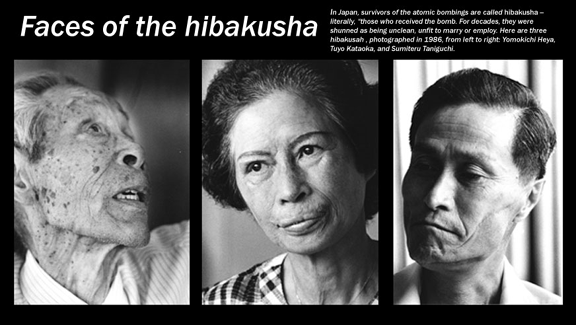
The combined number of officially recognized survivors of the two nuclear attacks, known as hibakusha, stood at 118,935 as of March, down 8,820 from a year earlier, the Ministry of Health, Labor and Welfare said. Their average age was 84.53. https://mainichi.jp/english/articles/20220809/p2g/00m/0na/010000c
Hisashi Ouchi Suffered an 83-day Death By Radiation Poisoning

https://science.howstuffworks.com/hisashi-ouchi.htm By: Patrick J. Kiger | Aug 8, 2022
On the morning of Sept. 30, 1999, at a nuclear fuel-processing plant in Tokaimura, Japan, 35-year-old Hisashi Ouchi and two other workers were purifying uranium oxide to make fuel rods for a research reactor.
As this account published a few months later in The Washington Post details, Ouchi was standing at a tank, holding a funnel, while a co-worker named Masato Shinohara poured a mixture of intermediate-enriched uranium oxide into it from a bucket.
Suddenly, they were startled by a flash of blue light, the first sign that something terrible was about to happen.
The workers, who had no previous experience in handling uranium with that level of enrichment, inadvertently had put too much of it in the tank, as this 2000 article in Bulletin of the Atomic Scientists details. As a result, they inadvertently triggered what’s known in the nuclear industry as a criticality accident — a release of radiation from an uncontrolled nuclear chain reaction.
Ouchi, who was closest to the nuclear reaction, received what probably was one of the biggest exposures to radiation in the history of nuclear accidents. He was about to suffer a horrifying fate that would become a cautionary lesson of the perils of the Atomic Age.
“The most obvious lesson is that when you’re working with [fissile] materials, criticality limits are there for a reason,” explains Edwin Lyman, a physicist and director of nuclear power safety for the Union of Concerned Scientists, and co-author, with his colleague Steven Dolley, of the article in Bulletin of the Atomic Scientists.
If safeguards aren’t carefully taught and followed, there’s potential for “a devastating type of accident,” Lyman says.
It wasn’t the first time it had happened. A 2000 U.S. Nuclear Regulatory Commission report noted that before Tokaimura, 21 previous criticality accidents had occurred between 1953 and 1997.
The two workers quickly left the room, according to The Post’s account. But even so, the damage already had been done. Ouchi, who was closest to the reaction, had received a massive dose of radiation. There have been various estimates of the exact amount, but a 2010 presentation by Masashi Kanamori of the Japan Atomic Energy Agency put the amount at 16 to 25 gray equivalents (GyEq), while Shinohara, who was about 18 inches (46 centimeters) away, received a lesser but still extremely harmful dose of about 6 to 9 GyEq and a third man, who was further away, was exposed to less radiation.
Internet articles frequently describe Ouchi as ‘the most radioactive man in history,’ or words to that effect, but nuclear expert Lyman stops a bit short of that assessment.
“The estimated doses for Ouchi were among the highest known, though I’m not sure if it’s the highest,” explains Lyman. “These typically occur in these kinds of criticality accidents.”
What Does a High Dose of Radiation Do To the Body?
The radiation dose in a criticality accident can be even worse than in a catastrophic accident at a nuclear power plant, such as the 1986 reactor explosion at Chernobyl in Ukraine, then a part of the Soviet Union, where the radiation was dispersed. (Even so, 28 people eventually died from radiation exposure.)
“These criticality accidents present the potential for delivery of a large amount of radiation in a short period of time, though a burst of neutrons and gamma rays,” Lyman says. “That one burst, if you’re close enough, you can sustain more than a lethal dose of radiation in seconds. So that’s the scary thing about it.”
High doses of radiation damage the body, rendering it unable to make new cells, so that the bone marrow, for example, stops making the red blood cells that carry oxygen and the white blood cells that fight infection, according to Lyman. “Your fate is predetermined, even though there will be a delay,” he says, “if you have a high enough dose of ionizing radiation that will kill cells, to the extent that your organs will not function.”
According to an October 1999 account in medical journal BMJ, the irradiated workers were taken to the National Institute of Radiological Sciences in Chiba, just east of Tokyo. There, it was determined that their lymphatic blood count had dropped to almost zero. Their symptoms included nausea, dehydration and diarrhea. Three days later, they were transferred to University of Tokyo Hospital, where doctors tried various measures in a desperate effort to save their lives.
Ouchi’s Condition Continued to Deteriorate
When Ouchi, a handsome, powerfully built, former high school rugby player who had a wife and young son, arrived at the hospital, he didn’t yet look like a victim of intense radiation exposure, according to “A Slow Death: 83 Days of Radiation Sickness,” a 2002 book by a team of journalists from Japan’s NHK-TV, later translated into English by Maho Harada. His face was slightly red and swollen and his eyes were bloodshot, but he didn’t have any blisters or burns, though he complained of pain in his ears and hand. The doctor who examined him even thought that it might be possible to save his life.
But within a day, Ouchi’s condition got worse. He began to require oxygen, and his abdomen swelled, according to the book. Things continued downhill after he arrived at the University of Tokyo hospital. Six days after the accident, a specialist who looked at images of the chromosomes in Ouchi’s bone marrow cells saw only scattered black dots, indicating that they were broken into pieces. Ouchi’s body wouldn’t be able to generate new cells. A week after the accident, Ouchi received a peripheral blood stem cell transplant, with his sister volunteering as a donor.
Nevertheless, Ouchi’s condition continued to deteriorate, according to the book. He began to complain of thirst, and when medical tape was removed from his chest, his skin started coming off with it. He began developing blisters. Tests showed that the radiation had killed the chromosomes that normally would enable his skin to regenerate, so that his epidermis, the outer layer that protected his body, gradually vanished. The pain became intense. He began experiencing breathing problems as well. Two weeks after the accident, he was no longer able to eat, and had to be fed intravenously. Two months into his ordeal, his heart stopped, though doctors were able to revive him.
On Dec. 21, at 11:21 p.m., Ouchi’s body finally gave out. According to Lyman’s and Dolley’s article, he died of multiple organ failure. Japan’s Prime Minister at the time, Keizo Obuchi, issued a statement expressing his condolences to the worker’s family and promised to improve nuclear safety measures, according to Japan Times.
Shinohara, Ouchi’s co-worker, died in April 2000 of multiple organ failure as well, according to The Guardian.
The Japanese government’s investigation concluded that the accident’s main causes included inadequate regulatory oversight, lack of an appropriate safety culture, and inadequate worker training and qualification, according to this April 2000 report by the U.S. Nuclear Regulatory Commission. Six officials from the company that operated the plant were charged with professional negligence and violating nuclear safety laws. In 2003, a court gave them suspended prison terms, and the company and at least one of the officials also were assessed fines, according to the Sydney Morning Herald.
1 This Month

of the week – Shut Down Drone Warfare!


Tell the Ukrainian Government to Drop Prosecution of Peace Activist Yurii Sheliazhenko

Petition to revoke the licensing of the Near Surface Nuclear Disposal Facility (NSDF) at Chalk River. https://www.ourcommons.ca/petitions/en/Petition/Details?Petition=e-7247
To see nuclear-related stories in greater depth and intensity – go to https://nuclearinformation.wordpress.com
-
Archives
- April 2026 (103)
- March 2026 (251)
- February 2026 (268)
- January 2026 (308)
- December 2025 (358)
- November 2025 (359)
- October 2025 (376)
- September 2025 (257)
- August 2025 (319)
- July 2025 (230)
- June 2025 (348)
- May 2025 (261)
-
Categories
- 1
- 1 NUCLEAR ISSUES
- business and costs
- climate change
- culture and arts
- ENERGY
- environment
- health
- history
- indigenous issues
- Legal
- marketing of nuclear
- media
- opposition to nuclear
- PERSONAL STORIES
- politics
- politics international
- Religion and ethics
- safety
- secrets,lies and civil liberties
- spinbuster
- technology
- Uranium
- wastes
- weapons and war
- Women
- 2 WORLD
- ACTION
- AFRICA
- Atrocities
- AUSTRALIA
- Christina's notes
- Christina's themes
- culture and arts
- Events
- Fuk 2022
- Fuk 2023
- Fukushima 2017
- Fukushima 2018
- fukushima 2019
- Fukushima 2020
- Fukushima 2021
- general
- global warming
- Humour (God we need it)
- Nuclear
- RARE EARTHS
- Reference
- resources – print
- Resources -audiovicual
- Weekly Newsletter
- World
- World Nuclear
- YouTube
-
RSS
Entries RSS
Comments RSS
 nuclear-news