Japan and France in a marketing frenzy to sell nuclear technology
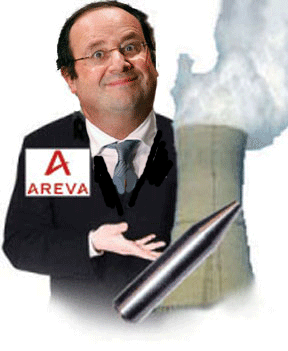 Hollande is on a three-day visit to Tokyo accompanied by several cabinet ministers and
  more than 30 executives, including the head of France’s nuclear energy giant Areva, Luc Oursel.
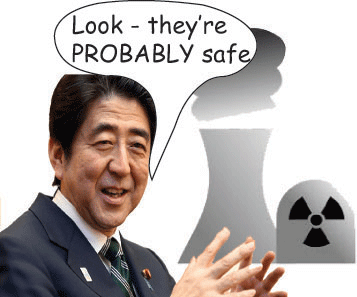
As well as agreeing to boost the exports of nuclear technology, Tokyo and Paris confirmed plans to cooperate on Japan’s troubled nuclear spent fuel reprocessing and fast-breeder projects,
France, Japan join forces for larger share of nuclear market http://www.reuters.com/article/2013/06/07/us-japan-france-nuclear-idUSBRE9560C720130607 By Antoni Slodkowski TOKYOJun 7, 2013 Japan and France on Friday agreed to boost nuclear cooperation to secure a larger share of global atomic energy markets as Tokyo’s pro-nuclear government looks to restart reactors despite public unease in the wake of the Fukushima disaster. Continue reading
Suicide of Fukushima farmer: TEPCO admits culpability
Fukushima operator admits culpability by: Shingo Ito From: AAP June 06, JAPAN’S Tokyo Electric Power has conceded the Fukushima disaster played a part in a farmer’s suicide, lawyers said, its first admission of culpability in such a case.
The utility, known as TEPCO, has reached an out-of-court settlement with the bereaved family of Hisashi Tarukawa, a Fukushima farmer who took his own life days after the Fukushima Daiichi nuclear power plant went into meltdown.
It was the first time the company has accepted in a settlement that the nuclear disaster at its plant was a factor in a suicide, the lawyers said, adding that terms of the settlement package were not being made public. The 64-year-old hanged himself from a tree in a vegetable field after authorities banned shipments of some farm produce from Fukushima because of fears it was contaminated by radiation.
“I just didn’t want TEPCO to keep saying no one was killed because of the nuclear accident,” said Kazuya Tarukawa, the dead man’s 37-year-old son.He said he still wanted the company to make an official apology for his father’s suicide.
“Does TEPCO think everything is finished if money is paid?” he said.”I want them to come to my house under the name of the company and bow to my father’s altar. My fight is not over yet.”
TEPCO refused to comment on the details of the settlement. http://www.news.com.au/breaking-news/world/fukushima-operator-admits-culpability/story-e6frfkui-1226659001710#ixzz2VZUeJYmy
Fukushima radiation release was made worse by operator error
Asahi: Tepco ‘failure’ may have increased Fukushima radiation release — Concern over ‘lethal levels’ escaping from ruptured containment vessel See also: NHK: “The unimaginable was happening” — Workers say part of Reactor 2 containment vessel destroyed — After alarming pressure readings, “we heard a loud bang… pressure is now zero” (VIDEO)
Title: TEPCO’s failure at math may have increased radiation release at Fukushima plant
Source: AJW by The Asahi Shimbun
Author: TOSHIHIRO OKUYAMA
Date: June 05, 2013
Workers miscalculated pressure levels inside a reactor during the early stages of the Fukushima nuclear crisis, leading to a reduction in cooling water and a possible increase in the volume of radioactive materials released.
Tokyo Electric Power Co. estimated the pressure inside the No. 2 reactor containment vessel at 400 kilopascals […]
The actual pressure was 40 kilopascals, far below the 101 kilopascals of the surrounding atmosphere, suggesting that a large amount of radioactive materials escaped from the reactor.
TEPCO later discovered the mistake but did not announce it. […]
“I think the airtightness (of the containment vessel) has not been maintained,” [Tadayuki Yokomura] said, according to a video footage of a TEPCO teleconference. […]
The difficulty in venting fueled concerns that mounting pressure could rupture the containment vessel and release lethal levels of radioactive materials.
Early on March 15, TEPCO temporarily evacuated all but the minimum required 70 or so workers from the plant compound. […]
Radioactive seawater travels towards USA from Fukushima
Are North Americans Already Succumbing to Radiation From Japan? http://www.complex.com/city-guide/2013/06/are-north-americans-already-succumbing-to-radiation-from-japan
BY JULIAN KIMBLE | JUN 5, 2013 We don’t mean to alarm anyone, but there’s reportedly been an increase in radiation levels in food and water thanks to the Japanese earthquake and tsunami that struck in 2011. In addition, children being born with thyroid issues has also been tied to radiation while both the U.S. and Canada are allowing more of specific toxic substances in food being imported from Japan.

The image above shows radiation on the move from the Fukushima nuclear plant following the horrible events of 2011. That was captured in March 2012, meaning it’s probably covered even more ground over the past year and change.
According to World Truth TV, milk samples taken from across the U.S. show that radiation levels are 2000 percent above the EPA maximums. Milk is also used to represent the entire food supply. Furthermore, the Food and Drug Administration and Environmental Deception Protection Agency have responded by raising the “acceptable levels” of radioactive materials that are found in foods.
So apparently water, dairy products, produce, seafood, and meat are all at risk. Great, just great. Remember that when you go grocery shopping this weekend. [via Jeromie Williams]
Leak in Water Tank at Fukushima adds to TEPCO’s woes
 Leak Found in Steel Tank for Water at Fukushima NYT, By MARTIN FACKLER June 5, 2013 TOKYO — The operator of the stricken Fukushima nuclear plant said Wednesday that it had found a leak in one of the hundreds of steel tanks used to store radioactive water at the plant, raising renewed questions about the company’s ability to handle the plant’s cleanup.
The discovery comes a day after the operator, the Tokyo Electric Power Company, or Tepco, admitted that it had found cesium particles in groundwater flowing into the Fukushima Daiichi plant, reversing its earlier assertion that the water was uncontaminated….
Tepco has struggled to deal with tens of millions of gallons of contaminated, toxic water at the plant, which must be stored in the large steel tanks that now occupy virtually every available bit of space there. The amount of radioactive water has continued to grow as groundwater has flowed at a rate of 100,000 gallons per day into the basements of the damaged reactor buildings. This contaminated water must be drawn off every day to prevent it from overwhelming makeshift systems that cool the melted reactors. Continue reading
Thyroid cancer in Fukushima children – nothing to worry about?
 Life and Death Choices: Radiation, Children, and Japan’s Future, Truth Out, By David McNeill, The Asia-Pacific Journal: Japan Focus, 4 June 13 “…….Many parents point to a recent finding that over 40 per cent of nearly 95,000 children checked by Dr Suzuki’s team had thyroid ultrasound “abnormalities”. About 35 per cent had nodules or cysts on their thyroids.
The cysts and nodules are not cancers but they point to an inevitable spike in future health problems, says Mr Fujimoto – a view contested by the government. “I have absolutely no faith in what the Fukushima government is saying,” he retorts. “They want people to go back and live there so they clearly want to keep a lid on the impact of the disaster.”
Parents accuse government scientists of making their minds up before the survey began – Professor Suzuki’s team said last July that their aim was “to calm the anxiety of the population.”
Iwata Wataru, who heads a non-profit group that measures radiation, believes that’s an abuse of science. “A scientific study is normally designed to detect an effect and lead the investigator to accept or reject a stated hypothesis,” he said. “In this case, they have a strong prior belief that there is no physical effect of exposure.” Iwata wants more independent testing.
In the absence of a consensus on the likely impact of the Fukushima accident, the debate has hardened into two sides: people like Fujimoto an Iwata who say the authorities are playing down or even covering up the disaster, and the increasingly vocal official view that their worries are overblown. Those who stray too far from the official line risk being accused of fear-mongering.
That criticism misses the point, says Mochizuki Iori, author of the blog Fukushima Diary. “I was exposed in the first week,” he writes. “It’s irreversible. Not so many people can share this feeling in the world. I check my thyroid, lymph and symptoms of other things that I don’t even want to mention.”
Doctors say children’s thyroids, which help regulate the body’s metabolism, are especially sensitive to radioactive iodine. The gland is very active during childhood development. A study published last year in the International Journal of Cancer found elevated risks of thyroid cancer in childhood survivors of Hiroshima and Nagasaki, 50 years after they were exposed to radiation. The study found over a third of 191 thyroid cancers in adults who were children at the time of the bombing were probably due to exposure. <link>
Whatever the scientists say, Mr. Fujimoto insists he won’t be persuaded by government reassurances that it is safe to return to Fukushima. “There is so much information not getting out at the moment. It will be too late for my children when it is eventually released.”
http://truth-out.org/news/item/16768-life-and-death-choices-radiation-children-and-japans-future
Tepco now admits that groundwater flowing into Fukushima reactors is radioactive
 Fukushima plant operator reverses claim groundwater not contaminated (Reuters) Reporting by Risa Maeda; Writing by Aaron Sheldrick. 4 June 13- Tokyo Electric Power Co said on Tuesday it had detected radioactive caesium in groundwater flowing into its wrecked Fukushima Daiichi plant, reversing an earlier finding that any contamination was negligible.
The announcement is yet another example of Tokyo Electric initially downplaying a problem, only to revise its findings because of faulty procedures. It casts further doubt over its control over the cleanup of the worst nuclear disaster since Chernobyl in 1986.
“Once again, they’ve missed something they should be aware of,” said Atsushi Kasai, a former researcher of radiation protection at the Japan Atomic Energy Research Institute…… The discovery that groundwater is also being contaminated before it enters the damaged reactor buildings compounds the problems for the company known as Tepco. It has been trying to convince local authorities and fishermen that the groundwater has negligible levels of contamination and is safe enough to be dumped into the ocean.
About 400 tonnes of groundwater flow daily into the reactor buildings only to be mixed with highly contaminated water that comes from cooling the melted fuel.That water has to be stored in tanks and pits. Leaks in the latter in recent weeks have prompted it to scramble to build more tanks.
Tepco on May 30 told fishermen that radioactive caesium in the groundwater was at a level that could not be detected.But the results were false as they were skewed by using procedures that failed to take into account the background radiation at the damaged plant, Tepco told Reuters on Tuesday. The findings were earlier reported by local media.
“We’ll have to correct the way we analyse sample data,” said Mayumi Yoshida, a Tepco spokeswoman.The revised results still show the radiation level to be below what Tepco views as the upper limit for releasing groundwater — one becquerel of caesium 137 per litre. A becquerel is a measure of radioactivity.
Follow up analysis showed the groundwater had 0.22 becquerel of caesium-134 per litre and 0.39 becquerel of cesium-137 per litre rather than an undetectable amount, Yoshida said……http://uk.reuters.com/article/2013/06/04/uk-nuclear-japan-tokyo-electric-idUKBRE95309020130604
27 Fukushima children have suspected or confirmed thyroid cancer
Kyodo: 27 Fukushima minors with confirmed or suspected thyroid cancer — Almost tripled since last report in February http://enenews.com/kyodo-27-fukushima-minors-with-confirmed-or-suspected-thyroid-cancer-almost-tripled-since-last-report-in-february
Title: Fukushima survey lists 12 confirmed, 15 suspected thyroid cancer cases
Source: Kyodo News
Date: June 5, 2013
An ongoing study on the impact of radiation on Fukushima residents from the crippled atomic power plant has found 12 minors with confirmed thyroid cancer diagnoses, up from three in a report in February, with 15 others suspected to have cancer, up from seven, sources familiar with the matter said Tuesday. […]
Researchers at Fukushima Medical University, which has been taking the leading role in the study, have so far said they do not believe that the most recent cases are related to the nuclear crisis. They point out that thyroid cancer cases were not found among children hit by the 1986 Chernobyl nuclear accident until four to five years later. […] Watch OPTV’s broadcast on Fukushima thyroid testing here
Fukushima children and thyroid abnormalities: predictions of thyroid cancers
“Rates of thyroid problems in children near Fukushima nuclear plant are high” — Expert: Parents have reason to worry — Gov’t accused of cover-up http://enenews.com/rates-of-thyroid-problems-in-children-near-fukushima-nuclear-plant-are-high-expert-parents-have-reason-to-worry-govt-accused-of-cover-up
Source: The Independent
Author: David McNeill
Date: June 1, 2013
h/t Anonymous tip Rates of thyroid problems in children near the nuclear plant are high
[…] Last December, the eldest of the two was diagnosed with adenoidal cysts, the prelude to a type of cancer that often strikes the salivary glands. “I was told by the doctor that it’s very rare,” [Yoji Fujimoto] says. […]
“I’m convinced this is because of the Fukushima accident.” […]
[Steve Wing, an epidemiologist at the University of North Carolina] says that parents like Mr Fujimoto do have reason to worry. “We know that doses to populations are both unquantified by the official agencies, that evidence suggests relatively high doses, and that children and women are more vulnerable to radiation. So the questions and deep concerns for the people in Fukushima will continue for the rest of their lives.” […]
“I expect a growth in the numbers of thyroid cancers in Japan from next year,” [Dr Alexey Yablokov, a Russian biologist] said. […]
Parents accuse government scientists of making their minds up before the [thyroid] survey began – Professor Suzuki’s team said last July that their aim was “to calm the anxiety of the population”.
Yoji Fujimoto
“I have absolutely no faith in what the Fukushima government is saying”
“They want people to go back and live there so they clearly want to keep a lid on the impact of the disaster”
“There is so much information not getting out at the moment — It will be too late for my children when it is eventually released”
See also: UN: “Fukushima nuclear disaster poses no IMMEDIATE health risks” — Unknown if increase in thyroid cancer is due to radioactivity
Tokyo anti nuclear rally – 60,000 protest
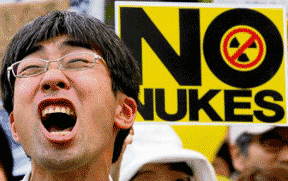 60,000 in Tokyo Protest Government Plans to Restart Nuclear Power Earth First Newswire by Adam Westlake / Japan Daily Press, 3 June 13
Approximately 60,000 people rallied in Japan’s capital of Tokyo on Sunday, June 2nd in order to protest recent government plans to restart the country’s idled nuclear reactors. People gathered in Shiba Park and later marched towards the parliament building. Among the organizers was Kenzaburo Oe, a Nobel literature laureate, who called on the Japanese government to leave the nuclear power plants in suspension out of fears for safety.
The Japanese government has previously stated that it will most likely allow those reactors to return to power which have been approved by the Nuclear Regulation Authority (NRA), whose new safety guidelines are scheduled to be adopted in July. One of Japan’s largest-ever protests saw 170,000 people gather in a similar fashion in July 2012, around the same time that then-Prime Minister Yoshihiko Noda decided on the first two reactor restarts since the March 2011 Fukushima disaster. As of now, the anti-nuclear protestors say they have collected over 8 million signatures of those opposed to reactor restarts…… http://earthfirstnews.wordpress.com/2013/06/03/60000-in-tokyo-protest-government-plans-to-restart-nuclear-power/
Rapidly increasing popularity of solar panels, in Japan

 Japan’s post-Fukushima solar boom SMH, June 2, 2013 Domestic shipments of solar cells and modules in Japan leapt by their most in at least 30 years last fiscal year as government efforts to spur clean energy after the 2011 Fukushima disaster began to pay off.
Local shipments rose to 3,809 megawatts in the 12 months ended March 31 from 1,404 megawatts the previous year, the Japan Photovoltaic Energy Association said today on its website. The increase was the largest since 1981 when the figures were compiled for the first time.
The data underscore the popularity of solar in Japan as pressures mount to boost energy supplies after the Fukushima Dai-Ichi accident led to the shutdown of almost all the nation’s nuclear reactors. Japan started offering above-market rates in July for renewable sources such as solar and wind. Continue reading
Compensation for Fukushima evacuees’ radiation anxiety
 Fukushima Evacuees To Get Radiation Uncertainty Compensation http://www.rttnews.com/2128844/fukushima-evacuees-to-get-radiation-uncertainty-compensation.aspx?type=gn&utm_source=google&utm_campaign=sitemap 6/3/2013 A government-backed arbitration body in Japan directed the operator of the tsunami-wrecked Fukushima nuclear power plant to pay compensation to former residents of a district for radiation exposure and future healthuncertainties.
As per a directive issued by the Nuclear Damage Claim Dispute Resolution Center, the Tokyo Electric Power Company (TEPCO) has to pay about $10,000 each to pregnant women and those aged below 18 years. The other residents of Nagadoro district would get $5,000 each, Japanese media reported on Sunday.
Nagadoro is near the Fukushima plant where radiation levels remain high and it is the only district that the government declared uninhabitable for a long period.
An evacuation order for the area was issued more than a month after the nuclear accident on March 11, 2011. The arbitrators accepted the residents’ claim of fear and anxiety as they had lived without any protection against high radiation doses because of their delayed evacuation. The residents had already received compensation for having to evacuate, but the amount did not cover health anxieties. Lawyers representing the residents said it was for the first time that compensation for health anxietywas granted.
The massive tsunami severely damaged four reactors at the Fukushima plant north of Tokyo, knocking out its cooling systems and triggering meltdowns and radiation leaks. Tens of thousands of people fled their homes in the worst atomic disaster since the 1986 Chernobyl nuclear accident.
Another try to fix Fukushima reactor – inject cement-like grout
Cement-like grout to be injected into Fukushima reactor? (PHOTO) http://enenews.com/cement-like-grout-to-be-injected-into-fukushima-reactor-photo Tepco Handout, May 30, 2013 (Summary translation of page 26 by Fukushima Diary): […] the […] the committee of experts suggested Tepco to fill the torus room with grout. […] Tepco plans to conduct the feasibility study with United States Department of Energy this year. […] They assume it takes 1.5 years to make planning, and 2 years to inject the grout material. […] The committee points out the benefit of using grout is it doesn’t directly touch the molten fuel. However, it hasn’t been confirmed that the fractured molten fuel is not really in the torus rooms.
Department of Energy: Grouting—Grout is a promising option to stop water leakage that’s occurring between reactor and turbine buildings at Fukushima Daiichi’s reactor units, and could be a key step toward facilitating decommissioning of units 1-4. SRNL has extensive experience in grout development and also has operating experience with grouting components reactors and other facilities.
Reuters: The company may resort to pouring a cement-like material into the rectors’ suppression chambers to plug leaks it has not been able to locate, Suzuki said. “One approach we are considering is putting grout, like cement,” he said. “In other words, filling it in. That would block all the holes.”
See also: “Too many holes” in Fukushima reactors? May have to fill up suppression chambers with cement -Tepco
As Fukushima radioactive water grows, situation hopeless for fishermen
Fukushima fishermen forced to test fish for radiation REUTERS, 31 May 13“….The fishermen of Hisanohama, forced out of work by the disaster, have had no choice but to take the only job available – checking contamination levels in fish just offshore from the destroyed nuclear reactor buildings. ”We used to be so proud of our fish. They were famous across Japan and we made a decent living out of them,” said 80-year-old Yaoita, who survived the tsunami by taking on the waves and sailing the six-person True Prosperity out to sea.”Now the only thing for us is sampling.”…..
The fishermen and Tepco are in dispute over the utility’s plans to dump 100 tons of groundwater a day from the devastated plant into the sea. The complicated clean-up plan for Fukushima could take 30 years or more. Tepco’s challenge is what to do with the contaminated water that has been pooling at the plant at a rate of 400 tons a day – enough to fill an Olympic-size swimming pool in a week.
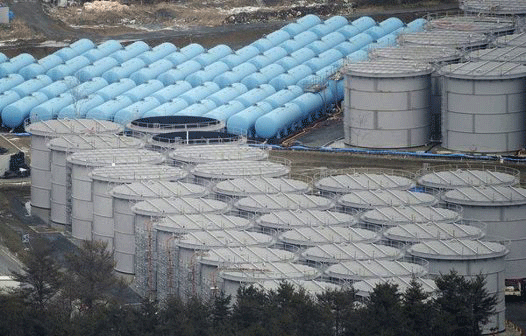
So far it has been racing to build tanks to store the contaminated water on the grounds of the plant, in which all the water is kept at the moment.It has also asked fishermen to support a plan to build a “by-pass” that would dump groundwater into the sea before it becomes contaminated by flowing under the reactor’s wreckage.
“We are staunchly against it,” said Tatsuo Niitsuma, 71, who fishes with Yaoita.
MORE CONTAMINATION, LESS HOPE Representatives from fishing cooperatives met Tepco officials on Thursday to discuss the proposal, with Trade Minister Toshimitsu Motegi to instruct Tepco on what to do, although no final plans were announced. In addition to the “by-pass” Motegi, who also holds the energy portfolio, told Tepco to create “protective walls” in the ground by freezing the soil around the reactors to create an underground barrier to stop groundwater from flowing in and mixing with contaminated water inside the reactor building.
The fishermen, however, worry the “by-pass” plan risks more contamination and delays, possibly ending any hope for the only job they know.
Tepco officials have said it may take as long as four years to fix the problem, but have said they do not need outside help.
The uncertainty and stress have become problems. Many former fishermen live in temporary homes next to people they barely know after losing not only their jobs, but also family members…….. http://www.reuters.com/article/2013/05/31/us-fukushima-fishermen-idUSBRE94U0D620130531
Transferring nuclear wastes – it’s like a game of “Pass The Parcel”
 Australia-Euratom Nuclear Safeguards: Plutonium Retransfers …..The Agreement will enter into force when Australia notifies the Delegation to the European Commission that all domestic requirements necessary to give effect to the Agreement have been satisfied…. Department of Foreign Affairs and Trade – Australian Government 01/06/2013 | Press release
  distributed by noodls http://www.noodls.com/view/2FBAFE516E5E78B9F15B62CBEB136F9A32994CC7
 Australia and the European Atomic Energy Community (Euratom) exchanged diplomatic notes in Canberra on 28 May 1998 as the first step towards bringing into force an Agreement under which Australia will – subject to certain conditions – broaden its consent for the return from the European Union to Japan of Australian obligated plutonium following the reprocessing of Japanese spent fuel in Europe. The European Union is an important provider of nuclear fuel cycle services for countries purchasing Australian uranium and Japan is a major market for Australian uranium exports. Continue reading
1 This Month





PLEASE OPPOSE HR 8255 AND S.3639 – bills would accelerate satellite deployment, with no environmental review or safeguards – https://ncstd5li.quorum.us/campaign/169331/
To see nuclear-related stories in greater depth and intensity – go to https://nuclearinformation.wordpress.com
-
Archives
- October 2026 (74)
- September 2026 (339)
- August 2026 (330)
- July 2026 (355)
- June 2026 (287)
- May 2026 (306)
- April 2026 (356)
- March 2026 (251)
- February 2026 (267)
- January 2026 (308)
- December 2025 (358)
- November 2025 (359)
-
Categories
- 1
- 1 NUCLEAR ISSUES
- business and costs
- climate change
- culture and arts
- ENERGY
- environment
- health
- history
- indigenous issues
- Legal
- marketing of nuclear
- media
- opposition to nuclear
- PERSONAL STORIES
- politics
- politics international
- Religion and ethics
- safety
- secrets,lies and civil liberties
- spinbuster
- technology
- Uranium
- wastes
- weapons and war
- Women
- 2 WORLD
- ACTION
- AFRICA
- Atrocities
- AUSTRALIA
- Christina's notes
- Christina's themes
- culture and arts
- Events
- Fuk 2022
- Fuk 2023
- Fukushima 2017
- Fukushima 2018
- fukushima 2019
- Fukushima 2020
- Fukushima 2021
- general
- global warming
- Humour (God we need it)
- Nuclear
- RARE EARTHS
- Reference
- resources – print
- Resources -audiovicual
- Weekly Newsletter
- World
- World Nuclear
- YouTube
-
RSS
Entries RSS
Comments RSS

