Ice wall around Fukushima nuclear plant might increase the risk
 Video: Recriticality Concerns at Fukushima — BBC: Professor warns underground ice walls could become ‘neutron reflectors’ and cause nuclear chain reaction Title: Jaczko, Johnson & Tsutsui, The Ongoing Fukushima Daiichi Crisis
Title: Jaczko, Johnson & Tsutsui, The Ongoing Fukushima Daiichi Crisis
Source: Foreign Correspondents’ Club of Japan
Date: September 24, 2013
Martin Kölling, reporter at Handelsblatt (German financial newpaper): Regarding this frozen wall […] some are concerned that this ice wall could work as a neutron reflector and increase the risk of recriticality in the reactor cores. Have you heard about this concern and what do you think about it?
Gregory Jaczko, Former Chairman of the U.S. Nuclear Regulatory Commission: I have not heard of the issue of neutron reflection. My gut reaction is that that would not necessarily be an issue. You have water at the site. So I would be skeptical that that would be an issue to be concerned about. But certainly I’m sure it’s something that should be looked at if there is a possibility of that, but I would not initially think that that’s something that would be of concern.
BBC, Sept. 4, 2013: Dr. Komei Hosokawa from Kyoto Seika University, Japan, warns that in some respects, the ice wall idea could make matters worse: “Underground ice walls surrounding the reactor basement may work as neutron reflectors, which might make an easier condition for the melted fuel debris to go back to criticality (i.e. chain reaction).” Watch the FCCJ event here
Should TEPCO, should Japan, be allowed to attempt this on its own?
 We are now within two months of what may be humankind’s most dangerous moment since the Cuban Missile Crisis. There is no excuse for not acting. All the resources our species can muster must be focused on the fuel pool at Fukushima Unit 4. … Neither Tokyo Electric nor the government of Japan can go this alone. There is no excuse for deploying anything less than a coordinated team of the planet’s best scientists and engineers. …
We have two months or less to act. For now, we are petitioning the United Nations and President Obama to mobilize the global scientific and engineering community to take charge at Fukushima and the job of moving these fuel rods to safety.
Risky repair of Fukushima could spill 15,000x radiation of Hiroshima, create 85 Chernobyls, America Blog 9/23/2013 10:00am by Gaius Publius
Should TEPCO be allowed to attempt this on its own?
Should Japan be allowed to attempt this on its own?
This is the heart of today’s problem. In reality, the events that are about to unfold at Fukushima in the next 60 days will affect much of the world. They could in fact change life in the northern hemisphere, if the worst of the worst occurs.
The Japanese government has ceded control of the next phrase — removing more than 1300 fuel rods from Reactor 4 — to TEPCO. (Seems that Japan has a “corporate capture of government” problem similar to our own.) Reuters (quoted here):
Tokyo Electric Power Co (Tepco) is already in a losing battle to stop radioactive water overflowing from another part of the facility, and experts question whether it will be able to pull off the removal of all the assemblies successfully.
“They are going to have difficulty in removing a significant number of the rods,” said Arnie Gundersen, a veteran U.S. nuclear engineer and director of Fairewinds Energy Education, who used to build fuel assemblies.
The operation, beginning this November at the plant’s Reactor No. 4, is fraught with danger, including the possibility of a large release of radiation if a fuel assembly breaks, gets stuck or gets too close to an adjacent bundle, said Gundersen and other nuclear experts. … The utility says it recognizes the operation will be difficult but believes it can carry it out safely.
Nonetheless, Tepco inspires little confidence. Sharply criticized for failing to protect the Fukushima plant against natural disasters, its handling of the crisis since then has also been lambasted.
Who has sovereignty here? Who has control? Better, who should have sovereignty and control? Continue reading
Research indicates Fukushima’s atmospheric release of 210 quadrillion becquerels of cesium-137
 EU-funded Research: Fukushima atmospheric release of 210 quadrillion becquerels of cesium-137 used as upper bound in simulation — Chernobyl estimated at 70 to 85 quadrillion http://enenews.com/eu-funded-research-fukushima-atmospheric-release-210-petabecquerels-cesium-137-upper-bound-simulation-chernobyl-estimated-70-85-petabecquerels
Title: Modelling the global atmospheric transport and deposition of radionuclides from the Fukushima Dai-ichi nuclear accident
Source: Atmospheric Chemistry and Physics
Authors: T. Christoudias and J. Lelieveld
Date: 2013
Emphasis Added
We modeled the global atmospheric dispersion and deposition of radionuclides released from the Fukushima Dai-ichi nuclear power plant accident. […]
We obtained good agreement with measurements of 133Xe, at both T255 and T106 resolution. The comparison for 137Cs is less favorable, though not systematically biased based on the 137Cs emission estimate of 36.7 (20.1–53.1) PBq [petabecquerels (quadrillion becquerels)] by Stohl et al. (2012). This is equivalent to somewhat less than half the 137Cs source by Chernobyl (85 PBq, International Atomic Energy Agency (IAEA) (2006)). The estimate of 13 PBq by Chino et al. (2011) (revised to 8.8 PBq by Terada et al. (2012) and confirmed as a lower bound of 12 PBq by Winiarek et al. (2012), with an upper bound of 210 PBq, was also included in our comparison.
[…] Although the prevailing wind direction during the accident was in easterly direction, some of the atmospheric radioactivity was transported toward the west and southwest, and deposited in Japan and to a lesser extent reached the Philippines. Based on the above mentioned emission estimates, we calculated that an area of Japan of 34,000 km2 was contaminated by more than 40 kBqm−2 of 137Cs and 131I, to which 9.4 million people were exposed. Our model results indicate that a surface area of 60,000 km2 received a total deposition greater than 10 kBqm−2, a region inhabited by 46 million people.
[…] The research leading to these results has received funding from the European Research Council under the European Union’s Seventh FrameworkProgramme.
Nuclear Energy Agency’s 2002 assessment of the Chernobyl disaster: The total 137Cs release was estimated to be 70 petabecquerels (PBq)
Radioactive water sprayed out on Fukushima workers, from tank leak

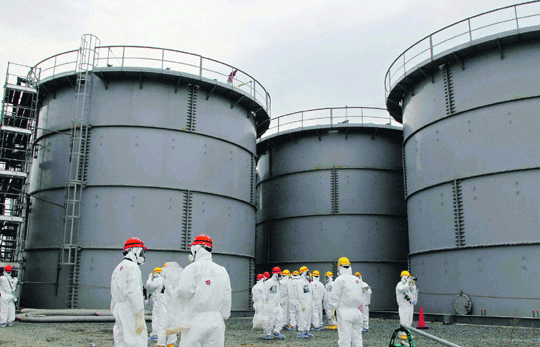 Fukushima Worker: People showered with highly radioactive water at plant — Leaking tanks spraying out contamination http://enenews.com/fukushima-worker-people-showered-highly-radioactive-water-plant-leaking-tanks-spraying-contamination
Title: People working at, living near Fukushima plant say Abe is in the dark
Source: Asahi Shimbun
Authors: Takuro Negishi and Shinichi Fujiwara
Date: September 20, 2013
[…] one man who has helped assemble the tanks from which contaminated water has leaked said, “I wonder if [Prime Minister Shinzo abe] is using words like ‘blocked’ and ‘control’ after really understanding what is going on at the site.”
The man recalls that one day he saw contaminated water spraying out of a tank. An employee of an affiliated company to TEPCO wore a raincoat over protective clothing to tighten a bolt on the tank, even as he was being showered with leaking water.
The man witnessed a similar scene on another day. However, TEPCO made no announcement about the two incidents.
“The affiliated company probably did not want to get on the bad side of TEPCO, so it stopped the leak and concealed the defect in the tank,” the man said. […]
Prime Minister Abe on nuclear marketing visit to India
Shinzo’s Delhi visit is an extension of his 2007 secret deal with Dick Cheney in Tokyo where a quadrilateral alliance in the Asia-Pacific region was sealed with the US, Japan, Australia and India as partners to contain and confront China and its allies North Korea and Russia. The nuclear mafia rules OK!

 The Japan-India Nuclear Energy Deal Manmohan Singh’s Atomic Pile May Become Critical after Shinzo Abe’s Deal By Arun Shrivastava Global Research, September 22, 2013 Japanese Prime Minister Shinzo Abe is coming to India to discuss a ‘range of issues;’ the truth is that he is coming here as chief salesman of global nuclear industry, now collapsing under the collective onslaught of nuclear scientists, nuclear power plant engineers, physicists, investigative journalists and people.
Shinzo is known for many things: dogged attempts at reviving Japan’s nuclear industry, his alleged connections with Japan’s notorious mafia, Yamaguchi-gumi. Continue reading
Radioactive cesium in wastes found 500 km from Fukushima near great lake
 ‘Extremely Malicious’: Hundreds of tons of radioactive waste found over 500 kilometers from Fukushima near Japan’s biggest lake http://enenews.com/extremely-malicious-hundreds-of-tons-of-radioactive-waste-found-near-japans-biggest-lake-over-500-kilometers-from-fukushima
Title: Tons of cesium-tainted wood chips found near Japan’s biggest lake
Source: Kyodo
Tons of cesium-tainted wood chips found near Japan’s biggest lake
Radioactive cesium has been found on an estimated 200 to 300 tons of wood chips that were left months ago near Lake Biwa in Shiga Prefecture, prefectural officials said.
Samples of the chips show a reading of up to 3,000 becquerels per kilogram, the officials said Tuesday. […]
The Shiga government started an investigation to determine where the chips came from. They were found in the dry bed of the Kamo River in Takashima and other locations near the lake, officials said. […]
“The site is an estuary leading to Lake Biwa, and leaving (the chips) there without permission is extremely malicious. We will deal with the matter strictly,” Gov. Yukiko Kada said.
Fukushima nuclear plant never should have been placed over river site
TV: Warnings the worst is yet to come at Fukushima — Deep underneath nuclear plant a massive pool of contamination is believed to be heading toward Pacific Ocean (VIDEO) Title: Fukushima leak questions handling of nuclear plant crisis
Source: ABC News (Australia)
Date: Sept. 19, 2013 MARK WILLACY, REPORTER: Atsunao Marui is one of Japan’s top groundwater scientists and a member of a panel set up by TEPCO and the Government to try to find ways of managing Fukushima’s growing reservoir of radioactive water. He says putting the nuclear plant on this stretch of coast in the first place was inviting disaster
ATSUNAO MARUI, GROUNDWATER SCIENTIST(voiceover translation): A river used to flow right where the turbine and reactor buildings are now standing, so the groundwater is flowing very fast through there and it’s spreading the contamination. The company should have known this could happen.
WILLACY: But there are warnings the worst is yet to come because it’s believed that deep beneath the nuclear plant is a massive underground pool of contaminated water which is slowly making its way towards the sea.
Japanese government considers taking over the Fukushima radiation cleanup
J apan LDP Plan Would Put Government in Control of Fukushima Cleanup, WSJ, Proposal Would Reduce Tepco’s Financial Burden By MARI IWATA, 20 Sept 13 TOKYO—Japan’s ruling Liberal Democratic Party is considering a plan that would give the government sole responsibility for containing and cleaning up contamination from the stricken Fukushima Daiichi nuclear-power plant, allowing its operator, Tokyo Electric Power Co., 9501.TO -2.28% to focus its dwindling resources more efficiently on decommissioning the facility……..
The government had already effectively nationalized Tepco by buying a majority of its shares, but the stock still trades on the Tokyo Stock Exchange, and Prime Minister Shinzo Abe’s administration is eager to see the cash-strapped company return to financial health, a significant challenge, given lost revenue from the idling of all of the company’s nuclear reactors, as well as the costs of the cleanup and purchasing of more liquefied natural gas than before the accident to fuel thermal-power plants to make up for lost nuclear generation.
Tepco has posted two straight years of large net losses since the accident. It swung to a profit in the April-June quarter, solely on the back of a large government subsidy to help it pay compensation to Fukushima victims but it carries Y800 billion ($8.14 billion) in debt that should be refinanced this fall. On top of that, Tepco estimates it must borrow an additional Y300 billion by the end of December if it wants to stay afloat, a spokesman said……..
Tepco President Naomi Hirose said Thursday that the company would prepare Y1 trillion ($10 billion) to decommission the entire plant in addition to Y960 billion it had reserved for the work by the end of June. This doesn’t include costs associated with handling contaminated water at the site. There hasn’t been any estimate on the total cost of decommissioning the stricken plant…….Japan’s Nuclear Regulation Authority Chairman Shunichi Tanaka has urged the government and Tepco to intensify the decommissioning effort, saying “the deadliest risk is another huge natural disaster,” which would “destroy all these makeshift tanks and water processing systems, releasing all the radioactive materials there into the environment.” http://online.wsj.com/article/SB10001424127887324492604579086742989825408.htm
Japan’s economy can move forward without nuclear power
Electricity in Japan Power struggle The Economist, Sep 21st 2013 | TOKYO “……….The LDP’s anti-nuclear coalition partner, New Komeito, also constrains the government somewhat. Meanwhile, rising business optimism appears to undermine the case that economic recovery depends on nuclear power. Probably no more than 12-15 reactors will be switched back on, says Kazuhiro Ueta, a renewable-energy specialist who sits on the government’s energy-advisory board. For the nuclear village, which once expected to supply at least half of Japan’s power, that would be a grave disappointment.
Instead, Japan is preparing for other long-term energy supplies. Since 2011 the number of independent power producers tapping renewable sources, such as solar power, has tripled, thanks in part to a new “feed-in” tariff system for renewables. Including hydro-electricity, renewables now represent 10% of the energy mix, leading to hopes that they might one day replace the share that nuclear power once claimed…………..
Long-overdue proposals to liberalise the electricity market may do much to diversify energy sources and lower electricity bills. The government’s plan, easier to push through now that TEPCO, the biggest utility, has been brought low by its handling of the Fukushima fiasco, is to split generation and transmission, with the residential electricity market open to new competition. If the reform succeeds, says Hiroshi Takahashi of the Fujitsu Research Institute in Tokyo, the share of nuclear power in the energy mix would fall as new, non-nuclear providers won customers. It would, at long last, give the public some say over Japan’s energy choices. http://www.economist.com/news/asia/21586570-shadow-fukushima-worlds-worst-nuclear-disaster-after-chernobyl-hangs-over-japans-energy
Fukushima rocked by earthquake
Earthquake rocks Japan’s Fukushima http://www.skynews.com.au/world/article.aspx?id=907741 20 Sept 13, A magnitude 5.3 earthquake has rocked Japan’s Fukushima prefecture.
The epicentre of the earthquake was 22km below the ground, according to the US Geological Survey.
It struck 20km west of the city of Iwaki, bordering the Pacific Ocean, at 2.25am (3.25am AEST) on Friday.
The epicentre was about 50km southwest of the damaged Fukushima Daiichi Nuclear Power Station, which was crippled by the major quake and tsunami in March, 2011.
The Japan Meteorological Agency, which put the quake at magnitude 5.8, said no tsunami warning had been issued.
The tremor caused buildings to shake in the capital Tokyo, 175km away, an AFP reporter there said.
It came just hours after Japanese Prime Minister Shinzo Abe toured the Fukushima nuclear plant on Thursday, ordering its operator Tokyo Electric Power to fix radioactive water leaks there.
TEPCO said in a statement to Kyodo news agency that no abnormalities in radiation or equipment were observed at the plant after the quake.
Leaks, cracks, and more lies at Fukushima Daiichi nuclear plant
TV: Officials concerned about 400 ft. tall pipe near Fukushima reactors collapsing during quake — 8 cracks found in support brace — Gov’t orders immediate investigation — Tepco unsure how to access area as radiation levels around it are 10 sieverts per hour (PHOTO & VIDEO) http://enenews.com/tv-officials-concerned-400-ft-tall-pipe-next-to-fukushima-reactors-will-collapse-during-quake-8-cracks-found-in-support-brace-govt-orders-immediate-investigation-tepco-unsure-how-to-acces
Fukushima Update: Leaks, Cracks and More Lies
NHK Newsline,, Sept. 19, 2013 (Transcript Excerpts): The people in charge of the Fukushima Daiichi nuclear plant have yet another problem on their hands. They say they found cracks in the brace supporting an exhaust pipe. Authorities are concerned the pipe could collapse in another earthquake […] Officials with Tepco say they spotted cracks in 8 places on the steel brace that holds the pipe upright. […] Overseers at the nuclear regulation authority are demanding that company officials investigate immediately. They want to know if the structure can withstand another earthquake.
NHK WORLD English, Sept. 18, 2013: […] workers on Wednesday discovered the cracks and cuts at 8 places in the buttress about 66 meters above the ground. The Nuclear Regulation Authority has ordered the company to assess the capacity of the pipe to withstand an earthquake as quickly as possible. The 120-meter vertical pipe stands between the number-1 and number-2 reactor buildings. […] they believe the 2011 earthquake damaged the steel framework. They say they have not observed any obvious damage in the pipe itself. The officials say they are considering how to access the pipe to assess its strength. The area around the pipe is contaminated with high levels of radiation measuring 10 sieverts per hour. Watch the broadcast here
Planned ice wall at Fukushima will make soggy ground worse, risking nuclear reactors collapsing
Asahi: Buildings at Fukushima plant can start floating from too much groundwater — Expert: Blocking groundwater with ice wall may weaken soil and cause buildings to topple (AUDIO) http://enenews.com/asahi-buildings-at-fukushima-plant-could-start-floating-from-continuous-flow-of-groundwater-expert-ice-wall-may-weaken-soil-and-cause-buildings-to-topple-audio
Asahi Shimbun,, Sept. 18, 2013: […] The site receives so much groundwater that special equipment–rendered useless by the 2011 earthquake and tsunami–was set up to prevent the plant’s buildings from floating on the continuous flow. […] The original site of the Fukushima No. 1 plant was a cliff more than 30 meters high. But 20 meters was lopped off […] putting the groundwater level only a few meters below the surface. The plant itself was constructed on land containing gravel layers through which water can easily pass through. In the past, a brook trickled by the No. 4 reactor. […] Without that pumping, the buildings faced the danger of being buoyed by rising groundwater. […] TEPCO officials have pinpointed only two locations, including the turbine building of the No. 1 reactor, where groundwater is entering the building basements. They believe there are many more breaches. […]
Atsunao Marui,, head of Groundwater Research Group at the National Institute of Advanced Industrial Science and Technology: “About 4 million tons of rain falls on the plant site over the course of a year. Of that figure, it is believed that between 1 million and 1.5 million tons seep into the ground.”
Gordon Edwards, nuclear expert (at 39:45 in): This underground river that we talked about flowing thorough — the problem with this is they don’t really know how to stop it. […] They really don’t know how to stop this flow because it’s a major aquifer. One of the plans that they are talking about is… a wall of ice a mile long to act as a barrier to prevent the groundwater from going in to the cores of these damaged reactors, in order to try and solve the problem… And nobody knows if it’s actually going to work. In fact, some of the experts in Japan have said that by diverting the groundwater around the sides of the building, you may weaken the soil to the point where the buildings themselves topple — and that could be a far worse problem. So, they really don’t know what they’re going. They literally don’t know what they’re doing.
TEPCO was warned 2 years ago about ground radiation at Fukushima
 Tetsu Nozaki, the chairman of the Fukushima fisheries federation, said the revelations show TEPCO was acting to protect corporate interests.
Fukushima operator TEPCO ignored advice two years ago to control ground contamination http://www.abc.net.au/news/2013-09-19/fukushima-operator-tepco-ignored-advice-two-years-ago-to-contro/4968614 By North Asia correspondent Mark Willacy, 19 Sep 2013, A memo prepared by the operator of the Fukushima nuclear plant has revealed the company ignored advice about controlling ground contamination, fearing the cost would spook investors. Continue reading
Japanese government spreading misinformation about radiation – says famous actress Norika Fujiwara
 Famous Japanese Actress: Gov’t is covering up Fukushima crisis — “Our nation has a right to know” — People who write the truth on Internet will be punished under new law — TV stars in Japan are to never discuss political views http://enenews.com/famous-japanese-actress-accuses-govt-of-fukushima-cover-up-our-nation-has-a-right-to-know-says-people-who-write-the-truth-on-internet-will-be-punished-under-new-law-stars-expected-to-ne
Japan Times, Sept. 18, 2013: Norika Fujiwara [former Miss Japan] has broken an unwritten rule of the television business: sharing her political views. The popular model and actress has come out against a bill that stiffens penalties against civil servants who leak classified information. […]
In a message posted on Friday, Fujiwara accused the government of covering up the truth about the crisis at the Fukushima nuclear plant, and spreading misinformation about radiation and leaks of radioactive water there. “As a citizen I am really concerned about it,” Fujiwara wrote in another message. “Our nation has a right to know.” […] “Once the bill is signed, the people who will write the truth on the Internet (or through other means) will be punished,” she stressed. […]
Tokyo Reporter,, Sept. 15, 2013: Norika Fujiwara says Secret Security Act could allow government to withhold information, such as radiation readings […]
Blacklisting of Japanese artists who oppose the nuclear industry
 Report: TEPCO paid for creation of a blacklist of actors and musicians who are against nuclear industry http://enenews.com/report-tepco-paid-creation-blacklist-actors-musicians-against-nuclear-industry
Toxic truth about Japan’s ‘miracle’: Post-tsunami harmony is a myth and the reality is startlingly different, Daily Mail by Richard Jones, June 18, 2011:
According to a well-known Japanese documentary maker, TEPCO paid for the creation of a blacklist of actors and musicians who are against the nuclear industry.
When one actor, Taro Yamamoto, joined an anti-nuclear protest, he lost his part in a popular soap opera. Yamamoto’s ‘crime’ was to say that schoolchildren in Fukushima should not be subjected to the same annual radiation dose (20 microsieverts per year) as nuclear power workers in Europe.
1 This Month





PLEASE OPPOSE HR 8255 AND S.3639 – bills would accelerate satellite deployment, with no environmental review or safeguards – https://ncstd5li.quorum.us/campaign/169331/
To see nuclear-related stories in greater depth and intensity – go to https://nuclearinformation.wordpress.com
-
Archives
- October 2026 (67)
- September 2026 (339)
- August 2026 (330)
- July 2026 (355)
- June 2026 (287)
- May 2026 (306)
- April 2026 (356)
- March 2026 (251)
- February 2026 (267)
- January 2026 (308)
- December 2025 (358)
- November 2025 (359)
-
Categories
- 1
- 1 NUCLEAR ISSUES
- business and costs
- climate change
- culture and arts
- ENERGY
- environment
- health
- history
- indigenous issues
- Legal
- marketing of nuclear
- media
- opposition to nuclear
- PERSONAL STORIES
- politics
- politics international
- Religion and ethics
- safety
- secrets,lies and civil liberties
- spinbuster
- technology
- Uranium
- wastes
- weapons and war
- Women
- 2 WORLD
- ACTION
- AFRICA
- Atrocities
- AUSTRALIA
- Christina's notes
- Christina's themes
- culture and arts
- Events
- Fuk 2022
- Fuk 2023
- Fukushima 2017
- Fukushima 2018
- fukushima 2019
- Fukushima 2020
- Fukushima 2021
- general
- global warming
- Humour (God we need it)
- Nuclear
- RARE EARTHS
- Reference
- resources – print
- Resources -audiovicual
- Weekly Newsletter
- World
- World Nuclear
- YouTube
-
RSS
Entries RSS
Comments RSS

